
ROBERT WILLIAMS BUCHANAN (1841 - 1901)
|
|
|
ROBERT WILLIAMS BUCHANAN (1841 - 1901) |
|
|
|
|
|
|
|
|
|
LETTERS TO THE PRESS (17)
The Pall Mall Gazette (21 September, 1892) “HOW I WRITE MY PLAYS.” I.—BY MR. ROBERT BUCHANAN. HAVING elicited from the novelists the various reasons why they do not write plays, we have asked one or two eminent playwrights to supplement what others of the same craft have written on the subject in these columns in former days, and to tell us how they write their plays. The first of these is Mr. Robert Buchanan:— ___
The Pall Mall Gazette (23 September, 1892) THE PARENTAGE OF THE NOVEL. To the EDITOR of the PALL MALL GAZETTE. SIR,—It seems to me that Mr. Buchanan’s allusion to a man marrying his own grandmother is a singularly unfortunate one. Not only in point of years is the drama the grandmother of the novel, and not the grandson, as Mr. Buchanan would persuade us to think, but, apart from this, it may be fairly considered to be a direct ancestor; and, what is more, the novel is not only its descendant, but perhaps its successor. Before the comparatively modern invention of printing, and the almost recent one of publishing, the dramatists held the field. Now the conditions are changed, and Mr. Buchanan’s attempts to cut off the novelist, so to say, with an adjective, savour a little of jealousy. Before calling the novel inchoate, invertebrate, anæmic, lopsided, or what not, Mr. Buchanan should remember and make allowance for its extreme youth. But it is grotesque, all the same, to see him round on the vulgar little boy who has thrown stones at him, and solemnly curse him with his prophecy of a “Deluge of Dismal Prose.”—I am, Sir, your obedient servant, ___
The Pall Mall Gazette (30 September, 1892) THE STORY AND THE PLAY. To the EDITOR of the PALL MALL GAZETTE. SIR,—One of your correspondents objects to my description of the Novel as the “grandmother” of the Play, and suggests that the description might be more correct if the relationships were reversed. His objection, I think, is hasty, and scarcely to be sustained, unless he means to circumscribe the Novel to its life during later generations. In England and in every other country the Story, Narrative, or Novel, whether improvised in vernacular at the fireside or thrown into loose verse and doggerel, dates far back beyond any kind of drama. The earliest form of Narrative is poetical or quasi- poetical, as in the Vedas, the Eddas, Homer, and certain national Ballads. It is, with all its felicities, invariably diffuse and often somewhat nebulous. Not until a far later stage of human art does Man arrive at the highest of all forms, the Dramatic. The radical difference of method between the shapeless Novel and the well-formed Play may be seen at one glance if we compare the dramas of Shakspeare and his contemporaries with the works of fiction from which many of those dramas were adapted; or, to go still further back, the plays of Æschylus and Sophocles with the Iliad of Homer. There is nothing in the latest manifestations of the Novel to distinguish it in form from the very earliest efforts of human story telling; it is still shapeless, awkward, diffuse, and tautological, while it has lost all the qualities of youth, freshness, and simplicity. When the toothless gums now mumble about Realism and Pessimism and every other dismal “ism,” it is hard to conceive that the sound comes from the same mouth which sang to wondering peasants the interminable tale of Troy. The divine life has died for ever out of this skeleton, and only second childhood remains. Once living, fresh, beautiful, and young, the Story is now old, dropsical, and (as I said) shapeless. At its best it is only a revival of a very primitive kind of Art—a “grandmotherly” attempt to remember the narrative feats of its own childhood. Art ever walks most freely when most fettered. The loosest and clumsiest walk of Art is the Novel; its highest and noblest walk is the Play. And that is why the Play fails to be affected by the last new discovery of Disease and Dirt, through which the poor purblind Novel hopes to be saved.—I am, &c., __________
The Daily Telegraph (10 November 1892 - p.4) THE LATE MR. W. E. FORSTER. TO THE EDITOR OF “THE DAILY TELEGRAPH.” SIR—In the review of Mr. G. J. Holyoake’s “Reminiscences,” published in your columns this morning, occurs the following passage: “Mr. Forster’s ruling passion, says Mr. Holyoake, rather unkindly, was ambition.” I have not as yet had an opportunity of seeing the work under review, and of perusing the author’s account of his relations with the late member for Bradford; but, having some little knowledge of Mr. Forster’s character, I am prepared to say that the statement you quote is so absurd as to be hardly worthy of serious contradiction. What chiefly impressed those who knew and loved W. E. Forster was his supreme unselfishnesss, his unflinching honesty, and his utter indifference to worldly success. These qualities, added to his phenomenal courage, were, I fancy, generally admitted by both friends and foes. “Yet Brutus says he was ambitious; and Brutus is an honourable man.” Perhaps, however, the powerful statesman, who had a shrewd insight into human character, together with a grim humour of his own, had little sympathy with those “agitators,” who hover dubiously between the homes of the working-classes and the dinner-tables of the classes who govern. He hated “trimming,” as he hated Humbug in any form.
[Note: This was Buchanan’s response to a comment in the Telegraph review of Sixty Years of an Agitator’s Life by George Jacob Holyoake (in the edition of 9th November, 1892 - p.3). The offending remark was as follows: “... With Mr. Forster the author was brought into rather unpleasant relations; yet it is impossible to think, after reading the account which Mr. Holyoake gives, that the slight which that statesman inflicted on him was an intentional insult. Mr. Forster’s ruling passion, says Mr. Holyoake, rather unkindly, was ambition.” Buchanan had previously written a reminiscence of W. E. Forster following his death, which was published in The Pall Mall Gazette on 9th April, 1886 and is available here.] __________
[Richard Le Gallienne’s review of Buchanan’s poem, The Wandering Jew, was printed in The Daily Chronicle on 11th. January, 1893 and sparked a debate in that paper which lasted until the end of the month. The scale of the controversy was such that I have only transcribed a selection of the contributions, but this includes the first six letters which Buchanan wrote to the Chronicle. These are available in a separate section of the site (attached to The Wandering Jew) and accessible from the link below.]
“Is Christianity Played Out?” - The Wandering Jew Controversy __________
[A letter from Buchanan was published in The Daily Chronicle on either 13th or 14th July, 1893 under the heading ‘Literature and Lucre’. It was written in response to comments made by Walter Besant about Buchanan’s contribution to the ‘My First Book’ feature in the May edition of The Idler. I don’t have the original letter, so these short extracts will have to suffice.]
Pall Mall Gazette (4 July, 1893 - p.5) Mr. Walter Besant, in commenting upon a recent paper by the irrepressible Scottish poet, playwright, novelist, and pamphleteer who has written under the names of Thomas Maitland and Robert Buchanan, makes an interesting confession. “There is one thing in my own experience,” he says, “on which I look back with great satisfaction. It is that I was able to resist the very great temptation to live by writing till such time—about eight years ago—when I thought myself justified in so doing. I then, and not till then, resigned a post which had for twenty years taken the cream of the day, and given me a certain independence.” ___
Pall Mall Gazette (13 July, 1893 - p.5) Mr. Robert Buchanan—tardily, it is true, but vigorously, and in his own manner—has replied to certain criticisms recently passed upon a paper of his by Mr. Walter Besant. We cannot agree with the enthusiastic young man of the Chronicle—in which journal Mr. Buchanan’s effusion appears—in thinking that “Mr. Besant’s ears ought to tingle.” Because a soured and disappointed man chooses to describe the literary profession as “mean, snobbish, and ill-paid,” is no reason why more genial and more successful writers should either exhibit wrath or cease to possess their souls in patience. And in this light Mr. Besant will, no doubt, regard the matter. ___
The Sheffield Evening Telegraph (14 July, 1893 - p.3) There is in this morning’s “Chronicle” a characteristic letter bespattered with capitals on “Literature and Lucre” by Robert Buchanan, who is always ready to tilt his lance no matter what the cause. To-day he wishes “to emphasise the fact that the pursuit of mere Fame is fully as demoralising as the pursuit of mere Money,” and he points the moral with numerous illustrations. Browning, for instance, according to Leigh Hunt, “hungered eagerly for the praise of even his washerwoman.” It may have been so, but in the case of authors without either Money or Fame, the washerwoman is generally understood to be quite as hungry for payment as her client is for praise. Mr. Buchanan on this occasion holds a brief for the Publisher, and contends that “the only real enemy of Genius is public stupidity,” which is another way of saying that the world knows nothing of its greatest men. But Publishers are different; again and again they have “helped the struggler, boiled the pot, guided the improvident, and sympathised with the deserving. There may be rascally Publishers; there are also rascally Authors. It is quite a mistake, at any rate, to regard the Writer of Books as a benignly innocent creature, absolutely at the mercy of Book-dealers and other Birds of Prey.” Certainly no one would be foolish enough to so regard Mr. Robert Buchanan. ___
The Bazaar, Exchange and Mart, And Journal of the Household (17 July, 1893 - Vol. XLIX, p.150) THE LITERARY WORLD. MR. ROBERT BUCHANAN hurls from his turret of Thor a thunderbolt at those who degrade literature “to its commercial elements of tallow-chandling.” His letter to the Daily Chronicle of the 13th inst. is ponderous and unmerciful; it comes crashing among the army of logrollers—those who praise the neighbours who, they hope, will praise them in return, and would grind them to powder did it not fortunately happen that the log-roller’s armour is impenetrable and his frame unbreakable. Mr. Buchanan quarrels with no man for exacting the full value of his literary wares, and with no man for doing his best to outstrip his fellows up the slopes of Parnassus, or along the more prosaic road that leads at last to fame and fortune. These are aspirations inherent to a greater or less extent in the breasts of all who take a pride in their work, and cannot be stifled. What he objects to is the forced partnership of literature and lucre, plus the little dirty tricks played by a mob of gentlemen who write with ease, and he is right. ___
The Bazaar, Exchange and Mart, And Journal of the Household (19 July, 1893 - Vol. XLIX, p.171) THE LITERARY WORLD. THE “Literature and Lucre” controversy which the Daily Chronicle hoped to raise—and in the very thick of the Parliamentary rehearsal too—seems to have practically collapsed, Mr. Buchanan’s interesting letter having only called forth one or two washy replies. That letter was of course directed against Mr. Besant, who happens at this moment to be doing something at Chicago, and is therefore unable to respond. In six or eight weeks he may appear in his wrath to pound away at Mr. Buchanan’s sturdy form, but we very much doubt whether he will, in that event, succeed in injuring it. Mr. Besant is of course an excellent writer, but he is not a good controversionalist—at least, not so good by a long way as his practised rival. ___
The Literary World (21 July, 1893 - Vol. 48, p.52-53) When two great men quarrel, it is sometimes interesting to find out who began. This remark applies to the war between Mr. Robert Buchanan and Mr. Walter Besant, in which the latter has the disadvantage of being absent from the scene of action, and therefore unable to strike back while the public mind still thrills with the former’s impassioned periods. Mr. Buchanan evidently regards Mr. Besant as the aggressor. His letter in The Daily Chronicle begins thus: In the current number of The Author, a publication in which literature is reduced to its commercial elements of tallow-chandling, Mr. Walter Besant, the editor, falls foul of me for forming a low estimate of the profession of letters—basing his diatribe, I should explain, on some remark of mine in last month’s Idler. As usual, the attack assumes the popular form of the argumentum ad hominem, Mr. Besant averring that a person like myself, who is in receipt of a Civil List pension, has no right to grumble about literary rewards and punishments. Fortunate in having been placed at a very early age above sordid needs and troubles, I had no necessity to scribble for money at all, and certainly no right to decry those who do! To this assertion Mr. Besant adds some truly ‘grubby’ insinuations, to the effect that I am a disappointed person, envious of the pure fame of Cockney contemporaries, and not appreciated in Grub-street to the extent which I consider my due. Upon this follow two long paragraphs of explanation of what Mr. Buchanan did say and did mean in his Idler article, interspersed with sneers and growls at Mr. Besant, and the most contemptuous remarks about the Society of Authors. But it is evident that Mr. Besant’s reference to Mr. Buchanan’s Civil List pension was the ‘unkindest cut,’ and the one that produced the most rankling wound. It is at first sight difficult to understand why it should. Mr. Besant is not opposed to pecuniary rewards being granted to authors by the State. It is part of his annual complaint, we believe, that they are so rarely bestowed. Why, then, should Mr. Buchanan be so ready to take the reference as a covert insult? Presumably because Mr. Besant used the fact of the pension to discount Mr. Buchanan’s masked attack, in The Idler, on the Society of Authors. If Mr. Buchanan was so anxious for peace—‘All I ask,’ he says, ‘from Mr. Besant and his fellow-authors is to be let alone’—he should not have written thus: With a fairly extensive knowledge of the writers of my own period I can honestly say that I have scarcely met one individual who has not deteriorated morally by the pursuit of literary fame. ___
[A reply of sorts to Buchanan’s letter occurs in an article in The Times of 18th August, written by Walter Besant about the Congress of Authors, which he had attended in Chicago in July, 1893. The full article is available here, but the following passage relates to Buchanan: “Another kind of literary man is he who is continually inveighing against the baseness of connecting literature with lucre. He appears in this country, on an average, once a year, with his stale and conventional rubbish. Where this kind of talk is sincere, if ever it is sincere—mostly it comes from those who have hitherto failed to connect literature with lucre—it rests upon a confusion of ideas. That is to say, it confuses the intellectual, artistic, literary worth of a book with its commercial value. But the former is one thing, the latter is another. They are not commensurable. The former has no value which can be expressed in guineas, any more than the beauty of a sunset or the colours of a rainbow. The latter may be taken as a measure of the popular taste, which should, but does not always, demand the best books. No one, therefore, must consider that a book necessarily fails because the demand for it is small; nor, on the other hand, is it always just or useful to deride the author of a successful book because it is successful. In the latter case the author has perhaps done his best; it is the popular judgment that should be reproved and the popular taste which should be led into a truer way. ___
The Literary World (29 September, 1893 - Vol. 48, p. 218) The September number of The Author contains Mr. Besant’s replies to the attacks on the Society of Authors by Mr. Robert Buchanan and Mr. Andrew Lang. Mr. Besant disposes of the latter by repeating and enforcing his statement that authors are dependent on publishers, and not, as Mr. Lang says, on the public. He does not condescend to bandy epithets with Mr. Buchanan, but hints that he is a hopeless person. __________
The Era (26 August, 1893) MR. BUCHANAN’S “DICK SHERIDAN.” TO THE EDITOR OF THE ERA. Sir,—May I call the attention of English dramatic authors to the following facts:— ___
The Era (23 September, 1893) PAUL POTTER AND ROBERT BUCHANAN. TO THE EDITOR OF THE ERA. Sir,—With the virulence which he mistakes for vigour, Mr Robert Buchanan has been abusing me because Mr Daniel Frohman has preferred my play of Sheridan to his. I know nothing of the differences between Mr Buchanan and Mr Frohman. I know nothing of Mr Buchanan’s manuscript on the subject of Sheridan. Having served my apprenticeship in dramatic criticism, I have no such opinion of Mr Buchanan’s abilities that I should care to borrow his ideas. But in case he is imitating the tactics of the cuttlefish, which darkens the waters to conceal its depredations, I beg to give him notice that my play is protected by international copyright, and that I will prosecute him if he attempts to reproduce the scenes, dialogue, or “business” which I have invented. ___
Era (30 September, 1893 - p.7) “SHERIDAN: OR, THE MAID OF BATH,” is still the subject of a bitter controversy. Mr Robert Buchanan recently attacked Mr Daniel Frohman, alleging unfair dealings with his play. Mr Frohman and Mr Paul M. Potter, the author of the American version recently produced in New York by Mr Sothern, have replied. Our own correspondent has thrown some fresh light on the whole business, and now we are in receipt of another letter from Mr Buchanan, who deals out libellous accusations so liberally that we are compelled to refuse him publication. Mr Buchanan was very angry, because from his first letter we expunged matter that was libellous; he will be angrier perhaps when he finds that we have thought it necessary to suppress his second altogether. ___
The Era (7 October, 1893) DANIEL FROHMAN & ROBERT BUCHANAN. TO THE EDITOR OF THE ERA. Sir,—I am informed that Mr Robert Buchanan declares in the London Telegraph that I have “pirated” his play of Dick Sheridan. The facts are these:—Over a year ago Mr Buchanan sent me a manuscript on the subject of Dick Sheridan. Subsequently I saw him in London, and explained to him that many alterations would be required in his play to make it suitable to our audiences. He agreed that many changes were needed. His letters to me on the subject show his arrangement of his work in the play. I agreed that if the play was not produced I should pay him a forfeit. Later, in considering the manuscript, I found that the play required more than mere alterations for our purposes—it needed radical readjustment. Mr Buchanan forbade us in a letter from making any changes. There was nothing to do but to abide by Mr Buchanan’s instructions. I therefore rejected his play and paid the forfeit. __________
[Another extract from a letter to The Daily Chronicle, published on 28th October, 1893.]
Pall Mall Gazette (26 October, 1893 - p.5) Mr. Hall Caine does not agree with Mr. Buchanan that literary men are mean creatures. On the contrary he defends Mr. Buchanan against himself. In the course of an interview in the Young Man he tells the following story. ___
Pall Mall Gazette (28 October, 1893 - p.5) So Mr. Robert Buchanan repudiates, both on his own part and that of the literary profession, the defence offered by Mr. Hall Caine. He will still have it that literature is not a noble profession, and is frequently a degrading one, and as for himself, why his one virtue is candour. ___
St. James’s Gazette (28 October, 1893 - p.15) MR. ROBERT BUCHANAN AND D. G. ROSSETTI. In a letter to the Daily Chronicle Mr. Robert Buchanan recalls a famous literary controversy. All admirers of Dante Gabriel Rossetti remember the attack made on him anonymously by Mr. Buchanan, under the title “The Fleshly School of Poetry,” and Rossetti’s answer, “The Stealthy School of Criticism.” Mr. Buchanan afterwards retreated from attacking Rossetti’s poems as immoral. This is the short account of the matter which he gives to-day:—“Years ago, I wrote an article on the ‘Fleshly School of Poetry,’ dealing sarcastically and, as I afterwards thought, unfairly with the amourettes of Dante Gabriel Rossetti. I dare say that article should never have been written; but such as it was it expressed not merely my own opinion, but that of the greatest of my contemporaries. Again and again, in conversation with me, Robert Browning had denounced the indecencies and absurdities of the school in question, just as for certain verbal improprieties he denounced Whitman. After the publication of the article Tennyson told me that in his opinion Rossetti’s sonnet on ‘Nuptial Sleep’ was one of the ‘filthiest’ poems ever written. Well, I printed my opinion, while those who shared it were silent. When, after long reflection, I concluded that I had written hastily and unjustly, I published that conclusion also, and I did so at a time when the school in question had gone right under the weather, and when no possible benefit could come to me from admitting my blunder. I may remark en passant, that I first began to suspect my own criticism on discovering that it had earned the warm approval of the late Archbishop Manning; from which I argued that it must have been uninstructed.” ___
The Literary World (3 November, 1893 - Vol. 48, p.334) Few people, we fancy, take Mr. Robert Buchanan seriously when he is on the war-path. He so entirely spoils his case always by exaggeration. But for the sake of the few who might be led to think there was something in his attack on his fellow-craftsmen in literature, it was worth while for some one to answer him seriously. This Mr. James Ashcroft Noble, the well-known critic, has done in The Daily Chronicle. We quote a part of the letter, with which we fancy most people will cordially agree. What it is necessary for Mr. Robert Buchanan to show is that the opportunities of literature are more likely to be neglected, its temptations more likely to be welcomed, than those of any other calling; and this showing he does not even attempt. Before he writes another word on the lines of his recent article in The Idler and of the letter published to-day in The Chronicle, he should inform us distinctly what there is in the telling of pretty stories like those of Mr. William Black, or in the singing of dainty songs like those of Mr. Norman Gale, or in the writing of graceful essays like those of Mr. R. L. Stevenson, which is calculated to degrade a man by making him mean or spiteful or hypocritical or self-seeking. I certainly do not think that any one of these writers would have made such a reference to two distinguished fellow-workers as Mr. Buchanan himself has made to Mr. Swinburne and Mr. Theodore Watts, a reference which is all the more regrettable because it is a matter of public knowledge that Mr. Buchanan’s personal relations with the eminent poet and the not less eminent critic have long been hostile. ___
St. James’s Gazette (4 November, 1893 - p.12) Does not Mr. Robert Buchanan’s vindication of his conduct in the matter of his notorious criticism of Rossetti go some way to be a vindication of his view of the meanness of the literary man? Mr. Buchanan attacked Rossetti pseudonymously. The authorship of the criticism was discovered, and the criticism itself widely resented. Mr. Buchanan made Rossetti the fullest retractations in prose and verse. Now that Rossetti is dead he informs the world that Browning and Tennyson (who are also dead) held the same views that he himself expressed in his original attack. Only, sharing his opinion, they were silent; he spoke out—pseudonymously. __________
[This is rather confusing since it seems to involve three letters from Buchanan: the first, prompted by the death of Henry Vizetelly on 1st January, 1894, presumably printed in The Daily Chronicle a couple of days later, a second referring to the memorial to James Russell Lowell in Westminster Abbey, which had been unveiled on 28th November, 1893, published in The Daily Chronicle on 6th January, and then a third letter, this time to The Daily Telegraph, published around 10th January. I don’t have the originals of the three letters, only extracts quoted in other newspapers, but they did engender a lot of comment in the Press, both here and in America, so I thought what bits I have were worth adding here.]
The Dundee Evening Telegraph (4 January 1894 - p.3) MR ROBERT BUCHANAN AND ZOLAISM. Mr Robert Buchanan writes to the Daily Chronicle:—In the year 1889 Mr Henry Vizetelly was committed to prison for publishing “immoral” books, notably translations of the novels of Emile Zola. With the exception of myself and Mr G. Moore, no English writer protested against that outrage on the freedom of literature. The public press approved the outrage, and more than one newspaper refused to insert my letters on the subject. Owing chiefly to his sufferings at that period, Mr Vizetelly, a man long and honourably connected with literature, has just died. In the year 1893 M. Emile Zola, the fons et origo of the said “immoral” books, visited England. He was rapturously received by the literary classes, and entertained with fulsome honours by the leading pressmen of the metropolis, who had approved openly or tacitly the persecution of his English publisher. Thus the chief offender escaped scot free, while the poor scapegoat languished away and perished. My opinions on the subject of the freedom of literature are well known. No one, however, sympathises less with the teachings of the pessimistic fiction. “Personally,” as I have already written in my letter asking for Mr Vizetelly’s liberation, “I claim the right of free deliverance, free speech, free thought, and what I claim for myself I claim for every human being.” No good has ever come, or ever can come, from quasi providential interference with human liberty. But what a satire is to be found in the circumstances to which I have alluded on the boasted liberality and intelligence of the writers and journalists of England. How the author of “Nana” must have smiled in his sleeve knowing what had been said and written of the works by the very classes who thronged to welcome the writer. ___
Aberdeen Evening Express (6 January, 1894 - p.3) “You English,” said Count Tolstoi to the “Chronicle’s” interviewer the other day, “have a terrible prevalence of hypocrisy and cant.” One instance of this is nailed to the counter by Mr Robert Buchanan, who, in a letter to the same journal, calls attention to a curious fact in connection with Mr Henry Vizetelly’s death. In 1889 Mr Vizetelly was sent to prison for publishing translations of Zola. In 1893 Zola himself was received and fêted. If there was no hypocrisy or cant anywhere about this, there was a remarkable sudden conversion. ___
The Sheffield Evening Telegraph (6 January, 1894 - p.2) CHIT-CHAT. BUCHANAN, LOWELL AND THE EDITOR. Mr. Robert Buchanan, writing in the “London Chronicle” today, says when a great man like Whitman dies the event is only thought worthy of a passing paragraph, but when the literary men of England erect in Westminster Abbey a tablet to the memory of an American flaneur and diner-out the newspapers flow over with enthusiasm.—The editor of the “Chronicle” adds a foot-note asserting that “we dissociate ourselves entirely from Mr. Buchanan’s characterisation of the late James Russell Lowell.” ___
The Dundee Evening Telegraph (11 January, 1894 - p.3) ROBERT BUCHANAN AND ZOLAISM. Mr Robert Buchanan, returning to the Zola controversy in the Daily Telegraph, says:—I have advocated again and again the right of perfect freedom of speech in literature. I hope that does not commit me to any sympathy with the gospel according to the Yahoos. I have admitted the genius of M. Zola and have approved its full and free manifestation, but that does not prevent me from believing and saying that Zolaism is an ugly, a corrupt, and an evil influence on literature generally, and that the whole series of the Rougon Macquart is a monument of great genius misapplied. If human nature, even under the Empire, had been exactly as Zola paints it, it would have perished long ago of its own corruption. The man who wrote “La Terre,” “Germinal,” and “Pot Boule” has not studied even the alphabet of human psychology, he is colour blind to character, and his ears, which might have heard the still, small voice of humanity, are stopped with ordure. So it is, so it will ever be with the writer whose search is chiefly for the execrable, whose experience of life is gained among the sewers. ___
The Leeds Times (13 January, 1894 - p.4) THE IMPOSSIBILITY OF ZOLA. Not so very long ago COUNT TOLSTOI told an interviewer that in spite of our many excellencies we English were much given to cant and hypocrisy. This trait in our character may or may not be peculiar to us, but that it goes a very long way to stultify the credit due for good intentions we have no doubt whatever. That literary Philistine, MR. ROBERT BUCHANAN, has drawn attention to the death, due to his confinement in prison, of MR. HENRY VIZETELLY, and, very properly, he points out that while ZOLA was feted in England by English pressmen, his English publisher was sent to prison for the publication in England of his works. Here MR. BUCHANAN hits the right nail on the head. It is unfortunately true that the journalists who recently feted the Apostle of French Naturalism had no word to say for good, where they said anything at all, of M. ZOLA at the time MR. VIZETELLY was placed upon his trial at the Old Bailey. The inconsistency, to employ no harsher term, cannot be defended or excused; at the same time we deny the right of the Institute of Journalists to speak as the voice of the English Press. When MR. BUCHANAN, however, goes on to claim “liberty” for the literary man, and when he construes liberty as license, we venture, despite even the booming of ZOLA by the Institute, to protest that the cankerous books of this artist in literary filth should be made impossible in this country. So long as it is illegal and punishable in England to exhibit an indecent picture, so long should it remain illegal and punishable to print and publish an indecent book. There may be pearls at the bottom of what TENNYSON calls “the troughs of ZOLAISM,” if we can only find them. But we have nothing to do with motive. Everything bad contains, no doubt, some good, and it is conceivable that no bad is so unutterably bad but that it might be worse. But those who read ZOLA read him not for what he thinks, or for what he is supposed to teach, but for what he says, and it is exactly what he says that tends to corrupt. It is certainly not an absolute necessity for a novelist of the Natural School to take pains in describing in detail everything one sees in life, or paint into the picture all the colours which vice reveals to the eyes of those who would see them. An outline is one thing; a lurid picture, foul as the subject which it treats, is surely another. Because we allow OUIDA to sit on our doorstep, that is surely no reason why we should permit ZOLA to deposit bucket after bucket of sewerage there. _____ . . . PITH AND POINT. . . . HER ACCOMMODATING MAJESTY. Referring to the article in the leader columns of this journal, it is proposed that a number of literary men, Messrs. Frank Harris, Ernest Vizetelly, Crackenthorpe, Robert Buchanan, and Moore, should combine for the purpose of defying Mrs. Grundy and a jury by publishing a translation either of “Nana” or “Au Bonheur des Dames.” I would like to see these brave advocates of literary liberty try it on. Her Majesty’s prisons can accommodate all classes. ___
The Yorkshire Evening Post (15 January, 1894 - p.3) THE NEW WOMANHOOD. Says Mr. Robert Buchanan:—The secret of modern literary decadence and gloom is the New Womanhood Invading—the half-emancipated but still inept and ignorant Femininity venturing into the regions of thought once occupied and held by mighty Men. The New Womanhood would fain be very wise, but it only succeeds in being very foolish. The old leaven sticks to it. It is morbidly curious, eagerly sympathetic, pertly intelligent, temperamentally hysterical, and incapable of humour. It fidgets over petty moral problems, and fumbles about intellectual trifles, and calls this fidgetting and fumbling by the blessed word Mesopotamia, or Emancipation. It repeats the old fallacy that Woman is the Slave of Man, although it knows right well that Man has been, ever since civilization began, the Slave of Woman. [I am not sure where this extract originated, whether from the three letters mentioned, or from a fourth. That it is part of the same sequence is confirmed by the fact that it was the subject of an article in the feminist magazine, Shafts. This is mentioned in Lyssa Randolph’s 2001 PhD thesis, ‘The New Woman and the New Science: Feminist Writing 1880-1900’, which is available to download from the CURVE Research Collection: ‘In an article in Shafts of 1894, ‘Mr Buchanan’s appeals for “Literary Freedom”’, the writer “X”, attacks Buchanan's claim that “the secret of modern literary decadence and gloom is the New Womanhood invading”. The writer defends the purpose novel when she states unequivocally that “there is room for literature as an art, plenty of room, more than room also, a need for literature which confronts human life and its woes — chiefly due to sexual relation — as it is and as they are, and which will not be silenced.” Buchanan had argued that the recent feminisation of literature — which he associates with naturalism — had stripped literature of its dignity and nobility: “everywhere in Literature nowadays we find, instead of great thoughts and noble aspirations and faith in the destiny of Humanity only the mean phenomena of a suburban villa — the rinsing of tea-cups, the opening of dust-bins [...] and the washing of dirty linen.” Playfully extending Buchanan's metaphors of feminine domesticity to describe the aims of a more realistic fiction, “X” insists that the “‘opening of the dust-bins’ has been the prelude to clearing them out, and the ‘washing of the linen’ a hygienic and wholesome necessity”. She historicises his evocation of the greatness of the Elizabethan age and its masculine literature and points up its barbarities: “religious free thinkers burnt alive in market places or imprisoned in dungeons; lunatics chained up like wild animals and scored with the lash”. Debunking a myth of a golden era her feminist critique firmly locates literature as part of a misogynist culture — citing for example women’s silencing and lack of legal rights in the sixteenth century.’] ___
New-York Daily Tribune (21 January, 1894 - p.2) Mr. Beerbohm Tree produced at the Haymarket on Thursday evening a new play by Mr. Robert Buchanan entitled “The Charlatan.” This is not an autobiographical sketch, but a dreary exposition of the more superficial aspects of theosophy and hypnotism. The piece is dull, disjointed, undramatic and hardly intelligible. The degree of toleration to which it attained with a friendly first-night audience was due to the excellent acting of Mr. and Mrs. Tree and some of their colleagues, to the care bestowed on its staging, and to a certain fitful melodramatic quality altogether alien from true dramatic art. ___
(p.14) ZOLAISM IN ENGLAND. WITH MR. VIZETELLY AS ITS MARTYR London, January 10. The death of Mr. Henry Vizetelly has given rise to a curious correspondence. Mr. Vizetelly was the English publisher who in 1889 was indicted, pleaded guilty, and was sentenced and imprisoned for publishing English translations of some of M. Emile Zola’s novels. Mr. Robert Buchanan now thinks it necessary to remind the English public that he and Mr. George Moore protested at the time against what he calls “that outrage on the freedom of literature,” and that no other English writer protested. Nay, there was more than one English newspaper, he tells us, which refused to insert Mr. Robert Buchanan’s letters on this subject. So he now writes another to point the contrast between the prosecution of Mr. Vizetelly and the subsequent rapturous reception of M. Zola in England, and his entertainment “with fulsome honors by the leading Pressmen of the metropolis.” ___
New-York Daily Tribune (24 January, 1894) NOTES FROM LONDON. London, January 12. . . . It appears from Mr. Robert Buchanan’s latest letter that he has been misunderstood. He is not an admirer of Zolaism. He believes it an ugly, a corrupt, and an evil influence on literature generally; that M. Zola’s ears “which might have heard the still small voice of humanity are stopped with ordure”; and that he is a writer “whose search is chiefly for the Execrable, whose experience of life is gained chiefly among the sewers.” As an opinion, that is very well, but it is, unhappily, a pious opinion and nothing more. For Mr. Buchanan expressly approves the “full and free manifestation” of this ugly, corrupt, and evil influence. He demands “full freedom” for him. That means, if it means anything, that there ought to be no legal restriction upon the publication of M. Zola’s most ugly and corrupting books. ___
New-York Daily Tribune (1 February, 1894 - p.8) Among a great many foolish things Robert Buchanan sometimes writes a wise one. “Some of us,” he says in the newspaper letter which has recently evoked severe criticism, “believe that when all is said and done the best books, the greatest books, are the purest. Why not leave us in peace to our simple diet, without ‘nagging’ us to feast constantly on the putrescent roe of the sturgeon?” __________
The Pall Mall Gazette (23 January, 1894 - p.3) THOUGHT TRANSFERENCE EXTRAORDINARY. To the EDITOR of the PALL MALL GAZETTE. SIR,—A really extraordinary instance of “thought transference” has come to pass. Over two years ago I wrote a Theosophistic play, entitled, “An Adept,” which I submitted to Mr. Tree; it was not produced. To- day Mr. Buchanan produces a Theosophistic play entitled “The Charlatan,” at the Haymarket, which in plot bears a curious resemblance to my play, whilst some of the characters are almost identical. My charlatan was an Anglo-Parsee; he had a hypnotic gift, and established an influence over his host’s niece; there was a séance, followed by a next-morning confession, and the charlatan of my story, as in Mr. Buchanan’s, leaves a reformed man, to return another day to the lady he has deceived. It is all such an extraordinary instance of thought-transference that I shall be glad of any light that can be thrown upon it.—Your obedient servant, ___
The Pall Mall Gazette (24 January, 1894 - p.3) “THE CHARLATAN.” To the EDITOR of the PALL MALL GAZETTE. SIR,—My attention has been directed to a letter in your issue of this evening, in which Mr. Stuart Cumberland states that he submitted to Mr. Tree, over two years ago, a play very similar in plot to “The Charlatan,” now running at the Haymarket Theatre. I can truthfully say that Mr. Tree has never mentioned any such play to me, and that he first became acquainted with “The Charlatan” some six weeks before its production. The manuscript of my first three acts was in existence nearly two years ago, when it was read by me to Mr. George Alexander, of the St. James’s Theatre. Mr. Alexander no doubt remembers the fact, and can, if necessary, substantiate my statement. Of Mr. Cumberland’s play I, of course, know nothing. _____
To the EDITOR of the PALL MALL GAZETTE. SIR,—I notice in this evening’s issue of your paper a letter from Mr. Stuart C. Cumberland referring to the curious resemblance of his play, “An Adept,” to Mr. Buchanan’s “The Charlatan.” May I be allowed to add my cry to the list? __________
[Another extract from a letter to The Daily Chronicle.]
The Freeman’s Journal (Dublin) (1 February, 1894 - p.4) In a very spirited letter to the Daily Chronicle on “Men and Books and Critics,” Mr Robert Buchanan gives incidentally a very interesting insight to the methods of criticism on the highest charactered London literary papers. The sarcasm in Pendennis on the subject is keen enough. But fiction falls far short of fact if Mr Buchanan’s statements belong to the latter category. He announces how when he himself was the target of universal attack, he published a book anonymously— ‘It was received with a chorus of eulogy. The editor of the Athenæum, who would have cut off his right hand rather than praise any work of mine, was the first to give it a welcome. The editor of the Spectator, who had begun to eye me askance because I was sceptical about the Trinity, based on my anonymous poem a whole theory of American humour. “Would that in England we had humourists who could write as well!” wrote another critic, adding: “but with Thackeray our last writer of humour left us.” Just previous to the publication an even more significant circumstance occurred. My publisher sent early proof-sheets to a great London daily, and received immediately afterwards a communication from the office, stating that a lengthy and eulogistic review was in type, but that the “chief” required to be satisfied on one point, whether the poem was “by Lowell”? My publisher refused to answer the question, and the review was never printed. On another occasion I wrote for a London manager a prologue in verse for a great Shakesperean production. At my request the manager concealed my name, and it was whispered about that the prologue was by Mr Swinburne. The newspapers praised the trifle immoderately, and one zealous critic, who loved Mr Swinburne and hated me, described it as a masterpiece, full of the “large utterance of the early gods”—frankly confessing afterwards that he would have torn the thing to shreds if he had guessed the authorship.’ ___
The Sun (New York) 4 February, 1894 - p.1) Robert Buchanan, who is perhaps the best-abused and best-praised literary man in England, has been setting traps for the critics, and has now taken revenge by exposing relentlessly some of their weaknesses. A characteristic letter from him this week says: ___
[I am guessing that the following extract is taken from the ‘Men and Books and Critics’ letter, but given the later date, it may refer to another letter entirely.]
New-York Daily Tribune (18 February, 1894 - p.14) The bumptious Robert Buchanan’s latest dictum is that in nine cases out of ten contemporary praise implies a sacrifice on the writer’s part to contemporary prejudices. “I think,” he adds, “that more than one pet of the parterres (Mr. R. L. Stevenson, for example) might have done fine work in literature but for the constant assurance of the critics that such fine work was being done. I think that there is no more certain hallmark of intellectual mediocrity than the approval of the mob of gentlemen who criticise and puff with ease.” __________
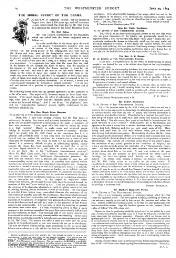
The Westminster Budget (29 June, 1894 - p.14) THE MORAL EFFECT OF THE DRAMA. A QUESTION of perennial interest—for its discussion began more than 2,000 years ago, and still continues—was raised afresh the other day by Mr. Hall Caine in a speech at the dinner of the Royal Theatrical Fund. Mr. Hall Caine. Mr. Hall Caine’s contribution to the discussion, which has called forth the letters subjoined, was as follows:— As to the moral effect of the drama upon the world—a well-known Nonconformist preacher, who was an enemy of the stage, once said that he had noticed that the young people of his congregation who went most to the theatre and wept most at the imaginative woes of the afflicted heroine in melodrama were precisely those who were hardest to move to pity and sympathy when a case of actual distress came their way in real life. I can only say this (said Mr. Caine), it is exactly the opposite of my own experience. My experience has been that the tears that are shed in the theatre do not exhaust the fount of tears; that the exercise of the muscles of the soul which the drama requires is good for the growth of the soul; and that if you want to test the moral effects of the drama on the world at large you cannot do better than look at the people who come closest to it; and that it is impossible to find a class more tender of heart, more easily moved to pity, more ready to respond to the cry of trouble than actors and actresses themselves. At all events, I should like to see the point discussed by ministers of religion generally. It is the very pith and marrow of a question of great importance to the drama and to society. The following letters show that any general agreement on the question is as far off as ever. One aspect of it, however, seems to have been overlooked. If the moral drama has the effect of exhausting the moral feelings, then does it not follow that the immoral drama must similarly exhaust the immoral feelings? And if that be so, “the playhouse,” even with its “objectionable features,” should, rightly understood, be the minister’s valuable ally.
Mr. Robert Buchanan. To the EDITOR of THE WESTMINSTER BUDGET.
[The other contributions, from the Rev. Hugh Price Hughes, Rev. Dr. Thain Davidson and Rev. F. B. Meyer, as well as the views of Herbert Spencer on the matter, can be read if you click the picture below.] |
|
|
 |
|
|
|
[Another extract from a letter in The Daily Chronicle.]
The Leeds Mercury (1 September, 1894) MR. ROBERT BUCHANAN ON The “Chronicle” publishes a letter from Mr. Robert Buchanan, who says—I have been frequently informed that publishers are entitled to large pecuniary gains because they risk their capital in a very precarious business. In my experience this is altogether untrue. As a rule, a publisher risks nothing. He gives the very lowest price possible for a certain marketable commodity, and he is utterly indifferent to its quality as long as it sells. The Society of Authors has done the State good service by issuing statistics of the bare-faced robberies daily and hourly practised by Barrabas and his kin, and though I personally decline to have my private transactions regulated by any society or Trades Union whatever, I am fully alive to the importance of the facts so issued. Publishers, like lawyers, are thieves within the shadow of the law. They toil not, neither do they spin, yet Solomon, in his glory, was not attired like one of them. ___
The Leeds Times (8 September, 1894 -p.4) BUCHANAN ON PUBLISHERS. Mr. Robert Buchanan, author and dramatist, strikes me as a most unreasonable man. He has done well out of literature. He has a civil list pension of £200, and at the time of his bankruptcy he admitted that he drove a brougham because riding was easier than walking. Now, in a letter to the Daily Chronicle, he denounces publishers as “thieves within the shadow of the law,” in league with the critics. Somehow Mr. Buchanan has spent the greater part of his life in bringing, not peace, but a double-edged sword; which, as the Reviewers never fail to remind him, is a dangerous weapon to fight with. __________
[Another extract from a letter in The Daily Chronicle.]
St. James’s Gazette (10 October, 1894 - p.13) MR. ROBERT BUCHANAN, who, in a court which it would be unkind to name, recently described the literary profession as a gambling one, is contemplating a new gamble in the form of a non-political weekly journal. By way of keeping his pen in practice he takes the editor of the Chronicle to task for having slashed at him on account of “Rachel Dene;” a story of which he seems now to be ashamed, and which has been re-issued in spite of his entreaties to the publishers. Here are some gems from the Buchanan treasury of recrimination:— I am at a loss to know whether the statement in question is inspired by malice or by mere stupidity. The stupidity I always take for granted when I read newspaper criticisms; the malice, in most instances, is equally obvious. But I think the manufacturers of cheap criticism for the Christian masses should be corrected when they travel out of their own region of uninstructed impudence into that of lying and spiteful imputation. There is no critic—cheap or otherwise—who could out do this. __________
Letters to the Press - continued or back to the Letters to the Press menu
|
|
|
|
|
|
|