
ROBERT WILLIAMS BUCHANAN (1841 - 1901)
|
|
|
ROBERT WILLIAMS BUCHANAN (1841 - 1901) |
|
|
|
|
|
|
|
|
|
BIOGRAPHY
“Buchanan, in fact, whatever his professions of high moral aims, had a mind which touched nothing it did not contaminate. Low in mind, low in taste, low in breeding, and, as an apostle of morality, evidently insincere; such was Buchanan. ... For Buchanan was not only a hypocrite, but a clumsy hypocrite; and not through any element of honesty, but through sheer stupidity perhaps the most contemptible figure in English literary history.” |
|
|
|
|
|
|
|
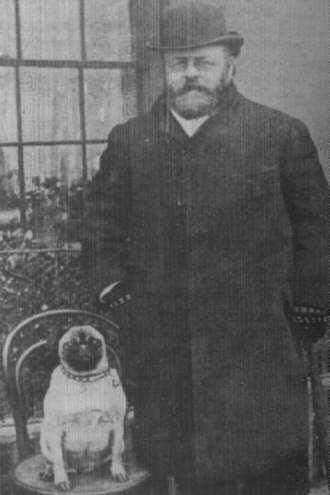 |
||||||
|
The 1911 edition of the Encyclopedia Britannica has the following entry for Robert Buchanan: “BUCHANAN, ROBERT WILLIAMS (1841—1901), British poet, novelist and dramatist, son of Robert Buchanan (1813—1866), Owenite lecturer and journalist, was born at Caverswall, Staffordshire, on the 18th of August 1841. His father, a native of Ayr, after living for some years in Manchester, removed to Glasgow, where Buchanan was educated, at the high school and the university, one of his fellow-students being the poet David Gray. His essay on Gray, originally contributed to the Cornhill Magazine, tells the story of their close friendship, and of their journey to London in 1860 in search of fame. After a period of struggle and disappointment Buchanan published Undertones in 1863. This “tentative” volume was followed by Idyls and Legends of Inverburn (1865), London Poems (1866), and North Coast and other Poems (1868), wherein he displayed a faculty for poetic narrative, and a sympathetic insight into the humbler conditions of life. On the whole, Buchanan is at his best in these narrative poems, though he essayed a more ambitious flight in The Book of Orm: A Prelude to the Epic, a study in mysticism, which appeared in 1870. He was a frequent contributor to periodical literature, and obtained notoriety by an article which, under the nom de plume of Thomas Maitland, he contributed to the Contemporary Review for October 1871, entitled “The Fleshly School of Poetry.” This article was expanded into a pamphlet (1872), but he subsequently withdrew from the criticisms it contained, and it is chiefly remembered by the replies it evoked from D. G. Rossetti in a letter to the Athenaeum (16th December 1871), entitled “The Stealthy School of Criticism,” and from Mr Swinburne in Under the Microscope (1872). Buchanan himself afterwards regretted the violence of his attack, and the “old enemy” to whom God and the Man is dedicated was Rossetti. In 1876 appeared The Shadow of the Sword, the first and one of the best of a long series of novels. Buchanan was also the author of many successful plays, among which may be mentioned Lady Clare, produced in 1883; Sophia (1886), an adaptation of Tom Jones; A Man’s Shadow (1890); and The Charlatan (1894). He also wrote, in collaboration with Harriett Jay, the melodrama Alone in London. In 1896 he became, so far as some of his work was concerned, his own publisher. In the autumn of 1900 he had a paralytic seizure, from which he never recovered. He died at Streatham on the 10th of June 1901. Buchanan’s poems were collected into three volumes in 1874, into one volume in 1884; and as Complete Poetical Works (2 vols., 1901). Among his poems should also be mentioned: “The Drama of Kings” (1871); “ St Abe and his Seven Wives,” a lively tale of Salt Lake City, published anonymously in 1872; and “ Balder the Beautiful” (1877); “ The City of Dream (1888); “The Outcast: a Rhyme for the Time” (1891); and “The Wandering Jew” (1893). His earlier novels, The Shadow of The Sword, and God and the Man (1881), a striking tale of a family feud, are distinguished by a certain breadth and simplicity of treatment which is not so noticeable in their successors, among which may be mentioned The Martyrdom of Madeline (1882); Foxglove Manor (1885); Effie Hetheringlon (1896); and Fathcr Anthony (1898). David Gray and other Essays, chiefly on Poetry (1868); Master Spirits (1873); A Poet’s Sketch Book (1883), in which the interesting essay on Gray is reprinted; and A Look round Literature (1887), contain Buchanan’s chief contributions to periodical literature. More valuable is The Land of Lorne (2 vols., 1871), a vivid record of yachting experiences on the west coast of Scotland.” |
||||||
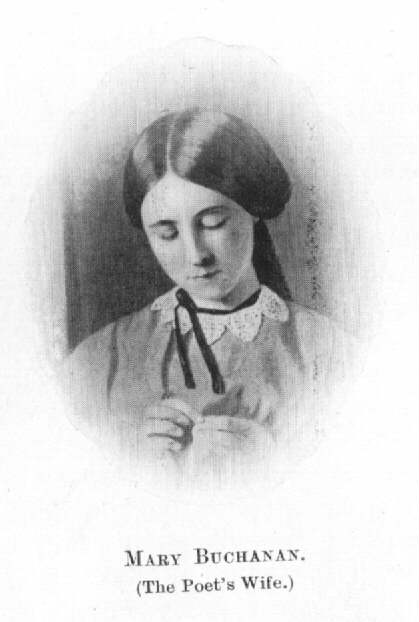 |
||||||
|
The fullest account of the life of Robert Buchanan is the biography written by his sister-in-law, adopted daughter, long-time companion and literary collaborator, Harriett Jay. Robert Buchanan. Some account of his life, his life's work and his literary friendships was published in 1903, two years after Buchanan’s death. I have added it to the site and it can be accessed from the link below. It is by no means a critical biography; more an affectionate portrait of the man. Harriett Jay attempts to let her subject speak for himself wherever possible, frequently using extracts from his own unpublished autobiography and letters. Robert Buchanan. Some account of his life, his life's work and his literary friendships by Harriett Jay Apart from Harriett Jay’s biography there have only been two books devoted solely to Robert Buchanan. Archibald Stodart-Walker’s Robert Buchanan, the Poet of Modern Revolt, published the year Buchanan died, is concerned with Buchanan’s poetry. John A. Cassidy’s Robert W. Buchanan, published in America in 1973, relies on Harriett Jay to provide most of the details of Buchanan’s life, although there is fresh material in the section on the ‘Fleshly School’ controversy. Another book-length examination of Buchanan’s life and work, which uses several sources missed by Cassidy, is the unpublished PhD thesis of Christopher D. Murray, Robert Buchanan (1841-1901): An assessment of his career, which is freely available from the British Library’s EThOS (Electronic Theses Online Service). Shorter biographical sketches of Buchanan tend to rely on the Jay biography and these can be accessed from the link below. As well as his 1912 entry in the Dictionary of National Biography, there are also several from books relating to Buchanan’s home county of Staffordshire. Although not available on this site I should also mention M.J.W. Rogers’ history of Caverswall, The Spirit Of The Place (Churnet Valley Books, 2000) which contains a chapter on Buchanan, although it tends to highlight the ‘Pooterish’ elements of his character, painting a picture of Buchanan as a slightly comical figure, stumbling from one misfortune to the next, an inveterate gambler and a keen cyclist whose last words were “I should like a good spin down Regent Street.” Two of Buchanan’s friends and collaborators in the dramatic field, G. R, Sims and Henry Murray, contribute short pieces to Harriett Jay’s biography. They expand on these on their own autobiographies and the relevant extracts from these, as well as material from other writers who knew Buchanan are available below: During my own research I have discovered several inconsistencies in Harriett Jay’s biography and also several gaps in the narrative. In an attempt to correct these, I have constructed a timeline of the life of Buchanan, which also contains copies of several documents including his birth certificate and several census returns: _____
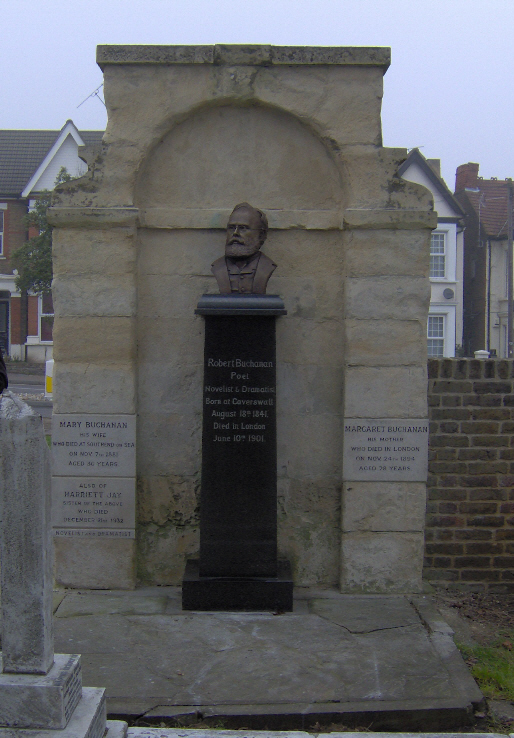
On Friday, 19th October, 1900, Robert Buchanan suffered a massive stroke which left him paralysed and without the power of speech. He remained in this condition for the next eight months until his death on Monday, 10 June, 1901. He was buried in Southend on 14th June beside the graves of his wife and mother. Although the press reports of his illness were initially widespread and sympathetic, these tended to disappear over the months while Buchanan lingered in his semi-comatose state. Whether the obituaries would have been more sympathetic had he died immediately after the stroke, it is impossible to say, but as a final piece of bad luck, Buchanan died a day after Sir Walter Besant, a far less controversial character than Buchanan, and several papers combined their obituaries, comparing the two writers, mostly to Buchanan’s disadvantage. This final period of Buchanan’s life, the state of his reputation at the time of his death, descriptions of his funeral and his grave (including material relating to its renovation in 2011), are examined in the following pages: The Last Months of Robert Buchanan Obituaries 4: Robert Buchanan and Sir Walter Besant |
||||||
|
|
 |
|
|
|
|
|
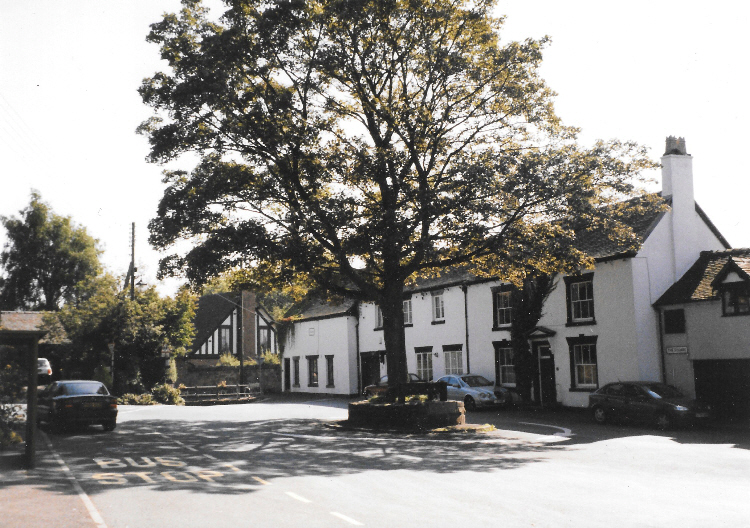
The village of Caverswall, Staffordshire, where Robert Buchanan was born. |
|||
 |
|||
|
|
|
Robert Buchanan’s grave in Southend-on-Sea, Essex.
|
|
|
|
|
|
|