ROBERT WILLIAMS BUCHANAN (1841 - 1901)
|
|
|
ROBERT WILLIAMS BUCHANAN (1841 - 1901) |
|
|
|
|
|
|
|
|
|
BOOK REVIEWS - NOVELS (3)
Foxglove Manor (1884) Matt: A Story of a Caravan (1885) Stormy Waters (1885) The Master of the Mine (1885) That Winter Night (1886)
|
|
|
 |
|
|
|
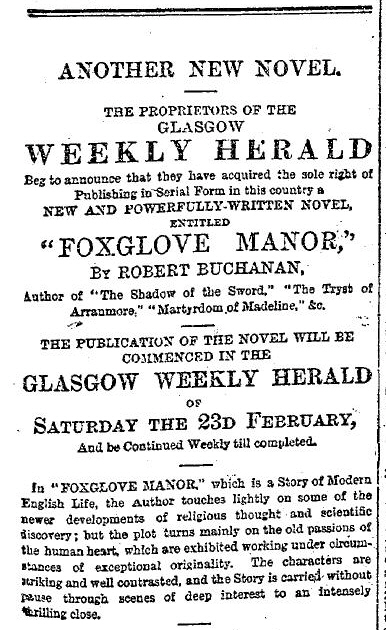
[Advert from the Glasgow Herald (11 February, 1884).]
The Derby Mercury (17 September, 1884 - p.6) Reviews. MR. ROBERT BUCHANAN’S NEW NOVEL. Mr. Buchanan describes his new story, “Foxglove Manor” (1), as “an attempt at a tragedy in fiction,”—a tragedy, however, without a tragic ending. He has chosen as his hero a clergyman of whom he says, “I have simply pictured, in the Rev. Charles Santley, a type of man which exists, and of which I have had personal experience.” Having read the story, we are glad to believe, with Mr. Buchanan, that “fortunately such men are uncommon;” and to join him in saying that, “still more fortunately, the clergymen of the English Establishment are for the most part sane and healthy men,” not subject to “morbid deviations.” This is not the first time that Mr. Buchanan has chosen a clergyman for his hero. In “A New Abelard” we had a cleric of an abnormal type, who allowed his common-sense to be overmastered by the fancies of an unchecked imagination and the speculations of an ill-trained mind. Yet the Rev. Ambrose Bradley was a saint compared with the Rev. Chas. Santley, who is the central character in “Foxglove Manor,” and Mr. Buchanan may be commiserated with on having had “personal experience” of such men. We cannot do better than let Mr. Buchanan introduce his hero:— The Rev. Charles Santley had been Vicar of St. Cuthbert’s for little less than a year. He was unmarried, just turned thirty, a little over the middle height, and remarkably handsome. It was not to be wondered at that, with such recommendations, the new vicar had at the very outset fascinated the maids and matrons of his congregation. A bright shapely face, with soft dark eyes, a complexion almost feminine in its clear flush, a broad scholarly forehead, black hair slightly thinned with study on the brow and at the temples, black moustache and short curling black beard—such was the face of the vicar as he stood uncovered before you. His voice was musical and sympathetic; the pressure of his hand invited confidence and trust; his soft dark eyes not only looked into your heart, but conveyed the warmth and eagerness of his own; you felt instinctively that here you might turn for help which would never be found wanting, and seek advice that would never lead you astray, appeal for sympathy with a certainty that you would be understood, obey the prompting to transfer the burthen of spiritual distress with a sure knowledge that your self-esteem would never be wounded. Of course there were ladies of a critical and censorious disposition among his flock, but even these were forced to acknowledge the charm of his presence and the kindliness of his disposition. Among the men he was less enthusiastically popular, as was natural enough; but he was still greatly liked for his frankness and cordiality, and his keen intellect and sterling common sense commanded their respect. On one thing you might always reckon at St. Cuthbert’s—a thoughtful, eloquent sermon, delivered in a voice full of exquisite modulations. It happened often enough that the preacher forgot the capacities of his hearers, and became dreamy and mystical; but, though you failed to comprehend, you were conscious that the fault lay less with him than with your own smaller spiritual nature. This, too, happened only in certain passages, and never throughout an entire discourse. He began on the grass, as the lark does, and gradually rose higher and higher in the brightening heavens till your vision failed; but, if you waited patiently, be descended again to earth, still singing. Santley’s mental condition may be best understood by the following paragraph:— Ardent, emotional, profoundly convinced of the eternal truths of revelation and of the glorious mission of the Church, the young clergyman was at the same time boldly speculative and keenly alive to the grandiose developments of the modern schools of thought. It was not till he stood on the extreme verge of science and looked beyond that he fully realized his position. He then perceived with horror that it was no longer impossible—that it was even no longer difficult—to regard the great message of redemption as a dream of the world, the glorious faith of Christendom as a purely ethnic mythology, morality as a merely natural growth of a natural instinct of self-preservation. Indeed, the difficulty consisted in believing otherwise. The Fatherhood of a personal God was slipping away from his soul; the Sonship of a Saviour was melting into a fantastic unreality; the conviction of a personal immortality was dissipating into mental mist and darkness. The mystery of evil was growing into a fiendish enigma; virtue passed him, and showed herself to be a hollow mask. His whole nature rose in revolt against this horrible scientific travesty of God’s universe. He shrank back alike from the new truths and from the theories evolved from them. His faith could not stand the test of the wider knowledge. If God were indeed a myth, immortality but a dream, virtue an unprofitable delusion, man simply a beast gifted with speech, better the old faith concerning all these—accepted though it were in despite of reason and in outrage of immortal truth—than the hideous simulacra of the new philosophy. He cast himself back upon the bosom of the Church; he clung to her as to the garment of God; but he was powerless to exorcise the spirit of scepticism. It rose before him in sacred places, it scoffed at his most earnest and impassioned utterances; he seemed to hear within himself cynical laughter as he stood at the bedside of the dying; when he knelt to pray it stood at his ear and suggested blasphemy; it converted the solemn light of the Church into a motley atmosphere of superstition; it stimulated his strong animal nature to the very bounds of self-restraint. Still, if he was unable to exorcise it, he had yet the strength to contend with and to master it. Precisely because he was sceptical he was rigid in outward doctrine, zealous for forms, and indefatigable in the discharge of his clerical functions. In his passionate endeavour to convince himself, he convinced his hearers and confirmed them in the faith in which he was himself unable to trust. Previous to taking orders Santley had been teacher of classics to a young ladies’ seminary, where he and his favourite pupil, a beautiful girl of seventeen, had pledged eternal fidelity. But their youthful dream had been rudely dispelled by the friends of the young lady, and, “after seven years of hopeless separation,” she appears again in the congregation of St. Cuthbert’s, completely upsetting the vicar’s self-possession, as he happens accidentally to catch sight of her just at the moment when delivering one of his most impassioned sermons. Ellen Derwent, he finds, is now Ellen Haldane, the wife of the owner of Foxglove Manor; and although she “is in the full lustre of her peerless womanhood” she is, alas, “another man’s wife.” This ought to have been enough to prevent the rev. gentleman from allowing his thoughts to dwell upon her beauty; but her “tall, graceful, supple figure, with the exquisitely moulded head of a Greek statue,” her “ripe, rich complexion suffused with a blush-rose tint,” her “large lovely black eyes full of fire and softness,” her “long, curved, black eyelashes,” her “profusion of silky black hair parted in little waves on a broad, bright forehead,” and her “pair of sweet red lips,” were too much for him. He permitted himself to dream of this vision of loveliness, until the old passion all came back upon him, with the greater force consequent upon his fuller manhood. Having begun with what was at first “a mere religious amorousness, a soft sensuous delight in female sympathy and female beauty,” Santley allowed his morbid imagination free play until he became a “self-convicted hypocrite, liar, adulterer, seducer, satyr—filthy from the soul to the finger-tips.” The process by which this result is attained is well described. We see how Santley descended step by step; how he dallied with temptation, how he nursed unholy thoughts, whilst his “faith in spiritual things, so far from being shaken, was as strong as ever. His own sense of moral deterioration, of spiritual backsliding, only made him believe all the more fervently in the heaven from which he had fallen, or might choose to fall.” The character which will absorb attention, next to Santley, is that of George Haldane, the owner of Foxglove Manor, and the husband of Ellen, “a tall, broad-shouldered, powerful man of about forty years of age.” “A grim, self-sufficing, iron-natured man, one would have said, until one had looked into his bright blue-gray eyes, which lit up his strong, rugged face with an expression of frankness and dry humour.” Mrs. Haldane has renewed her acquaintance with Santley, and she is most desirous that her agnostic husband should hear him preach. Haldane goes to church for his wife’s sake, and the effect made upon him is thus described:— The dim religious light of the painted windows pleased his eye, but failed to exercise any influence on his feelings. The decorations of the church seemed to him insincere and artificial. He missed in the atmosphere that sense of reverence which he had experienced in the old cathedrals in Spain and Italy. The ceremonies appeared dry, joyless, and uninteresting, and as he watched the congregation bowing, kneeling, praying, singing, pageants of the jubilant mythic worship of the ancient world crowded upon his imagination. “What are you thinking of?” his wife once whispered, as she caught a sidelong glance at his abstracted face. “Diana at Ephesus!” he replied, with a curious twinkle in his keen gray eyes. Haldane must not, however, be judged by this flippant remark. As his character is set before us, we are inclined to agree with the author that This man, who rejected all outward forms of belief, and whose conversation was habitually ironical, was in his inmost nature deeply and sincerely religious; humbly reverent before the forces of nature; spiritually conscious of that Power beyond ourselves which makes for righteousness. True, he rejected the ordinary forms of theism; but he had, on the other hand, a deep though dumb reverence for the character of Christ, and he had no sympathy with such out-and-out materialists as Haeckel and hoc genus omne. For the rest, he was liberal-minded, and had no desire to interfere with his wife’s convictions; could smile a little at her simplicity, and would see no harm in her clerical predispositions, so long as the clergyman didn’t encroach too far on the domain of married life and domestic privacy. George Haldane passes a good deal of time in making experiments, whilst his wife is left to pursue her own course of church-going, charitable visitation, and sentimental flirtation with the clergyman. In justice to her, it should be said that she is never untrue to her husband, either in thought or in act, but circumstances occur which cause Haldane to denounce Santley to his wife as “a meddler and a mischief-maker,” and to forbid his being received as a guest in his house. Haldane and Santley almost monopolise the reader’s interest; they are both so powerfully sketched. There is, however, one other character in behalf of whom strong sympathy will be felt—Edith Dove, an orphan, “a slim fair girl of two and twenty,” “a bright little fragile-looking blossom of a being who seemed scarcely to have yet slipped out of her girlhood.” Miss Dove is organist of St. Cuthbert’s, and is engaged to Santley. He basely betrays her, and the scenes in which she pleads with him for the fulfilment of his promise are very finely conceived. Santley’s sister, who was “as unimaginative as she was practical,” and who was “at a loss to understand her brother’s emotional mysticism and dreamy idealism,” is admirably pourtrayed. Miss Greathead, too, may be accepted as a pretty correct type of the gossiping village schoolmistress, the purveyor of village tittle-tattle for the benefit of the parson. The mysterious Spaniard, Baptist; Hetherington, the young Scotch painter; and his mother, who thought Patti’s singing “meedling loud,” but who had “heard far finer in the Kirk,” are all clever sketches. We cannot say that Mr. Buchanan has excelled himself in “Foxglove Manor,” because we remember that he is the author of “The Shadow of the Sword” and “The New Abelard;” but we do consider his latest story almost equal to the first-named, and little, if at all, inferior in power to the other. Mrs. Lynn Linton in “Under which Lord?” dealt with two similar characters to Mr. Buchanan’s clergyman and agnostic, and it is curious to note how the two writers run in almost parallel lines in the treatment of these kindred studies. In both novels the reader’s sympathy is bespoken for the agnostic. But Mr. Buchanan is careful to state that Santley is an exception to the general run of clergy, whilst the lady writer leaves unthinking readers to accept her hero as a type. There is much food for thought in “Foxglove Manor,” which is sure to have a wide circle of readers. (1) Foxglove Manor. A Novel. By ROBERT BUCHANAN. In Three Volumes. London: CHATTO and WINDUS, Piccadilly. ___
The Academy (20 September, 1884 - p.179) NEW NOVELS. Fox-Glove Manor. By R. Buchanan. In 3 vols. (Chatto & Windus.) ... MR. ROBERT BUCHANAN is one of our most prolific, and not one of our least powerful, writers of moral fiction. His novels have always some great ethical purpose, and we may cheerfully concede that this purpose is always high. But this does not commit us to approval of his methods, and in Fox-Glove Manor the vices of treatment with which readers of his former novels are familiar seem to have become aggravated. The motive of the plot is sufficiently unpleasant; nor can one say that the art of the author overcomes its unpleasantness. That Mr. Buchanan should have had personal experience —as he tells us in his Preface he has—of a type of man like the Rev. Charles Santley, is melancholy enough; but no amount of such personal experience can fully justify a writer in presenting us with an elaborate study of the human character in its most absolute corruption. That is not the province of art; there is neither beauty nor goodness to be had from raking out moral dungheaps. If M. Buchanan would but apply his unquestioned powers to some worthier object of study, he might give us a book we should be glad to read, even to read more than once; a book not full of the portraiture of degrading vices and unhealthy imaginings, which do not wholly lose their evil influence because they are depicted only to be condemned. A clergyman in the Church of England who seduces a girl in his congregation, and refuses to marry her because his attention is too much taken up with trying to seduce another man’s wife, is a character that may exist—Mr. Buchanan says he does—but of such, and such like, non ragionam di lor. ___
The Morning Post (23 September, 1884 - p.2) FOXGLOVE MANOR. Many sincere admirers of Mr. Buchanan’s talent will regret to see him persevere in the new phase inaugurated by his romance of “The New Abelard.” His latest work, “Foxglove Manor,” marks a further step in the same direction, and if, as the author affirms, it “is not to be construed into an attack on the English priesthood generally,” it is difficult to understand why it should have been written. Psychological studies so remarkable as the one contained in the portrait of the Rev. Charles Santley are rare. Yet, although the realistic school is now generally allowed to be according to the definition of a great artist “the love of truth and nature to the extent of accepting even the bad and ugly in form, and the useless and revolting in idea,” there are boundaries which cannot be passed with impunity, and to use the author’s words, in another sense, when they are employed by himself “sane and healthy men and women” without “morbid deviations” will experience a feeling of repulsion in the perusal of Mr. Buchanan’s pictures of his hero’s depravity. It is hard to know to which class of the community the writer’s new book will recommend itself. The nature of the subject is so painful, the details so crude that few women would care to confess to having read it, fewer still, who even in the retirement of their “sanctums,” would not find its style too sensuously realistic. Perhaps because the author declares that the type of the Rev. Mr. Santley exists, has he judged it expedient to divest his whole story of the faintest varnish of romance. In this sense it is in a measure likely to be harmless. Not one of the principal personages is calculated to inspire sympathy, and therefore is there no pity felt for their ultimate fate, no false compassion hides the nakedness of their misdeeds. Mr. Buchanan’s assurance, that “fortunately” such men as his reverend hero are “uncommon,” is superfluous. It may be affirmed that so great an amount of moral deformity has never been found in an individual of his class. The victims of the Vicar of Omberley are contemptible specimens of womanhood. Admitting that a young and inexperienced girl like Edith Dove might fall into the snare of her villanous clerical lover, it is difficult to imagine that he could attain so complete a hold on a woman in Mrs. Haldane’s position, married to a man against whom she can bring no reproach but that of unbelief. At the same time, this pious wife allows the vicar of her parish to address her in the following terms:— “If I love you with a love that will colour my whole life, do not imagine that it is with any hope of response in this world. I do your husband no injustice. I do you no dishonour. I loved you long before he knew you; I shall love you still in that after-life in which he has deliberately abandoned all claim to you, in the very existence of which he places no belief. Between this and then let me be your brother; let me be as one in whom you will ever find sympathy and devotedness—one who can share all your doubts and distress, all your temptations and trials. I do not ask you to love me; I only ask you to let me love you.” Instead of resenting this passionate declaration Mrs. Haldane goes on to what would have been the “bitter end” had not her unbelieving husband interfered in a manner equally efficacious and melodramatic. For, as Mr. Buchanan says, his book is a “tragedy in fiction without a tragic ending, unless it be the ruined life of one of his heroines.” Powerfully and dramatically written as is “Foxglove Manor,” the breadth and vigour of its author’s style does not suffice to gloss over the objectionable nature of the theme he has chosen. The work will offend many, without having apparently any definite object. As an attack against a certain body of men, or to oppose “a worn out, mildewy, and old-fashioned creed,” it is incomplete. As a realistic study it exceeds the license hitherto accorded to writers of English fiction. * Foxglove Manor. By Robert Buchanan. London: Chatto and Windus. ___
The Pall Mall Gazette (25 September, 1884) “FOXGLOVE MANOR.” * THE art of fiction, as understood by Mr. Robert Buchanan, is not without its mysteries. He has eulogized the late Mr. Charles Reade as the master of “Homeric story-telling,” and therefore a Triton among such minnows as his over-rated contemporaries. It is to be presumed, then that Mr. Buchanan himself aspires, however humbly, to something of this Homeric art, and indeed the influence of Charles Reade may be traced, not obscurely, in his manner. But we must frankly confess that we find more of Charles Reade than of Homer, and that certain other non-Homeric influences seem likewise in the ascendant. The heroes of Homer do not confide their crimes and meannesses to their diaries, padding them with vivid descriptions of scenery and other irrelevant matter; but this is a characteristic practice of the heroes of Mr. Wilkie Collins. Homer does not carry on his action through a systematic course of eavesdropping; Mr. Wilkie Collins does. As for an “elixir of death” which induces all the symptoms of dissolution down to the rigor mortis without in the least injuring the person who indulges in it, this is a Shakesperean rather than a Homeric touch. It is futile of Mr. George Haldane to pretend that the elixir is the invention of “Dr. Dupré, of Paris;” Friar Laurence, a Franciscan, of Verona, is known to have held the patent early in the fourteenth century, and it has been a drug in the melodramatic market ever since. * “Foxglove Manor.” A Novel. By Robert Buchanan. (London: Chatto and Windus. 1884.) ___
The Illustrated London News (27 September, 1884 - p.15) NOVELS. . . . Difficult, indeed, is it to deal with such a novel as Foxglove Manor: by Robert Buchanan (Chatto and Windus), because the author writes so well and so powerfully, and yet the story is so very shocking, so unlikely to serve any good purpose, that one cannot help wishing it had never been written at all. The author himself considers it necessary to write a short, apologetic preface and, in the course of his narrative, to make some kind of excuse for the employment of “plain language” (Which is certainly very plain indeed); and, whenever an author is reduced to apologies and excuses, it always looks—to use a vulgar but expressive phrase—a little “fishy.” The story, in fact, is an exceedingly painful one, sure to offend not only the susceptibilities, but the good, proper, decent feelings of very many worthy persons; it cannot be recommended on any ground but that of the cleverness, eloquence, humour, and power with which it is written; and so far is it from belonging to the category of those romances which “will not bring a blush to the cheek of modesty” that it “might make a door-plate blush for shame, if,” as poor Hood put it, “door-plates were not so brazen.” There is no disputing, however, that the most modest reader of novels should by this time have become quite case-hardened by continual experience of “risky” literature; and so a warning in the present instance may either be altogether wasted or prevent readers from enjoying a tale which is objectionable only for its theme and for the “warmth,” as well as the exceeding plainness, with which that theme is occasionally treated. The object appears to have been to exhibit in strong contrast the characters of a lustful, hypocritical, morbid English clergyman and a comparatively pure-minded, noble, philosophical agnostic. The precious parson; having met with a severe but not sufficiently severe punishment for his wickedness, is kindly handed over to the Roman Catholic Church as a convert; a kind attention, on the author’s part, which that communion will probably not appreciate very highly. The author says he has known just such a clergyman, and evidently implies that he was therefore bound to introduce so eligible an acquaintance to the public; but the necessity is not nearly so apparent as that of living, and even the necessity of that has been called in question. The author vows that he has not the least intention of gibbeting “clergymen of the English Establishment” generally, and his statement must, of course, be accepted. His intention, or rather want of intention, would evidently have been clearer had he contrasted the wicked priest not with a righteous agnostic but with another priest belonging to those “sane and healthy men, too unimaginative for morbid deviations,” of whom he professes to allow that “the English Establishment” consists “for the most part.” ___
The Standard (3 October, 1884 - p.2) “Foxglove Manor.” By Robert Buchanan, Author of “God and the Man,” &c. Three Vols. Chatto and Windus.— Time was when Mr. Buchanan thundered against the “fleshly school,” and when a tone of somewhat stern Puritanism pervaded his novels. In “God and the Man,” and in “The Shadow of the Sword,” the few faults which could not mar the many beauties were purely literary and artistic. There might be a little exaggeration here and there; what was meant to be sublime might now and then sound almost like bombast. But the writer’s tone was always noble, his conceptions poetical, his aspirations grand. Mr. Buchanan’s “second manner” shows a lamentable deterioration of thought and style. To his best friends and discriminating admirers it must ever be a matter of shame and regret that the author of the two books which we have named should have written “The New Abelard” and “Foxglove Manor.” The preface to his present work begins with a disclaimer, and ends with a sneer. In drawing a scoundrelly and profligate clergyman, of a type of which he has had “personal experience,” he by no means intends to attack “the English priesthood generally, which consists for the most part of sane and healthy men too unimaginative for morbid deviations.” It is easy to draw a rogue, and put him into canonicals. As Thackeray says, “Any man can do that; but when old Father Noah was overtaken in his cups there was only one of his sons to make merry at his disaster, and he was not the most virtuous of the family.” In “Adam Blair” and in “The Scarlet Letter” there are erring clergymen, and the story of their fall is told with a “kingly chastity of thought” which morally and æsthetically vindicates the choice of subject. Not one prurient word or thought is to be found in those stories. “The Vicar of Wrexhill” was a very different style of work. The half-forgotten unsavouriness of that unpleasant novel is brought back to our noses and memories in the pages of “Foxglove Manor.” An amiable and honourable Agnostic suspects his wife of an intrigue with her parish clergyman. Mr. Haldane is a scientist, and can, to all appearance, kill people and bring them to life again. He pretends to kill his wife, and shows her would-be seducer the supposed corpse. The wretched man is entrapped by this silly and ghastly artifice into a wild avowal of his sin. The dénouement is singularly weak and foolish. Mr. Buchanan should be above the vulgarism of substituting “whatever” and “wherever” for “where” and “what.” He should not talk such nonsense as this—“Haldane’s friend, Blakiston, had often gone to see Cerito in company with Horne Took” (sic). We presume that he means Horne Tooke—Was Cerito born before the author of “The Diversions of Purley” was dead? Mr. Haldane’s Spanish servant would not have sworn “Cuerpo di Baccho,” simply because the words are not Spanish. ___
The Graphic (4 October, 1884) New Novels. MR. ROBERT BUCHANAN’S “Foxglove Manor” (3 vols.: Chatto and Windus), is equal in power to any of its predecessors. It has not the fascination of what still remain his great prose works, “The Shadow of the Sword” and “God and the Man,” but only because its subject is by nature wanting in the elements of picturesqueness and adventure. As a study of morbid anatomy it reaches the highest level to which work of that kind can possibly attain. From a dramatic point of view there is genius shown in the gradual transmutation of our original sympathy with, and liking for, the Reverend Charles Santley first into pity, thence into contempt, thence into disgust and loathing, and finally into the renewed pity that must needs come when the whole of any human soul is opened fully before our eyes. The process of exhaustive dissection is never pleasant, even when exercised by genius; nor can “Foxglove Manor” be honestly recommended as pleasant reading. But a reader who follows it to the end without an increase of wisdom and widened sympathies must be a very strange sort of reader indeed. Moreover there is real need of such books as these at a time when there is so little manliness in fiction generally, and when the outlines between sentimentality and duty, and between right and wrong, are so commonly blurred. In his preface, Mr. Buchanan not unnecessarily vindicates himself beforehand from any possible charge of making the clergyman whom he has chosen for his subject in any way represent his calling. We should never, however, have made such a charge, because the ecclesiastical framework of the story was so obviously required by the construction of the story. It does away at once with a number of difficulties appreciable by artists and critics alone, into which therefore there is no need to enter. It, moreover, brings out into stronger relief the contrast between Charles Santley and the Agnostic philosopher, George Haldane: nor can it be said that Mr. Buchanan, however he deals with the men, sways the theological balance one way or the other. Mrs. Haldane, also, though studied only from the outside, is an admirable portrait, as showing how sin is, as George Haldane is made to put it, a moral leprosy, extending beyond the sinner. The manner in which the lost priest is brought at last face to face with conscience is certainly melodramatic, but not the less powerful, as an escape from the threatening tragedy. It is to be wished that Mr. Buchanan would realise the necessity for relief in fiction. His lurid monotone, without it, becomes oppressive at times, and would gain marvellously from an occasional breath of fresh air. But, with this solitary drawback, which indeed seems inseparable from Mr. Buchanan’s genius, “Foxglove Manor” is a work to be grateful for: though that it may be misunderstood we can readily believe. Perhaps it may help in some measure against this danger to note that it refuses to recognise any possible compromise, however purely sentimental, between conscience and passion. ___
The Glasgow Herald (26 November, 1884 - p.10) (4) Foxglove Manor. Mr Buchanan cannot be accused of having sacrificed too much in his new novel to the milk-and-water gods of conventionality, before which, according to French critics, British novelists, as a rule, bow down; in abject adoration. French critics, however, are not always correct in their ideas of the aims and purposes of art, and French novelists, in the very manner they use the liberty they claim as their right, impose upon themselves conditions as narrow as, and much more unhealthy than, those that ever bound the most “Mrs Grundy” worshipping of British fiction writers. Why, in the name of all things honest, should we for a moment grant that passion and humour and pathos¾the tragedy and the comedy of human existence¾are to be extracted only out of breaches or threatened breaches of the Seventh Commandment? If our writers are bigoted in their respect for the proprieties, our Gallic friends are as bigoted in their devotion to the improprieties of life, and the outlook of both, perhaps, requires widening. We would ask the latter, is there no area of artistic interest where men are self-denying and pure, and women honest wives and loving mothers? We need not sympathise with books and pictures that are fit intellectual food for only boarding-school girls to be of opinion that perpetual doses of the demi-monde and post-marital intrigues are rather unsavoury and nauseating. Shakespeare is generally credited with a wide knowledge of human nature, and his work is certainly not on the side of the French novelists and dramatists of to-day. We must not be supposed, however, to condemn Mr Buchanan's book because of the subjects with which it deals. Such things as he speaks of happen, and are accordingly topics open to artistic treatment. All we plead for is that our novelists will take up these topics only when they feel upon themselves the strong provocation of an inspiration. Mr Buchanan has shown himself master of his materials, and has given us a study so powerful and, in some points, so subtle that it justifies itself. Many people who confound religion with theological phrases and ecclesiastical organisation will object to the character of the Rev. Charles Santley, and accuse the author of laying impious hands on holy things. In fact, Mr Buchanan himself in his prefatory note anticipates this objection, and trusts the picture will not be construed into an attack on the English priesthood generally. We fear even this disowner will not save him from reproaches. The spiritually feeble, “the coneys” of the Church, are always trembling for Zion, as if Zion were not strong enough to take care of itself; and there are hypocrites in abundance who resent a Santley or a Stiggins as an implied reproach upon themselves. However this may be, Mr Buchanan has given us one of the most finished hypocrites in recent fiction. He is powerfully drawn from beginning to end, with hi half-stifled doubts, his ecclesiastical assumptions, his fascinating manner and appearance, his fleshly lusts, his miserable self-decernings. The gradual progress of the man downwards is admirably described. He is not one of those impossible self-conscious villains, common in third-rate fiction and melodrama, who, when left alone, strut about with folded arms and a complacent chuckle, and mutter—“Oh, how very wicked I am!” He hides, or tries to hide, his evil doings and tendencies even from himself; in the whirlwind of his guilty passions he does not take time to think where the tempest will drive him. His character is altogether a strong and most artistic bit of work. Haldane, the agnostic, is almost as well delineated. The emotional churchman certainly fares badly at the hands of the cool sceptic. The device by which the latter strikes horror into the soul of the would-be betrayer is novel but rather improbable. Mrs Haldane is a woman all over, in her weakness and impulses; and Edith is a little fool who deserved a better fate. However, girls who are ready to invest every handsome, soft-tongued clergyman with a saintly halo are, as a rule, rather poor creatures. Altogether Mr Buchanan may be congratulated on his book. It is the best he has yet written, and if the story is not a pleasant one—well, as we have already remarked, such things happen. (4) Foxglove Manor. By Robert Buchanan. London: Chatto & Windus. ___
The Liverpool Mercury (14 June, 1886) ... In Mr. Froude’s “Oceana” there is to be found a very emphatic expression of opinion on a novel which, though not named, it is easy to identify as “Foxglove Manor.” This book, the work of Mr. R. Buchanan, is described as “the very worst book” Mr. Froude “ever read.” In quoting such an opinion it is only just to say that Mr. Froude had his personal grievance against the novelist, and of that grievance he made no concealment. “Foxglove Manor” was a bad book to Mr. Froude because its motif was bad, and because it left a bad taste in the mouth when the reader set it down. The literary merit of the novel is not open to criticism of that sweeping kind. “Foxglove Manor” is not a wholesome book, though so far as the mere words and sentences go it has “no offence in’t.” It depicts a phase of life which may be real, but is not valuable to study. The world is no brighter and better for it. It is a tragedy that does not purify the air as true tragedy does. It is mere ruin and carnage, and all the characters lie at the bottom of the pit together. In parts it is extremely powerful, and such readers as do not shrink from a morbid inquisition cannot find in recent fiction a more subtle and truthful delineation of a rotten human heart. Back to Reviews, Bibliography or Fiction _____
Matt: A Story of a Caravan (1885)
The New York Times (24 February, 1885) —Matt. A Tale of a Caravan. By Robert Buchanan. New-York: D. Appleton & Co.—Mr. Buchanan’s story is somewhat in the Bressant manner. For love of art, with an inclination to lead a wandering life, Brinkley buys a caravan, a house on wheels, with the necessary horse, and accompanied by his servant, Tom, wanders through Wales. Of course his caravan is a centre of attraction for the village yokels, and Brinkley sometimes gets into trouble, because he gives no performances. One day a handsome, wild looking, and uncouth mannered girl comes to the caravan. Brinkley wants a model, and paints her. Matt is a nautical girl, and lives with William Jones, a wrecker, who is her adopted father. Mr. Monk, of Monkhouse, is the rich man of the neighborhood. Brinkley finds out that Matt, as a little child, was the only survivor of a shipwreck. Matt falls in love with the owner of the caravan, and wants Brinkley to marry her. Though he cares for her, he is a well-bred man and is rather indifferent to such a misalliance. Then Monk proposes to take Matt for his wife. Brinkley and Monk have had a quarrel. William Jones is very mysterious. He is always wandering around the sand dunes. Determined to discover the mystery of Matt’s origin, Brinkley finds a cave where Jones has concealed the spoil of his wreckage, and a Bible is discovered, which shows that Matt is Monk’s niece and the owner of all the land. Monk tries to kill the owner of the caravan, fails, and when Matt has been educated she becomes Mrs. Brinkley. If the story had been put back a century its possibility would have been greater. ___
The Critic (14 March, 1885) A STORY with a surprise attached to its title is very sure of a hearing. ‘Matt: a Tale of a Caravan.’ by Robert Buchanan (Appleton), has a charming surprise in it; for ‘Matt’ proves to be a young lady—an English rough diamond of the Bret Harte variety,—and the Caravan is not a melancholy procession crossing a desert, ‘but a caravan of the good old English kind; with small windows, ornamented by white muslin curtains, with a chimney atop for the smoke to come through from the fire inside; with a door behind, ornamented with a knocker, and only lacking a door-plate to make it quite complete; in short, a House on Wheels.’ And the occupant of the House is a handsome, agreeable young artist, driving himself about on the island of Anglesea for mingled ‘fun’ and business, reminding us, except in his solitariness, of the Tile Club luxuriating in its canal-boat. The story is a most pleasant one to read. That there is a little adventure and a good deal of improbability concerned does not spoil it in the least, and whoever feels tempted to give up an evening to smiling all to himself can hardly do better than remember the ‘Tale of a Caravan’ and reflect that ‘Matt’ is waiting ‘to be took.’ ___
The Leeds Mercury (14 March, 1885) Messrs. Chatto and Windus will publish immediately Mr. Robert Buchanan’s latest venture in fiction, “Matt: a Story of a Caravan,” as a little three-and-sixpenny volume. ___
Aberdeen Weekly Journal (30 March, 1885 - p.2) MATT. By Robert Buchanan. London: Chatto & Windus. The author of “God and the Man” has given to the world in Matt, a very different stamp of story from the ordinary. In its way the tale is unique, and we long to make a trial of the nomadic life, primitive cookery, and free and easy existence, duly set forth in this story of a caravan. Mr Buchanan has laid the scene of his book in Angelsea, and has invested its dreary swamps, desolate moorlands, and barren sandhills (out of which even the rabbits gain but a precarious living), with a dignity and beauty quite their own. Matt, the heroine, is a most unconventional young woman. We are tempted to say at the beginning— Out upon you; but her surroundings are peculiar, and her advantages nil; cast up by the sea at a very early age, she is housed and “done for” by a certain William Jones, whose calling, that of a wrecker, is rather out of fashion in these days. The hero, an artist, and owner of the caravan in question, makes Matt’s acquaintance, takes her “pictur,” and draws down vials of wrath on his head, from her guardian, who lives in horror of spies, and whose doubtful profession does not admit of criticism from all and sundry. The villain of the book, Monk of Monkhurst, deserves but little notice, but we are glad to find he loses his lady, his lands, and we trust his liberty, by the same stroke. On the other hand, Tim is a most amusing character, a true son of the soil from Co. Mayo, though he belies the national character in not helping on his master’s love affairs one whit, and in invariably referring to our heroine as the “bould-faced colleen.” It is manifestly unfair to the novelist to unravel the plot, but in this last of Mr Buchanan’s books the reader will find no lack of interest, though he is led through unbeaten tracks into pastures new, and we even lay down the book feeling pleased that Matt will spend her honeymoon in a . . . caravan. ___
The Morning Post (16 April, 1885 - p.3) MATT.* Mr. Buchanan is never more attractive than when, as in the present case, consenting to write without “a purpose” other than that of charming his readers, he allows a free course to his vivid imagination and poetic fancy. “Matt” is a love idyl composed of elements that are undeniably unique. The heroine is at one and the same time a storm waif, a bold and illiterate peasant, and a maiden with gleams of feminine modesty and traces of the gentle blood that runs in her veins. Mr. Buchanan’s plot is original and ingenious. The wild customs of the inhabitants of the lovely Welsh village recall those of the times when those who “go down to the sea in ships” had perils to dread from evil men on shore, almost greater than any to be found on the ocean. The educated villain of the tale and his tool, half wrecker, half thief, are drawn with the author’s usual power. The other personages belong for the most part to the realm of fantasy, but will not on that account excite less sympathy. * Matt. A Story of a Caravan. By Robert Buchanan. London: Chatto and Windus. ___
The Glasgow Herald (18 April, 1885 - p.6) That “Matt: a Story of a Caravan” (London: Chatto & Windus) is a trifle is no reason why Mr Robert Buchanan should have taken such scant pains with it. Evidences of carelessness are to be found on every other page. For example, on page 27 we learn that “the refraction of the heat from the sand is overpowering,” and again on page 58 that “the light blazed on the golden mirror of the water with blinding refracted rays.” Then on page 28, immediately after sunset “the moon comes out like a silver sickle” in the East; and on page 63, only a day or two later, it has suddenly become “full.” Such defects are slight, no doubt, but they are irritating and might just as well be avoided. In other respects “Matt” is a capital story. Of course it goes without saying that “Matt” is a waif, for Matt has become the stereotyped name for waifs and strays. But, contrary to one’s expectations, the waif is a female, and has nothing to do with the “Caravan.” The latter is occupied, not by the waif, but by a young artist whose whim it is to make a tour of Wales in this Bohemian fashion. While encamped near the sea he makes the acquaintance of Matt, a veritable child of nature, who was not born, but “came ashore” as a baby from a wreck, and had been reared by a wrecker (surely last of the species) at the instance and expense of a sinister gentleman who lived at the mansion of the place. As it turns out, Matt is the real heir to the estate confiscated by the sinister gentleman, who had hoped to keep her in ignorance of her identity, and tries to marry her, but his plans are frustrated by the young man of the caravan, who ultimately marries Matt himself. The interest of the story is well kept up. Matt’s unsophisticated love-making to the young man is very amusing. As we have said, the book is only a literary trifle (a juvenile effort resuscitated probably), but it would be a very pleasing trifle were it not so crude; and we wish Mr Buchanan had tossed it off with a little less of the “unconsidered” element in it. ___
The Spectator (18 April, 1885 - p.22-23) Matt: a Story of a Caravan. By Robert Buchanan. (Chatto and Windus.)—Mr. Buchanan’s dramatis personæ and plot are in part, at least, of an old-fashioned kind. Mr. Monk, of Monkshurst, the wicked usurping cousin, is quite the familiar villain of melodrama, and William Jones, the miserly and unscrupulous wrecker, is almost equally well known to us. Then we have the foundling washed on shore after a shipwreck, of course close to the ancestral home of which she is rightful heiress; nor do we miss the comic Irishman. The hero has more novelty about him. He is a light-hearted, insouciant, young Englishman, who goes about the country sketching in a caravan, and who comes across Matt, the heroine, the aforesaid foundling and heiress, in the course of his wanderings. It will be, of course, guessed by our readers that the love-story between these two is the main subject of “Matt;” and it is, on the whole, told in a pleasing way. We must take exception, however, to at least one touch in the description of the heroine’s affection. That she should be artless and frank enough to let it be seen, and even to press it upon the man she loves, is natural, and quite unobjectionable; but we can hardly say as much when we find her “ardent” kiss described as “precocious.” Is Mr. Buchanan quite correct in his language when he makes his hero say,—“I felt all my conversation had been categorical to monotony,” meaning that he had been doing little but ask questions? ___
The Illustrated London News (18 April, 1885 - p.27) Nothing beyond a “hors d’œuvre,” or “pot-boiler,” to use a more homely term, is to be expected by readers who take up Matt: by Robert Buchanan (Chatto and Windus), though the volume contains some notable specimens of the author’s powers as a dramatic, descriptive, conversational, imaginative, and humorous writer. But the tale is very slight, and its purport is soon told. A young artist, familiar with the paint-brush, takes it into his light head to go rolling about the country in a caravan—that is to say, about the island of Anglesea, where he falls in with a gentleman, who is morally a villain, with a vulgar man, who is a scoundrel and a wrecker withal, and with a very original young woman, who is a sort of ward under the joint care of the gentlemanly villain and the vulgar scoundrel, by whom jointly, if not equally, she is kept out of a very handsome inheritance. She has her likeness taken, gratis of course, by the young painter, unless kissing is to be considered payment; and what with taking likenesses and kissing and the conversation that would necessarily ensue, the young painter and the young girl get their hearts transplanted, in a manner, into one another’s bosoms. Something must come of it, evidently; and by way of helping the something to come, the young painter, assisted by the usual lawyer and the inevitable detective, is instrumental in obtaining for the young woman, transformed into a young lady, justice and the restitution of her rights. That is about all the story, whereof the interest lies chiefly in the manner of telling it; and for due appreciation of that manner the book itself must be consulted. ___
Northern Echo (27 April, 1885 - p.4) Mr Robert Buchanan’s novelette, “Matt” (3), is a bright and amusing little story enough, with a dash of the terrible to flavour it. The heroine, “Matt,” is an ocean waif—wreckage, in fact—and is cast as an infant upon the inhospitable shores of Wales, where she becomes the nominal protégé of one William Jones. “William Jones” and “William Jones’s father,” whose taste for wreckage of greater pecuniary value than babies leads them occasionally into collision with the myrmidons of the law, have accumulated and concealed in a subterranean cave much property, to which they have no legal claim. The arrival on the scene—in a caravan—of a young artist of an inquiring turn of mind leads to the discovery of this store, and also of the evidence of “Matt’s” identity, which has been carefully concealed. The enterprising artist narrowly escapes death at the hands of Matt’s nearest relation—who resides in the neighbourhood, and is calmly enjoying her property—and the irate William Jones: indeed it is not satisfactorily explained how—even with the young lady’s assistance—he made his escape with a broken arm and other injuries from the underground cavern, over the trap door of which the conspirators had heaped stones; but escape he did, and turned up in time to frustrate further knavish tricks on the part of W. J. and the wicked cousin, to establish the orphan’s claim to her own, and to be rewarded—after a decent interval for education and the acquirement of manners—for his broken arm and his exertions with the hand of the fair but not fragile “Matt.” (3) “Matt: A Story of a Caravan.” By Robert Buchanan, author of “The Shadow of the Sword,” &c. London: Chatto & Windus, Piccadilly, 1885. ___
The British Quarterly Review (July, 1885 - p.220) NOVELS. Matt: a Story of a Caravan. By ROBERT BUCHANAN, Author of ‘The Shadow of the Sword,’ ‘God and the Man.’ (Chatto and Windus.) Mr. Robert Buchanan in ‘Matt’ shows great power, versatility, and grasp of character; but, as in some other of his novels, there are traces of haste, impatience, and lack of reserve. Matt, whose birth is shrouded in mystery, and whose surroundings with the wreckers—father and son—in their poor hut are incongruous enough, is altogether an original, and is originally treated. The description of Matt’s relationship with the adventurous artist in his caravan, where she is ‘took,’ pertains to the very best style of realistic fiction; and the gradual dawning of the passion of love in the heart of the rudely- reared and utterly unsophisticated girl is admirably portrayed. Her utter lack of conventionality, her frank and direct confession of her liking for the hero, are skilfully described; no less than her bravery and her independence of her wrecker-friends. Old Jones, we should not forget to say, is a bit of excellent work, with his ‘heavenly dreams’ and recollections of past doings. But when Mr.Buchanan slips into melodrama—the cave in the mountain stored with untold hidden treasures, the fruits of wreckers’ toil for half-a-century, the artist’s discovery of the wreckers’ secret resort, his journey there with Matt, his seizure by his enemy and his mean rival in love, and the results of the wounds received by him—all this is as unreal and flimsy as what preceded had been real and true—fictions, indeed, all wrought from the writer’s brain, without reality, coherence, or possibility, reminding us of that famous school which so deeply excited Thomas Carlyle’s scorn. We regret this more than we can say. Mr. Buchanan has the instincts of the creative artist; but he does not sufficiently trust them. He believes in easy short-cuts to popularity, and knowingly avails himself of them, turning his back on sincerity, truth to nature, and real art. Matt, with a little more self-denial on his part, might have been made a great work, and we hope that Mr. Buchanan will do himself completer justice next time. Back to Reviews, Bibliography or Fiction _____
The Edinburgh Evening News (23 February, 1885 - p.2) Anyone who wishes to observe a curiosity of literature would not read, but skim, Mr Robert Buchanan’s new novel “Stormy Waters,” a narrative version of that very miserable play “A Sailor and his Lass.” In the first volume the hero sees with his own eyes a murder committed by the father of his sweetheart, and allows suspicion to fall upon himself, with the express purpose of shielding the real murderer. In the next chapter, too, the heroine overhears her father confessing the crime, and lets him know that she is aware of his guilt. But, wonderful to relate, in the third volume, after the hero has been tried and condemned for the murder, it appears that both he and the heroine have utterly forgotten who committed it, and are equally surprised and shocked when they learn who is the true criminal! Such a blunder is surely unique in the annals of novel-writing, and that it should have escaped the notice of the printer’s reader, not to mention the author, is utterly inexplicable. ___
The Pall Mall Gazette (24 February, 1885 - p.4-5) A MELODRAMA IN THREE VOLUMES.* THE dramatization of novels is not a practice to be recommended, but still less is the converse process—the novelization of Drury Lane sensation dramas. “A Sailor and his Lass” was a very poor play, and, rewritten in three volumes instead of three acts, it is an incredibly bad novel. The hero is one of those stage sailors who never open their mouths save in nautical metaphor after the fashion of this speech, addressed to a farmer whose daughter has been seduced: “Blame the pirate that drove her to this shipwreck, but remember she is made of the same timber as yourself.” He chooses to drive down to Buckinghamshire on the top of a four-wheel cab for no conceivable reason, but that a comic cabman may be introduced into the tale. Arrived there he finds the father of his “lass” (the farmer aforesaid) in the clutches of certain villainous land-law reformers whom Mr. Buchanan cheerfully identifies with Fenians, dynamitards, and anarchists in general under the collective name of “social revolutionists.” This luckless Buckinghamshire yeoman first commits a murder (the suspicion of course falling upon the sailor-hero), and then, at the command of his landlord, who is no other than “Number 13,” the head of the dynamite faction, comes up to London and perpetrates the Charles-street explosion. Mr. Buchanan takes us into the secret councils of the anarchists, which are no less comic than those of the conspirators in “Madame Angot.” Half the “Inflexible Brotherhood” proceeds to sea in a coffin-ship, at the command of “Number 13,” so as to effect the “removal” of the sailor-hero. The coffin-ship, “whose ropes looked taut and staunch, but were really at breaking strain,” is handled on the strange principles which govern stage-navigation, and at last gets scuttled and stranded; but the Inflexible Brotherhood fails to “remove” the sailor-hero. Having escaped drowning he is next in imminent peril of hanging, mainly through the imbecility of the counsel for the defence, who insists on informing the court what “his instructions lead him to suppose,” without bringing forward one tittle of evidence. After the most eccentric trial in the eccentric annals of stage-law, the sailor-hero is sentenced to death. At the last moment of course his innocence is proved, and the comic cabman arrives with a reprieve just as he is being led to the scaffold. Were not Mt. Buchanan’s name in large letters on the title-page one would hesitate to attribute to him this farrago of melodramatic absurdities, in which nothing “transpires” (to use his own phraseology) in a probable, possible, or even conceivable way. It seems as though some tiro in novel-writing had reduced to narrative a drama in which one had charitably hoped that there was more of the handiwork of Mr. Augustus Harris than of Mr. Robert Buchanan. * “Stormy Waters: a Story of To-day.” By Robert Buchanan. (London: J. and R. Maxwell.) ___
The Manchester Courier and Lancashire General Advertiser (27 February, 1885 - p.3) LITERARY NOTICES. STORMY WATERS. “Stormy Waters. A Story of To-day.” By Robert Buchanan, 3 vols. London: John and Robert Maxwell. ___
The Academy (28 February, 1885 - No. 669, p.147-148) The quality to which, a good many years ago, the meaningless and absurd name of “sensationalism” was given, is again making itself very observable in contemporary fiction of the second rank. The extraordinary popularity of Called Back may have done something—and, in one instance, to which we shall refer, certainly has done something—to revive an old and rather discredited fashion; or novelists may have a suspicion that their readers are pining for nutriment a little more savoury than the long-drawn-out analyses of Messrs. Howells and James; but, whatever be the true explanation, the fact remains, and no fewer than three of the six novels in our list this week are distinctly “sensational”—that is to say, their interest centres in the unravelling of a tangled skein of circumstance rather than in the presentation and evolution of character. Stormy Waters is one of the three, and not the best of them; for the work of Mr. Buchanan, who is distinctly a man of genius rather than of mere talent, is only good work when it is congenial work—when it runs in the line of his special endowments—and it seems to us evident that his recent stories have been written not from an inward impulse, but in answer to a supposed demand from without. They are accordingly painfully unsatisfactory, especially to those who, like the present writer, have derived more pleasure than they can adequately acknowledge both from his memorable verse and from those prose writings in which his imaginative endowment has “ample room and verge enough” to display itself freely. Stormy Waters deals with the doings and misdoings of a secret society established for the purpose of furthering the cause of socialism by the beneficent agency of dynamite; and Mr. Buchanan exhibits courage which surely crosses the borders of temerity by making one of his characters the perpetrator of the explosion at the Government offices in Charles Street. The criminal, Michael Morton, is a farmer who, in a fit of passion, has murdered his landlord, being urged to the deed partly by a notice to quit his farm, but mainly by a suspicion—which turns out to be altogether baseless—that the landlord is the unknown scoundrel who has seduced and deserted his daughter. The murder is witnessed by the real seducer, a certain Richard Kingston, who is the heir of the victim, and also the leading spirit in the secret society; and Morton, who is, of course, in Kingston’s power, is compelled by him to give his assistance in carrying out the designs of the Brotherhood. Suspicion falls upon a young sailor named Hastings, who is finally captured, tried, and condemned to death; but on the eve of his execution the truth is discovered, Kingston is unmasked, Hastings is reprieved on his way to the scaffold, and poetical justice is done all round. Some of the chapters devoted to the plottings of the dynamitards are exciting enough, and will just now be specially attractive to some readers; but, from an artistic point of view, the subject is not well chosen, and the treatment has occasionally a clumsiness which seems the result of haste. There are good things in the story—Bob, the cabman, is admirable—but it gives no indication of the true nature of its author’s power. ___ The Athenæum (28 February, 1885 - p.276) NOVELS OF THE WEEK. ... Stormy Waters. By Robert Buchanan. 3 vols. (Maxwell.) ... Mr. Robert Buchanan, having proved by a former novel, in which he worked out the story of a moral degradation, that he could write an able piece of fiction, seems to have been anxious to prove also that he could write as bad a novel as anybody. In verse he had already shown that he could write both very well and very badly; he has now fairly well shown that he can accomplish the same feat in fiction. ‘Stormy Waters’ is a wretched melodrama, presenting no essential feature of novelty, but dressed up with the modern accidents of socialistic plotters, a secret society, and a dynamite explosion. A written melodrama, which is not even well contrived and in which there is no interest of character, is not an attractive study, and the reading of ‘Stormy Waters’ has been made the more tedious by the introduction of the sailor of fiction and a humorous cabman. The climax of the story is a wrongful conviction for murder and the end a reprieve from the Home Secretary. The trial is too extravagantly unlike the real thing to be amusing, and it is hardly possible that Mr. Buchanan knows no better. Perhaps ‘Stormy Waters’ is intended as some sort of elaborate joke or an experiment on the novel-reading public; but, whatever hypothesis may be started to account for it, the book must be pronounced a conspicuous failure. ___ Lloyd’s Weekly Newspaper (1 March 1885) FICTION. Those who remember the Drury Lane drama, A Sailor and His Lass, by Robert Buchanan and Augustus Harris, will discover exactly the same plot and incidents in the new three-volume novel just published by Messrs. John and Robert Maxwell, under the title of “Stormy Waters,” by Robert Buchanan. It is described as “a story of to-day,” and deals with Irish conspiracies and murders, dynamite outrages, and other equally exciting criminal events. Mixed up with them is a complicated family history, beginning with a daughter’s betrayal, and leading up to the father’s tragic end, after confessing that he is guilty of an assassination for which his second daughter’s sailor sweetheart has been condemned to death. There is abundance of action in the story, and it will thus appeal to all who enjoy rapidity of movement and sensational excitement. ___ The York Herald (3 March 1885 - p.7) THREE NEW NOVELS. “Stormy Waters.” A story of To-day. By Robert Buchanan. 3 vols. J. and R. Maxwell. Although Mr. Buchanan would seem to be adventuring in unknown seas in dealing with the kind of people he brings before us in “Stormy Waters,” he succeeds admirably after the first plunge. We are hurried along breathlessly until the end is reached, with a skill that is all the more real because it is hidden. The idea of the story is to show us the working of Fenian and Dynamite societies, and the manner in which they frequently interfere with and over-ride personal and family affairs. No one who had not studied the whole question thoroughly could have written the story, or interested the reader, in spite of his moral repugnance, in the diabolical heroes of Richard Kingston’s acquaintance and leadership. To such persons as may be puzzled with these political phenomena, we can heartily commend Mr. Buchanan’s strange story. It will throw considerable light on some new phases in the natural history of enthusiasm. The opening chapters, dealing with agrarian troubles and a murder, do not want that kind of impartiality we have a right to expect in what we may call an expository novel. Henry Hastings and his sweetheart Mary Morton, Mawther, the cabman (a character worthy of Dickens), and some of the other and repulsive characters, are drawn with a distinctness and fidelity to nature and life we do not remember to have noticed in previous works from Mr. Buchanan’s hand. In fact, the purely poetical nature of Mr. Buchanan’s mind is kept so well in reserve throughout the story that we have a series of realistic pictures, and the poet is seen at his strongest in interpreting the queer kinds of feeling which animate some of the Inflexibles. “Stormy Waters” is, in fact, a powerful story, certain to be helpful to a large number of persons in understanding current dangers. ___
The Morning Post (5 March 1885 - p.3) STORMY WATERS.* Dynamiters, with their odious organisation and iniquitous plots, give an air of actuality to what Mr. Buchanan calls “A Story of To-day.” Otherwise, the state of the agricultural classes, and the tendencies of landlordism as painted by him in these pages, rather belong to the worst periods of oppression, than to a time which sees all grievances freely ventilated, and short of the carrying out of the socialistic theory of the division of land, almost every sacrifice made by those who possess it. The personages in this novel are unreal. The attempts at humour found in the sketch of Bob, and his mare “Mawther,” singularly dreary. Mr. Buchanan’s powerful style shows itself in the scenes on board the Charmian, the wreck of which vessel is graphically related. A good description is given of the manner in which men in a state of mad enthusiasm or desperation are laid hold of by the secret societies, and become their abject slaves. No book written by Mr. Buchanan can be an ordinary one, but in “Stormy Waters” he is not at his best. *Stormy Waters. By Robert Buchanan. London: John and Robert Maxwell. ___
The Illustrated London News (21 March, 1885 - p.10) Stormy Waters, by Robert Buchanan, in three volumes (J. and R. Maxwell), is distinctly a novel of adventure. Differing in style and ability from previous works of Mr. Buchanan’s, in which such a high standard has been reached, the present book will no doubt suffer greatly from the favourable recollection which all readers could not fail to retain of those able efforts, and “Stormy Waters” may proportionately disappoint many. The characters are stilted and unnatural, with the exception of Bob Downsey, the cabman, who is of a humorous turn of mind, and his excellent wife, “Matildar.” The opening of the story is decidedly good; the village policeman’s mistaken idea as to Bob’s fare, his pursuit in consequence, the bewilderment of the rustics, and the resurrection of the sailor, are well blended, and ;produce a happy and amusing episode. The meeting of the dynamite plotters is well described, and the analysis of the characters of the several members composing the brotherhood is clever. The scenes succeeding the start of Harry Hastings and Esther for the “other side,” on board an old and unseaworthy ship, are exciting; and, besides, the book has plots and incidents enough to satisfy the most sensational of readers: amongst these are an agitation meeting, a murder, a dynamite explosion, and a shipwreck. ___
The Academy (28 March, 1885 - No. 673, p.222) THE Roman Rassegna is issuing in its feuilleton a translation of Mr. Robert Buchanan’s Stormy Waters, under the title “I Dinamitardi di Londra.” This novel—an expansion in narrative form of the Drury Lane play, “It was a Sailor and his Lass”—was not regarded by English critics as a very favourable sample of Mr. Buchanan’s work, but it seems it is thought likely to prove attractive to Italian readers. ___
The Glasgow Herald (30 March 1885) “Stormy Waters.” By Robert Buchanan (London: J. & R. Maxwell).—The author has written this story under the influence of present day circumstances. Its pages are closely rendered paraphrases of dynamitard disclosures and the socialistic records of real life at the close of the nineteenth century. It is rich in dramatic interest, and in wild, exciting scenes and adventures; but here and there the characters are disposed in relations to each other, and endowed with failings or virtues which tax the reader’s credulity overmuch. Some are just a trifle too plastic, and appear too much the puppets of the leading villains of the story. Of these there are at least three simple characters of whom it may be said that their transparency and delusiveness detract from the possibility of their being accepted as typical of the class to which they belong. Yet the author is clever in his delineations of secret society organisation, and versatile in the shifting of his scenes. ___
The Graphic (4 April, 1885) Mr. Robert Buchanan is a novelist of genius, who has written some of the finest works of fiction of our time, and occasionally amuses himself, we can only assume, by showing the world how badly a man of genius can write if he tries. “Stormy Waters: A Story of To-Day” (3 vols.: J. and R. Maxwell), is a supreme example of this class of Mr. Buchanan’s literary pastimes, and demonstrates that practice does really enable a man to approach perfection.Perhaps it requires as much genius to produce absolutely perfect rubbish as to produce perfection in the other direction. As for tracing the hand that wrote those really great works, “The Shadow of the Sword” and “God and the Man,” and that, only the other day, with such terrible power laid bare the whole soul of a sinner in “Foxglove Manor,” such a thing cannot be done. Mr. Buchanan no doubt made an error of judgment in thinking that the story of his sensational play “A Sailor and his Lass” could be converted, as it stands, into a sensational novel. The utter unreality of all the characters and the staginess of all the incidents are the most striking features in a work written by one whose knowledge of human nature and whose power of reproducing all its harmonies and discords have few rivals. Bald talk and slipshod English come strangely from one of our masters in poetry and prose. All this is very sadly grotesque; but there is comfort in reflecting that Mr. Buchanan, having done his worst, has no more worlds left in that direction to conquer, and will content himself with his proper mission—that of letting us know that the giants of fiction are not all dead and gone. ___
The Era (4 April, 1885) STORMY WATERS: A Story of To-day. Three Vols. By ROBERT BUCHANAN.—The late Charles Reade quoted on one of his title-pages a passage from Horace, to the effect that he (Mr Reade) would form a novel which should be a real work of art, from materials taken from the events of the passing time; and added that others would endeavour to do the same and fail. Charles Reade abundantly justified his boast; and Mr Buchanan has fulfilled Mr Reade’s prediction. Mr Buchanan has collected a goodly store of materials from back numbers of the newspapers; but he has not made these dead bones of contemporary fact to live. The power of drawing character and the knowledge of human nature are required for this miracle of the fictionist’s art, and in this novel Mr Buchanan has not displayed the possession of either. From Mr Buchanan’s poetical work, and from the literary power he has displayed as an essayist, we should have at least expected that a novel from his hand would show style of execution, if not genius of conception and treatment. But “Stormy Waters” appears, like the horse mentioned by Artemus Ward, to have been “somewhat hastily constructed,” and the literary element is conspicuous by its absence. The raw material for a thrilling novel certainly exists in such themes as the agricultural labourer, the dynamiters, and “coffin”-ships; but though at times the incidents are sensational, the pleasure derivable from them is discounted by our lack of interest in the characters, and the inartistic way in which the strong points are utilised. The result is simply irritating. The book is one which a reader of penny dreadfuls would peruse without annoyance. To ourselves the jerky, inconsequent way in which the story is told; the occasional inconsistencies and lack of firm, distinct drawing of the characters; and the aggravating way in which good situations are manqué’s for the want of proper preparation and artistic treatment, quite discounted the interest which we occasionally felt in the sensational pictures of the dynamite plotters, and the excellent description of the “coffin”-ship and its adventures. The novel points the moral that it is not sufficient to invent or collect incidents, however striking; these must be suplemented by bold character drawing, artistic treatment, and good literary style. ___
The Yorkshire Post (15 April, 1885 - p.3) Mr Robert Buchanan, in “Stormy Waters,” seasons his dish with a variety of incidents startling enough to satisfy the most exacting lover of sensationalism. We are bound, however, to deem him capable of better work than this sorry transpontine drama, and must assume that he is designedly writing down to what he regards as the standard of nineteenth century taste in fiction. It may even be that Mr Buchanan is perpetrating an elephantine jest in solemn mockery of our recently developed taste for murders and the like. But even in that case he cannot be said to have succeeded; as a rival to the popular shillingsworth of mystery and murder “Stormy Waters” must be pronounced a hopeless failure. The comic cabman, the stage sailor, the morose and murderous farmer, the Fenian plotters, the trial at Aylesbury, the frail and fickle damsels—all these are insufficient to inspire any reader with a desire to see or hear more of the book. ___
The Spectator (30 May, 1885 - p. 41-42) MR. BUCHANAN’S LATEST NOVEL. WE are compelled to say—and we say it with real regret—that as a writer of prose fiction, Mr. Buchanan is not fulfilling the great expectations raised by those singularly powerful and beautiful works, The Shadow of the Sword and God and the Man, or even by such less strong but very charming writing as was to be found in A Child of Nature. In the matter of true romance, we have of late years been somewhat poverty-stricken; and as Mr. Buchanan had showed himself to be a romance-writer of a really high order, it was natural that his career should be watched with a good deal of interest. In the creation of ideal figures standing out against an imaginatively conceived background, his genius seemed at home; but of late it has wandered into a far country in which it is an alien. As a romancer, Mr. Buchanan stood alone; in forsaking romance for a very cheap kind of melodrama, he entered into competition with rivals who, though immeasurably inferior to himself, have special aptitudes which he does not possess. No other living English author could, we think, have written either the first or the second of the books we have just mentioned; but there are at least a score of novelists quite equal to the production of a book like Stormy Waters, and in the hands of not a few of them it would have turned out a much more satisfactory performance than it now is. In some respects we are glad to say that this latest novel from Mr. Buchanan’s pen is an improvement on one or two of its predecessors. It does not, like The Martyrdom of Madeline, derive any of its interest from attacks upon living notabilities, nor does it contain any of the offences against morality and decency which made Foxglove Manor such an unwholesome and unpleasant book; but, on the other hand, it is, we think, inferior to both these stories in constructive skill and literary finish. We do not know whether Stormy Waters appeared first in a serial form, but it certainly gives us the impression of having been written from hand to mouth—that is, the story reads as if the author had manufactured it chapter by chapter, instead of working along the lines of a preconceived plan. For example, we are in an early chapter introduced to an organisation composed principally of English agricultural labourers, the apparent object of which is the overthrow of landlordism; but as the story progresses this organisation completely changes its character, ceasing to be merely agrarian, and becoming politically anarchic; and as we advance still further its members are spoken of in quite a matter-of-course way as “Fenians,” and to one of them is committed the task of blowing up with dynamite the offices of the Local Government Board. Then, too, the hero of the book is a sailor named Hastings, who, when we make his acquaintance, cannot utter a sentence which is not incredibly rich in nautical metaphor of the “shiver-my-timbers” kind; but who, as he becomes involved in the active business of the plot, suddenly drops his sea tropes, and talks,—well, not like an ordinary human being, but, at any rate, like an ordinary melodramatic land-lubber. To say that gross and obvious carelessness of this kind is unworthy of Mr. Buchanan is to speak too mildly; it is unworthy of the merest literary hack who works in a conscientious manner, and would not, we should think, be tolerated even in a well-edited “penny dreadful.” It is bad enough when a man of Mr. Buchanan’s capabilities and attainments condescends, under any pressure less severe than that of actual necessity, to give himself up to the production of pot-boilers; but it is much worse when he shows himself so cynically indifferent to his reputation as not to care whether he reaches even the low average of pot-boiling work. ___
The Standard (2 June, 1885 - p.8) “Stormy Waters.” By Robert Buchanan. Three Vols. John and Robert Maxwell.—Farmer Morton, maddened by drink and a sense of wrong, stabs to death a person whom he falsely believes to have seduced his daughter. The real seducer, whom Morton thinks to be his good friend, hounds him on to the crime. Through the same person’s wicked machinations an honest-going sailor lad, who talks the pseudo-maritime gibberish which has long been banished even from the Transpontine stage, is arrested and condemned for the crime. The poor fellow is reprieved just as he is leaving the gaol-yard on his way to the gallows. This is the rough outline of as dull, worthless, and utterly improbable a tale, although it bears Mr. Buchanan’s name on the title-page, as it has ever been our lot to read. There is a most depressingly comic cabman in the story; there is an American agitator of the Mr. George type. There are several silly women, a gang of dynamiters, and various unmitigated villains. ___
The Illustrated Sporting and Dramatic News (11 July, 1885 - p.9) Stormy Waters. A Story of To-day. By ROBERT BUCHANAN. In Three Volumes. London: J. and R. Maxwell. “STORMY WATERS” is an Adelphi melodrama in three volumes. Here are the persecuted country maid, the sailor who loves her, the villainous young squire, and the rest of the familiar dramatis personæ, including some dynamiters. On the stage the explosion was more effective than it is in the novel. At the Adelphi, there was the flash, the bang, the falling houses, and all the rest of it (including the dust and smoke, which added to the reality of the scene by making the audience cough during the next act). This is feebly reproduced by the statement that the “ground trembled, and next instant there was a roar and a crash.” There are people who like Adelphi melodrama on the stage, and the same people will probably like this one in narrative form. ___
Daily News (26 September, 1885) It is almost equally impossible to believe either that Mr. Robert Buchanan can have written the novel “Stormy Waters” (three vols., John and Robert Maxwell), or that a writer of his established reputation can have lent his name to place on the title page of so worthless a production. It is true that some of Mr. Buchanan’s later novels have been disappointing and more, but they have not hitherto been destitute of sense, interest or capacity. None of these qualities do we find in the present work, which would be indeed unworthy of notice did not the well-known name attract attention. Unfortunately it attracts it only to excite surprise and pity. |
|
|
 |
|
|
|
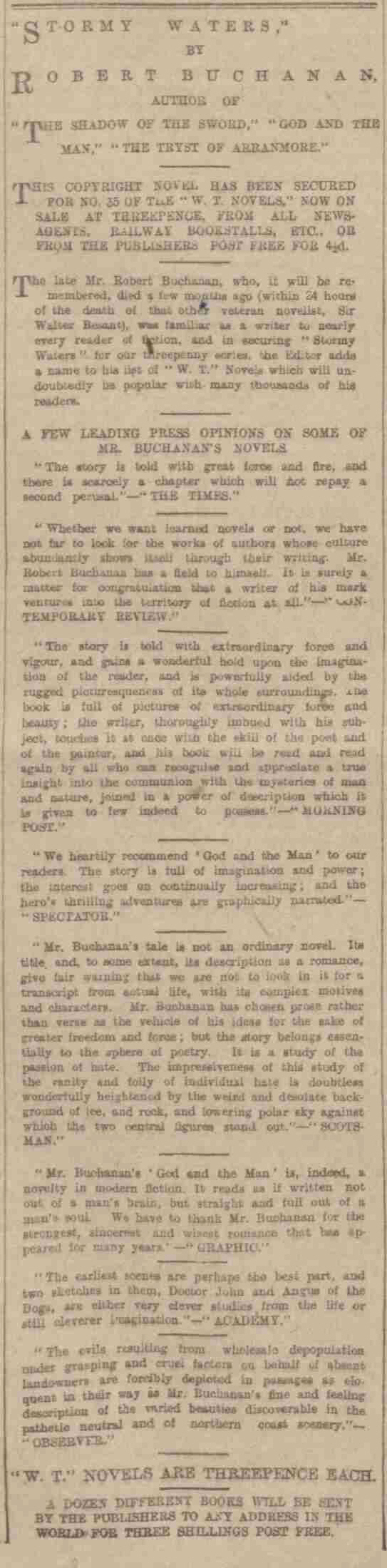
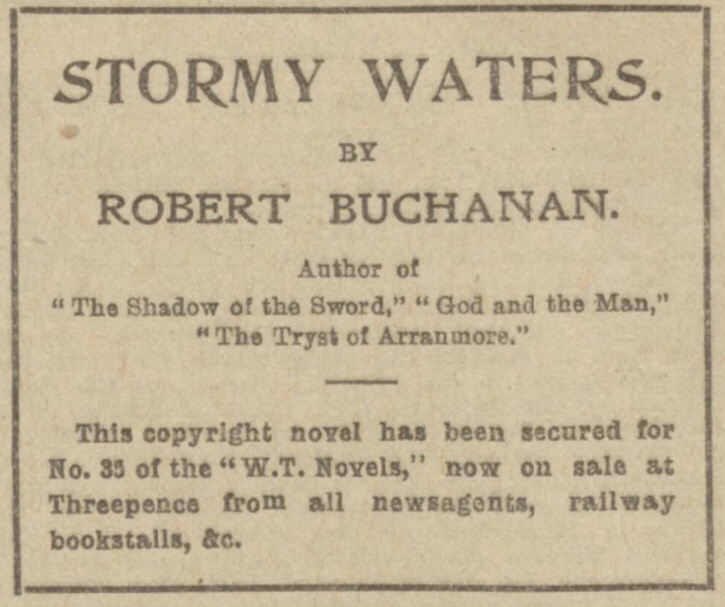
[Advert from The Sheffield Daily Telegraph (17 December, 1901 - p.4).
The Portsmouth Evening News (21 December, 1901 - p.3) The current number of the Weekly Telegraph’s threepenny novels ought to secure a quick and large sale, for it is a story by one of our best writers—the late Robert Buchanan. His vigorous impressive style at once fixes the attention of the reader, and retains it all through the book, and there is always a religious tone pervading his writings, although not obtrusively so. “Stormy Waters” is the name of Mr. Buchanan’s novel, which Sir W. C. Leng and Co. (180 and 181, Fleet-street, London) have published in this cheap form. It is intensely interesting, and we can well recommend its perusal. Back to Reviews, Bibliography or Fiction _____
[The Master of the Mine was serialised in The Illustrated London News, commencing on Saturday, 4th July, 1885. The first page of the illustrated serial is available here.]
The Athenæum (31 October, 1885 - p.567) NOVELS OF THE WEEK. ... The Master of the Mine. By Robert Buchanan. 2 vols. (Bentley & Son.) ... Mr. Robert Buchanan has assuredly added nothing to his reputation by his new novel. It is readable and fluently written, but there the matter ends. Decoct the sentimental scenes of ‘David Copperfield,’ add a dash of ‘Lorna Doone,’ and the result will give a fair notion of ‘The Master of the Mine.’ The love passages between the virtuous but calumniated hero and his high-born Madeline border dangerously on the grotesque, and Hugh Trelawney’s frequent indulgence in tears in her presence is quite out of keeping with the stern exterior he is otherwise supposed to wear. At best ‘The Master of the Mine’ is passable melodrama of the type of ‘Dark Days,’ but as a work of fiction it hardly calls for serious criticism. ___
The Morning Post (3 November, 1885 - p.2) THE MASTER OF THE MINE.* There are few writers of fiction whose style has varied so much as that of Mr. Buchanan. He has been weirdly mystic, then again he has sought with keen irony to combat the old order of spiritual influences, and, in short, a work from his pen denoted as a rule the development of a “purpose,” whatever its import. In his latest novel, “The Master of the Mine,” he tells a story full of human interest in the forcible manner that is so peculiarly his own. Without having sought to work out any especial theory or half-hidden meaning, he has produced a book which is calculated to add much to his popularity as a romance writer. His characters are few, as becomes a novelist who has any real knowledge of his craft, and each of them is in itself a finished study. Although “The Master of the Mine” is a realistic tale, Mr. Buchanan, true to the bent of his talent, has by no means sacrificed the ideal. This appears in the passionate attachment of the boy, Hugh Trelawney, for the bright vision which, in spite of Madeline Graham’s beauty, is in a great measure the outcome of his own poetical fancy. This makes him see the pretty child “walking in that land a wonder among all wonders there, with fruits and flowers over her head and brilliant insects floating round her, and luminous snakes gleaming harmless in her path, and dusky slaves waiting upon her and doing her courtesies.” No doubt there is a weird poetry in the life of the miners at St, Gurlott’s, but the figure of Madeline and the reverential yet passionate devotion of her lover, give imaginative colouring to the tale. This is in itself a drama of every day if heinous crime, the effect of which is heightened by the gloomy background of the wild Cornish coast and its semi-savage inhabitants. A novelist who places the scene of his book on these picturesque shores cannot be expected to resist the temptation of painting the aspect they present, either by a golden sunset or in a furious tempest. Mr. Buchanan’s powerful and vigorous pen has chosen the latter, and the graphic fidelity of his picture will be appreciated by all:— “There was nothing for it, but to wait and watch; for to go to the rescue in the teeth of such a storm was out of the question, even if we had been able to launch the lifeboat through the billows madly breaking on the shore. The wind still blew with extraordinary fury, though signs were not wanting that its strength was partially broken; and still, with thunderous roar, the waves came rolling in, sending up a cloud of white foam that reached to the very summit of the cliff where we were crouching; and still, trailing as it were on the waves, and belching hither and thither, like thick smoke from a furnace, the mist came driving shoreward, blotting the sea from sight.” Old Pendragon, George Redruth, and the Inspector, Johnson, are life-like portraits. The only ray of humour in this sombre story is to be found in the personage of John Rudd, “carrier and poet.” But humour does not sit naturally on Mr. Buchanan, who excels rather in depicting the stormy moods of nature and of men. * The Master of the Mine. By Robert Buchanan. London: Richard Bentley and Son. ___
The Academy (7 November, 1885 - No. 705, p.302-303) NEW NOVELS. The Master of the Mine. By Robert Buchanan. In 2 vols. (Bentley.) ... THERE is probably no contemporary man of letters more heedless of his reputation than Mr. Robert Buchanan. He takes the magic rod in his hand, and refreshing waters gush forth, and he is hailed with acclaim by many who are athirst. A little later, and his voice is heard again in waste places, the wand is once more waved, but the issue is of the scantiest and the savour brackish, if not salt. How the same author came to write The Shadow of the Sword, or God and the Man, and such a book as Stormy Waters must have puzzled even the most indiscriminate reader: the waters ran clearly enough in the former, in the latter they were “stormy” indeed, not to say turbid. Perhaps it would be too hard upon The Master of the Mine to bracket it with the last-named, but it is undoubtedly inferior to any other of Mr. Buchanan’s romances. It is certainly safe to say that if this had been the author’s first novel he would not have gained a hundredth part of the audience whom he has undoubtedly won over. Throughout it is manifest that Mr. Buchanan has had his eye on the stage, and the stage not of the Haymarket or the Court, but of the Olympic or Drury Lane. In these pages we breathe the air of melodrama, and unfortunately one is more apt to be wearied than amused by certain banalités beloved of a wide class of theatre goers. There are scenes that border on the ridiculous: for example, that where the determined hero enters the drawing-room of the manor-house, “first, however, having the grace to take off [his] hat,” and refuses to be daunted by any refinements or splendours, “even by the presence of a king”; or, again, in the would-be very dramatic scene in the next chapter, where, in true stage manner, the heroine remains in a dark corner of the drawing-room (unobserved, though her lover and her hostess have been sitting there since dinner), and comes to the front just as Hugh Trelawney, the hero, is about to strike her false lover, i.e., just as the curtain of an intermediate act falls. Mr.Buchanan shows himself to best advantage in descriptions of aspects of nature. The following account of a phenomenal herald of a great storm is vivid; and the present writer can vouch for its truth, having seen something of the kind off the coast of Brazil: “As the afternoon passed, and the dull leaden twilight increased, we saw, looking seaward,the phenomenon to which I have alluded: two suns—one round and purple, the other pink and ghostly—floating in the vapours to the west. Both were quite rayless, and they hung, as it were, some fifty yards from each other. Both seemed so near to us that one would have thought it possible to reach them with a bullet from a gun. . . . I cannot express in words the strangely depressing and vaguely alarming effect of this phenomenon on myself and all who witnessed it. Nor was the effect lessened when the dimmer of the two suns suddenly disappeared, and the other changed in a moment from purple to jet black—a jet black ball in the midst of a waste of leaden grey.” ___
John Bull (14 November, 1885 - p.13) A yet more unfavourable verdict must be passed upon The Master of the Mine, which is Mr. Robert Buchanan’s latest contribution to our English literature. The author has, as all readers are aware, a very good opinion of himself, and his poetical controversies with his critics have taken a place among the amenities of literature. We do not know if he fancies himself quite as much as a novelist as he unquestionably does as a poet, but there is a tone of self-satisfaction running through all his work which would lead us to that opinion. There is, without doubt, a good deal of vigour and energy about his literary style, but it is rather the vigour of the theatrical scene-painter than of an artist who aspires to a higher rank. The power shown in his book is very lacking in refinement, and there is more of the chromolithograph than of the water-colour or the oil-painting in his descriptive passages. We cannot say that there is anything very new in his book, except perhaps the position which Madeline and Hugh Trelawny occupy in relation to each other. This is certainly novel, but not very probable, and not very attractive. The other ingredients of the book, such as the leading astray of poor Annie, the unfounded suspicion of murder to which Hugh himself is subjected, and the flooding of the mine, have been already used again and again, and there is nothing in Mr. Buchanan’s treatment of them to make up for their want of novelty. We must think that the novel will be a disappointment even to the author’s admirers, and will confirm those who are not among his admirers in their estimate of his talents, far removed as that estimate may be from that entertained by Mr. Buchanan himself. It should have been stated on the title-page that The Master of the Mine is republished from the Illustrated London News, in which it appeared as a feuilleton, with the additional attraction (?) of some highly sensational woodcuts quite in keeping with its literary style. ___
The Saturday Review (5 December, 1885 - p.751) It may at least be said of The Master of the Mine that it does not display any of the remarkable faults of taste or anything of the morbid and offensive attitude towards morals and religion which have distinguished more than one of Mr. Robert Buchanan’s later novels. In respect, too, of extravagance of incident and language it is a long step backward in the direction of sobriety and sense from the point reached in Stormy Waters. But it must remain as surprising as ever that a man of Mr. Buchanan’s undoubted literary ability should, year after year, and in the most widely different kinds of literature, be content to produce such crude and faulty work. The Master of the Mine would be a fair, and no more than a fair, melodramatic romance for a young beginner in romantic melodrama. A Cornish boy, Hugh Trelawney, is early deprived of education and chance in the world by the death of his father. In his comparatively fortunate earlier days he has made the acquaintance of a beautiful little creole, Madeline Graham. They part, and he is reduced to actual mining in his native county and at the home of his nearest relations, who are poor folk. He rises to be overseer, but makes himself unpopular with the young owner of the mine by faithfully representing the dangerous condition of its under-sea workings. The situation is complicated by the reappearance of Madeline Graham on the scene as a wealthy heiress courted by the young mine-owner, and by Hugh’s discovery of underhand wooing by the same person of his own cousin Annie. How Hugh is suspected of and tried for the murder of the sycophant who has succeeded him in the overseership Mr. Buchanan may fairly claim that his readers shall be left to find out for themselves, and so they shall be. Nor is it any more necessary to hint at the dénouement, which indeed can be easily guessed. It is preceded by a climax scene when the sea breaks into the submarine workings of the mine, and Hugh at great risk plays the part of rescuer. This scene naturally shows traces of Mr. Buchanan’s considerable faculty of dealing with such things, but the overdrawing and the confusion which were noticeable even in The Shadow of the Sword and in God and the Man, are much more noticeable here, and mar the effect of the picture considerably. It is curious that the admirers of the late M. Gustave Doré, who is responsible for so much of this kind of thing in literature as well as in art, should have omitted to notice that their master, very far from impeccable, does not often confine himself to merely pitching a pot of colour at the canvas. They do. ___
Daily News (26 December, 1885 - p.3) Mr. Robert Buchanan’s story “The Master of the Mine” (2 vols., Richard Bentley and Son) is one of incident, boldly told, without the poetic or picturesque character we used to expect from the author, but also without the unpleasant features which have spoiled some of his later productions. Hugh Trelawney is a youth whose personality is uninteresting, but whose experience as an overseer of a Cornish mine has some exciting elements. The mine is one of those, now chiefly disused, which run a distance under the sea, and although there is not much detail of the submarine life one or two dangerous adventures are simply described. Madeline Graham is very much of a lay figure, introduced to support the needful amount of sentimental drapery; and Annie Pendragon, the Cornish village maiden, has also a good deal of the wooden block about her. But the tale is nevertheless readable. ___
The Illustrated London News (2 January, 1886 - p.27) Regular readers of this Journal will not need to be told what sort of entertainment they may expect to obtain from The Master of the Mine: by Robert Buchanan (Richard Bentley and Son); but irregular readers, who take up periodicals at haphazard, may be glad to have their attention turned to two volumes containing a story which, if it cannot be described as one of the author’s very best, is in many respects a notable specimen of the novelist’s art, full of vigour, picturesque, dramatic, and—good faith—melodramatic. That it should have been written in the autobiographical form is somewhat unfortunate; for it goes against the grain to listen, as it were, to a hero telling of his own heroic deeds and singing his own praises—at any rate in these modern days; in the days of Homer—when, however, the novel was not known—it was, no doubt, “the cheese” with heroes to proclaim their own virtues and exploits, but even then it was chiefly when hero engaged with hero in a game of brag, that they might lash themselves into condition for a personal encounter; they did not intend their observations for “the gallery.” Madeline Graham is a most charming creation, and Annie Pendragon’s father and mother, especially the former, are admirable portraits; but Annie herself, though she enlists sympathy, is comparatively commonplace, and her misfortune is of too ordinary a kind, and attended by too ordinary circumstances, for so inventive a genius and so original a thinker as the author. ___
The Pall Mall Gazette (7 January, 1886 - p.5) TWO NOVELS.* “THE MASTER OF THE MINE.” It is not pleasant to picture the effort which the writing of “The Master of the Mine” must have cost Mr. Robert Buchanan. To have written a novel without one brilliant passage in it, with no eloquent outbursts, with no penitential self- communings half à la Gauthier and half à la Kempis, with no poetry and no passion—this must indeed have sorely taxed the author of “God and the Man.” “The Master of the Mine” is an eminently readable work—no more and no less. If there is any reason why we should take it up in preference to the thousand and one readable romances which have this year come round in Mr. Mudie’s own good time to country readers, we should like Mr. Buchanan to disclose it. There is not much plot in the work, nor is there what makes up for its absence—original style, harmonious representation of character, or poetic views of life. It is full of half-finished sketches, not quite at first hand. There is a carrier, for instance, who faintly reminds us of Barkis, and yet tails off as quite a commonplace “circulating medium,” losing even his Cornish accent. There is an old miner—perhaps the best-drawn character in the book—who after giving out a distant flavour of Mr. Peggotty, and developing some characteristics of his own, becomes mimetic only. Here and there a suggestion of the “Vicar of Wakefield” seems to stray across Mr. Buchanan’s pages, and strays loosely back again. It need not be said that so accomplished a story-teller makes good use of such materials as he cares to use, and that his tale runs on a tolerably continuous level of interest. There is plenty of good—though not brilliant—description in it, and the account of the flooding of the mine and the rescue of young Redruth by the man whose daughter he has ruined, and who has already slain her supposed betrayer, is a dramatic piece of writing, and should work out as another great Sluice Scene. All this, however, we expect of lesser lights than Mr. Buchanan, and we want something more from him. There are some points which are distinctly unworthy of his reputation—such as a caricature of an American which would move the gorge even of a Drury Lane pittite. In a word, “The Master of the Mine” is in Mr. Buchanan’s “later manner,” for Mr. Buchanan, like Shakspeare, has two manners and “two loves.” The better spirit is a man right fair, And which is the better and which the worser spirit we leave Mr. Buchanan’s admirers to guess. * “The Master of the Mine.” By Robert Buchanan. (Richard Bentley and Son. 1885.) ___
The Graphic (16 January, 1886 - Issue 842) Of a very different order of interest is Robert Buchanan’s “The Master of the Mine” (2 vols.: Bentley and Son). Full of romantic and even sensational interest, it supplies all the materials for theatrical representation. As a story, it is by no means to be classed among the greater works of its bewilderingly-unequal writer; but neither does it take the lowest place, and its weaknesses are obviously due to careless hurry, and not to any lack of strength in its motive. It would be only too easy to make a long catalogue of inexcusable blemishes, both in its construction and in its treatment of the English tongue; but no doubt a master of the art of fiction like Mr. Buchanan is perfectly aware of the natural effects of hurry, and the novel evidently appeals to a public that is anything but critical. To that widest of all literary circles we recommend it, in the assurance that they will be in no wise disappointed with its wealth of incident and the strongly- labelled characters of whose adventures Cornwall has a traditional monopoly. ___
Overland monthly and Out West magazine (Vol. 7, Issue 39, March 1886 - p. 320) RECENT FICTION. WE spoke last month of the generally slim character of the English pamphlet reprints among our collection of new novels, and mentioned B. L. Farjeon’s as the only one of any value whatever. We must add to this now The Master of the Mine, which, being by Robert Buchanan, can hardly fail to be a more or less pleasant story, and possessed of character and intelligence. It has a fine young fellow for a hero, and fine young women for heroines, and some excellent Cornish folk. The chief incident in the plot is the old and ugly one of the “gentleman” scoundrel and the cottage girl, which is not to American ideas appropriate for use in any but a seriously tragic spirit—as in “Adam Bede,” for instance. It is useless to expect this, however, of the English light novel, in which it seems to be indispensable to about one half of the limited number of plots that constitute their stock in trade. Mr. Buchanan has, in fact, so far presumed upon his ability to make all that he writes about reasonably entertaining, as to use stock incidents very freely, including the fishing of the wicked rival out of a flooded mine by the good rival at the extremest peril of his life, in the most old-fashioned manner. Back to Reviews, Bibliography or Fiction _____
The Bristol Mercury (13 October 1886 - p.6) Arrowsmith’s Bristol Library—That Winter Night, by Robert Buchanan. In this volume Mr Buchanan has woven a pretty little story of the Franco-German war, in which love asserts his power even over the hate of contending races, and binds together the hearts of a young German officer and a French girl who nurses him. Of course this theme cannot be worked out without our seeing something of the misery and fright occasioned by the military invasion of the quiet village of Normandy, and a good deal of trouble and misunderstanding between the young lovers. The story is said by the author to be founded upon actual occurrence, which has formed the subject of a poem by Coppé. Mr Buchanan has certainly treated it very well, and makes his characters think and speak in a thoroughly French fashion, one or two of the remarks indeed reading like literal translations. ___
The Academy (23 October, 1886 - No. 755, p.274) Not the least of the attractions of Mr. Buchanan’s little romance—for it is a romance—of That Winter Night, is that it does not recall much of its author’s recent work. The scene is laid in the same country as The Shadow of the Sword; but it is, happily, free from the literary “storm and stress” which marred that, in many respects, powerful work. But since writing The Shadow of the Sword Mr. Buchanan has tried his hand as a moralist and realist, and published The New Abelard and Foxglove Manor. His new story resembles these books in no respect. It is the account of an incident in the second stage of the Franco-German War, an incident which, it seems, has a basis of fact, and has already been turned to account by M. François Coppée. It is told in Mr. Buchanan’s best and directest style. Blanche de Gavrolles, the daughter of a fine old Chevalier, who has offered himself for service in the improvised Gambettist war à outrance against German invasion, and who finds in her simple faith and Norman blood an adequate protection and consolation, is saved by a Uhlan officer from insult, if not death, at the hands of a rude colleague. When he is severely wounded in the guerilla warfare of the time, she nurses him back to life and health. She even performs this service a second time, Hartmann (that is the name of her Uhlan) being shot by Houzel—a plebeian admirer of Blanche, half lover, half watch-dog. By this time, of course, Hartmann and Blanche are lovers; and the crisis of the story is reached when he confesses to having cut down a French officer in a manner resembling murder rather than fair fight—an officer whom Blanche has no difficulty in recognising as her father. The story should have stopped here, and as a tragedy; but Mr. Buchanan has felt constrained to arrange a good ending, and this he does in a rather commonplace fashion. All the characters in That Winter’s Night—there are not many—are carefully drawn. The Chevalier de Gavrolles is, perhaps, too like the George Washington of childhood’s fancy, but his character as a sketch of moral excellence is thoroughly sustained. There is a capitally drawn priest in the story; and Houzel, who hates all Germans with the hatred of one of Gambetta’s “wolves,” is a powerful sketch. ___
The Graphic (13 November, 1886) Mr. Robert Buchanan’s principal literary fault is—apparently at least—that he sets too little store by his own reputation. “That Winter Night; or, Love’s Victory” (Bristol: Arrowsmith and Co.), seems due to the supposed necessity on the part of every novelist, with or without a name, to bring out at least one piece of rubbish for a shilling. Some, of course, are very good hands at rubbish; others very bad ones. And Mr. Buchanan yields to nobody in incapacity for writing rubbish—when he tries he is foredoomed to fail. The strange part of it is that he should be so perversely fond of trying. These episodes of the Franco-German War might have been turned out by almost any unskilled hand in the market; and therefore ought not to bear the name of Robert Buchanan. ___
The Yorkshire Post (1 December, 1886 - p.3) Mr. Robert Buchanan is most wondrously mild in “That Winter’s Night” (J. W. Arrowsmith), which can hardly be called “A shilling dreadful” without insulting the shade of Hugh Conway. Instead of mystery and murder, we have a simple incident or two in the Franco-German War worked up with an equally simple love story, and just a spice of jealousy to season the whole. The result is a rather tame but harmless little book. ___
The Oban Times (8 January, 1887 - p.2) THAT WINTER NIGHT; OR LOVE’S VICTORY. By Robert Buchanan, Bristol: Arrowsmith. The groundwork of this story is founded upon an incident that occurred in Normandy during the time of the Franco-German war. The vanguard of the German army had crossed the frontier, and France was stirred to its very depths. Brave hearts were flocking from all parts to swell the army of defence. The Chevalier de Gavrolles—a Norman baron, and the head of a sleepy little community on the Norman coast—felt the time had arrived for action. Leaving Blanche, his only daughter and the heroine of the story, to the care of the curé and an old housekeeper, the Chevalier sets out for the front. Meanwhile, struggling bands of the enemy overspread the country, and entered Normandy. Blanche, whose life becomes endangered, is saved by the intervention of a young officer of Uhlans. This young German soldier is wounded in a skirmish, and is brought to the chateau to be nursed. While under the care of its young mistress, the wounded officer, in a fit of delirium, confesses to have cut down a French officer. The girl, horrified, finds the victim to be her own father, and the man whom she has so carefully tended, and to whom she has secretly given her heart, is the slayer. Torn with conflicting emotions, poor Blanche becomes sick nigh unto death. However, all ends pleasantly enough, as all novels should do. The Chevalier did not die, and stoutly declared the blow he received to have been given in fair fight. When peace once more reigned in France, a happy little party assembled within the old Norman chateau:— The Chevalier had his glass charged, and was in the act of giving a toast: Such, in brief, is the outline of a pleasant and very readable story. ___
The Pall Mall Gazette (2 May, 1887 - p.11) A BATCH OF NOVELS.* . . . As for “A Marked Man,” “That Winter Night,” and “Driven Home,” the first shows some power of description and treatment, but is sadly incomplete, the second is quite unworthy of any man of letters, and the third is absolutely silly. We sincerely hope that a few more novels like these will be published, as the public will then find out that a bad book is very dear at a shilling. * “A Marked Man.” By Faucet Streets. (Sunderland: Mawson, Browne, and Browne; London: Hamilton and Adams.) [Note: Back to Reviews, Bibliography or Fiction _____
Book Reviews - Novels continued The Heir of Linne (1888) to The Charlatan (1895)
|
|
|
|
|
|
|