Home
Biography
Bibliography

ROBERT WILLIAMS BUCHANAN (1841-1901)

Poetry
Novels
Plays

Essays
Letters
Miscellanea

Harriett Jay
Critical Writings about Buchanan
The Fleshly School Controversy

Links
Site Diary
Site Search

THE EARTHQUAKE.

Picture
Picture

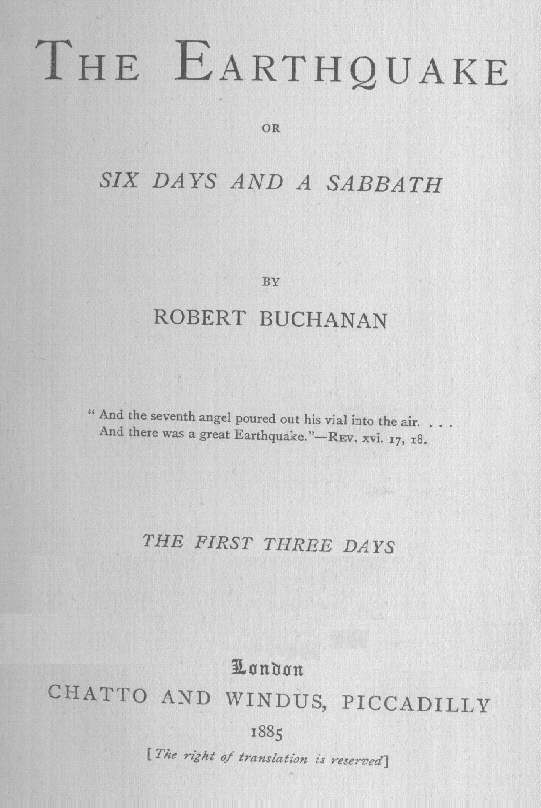
THE  EARTHQUAKE

OR


SIX DAYS AND A SABBATH


BY

ROBERT BUCHANAN


          “And the seventh angel poured out his vial into the air. . . .
           And there was a great Earthquake.”—Rev. xvi. 17, 18.


THE FIRST THREE DAYS


London

CHATTO AND WINDUS, PICCADILLY

1885

[The right of translation is reserved]


_____


Ballantyne Press
BALLANTYNE, HANSON AND CO.
EDINBURGH AND LONDON


_____


PREFATORY NOTE.

          The following work has been in preparation for years.
          Curiously enough, since the poem was planned and
          practically completed, an Earthquake has been actually
          felt on the south coast of England, and London itself
          has been slightly threatened.
               The present volume, containing the first three days
          or sections, is practically complete in itself. The second
          and concluding volume is ready, and will be published
          after a short interval.

                                                    ROBERT BUCHANAN.

               LONDON, November 13, 1885.


_____


CONTENTS.


PAGE

DEDICATION—“AD MATREM”          .          .          .          .          .          .          .          .                1

PRELUDE—THE EXODUS OF LADY BARBARA                .          .          .          .          .               2

THE FIRST DAY:               .         .          .          .          .          .          .          .          .          .             35

          JULIA CYTHEREA: A LEGEND OF THE RENAISSANCE               .          .          .             41

          PAN AT HAMPTON COURT      .          .          .          .          .          .          .          .             87

          “RIZPAH-MADONNA”                .          .          .          .          .          .          .          .           104

THE SECOND DAY:                               .          .          .          .          .          .          .          .           115

          SERAPION                                    .          .          .          .          .          .          .          .           128

          RAMON MONAT                         .          .          .          .          .          .          .          .           144

          IN A FASHIONABLE CHURCH             .          .          .          .          .          .          .           152

          “STORM IN THE NIGHT”                       .          .          .          .          .          .          .           158

THE THIRD DAY:                                              .          .          .          .          .          .          .           163

          THE VOYAGE OF MAGELLAN             .          .          .          .          .          .          .           170

          SOLILOQUY OF THE GRAND ÊTRE    .          .          .          .          .          .          .           201

          “O MARINERS”                                       .          .          .          .          .          .          .           226

INTERLUDE—TO H——                                  .          .          .          .          .          .          .           229


[Notes:

The second volume of ‘The Earthquake’ which Buchanan refers to in his prefatory note, was never published, presumably due to poor sales of this first volume. The only reference to ‘The Earthquake’ in Harriett Jay’s biography is the following sentence from Chapter 23:
“Since his wife’s death, in 1881, he had published two volumes of poetry—“Ballads of Life, Love, and Humour” (1882) and “The Earthquake” (1885), and both had met with scant recognition.”

The actual earthquake which Buchanan mentions in his prefatory note occurred in Essex on 22nd April 1884. The following description is taken from the Geology of Essex site:

“The most destructive earthquake ever recorded in Britain occurred in Essex on the morning of 22 April 1884 and strongly shook most of the county. It is known as the Colchester Earthquake because the greatest damage was caused to Colchester, Wivenhoe and the towns and villages nearby. The tremor was felt over much of southern England and parts of France and Belgium, and its magnitude has been estimated at 5.2 on the Richter scale.The number of casualties is difficult to estimate, but it is doubtful whether any deaths or serious injuries can be attributed to the earthquake. There was, however, considerable damage to over 1,200 buildings in Essex. The earthquake was probably due to movement along a fault in the ancient Palaeozoic rocks under Essex, which would have affected the overlying cover of Cretaceous and Tertiary strata.”

The Foxearth and District Local History Society has a more detailed description of the event including extracts from a report in the local newspaper, and the Colchester Archaeological Trust site has an article by Philip Crummy entitled ‘Virley Church: a survivor of the Essex earthquake of 1884’ which includes the following reference to the earthquake’s effects elsewhere:

“In London, as in many places closer to the epicentre, the shock was fairly severe. The Houses of Parliament were violently shaken and a three-foot wave engulfed some boats in the Thames. Throughout much of the south-east of England, and in places as far away as Portsmouth, Birmingham, and Leicester, houses shook, windows rattled, furniture and crockery moved, church bells rang and clocks stopped. Even where the earthquake was too weak to cause any serious damage, the vibrations left many people feeling frightened and nauseous.”

An explanation of the earthquake appeared in ‘The Manufacturer and Builder’  magazine of June 1884 and it is also mentioned in Charles Fort’s ‘New Lands’. There is also an essay,  The Wivenhoe Earthquake, by Ruth Baker, which discusses its astrological implications.]

Picture

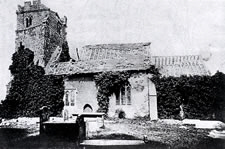
The ancient parish church at Langenhoe after the 1884 earthquake
Photo: Essex County Libraries


[Reviews of ‘The Earthquake’ from The Scotsman and The Graphic.]


Home
Biography
Bibliography

Poetry
Novels
Plays

Essays
Letters
Miscellanea

Harriett Jay
Critical Writings about Buchanan
The Fleshly School Controversy

Links
Site Diary
Site Search