Home
Biography
Bibliography

ROBERT WILLIAMS BUCHANAN (1841-1901)

Poetry
Novels
Plays

Essays
Letters
Miscellanea

Harriett Jay
Critical Writings about Buchanan
The Fleshly School Controversy

Links
Site Diary
Site Search

{London Poems 1866}

149

VIII.

NELL.

               She gazes not at her who hears,
                   But, while the gathering darkness cries,
              Stares at the vacancy through tears,
                   That burn upon her glistening eyes,
              Yet do not fall. Her hair falls free                                                                         
              [i:5]
                   Around a face grown deathly thin;
              Her elbow rests upon her knee,
                   And in her palms she props her chin;                                                           
              [i:8]
              Her voice sounds hollow on the air                                                                     [i:9]
                   And often, ere her tale is told,
              A groan disturbs her blank despair,
                   And leaves a sense of bitter cold.


            151

NELL.


I.

            YOU’RE a kind woman, Nan! ay, kind and true!                                [1:1]
                 God will be good to faithful folk like you!
            The neighbours all look black, and snap me short—                             
            [1:3]
            Well, I shall soon be gone from Camden Court.
            You knew my Ned?
                 A better, kinder lad never drew breath—
            We loved each other true, though never wed
                 In church, like some who took him to his death:
            A lad as gentle as a lamb, but lost
                 His senses when he took a drop too much—
            Drink did it all—drink made him mad when cross’d—
                 He was a poor man, and they’re hard on such.
            So kind! so true! that life should come to this!                                     
            [1:13]
                 Gentle and good!—the very week before                                        152
            The fit came on him, and he went amiss,
            He brought me home, and gave me, with a kiss,
                 That muslin gown as hangs behind the door.


II.

            O Nan! that night! that night!
                 When I was sitting in this very chair,
            Watching and waiting in the candle-light,
                 And heard his foot come creaking up the stair,
            And turn’d, and saw him standing yonder, white                                  
            [2:5]
                 And wild, with staring eyes and rumpled hair!
            And when I caught his arm and call’d, in fright,
                 He push’d me, swore, and pass’d                                                  
            [2:8]
                 Back to the door, and lock’d and barr’d it fast!                               [2:9]
            Then dropp’d down heavy as a lump of lead,                                      [2:10]
                 Holding his brow, shaking, and growing whiter,
                 And—Nan!—just then the candle-light grew brighter,                    
            [2:12]
            And I could see the hands that held his head,
            All red! all red!                                                                                  
            [2:14]
            What could I do but scream? He groan’d to hear,
                 Jump’d to his feet, and gripp’d me by the wrist;
                 “Be still, or I shall kill thee, Nell!” he hiss’d.
            And I was still for fear.                                                                 
            153 [2:18]
            “They’re after me—I’ve knifed a man!” he said.
            “Be still!—the drink—drink did it—he is dead!
            And as he said the word, the wind went by
            With a whistle and cry—
            The room swam round—the babe unborn seem’d to scream out, and die!


III.

            Then we grew still, so still. I couldn’t weep—                                       [3:1]
                 All I could do was cling to him and hark—                                      [3:2]
            And Ned was cold, cold, cold, as if asleep,
            But breathing hard and deep;                                                               
            [3:4]
                 The candle flicker’d out—the room grew dark—
            And—Nan!—although my heart was true and tried,—
                 When all grew cold and dim,
            I shudder’d—not for fear of them outside,
                 But just afraid to be alone with him:                                                
            [3:9]
            And he was hard, he was—the wind it cried—                                    [3:10]
            A foot went hollow down the court and died—                                   [3:11]
            What could I do but clasp his knees and cling?
                 And call his name beneath my breath in pain?
            Until he raised his head a-listening,                                                     
            [3:14]
                 And gave a groan, and hid his face again;
            “Ned! Ned!” I whisper’d—and he moan’d and shook—                     
            154
            But did not heed or look!
            “Ned! Ned! speak, lad! tell me it is not true!”
                 At that he raised his head and look’d so wild;
            Then, with a stare that froze my blood, he threw
                 His arms around me, sobbing like a child,                                      
            [3:21]
            And held me close—and not a word was spoken—
                 While I clung tighter to his heart and press’d him—
            And did not fear him, though my heart was broken—
                 But kiss’d his poor stain’d hands, and cried, and bless’d him!


IV.

            Then, Nan, the dreadful daylight, coming cold
                 With sound o’ falling rain,—
            When I could see his face, and it look’d old,
                 Like the pinch’d face of one as dies in pain;                                    
            [4:4]
            Well, though we heard folk stirring in the sun,
            We never thought to hide away or run,
            Until we heard those voices in the street,
            That hurrying of feet.
            And Ned leap’d up, and knew that they had come.
            “Run, Ned!” I cried, but he was deaf and dumb!
            “Hide, Ned!” I scream’d, and held him—“hide thee, man!”                  
            155
            He stared with bloodshot eyes, and hearken’d, Nan!
            And all the rest is like a dream—the sound
                 Of knocking at the door—
            A rush of men—a struggle on the ground—
                 A mist—a tramp—a roar;
            For when I got my senses back again,
                 The room was empty,—and my head went round!
            The neighbours talk’d and stirr’d about the lane,
                 And Seven Dials made a moaning sound;
            And as I listen’d, lass, it seem’d to me
            Just like the murmur of a great dark sea,                                             
            [4:22]
                 And Ned a-lying somewhere, stiff and drown’d!


V.

            God help him? God will help him! Ay, no fear!
                 It was the drink, not Ned—he meant no wrong;
            So kind! so good!—and I am useless here,
                 Now he is lost as loved me true and long.                                       
            [5:4]
            Why, just before the last of it, we parted,
            And Ned was calm, though I was broken-hearted;
            And ah, my heart was broke! and ah, I cried
            And kiss’d him,—till they took me from his side;
            And though he died that way, (God bless him!) Ned                          
            156
                 Went through it bravely, calm as any there:
            They’ve wrought their fill of spite upon his head,
                 And—there’s the hat and clothes he used to wear!


VI.

            . . . That night before he died,
            I didn’t cry—my heart was hard and dried;
            But when the clocks went “one,” I took my shawl
                 To cover up my face, and stole away,
            And walk’d along the moonlight streets, where all                                
            [6:5]
                 Look’d cold and still and gray,—
            Only the lamps o’ London here and there
                 Scatter’d a dismal gleaming;
            And on I went, and stood in Leicester Square,
                 Just like a woman dreaming:                                                          
            [6:10]
            But just as “three” was sounded close at hand,
                 I started and turn’d east, before I knew,—
            Then down Saint Martin’s Lane, along the Strand,
                 And through the toll-gate, on to Waterloo.
            How I remember all I saw, although
                 ’Twas only like a dream!—
            The long still lines o’ lights, the chilly gleam
                 Of moonshine on the deep black stream below;
            While far, far, far away, along the sky                                                  
            157
                 Streaks soft as silver ran,
            And the pale Moon look’d paler up on high,
                 And little sounds in far-off streets began!
            Well, while I stood, and waited, and look’d down,
            And thought how sweet ’twould be to drop and drown,
            Some men and lads went by,
                 And I turn’d round, and gazed, and watch’d ’em go,                     
            [6:26]
            Then felt that they were going to see him die,
                 And drew my shawl more tight, and follow’d slow.
            How clear I feel it still!
                 The streets grew light, but rain began to fall;
            I stopp’d and had some coffee at a stall,
                 Because I felt so chill;
            A cock crew somewhere, and it seem’d a call
                 To wake the folk who kill!
            The man who sold the coffee stared at me!
            I must have been a sorry sight to see!
                 More people pass’d—a country cart with hay
            Stopp’d close beside the stall,—and two or three
                 Talk’d about it! I moan’d, and crept away!

            158

VII.

            Ay, nearer, nearer to the dreadful place,
                 All in the falling rain,
            I went, and kept my shawl upon my face,
                 And felt no grief or pain—
            Only the wet that soak’d me through and through
                 Seem’d cold and sweet and pleasant to the touch—
            It made the streets more drear and silent, too,
                 And kept away the light I fear’d so much.
            Slow, slow the wet streets fill’d, and all were going,                             
            [7:9]
                 Laughing and chatting, the same way,
            And grayer, sadder, lighter, it was growing,
                 Though still the rain fell fast and darken’d day!
            Nan!—every pulse was burning—I could feel
            My heart was made o’ steel—
            As, crossing Ludgate Hill, where many stirr’d,                                    
            [7:15]
                 I saw Saint Paul’s great clock and heard it chime,                           [7:16]
            And hadn’t power to count the strokes I heard,
                 But strain’d my eyes and saw it was not time;                                
            [7:18]
            Ah! then I felt I dared not creep more near,
                 But went into a lane off Ludgate Hill,
            And sitting on a doorstep, I could hear
                 The people gathering still!
            And still the rain was falling, falling,                                                      
            159
                 And deadening the hum I heard from there;
            And wet and stiff, I heard the people calling,
                 And watch’d the rain-drops glistening down my hair,
            My elbows on my knees, my fingers dead,—
            My shawl thrown off, now none could see,—my head
                 Dripping and wild and bare.
            I heard the murmur of a crowd of men,                                              
            [7:30]
                 And next, a hammering sound I knew full well,                               [7:31]
            For something gripp’d me round the heart!—and then
                 There came the solemn tolling of a bell!
            O Lord! O Lord! how could I sit close by                                          
            [7:34]
            And neither scream nor cry?
            As if I had been stone, all hard and cold,
                 But listening, listening, listening, still and dumb,                               
            [7:37]
            While the folk murmur’d, and the death-bell toll’d,
                 And the day brighten’d, and his time had come. . .
            . . . Till—Nan!—all else was silent, but the knell
            Of the slow bell!
            And I could only wait, and wait, and wait,
                 And what I waited for I couldn’t tell,—
            At last there came a groaning deep and great—
            Saint Paul’s struck “eight”—
                 I scream’d, and seem’d to turn to fire, and fell!

            160

VIII.

            God bless him, live or dead!
                 He never meant no wrong, was kind and true—                             
            [8:2]
            They’ve wrought their fill of spite upon his head—
                 Why didn’t they be kind, and take me too?
            And there’s the dear old things he used to wear,
            And here’s a lock o’ hair!
            And they’re more precious far than gold galore,                                   
            [8:7]
                 Than all the wealth and gold in London town!
            He’ll never wear the hat and clothes no more,
                 And I shall never wear the muslin gown!
            And Ned! my Ned!
                 Is fast asleep, and cannot hear me call;—
            God bless you, Nan, for all you’ve done and said,
                 But don’t mind me! My heart is broke—that’s all!                         
            [8:14]


[Notes:
Alterations in the 1884 edition of ‘The Poetical Works of Robert Buchanan’:
Introductory verse, l. 5: Yet do not flow. Her hair falls free
Intro v., l. 8: And in her palms she props her chin.
Remaining lines of intoductory verse, 9-12, omitted.
The following is added as Verse 1:

            See, Nan! his little face looks pinch’d with fright,
            His little hands are clench’d together tight!
            Born dead, that’s comfort! quiet too; when one
                 Thinks of what kill’d him! Kiss him, Nan, for me.
            Thank God, he never look’d upon the sun
                 That saw his father hang’d on gallows-tree.
            O boy, my boy! you’re better dead and sleeping,
            Kill’d by poor mother’s fear, and shame, and weeping:
            She never loved another living man,
                 But held to father all thro’ right and wrong—
            Ah, yes! I never turn’d against him, Nan,
                 I stuck by him that stuck by me so long!

v. 1, l. 3-4 omitted.
v. 1, l. 13-17 omitted and verse continues without break.
v. 2, l. 5: And turn’d, and saw him standing yonder, white
v. 2, l. 8: He push’d me, swore, and to the door he pass’d
v. 2, l. 9: To lock and bar it fast!
v. 2, l. 10: Then down he drops just like a lump of lead,
v. 2, l. 12: And—Nan!—just then the light seem’d growing brighter,
v. 2, l. 14: All red! all bloody red!
v. 2, l. 18: And I was still, for fear.
v. 3, l. 1: Then we grew still, dead still. I couldn’t weep—
v. 3, l. 2: All I could do was cling to Ned and heark—
v. 3, l. 4: But breathing hard and deep.
v. 3, l. 9: But just afraid to be alone with him.
v. 3, l. 10: For winds were wailing—the wild rain cried,—
v. 3, l. 11: Folk’s footsteps sounded down the court and died—
v. 3, l. 14: Until he threw his head up, listening,
v. 3, l. 21: His arms around me, crying like a child,
v. 4, l. 4: Like the pinch’d face of one that dies in pain;
v. 4, l. 22: Just like the murmur of the great dark Sea,
v. 5, l. 4: Now he is lost that loved me true and long.
v. 6, l. 5: And walk’d along the silent streets, where all
v. 6, l. 10: Ay, like a woman dreaming:
v. 6, l. 26: And turning round, I gazed, and watch’d ’em go,
v. 7, l. 9: Slow, slow the wet streets fill’d, and all seem’d going,
v. 7, l. 15: As crossing Ludgate Hill, I saw, all blurr’d,
v. 7, l. 16: Saint Paul’s great clock and heard it slowly chime,
v. 7, l. 18: But strain’d my eyes and saw it wasn’t time.
v. 7, l. 30: I heard the crying of a crowd of men,
v. 7, l. 31: And next, a hollow sound I knew full well,
v. 7, l. 34: O God! O God! how could I sit close by,
v. 7, l. 37: I listen’d, listen’d, listen’d, still and dumb,
v. 8, l. 2: Oh, he was kind and true—
v. 8, l. 7-10 omitted.
v. 8, l. 14: But don’t mind me! My heart is broke, that’s all!]


161

IX.

ATTORNEY SNEAK

              Sharp like a tyrant, timid like a slave,
                   A little man, with yellow, bloodless cheek;
              A snappish mingling of the fool and knave,
                   Resulting in the hybrid compound—Sneak.


              163

              ATTORNEY SNEAK.

            PUT execution in on Mrs. Hart—
            If people will be careless, let them smart:
            Oh, hang her children! just the common cry!
            Am I to feed her family? Not I.
            I’m tender-hearted, but I dare be just,—
            I never go beyond the law, I trust;
            I’ve work’d my way, plotted and starved and plann’d,
            Commenced without a penny in my hand,
            And never howl’d for help, or dealt in sham—
            No! I’m a man of principle, I am.

                 What’s that you say? Oh, father has been here?
            Of course, you sent him packing? Dear, oh, dear!
            When one has work’d his weary way, like me,                                     
            164
            To comfort and respectability,
            Can pay his bills, and save a pound or two,
            And say his prayers on Sunday in a pew,
            Can look the laws of England in the face,
            ’Tis hard, ’tis hard, ’tis shame, and ’tis disgrace,
            That one’s own father—old and worn and gray—
            Should be the only hindrance in his way.
            Swore, did he? Very pretty! Threaten’d? Oh!
            Demanded money? You, of course, said “No?”
            ’Tis hard—my life will never be secure—
            He’ll be my ruin some day, I am sure.

            I don’t deny my origin was low—
            All the more credit to myself, you know:
            Mother (I never saw her) was a tramp,
            Father half tramp, half pedlar, and whole scamp,
            Who travell’d over England with a pack,
            And carried me about upon his back,
            Trudging from door to door, to feasts and fairs,
            Cheating the silly women with his wares,
            Stealing the farmers’ ducks and hens for food,
            Pilfering odds and ends where’er he could,
            And resting in a city now and then,                                                       
            165
            Till it became too hot,—and off again.
            Beat me? No, he knew better. I confess
            He used me with a sort of tenderness;
            But would have warp’d my nature into sin,
            Had I been weak, for lack of discipline.
            Why, even now, I shudder to the soul,
            To think how oft I ate the food he stole,
            And how I wore upon my back the things
            He won by cheats and lawless bargainings.
            Oh, he had feelings, that I freely say;
            But, without principle, what good are they?
            He swindled and he stole on every hand,
            And I was far too young to reprimand;
            And, for the rest, why, he was circumspect,
            And might have been committed for neglect.

                 Ah! how I managed, under stars so ill,
            To thrive at all, to me is mystery still.
            In spite of father, though, I got along,
            And early learn’d to judge the right from wrong;
            At roadsides, when we stopp’d to rest and feed,
            He gave me lessons how to write and read,
            I got a snack of schooling here and there,                                            
            166
            And learn’d to sum by instinct, as it were.
            Then, latterly, when I was seventeen,
            All sorts of evil I had heard and seen;
            Knew father’s evil ways, bemoan’d my fate,
            Long’d to be wealthy, virtuous, and great;
            Swore, with the fond ambition of a lad,
            To make good use of what poor gifts I had.

                 At last, tired, sick, of wandering up and down,
            Hither I turn’d my thoughts,—to London town;
            And finally, with little doubt or fear,
            Made up my mind to try my fortune here.
            Well, father stared at first, and shook his head;
            But when he found I held to what I said,
            He clasp’d me tight, and hugg’d me to his heart,
            And begg’d and pray’d that I would not depart;
            Said I was all for whom he had to care,
            His only joy in trudging here and there;
            Vow’d, if I ever left him, he would die,—
            Then, last of all, of course, began to cry.
            You know how men of his position feel?
            Selfish, at best, even when it is real!
            I tried to smooth him over, and, next day,                                            
            167
            I pack’d what things I had, and ran away.

                 I need not tell you all my weary fight,
            To get along in life, and do aright—
            How often people, when I sought a place,
            Still push’d my blessed father in my face;
            Until, at last, when I was almost stark,
            Old Lawyer Hawk made me his under-clerk;
            How from that moment, by avoiding wrong,
            Possessing principle, I got along;
            Read for the law, plotted, and dream’d, and plann’d,
            Until—I reach’d the height on which I stand.

                 ’Twas hard, ’twas hard! Just as my business grows,
            In father pops his miserable nose,
            Steps in, not sober, in a ragged dress,
            And worn tenfold with want and wickedness;
            Calls me hard names because I wish’d to rise;
            Here, in the office, like a baby cries;
            Smothers my pride with shame and with disgrace,
            Till, red as fire, I coax’d him from the place.
            What could I do under so great a blow?                                              
            168
            I gave him money, tried to make him go;
            But ah! he meant to rest, I plain could see,
            His ragged legs ’neath my mahogany!
            No principle! When I began complaining,
            How he would be my ruin by remaining,
            He turn’d upon me, white and wild, and swore,
            And would have hit me, had I utter’d more.

                 “Tommy,” he dared to say, “you’ve done amiss;
            I never thought to see you come to this.
            I would have stopp’d you early on the journey,
            If I had ever thought you’d grow attorney,
            Sucking the blood of people here in London;
            But you have done it, and it can’t be undone.
            And, Tommy, I will do my best to see
            You don’t at all disgrace yourself and me.”

                 I rack’d my brains, I moan’d and tore my hair,
            Saw nothing left but ruin and despair;
            Father at hand, why, all would deem me low:
            “Sneak’s father? humph!”—the business would go.
            The labour of long years would come to nought!                                  
            169
            At last I hit upon a happy thought:
            Why should not father, if he pleased to be,
            Be decent and respectable like me;
            He would be glad and grateful, if a grain
            Of principle were settled in his brain.
            I made the offer,—proud he seem’d and glad,—
            There rose a hope he’d change to good from bad,
            Though, “Tommy, ’tis a way of getting bread
            I never thought to come upon,” he said;
            And so I put him in the office here,                                                     
            [9:15]
            A clerk at five and thirty pounds a year.

                 I put it to you, could a man do more?
            I felt no malice, did not close my door,
            But gave the chance to show if he was wise:                                       
            [10:3]
            He had the world before him, and could rise.

                 Well, for a month or more, he play’d no tricks,
            Writ-drawing, copying, from nine to six,
            Not smart, of course, nor clever, like the rest,                                    
            [11:3]
            But trying, it appear’d, to do his best;
            But by and by he changed—old fire broke out—                                 
            170
            He snapp’d when seniors order’d him about—
            Came late to office, tried to loaf and shirk—
            Would sit for precious hours before his work,
            And scarcely lift a pen, but sleepily stare
            Out through the window at the empty air,
            And watch the sunshine lying in the lane,
            Or the bluebottles buzzing on the pane,
            And look as sad and worn and grieved and strange
            As if he ne’er had had a chance to change;
            Came one day staggering in a drunken fit;
            Flatly refused one day to serve a writ.
            I talk’d, appeal’d, talk’d of my honest name,
            He stared, turn’d pale, swore loud, and out it came:
            He hated living with that monkey crew,
            Had tried his best and found it would not do;
            He could not bear, forsooth, to watch the tears
            Of people with the Law about their ears,
            Would rather steal his meals from place to place,
            Than bring the sorrow to a poor man’s face—
            In fact, you see, he hated all who pay,
            Or seek their moneys in the honest way;
            Moreover, he preferr’d a roadside crust,
            To cleanly living with the good and just:
            Old, wild, and used to roaming up and down,                                      
            171
            He could not bear to stagnate in a town;
            To stick in a dark office in a street,
            Was downright misery to a man with feet;
            Serving the law was more than he could bear,
            Give him his pack, his freedom, and fresh air.

                 Mark that! how base, ungrateful, gross, and bad!
            His want of principle had made him mad.
            I gave him money, sent him off by train,
            And trusted ne’er to see his face again.

                 But he came back. Of course. Look’d wan and ill,
            More ragged and disreputable still.
            Despairing, groaning, wretchedest of men,
            I granted him another trial then.
            Still the old story—the same vacant stare
            Out through the window at the empty air,
            More watching of the sunshine in the lane,
            And the bluebottles buzzing on the pane,
            Then more of tipsiness and drunken dizziness,
            And rage at things done in the way of business.
            I saw the very office servants sneer,                                                     
            172
            And I determined to be more severe.
            At last, one winter morn, I went to him,
            And found him sitting, melancholy, grim,
            Sprawling like any schoolboy on his seat,
            And scratching drawings on a foolscap sheet:
            Here, an old hag, with half-a-dozen chits,
            Lash’d with a cat-o’-nine-tails, labell’d “W
            RITS;”
            There, a young rascal, ragged as a daw,
            Drinking a cup of poison, labell’d “L
            AW;”
            Elsewhere, the Devil, looking o’er a pile
            Of old indictments with a crafty smile,
            And sticking Lawyers on an office file;                                              
            [13:23]
            And in a corner, wretchedly devised,
            A shape in black, that kick’d and agonised,
            Strung by a pauper to a gallows great,
            And underneath it written, “T
            OMMIE’S FATE!”
            I touch’d his arm, conducted him aside,
            Produced a bunch of documents, and cried:
            “Now, father, no more nonsense! You must be
            No more a plague and a disgrace to me—
            If you won’t work like others, you must quit;
            See, here are two subpœnas, there a writ,
            Serve these on Such-a-one and So-and-So.                                
            173 [13:34]
            Be sharp,—and mind your conduct, or you go.”
            He never said a word, but with a glare
            All round him, drew his thin hand through his hair,
            Turn’d white, and took the paper silently,
            Put on his hat, and peep’d again at me.
            Then quietly, not like a man in ire,
            Placed all the precious papers on the fire!                                          
            [13:41]
            And turning quickly, crying with a shout,
            “You, and all documents, be damn’d! ” went out.                             
            [13:43]

                 He came again! Ay, after wandering o’er
            The country as of old, he came once more.
            I gave him money, off he went; and then,
            After a little year, he came again;
            Ay, came, and came, still ragged, bad, and poor,
            And he will be my ruin, I am sure.
            He tells the same old tale from year to year,
            How to his heart I ever will be dear;
            Or oft into a fit of passion flies,
            Calls me ungrateful and unkind,—then cries,
            Raves of his tenderness and suffering,
            And mother’s too——and all that sort of thing!
            He haunts me like a goblin pale and grim,                                     
            174 [14:13]
            And—to be candid—I’m afraid of him;
            For, ah! all now is hopeless, to my cost,—
            Through want of principle the man is lost.

                 —That’s Badger, is it? He must go to Vere,
            The Bank of England clerk. The writ is here.
            Say, for his children’s sake, we will relent,                                         
            [15:3]
            If he’ll renew at thirty-five per cent.


[Notes:
Alterations in the 1884 edition of ‘The Poetical Works of Robert Buchanan’:
v. 9, l. 15: And so I placed him in the office here,
v. 10, l. 3: Gave him the chance to show if he was wise:
v. 11, l. 3: Not smart, of course, or clever, like the rest,
v. 13, l. 23: And sticking Lawyers on an office file!
v. 13, l. 34: Serve these on Such-a-one and So-and-so.
v. 13, l. 41:
Threw all the precious papers on the fire!
v. 13, l. 43: ‘
You, and your documents, be damn’d!’ went out.
v. 14, l. 13: He haunts me ever like a goblin grim,
v. 15, l. 3: Say, for his children’s sake, we may relent,]


175

X.

BARBARA GRAY.

              A mourning woman, robed in black,
              Stands in the twilight, looking back;
              Her hand is on her heart, her head
              Bends musingly above the Dead,
              Her face is plain, and pinch’d, and thin,
              But splendour strikes it from within.


177

BARBARA GRAY.


I.

            BARBARA GRAY!
            Pause, and remember what the world will say,”
            I cried, and turning on the threshold fled,
            When he was breathing on his dying bed;
                      But when, with heart grown bold,
                      I cross’d the threshold cold,
            Here lay John Hamerton, and he was dead.


II.

            And all the house of death was chill and dim,
            The dull old housekeeper was looking grim,
            The hall-clock ticking slow, the dismal rain
            Splashing by fits against the window-pane,
            The garden shivering in the twilight dark,
            Beyond, the bare trees of the empty park,
            And faint gray light upon the great cold bed,                                         
            178
            And I alone; and he I turn’d from,—dead.


III.

            Ay, “dwarf” they called this man who sleeping lies;
            No lady shone upon him with her eyes,
            No tender maiden heard his true-love vow,
            And pressed her kisses on the great bold brow.
            What cared John Hamerton? With light, light laugh,
            He halted through the streets upon his staff;
            Halt, lame, not beauteous, yet with winning grace
            And sweetness in his pale and quiet face;
            Fire, hell’s or heaven’s, in his eyes of blue;
            Warm words of love upon his tongue thereto;
            Could win a woman’s Soul with what he said,
            And I am here; and here he lieth dead.


IV.

            I would not blush if the bad world saw now
            How by his bed I stoop and kiss his brow!
            Ay, kiss it, kiss it, o’er and o’er again,
            With all the love that fills my heart and brain.


V.

            For where was man had stoop’d to me before,
            Though I was maiden still, and girl no more?
            Where was the spirit that had deign’d to prize
            The poor plain features and the envious eyes?                                      
            179
            What lips had whisper’d warmly in mine ears?
            When had I known the passion and the tears?
            Till he I look on sleeping came unto me,
            Found me among the shadows, stoop’d to woo me,
            Seized on the heart that flutter’d withering here,
            Strung it, and wrung it, with new joy and fear,                                     
            [5:10]
            Yea, brought the rapturous light, and brought the day,
            Waken’d the dead heart, withering away,
            Put thorns and roses on the unhonour’d head,
            That felt but roses till the roses fled!
            Who, who, but he crept unto sunless ground,
            Content to prize the faded face he found?
            John Hamerton, I pardon all—sleep sound, my love, sleep sound!


VI.

            What fool that crawls shall prate of shame and sin?
            Did he not think me fair enough to win?
            Yea, stoop and smile upon my face as none,
            Living or dead, save he alone, had done?
            Bring the bright blush unto my cheek, when ne’er
            The full of life and love had mantled there?
            And I am all alone; and here lies he,—
            The only man that ever smiled on me.

            180

VII.

            Here, in his lonely dwelling-house he lies,
            The light all faded from his winsome eyes:
            Alone, alone, alone, he slumbers here,
            With wife nor little child to shed a tear!
            Little, indeed, to him did nature give;
            Nor was he good and pure as some that live,
            But pinch’d in body, warp’d in limb,
            He hated the bad world that loved not him!


VIII.

            Barbara Gray!
            Pause, and remember how he turn’d away;
            Think of your wrongs, and of your sorrows. Nay!
            Woman, think rather of the shame and wrong
            Of pining lonely in the dark so long;
            Think of the comfort in the grief he brought,
            The revelation in the love he taught.
            Then, Barbara Gray!
            Blush not, nor heed what the cold world will say;
            But kiss him, kiss him, o’er and o’er again,
            In passion and in pain,
            With all the love that fills your heart and brain!
            Yea, kiss him, bless him, pray beside his bed,
            For you have lived, and here your love lies dead.


[Notes:
Alterations in the 1884 edition of ‘The Poetical Works of Robert Buchanan’:
v. 5, l. 10: Stung it and wrung it with new joy and fear,]


181

XI.

THE BLIND LINNET.

Picture

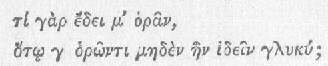
                                                     SOPH. ŒD. TYR.


[Translation of quotation from Sophocles’ Oedipus Tyrannus (trans. Sir Richard Jebb):

Why should I see, when sight showed me nothing sweet?

Lines 1329 - 1335:
It was Apollo, friends, Apollo who brought these troubles [1330] to pass, these terrible, terrible troubles. But the hand that struck my eyes was none other than my own, wretched that I am! [1335] Why should I see, when sight showed me nothing sweet?]
 

            183

THE BLIND LINNET.


I.

              THE sempstress’s linnet sings
                   At the window opposite me;—
              It feels the sun on its wings,
                   Though it cannot see.
              Can a bird have thoughts? May be.


II.

              The sempstress is sitting,
                   High o’er the humming street,
              The little blind linnet is flitting
                   Between the sun and her seat.
              All day long                                                                               
              184
                   She stitches wearily there,
              And I know she is not young,
                   And I know she is not fair;
              For I watch her head bent down
                   Throughout the dreary day,
              And the thin meek hair o’ brown
                   Is threaded with silver gray;
              And now and then, with a start
              At the fluttering of her heart,
                   She lifts her eyes to the bird,
              And I see in the dreary place
              The gleam of a thin white face,
                   And my heart is stirr’d.


III.

              Loud and long
              The linnet pipes his song!
              For he cannot see
                   The smoky street all round,
              But loud in the sun sings he,
                   Though he hears the murmurous sound;
              For his poor, blind eyeballs blink,
                   While the yellow sunlights fall,
              And he thinks (if a bird can think)                                              
              185
                   He hears a waterfall,
              Or the broad and beautiful river
                   Washing fields of corn,
              Flowing for ever
                   Through the woods where he was born;
              And his voice grows stronger,
                   While he thinks that he is there,
              And louder and longer
                   Falls his song on the dusky air.                                            
              [3:18]
              And oft, in the gloaming still,
                   Perhaps (for who can tell?)
                   The musk and the muskatel,
              That grow on the window sill,
                   Cheat him with their smell.


IV.

              But the sempstress can see
              How dark things be;
              How black through the town
                   The stream is flowing;
              And tears fall down
                   Upon her sewing.
              So at times she tries,                                                                 
              186
                   When her trouble is stirr’d,                                                    [4:8]
              To close her eyes,
                   And be blind like the bird.
              And then, for a minute,
                   As sweet things seem,
              As to the linnet
                   Piping in his dream!
              For she feels on her brow
                   The sunlight glowing,
              And hears nought now
                   But a river flowing—
              A broad and beautiful river,
                   Washing fields of corn,
              Flowing for ever
                   Through the woods where she was born—
              And a wild bird winging
              Over her head, and singing!
              And she can smell
              The musk and the muskatel
                   That beside her grow,
              And, unaware,
              She murmurs an old air
                   That she used to know!


[Notes:
Alterations in the 1884 edition of ‘The Poetical Works of Robert Buchanan’:
v. 3, l. 18:  Falls his song on the dusky air,
v. 4, l. 8: When her trouble is stirr’d

After ‘The Blind Linnet’ a number of additional poems are included in the London Poems section before ‘London, 1864’. These are as follows: ‘Tiger Bay’, ‘The City Asleep’, ‘Up In An Attic’, ‘To The Moon’, ‘Spring Song In The City’, ‘In London, March 1866’, ‘A Lark’s Flight’, ‘De Berny’, ‘The Wake Of Tim O’Hara’, ‘Kitty Kemble’, ‘The Swallows’, ‘Tom Dunstan: Or, The Politician’, ‘O’Murtogh’, ‘The Bookworm’ and ‘The Last Of The Hangmen’.]


187

XII.

LONDON, 1864


189

LONDON, 1864.


I.

            WHY should the heart seem colder,                                                   [1:1]
                 As the song grows stronger and surer?
            Why should the brain grow darker,                                                     
            [1:3]
                 And the utterance clearer and purer?
            To lose what the people are gaining
                 Seems often bitter as gall,
            Though to sink in the proud endeavour                                                
            [1:7]
                 Were the bitterest of all.
            I would to God I were lying
                 Yonder ’mong mountains blue,
            Smiling in sweet conceptions                                                              
            [1:11]
                 That were dried from my brow like dew,                                        [1:12]
            Burning, and aching, and yearning                                                  190 [1:13]
                 To conquer, to sing, and to teach,
            With the brain at white-heat, clutching                                                
            [1:15]
                 At visions beyond my reach,—                                                      [1:16]
            But with never a feeling or fancy                                                          [1:17]
                 I could utter in tuneful speech!


II.

            Yea! that were richer and sweeter                                                        [2:1]
                 Than all that my soul hath found,—
            Than to see and to know, and be able
                 To utter the knowledge in sound;                                                    
            [2:4]
            For the heart feels colder and harder,                                                   [2:5]
                 And a glory hath gone from me,
            And I hate, for I view so clearly,
                 So much that I loved to see,
            And the far blue misty mountains
                 Are grand as they used to be!


III.

            And Art, the avenging angel,                                                                [3:1]
                 Comes, with her still, gray eyes,
            Kisses my forehead coldly,                                                                 
            [3:3]
                 Whispers to make me wise;
            And, too late, comes the revelation,                                                     
            191
                 After the feast and the play,
            That she works her end, not by giving,                                                 
            [3:7]
                 But cruelly taking away:                                                                   [3:8]
            By burning the heart till it shrivels,                                                         [3:9]
                 Scorching it dry and deep                                                              [3:10]
            And changing the flower of living                                                         [3:11]
                 To a poor dried flower that may keep!
            What wonder if often and often                                                          
            [3:13]
                 The passion, the wonder dies;
            And I hate the terrible angel,                                                              
            [3:15]
                 And shrink from her passionless eyes,—
            Who, instead of the rapture and vision,                                               
            [3:17]
                 I held as the poet’s dower—
            Instead of the glory of living,                                                               
            [3:19]
                 The impulse, the splendour, the power—
            Instead of the singing raiment,                                                            
            [3:21]
                 The trumpet proclaiming the day,                                                   [3:22]
            Gives, and so coldly, only                                                                   [3:23]
                 A pipe whereon to play!
            While the spirit of boyhood hath perish’d,                                           
            [3:25]
                 And never again can be,
            And the singing seems so worthless,                                                   
            [3:27]
                 Since the glory hath gone from me,—
            Though the far blue misty mountains,                                             
            192 [3:29]
                 And the earth and the air and the sea,
            And the manifold music and beauty,                                                   
            [3:31]
                 Are grand as they used to be!


IV.

            Is there a consolation
                 For the joy that comes never again?
            Is there a balm remaining?                                                                   
            [4:3]
                 Is there a refuge from pain?
            Is there a balm to quiet                                                                        
            [4:5]
                 The shame and the grief and the stinging?                                         [4:6]
            Only the sweet, strange sadness,
                 That is the source of the singing.


V.

            For the sound of the city is awful,                                                         [5:1]
                 As the people pass to and fro,
            And the friendless faces are dreadful,                                                   
            [5:3]
                 As they come, and thrill through us, and go;
            And the ties that bind us to others                                                        
            [5:5]
                 Of our error and weakness are born;
            And our dear ones ever love dearest
                 Those parts of ourselves that we scorn;
            And the weariness will not be utter’d,                                             
            193 [5:9]
                 And the bitterness dare not be said,
            And we hood the proud nature with meanness                                    
            [5:11]
                 To shut out the sight of our Dead!                                                  [5:12]
            And what, then, remaineth as solace?                                                  [5:13]
                 Dear ones, or fortune, or fame?
            Only the sweet singing sadness
                 Cometh between us and shame.


VI.

            And there dawneth a time to the Poet,
                 When the bitterness passes away,
            When his heart is humbled in silence,                                                   
            [6:3]
                 And he kneels in the dark to pray;                                                   [6:4]
            And the prayer is turn’d into music,                                                      [6:5]
                 And the music findeth a tongue,                                                       [6:6]
            And Art, the cold angel, seems kinder,                                                 [6:7]
                 And comforts the soul she has stung.                                               [6:8]
            Then the Poet, worn with the struggle,                                                  [6:9]
                 Findeth his loss is his gain:
            The sweet singing sadness is stranger,                                                 
            [6:11]
                 Though nought of the glory remain;
            And the awful sound of the city,
                 And the terrible faces around,
            Take a truer, tenderer meaning,                                                     
            194 [6:15]
                 And pass into sweetness and sound;
            The mystery deepens and deepens,                                                    
            [6:17]
                 Strange vanishings gleam from the cloud,
            And the Poet, though often and often                                                  
            [6:19]
                 Stricken, and eyeless, and bow’d,                                                  [6:20]
            Starteth at times from his wonder,
                 And sendeth his Soul up aloud!


VII.

            Lo! I stand at the gateway of Honour,                                                  [7:1]
                 And see the lights flashing within,
            And I murmur these songs of the city,
                 Its sorrow, its joy, and its sin;
            And the sweetness is heavy upon me,
                 Though grown of the past and its wrong;
            My losses are sure if that sweetness
                 Be felt in the soul of the song.
            I murmur these songs of the city,
                 And cast them as bread on the sea;
            And mine eyes are dim with the singing
                 That is all in the world to me!


[Notes:
Alterations in the 1884 edition of ‘The Poetical Works of Robert Buchanan’:
v. 1, l. 1: Why should the heart seem stiller,
v. 1, l. 3: Why should the brain grow chiller,
v. 1, l. 7: Though to sink in the proud attaining
v. 1, l. 11: Chasing the morn with flying
v. 1, l. 12: Feet in the morning dew!
v. 1, l. 13: Longing, and aching, and burning
v. 1, l. 15: A passionate face upturning
v. 1, l. 16: To visions beyond my reach,—
v. 1, l. 17: But with never a feeling or yearning
v. 2, l. 1: Yea! that were a joy more stable
v. 2, l. 4: To utter the seeing in sound;
v. 2., lines 5-10 and verse break omitted.
v. 3, l. 1: For Art, the Angel of losses,
v. 3, l. 3: Coldly my forehead crosses,
v. 3, l. 7: That she works God's dispensation
v. 3, l. 8: By cruelly taking away:
v. 3, l. 9: By burning the heart and steeling,
v. 3, l. 10: Scorching the spirit deep,
v. 3, l. 11: And changing the flower of feeling,
v. 3, l. 13: What wonder if much seems hollow,
v. 3, l. 15: And I hate the angel I follow,
v. 3, l. 17: Who, instead of the rapture of being
v. 3, l. 19: Instead of the glory of seeing,
v. 3, l. 21: Instead of merrily blowing
v. 3, l. 22: A trumpet proclaiming the day,
v. 3, l. 23: Gives, for her sole bestowing,
v. 3, l. 25: While the spirit of boyhood hath faded,
v. 3, l. 27: And the singing seemeth degraded,
v. 3, l. 29: Though the glory around me and under,
v. 3, l. 31: And the manifold music and wonder,
v. 4, l. 3: Is there a reservation?
v. 4, l. 5: Is there a gleam of gladness
v. 4, l. 6: To still the grief and the stinging?
v. 5, l. 1: For the sound of the city is weary,
v. 5, l. 3: And the friendless faces are dreary,
v. 5, l. 5: And the ties that bind us the nearest
v. 5, l. 9: And the weariness will not be spoken,
v. 5, l. 11: The silence of souls is unbroken,
v. 5, l. 12: And we hide ourselves from our Dead!
v. 5, l. 13: And what, then, secures us from madness?
v. 6, l. 3: With none but his God to know it,
v. 6, l. 4: He kneels in the dark to pray;
v. 6, l. 5: And the prayer is turn’d into singing,
v. 6, l. 6: And the singing findeth a tongue,
v. 6, l. 7: And Art, with her cold hands clinging,
v. 6, l. 8: Comforts the soul she has stung.
v. 6, l. 9: Then the Poet, holding her to him,
v. 6, l. 11: The sweet singing sadness thrills through him,
v. 6, l. 15: Take a truer, tenderer pity,
v. 6, l. 17: The mystery deepens to thunder,
v. 6, l. 19: And the Poet, with pale lips asunder,
v. 6, l. 20: Stricken, and smitten, and bow’d,
Final verse omitted.

‘London 1864’ is followed by ‘The Modern Warrior’, ‘Pan: Epilogue’ and ‘L’Envoi to London Poems’.]


______________________________


London Poems continued

_____

London Poems Contents


Home
Biography
Bibliography

Poetry
Novels
Plays

Essays
Letters
Miscellanea

Harriett Jay
Critical Writings about Buchanan
The Fleshly School Controversy

Links
Site Diary
Site Search