Home
Biography
Bibliography

ROBERT WILLIAMS BUCHANAN (1841-1901)

Poetry
Novels
Plays

Essays
Letters
Miscellanea

Harriett Jay
Critical Writings about Buchanan
The Fleshly School Controversy

Links
Site Diary
Site Search

            {North Coast and other Poems 1868}

                                                                                                                        Pg
                                                                                                                                                             90

THE BALLAD-MAKER.

(LONDON.)


            STOP! that’s your training. You’re too hard, I say,
            Far, far too hard on those that go astray:
            There’s something to be said, by folk who feel,
            For girls that step astray, and lads who steal,
            And they are human souls in sin’s despite.
            ’Tis hard to find one’s way without a light
            Through this dark world, seeking the bit o’ bread;
            And being good comes after being fed.
            If you had seen as much of town as me,
            As much of wickedness and misery,
            You’d look on townsfolk with a friendlier gaze;
            But you are from the country, and their ways
            Look black beside the life that you have led.

Picture

91

                 How did I know that you were country bred?
            Ah, that’s a trick I keep, though I am gray;
            For once I lived in Sussex, far away;                                                    
            92
            And though full forty years have passed, and more,
            I know a country face among a score,
            By tokens that I catch before it flies—
            Dress, voice, and something cow-like in the eyes.
            Ay, and whene’er a coster girl I meet
            Selling her violets up and down the street,
            Or see a country cart go past with hay,
            It seems I lived in Sussex yesterday,
            And I can see the salt green marsh, and hear
            The washing of the waters low and clear,
            And see the silver sails out in the bay
            Come in the moon like ghosts, and dip, and melt away.

                 Yes, friend, I am the man who makes the rhyme;
            Much have I made and sold too in my time:
            This room is papered with them, big and small,
            So that a man can read them on the wall.
            And they are but a few of those I made,
            Since I began the task and found it paid.
            There’s one that every ’prentice boy has read,—
            How Tommie Thresher shot his sweetheart dead;
            And that’s another on the poisoner Brown,
            And there’s a comic song that took the town.

                 But these are poor weak things, although they pay;                            93
            There’s something in me better far than they!
            There’s nothing in them fine, and fresh, and true,—
            They jingle, but they never thrill one through,
            Like some by other men that I have read.
            But I should like for once, ere I am dead,
            To write a thing more true, and fresh, and fair,
            Fit for poor folk whose hearts are full of care.
            Why, if a man, just by a rhyme, could show
            How fresh the winds down in the country blow,
            How by the sea the marsh smells salt and sweet,
            Or how the bird cries ‘cuckoo’ in the heat,
            Or if a man his feelings could write down
            When flower girls sell their flowers about the town,
            Or put in music all the frets and fears
            Of townsfolk, the deep murmur in their ears,
            The crying out for sleep, the fight for bread,
            The strange hard thoughts they feel when they lay down their dead.

                 Ah, many a night I’ve tried to speak my mind,—
            I wanted learning, though, as now I find;
            The rhymes would never answer as they ought,
            Or, coming, killed the feeling and the thought.
            And so I found ’t was useless waste of time,                                         
            94
            But turned again to money-making rhyme,
            Where thoughts and feelings were of small ado,
            So that the words were strong, the jingle true;
            And when the printer sold ’em far and wide,
            Was fool enough to feel a kind of pride.

                 Last year I tried it hard, but all in vain,
            Although my heart was full of a sharp pain,
            Because my little neighbour, up on high,
            Was taken badly, and about to die,—
            Little Jem Hart, half coster lad, half thief,
            One of the sort you wish to bring to grief;
            Only sixteen, and with his spine amiss,—
            So thin, that when he raised his hand like this,
            You saw the yellow sunlight shining through.

                 He had been bred among a wicked crew,
            And ne’er a friend in all the world had he,—
            Never a friend in all the world but me,
            To nurse him, shake the straws to make his bed,
            And stuff with rags a pillow for his head.
            For hope was gone—he knew that he must die;
            But life was dismal, and he did not cry,
            And wore away with little pain—up there.

                 And so, whenever I had time to spare,                                             95
            I sat by Jem, and tried to give him cheer;
            And he was thankful from his heart, poor dear!
            And proud he had at least one friend to stay
            Beside him watching as he went away.
            And though he said but little, now and then
            He startled me with what he knew of men:
            For it was terrible how one so young
            Could have such crafty sayings on his tongue;
            And sore to look on one so weak and wan,
            A child, yet weary as an old, old man.

            He knew full well his time was short below,
            And yet his heart was not afraid to go;
            And when I sunk my voice and took his hand,
            And talked to him about a better land,
            He seemed to think it sure no place could be
            More dull than London was to such as he.
            But now and then, when he could hear the cries
            Of boys outside, a sharp look filled his eyes,
            And his thin hand hung heavier on mine.

                 And it was summer, and the days were fine,
            And through the smoky glass the light came red,
            And tinted little Jem upon his bed;                                                         
            96
            And he would wake for hours, and watch the pane,
            Until it dazzled him to sleep again.
            And he would have strange dreams, and toss, and moan,
            And cry to some one to be let alone,
            Whining for fear; and often it would seem
            He stole or picked a pocket in his dream,
            And drew breath hard, hearing the folk rush by,
            And ran till he was caught, and wakened with a cry.

                 It was a sight to make a man’s heart ache
            To sit like me up there and see him wake
            From one of those hard dreams; for ‘Dick,’ he said,
            ‘Give me your hand—I thought that I was dead.’
            And then, afraid, he told me all he dreamed.
            He thought he was in Heaven, and it seemed
            Pleasant and bright and green like Primrose Hill,
            And there was no one there, but all was still;
            And he was clean and naked, and the light
            Shone on his body, and made it golden bright;
            And though a little hungry, through his breast
            He felt a tired and pleasant peace and rest.
            Then, seeing no one nigh, and tired, he crept
            Into a corner full of flowers, and slept.
            But all at once, while lying on the sod,                                                   
            97
            He heard a deep gruff voice, and knew ’t was GOD,
            And felt rough fingers seize him by the ears,
            While he was thick with sleep, and full of fears;
            And heard G
            OD say, ‘What boy lies here apart?’
            And some one said it was the thief, Jem Hart;
            And though he sobbed and cried, they would not hark,
            But took him to a gateway, cold and dark,
            And thrust him out—and full of pain he woke.

                 Pale was his face and fearful as he spoke:
            But when I answered him in cheerful style,
            I coaxed his poor pinched features to a smile.
            And lying back be watched the smoky pane,
            And hearkened to the people down the lane,
            In silence thinking till his eyelids closed;
            But, looking up o’ sudden as he dozed,
            He pressed my hand more tight, and held his head,—
            ‘Dick, say some bits of poetry,’ he said.

                 I stared at first, because it seemed so new;
            But, after pondering what to say and do,
            I murmured low some things that I had made,—
            Fine-sounding things, that took the town and paid;
            And Jem closed eyes, and noted every one,                                          
            98
            And kept as still as stone till I had done,
            And hearkened to the rhyme as one might list
            To the clock’s ticking, careless though he missed
            The meaning of the ditty, sad or glad.

                 But when my stock was done, and still the lad
            Asked me to tell him more, I called to thought
            A poor thing I had made when overwrought,
            One of those weary times I tried in vain
            To put in honest verse my own heart’s pain;
            And I was troubled, as I said it o’er,
            By feelings written down so long before,
            And my voice broke,—my throat was full of tears,—
            The sounding city murmured in my ears,—
            I felt Jem’s hand between my fingers creeping,
            And, looking down, I saw that little Jem was weeping.

                 Then I was touched to see him grieving so,
            And clasped his hand, and spoke more sad and low,
            Peering upon his face; and as I spoke,
            Instead of the low hum of city folk,
            I heard the washing sea upon the shore;
            And when I had said the silly verses o’er,

Picture

99

            ‘Say it again!’ cried little Jem; and when,
            To please his heart, I said the song again,
            In through the smoky glass the setting sun                                             
            100
            Gleamed sickly, and the day was nearly done.


I.

              Oh, London is a dismal city,
                   When one is all alone,
              And it’s hard to keep your heart up
                   When your friends are dead and gone;
              And what is the good of living,
                   And struggling bitterly, wet or dry?
              It’s better just to shut your eyes,
                   And lie down on your back and die!


II.

              Oh, who would struggle and struggle
                   To get the bit of bread,
              Who would be cold and weary,
                   With an aching heart and weary head,
              When all in the dark still earth
                   Quiet and peaceful you can lie?
              Then isn’t it better to close your eyes,
                   And lie down on your back and die?

                                                                                                                101

III.

              There’s green fields, flowers, and cresses
                   In the place where I was born,
              And you hear the waters of the sea
                   A-sounding night and morn;
              But London city is dismal work,
                   And your heart feels lonely as the days go by;
              Then isn’t it better to close your eyes,
                   And lie down on your back and die?


                 That was the song, and o’er and o’er to him
            I murmured it until mine eyes were dim,
            And my heart ached again;—for all the time
            There seemed a kind of magic in the rhyme,
            And I could hear the washing sea, and smell
            The salt green marshes where I used to dwell,
            And see the grim room melt around me, showing
            The water trembling, and the fresh breeze blowing,
            And white-sailed fish-boats dipping in the breeze.

                 But while my heart was full of things like these,
            The evening came; and when the pale moonlight
            Crept o’er the house-tops, dim and dusky bright,
            The arm of little Jem grew heavy as lead,                                             
            102
            And, looking down, I saw that he was dead.

                 And even then, far, far away, I seemed
            Staring down dumbly at a face that gleamed
            On water in the moonlight silver clear,
            And though ’twas night, full plainly I could hear
            The bird that comes when summer days are blue,
            Crying afar away, ‘Cuckoo! cuckoo! cuckoo!’

                 Ah! many a time, amid the hum of town,
            I’ve tried my best to put such feelings down:
            Full oft they come, they go; but when I try
            To hold them fast, they turn to mist, and die.


[Notes:
‘The Ballad-Maker’ is not included in the 1884 edition of ‘The Poetical Works of Robert Buchanan’.]


Back to Contents

Picture

103

THE BROOK.


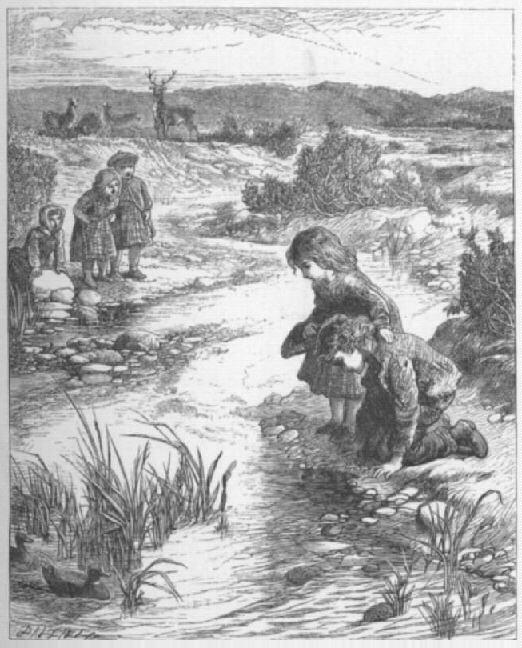
            OH, sweet and still around the hill
                 Thy silver waters, Brook, are creeping;
            Beneath the hill as sweet and still                                                   
            104  [1:3]
                 Thy weary friend lies sleeping:                                                         [1:4]
            A laurel leaf is in his hair,
                 His eyes are closed to human seeming,
            And surely he has dreams most fair,                                                     
            [1:7]
                 If he indeed be dreaming.                                                                [1:8]

            O Brook, he smiled, a happy child,                                                       [2:1]
                 Upon thy banks, and loved thy crying,
            And, as time flew, thy murmur grew
                 A trouble purifying;
            Till, last, thy laurel leaf he took,
                 Dream-eyed and tearful, like a woman,
            And turned thy haunting cry, O Brook,                                                
            [2:7]
                 To speech divine and human.

            O Brook! in song full sweet and strong                                                 [3:1]
                 He sang of thee he loved so dearly;
            Then softly creep around his sleep,
                 And murmur to him cheerly;
            For though he knows nor fret nor fear,                                                 
            [3:5]
                 Though life no more slips strangely through him,
            Yet he may sleep more sound to hear                                                  
            [3:7]
                 His friend so close unto him.

            And when at last the sleepers cast                                                         105
                 Their swathes aside, and, wondering, waken,
            Let thy friend be full tenderlie                                                               
            [4:3]
                 In silver arms uptaken.                                                                    [4:4]
            Him be it then thy task to bear
                 Up to the Footstool, softly flowing,—
            Smiles on his eyes, and in his hair
                 Thy leaf of laurel blowing!


[Notes:
In the 1884 edition of ‘The Poetical Works of Robert Buchanan’ ‘The Brook’ appears under the title, ‘To The Luggie’ in the ‘Early Poems’ section. The poem has the following footnote:
“See ‘The Luggie and other Poems,’ by the late David Gray.”
Alterations:
v. 1, l. 3: Beneath the hill, as sweet and still,
v. 1, l. 4: Thy weary Friend lies sleeping:
v. 1, l. 7: And surely he hath dreams most fair,
v. 1, l. 8: If he, indeed, be dreaming.
v. 2, l. 1: O Brook! he smiled, a happy child,
v. 2, l. 7: And turned thy haunting cry, O Brook!
v. 3, l. 1: O Brook! in song full sweet and strong,
v. 3, l. 5: For though he knows no fret or fear,
v. 3, l. 7: Yet he may rest more sound to hear
v. 4, l. 3: Let thy Friend be full tenderly
v. 4, l. 4: In silvern arms uptaken. ]


Back to Contents

                                                                                                                       106

THE NORTHERN WOOING.

(NORTH COAST.)


            SKIES are dusky, winds are keen,
            Round Lallan Farm on Hallowe'en.                                                      
            [1:2]

            All is dark across the night,
            But, see! one crimson glare of light.                                                     
            [2:2]

            What are those that in the air
            Flit against the crimson glare?                                                              
            [3:2]

            Falling flakes of snow they seem,
            Or night-moths gathered by the gleam.                                                 
            [4:2]

            Round and round they wind and wind,—
            Tiny shades against the blind.

            Child, wish now! while thou canst see!                                            107  [6:1]
            ’Tis the faëry companie!

            O’er thy shoulder peep; and so                                                            [7:1]
            Behold thy future bedfellów.                                                                 [7:2]

            Once a year, on Hallowe’en,
            Are the faëry people seen.

            Thus round happy farms they fly,
            While the peat-fire blazes high.

            Lad and lass, to-night beware!
            There is magic in the air!

*                      *

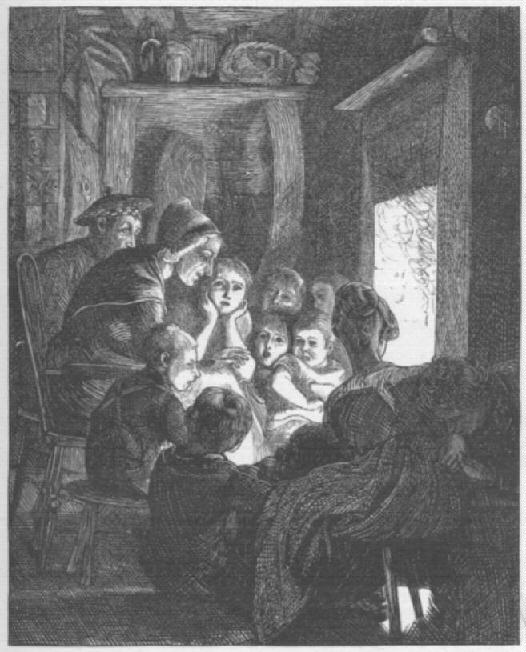
             ‘Ah, bairns, my bairns, forbear on Hallow Night
          To mock the folk o’ faëry and their might,                                                    
          [11:2]
          For though ye deem these things are all untrue,
          Yourselves may be the first to see and rue!
          Hark! now the wind a moment sinks and dies,                                              
          [11:5]
          Hear ye not low faint voices and strange cries                                                [11:6]
          Outside the door, and flutterings on the pane                                                 [11:7]
          Of little finger-taps, like gentle rain?                                                         108  [11:8]
          Ay! ’tis the folk o’ faëry hovering nigh:                                                          [11:9]
          Draw back the blind to peep, and they will fly;                                             [11:10]
          But serve them maidenly, with charm and spell,                                            [11:11]
          And the old customs that they love so well,
          And they will show you all you wish to see,—
          Your true-love’s face, his country and degree,—                                         
          [11:14]
          All, all a lass with pleasure asks and learns,
          Down to the very number of her bairns.                                                       
          [11:16]

             ‘Aye please the fays! ’tis easy if ye will;                                                      [12:1]
          But woe be yours if they should wish ye ill:                                                    [12:2]
          Your joe will take to drink, or drown at sea,                                                  [12:3]
          Or find another sweeter companie;
          Your cheeks will droop, your een will lose their light;                                    
          [12:5]
          Ye’ll marry an old man, and freeze at night!
          In vain, in vain ye seek to change your fate,                                                  
          [12:7]
          When they have fixed your lot and future mate;                                              [12:8]
          In vain ye seek to frown and turn aside,—
          They make your heart consent in spite of pride.
          ’Twas so with me, when I was young and gay,
          Though I was loth to hearken and obey.
          They led me to their choice by spells and charms;
          They closed my eyes, and drew me to his arms!                                          
          [12:14]

Picture

109

          Or grandfather had ne’er prevailed on me
          To droop my pride, and smile as low as he.                                                 
          [12:16]

             ‘For, though I say it, bairns, my face was fair,                                              110
          And I was Farmer Binnie’s child and heir;
          A widowed father’s pet, I ruled the place,
          Right proud, be sure, of fortune and of face.
          My hair was golden then, like Maggie’s here,
          And I had een as sly, yet crystal clear,
          And I could look as bright when pleased and fain,
          Or toss my curls with just as sweet disdain!
          What wonder, then, if half the country-side
          Looked bairns into my face, and blushed and cried,                                     
          [13:10]
          Bleating behind me, like a flock of sheep
          Behind a shepherd-lass, who, half asleep,                                                    
          [13:12]
          Counts them in play, leads them with pretty speech,
          Rates all alike, and scarce knows each from each?                                      
          [13:14]
          One found me coy, another found me gleg,
          Another skittish as the gray mare Meg;
          Just as the humour took me, I was wild
          Or gentle,—one day cross, the next day mild;
          But cared no more for handsome Jamie West,
          When he came o’er the heather in his best,
          Jingling his silver spurs at our fire-end,
          In breeks so tight ’twas near his death to bend,
          Than for the grim old Laird of Glumlie Glen,
          Who rode on solemn sheltie now and then
          Over the moors,—and, making mouths at me,                                               
          111
          With father cracked of crops o’er barley-bree,—
          While Jock the groom, who knew I loved such fun,
          Gingered the sheltie for a homeward run!                                                    
          [13:28]

             ‘Yet oft I tried to picture in my brain
          What kind of laddie in the end would gain,
          And vainly sought ’mong those around to find
          The substance of the shadow in my mind.
          But, bairns, in vain I pictured; and anew
          Will you and children’s children picture too:—
          The bonnie shadow flies, and in its place
          The chilly substance steals to our embrace.
          I swore he should be stately, dark, and tall,—
          His hair was fiery red and he was small;                                                      
          [14:10]
          I swore he should be rich in gold and lands,—
          His fortune was the strength of his two hands;                                              
          [14:12]
          I swore he should be meek and ruled by me,—
          The De'il himself were easier led than he!’                                                   
          [14:14]

*                      *

            Round the happy farm they flee,—
            Faëry folk in companie.

            Near the peat-blaze range in ring;                                                         112
            Fiddler, twang the fiddle-string.

            In the great tub duck the head
            After apples rosy red!

            Slyly let each pair by turn
            Watch the magic chestnuts burn!

            Love who never loved before,—
            Kiss me quick behind the door!

            Lad and lass, to-night beware!
            There is magic in the air!

*                      *

             ‘O bairns, we gathered round the blazing peat,
          And lad and lass sat close and whispered sweet,
          While ancient women spake of wonders seen
          On many a long-forgotten Hallowe’en,
          And old men nodded snowy polls the while,
          Passing the snuff-box round with sceptic smile.
          Tall in the midst my father had his place,
          Health and a golden harvest in his face;
          And, hand in his, full rosy and full sly,                                                             
          113
          Surrounded by my silly sheep, sat I.                                                             [21:10]
          Loud rang the laughter! fearless grew the fun!
          Happy and warm at heart was every one!
          The old, old shepherd, worn with rain and wind,
          Blinked in the ingle-nook with eyes half blind,                                              
          [21:14]
          While at his feet his tired old dog slept deep,
          And, barking, dreamed of gathering the sheep.                                            
          [21:16]

             ‘James West was there, the Laird, and many more,
          Wooers both old and young, and rich and poor;
          And, though I say it, bairns, that night I smiled
          My sweetest, and their hearts were fairly wild.                                              
          [22:4]
          Braw with new ribbons in my hair lint-light,
          Clean as a guinea, newly minted, bright,
          I sat and hearkened to their silly speech,
          Happy, and with a careless smile for each;
          And yet, though some were fine and fair to see,
          Not one had power to steal my heart from me.

             ‘Oh, Hallowe’en in those old times, I vow,
          Was thrice as merry, thrice as sweet, as now!
          The benches drawn aside, the supper o’er,
          Fresh sand was strewn upon this very floor;
          The fiddle played—the fiddler gave a squeal—                                              
          114
          Up stood the folk, and father led the reel;                                                      [23:6]
          The lads louped up and kicked the beam for fun,                                           [23:7]
          The crimson lassies screamed to see it done;                                                 [23:8]
          Meantime the old men, with contented look,
          Smoked clean new cutties in the chimney nook,
          And thought of days when they were young and gay,
          And pleased the lassies, too, with feats of play.
          Yet one was there, my bairns, amid the throng,
          Who, though his years were young, his limbs full strong,
          Danced not that night; but pale and gloomy, stayed
          Among the gaffers, in the chimney shade,—
          Hugh Scott his name, an orphan lad, whose hand
          Guided the ploughshare on my father’s land,
          But one my father prized and trusted best
          For cunning and for skill o’er all the rest.
          Full well I knew the rogue esteemed me sweet,
          But I was gentry, and his masters’ meat,                                                      
          [23:22]
          And often smiled on him full fond and free,                                                   [23:23]
          As ne’er I smiled on those who courted me,
          Pleased that my smiles sank sweet to his heart’s core,
          But certain he would never hope for more.                                                  
          [23:26]

             ‘There in the chimney shadow, pale and sad,
          Clad in his clothes o’ Sabbath, sat the lad:                                             
          115  [24:2]
          In vain, to catch his look, the lassies leered,
          In vain the old folk saw his sulks, and sneered,
          But aye his dim and melancholy e’e
          Turned glittering in the shade and followed me;                                             
          [24:6]
          Whene’er I danced with some fine wooer there,
          I saw his fist clench and his eyeballs glare,—
          Red as a rick on fire I saw him grow                                                            
          [24:9]
          Whene’er my partner whispered sweet and low,                                          [24:10]
          And had a kiss been stolen in his sight,
          I swear he would have ta'en revenge in fight.
          Half pleased, half careless, to increase his ill,
          I marked him kindly, as a lassie will,
          And sent him many a smile of tender light
          To cheer him in his nook, that Hallow Night.                                               
          [24:16]

             ‘Louder the fiddler, warmed with many a glass,                                          [25:1]
          Shouted to stir the hearts of lad and lass!
          Faster and faster on his strings he skirled!
          Faster and faster round the dancers whirled!
          Close by, the young folks ducked for apples red,                                          
          [25:5]
          Splashing, with puffing cheek and dripping head,
          Into the washing-bine, or, in a ring,
          With gaping mouths, they played at cherry-string.
          But in the parlour, from the turmoil free,                                                         
          116
          My father sat with antique companie—                                                        [25:10]
          Cronies who mixed their tumblers strong and deep
          Twelve times, and toddled sober off to sleep.                                              
          [25:12]

             ‘But, bairns, ’twas near the hour when ghaists are said
          To rise white-sheeted from their kirkyard bed,
          When the owl calls, and blinks his e’eball white,                                           
          [26:3]
          In ruins, where the fairies flit by night.
          And now my heart beat fast and thick for fear,
          Because the time of spells and charms was near,
          And I was bent that night alone to fly                                                            
          [26:7]
          Out o’er the meadow to the kiln,—and try
          The twining charm, the spell of fairy fate,
          And hear the name of him that I should mate.’

*                      *

            Lad and lass, to-night beware!
            There is magic in the air!

            Winds are crying shrill, and, hark!
            Ghosts are groaning in the dark.

            Who will dare this Hallow Night                                                           117
            Leave the happy ingle-light?

            Who will dare to stand alone,
            While the fairy thread is thrown?

            Who this night is free from fear?
            Let her ask,—and she shall hear!

*                      *

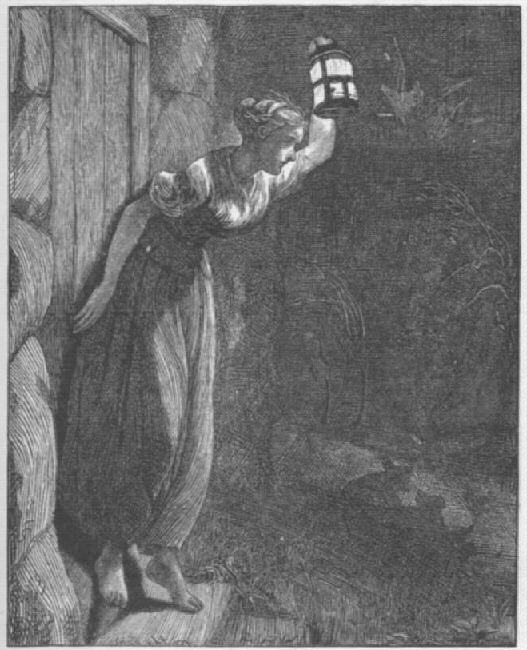
             ‘Dark, dark was all, as shivering and alone
          I set my foot upon the threshold-stone,
          And, trembling close, with twitching fingers caught
          The great horn lanthorn from the stables brought,                                          
          [32:4]
          And leant against the door to keep it wide,
          And peered into the dreadful gloom, and sighed.                                           
          [32:6]
          Black was the lift, and faintly fell the rain,
          The wind was screeching like a ghaist in pain;                                               
          [32:8]
          And, while I paused, and pinched my e’en to mark,                                       [32:9]
          The wind swung to the door, and left me in the dark.                                    [32:10]

             ‘O bairns! what would my foolish heart have gi’en
          To let the fairies be, that Hallowe’en!
          But I had sworn, and all the lassies knew,
          And I was shamed, and fain must see it through.                                             
          118
          Oh, where were all my boasts, my laughter light,                                            [33:5]
          Now I was there alone amid the night?
          While faint far ben the farm the fiddle cried,                                                  
          [33:7]
          And far away the sound of dancing died.

             ‘Thud, thud against my breast my wild heart leapt,
          As out across the misty yard I crept,
          Holding the lanthorn up, whose flickering ray                                                
          [34:3]
          Made darkness doubly deep along the way.
          Then in my ears I seemed to hear strange screams,                                       
          [34:5]
          And awesome faces flashed with lightning-gleams,                                         [34:6]
          And, as I wandered, fingers sharp and wee
          Pinched me and pulled my garter o’er the knee,                                            
          [34:8]
          And nipt my breasts (ay, laugh! your time is near!)                                         [34:9]
          Yet still I held along, though sick with fear;                                                   [34:10]
          Out of the yard, across the field, the dew
          Still drizzling blindly in my face, I flew,                                                         
          [34:12]
          Till, breathless, panting hard against the wind,
          Fearful to look before me or behind,
          I reached the kiln,—and, standing dizzy there,
          Heard softer voices round me in the air,
          A sound like little feet along the gloom,
          And hummings faint as of a fairy loom.                                                       
          [34:18]

Picture

119

          ‘Then setting down the lanthorn on the ground,                                            [34:19]
          I entered in, nor paused to look around,                                                      [34:20]
          But faint and fast began to say the charm                                                        120
          All northern lasses know, and reached my arm,                                            [34:22]
          Casting the twine, and holding one end tight—                                             [34:23]
          Flinging the other loose into the night.
          O bairns! O bairns! scarce had I uttered thrice
          The fairy spell, with lips as cold as ice,                                                        
          [34:26]
          When through my blood a fearful shudder spread,                                        [34:27]
          For ghaistly fingers tightened at the thread!                                                   [34:28]
          Then in a hollow voice, to know my doom,
          “Who holds, who holds?” I cried, into the gloom,                                        
          [34:30]
          And ere the echo of my voice had died,
          “Hugh Scott! Hugh Scott!” a hollow voice replied:
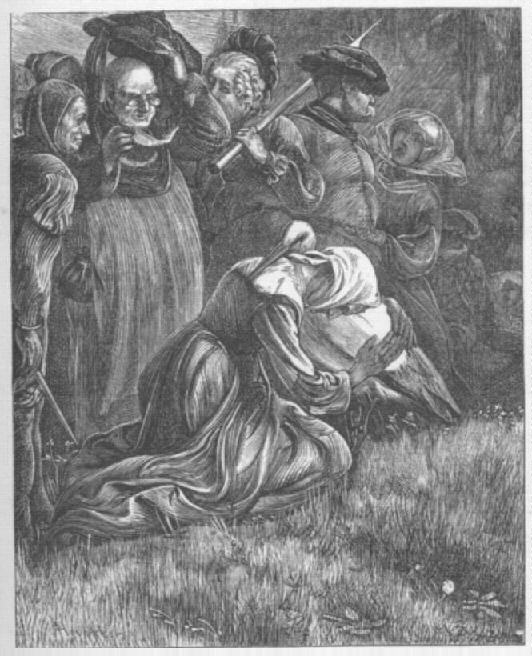
          And, screaming out, and covering up my face,
          Kicking the lanthorn o’er, I fled the place,
          Stumbling and tripping, flew across the field,
          Till, white as any ghaist, I reached the bield,                                                
          [34:36]
          And crept up to my room, and hid my head,
          Moaning, among the blankets of the bed!’

*                      *

            Lightly soon shall rise the sun!
            Fays, begone! your work is done.

            Fiddler, put your tools away,
            Take a nap among the hay.

            Lads and lassies, flushed and red,                                                 121  [37:1]
            Yawn no more, but off to bed.

            Maiden, thou hast heard and seen
            Wonders strange at Hallowe’en.

            Thou hast wished to hear and see—                                                   [39:1]
            And thy fate is fixed for thee.

            Sad or merry, ill or well,
            Fairy looms have spun the spell.

            In among the blankets creep—
            Dream about him in your sleep.

            Wake and smile with heart resigned!
            Kiss and cuddle, and be kind!

*                      *

             ‘Oh, bitter was my heart, my wits amazed;
          Wildly I pondered like a lassie crazed:
          Hugh Scott my mate! Hugh Scott, of all around!
          A pauper lad, a tiller of the ground!
          When wealthy men came lilting o’er the lea,
          In shining braws, and sought to marry me!
          “Nay, nay!” I cried, and frowning raised my face,                                          
          122
          “No force shall make me choose a lot so base:
          The spirits of the air but wish this night
          To try my heart, and fill my soul with fright;
          Yet they shall know full soon they rate me ill,—
          I fear them not, nor shall I work their will!”
          But as I spoke, I shook, and unaware
          Keeked o’er my shoulder at the glass, and there                                         
          [43:14]
          In the faint lamplight burning by the bed,
          His face, a moment mirror’d, came and fled!                                               
          [43:16]

             ‘O bairns!—what further tale have I to tell?
          How could I fight against a fate so fell?
          Strive as I might, awaking or asleep,
          I found my eyes in fascination deep
          Follow Hugh Scott, and, till my heart went wild,
          He haunted me from place to place, and smiled.                                           
          [44:6]
          Then, unaware, to notice I began
          That he was trim and stout, and like a man,
          That there was winning sweetness in his tongue,                                           
          [44:9]
          And that his voice was honeyed when he sung.                                            [44:10]
          Nay, more, full soon his manners seemed to me
          More fine than those of loftier degree,
          And as for gold, though he was humble, still
          He had a fortune in his farming skill.                                                               
          123
          Ay, bairns! before another Hallow Night
          The fairies to their wish had worked me quite;
          And, since his heart had ever favoured Hugh,
          Full easily they won my father too—
          And when at last Hugh craved me to be his,
          I fell upon his heart and cried for bliss.                                                        
          [44:20]

             ‘Ah! heed not, bairns, though grandfather should swear
          That, when I tried the spell, himsel’ was there;                                              
          [45:2]
          That, when I saw the phantom in the room,                                                   [45:3]
          He too, was near me, keeking through the gloom;                                         [45:4]
          And that his craft and cunning were the charms
          Which cheated me and drew me to his arms.
          Nay! nay! but maidenly, with song and spell,                                                
          [45:7]
          And the old customs that they love so well,
          Serve ye the fays this night—be meek! be brave!                                         
          [45:9]
          And though they may not give you all ye crave,                                            [45:10]
          Be sure that you will find, as I have found,
          Their choice right wise, and all their counsels sound,
          And bless for many a year the love and light
          They spin for happy hearts, on Hallow Night.’


[Notes:
Alterations in the 1884 edition of ‘The Poetical Works of Robert Buchanan’:
Subtitle omitted.
v. 1, l. 2: Round Lallan Farm this Hallowe’en.
v. 2, l. 2: But see! one glimmer of pink light!
v. 3, l. 2: Flit against the window-glare?
v. 4, l. 2: Or night-moths gather’d by the gleam.
v. 6, l. 1: Child, wish now! while thou canst see!
verse 7 omitted.
v. 11, l. 2: To mock the faëry people and their might,
v. 11, l. 5: Hark! now the winds a moment cease to roar,
v. 11, l. 6: A sound like some one breathing at the door!
v. 11, l. 7: And hark again! faint pattings on the pane
v. 11, l. 8: Of little finger-taps, like fluttering rain!
v. 11, l. 9: Ay! ’tis the faëry people hovering nigh:
v. 11, l. 10: Draw back the blind to peep, and they will fly!
v. 11, l. 11: But serve them solemnly, with charm and spell,
v. 11, l. 14: Your true love’s face, his country and degree,—
v. 11, l. 16: Down to the number of her unborn bairns!
v. 12, l. 1: ‘Ay, please the fays! ’tis easy if ye will;
v. 12, l. 2: But woe be yours if they should wish you ill:
v. 12, l. 3: Your jo will take to drink, or drown at sea,
v. 12, l. 5: Your cheeks will droop, your looks will lose their light;
v. 12, l. 7: In vain, in vain ye try to change your fate,
v. 12, l. 8: When they have fix’d your lot and future mate:
v. 12, l. 14: They closed my een, and drew me to his arms!
v. 12, l. 16: To droop my pride, and smile as low as he!
v. 13, l. 10: Looked love into my face, and blush’d and cried,
v. 13, l. 12: Around a shepherd-lass, who, half asleep,
v. 13, l. 14: Rates all alike, and scarce kens each from each?
v. 13, l. 28: Ginger’d the sheltie for a homeward run!
v. 14, l. 10: His hair was fiery-red and he was small!
v. 14, l. 12: His fortune was the strength of his two hands!
v. 14, l. 14: The De'il himself is easier led than he!’
v. 21, l. 10: Surrounded by my silly sheep sat I.
v. 21, l. 14: Blink’d in the ingle-nook with eyes half blind,
v. 21, l. 16: And, starting, dream’d of gathering the sheep.
v. 22, l. 4: My sweetest, and their wits were fairly wild.
v. 23, l. 6: Up stood the folk, and father led the reel!
v. 23, l. 7: The lads loup’d up and kick’d the beam for fun!
v. 23, l. 8: The crimson lassies screamed to see it done!
v. 23, l. 22: But I was gentry, and his masters’ meat!
v. 23, l. 23: And oft I smiled on him full fond and free,
v. 23, l. 26: But certain he would never hope for more.
v. 24, l. 2: Clad in his clothes of Sabbath, sat the lad:
v. 24, l. 6: Turned flashing in the shade and followed me.
v. 24, l. 9: Red as a rick on fire I watched him grow
v. 24, l. 10: Whene’er my partner whispered light and low,
v. 24, l. 16: To cheer him in his nook, that Hallow night.
v. 25, l. 1: ‘Louder the fiddler, gay with many a glass,
v. 25, l. 5: Close by, the young folks duck’d for apples red,
v. 25, l. 10: Father sat now with antique companie—
v. 25, l. 12: Twelve times, and toddled, sober, off to sleep.
v. 26, l. 3: When the owl calls, and blinks his e’eball white
v. 26, l. 7: And I was bent that very night to fly
v. 32, l. 4: The great horn-lanthorn from the stables brought,
v. 32, l. 6: And peer'd into the solemn gloom, and sighed.
v. 32, l. 8: The wind was screeching like a sprite in pain;
v. 32, l. 9: And, while I paused, pinching my e’en to mark,
v. 32, l. 10: The wind swung-to the door, and left me in the dark!
v. 33, l. 5: Oh! where were all my boasts, my laughter light,
v. 33, l. 7: While faintly ben the farm the fiddle cried,
v. 34, l. 3: Holding the lanthorn up;—its flickering ray
v. 34, l. 5: Then in my ears I seem’d to hear strange screams,
v. 34, l. 6: And fearful faces flashed with lightning-gleams,
v. 34, l. 8: Pinched me and pulled my garter o’er the knee.
v. 34, l. 9: omitted
v. 34, l. 10: omitted
v. 34, l. 12: Still drizzling damply in my face, I flew,
v. 34, l. 18: And hummings faint as of a fairy loom.
v. 34, l. 19: Then setting down the lanthorn on the ground
v. 34, l. 20: I entered in, nor paused to look around.
v. 34, l. 22: All northern lassies know, and reached my arm,
v. 34, l. 23: Casting the twine, and catching one end tight—
v. 34, l. 26: The secret spell, with lips as cold as ice,
v. 34, l. 27: When through my blood a sick’ning shudder spread,
v. 34, l. 28: For ghaistly fingers tighten’d at the thread!
v. 34, l. 30: “Who holds? who holds?” I cried into the gloom;—
v. 34, l. 36: Till, white as any lamb, I reached the bield,
v. 37, l. 1: Lads and lassies, flush’d and red,
v. 39, l. 1: Thou hast wish’d to hear and see—
v. 43, l. 14: Keek’d o’er my shoulder at the glass, and there,
v. 43, l. 16: His face, a moment mirror’d, flash’d and fled!
v. 44, l. 6: He haunted me from spot to spot, and smiled.
v. 44, l. 9: That there were tender tones upon his tongue,
v. 44, l. 10: And that his voice was sweet whene’er he sung.
v. 44, l. 20: I—fell upon his heart and blush’d for bliss!
v. 45, l. 2: That, when I tried the spell, himsel’ was there,
v. 45, l. 3: And, when I saw the phantom in the room,
v. 45, l. 4: Again, was near me, keeking through the gloom;
v. 45, l. 7: Nay! nay! right solemnly, with song and spell,
v. 45, l. 9: Serve the good fays this night—be bold! be brave!
v. 45, l. 10: And though they may not give you all ye crave,]


______________________________


North Coast and other Poems continued

_____

North Coast and other Poems Contents


Home
Biography
Bibliography

Poetry
Novels
Plays

Essays
Letters
Miscellanea

Harriett Jay
Critical Writings about Buchanan
The Fleshly School Controversy

Links
Site Diary
Site Search