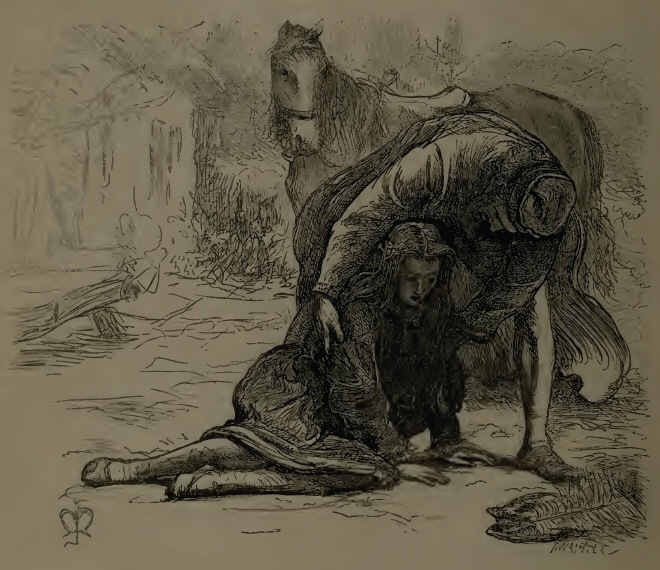
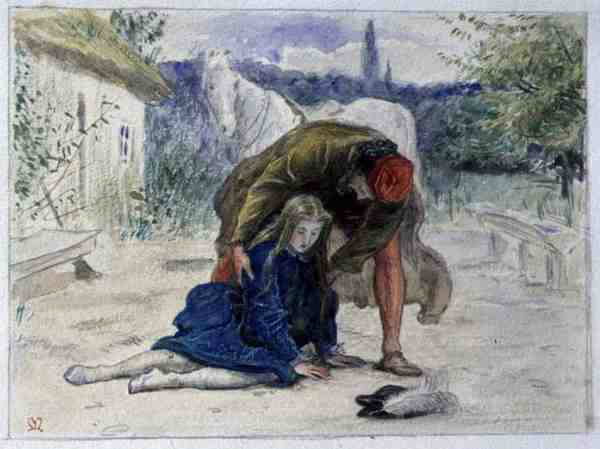
|
THE GIFTS: AN ARAB PARAPHRASE.
FIRST SONG.
I.
IN an ancient Arab story
Lies a meaning to my mind;
’Tis as pure as sweet snow-fairies,
And as vagrant as the wind.
’Tis as pure as sweet snow-fairies,
When they weave in silent hours,
O’er the tranced and dying winter,
Strange, weird visions of the flowers.
And the story holds a moral,
And a meaning fit for rhymes,
Soothly writ for fireside readers
In the busy modern times.
II.
Years ago, there lived a maiden
In whose sunshine-crimson’d blood
Dwelt a spirit, like the odour
In the rose’s swelling bud.
On her face that tender spirit
Was as tremulous for speech,
When the winds of feeling swept it,
As the shivering silver beech;
And she long’d to set to kisses
Such sweet songs as young souls sing,
’Till she grew too fair for any
Save a lover or a king.
III.
Lo! her hair was black and fragrant,
And it floated to the knee;
And her lips were riper, richer,
Than the palace of the bee;
Slender was her form, and lovely
As a cloud in summer skies,—
As a small white cloud by distance
Shaped to grace for human eyes;
And her radiant eyes were troubled
With sweet pictures manifold;
And she was a chieftain’s daughter
In an Arab tribe of old.
IV.
For the nut-brown men and women,
Of whose race the maid was one,
Faced the sunshine, and their faces
Took the brightness of the sun.
And they wander’d eastward, westward,
In a pastoral content;
And the chieftain, like his children,
Pitch’d an ever-changing tent;
Ever changing, ever stirring,
By the winds blown to and fro;
But the sun and stars went with them
Wheresoever they might go.
V.
When the sun and stars, that follow’d
Wheresoever they might ride,
Brought a bashful boy, Oneddah,
To the Arab maiden’s side.
He was fair, and tall, and comely,
And his heart was bravely meek;
And the moon that shines on lovers
Met the sunshine on his cheek.
He was lowly born and humble,
Of no mark, and no degree;
But she said, “I love Oneddah,
For his face is fair to see.”
VI.
And in secret, when blue heaven
Bared her starry-veinèd breast,
Met the maiden and Oneddah,
In a love that lips confest.
Vows were spoken, and the token
Made Oneddah sweetly proud;
While the maiden’s eyes were brighter,
And her laughter was less loud.
Fondly meeting in the darkness,
Though the clouds were in the skies,
They could glimpses catch of heaven
Thro’ each other’s lovelorn eyes.
VII.
But the maiden wept in secret,
Wholly helpless and forlorn,
O’er the gulf that hung between her
And Oneddah, lowly born;
And to bridge the gulf with flowers
Well she knew was all in vain,
Though whene’er they met she labour’d
At the bridge of flowers again.
Till at last the dark cloud gather’d
O’er the white tent of her life,—
For the chieftain, Abd-el-Azig,
Came to woo her for a wife.
VIII.
Quoth her sire, “The Abd-el-Azig
Bringeth wedding gifts in store;
And for every gift he bringeth,
Child, he loveth thee the more.
He is noble, he is gentle,
And his house is like a king’s;
And his courser on the desert
Flieth like a bird with wings;
And his words are truly spoken,
And his vows are truly said,—
So array thee white and saintly
For the Abd-el-Azig’s bed.”
IX.
Then the life-blood of the maiden
Curdled icy as it ran;
But a father’s will was gospel
In that rude, untutor’d clan.
Deaf to hope, and blind to sorrow,
Low the maiden bent her head;
And she dress’d her white and saintly
For the Abd-el-Azig’s bed.
Then the Abd-el-Azig raised her
To his saddle by the hands,
And amid a mist of lances
Bore her swiftly o’er the sands.
SECOND SONG.
I.
Then the Abd-el-Azig gave her,
As the custom went, a place
Deck’d to be her own to dwell in,
With a veil upon her face.
He was white with fifty summers;
On his cheeks his age did burn;
And his snowy beard before him
Swept his heart, and kept it stern.
So he gave her food and raiment,
Silent maids to wait upon her;
And from eyes of all, save maidens,
She was vineyarded by honour.
II.
And the woman—maid no longer,
Very patient in her place,
Felt the shadow of Oneddah
Dark upon her marriage face;
But her thoughts were calm and steadfast,
And her heart could think at last
Of Oneddah, as of something
Very holy in the past.
If a sympathy unhallow’d,
Looking on her, seem’d to doubt her,
Lo! she rose her height, and calmly
Drew her marriage veil about her.
III.
Came a knave from Abd-el-Azig:—
“Lo, my master sends thee these
Gifts of raiment rich, enclosed in
Costly boxes made of trees.
They are pure and perfect pledges
That he loves thee next to Heaven;
And my master bids me greet thee
With the gifts that he has given.”
Veil’d, and chastely proud, not deigning
To unveil her matron face,
Said the woman, “Tell thy master
That I thank him for his grace.”
IV.
So they set them in her chamber,—
Gifts a matron’s heart to please;
Gifts of raiment rich, enclosed in
Cumbrous boxes made of trees;
And they spread them out in secret—
Being vineyarded by honour,—
And the dress that seemed the purest
Took she forth and put upon her.
From the rustling dress there floated
Clouds of perfume through the room,
And the boxes savour’d sweetly
Of the barks of trees in bloom.
V.
Came a maiden, briefly saying,—
“Lo! there standeth at the gate,
Very footsore, pale, and weary,
One—a man of poor estate;
And his lips are parch’d and hungry,
From the thirsting desert ways;
Hither, o’er the yellow desert,
He has journey’d many days.
Burning tears are on his eyelids
Where he standeth at the door;
He is named, he saith, Oneddah,
And he craves to see thee sore.”
VI.
Then began a bitter struggle
In the matron’s heart and brain;
For her heart, with bitter longing,
Craved to see him once again;
And she murmur’d, “I will see him,
Very pure in sight of Heaven,
Like a matron, and array’d in
This, the gift my lord has given.”
Veil’d she murmur’d, “Bid him enter!”
And he shone upon the place,
Mean and ragged, with the radiance
Of the past upon his face.
VII.
Came Oneddah, like a famish’d
Pilgrim to a saintly shrine;
And she set rich meats before him,
With a fountain for his wine.
Him she greeted, not unveiling,
In a calm and measured phrase,
While around her pure heart coiling,
Stirr’d the snake of other days;
And with wistful tender gazes
Young Oneddah look’d upon her,
But his sorrow seem’d the sweeter
For her wifehood and her honour.
VIII.
Then the gift of Abd-el-Azig,
Round her wrapt rich fold on fold,
Kept her master’s form before her,
Press’d her heart, and kept it cold.
But a footstep sounding thither
Startled thro’ her firm repose,
And her breath was like the odour
Frozen in a winter rose.
Fearing taint of chiding voices,
“Hide,” she said, “in one of these
(Quickly, for the foot draws nearer)
Cumbrous boxes made of trees.”
IX.
Quickly flew the pale Oneddah,
In the cumbrous box he hid
Whence she took the dress that clothed her,
And she closed the heavy lid.
Came the knave behind her, greeting,
“Lo! my master craves to know
If those eyes, or bright or weary,
Will behold his face, or no?”
Scarcely knowing that she utter’d,
In her sinless fear half dumb,
Veil’d and trembling said the matron,
“Certes, bid my master come.”
X.
Fearful of the words thus spoken,
In her stainless wifely fear,
Fearful for the young Oneddah,
Made by very honour dear,
Sat the veilèd Arab woman
Stately, waiting for her master.
Flew the knave to Abd-el-Azig
Than the wingless ostrich faster:
“In thy lady’s scented chamber,
Underneath the cumbrous lid
Of the gift thy servant gave her,
One, a stranger youth, lies hid.”
XI.
Abd-el-Azig, wroth and angry,
Smote the knave upon the cheek,
Gnaw’d his beard, and spat it from him,
Ere he moved his tongue to speak:
“Knave!” he cried, “I know thou liest!
Tell me, did thy mistress say
If, thy master’s greeting given,
She would welcome me to-day?”
Being answer’d, Abd-el-Azig
Bade the trembling knave unfold
Where amid the rest was lying
That one box of which he told.
XII.
In the scented room the chieftain
Kiss’d the cold and trembling wife,
Where she sat, all veil’d and stately,
With the white sin of her life.
Then he sat him down, with greetings,
On the box made of a tree;
Stooping downward, smiling, lock’d it;
Rising, cast away the key.
Then he sought again, with kisses,
That one gift that he had given,
Whence she took the dress that clothed her
Purely then in sight of Heaven.
XIII.
Trembling, fearful to refuse him,
Robb’d of all that made her brave
By her sinless pride, the matron
Gave him back the gift he gave.
Calling five strong men, he bade them
Bear it to the sandy plain,
Thinking gladly, “She refused not,
She is white without a stain.”
Then he follow’d that great burthen,
Borne with pain in ten strong hands:
“Dig me here a pit, I pray ye,
Deep among the desert sands.”
XIV.
Deep they dug, while Abd-el-Azig
Close beside them smiling paced.
Two short hours, and in the bottom
Of the pit the box was placed.
Then the chieftain bade the toilers
Leave the pit unfill’d, and go;
And they left him in the desert,
Gravely pacing to and fro.
Leaping quickly to the bottom,
Abd-el-Azig bent his head,
Put his proud lips to the keyhole,
Though they scorn’d himself, and said:
XV.
“If so be that flesh of living
Man in this broad box doth lie,
Let him pay the debt he owes me;
He has wrong’d me—let him die!”
Fearful lest a voice might answer,
Upward leapt he, stauncher, stouter;—
“I believe her pure and holy,
Act of mine shall never doubt her;
If, as I believe most duly,
In the box there lieth none,
Let the gift earth gave be given
Back to earth—no wrong is done.”
XVI.
Then with strengthen’d hands he labour’d,
Heaping down the solid sands:
“Meet it is a matron’s wrongs be
Buried by her master’s hands.”
Then the box was cover’d over
With a crust of solid soil,
And the smiling chieftain rested
From his fears and from his toil.
Calling then his knaves unto him—
“Sacred as your father’s bones
Be this spot, and, best to show it,
Pile me here a cairn of stones.”
THIRD SONG.
I.
In the early desert morning,
With the desert for a bed,
Pillow’d by the cairn, they found her,
Calmly smiling, cold and dead;
Often had she linger’d near it,
Shaking parting hands with life,
Sad and calm, but ne’er forgetting
Patient duties of a wife.
Veil’d her face, as veil’d when living,
There the matron slumber’d—drest
In the gift her master gave her,
With his baby on her breast.
II.
Abd-el-Azig, grave and solemn,
Gnaw’d his snowy beard, and said:
“Be she buried where ye found her,
With these stones above her head;
Place the child upon her bosom,
Wrap them in the gift I gave,
Let her slumber as a matron
Very holy, in this grave;
Dig to the box of price, and in it
Lay her down; but on your oath
Hold it sacred, look not near it—
Pile the solid sands on both!”*
R. WILLIAMS BUCHANAN.
___________
*The rude outline of this story—which was capable of the subtle poetic interpretation which I have tried to give it—is to be found in some French MSS. The whole beauty of the idea is to be measured by the limits of primitive ethics.—R. W. B.
_____
‘The Gifts. An Arab Paraphrase’ was published in The St. James's Magazine (September, 1862).
_____
AD VIRGILIUM:
THE THIRD ODE OF THE FIRST BOOK.
SAIL safely, SHIP, across the sea,
And bear my other soul away from me!
Sail on! May Cyprian starlight guide
Thy pilgrimage across the waters wide!
May Helen’s brothers shining o’er thee
Make a bright path of silvery light before thee!
And may the Sire whose arms command
All winds save swift Iapegus, make bland
My Virgil’s passage to the Attic strand!
His breast was made of oak and brass
Who in frail ships first o’er fierce seas did pass;
Who feared not Africus, brought forth
In wombs of tempests blackening from the North;
Who ruled the doelful Hyades,
And lulled the wrath of Notus, whose strong breeze
Lifts up and down the Adriatic seas.
What death feared he whose eyes with scorn
Could watch the awful monsters ocean-born,
And fix his gaze upon the drear
Ill-famed Acroceraunians without fear?
In vain did Jove with outstretched hand
Divide the hissing waters from the land,
If yonder dark inviolate sea
Be trampled on by impious ships like thee.
Ah, that the human race should thus
Rush into evil black and dangerous!—
Prometheus, tempted to aspire,
Unto the trembling nations brought down Fire,
And lo, with that strange radiance, came
Fevers that turned the blood of men to flame,
And listening hearts of men could hear
Death with quick-hurrying footsteps sounding near.
Then Dædalus essayed to span
The azure air with wings unfit for man,
And Hercules’ affrighted eyes
Saw Acheron’s dull mysteries!
Naught can affright our vision! Can it be
Our hearts are oak and brass, O SHIP, like thee?
To heaven itself we seek to rise,
Though seas wax dark and cloudy tempests frown;
And thus stern Jove, who guards the skies,
Grasps tight his thunderbolts to strike us down.
B.
Chertsey, Sept. 6, 1862.
_____
‘Ad Virgilium’ was published in The Athenæum (20 September, 1862, No. 1821, p. 371). It is a translation of the third Ode of the First Book of Horace.
_____
IN THE CAMP.
COMRADE Ned,
This wine is as red
(Though sweet to the taste) as the blood we shed;
When yesternight,
On the dead-strewn height,
We put the Frenchmen by scores to bed;
Sung them to sleep with our cannon by hordes,
And tuck’d them up with our English swords!
So it puts me in mind of the fight again,
The boiling and seething of blood and brain,
When the trumpet, awaking with urging breath,
Blew us together in mists of death,
And our corselets rattled like wind and rain;
It reminds me, too,
Of a foe I slew,
Of a ghastly face that I cleft in twain.
Last night the work of a life was done;
Whether Providence did it, or Chance, all’s one;—
But before I return to my primitive mud,
I’ve a tale to tell in your ears, old friend.
(I’m glad that this wine has the colour of blood—
’Twill keep me in patience to get to the end!)
Well, Ned, you must know
That, eight summers ago,
My heart, like a rose just beginning to blow,
Caught the sweet sunny light of a young girl’s smile,
That hung like a butterfly on it the while;
And my heart began throbbing, and sounding, and burning,
And my blood began glowing, and aching, and yearning;
And, bewilder’d in sunshine, my head began turning.
Pshaw! I had fallen in love, to be brief just here.
Delight pour’d upon me, old friend, in a flood;
And I hoped—what I hoped for is perfectly clear—
She was weak, though, in spite of her face,—weak as dust;
Too lovely to doubt, and too fragile to trust:
And I knew it, in spite
Of the tender love-light
That absorb’d me
And orb’d me,
Both morning and night,
With a fanciful brightness of hope and of home;
And I felt that her will, if permitted to dash on
The fatal rock of some treacherous passion,
Would break, leave her naked, and fly like the foam!
In the quiet depth of her azure eyes
Slept a fire which the angels would deem undivine,
But the halt and the blind, comrade Ned, are more wise
And keen-vision’d than I in this love-dream of mine.
(Well, the fire has been quench’d in that blood and this wine!)
I doubt if she loved me at all, though her scorning
Was buried by inches away till the morning
When the radiant and beautiful dream of my life
Was merged in completion;—I made her my wife.
I doubt if she loved me, I said. Do I doubt?
Nay, she loved me much less than some pence that I had:
That’s the English of love, if the truth must out,
As you’ll find by-and-bye to your cost, my lad.
For Cupid, when young and just trying to speak,
Uses a sort of bewildering Greek;
But after the moon is exhausted of honey,
He takes to good English, and prattles of money.
So we dwelt in our joy for a summer or more,—
The honey remain’d, though the moon shone no longer;
And I fancy my manhood grew prouder and stronger,
And something more tender than thithertofore.
But oh, comrade Ned, the proud hope and the joy
When she lay in the darkness and bare me my boy!
When the little stranger oped eyes and smiled,
Till the wine in our veins was rubied as this is,
When with blind, proud kisses,
We peer’d into heaven through the eyes of our child,
And saw the white angels in beautiful calm,
And heard not, but felt, they were singing a psalm;
While, fresh from the shadow of death,
We could feel their breath
Blow cool on our kissing lips through his mouth of balm!
We? Did she see as I saw the vision of wonder,
The glory above us, within us, and under?
Can that breath out of heaven have blown us asunder?
Or should we again
Have been wedded by pain,
When the woman’s grand agony dazzled and stunn’d her?
To see her sit with the child on her knee,
And the first soft light of its love awake,
Morning and eve, was a sight to make
The heart grow big, and the blood feel free!
(More wine, friend Ned:
I’m glad ’tis red
As the blood we shed;
For the child and the woman were heaven to me!)
I had a friend, but his soul was vile,—
I had a friend, with a lie in his smile;
I had a friend, and a wife who defiled
The blood that ran red in the veins of our child.
They fled together, the woman and man,—
The foul French slime and the English wife;
But swift as they, flew, Ned, they never outran
The purpose that goaded me on like a knife,
When the fiends had still left me the hate of my life.
They fled in their shame,
With the babe, whose smile was a curse upon her;
They fled with the jewels of my good name.
(But this wine is less bright than the life-blood of honour!)
With my blood at white heat, without pain, without pity,
I hounded them onward from city to city;
From place to place, o’er hill and vale,
O’er snowy ridges and waters blue,
They fled in their fear, and my face was pale
In their track as they flew!
And I was unconscious of sun and moon,
Of stars that glide to a spheric tune,
Of rain and snow, and the flying wind,
Which I quickly outstripp’d and left behind;
Conscious only by day and night
Of some strange devil within my mind,
Who pointed me on with a finger of light,
Though his eyes were blind!
’Neath the snow scalps
Of the giant Alps,
The woman and I came face to face,
While the man flew onward in fear alone;
And she dropp’d at my feet in a lonely place,
But my heart was stone.
O Ned, friend Ned, to stand and gaze
In the eyes she had given to the little child;
To grasp her wrist in a dumb amaze,
While the stern lips clench’d, and the heart went wild;
To look upon her, and have no words,
While the hot face swoon’d to a scorn snow-white,
Was worse than a million of Frenchmen’s swords,
And all the red horror of yesternight!
But while with her face at my knee she wept,
I lifted the child from her hold as it slept,
And, behold, it open’d its eyes from sleep,
And stirr’d in my grasp with a sweet unrest,
Smiling, and stretching out arms to leap
Back to her breast.
Whereat she heard its pleadings and cries.
And lifting her eyes,
Yearn’d to the child, with no power to speak,
And hid her face again with a shriek.
Then I said, “The smile of the innocent
Little child is my deepest revenge on thee;
But the sin with his innermost life is so blent,
The shame clings to him so bitterly,
That nought can free the sweet boy from the stains
Ye have cast upon him, till he can be
Baptized with the blood of your paramour’s veins!”
(Drink, comrade Ned,
Nor look upon me with awe-struck eyes:—
This wine is red,
Like the blood wherewith I swore to baptize
The innocent urchin’s head!)
Well, well, well!
Comrade, I’ve little more to tell.
We met and parted,
And I turn’d bewilder’d, but stony-hearted,
With a heart stone-stubborn, but ready to break,
To the oath I swore for the little one’s sake.
Years, long years, without care or joy,
I have been haunted by one dark thought;
Years, long years, I have sought and sought
The living baptismal font of my boy,
Till lately Queen Fortune invented these wars,
As a means of ridding the world of scamps,
And hither, thither, o’er fens and swamps,
Under the sun, and under the stars,
I have fought for a time by your side, old friend,
With a consciousness, undefined and dark,
That I somehow was reaching my purposed end.
Now, mark!
When yesternight,
In the dim starlight,
We horsemen rode up the rocky height,
And struggled onward o’er living and dead,
With horses’ hoofs that were stain’d blood-red,
In the very midst of the panting fight,
At length—we met!
And without the light of the garish day,
I knew the face I can never forget;
And I whisper’d my name, and pale and white
As the foam of ocean he turn’d away;
But I gripp’d him back . . . and then—and then . . .
’Mid the roaring of cannon and shouting of men,
The groans of the brave as they died in their strength,
’Mid the crimson smoke as it roll’d to and fro,
I baptized my innocent boy at length,
In the blood of my country’s foe!
Hark! The drum is beating to arms below—
There’ll be bloodshed again to-night, I know—
We’ve finish’d the bottle.—Let us go!
R. WILLIAMS BUCHANAN.
_____
‘In The Camp’ was published in The St. James's Magazine (March, 1863).
_____
BARSTONE WATER.
I.
MIRIAM HART was the miller’s daughter,
Bertram Barth was the son of the squire;
And they met at gloaming by Barstone Water,
Under the mill by Barstone Water,
With yearning faces and hearts of fire.
Leadenly hung the wheels of the mill,
The nightingale sang, the woods were still,
And the place was meet for love;
And their young hearts danced to a golden tune,
While the silver scythe of the April moon
Grew luminous up above.
II.
Dark was the hair of the miller’s daughter,
Calm her face as the peaceful skies;
As the sweet moon trembles on Barstone Water,
Troubling the blackness of Barstone Water,
The love-dream gleam’d in the depths of her eyes.
The mill-wheels paused in their busy round,
The night was full of a syren-sound,
That witch’d her spirit to bliss;
And the scythe of the early moon grew dim
As she tremblingly yielded her heart to him,
And clung to his lips with a kiss.
III.
Passing proud was the miller’s daughter,
Proud in the love of the rich squire’s son;
And she met him o’ nights by Barstone Water,
And their shades clung together in Barstone Water,
While the miller slept after labours done.
The mill was silent, the miller slept,
And close to her lover’s heart she crept
Till the nightingale ceased its song;
And she loved him, fearing nor scath nor scorn,
Till the pale moon broaden’d o’er yellowing corn,
And the summer nights grew long.
IV.
The widow’d miller look’d on his daughter,
With a proud heart full of her loveliness,
The mill chimed blithely by Barstone Water,
All the day long by Barstone Water,
While he dream’d of his child in her bridal dress.
And the miller watch’d her with eyes that yearn’d,
And counted his guineas proudly earn’d
To dower a daughter dear;
But her foot was stealthy upon the ground,
And it haunted the house with a heavier sound,
Through the weight of a passionate fear.
V.
For a spirit haunted the miller’s daughter,
Whispering evil by day and night:
When the gloaming was dark on Barstone Water,
Her pale face, mirror’d in Barstone Water,
Look’d ghastly cold as the dim moonlight.
The mill was silent, the wind was shrill,
The nightingale sang not, the woods were chill,
And the golden summer was dead,
When he left her weeping amid the dark,
While the moon grew grey to her autumn arc,
And the leaves fell wither’d and red.
VI.
Pale was the cheek of the miller’s daughter,
Cold her heart as a churchyard stone,
When the winter darken’d on Barstone Water,
Chilling the blackness on Barstone Water,
And the wind and the whistling rain made moan.
The mill was silent, the air was chill,
And a thin black frost encrusted the still
Breast of the water cool;
Then a wild wind rose with an eldritch croon,
And drew a black veil round the flying moon,
And clouded the sleeping pool.
VII.
Strangely fair look’d the miller’s daughter,
When the dim dawn whiten’d the gruesome air,
And they found her floating on Barstone Water,
In the rushy shallows of Barstone Water,
With her wild, blank eyes and her dripping hair.
The sun rose bright, the wild wind dropp’d,
A wild cry rose, and the mill-wheel stopp’d,
And they bore her from the place;
But when she lay on her death-bed white,
The pallid peace of the spring moonlight
Had faded into her face.
R. WILLIAMS BUCHANAN.
_____
‘Barstone Water’ was published in The St. James's Magazine (June, 1863).
_____
Poems from Other Sources - continued
or back to List of Poems from Other Sources
|