|
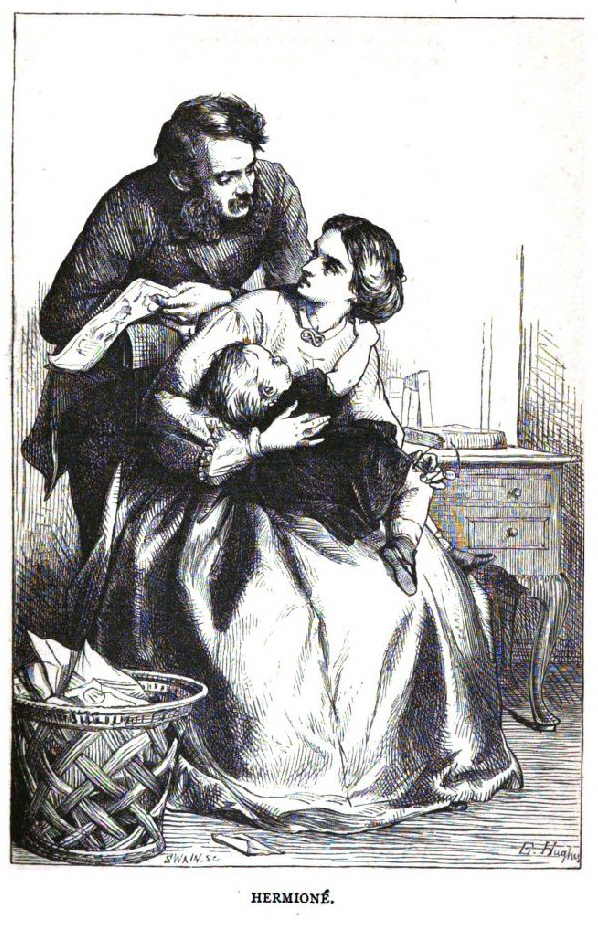
‘Hermioné’ was published in The Argosy (December 1865 - No. 1, pp.47-49).
_____
VERNER RAVN: A DRAMA.
CHARACTERS.
VERNER, called the Raven, a Norwegian barbarian, in arms against King Oluf the Holy.
HELGA. His Daughter.
ORM. His Son, a boy.
EBBESEN. A Heathen Priest.
VANA. A Sorceress.
ULV.
ERIK. } Barbarians.
BJÖRN.
PLACE: Norway. PERIOD: The reign of King Oluf, called the Holy, who forced Christianity on his kingdom with fire and sword.
SCENE: THE SACRED GROVES. High Druid Arches, surrounding an Altar, on the steps of which crouches VANA the SORCERESS. In the far distance, Mountains of Snow. A Dark Night, with the Moon driving through the Storm-Rack. Close to the Altar, gazing upward, EBBESEN. Distant thunder.
EBBE. From vale to vale pale Oluf’s banners pass
Triumphant, dreadful with the blood-red Cross,
Leaving upon their track the whitening bones
Of Odin’s children. Thrice hath Verner Ravn
Flown, shrieking hoarsely, with his scatter’d hosts;
And now, a price upon his head, he wanders
Homeless among these wilds; while nearer, nearer,
Comes Oluf victory-crown’d—the ghastly man,
Like to a skeleton equip’d in steel!
O spirits, to whom these hands have offered up
Life’s costliest sacrifice of flesh and blood,
Hither, from mansions of the sunless snow,
To Verner and your children!
Enter, hurriedly, ERIK and BJÖRN.
ERIK. He is here!
BJÖRN. He stands beside the Altar!—Ebbesen!
EBBE. Whence come ye in such haste?
ERIK. From Verner Ravn.
Again have we been scatter’d, and again
Is Verner conquer’d.
EBBE. [Hearken, and be pitiful!]
Where met the hosts?
ERIK. Yonder in Bergendal,
Under the hills, and fought a fearful fight,
Till one croak’d out aloud the chief was slain,
And panic-struck we fled. O Ebbesen,
Our enemies are not human!
EBBE. Wherefore not?
ERIK. Knife, bolt, and iron fail to penetrate
Their hard and glistening skins. The God they serve
Arms them against us.
EBBE. [Hear, ye pale gods, hear!]
BJÖRN. Onward they sweep like things ye cannot kill,
With ranks that gleam like corn against the sun;
And in their midst the bloodless monarch stalks,
Huge, gaunt, white-faced, with horror-gleaming eyes,
Making a burning circle with his sword
And striking down in fire!
Enter ULV.
ULV. Say, where is Verner Ravn?
EBBE. Ask the gods!
ULV. He fled this way,—I followed. O my friends,
All hope is gone! In yonder battle, Verner
Faced Oluf singly twice; twice, as he fled,
The ghastly leader laughed!
BJÖRN. Who comes?
ULV. ’Tis he!
Wild, haggard, bleeding, like a murder’d man
Started to life, he rushes hither.
VERNER rushes in, and prostrates himself before the altar.
VANA stirs, watching him intently.
VERNER. Odin!
Gods of the mists and snows! ye awful shapes
Who in Valhalla sit with sword on thigh,
Come from your halls behind the thunder-cloud,
Gather, O gather, gather!
EBBE. Verner!
VERNER (starting up). Ebbesen!
And ye—O cowards, that ye turned and fled
When victory was so near!
ERIK. It is too late—
Their god is strongest.
VERNER. Liar!
EBBE. It is true!
The gods are angry. Pale and fierce and still
They gaze upon thee from their icy realm
Beyond the thunder: white and tame the lightning
Plays round their dreadful foreheads silently—
They grasp it not to wither up the foe!
We must appease them.
VERNER. How?
VANA creeps forward, gripping the arm of VERNER.
VANA. By sacrifice!
At sunrise, Verner, must our choicest blood
Stain yonder altar.
VERNER. Vana!
VANA. Since the sun
Burnt to its setting, and the tempest gather’d,
Under the naked heaven have I lain
Communing with the dead. They answer’d me.
VERNER. Their answer?
VANA. Even this: “O widow’d Vana,
Whose husband Verner in his anger slew,
O Vana! homeless as the winter wind,
Hearken! The gods are wroth, yet would appoint
Verner the leader of their scatter’d children;
And this bright boon they will deny till blood
Appeaseth them!”—Nay, hush,—and hear the rest:
“That which is dearest to the Raven’s heart,
Must Verner, at to-morrow’s sunrise, slay
On yonder altar. Let his heart fail now,
And Oluf treads him down. Let him be strong,
And lo! his host shall conquer, and himself
Pass armëd to Valhalla!” (Aside) Now, ye gods,
I hold him!—Now, O husband, Sigurdsön,
Slumber in peace, avenged!
VANA and EBBESEN go up. ULV and ERIK whisper.
ULV. Question it not!
Their god is mightiest of gods, and ours
Speed shrieking from the thunder of his feet:
Wait calmly but the issue of to-night;—
If it be fatal, fly to Oluf!
ERIK. Oluf!
ULV. Yea,—with the head of Verner for a gift!
For Oluf, taught by him he serves, hath offer’d
Red gold for Verner’s life. When all is done,
The mighty god who makes the king so strong
Will guard our lives against the gods of Verner! [They retire.
VERNER. “That which is dearest to the Raven’s heart?”
Gods, I have given ye blood of friend and foe,
And still ye gaze with pale insatiate eyes,
Nor send the mighty wind whereby our foes
Shall droop and break and fall like stalks of corn.
What further can I offer ye, O gods,
Ere, on your fatal fields, I offer up
This battle-bruiséd body? (ORM passes.) Who goes there?
Speak!
ORM. ’Tis I!
VERNER. Orm?
ORM. Yea, father, Orm, thy son.
VERNER. Whence comest thou?
ORM. From within the cavern yonder,
Where thou didst leave me yesternight.
VERNER. And Helga?
ORM. Is yonder also, praying on her knees
That the great gods may charm thy life, and put
The battle in thy hands.
VERNER. She prays in vain!
The gods are angry with thy father, Orm!
I am again a shadow on the hills
Fleeing the foeman’s foot, alone, alone,
And hounded like the bird of prey I am!
(Aside, watching ORM earnestly) Can it be thus ye answer me, O powers?
Thirst ye for blood of one whose light young step
Is yet so weak upon the ground, whose arm
Would crack beneath the sword his father wields?
(Aloud) Come to my side, boy!—closer, let the moon
Scatter her dusky silver on thy face:
’Tis not too like thy mother’s face to show
Some glimmering of thy father’s soul beneath.
It was my precious dream, when thou wert born,
That thou shouldst be a warrior trained in arms—
Hast thou a warrior’s heart?
ORM. Ay! I were else
No son of thine! Oh, I have knelt and prayed
The powers above to hasten on the time
When by thy side, in battle, I might show
A spirit worthy thee.
VERNER. ’Tis bravely spoken!
Art thou prepared to die?
ORM. To die?—I am!
To die a warrior’s death; amid the din
Of battles, ’mong the dying and the dead,
Blood steaming in my nostrils, to be wafted
By spirits to Valhalla!
VERNER. That is well!
Yet, boy, the mighty gods will otherwise:
Thy fight shall be in regions far from here,
Beyond these hills where wearily we walk
With bloody footprints round us in the snow.
Yea, thou shalt die a calmer, grander death,
Mild as the going of a summer day,
On yonder holy Altar!
ORM (screaming). Ah!
VERNER. Be still!
Be silent! Is thy heart a craven, Orm?
Or art thou Verner's son?—Were it not glorious
To die for the good spirits who have made thee
So strong, so bold?
VANA interposes, gazing sternly at VERNER.
VANA. Verner, forbear!—and thou, (to ORM)
Get thee within the cavern! (Exit ORM.) Verner, Verner,
Dissemble not with thine own heart. The gods
Demand thy dearest gifts. Thou hast a daughter!—
(With malicious emphasis.) A girl whose eyes are blue and deep as water,
Whose face and frame are like the snow, whose motion
Is light as clouds upon a summer heaven!
The pale gods see that she is beautiful!
And smiling, with their large eyes fixed on thine,
As holy offering demand her. (A thunder-clap.) Hark!
They answer from their clouds. Why dost thou bow
Thy face within thy hands? (Thunder.) Hark! hear again
The muttering gods. Ha, wouldst thou be a slave
To slaves—that serve a petty spirit bred
I’ the summer storm o’ the south? Thou, o’er whose cradle
Fair Freya bent with falling golden hair,
That made a holy radiance round thy sleep!
Thou, by whose side immortal Bragi struck
His fiery harp-strings, while the melody
So blended with thy soul that it became
Part of the very motion of thy limbs!
Thou, bird of omen on the bloody field,
Raven of Battle, at whose shriek the hosts
Turn pale, and rush upon their dooms, and die,
Echoing thee!—Arouse, and follow me!
Strengthen thy heart with silence and with prayer;
Pray to the gods for courage; since, at sunrise,
Helga must die!
VERNER. Helga!—O gods, be pitiful!
’Tis doom’d! Thy dearest sacrifice once given,
The thunder-bolt drops down from yonder heaven,
The bloody Cross is rent, the Raven calls,
The ordeal is reversed, and Oluf falls.
Lo, steel thy heart and gain immortal life!
Lay bare the Altar, and uplift the knife!
Then raise aloft thy bloody hands and cry,
And crave the aid gods dare not then deny!
[Exeunt. The clouds thicken. Thunder and lightning.
VOICES IN THE STORM.
Lo! the blood of heroes
Stains our banquet-hall,—
Yea, the blood of women,
And of children small!
With the red feast drunken,
From the clouds we cry—
Pour the bright stream faster,
Lest we shriek and die!
And, like distant thunder,
Comes a sound of woe,
From the battles under,
To our thrones of snow.
Lay bare the altar!
Uplift the knife!
For the blood of mortals
Is our breath and life.
Ho, faster, faster,
Let the bright stream fall,
While we quaff and listen
In our banquet-hall!
Ah woe! ah terror!
As we cry aloud,
From the distance northward
Comes a thunder-cloud;
And within its shadow
Walk priests and kings,
And it floateth hither
With a sound of wings!
And behold! it opens,
And a Face snow-white,
Whose eyes are troubled
With a dreadful light,
Whose brow is bleeding
With a thorny crown,
Whence the blood-drops trickle
And brighten down,
Smiles strangely on us,
And approaches near,
With a peace we fade from,
With a light we fear;
And our thrones are thawing,
And our sceptres fall,
And the Face’s breathing
Melts our banquet-hall.
Lay bare the altar!
Uplift the knife!
For the blood of mortals
Is our breath and life!
For the pale Face brightens
From the southern sky—
Pour faster, faster,
Lest we shriek and die.
[The voices die in the distance. The scene grows lighter.
Enter HELGA.
HELGA. The cave is full of eyes and tongues!—wild shapes
Are thronging in the darkness, dreadful voices
Dismally moaning!—and methought I heard
Out in the tempest fearful mutterings
Of gods at strife. How cold it is! how still!
The storm is over, and the lightning, playing
On yonder snowy peaks without a sound,
Grows fainter, fading upward to its bourne
Beyond the clouds. I would that Orm were here!
Yea, even Vana’s cruel voice were sweeter
Than this dark silence. Hush! What sound was that?
VERNER (without). Hoa, Helga! Helga!
HELGA (clings affrightedly to one of the pillars). ’Tis no human voice
That shrieks so wildly! . . . Nay, an angry god
Beats the black air above with dreadful wings,
And calls upon me!
VERNER (without). Helga!
Enter VERNER.
HELGA. What art thou,
Who callest in so terrible a tone
For Helga?
VERNER (aside). She is here! (Aloud) Come hither, child!
Thy father calls thee!
HELGA. Father! . . . yea, indeed,
The lightning lights thy brow, and thou art he!
Why dost thou turn away, and hide thy face?
(The scene grows lighter.)
VERNER. Art thou alone?
HELGA. Alone!
VERNER. Methought I saw
A shadow at thy back,—as of a man,
Yet awful, like the shadow of a god!—
Why dost thou tremble?
HELGA. It is bitter cold,—
And—and—I fear thee!—See, thine eyes gleam strangely!
Thy voice is hoarse and awful!—and I feel
That thou art frowning on me!
VERNER. Frowning on thee!
O that a father’s brightest smiles could equal
The love I bear thee as I frown. Fear nothing!
My voice is broken with appeals to those
Who hear me not; mine eyes are bright with seeking
The light that never dawns in yonder sky,
Where stir the powers who heed me not. But hush!
Didst thou hear nothing?
HELGA. Only the whispering wind.
VERNER. The gods are out across the heavens to-night.
The lift is dark; but yonder, far away,
Faint silver streaks creep up behind the snows—
’Twill soon be dawn!
HELGA. Why dost thou grip me so?
Art angry with me?
VERNER. Angry with thee, Helga!
I am a woman when I look upon thee!
The blood-stained Battle-Raven, near to thee,
Becomes the innocent dove. Until to-night
I scarcely knew I loved thee half so well.—
Teach me to hate thee!
HELGA. Hate me!
VERNER. Creep unto me,
Hide thy fair face upon my bosom, thus,
And whisper in mine ears some hideous thing
That thou hast done—that thou hast even thought—
But speak not with thy buried mother’s voice
To rob me of my strength!
HELGA. O father! father!
The sorcerer Oluf hath a spell upon thee!
His black arts fret thee, and thy looks are wild,
Thy brain is dizzy, and thy limbs are feeble,—
Come in, and rest!
VERNER. Oluf! it is a name
To make me strong as Thor. His bloodhounds yelped
Around our hiding-place that summer night,
When in a mountain cave thy gentle mother
Woke on her bed of rain-soak’d reeds, stretch’d up
Her arms, drew down the face she could not see,
And kissing it, breath’d deep—and died. O child,
I have sworn a dreadful oath.
HELGA. What hast thou sworn?
VERNER. To tear the heart of Oluf from between
The iron ribs where now it beats so proudly,
And fling it to the wolves;—the toughest meal
The famish’d ever gnaw’d! It shall be done,
Ye gods, it shall be done? (In a very low voice) The dawn creeps near—
I feel its clammy breath upon my brow
From far away. O that some wondrous hand
Would hold the round sun down beneath the sea,
That sunrise ne’er might come.—’Twere bliss to grope
For ever in this darkness.
HELGA. Thou art mad!
VERNER. I am mad! and the gods have made me mad!
I am the rude barbarian Oluf calls me,
A cruel, peevish, wild, untutor’d man,
Whose playmates were the bear and mountain wolves;
And yet, if those cold gods would grant my prayer,
And hurl the blood-red horror from the land,
I could lie down between thine arms and sleep
Mildly as any lamb!
HELGA. Thou shalt do so!
Sleep—with thy dear head pillow’d on my knee!
Sleep—I will watch with loving, sleepless eyes,
And at the sound of any foeman’s foot
Will wake and bid thee fly.
VERNER. Fly! Verner fly!
Am I a wolf?—I am hunted like the wolves!
Ye gods, it shall be done. Helga, behold! (He draws the knife.)
HELGA. Something is glittering close before mine eyes!
VERNER. Feel!
HELGA. Something cold is pressed against my cheek!
VERNER. Child, ’tis the knife wherewith the sacrifice
Is slain on yonder altar! (Gripping her.)
HELGA (struggling). Father! father!
Thou wouldst not harm me!
VERNER (releasing her; vacantly). Harm thee? Nay, not I!
I am foolish, and I knew not what I said.
Is there no refuge from this thing, O gods?
O that for one short hour, one little hour,
The King and I stood face to face alone—
He arm’d with every spell that sorcery gives,
And I a famish'd thing, weary and weak—
Then would I give, ye gods, a sacrifice
To make ye glow thro’ all your banquet-halls
And rain your smiles on Verner. Answer me,
Ye spirits; are ye still so pitiless,
Forgetting, in your chilly lairs of snow,
Even the hunted Raven loves its young?
(As he walks up, the morning breaks, and the scene is suddenly bright. He screams and flings up his arms.)
Ha! ’tis the sun! Roll back, thou horrible light,
And leave us sightless in the happy dark!
He hears not! Higher—higher—higher!—gods!
He gleams upon the altar! (Sinks on the altar steps.)
HELGA. Ah, he raves!
Look up, my father!—It is but the sun,
The beautiful god that brings the warmth and light,
Who walks the bright blue sky, and hides his face
In wings of blinding gold!
VERNER (leaping up and seizing her). I have thee now!
I will not think—I will not pause to breathe
Until the deed is done. This way! this way !
Up to the altar!
HELGA. Help! What wouldst thou do?
Grip me not so . . . thou hurtest me!
VERNER. Be silent!
For thou must die!
HELGA. Die!
VERNER. Ay, the gods demand it!
It is ordained;—that cruel spirit comes
To drink into his greedy orbs of fire
The radiance of the sweetest eyes that live.
Come, come!
HELGA. O mercy, mercy!
VERNER. Ask the gods
For mercy—l have none.
HELGA. Thou canst not kill me!
VERNER. I must!
(He stands on the altar steps, holding her by the hair, and raising the knife; she clings to his knees, looking up at him.)
HELGA. Thou art too gentle! Long ago,
When I was playing at my mother’s knee,
Although thy face was rugged, fierce, and wild,
So that I cried, and feared it, didst thou not
Kiss me, and were thine eyes not dim with tears?
Thou art my father! thou didst give me life!
My mother taught me how to pray for thee
To those strange gods who led thee forth a-field!
I do remember many a woman’s task
Thy great strong hands have gently done for me;
Yea, many a merry sport to pleasure me,
And many a simple jest to make me smile.
Thy love conceives I am a little one still,
And frights me thus in sport.
VERNER (aside). Has my heart broken,
Or am I Verner Ravn? Can these tears
Moisten the eyelids of the bird of prey
Bloody and torn from battles. (Aloud) Child, prepare!
Stay! let me kiss thee once before thou diest,—
I could not bear to see thee go away
Before I kissed thee—thus? My child, my child,
The gods are pitiless, but their will is law
For miserable lives . . . Now, turn thy face!
I canst not slay thee looking in thine eyes!—
Thus!
HELGA. Must I die?
VERNER. I have sworn!
HELGA. Then will I die,
Thus hanging on thy neck and kissing thee,
Breathing my mother’s name! Is it not meet
A daughter should die thus? Uplift thy knife,
And think it is the babe upon the breast
Whom thou art slaying!
VERNER (dropping knife). O ye gods, ye gods!
Pitiless, pitiless, pitiless, pitiless!
Launch down your thunderbolts—set loose your fires—
Let your fierce thunders roar our people’s doom—
Scorch me, consume me, trample on me, curse me—
I will not do this deed!
[He falls, weeping, with his face to the ground. HELGA clings to the altar, looking upward. Full daylight.
DISTANT VOICES.
Lo! thawing, melting,
Are our thrones of snows,
And from them swiftly
A rainbow grows,
That brightens southward
With a singing sound,
And puts a sweetness
On the Face thorn-crown’d!
And the wingëd meteors
Burst brightly forth,
And illume the whiteness
Of the frozen North;
And looming dimly
On the cold white sky,
We clasp each other,
We implore and cry,—
And the meteors drink us
As we melt and die!
[The music dies away as the scene closes.
_____
‘Verner Ravn: a Drama’ was published in The Argosy (December, 1865 - No. 1, pp. 69-79).
___
ROMANCE FROM THE DANISH.
THE TREASURE-SEEKER.*
BY ŒHLENSCHLAGER.
WHILE winter snows were falling,
So glistening and white,
And while the tempest murmur’d
Across the fields by night,
Within the peasant’s dwelling,
Beside the peasant’s hearth,
They sat and talk’d together,
In fellowship and mirth.
Old Hans, in quiet gossip,
Sits where the oven glows
(What one would list to rather
Than the strange tales he knows?):
“But is it true, my father?
And is there treasure still,
Which unto favour’d mortals
The elves can give at will?”
“Ay, son, when the cock croweth,
One needs must seize it then!
But if a word thou speakest,
It vanishes again.”
Then in a silent wonder
All sat as still as stone,
When lo! a hasty knocking,
And the door was open thrown.
Then enter’d, spade on shoulder,
A stripling, snowy white;
A shadow is on his features,
But in his eyes strange light.
His locks are wild and tangled,
With melting snowflakes drown’d,
The look is full of sadness
With which he looks around.
* Skaltegraveren—signifying the digger after hidden treasures.
“It is so cold without there!
I am so stiff with cold!
Ha! hear ye not the tempest
Howling across the wold?
Ah! the cancer was so bitter,
And the earth as hard as stone;
Oh, help, that I my treasure
May lift and make my own!”
So pale he stands, and bloody,
They gaze in fear the while.
“Art thou a treasure-seeker?”
He nods with pensive smile,
And eagerly leaps upward;
Then, standing still once more,
Wipes strangely tearful eyelids
Ere he glimmers through the door.
His spade he quickly shoulder’d,
And whisper’d, “Follow me!”
And all the household follow’d,
Palely and silently.
In haste he crept, while midnight
Chimes solemn, dull, and deep,
Toward the silent churchyard,
Where the dumb dead men sleep.
Dimly along the darkness
His lantern glimmereth;
The churchyard gate he opens,
And gains the place of death.
The wondering peasants follow,
And quake with cold and fright,
While above the graves gleams ghostly
The lantern’s fitful light.
They follow, but in horror,
They, shrinking backward, gaze,
For the treasure gleams before them
In the faint and yellow rays.
The lantern glimmers dimly,
And they see with awful eyes
That among the graves below them
A blood-stain’d coffin lies.
“See!” cried the pallid stripling,
Wildly and eagerly,
“Here, in the grave’s embraces,
Lies my dearest treasure—see!
Lo! here, for four long hours,
Labour’d these arms of mine.
I bleed! the clock strikes midnight!
Eliza, I am thine!”
“Oh, gracious God of heaven!”
The peasants cried, “’tis he,
Who, when his sweetheart perish’d,
Lost reason utterly;
From home outcreeping hither,
In frenzy he has hied.”
So, pale as snows of winter,
The fearful peasants cried.
See how he wildly claspeth
The coffin to his breast!
Hark, how the death-clock chimeth!
O Jesu, give him rest!
See how the poor wretch quivers;
“Raise him!” the peasants said.
They drew him from the coffin;
He smiled—and he was dead!
‘Romance From The Danish: The Treasure-Seeker by Œhlenschlager’ was published in The St. James’s Magazine (December, 1865). In the previous month’s issue ‘Newton Neville’ had published an article entitled ‘Danish Romances’ which had included several other of his translations from the Danish. ‘The Treasure-Seeker’ is also included in Buchanan’s Ballad Stories of the Affections: from the Scandinavian, published in December 1866, in fact it is the only poem translated by both Buchanan and Neville, and the translations are completely different.
___
AT THE THRESHOLD.
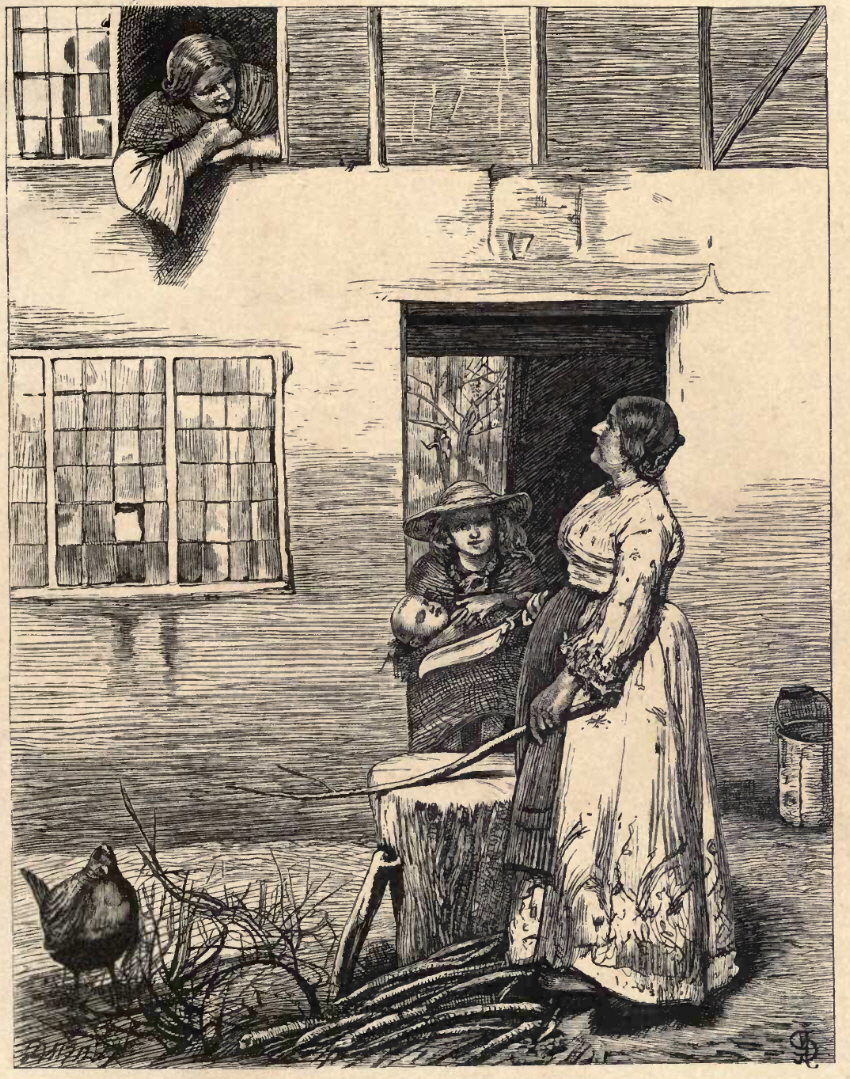
AY! there is Silly Nanny with the child!
And here am I, a-chopping wood, you see!—
For Tom has got the fit, and drinking wild—
We’ve a hard pull to manage such as he!
Drink makes him mad, and he will have his way;
I wouldn’t be the one to speak him nay;
But, Lord! his heart is right, his love is tried,
And we’ve a trick that serves our purpose best—
I chop the sticks, and make a bright fire-side,
And Nanny, though she’s witless, does the rest!
For though he’d frown on me when he’s in drink,
His girl can manage him and bring him round:
Though she’s no brains to use, no head to think,
Though Nature stinted her, her heart is sound.
Well, father sees her moving ’bout the place
With kindly ways and tender quiet face,
And thinks, I know, how Nature has denied
His Nanny wits, but made her all good-will,—
Then, his eyes fall upon the bright fire-side,
And he feels shamed to use his brains so ill!
He thinks,—how witless ones are good and kind,
How even silly beasts have gentle ways,
And all the while the fire-light fills his mind
With homely thoughts of cozier, brighter days;
And by the time I bring his cup o’ tea,
The drink is conquer’d, he has warm’d to me!
His eyes grow dim, he holds his arms out wide,
Poor Nanny brings the baby to his breast!—
Ay! there’s our plan! Make up a bright fire-side,
And leave a man’s own love to do the rest!
Robert Buchanan.
|