Home
Biography
Bibliography

ROBERT WILLIAMS BUCHANAN (1841-1901)

Poetry
Novels
Plays

Essays
Letters
Miscellanea

Harriett Jay
Critical Writings about Buchanan
The Fleshly School Controversy

Links
Site Diary
Site Search

{Ballad Stories of the Affections 1866}


        117

AXEL AND WALBORG;

OR,

THE COUSINS.


I. SIR AXEL BETROTHS THE CHILD WALBORG.

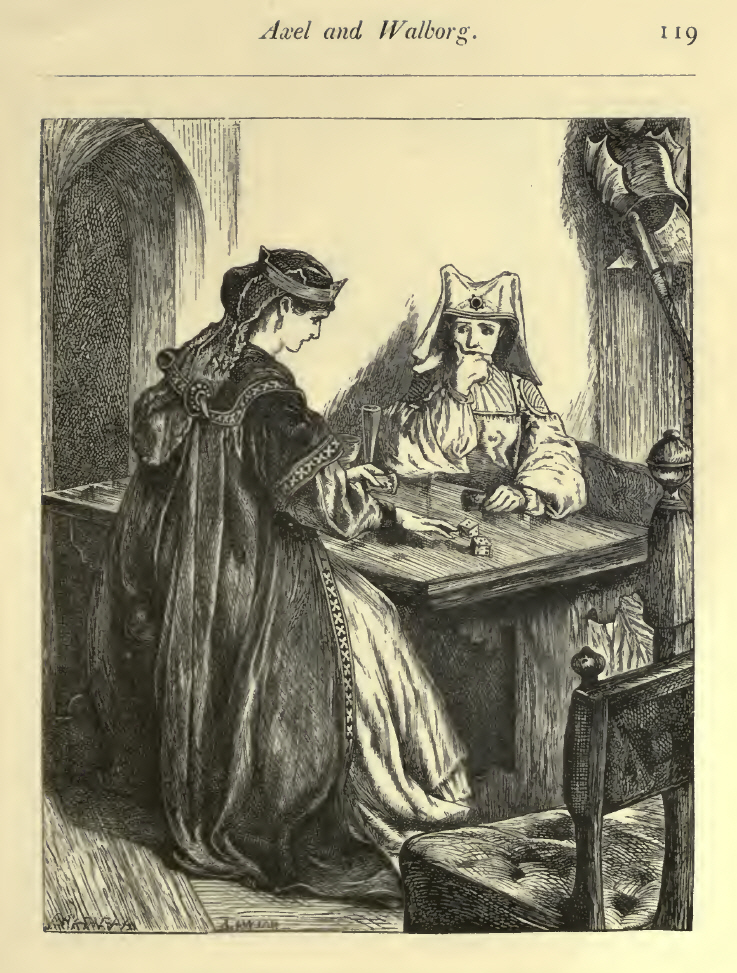
            THEY scattered dice on the golden board,
                 And blithe and merry were they;
            The two fair ladies face to face,
                 Smiled at the wondrous play.
            The wheel of Fortune goes round and round.

            And up and down were scattered the dice,
                 And round and round they rolled;
            And round goes Fortune’s wheel, too swift
                 For mortals to behold.

            Dame Juliet and Queen Malfred
                 The white dice nimbly threw;
            And on the floor, with apples and pears,
                 The bairn was playing too.

            The bonnie bairn with apples and flowers                                             118
                 Was playing on the ground,
            When in Sir Axel Thorsen stept,
                 And he for Rome was bound.

            He greeted the dames and maidens fair,
                 For a courteous knight was he;
            He smiled upon the bonnie bairn,
                 And took her on his knee.

            He tapped her on the white, white cheek,
                 For dear to him was she:
            “Now, would thou wert a woman grown,
                 Mine own true-love to be!”

            Then, covered o’er with seams of gold,
                 His youngest sister said,
            “Were she a woman grown this night,
                 Ye twain could never wed!”

            Then up and spake his mother dear,
                 And true, I ween, spake she:
            “My son, ye are too near of kin,
                 Though equal in degree.”

            For plaything to the bonnie bairn                                                          119
                 He gave his golden ring:
            The gift, ere she was woman grown,
                 Had set her sorrowing.

            “Now, mark thou well, my little bride,
                 We twain betrothen are;
            And now I leave thy side, to fight
                 For foreign kings afar.”


II. SIR AXEL’S RETURN FROM AFAR.

            ’Tis bright, bright where Sir Axel rides,
                 As out of the land he hies;
            ’Tis dark, dark in the cloister walls
                 Where his little true-love lies.
            The wheel of Fortune goes round and round.

            In cloister walls she learns to read,
                 And silken seams she sews;
            She turns into a maiden fair,
                 The bonniest flower that grows.

            She turns into a maiden fair,                                                                 120
                 And maidenly things is taught;
            And strange old songs and ancient lore
                 Sweeten her face with thought.

            Eleven years she in cloister dwelt,
                 Until her mother died,
            And she was ta’en to the Queen’s own Court,
                 And set at the Queen’s own side.

            Sir Axel serves in the Emperor’s Court,
                 With golden spurs at heel,
            And many are the knightly deeds
                 Done by his glittering steel.

            Sir Axel, sweetly stretched in sleep,
                 Full fair and still doth seem;
            But in the dead of night he groans,
                 And hath a fearful dream.

            Sir Axel in the high chamber
                 On silken cushions lies,
            But dreams he sees his own true-love
                 Stand pale before his eyes;

            He dreams he sees sweet Walborg stand                                              121
                 Clad in her velvet dress,
            And at her side Prince Hogen stoops,
                 Wooing in tenderness.

            Early at morning, at dawn o’ day,
                 When the laverock singing rose,
            Up leapt Sir Axel from his bed,
                 And tremblingly donn’d his clothes.

            Swiftly he saddled his good gray steed,
                 Swiftly he galloped along;
            Sadly he sought to forget his dream,
                 And hark to the wood-bird’s song.

            It was Sir Axel Thorsen,
                 Through the rose grove bent his way,
            And there, all in the morning-time,
                 He met a pilgrim gray.

            “Well met! Good day, thou pilgrim gray!
                 What may thy errand be?
            Now, from thy raiment it is clear
                 Thou art from my countrie!”

            “Norway it is my fatherland;                                                                 122
                 From Gildish race I come;
            And, bent to look upon the Pope,
                 I drag my way to Rome.”

            “If thou art sprung of Gildish race,
                 Then near of kin are we:
            Speak! dost thou know the fair Walborg?
                 Hath she forgotten me?”

            “Fair Walborg is a maiden sweet!
                 I ken her certainlie;
            Many a knight’s son, pale wi’ love,
                 Doth woo her on his knee.

            “Full oft fair Walborg have I seen,
                 All in her sable gear!
            The Court holds many a bonnie maid,
                 But none can be her peer.

            “And she is now a woman grown,
                 A lily white and tall;
            Ah! many a beauty lights the land,
                 But she is crown of all!

            “Dame Juliet sleeps ’neath kirkyard stone,                                            123
                 By her proud husband’s side:
            Queen Malfred fostered Walborg well,
                 When her dear mother died.

            “And gold is on her small white hand,
                 And pearls are in her hair;
            Yet is she named Sir Axel’s bride
                 By people everywhere.

            “They call her Axel’s own true-love,
                 Yet loveless is her lot;
            They seek her for Prince Hogen’s bed,
                 And murmur, and scheme, and plot.”

            It was Sir Axel Thorsen drew
                 His cloak across his face,
            And stept before the Emperor
                 All in the audience-place.

            “All hail to thee, my Emperor!
                 Thou art my lord and pride,
            And on my knee I crave thy leave
                 To fatherland to ride.

            “For strange men seek my goods and gear,                                           124
                 Now father and mother are dead;
            But most I fear for my own true-love,
                 Whom others seek to wed.”

            “Leave shalt thou have right willingly,
                 Herewith I give it thee;
            And till thou dost return again,
                 Thy place shall open be.”

            With armèd men from the Emperor’s Court
                 Doth Axel Thorsen hie,
            And all the Emperor’s courtiers bid
                 “Good speed,” as he rides by.

            With thirty armèd men behind,
                 So swiftly did he ride,
            That when he reached his mother’s gate
                 Not one rode at his side.

            Up to his mother’s castle gate
                 Rode Axel, gloomy and grim;
            There stood Helfred his sister sweet,
                 Who soothly greeted him.

            “Thou standest here, my sister sweet,                                                    125
                 Nor thought me close at hand!
            How fares Walborg, mine own true-love,
                 The rose of all the land?”

            “With that sweet May it fareth well,
                 For great hath been her gain—
            She is the Queen’s own waiting-maid,
                 And bonniest of the train.”

            “Thy counsel, sister, give to me,
                 As tender sisters can:
            How may I speak with my true-love,
                 Unheard by mortal man?”

            “Go, dress thyself in beauteous silk,
                 In silk and eke in fur;
            Say that thou carriest from me
                 A message unto her.”

        126

III. THE RE-MEETING.

            It was Sir Axel Thorsen
                 Unto the Court hied he,
            And as they came from vespers, met
                 The maiden companie.
            The wheel of Fortune goes round and round.

            He touched sweet Walborg’s white, white hand,
                 And soft and low he said,
            “I am a trusty messenger
                 From the fair dame, Helfred.”

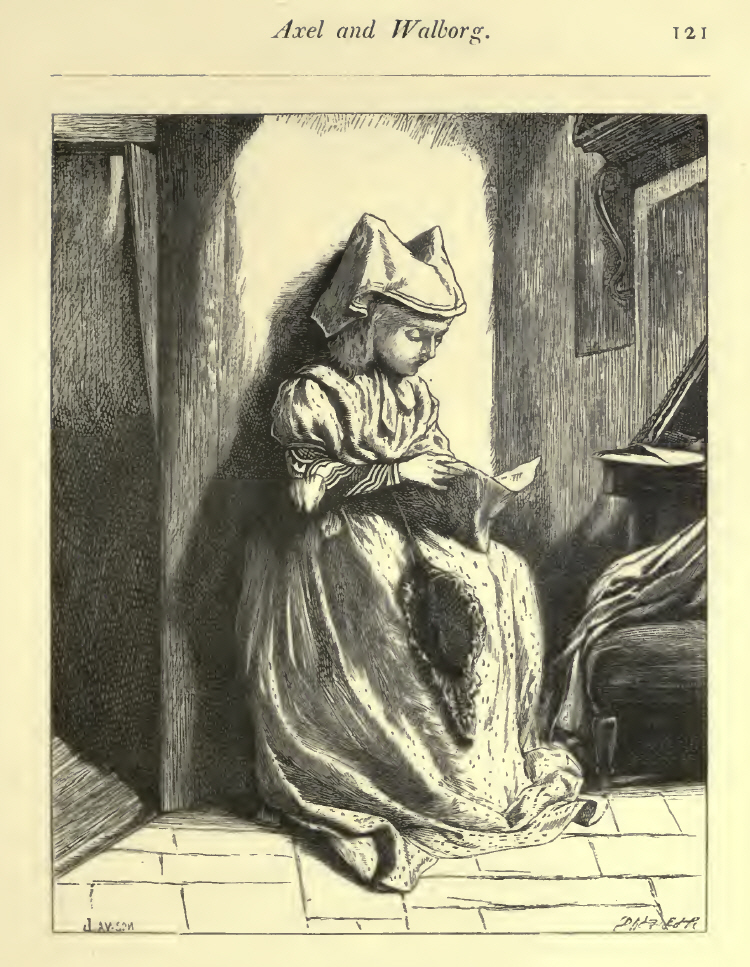
            She brake the seal, and on her knee
                 Spread smoothly out the screed,
            And there were words but one could write
                 For only one to read.

            There lay five rings of red, red gold,
                 Enwrought with lily and rose.
            “Walborg, thine own betrothen knight,
                 Sir Axel, sends thee those.

            “Thou vowed to be his own true-love,                                                  127
                 And wilt not break thy vow:
            I loved thee when thou wert a child,
                 And dearly love thee now.”

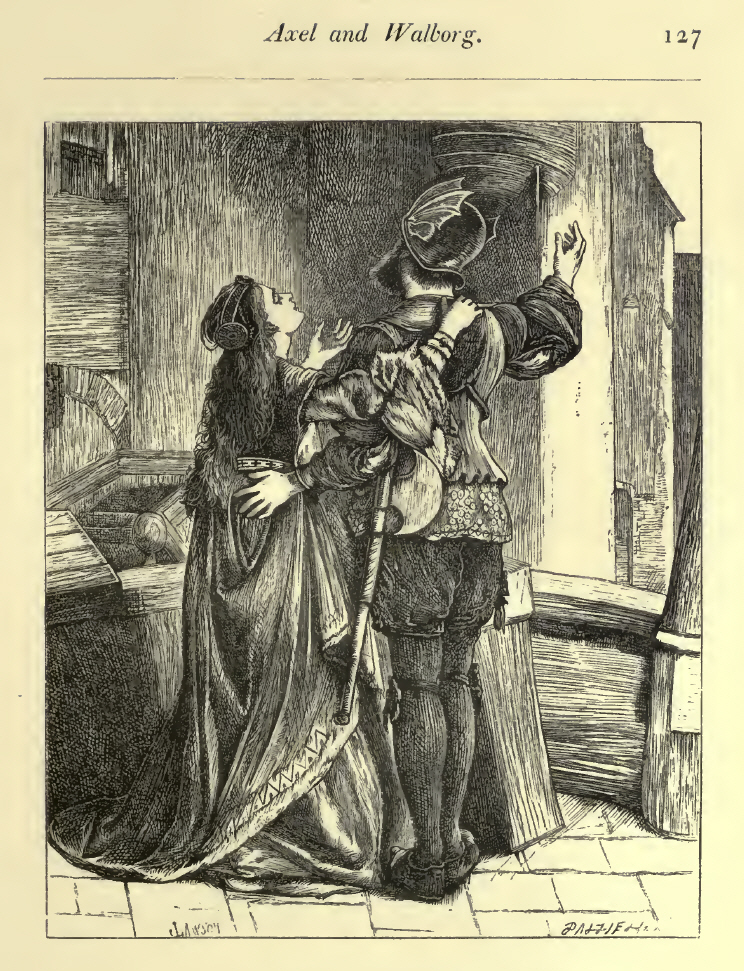
            There on the castle balcony,
                 By earth and heaven above,
            By everything that solemn is,
                 They sware a vow of love:

            By Mary Mother did they sware,
                 And by Saint Dorothy,
            In honour would they live and love,
                 And eke in honour die.

            Sir Axel rode to the Emperor’s Court
                 As blithe as well could be;
            Maid Walborg in the high chamber
                 Sat laughing merrilie.

        128

IV. PRINCE HOGEN WOOS WALBORG.

            For months full five they dwelt apart,
                 And months full nine thereto:
            Eleven earls’ sons at Walborg’s feet
                 Kneel down, and plead, and sue.
            The Wheel of Fortune goes round and round.

            Eleven fair and gallant knights
                 Knelt down, and prayed, and sued;
            And twelfth the proud Prince Hogen came
                 And early and late he wooed.

            “Hearken to me, O sweet Walborg!
                 O Walborg, turn and hear;
            Thou shalt be Queen and wear the crown,
                 An thou wilt be my dear!”

            “Hearken to me, Prince Hogen,
                 It is vain to plead and sue;
            Sir Axel hath my love and truth,
                 And I will aye be true.”

            Wroth grew the young Prince Hogen,—                                               129
                 Drew his cloak across his face,
            And hied unto his mother dear
                 All in the audience-place.

            “Hail unto thee, dear mother mine!
                 Thy counsel give to me!
            I seek to wive the May Walborg,—
                 She answereth scornfullie!

            “In honour and truth I sue and woo,
                 Offering riches and land;
            She cries Sir Axel is her dear,
                 And he shall have her hand.”

            “If May Walborg her troth hath given,
                 Then is she vowed and won,
            And many a May as sweet as she
                 Bides in the Court, my Son.”

            “Full many a May is at the Court,
                 But none so high in grace;
            Full many a noble May I ken,
                 Yet none so fair of face.”

            “Thou canst not win the maid by force,—                                             130
                 That were a shame and woe;
            Thou hast a sword, but he she loves
                 Can wield a sword alsò!”

            More wroth grows young Prince Hogen,
                 And from the palace flies,
            And meeteth Knud, the Black Friàr,
                 With coal black hair and eyes.

            “Why paceth my lord so sadly forth,
                 With dull and heavy gait?
            If aught hath happ’d to cause him woe,
                 Let him unfold it straight.”

            “A grievous woe hath happ’d to me,
                 A sorrow sore to tell:
            The fair Walborg betrothen is
                 Unto the young Axèl.”

            “Ne’er shall he bear the maiden home,
                 Though they betrothen be,
            For in our cloister black we keep
                 May Walborg’s pedigree:

            “And they are born of two sisters,                                                        131
                 Full stately dames and fair,
            And one nurse held both lass and lad
                 When they baptizèd were.

            Thence brethren by the cloister law
                 They are full certainlie,
            Thence can we prove them lass and lad
                 Akin in fourth degree.

            “To chapter summon priests and clerks,
                 And they shall swift decide:
            Sir Axel by the cloister black
                 Shall lose his lily bride!”


V. THE CHURCH DISSOLVES THE BETROTHAL.

            It was the young Prince Hogen
                 Spake to his trusty groom:
            “Go, summon Walborg’s uncles straight
                 Into the audience-room.”
            The Wheel of Fortune goes round and round.

            The earls around the broad board stand                                               132
                 And the great chamber fill:
            “Our noble lord hath sent for us,
                 And we would hear his will.”

            “Your bonnie niece, the sweet Walborg,
                 In honour I crave of ye,
            And surely if ye will consent,
                 The May my Queen shall be.”

            Answered the maiden’s uncles three,
                 And their delight was great,
            “Thus to be sought by the prince himself,
                 Sooth, she is fortunate!”

            It was the noble uncles wrapt
                 Their faces in mantles red,
            And strode into the high chamber
                 Before the Queen, Malfred.

            And first they hailed the comely Queen,
                 And wished her right good cheer,
            And then they hailed the sweet Walborg,
                 Who waited trembling near.

            “Hail unto thee, O bonnie niece!                                                           133
                 Fair may thy fortune be!
            If thou wilt take the fair young prince
                 Whom we would wed to thee.”

            “And have ye falsely promised me?
                 Then hearken what I say,—
            To Axel, to my dearest dear,
                 I will be true for aye.”

            Then answered back her uncles three,
                 Those mighty earls and bold,
            “Never, in sooth, thou wilful girl,
                 Shalt thou that troth-plight hold.”

            It was the young Prince Hogen,
                 He hastily wrote again,
            And summonèd the archbishop,
                 With his clerks seven times ten.

            It was Erland the archbishòp,
                 He read in angry mood,
            “Shame on the planner of this deed,
                 Ay, first and last, on Knud!”

            Proud Erland stood before the board,                                                   134
                 And spake full calm and clear:
            “My honoured lord hath sent for me,
                 And humbly wait I here.”

            “I have a bonnie maiden wooed,
                 Whom thou shalt make my bride:
            Dear is Sir Axel to her heart,
                 But he must stand aside.”

            They wrote the solemn summons out,
                 They read it out in state,—
            It called the lovers to appear
                 Before old Erland straight.

            The matin-song was sounding,
                 All in the morning tide—
            To kirk, and with his own true-love,
                 Must young Sir Axel ride.

            The knight he climbs upon his steed,
                 And sighs to hear the bell;
            The May rides in her coach behind,
                 And hides her sorrow well.

            The knight hangs o’er his saddle-bow,—                                              135
                 His thoughts they wander wide;
            The May rides in her coach behind,
                 And hides her pain by pride.

            Without the Kirk of our Ladye
                 They all from horse alight,—
            Into the holy kirk there steps
                 Full many a gallant knight.

            There in the aisle are the lovers met
                 By the bishop and his clerks,
            And woefully their faces look,
                 To every eye that marks.

            There meeteth them the archbishòp
                 Holding his silver wand,
            And round about with gloomy looks
                 The Black Friar brethren stand.

            Then forth stept Knud the Black Friàr,
                 The convent book gript he,
            And read that Axel and Walborg
                 Were kin in fourth degree.

            The record old of the convent cold                                                       136
                 He read full loud and slow;
            Akin were they by rite of kirk,
                 Akin by birth alsò.

            Cousins by birth they surely were
                 In fourth degree akin;
            For such to wed, the grim law said,
                 Were little else than sin.

            They both were born of Gildish race,
                 Akin in fourth degree:
            Sir Axel and the fair Walborg
                 Must never mated be.

            “One nurse held both unto the font
                 When they were baptizèd;
            Sir Asbiorn sponsor was to both,”
                 The ghostly record said.

            Yea, kin they were by birth and blood,
                 And kin by ghostly rite,—
            The kirk forbade that such a pair
                 In honour should unite.

            Up to the altar they were led,                                                               137
                 Weary and pale of hue:
            They placed a kerchief in their hands,
                 And, praying, cut it in two.

            They placed the kerchief in their hands,
                 And cut it cruellie.
            “The hand of Fate is stronger far
                 Than any folk that be.

            “The kerchief ye have cut in two,
                 And still we hold the parts,
            But never, never can ye cut
                 The love of leal young hearts.”

            They took the ring from her fingèr,
                 The bracelet from her hand,
            They gave the knight his gifts again,
                 Breaking the true-love band.

            Sir Axel on the altar cast
                 Bracelet and ring of gold,
            And sware so long as he did live
                 His love should ne’er grow cold.

        138

VI. PRINCE HOGEN IMPEACHES WALBORG’S PURITY.

            Then wroth grew young Prince Hogen,
                 Wrapt in his mantle red.
            “If thou canst not forget her now,
                 She is not pure!” he said.
            The wheel of Fortune goes round and round.

            Up spake the good old archbishòp,
                 All in his priestly guise,
            “Who knoweth not the strength of love
                 I hold to be unwise!

            “Water may quench the flaming fire,
                 Put out the brand ablaze,
            But the fire of love in mortal breast
                 No power of earth allays.

            “Hot, hot is the summer sun,
                 And who its heat can still?
            Hotter far is the fire of love,
                 And it must cheer or kill.”

            Young Hogen spake to young Axèl                                                      139
                 Wrapt in his mantle red,
            “This thing, I swear, shall have an end,
                 Though I should die!” he said.

            Wroth grew the young Prince Hogen,
                 Treading the paven floor:
            “To-morrow shalt thou swear an oath,
                 Or rue thy baseness sore.

            “To-morrow shalt thou swear an oath
                 Upon thy sword and glaive,
            That, falsely wooing fair Walborg,
                 Thou ne’er hast played the knave.”

            “And must I swear upon my sword
                 Walborg from stain is free?
            That will I do, and with my sword
                 Uphold her purity!”

            Sir Henrik’s wife, Dame Eskelin,
                 Awoke from sleep in fright:
            “Saint Bridget clear unto my soul,
                 What have I dreamt this night!

            “I dreamt my cousin Juliet rose                                                             140
                 Out of the black, black grave,
            And cravèd me full sisterlie
                 Her child, Walborg, to save.

            “Lord, I have seven sons, and each
                 Hath thirty men beside—
            Let them go bind the sword on thigh,
                 And unto Walborg ride.

            “Lord, saddle, saddle ten good steeds,
                 And ride in lordly state;
            Follow thy sons! stand by her side!
                 It is not yet too late!

            “Seven sons we now together have—
                 Seven strong and goodly wights—
            And it is now our hope and joy
                 They hold themselves like knights.

            “I and Dame Juliet alsò
                 Were of two sisters born;
            And by this deed against Walborg
                 We two are brought to scorn.”

            The sun is shining on the heath,                                                             141
                 All in the morning-tide,
            As, bent to swear Walborg is pure,
                 The gallant champions ride.

            Sir Axel, all in armour clad,
                 Reached out his hand, and cried,
            “Welcome, ye knights of Gildish race,
                 Right welcome, to my side!”

            The seven knights then forward strode
                 Arrayed in sable all:
            “We come to swear with Sir Axèl,
                 And with him stand or fall!”

            Then tears ran down the maiden’s cheek
                 Like rain, and she made moan:
            “What men that be will swear by me?—
                 I am alone, alone!”

            Then answered back her uncles three,
                 Those wroth and angry men,
            “Thou hast loved alone—thou hast sworn alone—
                 Thou canst swear alone again!”

            But murmured Erland, archbishòp,                                                       142
                 With mild and gentle mien,
            “Kinsmen thou hast full many here—
                 Friends only few, I ween.

            “Kinsmen thou hast full many here,
                 Yet none to take thy part:
            God help thee from thy peril now,
                 And soothe thy gentle heart!”

            “My father and my mother are dead,
                 And piteous is my plight;
            But God, who helpeth all in need,
                 Knows well my soul is white.

            “Dame Juliet sleeps ’neath the marble stone,
                 Sir Immer in black, black clay;
            I should not stand alone and weep
                 Were they alive this day.”

            And while she sat in sorrow and fear,
                 Weeping and desolate,
            She saw Sir Henrik riding swift
                 Up to the castle gate.

            With hasty step he ran to her,                                                               143
                 And cheerfully he cried,
            “Thou goest to take the oath, and I
                 Will take it by thy side.

            “Dame Eskelin, my own goodwife,
                 Holdeth thine honour dear;
            Thy mother and she were kin by blood,
                 And therefore am I here.

            “Now, forward, forward, my seven sons,
                 And swear the May is true;
            Seven sons of Carl from Sonderland
                 Will do as we must do.”

            Seven earls’ sons, in sable clad,
                 Stept lightly forth to swear—
            Full daintilie they all were clad,
                 And curlèd was their hair.

            Seven young counts stept forward next,
                 And fair was each and bold,
            Curled also was their golden hair;
                 Their swords were bright with gold.

            “To swear the May is free from stain,                                                   144
                 Ho! hand in hand come we:
            Step forth and speak, O noble pair!
                 For all shall hark to ye.”

            One hand upon the Mass-book laid,
                 The other on his brand,
            Sir Axel swears; and, round about,
                 His gallant kinsmen stand.

            He held the sword-hilt in his hand,
                 The blade upon a stone,
            And there he swore the May was pure,
                 And in no woman’s tone.

            “Dear, dear to me is May Walborg,
                 That stainless May and meek,
            Yet never have I been so bold
                 As even to kiss her cheek!”

            She touched the Mass-book with her hand,
                 Sware by our Lady of Grace,
            “Mine eyes have scarcely been so bold
                 As look into his face.”

            They raised bright banners o’er her head,                                             145
                 And none her oath denied,
            And they bare her along unto her bower,
                 And called her “Prince’s Bride.”

            Outspake young Prince Hogen
                 Unto that gathering bright,
            “Never a gentleman or squire
                 Shall ride away this night.”

            He said, “The bonnie May Walborg
                 I my Heart’s Dearest hold,
            And she shall be mine own sweet Queen,
                 And wear the crown of gold.”


VII. THE LAST FAREWELL.

            The cloth was spread, the board was filled,
                 The mead and wine ran free:
            Sir Axel Thorsen sat apart,
                 Beside his lost ladie.
            The wheel of Fortune goes round and round.

            “Speak to me, speak to me, Heart’s Dearèst,                                       146
                 While here we sit alone;
            What peace remains on earth for me,
                 What cheer for thee, mine own?”

            “If they should wed me to the King
                 And crown my brow with gold,
            Although I live a thousand years,
                 My love will ne’er grow cold.

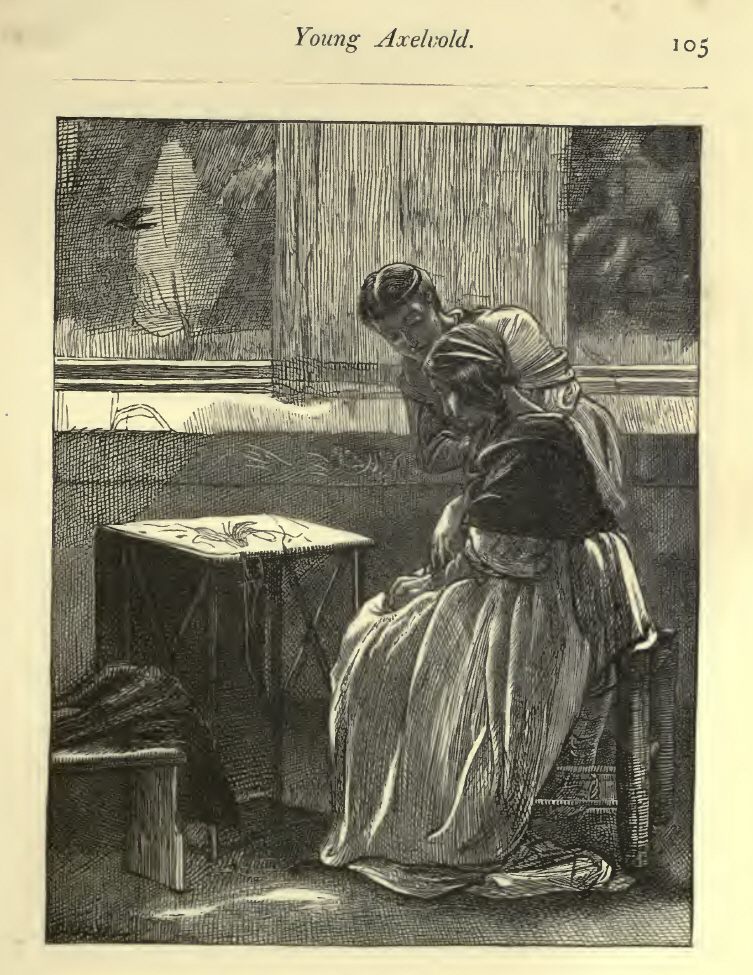
            “But I will gold embroidery sew,
                 And moan for my true-love;
            In lonely pain will I remain,
                 Like to the turtle-dove:

            “She sleepeth not in greenwood bough,
                 She seeketh not to eat,
            She drinketh ne’er the pure clear well
                 Till muddied with her feet.

            “But thou, my lord, wilt gladly ride
                 To hunt the forest hart;
            If thoughts of me e’er trouble thee,
                 Full soon they will depart.

            “Ay, thou, my lord, wilt merrilie ride                                                     147
                 To chase the hind and hare;
            If thoughts of me e’er trouble thee,
                 They will be light as air.”

            “And if I chase in greenwood grove
                 To drown the thought of thee,
            What shall I do at midnight hour
                 When sleep comes not to me?

            “My lands and goods I straight will sell
                 For pieces golden red,
            And hie away to a strange countrie,
                 And mourn till I be dead.”

            “Dear lord, sell not thy goods and lands
                 For pieces golden red,
            But hie away to old Asbiorn,
                 And wive his child, Alhed.

            “Hie there, and woo the fair Alhed,”
                 The weeping Walborg cried,
            “And I will take the mother’s place,
                 And sadly bless the bride.”

            “Never will I fair maiden woo,                                                              148
                 Never, ah, nevermore!
            I will be leal, though I might wed
                 The child of the Emperòr!”

            In stept Erland, archbishòp,
                 And tapped their cheeks of snow:
            “Now must ye say a sad ‘good-night,’
                 For it must e’en be so.”

            The archbishop raised up his hand,
                 And angrily cried out,
            “Shame be the fall of Black Friar Knud,
                 Who brought this grief about!”

            Sir Axel bade the May good-night,
                 And his voice was hoarse with pain,
            His heart was aching with its woe
                 Like a slave beneath his chain.

            Fair Walborg hied to the high chamber,
                 And her maidens followed slow,
            Her heart was like the flaming fire,
                 Her cheek was like the snow.

            Early in the morning-tide,                                                                     149
                 When sunshine ‘gan to fall,
            The gentle Queen arose from sleep,
                 And called her maidens all.

            Queen Malfred bade her maidens sweet
                 To work the red, red gold;
            But still stood May Walborg, with heart
                 As full as it could hold.

            “Hearken, Walborg, bonnie May!
                 Why stand so sad aside?
            Thy heart should happy be, because
                 Thou art a prince’s bride.”

            “Rather would I Sir Axel have,
                 And love as poor folk may,
            Than take the mighty gift ye bring—
                 The crown of all Norwày.

            “Ah, little care my kinsmen proud,
                 But smile to find it so;
            My heart may bleed, my eyes may weep,
                 My life may melt like snow!”

        150

VIII. HOGEN AND AXEL FIGHT AGAINST THE ENEMY.

            A gloomy time, two weary months,
                 Passed bitterlie away:
            Sir Axel and the fair Walborg
                 Smiled neither night nor day.
            The wheel of Fortune goes round and round.

            Then came a war upon the land,
                 And the foe rushed on in might;
            The young Prince Hogen verily
                 Must lead his folk to fight.

            Prince Hogen called his men to field,
                 Yea, priests and clerks alsò.
            Sir Axel was a gallant knight,
                 And was not loath to go.

            It was the young Prince Hogen
                 Rode up and down the land,
            And called unto him every man
                 With strength to wield a brand.

            He called upon him every man                                                              151
                 Who could a weapon wield,
            And as a captain of the host
                 Bids Axel hie afield.

            Sir Axel’s shield was blue and white,
                 And terriblie it shone,
            And all the warriors could see
                 Two bleeding hearts thereon.

            There riding forth afield they saw
                 The foeman’s armour glance:
            In sooth, ’t was bloody strife of men,
                 And not a ladies’ dance!

            Sir Axel strikes for fatherland,
                 His sword reeks hot and red:
            They who come face to face with him
                 Drop from their saddles, dead.

            Full many a gallant gentleman
                 By his strong hand doth bleed;
            The noble and the base alike
                 He tramples ’neath his steed.

            He slays the lords of Oppeland,                                                           152
                 Who ride on chargers tall;
            King Amund’s sons fall by his hand,—
                 Full gallant foemen all.

            As thick as hay by peasants tost,
                 The killing arrows fly;
            Prince Hogen drops upon the dust,
                 And, wounded sore, must die.

            It was the young Prince Hogen
                 He dropt from his charger gray;
            Sir Axel to the prince’s side
                 Full swiftly cut his way.

            “Hearken, Sir Axel Thorsen,—
                 Avenge my death on the foe,
            And thou shalt get my lands and crown,
                 And May Walborg alsò.”

            “Terribly will I wreak thy death
                 Upon the coward foe:
            Though score on score encircle me,
                 I’ll give them blow for blow.”

            Sir Axel seeks the thick o’ the fight,                                                      153
                 With black and angry frown,
            And every wight he meets in fight
                 Is slain and trampled down.

            So manfullie Sir Axel fought,
                 No man his sword dared meet;
            Swiftly he slew the gallant foe
                 As a reaper reapeth wheat.

            So manfullie Sir Axel fought,
                 Till his armour stained the field,
            So manfullie Sir Axel fought
                 Till cloven was his shield;

            Still manfullie Sir Axel fought
                 Until his helm was cleft;
            Yet manfullie Sir Axel fought
                 Till his sword brake at the heft.

            With eight red wounds upon his breast
                 Sank Axel, worn and spent;
            Deeply he breathed, brightly he bled,
                 As they bare him to his tent.

            Ah! woefully Sir Axel bled                                                                   154
                 After the victorie:
            The latest words he spake alive
                 Were of his dear ladie:

            “Say to my love a thousand ‘good-nights;’
                 Our Lord will soothe her pain:
            In heaven above full speedilie
                 We two shall meet again!”


IX. WALBORG HEARS THE FATAL NEWS.

            In before the fair Queen’s board
                 Sir Axel’s page did walk;
            He was a wise and gentle child,
                 And fittingly could talk.
            The wheel of Fortune goes round and round.

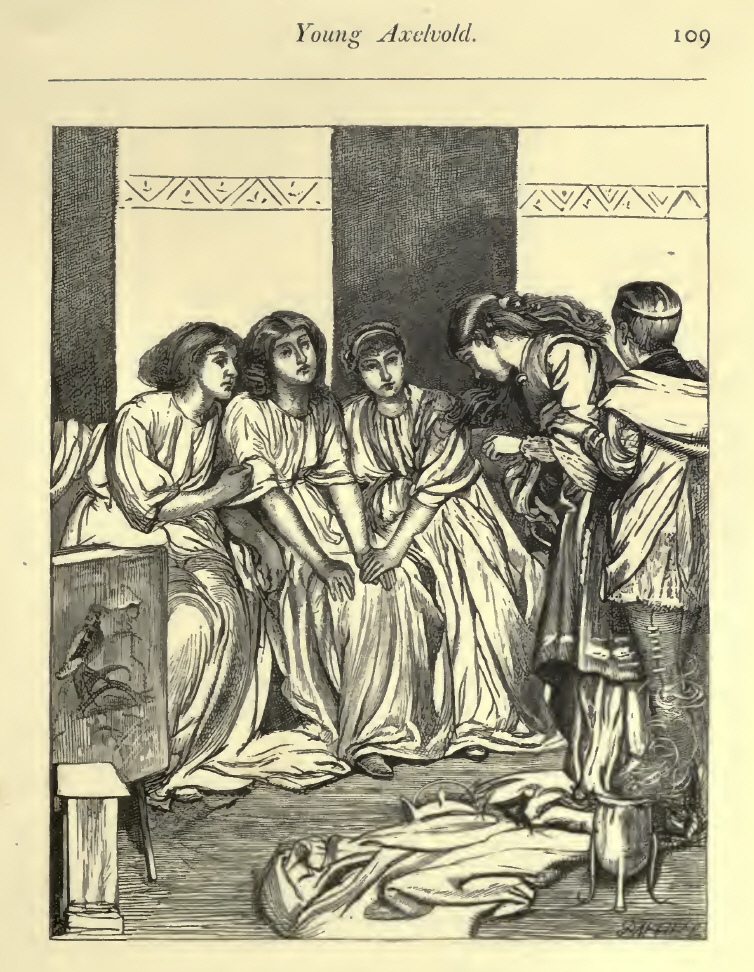
            “Maidens, who sew the linen white
                 And eke the silk so red,
            Prince Hogen and the young Axèl
                 They both are lying dead.

            “Dead is the young Prince Hogen,                                                        155
                 He lies on his bier of death!
            Sir Axel to avenge his fall
                 Fought till his dying breath.

            “And they have won the victorie,
                 And they for Norway died,
            And many a knight lies dead afield,
                 And many a swain beside.”

            Ah! bitterlie Queen Malfred wept
                 All for her gentle son;
            Sweet Walborg wrang her lily hands
                 For her belovèd one.

            May Walborg called her little page,
                 And murmured woefullie,
            “Haste! haste, and find my chest of gold,
                 And bring it in to me.

            “Place my gray steed in the chariot red,—
                 To cloister I’ll begone;
            I never can forget Axèl
                 So long as I live on.”

            Without the Kirk of our Ladie                                                              156
                 She from her chariot stept,
            And as she stept into the kirk
                 Most bitterlie she wept.

            She took the gold crown from her head,
                 She set it on a stone.
            “And never will I mate with man,
                 But live a maid alone.

            “Twice have I been a maid betrothed,
                 But never yet a wife,
            And now unto the cloister cold
                 I give my woeful life.”


X. WALBORG TAKES THE VEIL.

            They brought to her the red, red gold
                 That filled the golden chest,
            She shared the same among the friends
                 Who had been goodliest.
            The wheel of Fortune goes round and round.

            She took the great neck-band of gold,                                                  157
                 Inlaid with jewels fine,
            And that, for having loved her long,
                 She gave to Eskeline.

            Unto Sir Henrick next she gave
                 The great clasped armlet bright,
            Because he sware with mouth and hand
                 Her name and fame were white.

            She took a hundred golden rings,
                 And silver and gold good store,
            And these she gave the gallant knights
                 Who with Sir Henrick swore.

            She dowered the kirk and cloister old,
                 And priests and clerks so gray,
            That they for Axel’s soul and hers
                 With daily Mass should pray.

            She gave to widows and fatherless bairns,
                 And footsore pilgrims old,
            And to the image of Saint Ann
                 She gave her crown of gold.

            “Hither, hither, O archbishòp,                                                               158
                 Scatter me o’er with clay!
            For here I take the cloister oath
                 And quit the world for aye.

            “Hither, hither, O archbishòp,
                 And make me God’s alone,
            For ne’er shall I quit cloister more
                 Till I be cold as stone.”

            Many and many a gallant knight
                 Wept like a little child
            To see them cast the black, black dust
                 Over that maiden mild.

            So sweet Walborg in cloister dwelt
                 A weary nun for long,
            And never missed the blessed Mass
                 Or holy vesper-song.

            Full many a noble woman and maid
                 In cloister dwell, I wis,
            But never a maiden of them all,
                 So fair as Walborg is.

            Far better never be born at all                                                              159
                 Than wearily mourn and ’plain—
            Than drink a bitter daily cup,
                 And eat the bread of pain.

            God’s ban be on the wicked churl,
                 And thriftless may he be,
            Who tears in twain two lovers’ hearts
                 That love so tenderlie!
            The wheel of Fortune goes round and round.


        160

THE BLUE COLOUR.


            I LOVE you, Heaven’s divinest blue!
            The light I cannot reach unto;
            With earthly joys and wishes, I
            Remain heart-laden utterly.

            I love the shadowy blue of waves,
            That whisper in the sweet sea-caves;
            But earth so pleasant is to me,
            I would not sail upon the sea.

            I love the blue of yonder plots,
            Where blow the sweet forget-me-nots;
            But dare not pluck them from their bed,
            They would so soon be vanishèd.

            The blue for me—and here it lies,
            Sweet-shining in my true-love’s eyes,
            Where flower’s blue, heaven’s blue, sea’s blue shine,
            Mingled, to make my bliss divine.


        161

THE ROSE.


        IN the warmth of a singer’s chamber, where never wild wind blew,
        Whither no cold was wafted, a tender rose-tree grew.

        The sweet wood sent out knots, and each a red rose gave:
        And “My tree,” cried the happy singer, “shall grow upon my grave!”

        Then came the Angel who smileth through tears while mourners weep,
        And the tree was red and in bloom, but the singer was asleep.

        And his friends fulfilled his wish: the tree grew over the dead;
        The sunrise shimmered upon it, and the sunset stained it red.

        But the cold, cold winds of night blew in the leaves of the tree;                                  162
        Alas! ’twas born for a chamber, not for the life of the free.

        Poor tree! in the air of freedom thou couldst not live and grow,
        Whence over thy grave, poor singer! not one of thy roses blow!


      163

LITTLE CHRISTINA’S DANCE.


            LITTLE CHRISTINA, come dance with me,
                 Hither unto me!
            And a silken sark will I give to thee.”
                 For methought that no one knew me!

            “A silken sark is a precious thing,
            But I would not dance for the son of a King.”

            “Little Christina, come dance with me—
            Two silver shoes shall thy guerdon be.”

            “Two silver shoes were a guerdon fair,
            But I would not dance with the King’s own heir.”

            “Little Christina, come dance with me,
            And a red gold band I will give to thee.”

            “A red gold band is a precious thing,
            But I would not dance for the son of the King.”

            “Little Christina, come dance with me,                                                  164
            And half a gold ring shall thy guerdon be.”

            “I dance not for half of golden ring—
            I would not dance with the son of the King.”

            “Little Christina, come dance with me—
            Two silver knives will I give to thee.”

            “Two silver knives were a guerdon fair—
            But I would not dance with the King’s own heir.”

            “Little Christina, come dance with me,
            And my honour and troth I will plight to thee.” *

            Into his arms leapt the little one fair—
            The pale, pale face set in golden hair.

            Round and round the dancers sped,
            Till the cheeks of Christina were rosy red.

            “My troth and plight I have given to thee”—
            They are wedded together where none can see.

            The days and the nights have swiftly flown:                                            165
            Little Christina is all alone.

            On a mantle spread in a secret place,
            Christina lies with a blush on her face.

            To the King on his throne a murmur runs—
            “Little Christina hath two little sons.”

            Lonely little Christina lies:
            There is royal light in her little ones’ eyes.

            The monarch stands by the maiden’s bed,—
            He covers his face and bows his head:

            He covers his face with his mantle blue:
            “Name me the sire of thy children two.”

            “Now God the Father forgive my shame!
            Be he living or dead, I know not his name.

            “My father wandered the ocean o’er;
            He built me a bower on the ocean shore.

            “Thither came men of the stormy sea,
            With dancing and feasting and melody;

            “Thither came men of the stormy sea,                                                   166
            Each of them seeking to marry me.

            “With none of them danced I night or day,
            No man of them stole my heart away.

            “A stranger plighted his troth to me—
            We were wedded together where none could see.”

            “Hearken, little Christina, to me:
            What gifts did the stranger give to thee?”

            “He gave me a sark of the silk so fine,—
            It covers this beating heart of mine;

            “He gave me shoes of the silver bright,—
            They are worn with seeking him day and night;

            “He gave me a band of the red, red gold,—
            It burns like fire on my temples cold;

            “He gave me the half of a golden ring,—
            Shame and pain may the other half bring!

            “He gave me two silver knives of price,—
            Would they were stuck in his heart of ice!”

            The monarch trembled and tried to speak,                                            167
            Then plucked the mantle of blue from his cheek.

            “O little Christina! my sweet! my true!
            I am the sire of thy children two!

            “O little Christina! my sweet! my true!
            That dance of thine thou shalt never rue!”

            He clasps in his arms the little one fair,
            The pale, pale face set in golden hair.

            The rumour wanders from town to town—
            She is Queen Christina, and wears a crown!

            Little Christina is throned in pride—
                 Hither unto me!
            She sits by the King of Denmark’s side.
                 For I thought that no one knew me!


* This plighting of troth was, as nearly as possible, equivalent to marriage.


168

THE TREASURE-SEEKER.


              WHILE the white snows are falling
                   So glistening and cold,
              And while the chilly tempest
                   Shrieks in the wintry wold,
              Safe in the chimney corner,
                   With faces brown uplit,
              Talking of village wonders,
                   The quiet cotters sit.

              And gray old Hans sits talking
                   In the bright oven’s light—
              What would one hark to sooner
                   Than tales he tells to-night?
              “But is it true, then, father,
                   That underneath the ground,
              If men will seek them rightly,
                   Such treasures may be found?”

              “Ay, boy! when the cock croweth                                              169
                   One find the treasure may,
              But if a word be spoken,
                   It vanisheth away!”
              By strange wild thoughts kept silent,
                   They gather, wondering-eyed,
              When, lo! there comes a knocking,
                   And the door is opened wide;

              And bearing spade on shoulder
                   Enters a peasant boy,
              And though his face be haggard,
                   He smiles as if with joy;
              His hair about his forehead
                   By the wild wind is blown;
              And glancing round, he speaketh
                   In words of eldritch tone.

              “Chill, chill is all without there!
                   And I am stiff with cold!
              Hark! hear the wild wind beating
                   Upon the kirkyard old!
              Deep was the treasure buried!
                   Hard was the prize to win!
              It lieth close without there—
                   Help me to bear it in!”

              Bloody and pale he standeth,                                                      170
                   Trembling the cotters see—
              “Art thou a treasure-seeker?”
                   He smileth craftilie.
              Up in the air he springeth,
                   Then standeth still once more,
              And wipes his eyes a-weeping,
                   And moveth to the door.

              “Follow!” he crieth, showing
                   The spade begrimed with clay:
              All trembling, hoping, follow,
                   And mutter on the way.
              And suddenly he halteth
                   While midnight hour is tolled,
              Where the dead lie a-sleeping,
                   All in the kirkyard cold.

              In the chill mist of midnight
                   His lantern glimmereth dim;
              He entereth at the wicket,—
                   Trembling they follow him.
              Dark, dark is all around them,
                   Loudly the wild winds rave,
              And the lantern gleameth faintly
                   Upon an open grave.

              Nearer they creep, and nearer,                                                   171
                   Through the chill mist of night,
              And look upon the treasure
                   In the faintly glimmering light:
              While thin sick beams are falling,
                   Below them they behold
              A black and blood-stained coffin,
                   Half dug from the black mould.

              “See!” cried the stripling, pointing,
                   With wild and hollow eyes,
              “Here in the grave’s embraces
                   My dearest treasure lies!
              Four hours my hands have laboured
                   Out in the tempest drear.
              I bleed! The clock is sounding!
                   Eliza, I am here!”

              “O God that art in heaven!
                   This is the hapless lad
              Who, when his true-love perished,
                   For woe of heart grew mad;
              And from his home out creeping
                   He here this night hath hied”—
              Thus, tremblingly and faintly,
                   The pale-faced cotters cried.

              “See! see how still he lieth                                                          172
                   In the coffin’s cold embrace!
              Hark to the death-clock singing!
                   God on his soul have grace!
              Raise him, and bear him homeward,”
                   The shivering cotters said:
              They raised him from the coffin,
                   He smiled—and he was dead!


          173

SIGNE AT THE WAKE.


            IT is wake to-night, it is wake to-night!
            Come, dance who will!
            So many are dancing by candle-light.
            Thither, alas! goes Signelil.

            Fair Signelil to her mother spake,
            “Mother, dear, may I see the wake?”

            “What wouldst thou there, O little one?
            Sisters or brothers thou hast none.

            “If thou alone to the wake-room go,
            Thine will be bitterness and woe.

            “There dance the King and his companie:
            List to my rede and stay with me.”

            “The Queen and her maidens are also there,
            And I long to chat with those maidens fair.”

            So long the maiden prayed and cried,
            At last the mother no more denied.

            “Go then, go then, if thou must, my child,                                              174
            But thy mother ne’er went to a place so wild.”

            Alone she went through the greenwood gloom
            Unto the merry dancing-room.

            As o’er the dusky meads she sped,
            The Queen and her maidens had gone to bed.

            Into the wake-room Signe tript;
            Wildly the dancers twirled and skipt—

            Madder dance could never be;
            And the King danced there with his companie.

            The King stretched out his hand in glee,
            “Pretty maiden, come dance with me!”

            “Over the dale have I come to see
            The Danish Queen and her companie.”

            “Dance with me and my merry men—
            The Queen will soon be here again.”

            Light and lithe as a willow wand
            She danced, and the monarch held her hand.

            “Signelil, pause on thy small white feet;
            Sing me a song of love, my sweet!”

            “I know no love-song, sad or gay,                                                        175
            But I will sing ye the best I may.”

            Sweet she sang: the King stood nigh;
            The pale Queen heard in her chamber high.

            The pale Queen heard upon her bed:
            “Which of my maidens sings?” she said.

            “Who dares to linger after me,
            And sing so loud to that companie?”

            Answered the page in kirtle red,
            “’Tis none of thy maidens who sing,” he said;

            “None of thy maidens linger still;
            ’Tis the little peasant, Signelil.”

            “My cloak and hood come give to me;
            I am fain this maiden’s face to see.”

            Better dance could never be;
            And the King danced there with his companie.

            Round and round in a ring went they:
            The Queen stole down and watched the play.

            “Sin and sorrow!” thought the Queen,
            “That he holds the hand of one so mean!”

            The pale Queen whispered quietlie,                                                      176
            “A wine-filled beaker bring to me.”

            The King reached out his hand: “Sophiè,
            Hither, and trip a step with me.”

            “I will not dance till this maiden fine
            Drinketh to me in the red, red wine.”

            Signelil drank the wine so red,—
            On the floor of the hall she lieth dead!

            Long looked the King on that maiden sweet,
            Slain so cruelly at his feet.

            “I have never, since I drew breath,
            Known sweeter maid or fouler death.”

            Maids and good women wept full sore
            As they followed the corse through the kirkyard door.

            There ne’er had been so black a deed,
            Come, dance who will!
            Had Signe hearked to her mother’s rede.
            Thither, alas! goes Signelil.


______________________________

BALLANTYNE AND COMPANY, PRINTERS, EDINBURGH.


_____

Ballad Stories of the Affections Contents


Home
Biography
Bibliography

Poetry
Novels
Plays

Essays
Letters
Miscellanea

Harriett Jay
Critical Writings about Buchanan
The Fleshly School Controversy

Links
Site Diary
Site Search