Home
Biography
Bibliography

ROBERT WILLIAMS BUCHANAN (1841-1901)

Poetry
Novels
Plays

Essays
Letters
Miscellanea

Harriett Jay
Critical Writings about Buchanan
The Fleshly School Controversy

Links
Site Diary
Site Search

{Ballad Stories of the Affections 1866}


        45

MAID METTELIL.


I.

            SIR PETER and Sir Oluf at table sit;
            Under the linden!
            They drink their red wine with words of wit.
            Under the linden wakens my dearest!

            “O hearken, Sir Oluf, boon comrade mine:
            Why pledge not thy troth to some maiden fine?”

            “And wherefore marry a housewife cold
            When I have my magical horn of gold?

            “Whenever upon my horn I play
            I can gain as many maids as I may;

            “Whenever upon my horn I play
            There is never a maiden can say me nay.”

            “I know a maiden in this countree                                                           46
            Who never would answer ‘ay’ to thee.

            “I stake my horse—’tis a goodly steed—
            With Mette, my bride, thou canst never succeed.”

            “I stake my necklace of pearls of price,
            I’d win her though she were made of ice.”


II.

            Late in the eve, in the gloaming shade,
            Sir Oluf began to lure the maid.

            Deftly he blew in his horn of gold:
            Maid Mettelil heard him across the wold.

            Long listens Maid Mettelil eagerly:
            “Who playeth so sweetly to summon me?”

            Up and down swell her breasts of snow:
            “Dare I thither by moonlight go?

            “If I thither by moonlight go,
            Never one of my maids must know.”

        47

III.

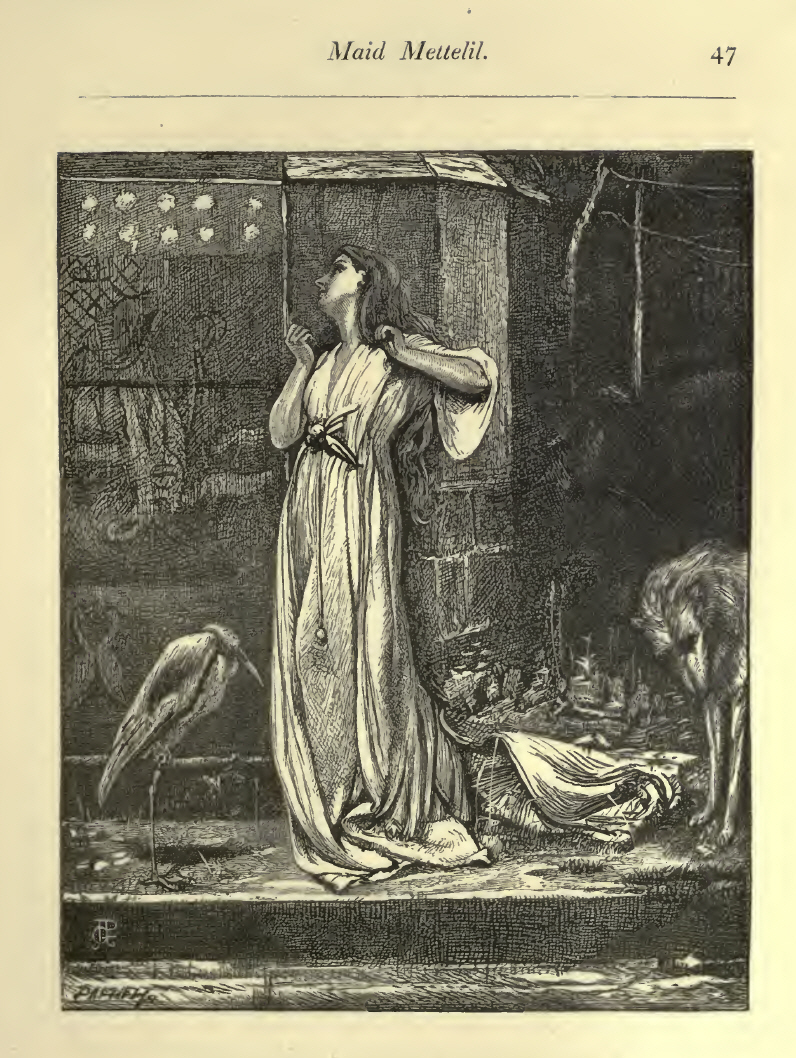
            Maid Mettelil, and her hound so small,
            Through the rose grove creep with light footfall.

            Maid Mettelil, in a mantle blue,
            Unto the bower of Sir Oluf flew.

            She knocks at the door with her white, white hand—
            “Open, Sir Oluf, for here I stand!”

            “None have I summoned unto my bower;
            None shall enter at gloaming hour.”

            “Open the door, Sir Oluf, to me—
            Heart-sick am I with thy minstrelsie.”

            “Heart-sick art thou with my minstrelsie?
            Nathless, you come not by night to me.

            “Gladly would I welcome thee here,
            Were not Sir Peter my comrade dear.

            “And if I am grown so dear to thee,                                                       48
            Still dearer thy husband is to me.”

            “Rise up, Sir Oluf, and open the door—
            On my forehead of white the damp dews pour.”

            “And fall the dews on thy forehead fair?
            Hie thee homeward, and rest thee there.”

            “And if thou wilt not open the door,
            Let thy servant follow me, I implore.”

            “The moon is clear and the white stars burn—
            Alone thou hast come, and canst return.

            “The moon shines clearly overhead,
            And will light thee safely to thy bed.”


IV.

            Maid Mettelil, and her hound so small,
            Are running homeward with light footfall.

            To the castle gate they come full soon;
            Sir Peter stands in the light of the moon.

            “Welcome, Maid Mettelil, my bride!                                                      49
            Where hast wandered at midnight tide?”

            “Out in the greenwood grove, I ween,
            Plucking the blossoms, the blue and the green;

            “Plucking the blossoms, the red and white,
            That look so bonnie by pale moonlight.

            “Yonder have I been wandering,
            Hearing the nightingale sweetly sing.”

            “No nightingale hast thou heard to-night,
            But only Sir Oluf’s horn so bright.

            “Hearken, O Mettelil, unto me:
            Thou hast made thy couch ’neath the linden tree.

            “Now have I lost my steed, I ween,
            Since thou so shameless a bride hast been.”


V.

            And no man knew she had been so light,
            But her bower was burnt to the ground that night.

            Sir Peter wanders so gloomy and grim;                                                 50
            Sir Oluf feareth to meet with him!


VI.

            May this to the young a lesson prove,—
            Under the linden!
            Tempt not and try not the wives ye love.
            Under the linden wakens my dearest!


        51

THE OWL.


            THERE dwelt by my chamber window
                 An owl among ivy leaves;
            He spoilt with his dismal music
                 The sweetest of summer eves.

            The other birds were silent
                 At the nightingale’s twilight tune;
            But the owl awakened, crying
                 And rolling his eyes at the moon.

            “Curst be the owl!” I muttered,
                 Nursing my wrath for long,
            “He breaks my slumber nightly,
                 And drowns the nightingale’s song!”

            It was my trusty huntsman
                 Went out at night with his gun,
            And shot the owl at my window,
                 Just as his song begun.

            It was my trusty huntsman                                                                     52
                 Hung the owl on a forest tree,
            To frighten away from my window
                 All neighbours as hoarse as he.

            But now the summer is over
                 And the stork has winged away,
            Gone are the many voices
                 That rendered the greenwood gay.

            Among the leafless branches
                 Low winds of the autumn creep,—
            They weary me many a gloaming,
                 And trouble my thoughts from sleep.

            I think of the old owl often,
                 When the nights are lonely and long
            And I wish the owl were living,
                 And let me list to his song.


        53

THE ELF DANCE.


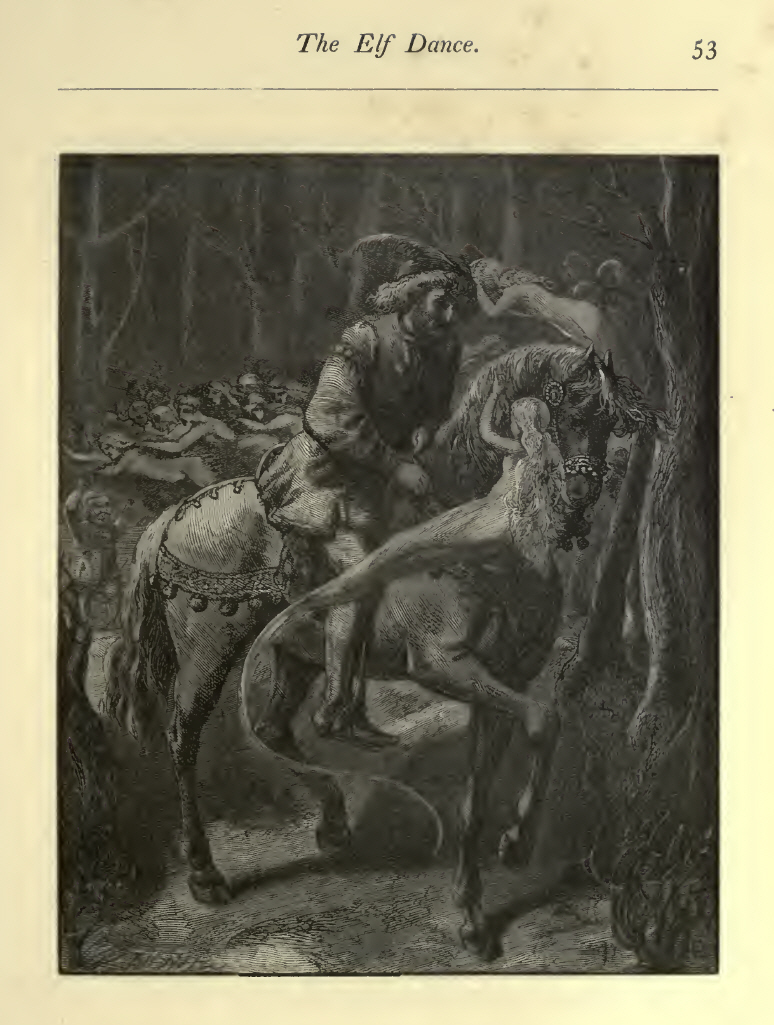
            SIR OLUF, the knight, full wide hath rid,
            The guests to his wedding feast to bid.
            But all in the moonlight the elves dance featly!

            Lightly the elfin companie
            Is dancing under the greenwood tree.

            There dances four, there dances five—
            How in their midst shall Sir Oluf thrive?

            The Elf King’s daughter is featest of all:
            She grips his rein with her fingers small.

            “Welcome, Herr Oluf! welcome to thee!
            Hither, and tread in the dance with me.”

            “I dare not dance, and I must away,
            For to-morrow is my bridal-day.”

            “Listen, Herr Oluf: dance with me—
            Buck-skin boots will I give to thee!”

            “I dare not dance, and I must away,                                                       54
            For to-morrow is my bridal-day.”

            “Listen, Herr Oluf, listen to me—
            A silken sark will I give to thee!

            “A silken sark, so white and fine,
            My mother wove it by pale moonshine.”

            “I dare not dance, and I must away,
            For to-morrow is my bridal-day.”

            “Listen Herr Oluf: dance with me—
            A helmet of gold I will give to thee.”

            “A helmet of gold were fine to see;
            But I dare not tread in the dance with thee.”

            “And wilt thou not tread in the dance with me?
            Sickness and blight shall thy portion be!”

            His shoulders she strikes with her fingers white:
            Ne’er hath he felt a blow so light.

            She lifts Sir Oluf upon his steed:                                                             55
            “Now off and away to thy lady speed!”

            Sir Oluf rides—he rides in fear:
            At the gate is waiting his mother dear.

            “Listen, Herr Oluf, my own bonnie knight:
            Why are thy cheeks so ghastly white?”

            “Well may my cheeks be ghastly white,—
            I have been in the Elf-wife’s dance to-night.”

            “Listen, Herr Oluf, and woe betide!
            What shall I say to thy dear young bride?”

            “Say I am gone to the wood hard by,
            My horse and eke my hound to try.”

            Early at dawn, when it was day,
            The bride came down in her bride-gear gay.

            They drank of mead and they drank of wine:
            “But where is Herr Oluf, bridegroom mine?”

            “Herr Oluf hath gone to the wood hard by,                                            56
            His horse and eke his hound to try.”

            She lifted up the curtains red—
            There lay Sir Oluf, and he was dead.

            Early at dawn, when the sun was hie,
            From Sir Oluf’s gate came corses three,—

            Sir Oluf the knight, and his bonnie bride,
            And his broken-hearted mother beside.
            But all in the moonlight the elves dance featly!


        57

THE LOVER’S STRATAGEM.


              IT was the young Herr Carl
                   Fell sick, and sick he lay;
              He heard nor Mass nor even-song
                   For many and many a day.
              Thou waitest for me in the bower of roses, all-dearest!

              Nor Mass nor even-song
                   He heard for many a day;
              His sisters and his mother dear
                   They nurse him as they may.

              First step in his sisters,—
                   They stand aloof in fear;
              But to his bed his mother creeps,
                   And whispers in his ear:

              “And say, my son, Herr Carl,
                   Unto thy mother dear,
              Is it a sickness of the flesh
                   Wherein thou lingerest here?”

              “No sickness of the flesh                                                              58
                   Keepeth me lying here—
              But ’tis the little maid, Eline,
                   Whom I hold so dear, so dear!”

              “If little Maid Eline
                   Maketh thy cheek so wan,
              Rise up and ride unto her gate,
                   And woo her like a man.”

              “Her father have I asked,
                   And he hath answered me,
              That I may never wed Eline
                   Till I win her secretly.”

              Herr Carl arose in bed,
                   So sad and sweet of mien;
              They have decked him in woman’s gear,
                   And called him Maid Christine.

              It was the young Herr Carl,
                   And forth to kirk went he;
              Bright golden gems are on his head,
                   But his eyes droop bashfully.

              Bright gems are on his head,                                                        59
                   His robe is lily white,
              But ye may hear how underneath
                   Jingles his armour bright!

              Up peeps the fair Eline,
                   While all the people pray:
              “And who is yonder stranger maid
                   That comes to kirk this day?”

              Answered the serving-maids—
                   And they were warned, I ween—
              It is the sister of Herr Carl,
                   And she is called Christine.”

              It was the fair Eline,
                   A lily hand reached she:
              “O will you hither, Maid Christine,
                   And keep me company?

              “O little Maid Christine,
                   Keep me companie;
              Full many a merry song and tale
                   I have to tell to thee.

              “Many a merry tale                                                                      60
                   Have I to tell to thee,
              And how thy brother, young Herr Carl,
                   Tried hard to wanton me.”

              It was the young Herr Carl
                   Smiled in his sleeve, and said,
              “Ne’er heard I that my brother Carl
                   Had wantoned wife or maid.”

              But when the Mass was sung,
                   And the priest had gone his way—
              “I swear that thou shalt be my guest,
                   O Maid Christine, to-day!”

              They ride across the fields,
                   And through green groves they go,
              And aye the hand of sweet Christine
                   Holds the other’s saddle-bow.

              Then in the dusky eve
                   The dews began to gloam;
              It was the little Maid Christine
                   Rose up to journey home.

              Then sware the fair Eline—                                                          61
                   By God and men sware she—
              “The rude and drunken roam by night,
                   And they might wanton thee!”

              Then sware the fair Eline—
                   By God and man alsò—
              “Here rest with me, sweet Maid Christine;
                   It is too late to go.”

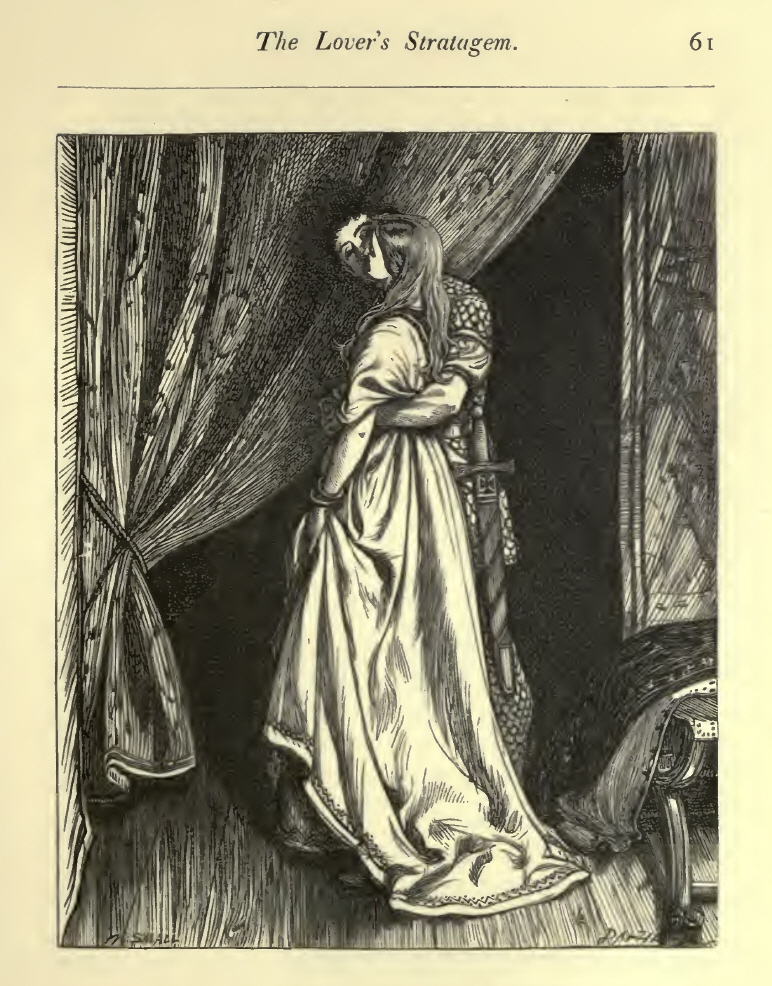
              Into her sleeping room
                   Then went the fair Eline;
              And after, laughing in her sleeve,
                   Tript little Maid Christine.

              He doffed his robe of white,
                   And eke his skirt of blue,
              And, underneath, his suit of mail
                   Glittered like golden dew.

              Then marvelled fair Eline,
                   Such glittering gear to mark:
              “Oh, never saw I maid before
                   Who wore so strange a sark!”

              “O tell me, fair Eline,                                                                    62
                   And true as Heaven above,
              Is there never man in all the world
                   Whom thou couldst wed and love?”

              “No man in all the world,
                   I swear by Heaven to thee,
              Unless it be the young Herr Carl,
                   Who ne’er may marry me!”

              “And if thou lovest him—
                   Herr Carl, dear brother mine—
              I swear to thee, O fair Eline,
                   He surely shall be thine!

              “And if thou lovest him—
                   Herr Carl, my brother dear—
              Oh, turn and kiss him on the cheek,
                   For he stands so near, so near!”

              “O hearken, young Herr Carl,
                   And kiss me not, I pray;
              My father gave my maiden life
                   To the cloister yesterday!”

              Upon her throbbing heart                                                             63
                   His tender hand laid he:
              “By the good craft that brought me here,
                   Herewith I marry thee!”

              He kissed her on the cheek,
                   He kissed her tenderlie:
              “Oh, wilt thou now to cloister go,
                   O fair Eline, from me?”

              “And what care I for cloister?”
                   The little maiden laughed;
              “But let the bridal bells be rung,
                   And the bridal cup be quaffed.”

              ’Tis merry in the hall—
                   Eline is fairly won—
              They merrily drain the bridal cup,
                   And are wed at rise o’ sun,
              Thou waitest for me in the bower of roses, all-dearest!


        64

THE BONNIE GROOM.


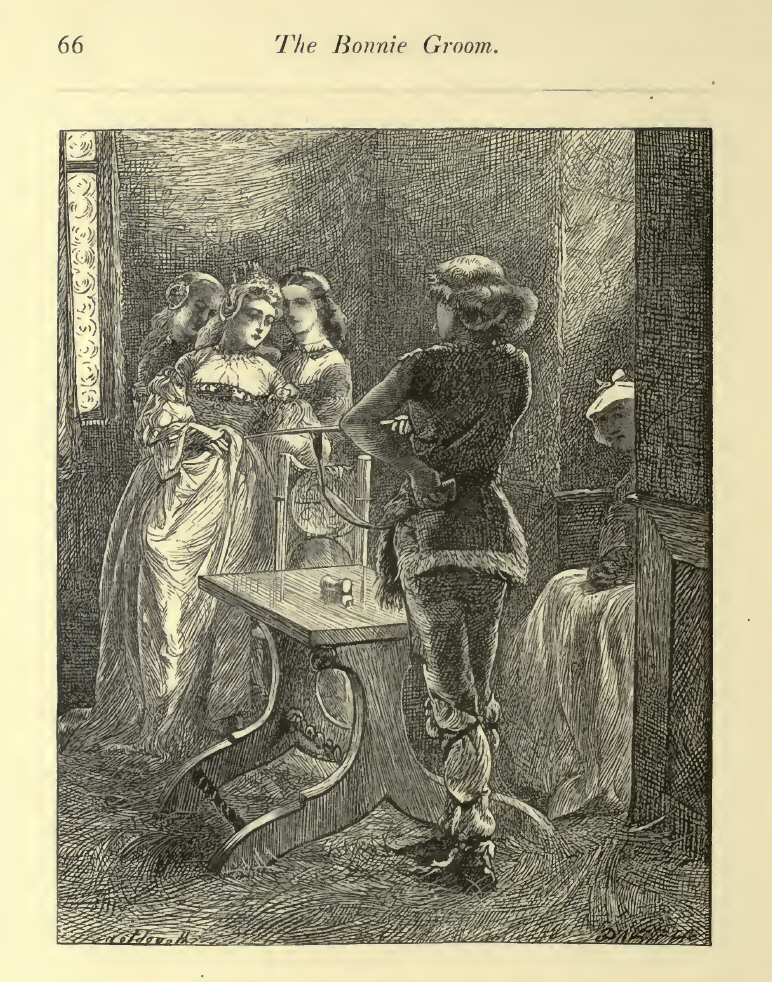
            O SIT thee down, my bonnie groom,
                 And play at dice with me.”
            “I have never a piece of red, red gold,
                 Fair maid, to stake with thee.”
            The game is played, and hearts are lost and won!

            “O stake thy hat, my bonnie groom,
                 And either give or take:
            My necklace of the white, white pearl
                 Against thy hat I stake.”

            When first upon the table board
                 The golden dice are played,
            The bonnie groom hath lost his hat
                 Unto the laughing maid.

            “O sit thee down, my bonnie groom,
                 And play at dice with me.”
            “I have never a piece of red, red gold,
                 Fair maid, to stake with thee.”

            “O stake thy tunic, bonnie groom,                                                          65
                 And either give or take:
            Against thy tunic, poor and torn,
                 My crown of gold I stake.”

            When next upon the table board
                 The golden dice are played,
            The groom hath lost his tunic poor
                 Unto the laughing maid.

            “O sit thee down, my bonnie groom,
                 And play at dice with me.”
            “I have never a piece of red, red gold,
                 Fair maid, to stake with thee.”

            “O stake thy hose, my bonnie groom,
                 And add thy shoon beside:
            I stake my honour and my troth,”
                 The laughing virgin cried.

            When next upon the table board
                 The golden dice they pour,
            The bonnie groom hath won the game,
                 And the maiden smiles no more.

            “O hearken, hearken, bonnie groom;                                                      66
                 I knew not what I said;
            My silver-handled knives of price
                 I give to thee instead.”

            “Thy silver-handled knives of price
                 At little worth I hold;
            But I will wed the maiden fair
                 I have won with dice of gold.”

            “O hearken, hearken, bonnie groom;
                 I knew not what I said;
            And sarks and stockings, silken-sewn,
                 I give to thee instead.”

            “Thy sarks and stockings, slken-sewn,
                 At little worth I hold;
            But I will wed the maiden fair
                 I have won with dice of gold.”

            “O hearken, hearken, bonnie groom;
                 I knew not what I said;
            A snow-white horse and saddle eke
                 I give to thee instead.”

            “Thy snow-white horse and saddle eke                                                  67
                 At little worth I hold;
            But I will have the maiden fair
                 I have won with dice of gold.”

            “O hearken, hearken, bonnie groom;
                 I knew not what I said;
            My castle and the wealth therein
                 I give to thee instead.”

            “Thy castle and the wealth therein
                 At little worth I hold;
            But I will wed the maiden fair
                 I have won with dice of gold.”

            The maiden rends her golden hair,
                 And hides her pale, pale face:
            “God help a wretched maiden, won
                 By a wight so poor and base!”

            The bonnie groom stands up in court,
                 And taps her with his sword:
            “O I have won thee, maiden fair,
                 And I am now thy lord!

            “And yet am I no stable groom,                                                             68
                 Nor yet of low degree;
            I am as bonnie and rich a prince
                 As dwells in this countrie.”

            “Art thou a bonnie prince indeed,
                 And not of low degree?
            My love, my honour, and my troth
                 I gladly give to thee.”
            The game is played, and hearts are lost and won!


        69

CLOISTER ROBBING.


              I’LL sing to ye a song,
                   If ye will list to me,
              Of how the young Sir Morten Dove
                   Betrothed a fair ladye.
              The roses and lilies grow bonnily!

              Sir Morten loved fair Adelaide,
                   And Adelaide loved him;
              But since the maid had little gear,
                   His friends looked black and grim.

              So full of wrath were one and all,
                   When the strange news was spread:
              They prayed the Lord who rules the world,
                   The two might never wed.

              Sir Morten’s father drove him forth
                   Into a strange countrie,
              And Adelaide was to cloister borne,
                   Though sorely struggled she.

              And young Herr Morten dwelt afar                                              70
                   For weary winters nine,
              And all the while for his true-love
                   Did nought but fret and pine.

              So sore the young Sir Morten yearned
                   To see his winsome May,
              Though it should be his death, he would
                   No longer stay away.

              It was the young Sir Morten hied
                   Home to his own countrie;
              But there they carried unto him
                   Tidings of miserie.

              Ah! bitter, bitter was the tale
                   They whispered in his ear,—
              That they had to the cloister borne
                   The maid he held so dear.

              Unto his father dear he spake,
                   “O father, father, hark!
              My foes have given my own true-love
                   Unto the cloister dark!”

              “O dry thine eyes, my son, my son,                                              71
                   And hearken unto me:
              The maid that waits to be thy bride
                   Is twice as rich as she.

              “Unto a bonnier, richer May
                   Thou soon shalt give thy hand;
              Little red gold hath Adelaide,
                   And less of rich green land.”

              “Sweeter to me my own true-love,
                   With nought but her red dress,
              Than the rich daughter of Sir Stig,
                   And all she will possess!

              “And what care I for rich green land?
                   And what care I for wealth?
              I care but for my own true-love,
                   Whom I have won in stealth.

              “And what care I for kinsmen,
                   Were they thrice as high in worth?
              Yea, I will seek my own true-love,
                   Though ye hound me o’er the earth.”

              Then whispered with his brother dear                                           72
                   The young Sir Morten Dove:
              “And how may I from cloister steal
                   Away my own true-love?”

              “Go, deck thyself in grave-clothes white,
                   And lay thee in a shell,
              And I will to the cloister ride,
                   The bitter tale to tell.”

              He decked himself in grave-clothes white,
                   And lay in death-shell cold;
              Herr Nilans to the cloister rode
                   And the bitter tale was told.

              “Hail unto ye, O holy maids,
                   And great shall be your gain,
              If my dear brother Morten’s corse
                   May in your walls be lain.”

              All silent sat the holy maids,
                   In black, black raiment all—
              Only the sweet maid Adelaide
                   Let work and scissors fall.

              Then cried the sweet maid Adelaide,                                            73
                   With tears upon her face,
              “Yea! bury Morten, if ye list,
                   Here in this holy place.

              “Yea, here, in holy cloister-kirk,
                   Bury his sweet young clay,
              And daily where he lies asleep
                   I’ll kneel me down and pray!

              “I was a little child when first
                   I heard him sue and woo;
              The Powers of heaven know full well
                   That I have loved him true.

              “His cruel father drove him off
                   Into a strange countrie,
              And into these dark cloister walls
                   Against my will brought me.”

              It was Sir Nilans bent his head,
                   And whispered in her ear,
              “Ah, dry thine eyes, Maid Adelaide,
                   And be of happy cheer.”

              “Never shall I forget my woe!                                                      74
                   Never forget my wrong!
              For murdered is my own true-love,
                   Whom I have loved so long.”

              Sorely she wept, Maid Adelaide,
                   And her wet eyes were red,
              When through the dismal cloister gate
                   They brought Sir Morten, dead.

              She crept unto Sir Morten’s bier,
                   And prayed to Heaven above:
              “I loved thee, Morten, to the end,
                   As never maid did love!”

              She lighted up the wax lights two,
                   And sat her by his side:
              “I would to God, dear love, that I
                   Had in my cradle died.

              “Nine winters, while thou wert away,
                   Here weary life I led,
              And never saw thy face again
                   Until I saw thee dead!”

              And bitterly wept Adelaide,                                                         75
                   Wringing her hands so white.
              Herr Morten heard her in his shell,
                   Laughed loud, and rose upright.

              Oh, up he stood, and gazed again
                   On her he loved the best,
              And tossed the gloomy grave-clothes off,
                   And caught her to his breast.

              “O hearken, hearken, my own true-love,
                   Put all thy grief aside;
              Thou shalt from cloister follow me,
                   And be my bonnie bride!

              “Black are the horses that await
                   In the kirkyard there without,
              And black in suits of iron mail
                   Await my henchmen stout.”

              Softly Sir Morten led her forth
                   Out of the chapel wall,
              And over her shoulders, for a cloak,
                   He threw the sable pall.

              All silent stood the cloister maids,                                                76
                   Reading by candle-light;
              They thought it was an angel bore
                   Their sister off by night.

              All silent stood the holy maids,
                   Save only two or three.
              “That such an angel,” murmured these,
                   “Would come by night for me!”

              Honour to young Sir Morten Dove!
                   His heart was staunch and stout.
              He bore her to his dwelling-house,
                   And bade the bells ring out.

              Honour to young Sir Morten Dove,
                   And to his sweet ladye!
              May more such maids be carried off
                   By angels such as he!
              The roses and lilies grow bonnily!


          77

AGNES.


I.

            MAID AGNES musing sat alone
                
            Upon the lonely strand;
            The breaking waves sighed oft and low
                 Upon the white sea-sand.

            Watching the thin white foam, that broke
                 Upon the wave, sat she,
            When up a beauteous merman rose
                 From the bottom of the sea.

            And he was clad unto the waist
                 With scales like silver white,
            And on his breast the setting sun
                 Put rose gleams of light.

            The merman’s spear a boat-mast was,
                 With crook of coral brown,
            His shield was made of turtle-shell,
                 Of mussel-shells his crown.

            His hair upon his shoulders fell,                                                              78
                 Of bright and glittering tang;
            And sweeter than the nightingale’s
                 Sounded the song he sang.

            “And tell to me, sweet merman,
                 Fresh from the deep, deep sea,
            When will a tender husband come
                 To woo and marry me?”

            “O hearken, sweetest Agnes,
                 To the words I say to thee—
            All for the sake of my true heart,
                 Let me thy husband be.

            “Far underneath the deep, deep sea,
                 I reign in palace halls,
            And all around, of crystal clear,
                 Uprise the wondrous walls.

            “And seven hundred handmaids wait,
                 To serve my slightest wish—
            Above the waist like milk-white maids,
                 Below the waist, like fish.

            “Like mother-of-pearl the sea-sledge gleams,                                         79
                 Wherein I journey crowned,
            Along the sweet green path it goes,
                 Dragged by the great seal-hound.

            “And all along the green, green deeps
                 Grow flowers wondrous fair;
            They drink the wave, and grow as tall
                 As those that breathe the air.”

            Fair Agnes smiled, and stretched her arms,
                 And leapt into the sea,
            And down beneath the tall sea-plants
                 He led her tenderlie.


II.

            Eight happy years fair Agnes dwelt
                 Under the green-sea wave,
            And seven beauteous little ones
                 She to the merman gave.

            She sat beneath the tall sea-plants,
                 Upon a throne of shells,
            And from the far-off land she heard
                 The sound of sweet kirk bells.

            Unto her gentle lord she stept,                                                               80
                 And softly took his hand:
            “And may I once, and only once,
                 Go say my prayers on land?”

            “Then hearken, sweet wife Agnes,
                 To the words I say to thee—
            Fail not in twenty hours and four
                 To hasten home to me.”

            A thousand times “Good night” she said
                 Unto her children small,
            And ere she went away she stooped,
                 And softly kissed them all;

            And, old and young, the children wept
                 As Agnes went away,
            And loud as any cried the babe
                 Who in the cradle lay.

            Now Agnes sees the sun again,
                 And steps upon the strand—
            She trembles at the light, and hides
                 Her eyes with her white hand.

            Among the folk she used to know,                                                         81
                 As they walk to kirk, steps she,
            “We know thee not, thou woman wild,
                 Come from a far countrie.”

            The kirk bells chime, and into kirk
                 And up the aisle she flies;
            The images upon the walls
                 Are turning away their eyes!

            The silver chalice to her lips
                 She lifteth tremblinglie,
            For that her lips were all athirst,
                 Under the deep, deep sea.

            She tried to pray, and could not pray,
                 And still the kirk bells sound;
            She spills the cup of holy wine
                 Upon the cold, cold ground.

            When smoke and mist rose from the sea,
                 And it was dark on land,
            She drew her robe about her face,
                 And stood upon the strand.

            Then folded she her thin, thin hands,                                                       82
                 The merman’s weary wife:
            “Heaven help me in my wickedness,
                 And take away my life!”

            She sank among the meadow grass,
                 As white and cold as snow;
            The roses growing round about
                 Turned white and cold alsò.

            The small birds sang upon the bough,
                 And their song was sad and deep—
            “Now, Agnes, it is gloaming hour,
                 And thou art going to sleep.”

            All in the twilight, when the sun
                 Sank down behind the main,
            Her hands were pressed upon her heart,
                 And her heart had broke in twain.

            The waves creep up across the strand,
                 Sighing so mournfullie,
            And tenderly they wash the corse
                 To the bottom of the sea.

            Three days she stayed beneath the sea,                                                  83
                 And then came back again,
            And mournfully, so mournfully,
                 Upon the sand was lain.

            And, sweetly decked by tender hands,
                 She lay a-sleeping there,
            And all her form is wreathed with weeds,
                 And a flower was in her hair.

            The little herd-boy drove his geese
                 Seaward at peep o’ day,
            And there, her hands upon her breast,
                 Sweet Agnes sleeping lay.

            He dug a grave behind a stone,
                 All in the soft sea-sand,
            And there the maiden’s bones are dry,
                 Though the waves creep up the strand.

            Each morning and each evening,
                 The stone is wet above;
            The merman hath wept (the town girls say)
                 Over his lost true-love.


            ______________________________


Ballad Stories of the Affections continued

_____

Ballad Stories of the Affections Contents


Home
Biography
Bibliography

Poetry
Novels
Plays

Essays
Letters
Miscellanea

Harriett Jay
Critical Writings about Buchanan
The Fleshly School Controversy

Links
Site Diary
Site Search