Home
Biography
Bibliography

ROBERT WILLIAMS BUCHANAN (1841-1901)

Poetry
Novels
Plays

Essays
Letters
Miscellanea

Harriett Jay
Critical Writings about Buchanan
The Fleshly School Controversy

Links
Site Diary
Site Search

{Ballad Stories of the Affections 1866}


        84

HOW SIR TONNE WON HIS BRIDE.


            SIR TONNE forth from Alsö fares,
                 With his good sword by his side,
            Whether it be on sea or land,
                 A hero trusty and tried.
                                            Listen to my rune!

            Herr Tonne in the rose grove rides,
                 He rides to hunt the hare,
            And there he spies the dwarf’s daughter
                 Among her maidens fair.

            Herr Tonne in the rose grove rides,
                 To hunt the hind rides he,
            And there he spies the dwarf’s daughter
                 Under the linden tree.

            With golden harp in hand, she lies                                                          85
                 Under a linden fair:
            “See, yonder where Sir Tonne rides,
                 And hunts the hind and hare.

            “Sit down, sit down, my maidens small,
                 And my little foot-page alsò,
            While I play a rune, and cause the flowers
                 O’er field and mead to grow.”

            Upon her harp of gold she struck,
                 And played a Runic lay:
            The wild, wild fowl forgot his song
                 And listened on the spray.

            The wild, wild fowl upon the spray
                 Forgot to pipe and sing;
            The wild, wild hart on greenwood path
                 Paused in the act to spring.

            The meadow flowered, the greenwood bloomed,
                 So wondrous was the song;
            Deep, deep Sir Tonne spurred his steed,
                 But could not move along.

            The meadow flowered, the greenwood bloomed—                                86
                 Sir Tonne could not ride;
            Lightly he sprang from off his horse,
                 And sat him by her side.

            “Hail unto thee, O dwarf’s daughter!
                 And wilt thou be my May?
            And I will love and honour thee
                 Until my dying day.

            “Hail unto thee, O dwarf’s daughter!
                 A rose among lilies thou art!
            There is never a man who longs so much
                 To wear thee in his heart.”

            “Hearken, Sir Tonne, hearken,
                 Talk not of love to me!
            I have a lover, and the King
                 Of all the Dwarfs is he.

            “My father sits in the mountain,
                 Among his men sits he;
            And in a month I shall be wed,
                 With feast and melodie!

            “My mother sits in the mountain,                                                             87
                 Spinning with golden thread;
            But I have crept away from her
                 To strike the gold harp red.”

            “Ere the Dwarf King shall marry thee,
                 Foul, foul shall be his fall;
            Ho! I will lose my life, or break
                 My sword in pieces small.”

            Answered the weird dwarf’s daughter,
                 And softly answered she:
            “A fairer maid shall be thy May,
                 Thou ne’er canst marry me!

            “Haste, haste away, Herr Tonne!
                 As fast as thou canst ride;
            My father and my lover fierce
                 Will soon be at my side.”

            It was her dear, dear mother,
                 Out of the hill peered she,
            And there she saw Herr Tonne stand
                 Under the linden tree.

            Out came her dear, dear mother,                                                           88
                 And she was wroth, I ween.
            “Now, wherefore, Alfhild, daughter mine,
                 Sit here in the forest green?

            “Better, better thy linen sew
                 Within the mountain old,
            Than here within the rose grove sit
                 And strike thy harp of gold.

            “The King of Dwarfs hath feasted thee
                 All for thy honeymoon—
            Shame, shame! to meet Sir Tonne here,
                 And bind him with a rune.”

            It was the weird dwarf’s daughter,
                 Unto the cave hied she,
            And young Sir Tonne followed her,
                 But could not hear nor see.

            Upon a stool, within the cave,
                 The dwarf’s wife spread a cloak,
            And there Sir Tonne sat in trance,
                 But at cock-crow he awoke.

            The dwarf’s wife opened her mystic book,                                             89
                 All in the cavern dim,
            And freed Sir Tonne from the spell
                 Her daughter had cast on him.

            “Now have I freed thee from the rune,
                 And cast the spell away;
            And this I did for honour’s sake,
                 And thou art safe for aye.

            “And I for love and right goodwill,
                 A goodlier gift will give;
            And I will woo a maid for thee,
                 Fairest of all that live.

            “For I was reared of Christian folk,
                 And stolen here to wean:
            I have a sister dear to me,
                 And named the Queen Christine.

            “She bears a crown in Iceland,
                 And a Queen’s proud name also:
            Her daughter once was stolen away
                 Many a year ago.

            “Her daughter once was stolen away,                                                    90
                 And the search was long and drear,
            And never now at kirk or dance
                 They see that daughter dear.

            “She dares not from her window peep,
                 They watch her so in fear;
            She dare not play at chess with the King,
                 Unless the Queen be near.

            “Save that old King, her gentle eyes
                 Have seen no mortal wight;
            Her mother locks with lock and bolt
                 Her chamber door at night.

            “This maiden sits in Upsal,
                 And they name her Ermelin,
            And steel, and bolt, and iron ring
                 From lovers lock her in.

            “The old King’s brother hath a son,
                 Who is the old King’s heir—
            Sir Allerod will have the throne,
                 And wed the maiden fair.

            “And I will give thee saddle and horse,                                                   91
                 And spurs of gold beside;
            How wild soe’er thy path may be,
                 Thou shalt in safety ride.

            “And I will give thee clothes of price,
                 With golden seams and hems;
            And I will give thee the red shield, deckt
                 With precious stones and gems;

            “And I will give thee a golden scroll,
                 Where runes are wrought by me;
            And every word thou utterest
                 Like written speech shall be.”

            Out spake Alfhild, the dwarf’s daughter,
                 For well she loved the knight:
            “And I will give a trusty sword,
                 And a lance all burnished bright;

            “And thou shalt never miss the way,
                 However wild it be;
            And thou shalt never fight with foe,
                 But gain the victorie;

            “And thou shalt safely come to land                                                        92
                 Whene’er thou sailest the sea;
            And never by a man on earth
                 Shall thy body wounded be.”

            It was the dwarf’s wife, Thorelil,
                 Filled out the wine so clear:
            “Haste, haste upon thy way, before
                 My husband cometh near.”

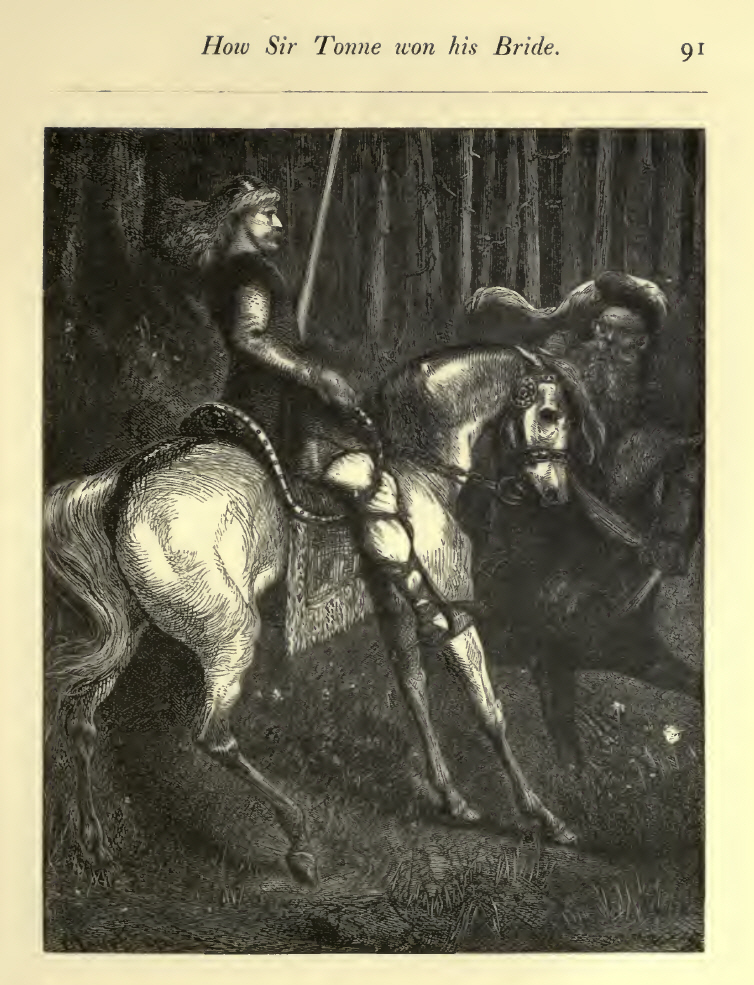
            Herr Tonne in the rose grove rode,
                 With glittering lance rode he,
            And there he met the dwarf himself
                 A-riding moodily.

            “Well met, well met, Sir Tonne;
                 But wherefore thus away?
            And whither doth thy charger step
                 So gallantly, I pray?”

            “I ride unto a distant place,
                 To pluck a bonnie rose;
            And I am bold to break a lance
                 With the doughtiest of foes.”

            “Ride on, ride on, and fare thee well—                                                   93
                 Ride on, my gallant knight—
            At Upsal waits a champion stout,
                 And all athirst for fight.”

            Herr Tonne swiftly rode along
                 Till he came to Swedish ground,
            And there beneath the greenwood boughs
                 Ten armèd knights he found.

            On every head a helmet bright,
                 A shield on every breast,
            At every side a glittering sword,
                 And a shining lance in rest.

            “Hail unto ye, O Swedish knights,
                 That gather armèd here,
            And will ye fight for gold, or fame,
                 Or for your true-loves dear?”

            Answered the slim Prince Allerod,
                 Proud to the red heart’s core,
            “Ho! I have honour and red, red gold,
                 And seek to win no more;

            “But there in Upsal dwells a maid,                                                          94
                 By name Maid Ermelin,
            And he who conquers in the joust
                 Shall that sweet lady win.”

            The first joust they together rode,
                 With wondering knights around,
            Their shields were shattered, and their spears
                 Drove deep into the ground.

            The second joust the warriors rode,
                 They met at topmost speed,
            And Allerod with broken neck
                 Was hurled from off his steed.

            Then fiercely strove those Swedish knights
                 To venge their leader’s fall;
            But young Sir Tonne waved his sword,
                 And overthrew them all.

            And up they picked their mantles blue,
                 Moodily muttering,
            And off they rode into the west,
                 And stood before the King.

            “A Jutish knight hath come to land,                                                         95
                 With neither fame nor name;
            Eight warriors hath he overthrown,
                 And made them blush for shame.

            “Eight warriors hath he overthrown,
                 And put them all to flight,
            And he hath slain thy brother’s son,
                 Young Allerod the knight.”

            Then answered back the fierce old King,
                 With long and silver hair,
            “Revenge me on that traitor knight,
                 And ye shall sable wear.”

            Out rode those angry Swedish knights,
                 The precious prize to gain;
            But in a trice those Swedish knights
                 Were overthrown again;

            And skin of calf they still must wear,
                 Not sable rich and gay;
            Yea! skin of calf they still must wear
                 And cloth of wadmel gray.

            It was the angry Swedish knights                                                            96
                 Turned wild and shamed and wan:
            There lives no man in all the world
                 Could beat this Jutland man.

            Herr Tonne still in Upsal rides
                 With glittering sword and spear;
            His foemen thank the Lord they live,
                 And sneak away in fear.

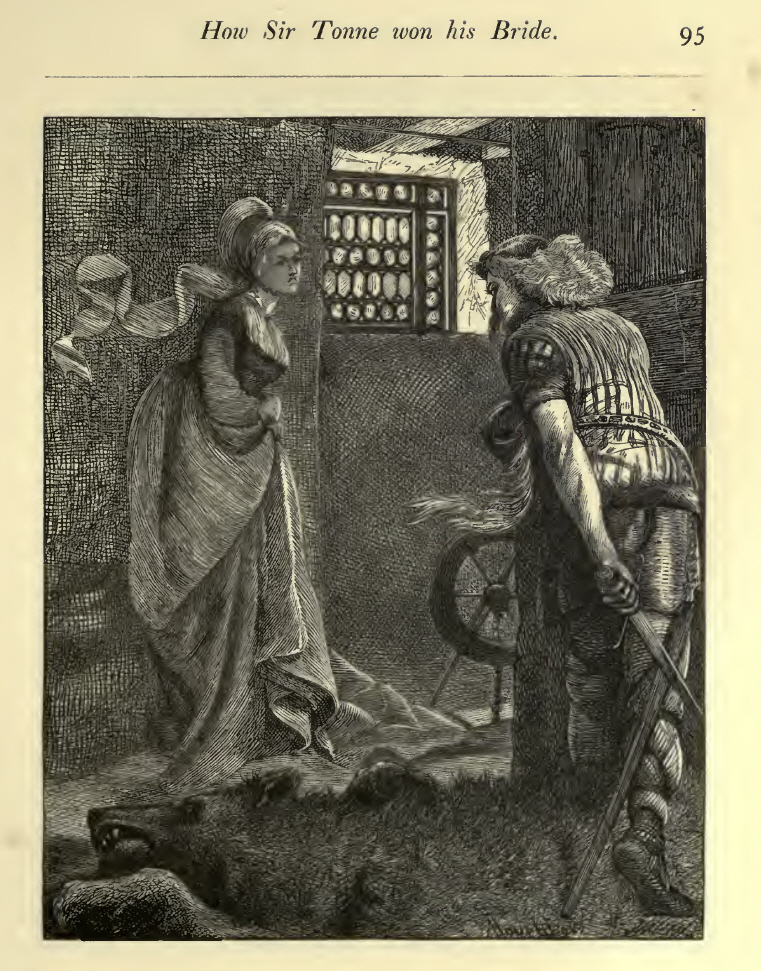
            He slew the bear that watched the door,
                 And broke the great door-pin,
            And gazed upon the captive maid,
                 The sweet Maid Ermelin.

            The Swedish courtiers silent were,—
                 They dared not speak a word,
            For of this gallant Jutland knight
                 Such wonders they had heard.

            He hurled aside the Swedish knights,
                 And slew the lion and bear,
            And entered in the high chamber,
                 And freed the maiden fair.

            And there was joy in Iceland,                                                                 97
                 When the tidings there were ta’en,
            Joy in the hearts of King and Queen,
                 That their child was found again.

            Herr Tonne now in Iceland
                 The old King’s crown doth wear,
            And blooming sweetly by his side
                 Sits Ermelin the Fair.
                                        Listen to my rune!


          98

SIR MORTEN OF FOGELSONG.


              IT was Sir Morten of Fogelsong,
                   He rode in greenwood lawn,
              And there a fatal blow gat he,
                   All in the morning dawn.
              Dead rides Sir Morten of Fogelsong!

              To kirk he gave the red, red gold,
                   To cloister gave his horse;
              All in the black and chilly earth
                   They laid Sir Morten’s corse.

              It was the young Sir Folmer Skot—
                   He swiftly galloped along—
              For, craving speech, behind him rode
                   Sir Morten of Fogelsong.

              “O hearken, young Sir Folmer Skot,                                            99
                   Rein in and talk with me,
              For by my faith in Christ the Lord,
                   I will not injure thee!”

              “O hearken, dark Sir Morten;
                   How ridest thou here to-day?
              They tolled the church bells yesternight,
                   And laid thy corse in clay!”

              “I ride not here to sue for gifts,
                   Nor doomed to ride for wrong,
              But only for a plot of ground
                   Forsworn to Fogelsong.

              “I ride not here for red, red gold,
                   And unto thee make moan;
              I ride here for the plot of ground
                   Two fatherless bairns should own.

              “O haste to Mettelil, my wife,
                   And tell her my behest:
              Until she yield the ground again,
                   My soul can never rest!

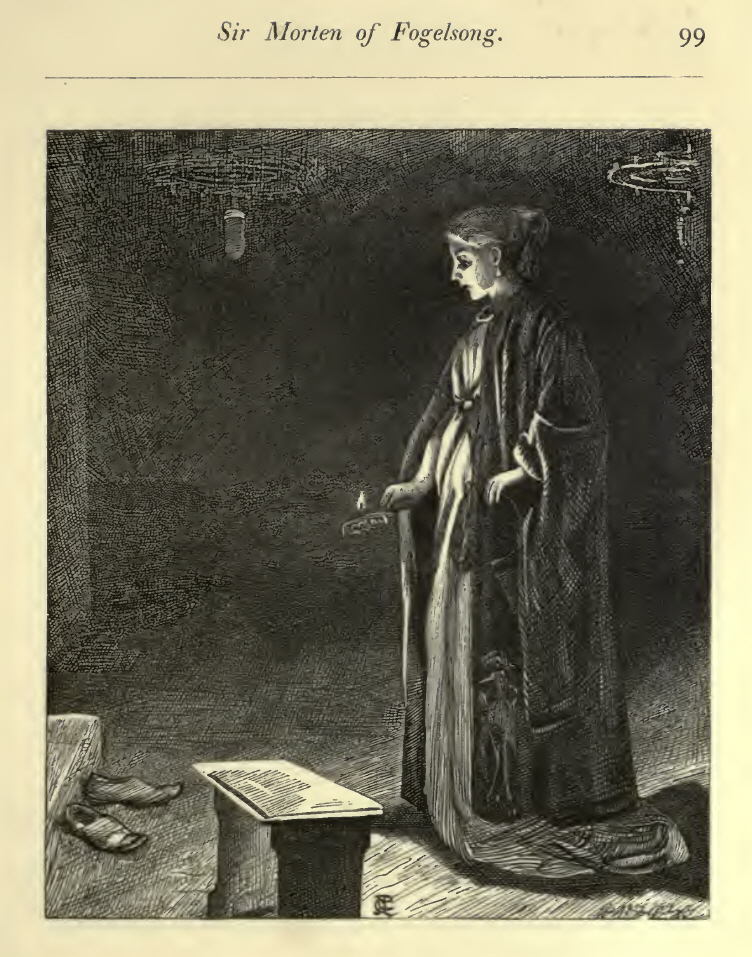
              “And if fair Mettelil, my wife,                                                      100
                   Should doubt thee or deny,
              Say that without my chamber door
                   My chamber slippers lie.

              “Say that my chamber slippers lie
                   Without my chamber door,
              And if she look at dead of night,
                   They will be full of gore.”

              “Ride back, ride back, Sir Morten,
                   And slumber peacefullie;
              The fatherless bairns shall have their own,
                   By Christ I swear to thee!”

              Black was Sir Morten’s horse,
                   Black was Sir Morten’s hound,
              And black, black were the ghostly folk
                   That followed him into the ground.

              But grace to fair Dame Mettelil!
                   She heard her lord’s behest:
              The fatherless held their own again,
                   And Sir Morten’s soul had rest.
              Dead rides Sir Morten of Fogelsong!


          101

THE LEAD-MELTING.


              ’TWAS clear, cold, starry, silver night,
                   And the old year was a-dying,
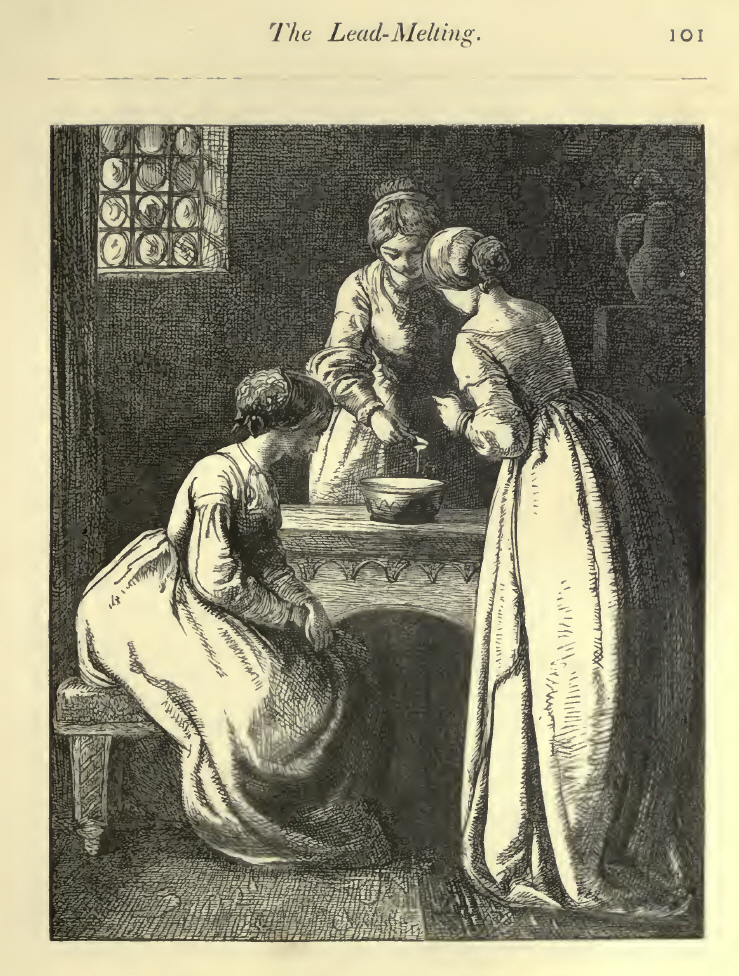
              Three pretty girls with melted lead
                   Sat gaily fortune-trying.
              They dropt the lead in water clear,
                   With blushing palpitations,
              And as it hissed, with fearful hearts
                   They sought its revelations.

              In the deep night, while all around
                   The snow was whitely falling,
              Each pretty girl looked down to find
                   Her future husband’s calling:
              The eldest sees a castle grand
                   Girt round by shrubland shady,
              And, blushing bright, she feels in thought
                   A lady rich already!

              The second sees a silver ship,                                                     102
                   And bright and glad her face is:
              Oh, she will have a skipper bold,
                   Grown rich in foreign places!
              The youngest sees a glittering crown,
                   And starts in consternation,
              For Molly is too meek to dream
                   Of reaching regal station.

              And time went by,—one maiden got
                   Her landsman, one her sailor—
              The lackey of a country count!
                   The skipper of a whaler!
              And Molly has her crown, although
                   She unto few can show it—
              Her crown is true-love, fancy-wrought,
                   Her husband,—a poor Poet!


[Notes:
‘The Lead-Melting’ was included in ‘The New Rome’ (1898), by which time Buchanan seems to have adopted it as his own - there is no mention of it being a translation of a poem by Claudius Rosenhoff. The poem was also published in the 1901 edition of ‘The Complete Poetical Works of Robert Buchanan’. There are a couple of changes in this later version of the poem, which is available in
‘The New Rome’ section of this site.)


          103

YOUNG AXELVOLD.


            THE King’s men ride in merry greenwood,
                 To hunt the hart and hind,
            And lying under a linden tree
                 A little child they find.
            In the greenwood slumbers fair Ellen!

            They lifted up the bonnie boy,
                 They wrapt him in mantle blue,
            They bore him back to the King’s own Court,
                 And found him a nurse so true.

            They carried him forth when all was still,
                 To christen him by night;
            They christened him young Axelvold,
                 All in the pale moonlight.

            They fostered him in winters cold,                                                         104
                 In winters cold full three;
            He blossomed to the sweetest flower
                 The eye of man could see.

            They fostered him for fifteen years,
                 In sun and snow and wind;
            He grew to be the bravest youth
                 That hunted hart and hind.

            The King’s men shoot upon the lawn,
                 With jest and loud acclaim:
            Who shoots like young Herr Axelvold
                 He puts them all to shame.

            The King’s men gather on the lawn,
                 And shoot with arrow and bow;
            They gnaw the trembling under lip
                 That he should shame them so.

            “Far better run unto thy nurse,
                 And ask thy mother’s name,
            Than meet the honourably born,
                 And put them all to shame.”

            Then answered back young Axelvold,                                                  105
                 His cheeks were white with pain:
            “I’ll know the name of my mother dear
                 Before we meet again!”

            It is the fair young Axelvold,
                 His bonnie brow he knits,
            He strideth to the high chamber
                 Where his foster-mother sits.

            “God save thee, foster-mother dear!
                 And listen unto me:
            Tell me the name of my dear mother,
                 For it is known to thee.”

            “God save thee, dearest Axelvold!
                 And listen unto me:
            I know not the name of thy dear mother,
                 Whether living or dead she be.”

            It was the pale young Axelvold,
                 He drew his glittering knife:
            “Name me the name of my dear mother,
                 Or yield me up thy life!”

            “Then sheathe thy knife, and hasten down,                                            106
                 And heed what thou art told—
            Thy mother in the palace sits,
                 And wears a crown of gold.”

            It is the fair young Axelvold,
                 To the women’s hall hies he,
            Among the matrons and the maids
                 That sit in company.

            And some are brown, and some are fair,
                 And some white-haired and old,
            And Ellen is the fairest there,
                 And wears the crown of gold.

            “God save ye, wives and maidens eke,
                 Maidens and matrons dear!
            God also save my sweet mother,
                 If she be sitting here.”

            And silent sat the women all,
                 And none dared breathe a breath;
            But Ellen plucked her crown away,
                 And grew as pale as death.

            “God save thee, then, my true mother,                                                  107
                 That wear’st the crown of gold!
            Where is the son you left asleep
                 All in the greenwood cold?”

            Fair Ellen stood with downcast eyes,
                 And heart that wildly stirred;
            Her cheeks grew pale as the ash of fire,
                 And she answered not a word.

            She took the gold brooch from her breast,
                 The crown from off her brow:
            “Ne’er left I son in greenwood cold,
                 By God and our Lady I vow!”

            “O hearken to me, dear mother mine!
                 And blushest thou not for shame,
            That thou from such a son so long
                 Hast hid thy name and fame?

            “O hearken, dearest mother mine!
                 By the tears ye cause to me,
            Name me the name of him who put
                 The shame on thy son and thee!”

            Fair Ellen clutched her brooch of gold,                                                  108
                 And eke her golden crown,
            She held her hand upon her heart,
                 With moist eyes drooping down.

            “Haste, haste thee to the palace hall,
                 Where they drink red wine and white;
            Thy father at the table sits
                 With many a goodly knight.

            “Haste, haste thee to the palace hall,
                 Where they drink both mead and wine;
            For there the king’s son Erland sits,
                 With a calm proud smile like thine!”

            It is the fair young Axelvold,
                 His cheeks are brightening;
            He strides into the banquet-hall
                 Before the Danish King.

            “All hail, ye knights and merry men,
                 Who drink the wine and mead!
            All hail, my dearest father too,
                 If thou be here indeed!

            “All hail, O dearest father mine!                                                            109
                 And blushest thou not for shame?
            A foundling thing they call the son
                 Who is meet to bear thy name!”

            All frowning sit the king’s men all,
                 And never a word they speak;
            Only the King’s son Erland stirs,
                 With a blush upon his cheek.

            Only the King’s son Erland speaks,
                 And him all eyes behold:
            “I am not thy father, by my troth
                 I swear it, Axelvold!”

            It was the pale young Axelvold,
                 He drew his glittering knife:
            “Thou shalt wipe my mother’s shame away,
                 Or yield me up thy life!”

            “O shame! among these goodly knights
                 To be so basely styled!
            Shame to be named as basely born,
                 Yet be a prince’s child!”

            Up sprang Prince Erland eagerly,                                                          110
                 And a smile was on his face:
            “Thou worthy art to be called my son,
                 I swear, by Heaven’s grace!

            “Thou art indeed, young Axelvold,
                 As brave a knight as stands,
            And Ellen is my own true wife,
                 And thou shalt join our hands!”

            ’Tis merry, ’tis merry, in palace hall,
                 Morning and eventide;
            Young Axelvold gives his mother away,
                 And she is a prince’s bride!

            It was the brave young Axelvold
                 Was blithe as ever a one:
            “Last night I was a foundling base,
                 To-day am a prince’s son!”
            In the greenwood slumbers fair Ellen!


          111

THE JOINER.


            “WHY planest thou with weary moan,
            Pale youth, by midnight and alone?
            Why is thy cheek so thin and ghast?
            Why do thy still tears fall so fast?”

            “The work I do must all be done
            Ere the red rising of the sun;
            Wherefore at dead of night I plane,
            So thin and ghast, with mickle pain!”

            “Why must thou work while others sleep?
            While others smile, why must thou weep?
            Though here thou moanest, planing slow,
            Of old thou wert a gay fellòw.”

            “My hope, my joy, have wholly died—
            My girl became another’s bride;
            God also held her very dear,
            For, see! I make her coffin here.”


          112

AAGE AND ELSIE.


              IT was the young Herr Aage,
                   He rode in summer shade,
              To pay his troth to Elsie,
                   The rosy little maid.

              He paid his troth to Elsie,
                   And sealed it with red, red gold;
              But ere a month had come and gone
                   He lay in kirkyard mould.

              It was the little Elsie,
                   Her heart was clayey cold,
              And young Herr Aage heard her moan
                   Where he lay in kirkyard mould.

              Uprose the young Herr Aage,                                                    113
                   Took coffin on his back,
              And walked by night to Elsie’s bower,
                   All through the forest black.

              Then knocked he with his coffin,
                   He knocked and tirled the pin:
              “Rise up, my bonnie Elsie lil,
                   And let thy lover in!”

              Then answered little Elsie,
                   “I open not the door
              Unless thou namest Mary’s Son,
                   As thou couldst do before.”

              “Stand up, my little Elsie,
                   And open thy chamber door,
              For I have named sweet Mary’s Son,
                   As I could do before.”

              It is the little Elsie,
                   So worn, and pale, and thin,
              She openeth the chamber door
                   And lets the dead man in.

              His dew-damp dripping ringlets                                               114
                   She kaims with kaim of gold,
              And aye for every lock she curls
                   Lets fall a tear-drop cold.

              “O listen, dear young Aage!
                   Listen, all dearest mine!
              How fares it with thee underground
                   In that dark grave of thine?”

              “Whenever thou art smiling,
                   When thy bosom gladly glows,
              My grave in yonder dark kirkyard
                   Is hung with leaves of rose;

              “Whenever thou art weeping,
                   And thy bosom aches full sore,
              My grave in yonder dark kirkyard
                   Is filled with living gore.

              “Hark! the red cock is crowing,
                   And the dawn gleams chill and gray,
              The dead are summoned back to the grave,
                   And I must haste away.

              “Hark! The black cock is crowing,                                             115
                   ’Twill soon be break of day—
              The gate of heaven is opening,
                   And I must haste away!”

              Up stood the pale Herr Aage,
                   His coffin on his back,
              Wearily to the cold kirkyard
                   He walked through the forest black.

              It was the little Elsie,
                   Her beads she sadly told—
              She followed him through the forest black,
                   Unto the kirkyard cold.

              When they had passed the forest,
                   And gained the kirkyard cold,
              The dead Herr Aage’s golden locks
                   Were gray and damp with mould;

              When they had passed the kirkyard,
                   And the kirk had entered in,
              The young Herr Aage’s rosy cheeks
                   Were ghastly pale and thin.

              “O listen, little Elsie,                                                                   116
                   All-dearest, list to me!
              O weep not for me any more,
                   For I slumber tranquillie.

              “Look up, my little Elsie,
                   Unto the lift so gray,
              Look up unto the little stars,—
                   The night is winging away.”

              She raised her eyes to heaven,
                   And the stars that glimmered o’er,
              Down sank the dead man to his grave—
                   She saw him never more.

              Home went little Elsie,
                   Her heart was chilly cold,
              And ere a month had come and gone
                   She lay in kirkyard mould.


______________________________


Ballad Stories of the Affections continued

_____

Ballad Stories of the Affections Contents


Home
Biography
Bibliography

Poetry
Novels
Plays

Essays
Letters
Miscellanea

Harriett Jay
Critical Writings about Buchanan
The Fleshly School Controversy

Links
Site Diary
Site Search