ROBERT WILLIAMS BUCHANAN (1841 - 1901)
|
|
|
ROBERT WILLIAMS BUCHANAN (1841 - 1901) |
|
|
|
|
|
|
|
|
|
A ROBERT BUCHANAN FILMOGRAPHY
Several of Buchanan’s works were adapted for the cinema during the early silent period. I came across the following passage from Alexis Weedon’s Victorian Publishing: The Economics of Book Publishing for a Mass Market 1836- 1916 (Ashgate 2003 - p. 152) which gives a brief explanation of how this came about. “An opportune change in the copyright law in 1911 extended the right from seven to 50 years after the author’s death. Ouida’s and Collins’ copyrights - at least those owned by the publishers - became more valuable assets. The evidence in the agreement files suggests Chatto & Windus gradually came to see the film industry as a source of revenue. Originally it was not clear to the firm whether film rights were included in general book copyright or were part of performing rights - many of which they did not own - and they sought legal opinion. One incident aptly illustrates how Chatto & Windus were in a position to take advantage of the burgeoning film industry. On 22 November 1915, B. Nicholls of the M. P. Sales film agency wrote to Chatto & Windus enclosing royalties for a film of Ouida’s Under Two Flags. In what may be one of the earliest film tie-ins, Nicholls suggested the agency send the publishers a list of the bookings so that Chatto ‘could interest the local booksellers throughout the kingdom with one of your cheap editions’ (letter in agreements file). Obviously, opportunities to work with agencies such as M. P. Sales’ were to be seized upon. Nicholls indicated in his letter to Chatto & Windus that the agency was ‘always looking for new material’ and he would be ‘pleased to forward any suggestions you desire to my two American producers’, who, he said, were ‘putting out between them an average of ten subjects weekly’. So Chatto & Windus took the opportunity to recommend a range of their most popular novelists and Nicholls picked out the names of Robert Buchanan, Edward Dyson, Frank Barrett, Dick Donovan, W. Clark Russell, and Thomas Hardy. As well as these early silents, only one of which has survived (the Italian La Donna e l’uomo, a restored copy of which was shown in 1996 at the La Rochelle International Film Festival), there were also four film versions of When Knights Were Bold. Since Buchanan’s name was not listed in the credits of these films, I thought it best to deal with them in the section devoted to the play. It does include a link to the 1936 version starring Jack Buchanan and Fay Wray. ___
Films based upon the works of Robert Buchanan Fra Giacomo, or the Count’s Revenge (1913) Phil Blood’s Leap (1913) Alone in London (1915) The Trumpet Call (1915) The Charlatan (1916) God and the Man (1918) Matt (1918) A Man’s Shadow (1920) The Lights of Home (1920)) The English Rose (1920) Love in an Attic (1923) (based on the poem, ‘The Little Milliner’) La Donna e l’uomo (1923) When Knights Were Bold - the Films ___
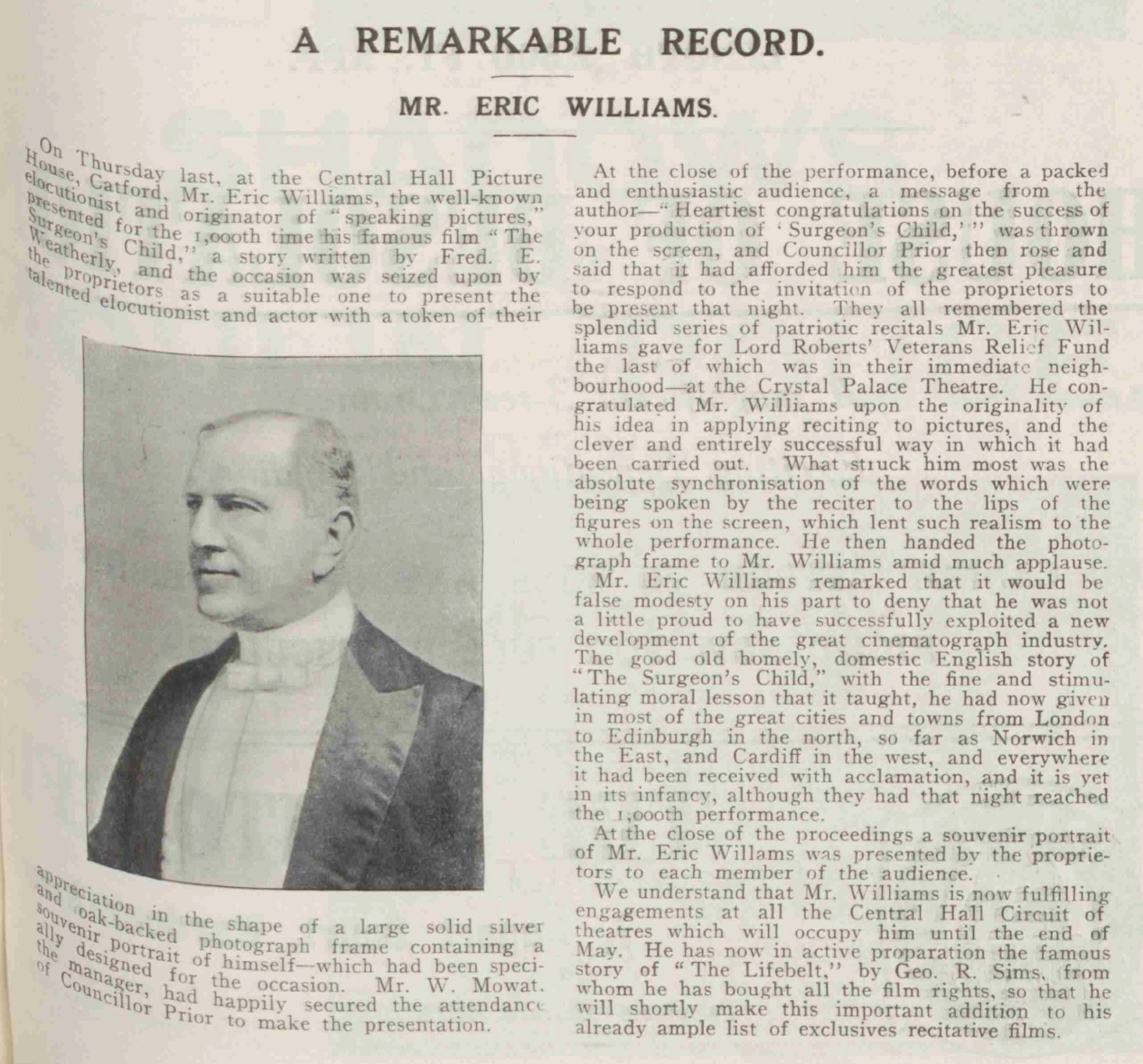
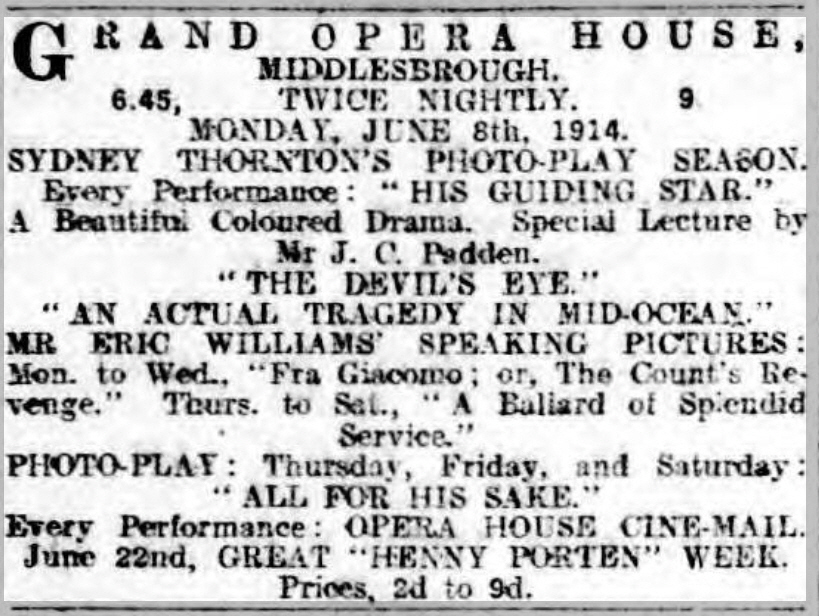
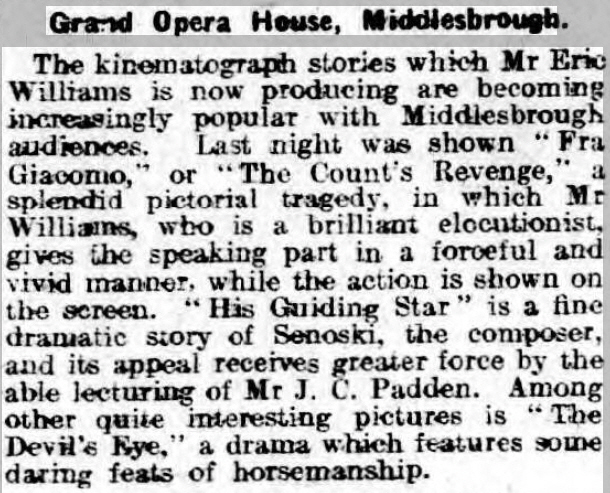
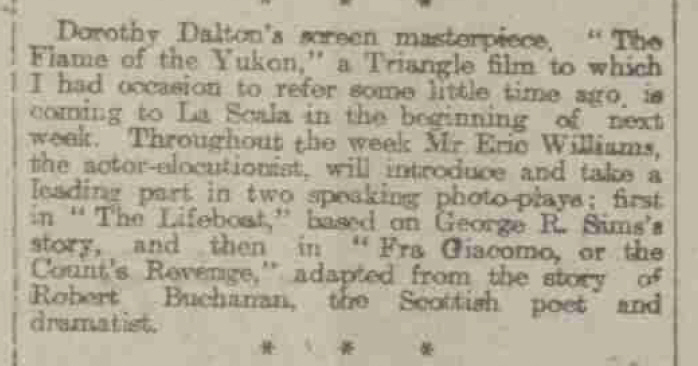
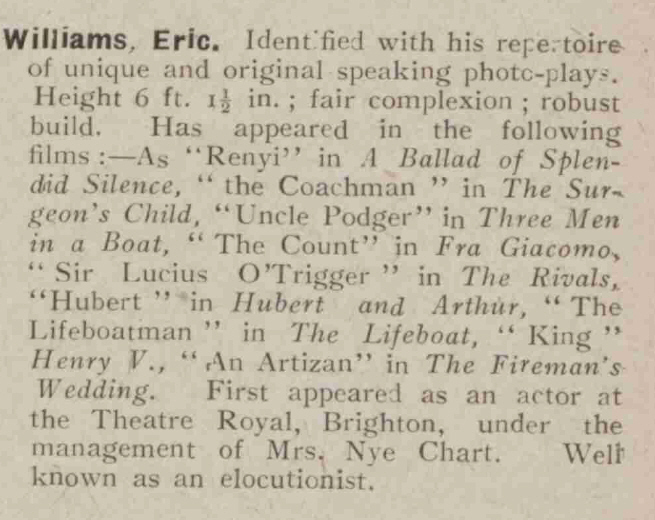
FRA GIACOMO: OR, THE COUNT’S REVENGE (1913) A curious hybrid of play and film - or an example of a very early talkie. The Bioscope (19 September, 1912 - p.13) A BIOSCOPE SCENA. A rather remarkable novelty was to be seen at the Kensington Picture Palace during the first three nights of last week in Mr. Eric Williams’ original “Bioscope Scena,” entitled “The Surgeon’s Child.” This is a ballad by Fred Weatherley, which Mr. Williams recites, whilst a film, in which he himself appears, illustrates the story visually. One sees the actor in his character as an old coachman on the screen, and one hears his voice, perfectly synchronised with the picture for the most part, emerging from the darkness—it is, indeed, almost an uncanny sensation to listen to what is, apparently, a real, live “talking picture.” It is an admirable idea, and Mr. Williams has made a distinct success of it. It suggests all sorts of rather wonderful possibilities for the reciter who will thus prepare his own films and appeal to his audiences visually through the photograph and really in person. Mr. H. B. Morris, the manager of the Kensington Picture Palace, si to be congratulated warmly upon his enterprise in making this novel and interesting engagement. That his patrons appreciated Mr. Williams’ clever combination of pictures and elocution was never for a moment in doubt. They were almost boisterously enthusiastic. ___
The Era (1 February, 1913 - p.26) Eric Williams’ Bioscope Stories. ___
The Era (19 February, 1913 - p.5) The popular reciter, Mr. Eric Williams, has scored a big success with his illustrated bioscope stories. On the two visits we paid last week to the magnificent picture palace in Tottenham Court-road he gave the stirring recitation “Fra Giacomo,” and an excerpt from J. K. Jerome’s “Three Men in a Boat,” entitled “Hanging a Picture.” The films alone were worth a visit—clear and suggestive of every point in the stories—and Mr. Williams’ distinct enunciation held the audience as though the pictures were speaking for themselves. ___
The Era (19 April, 1913 - p.28) FILM GOSSIP. Mr. Eric Williams’ Bioscope Stories. ___
The Bioscope (9 April 1914 - p.94) |
|
|
 |
|
|
 |
|
|
|
|
|
|
|
|
|
|
|
|
|
|
|
|
|
|
|
|
|
|
|
[From the Middlesbrough Daily Gazette (9 June, 1914 - p.2).] |
|||||||||||||||||||||
 |
|||||||||||||||||||||
|
[From the Middlesbrough Daily Gazette (9 June, 1914 - p.4).]
The Bioscope (5 November 1914 - p.93) Ample evidence of the popularity of Mr. Eric Williams as a reciter was afforded on Friday morning last, when a private presentation of his “Speaking Pictures” was given before a large and appreciative audience at the Shaftesbury Pavilion. Mr. Williams is an elocutionist of distinct merit, and, moreover, he is a very capable actor, while the excerpts with which he favoured us from his extensive repertoire afforded sufficient proof of his versatility. It was an arduous task that Mr. Williams set himself to render five pieces in quick succession, and it testifies to his ability that the applause grew in intensity and became most vociferous with the last item on the programme, an effective rendition of Robert Buchanan’s well-known and dramatic poem, entitled “Fra Giacomo.” Opening with the trying scene between Hubert and Arthur taken from Shakespeare’s “King John,” Mr. Williams next essayed the late Fred Weatherly’s “The Surgeon’s Child,” which he followed with Mr. Geo. R. Sims’ ever-popular “Lifeboat” story, in both of which the pathetic note was very vividly struck, while in the comedy line he gave us a taste of his quality in one of the capital scenes between Sir Lucius O’Trigger and Bob Acres from Sheridan’s “The Rivals.” The films thrown upon the screen served their purpose of effectively illustrating the various scenes, and in the case of Mr. Sims’ poem Mr. Williams acknowledged his indebtedness to the National Lifeboat Institution. The synchronisation, which is obtained without any mechanical aid, was not always perfect, but this is a trifling matter which can easily be remedied. Cinematography is an art of its own creation, and while admitting that it cannot lend colour to an indifferent presentation, and that a competent artist requires no mechanical aid in the portrayal of his own picture, we can quite imagine the “Eric Williams Speaking Pictures” forming an attractive feature in the regular programme. |
|||||||||||||||||||||
 |
|||||||||||||||||||||
|
[From the Aberdeen Evening Express (13 December, 1918 - p.6).]
The Bioscope (1 July, 1920 - p.179) |
|||||||||||||||||||||
 |
|||||||||||||||||||||
|
The Bioscope (6 December, 1923 - p.30) IT is with deep regret that I have to record the death, which took place at Tonbridge the other day, of Mr. Eric Williams, whose speaking pictures, to which he himself contributed the spoken story, have been seen in almost every town and village in this country, as well as in France. It was but last summer at Tonbridge that the deceased acted as pageant master, producing a spectacle that was witnessed by thousands of persons, including members of the Royal family. His demise robs the cinema theatre of a familiar figure, and one whose contribution to its programme was as deservedly appreciated as it was popular. _____
PHIL BLOOD’S LEAP (1913) |
|||||||||||||||||||||
 |
|||||||||||||||||||||
|
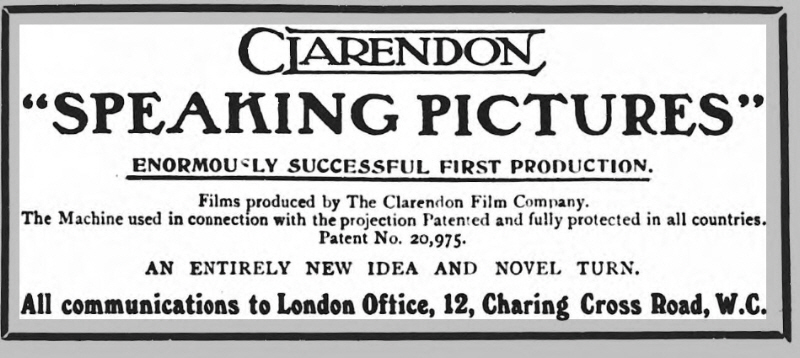
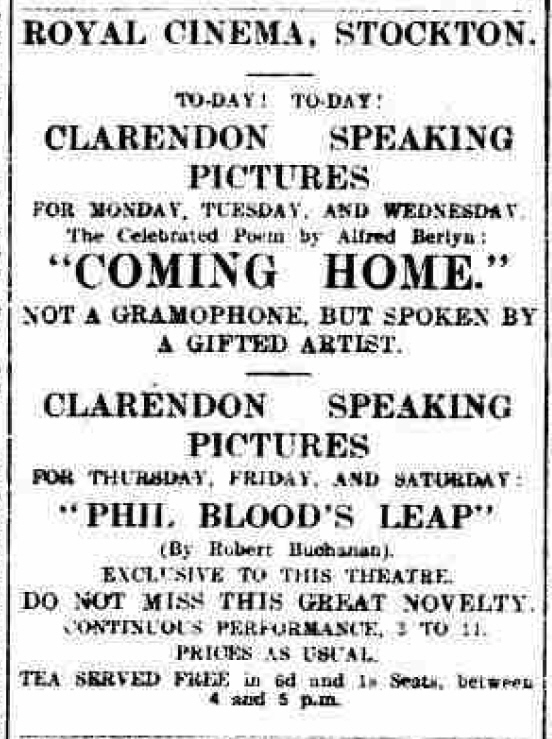
[Advert for Clarendon Speaking Pictures from The Era (8 October, 1913 - p.32).]
The Era (3 December, 1913 - p.29) FILM GOSSIP. Speaking Pictures. ___
The Manchester Courier (9 December, 1913 - p.6) OUR LONDON LETTER. Monday Night. Films, Poetic and Historic. ___
The Arbroath Herald (20 March, 1914 - p.5) |
|||||||||||||||||||||
 |
|||||||||||||||||||||
 |
|||||||||||||||||||||
|
[From the North-Eastern Daily Gazette (15 June, 1914 - p.2).]
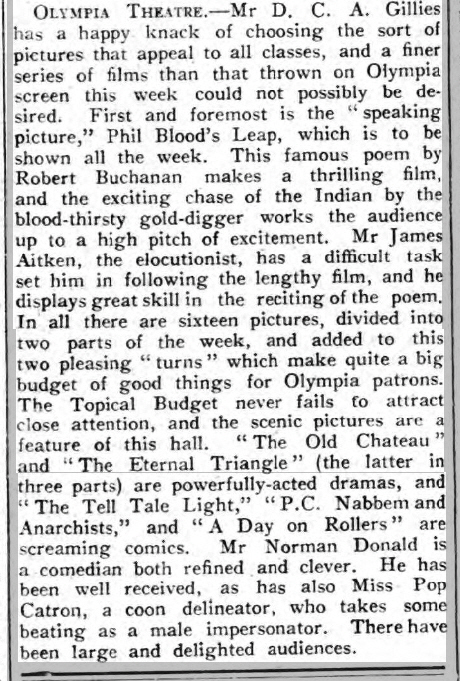
Cheltenham Looker-On (27 June, 1914 - p.6) WINTER GARDEN. The latest innovation in cinematography has attracted even more numerous audiences than usual to this popular house. Exclusive rights for the town had been secured by the enterprising management for these speaking pictures, and we have been enabled to see a poem and at the same time hear it recited by the human voice. Phil Blood’s Leap is visualised in this way and may be seen to-day. The recitation is perfectly synchronised with the picture, and marks a distinct advance in the “movie” world. Golfers were deeply interested in the demonstration by J. A. Taylor, five times open champion. Protea and the infernal automobile is full of sensations, and is a story which enthrals the imagination from start to finish. ___
Hastings & St. Leonards Observer (4 July, 1914 - p.2) “A LADY OF QUALITY” AT THE The heat wave notwithstanding, coolness and comfort can be obtained at the Royal Cinema de Luxe. ___
Coventry Evening Telegraph (14 July, 1914 - p.4) CROWN PICTURE THEATRE. Despite the sultry weather prevailing, many patrons were in attendance at the Crown Picture Theatre, Gosford Street, on Monday evening, when, in addition to the usual high-class programme of films, another of the popular Clarendon speaking pictures was submitted. The film, which will be shown at each performance during the week is entitled, “Phil Blood’s Leap.” During the exhibition of the picture Mr. Frederick Lytton, the elocutionist, who has already grown popular with the Crown audiences, delighted his hearers with the story of the film, which is of a stirring character. The deep dramatic voice of Mr. Lytton and the expression with which he recites during the exciting incidents add to the effectiveness of the picture, and well merit the applause received at the conclusion. “Excelsior” or “The Triumph of Progress” is a spectacular four-part production, which will be shown during the first part of the week. The film depicts the struggle between “Progress” and “Inactivity” in which the “Light” of Civilisation overcomes the “Darkness” of Ignorance and leads the way to the discoveries and gigantic works of our century. Two comics which cause amusement are “Oh! What a Day,” and “Wifey’s Christmas Present,” while Gaumont’s Graphic contains some attractive items. “Tragedy at the Pepper Box Inn,” a three-part drama, should prove a great attraction on Thursday. _____
ALONE IN LONDON (1915) |
|||||||||||||||||||||
 |
|||||||||||||||||||||
|
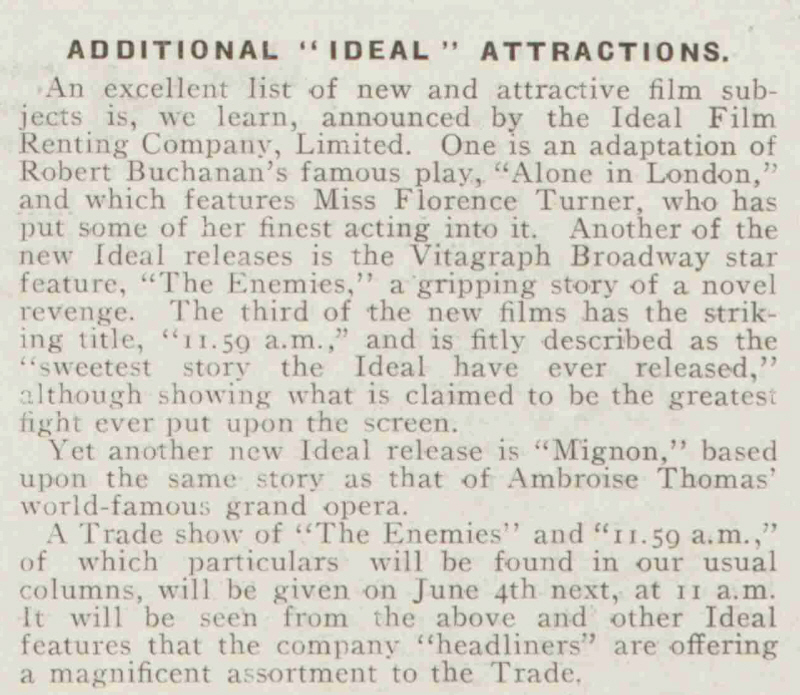
The Bioscope (13 May, 1915 - p.23) |
|||||||||||||||||||||
 |
|||||||||||||||||||||
|
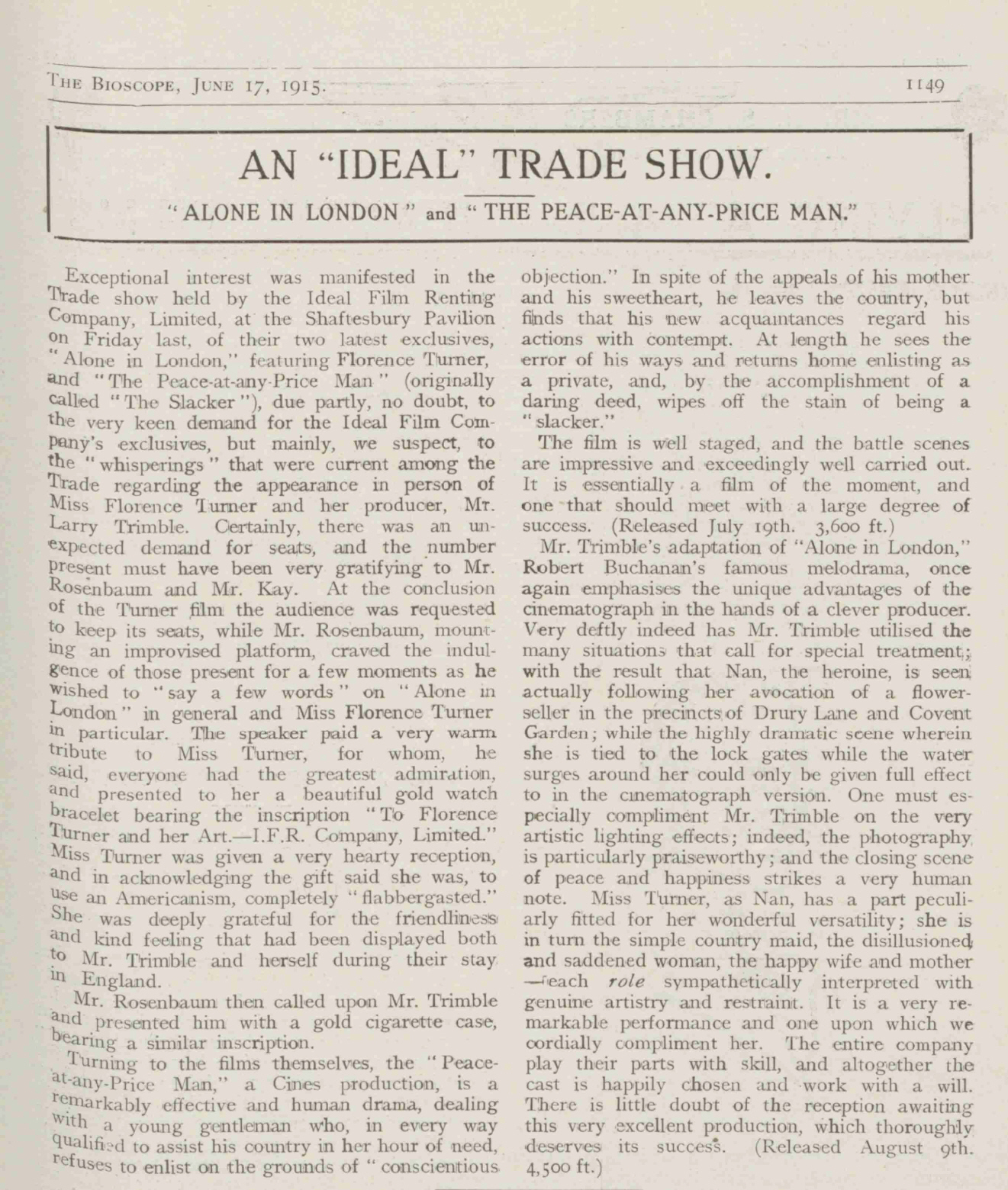
The Bioscope (17 June, 1915 - p.33) |
|||||||||||||||||||||
 |
|||||||||||||||||||||
 |
|||||||||||||||||||||
|
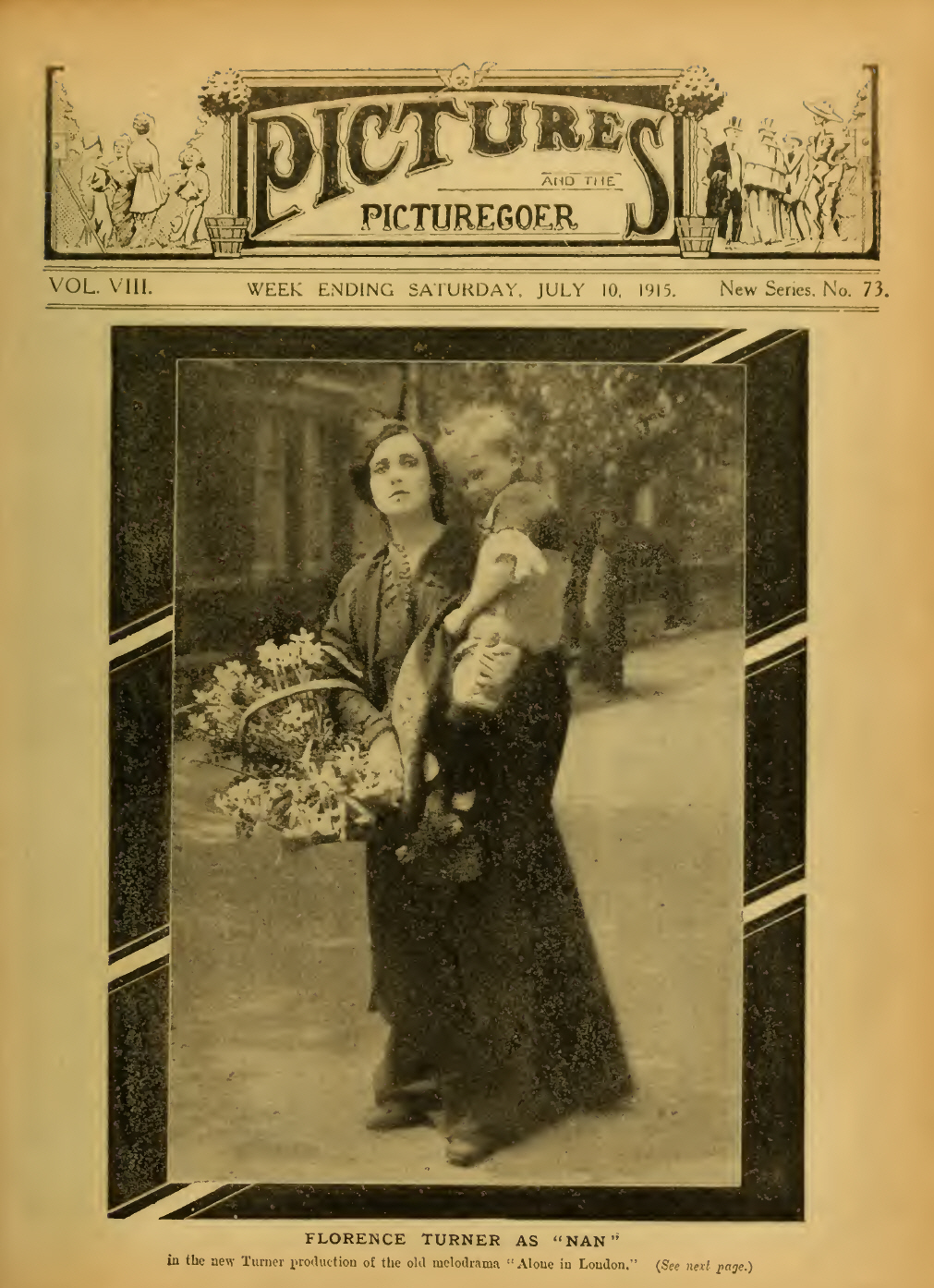
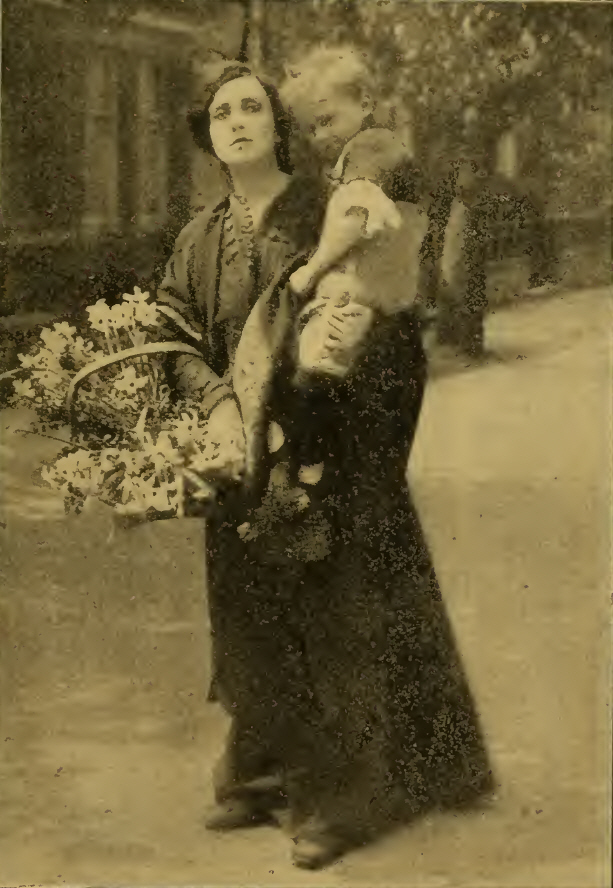
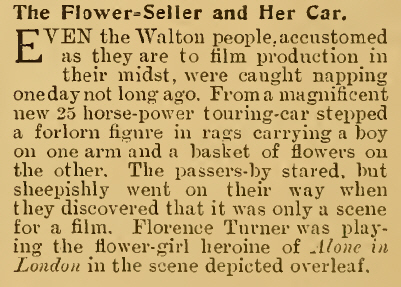
[From the cover of Pictures and the Picturegoer (10 July, 1915).] The Bioscope (13 May, 1915 - p.23) |
|||||||||||||||||||||
 |
|||||||||||||||||||||
|
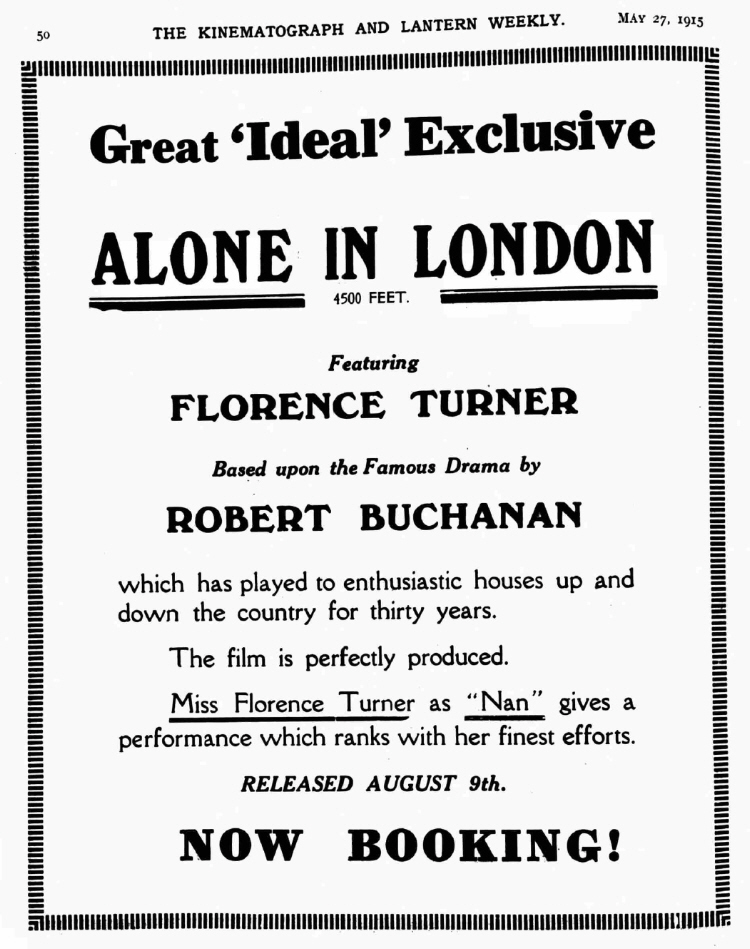
The Kinematograph And Lantern Weekly (27 May, 1915 - p.50) |
|||||||||||||||||||||
 |
|||||||||||||||||||||
|
The Kinematograph And Lantern Weekly (17 June, 1915 - pp.15-16) A Famous Drama on the Screen REVEALING FLORENCE TURNER AT HER BEST. THE Ideal Film Renting Company is to be congratulated upon the complete success which attended their trade show at the Shaftesbury Pavilion on Friday morning. That there would be a large attendance was to be expected, in view of the interest which centred on the first screening of so attractive a subject as the film version of Robert Buchanan’s famous old-time drama, “Alone in London.” Exactly how many times the writer has seen the play it is unnecessary to state, but it may be said that he saw it for the first time before the kinematograph was even thought of. To say that it wears as well to-day as it did then is to pay an entirely sincere compliment to the art of the dead dramatist who made it. But we were not called together on Friday for the purpose of making comparisons, except in so far as the film version of the drama compares with its original. ___
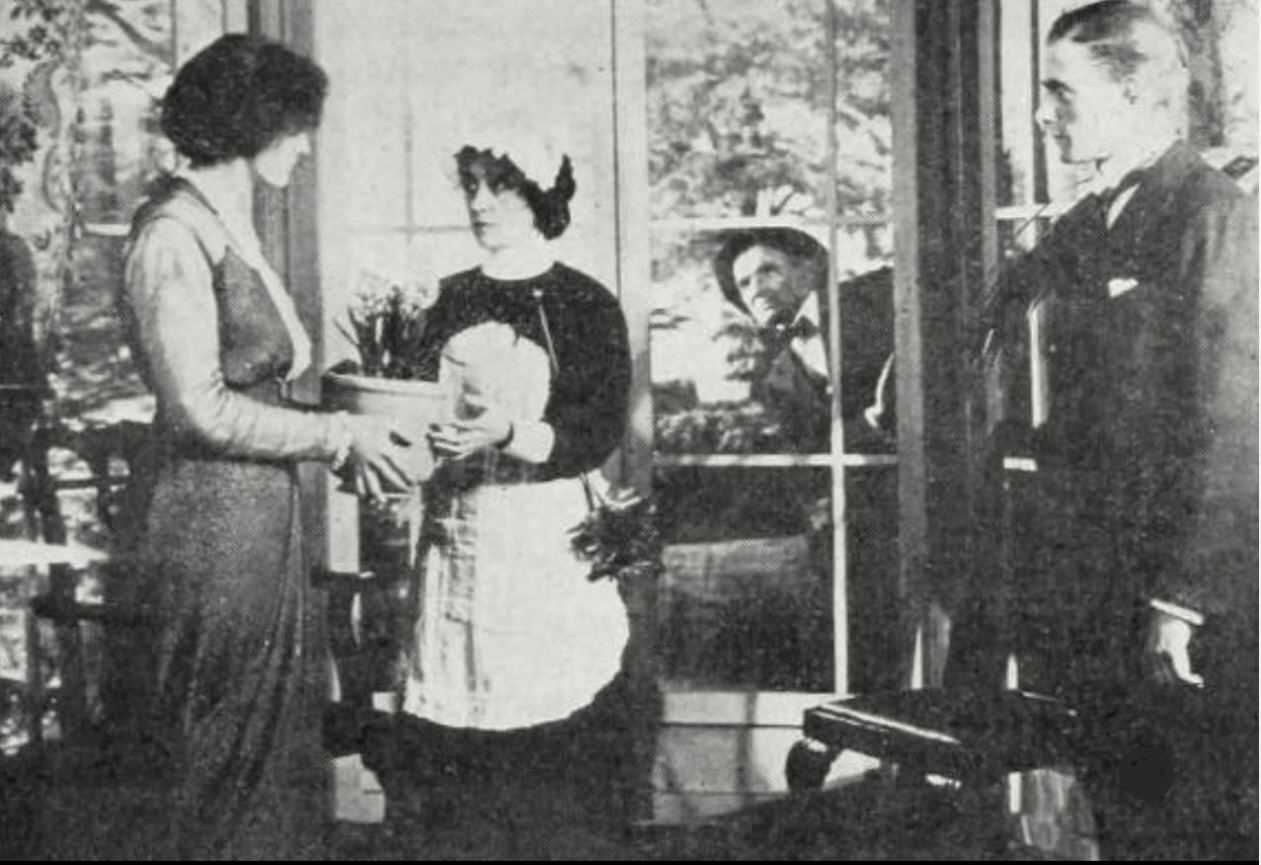
Pictures and the Picturegoer (24 July, 1915) ALONE IN LONDON.— You must see Florence Turner in the film version of this great Adelphi success. Old-fashioned melodrama, with its breathless and impossible situations, does not as a rule lend itself to screen production; but Larry Trimble has handled this one in a manner which will interest and hold the attention of all picturegoers. We recently published a fine portrait of Miss Turner as Nan, the flower-seller, one of the scenes in the play. ___
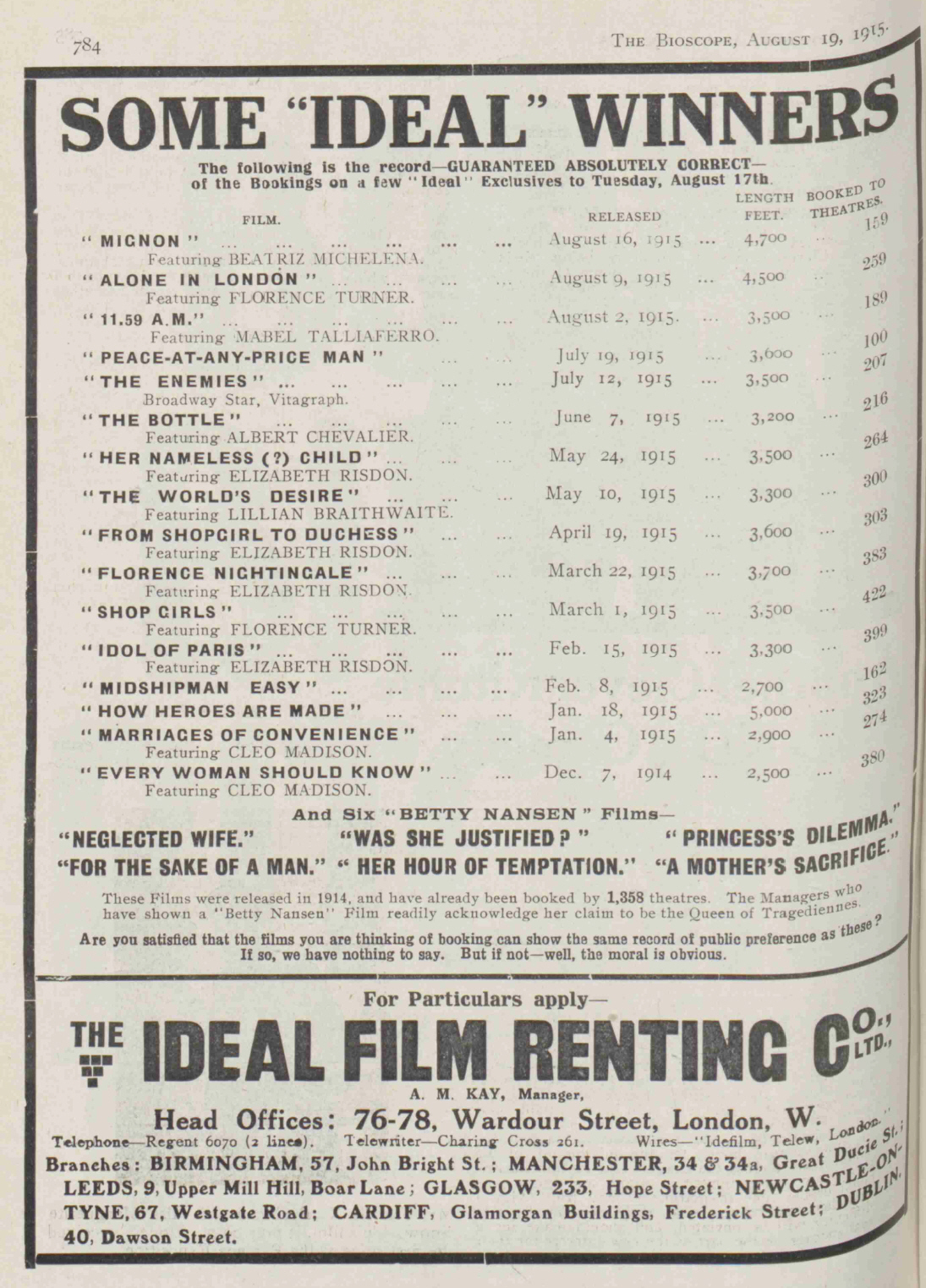
The Bioscope (19 August, 1915 - p.28) |
|||||||||||||||||||||
 |
|||||||||||||||||||||
|
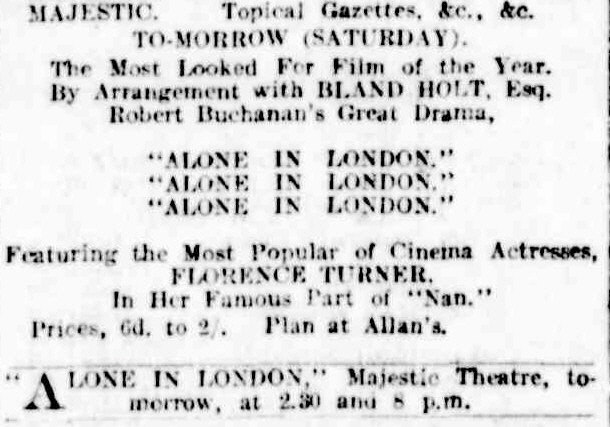
The Argus (Melbourne, Australia) (27 August, 1915 - p.14) |
|||||||||||||||||||||
 |
|||||||||||||||||||||
|
The Argus (Melbourne, Australia) (30 August, 1915 - p.10) MAJESTIC PICTURES. A fine film adaptation of Robert Buchanan’s play “Alone in London,” the story of which is familiar, through its previous stage representation in Melbourne, was the principal feature of the new programme of Spencer’s Pictures displayed at the Majestic Theatre on Saturday. The story is effectively reproduced on the screen, and the cinema actress Miss Florence Turner gives a splendid portrayal of the role of Nan, betrayed and deserted by a profligate husband, and fighting for the sake of her child against the machinations of the rogues who seek to lay the blame of their crime on the shoulders of the brave, innocent little girl. In this effort Miss Turner is seen at her best, and the audience follow with absorbing interest the stirring adventures of a country lass in the highways and byways of mighty London. Another attractive and enjoyable film was onme depicting the Royal Naval Division at work and at play. The Topical Gazettes—Australian and European—were replete with interesting matter, and a new Charles Chaplin comedy, “A Woman,” was thoroughly enjoyed. ___
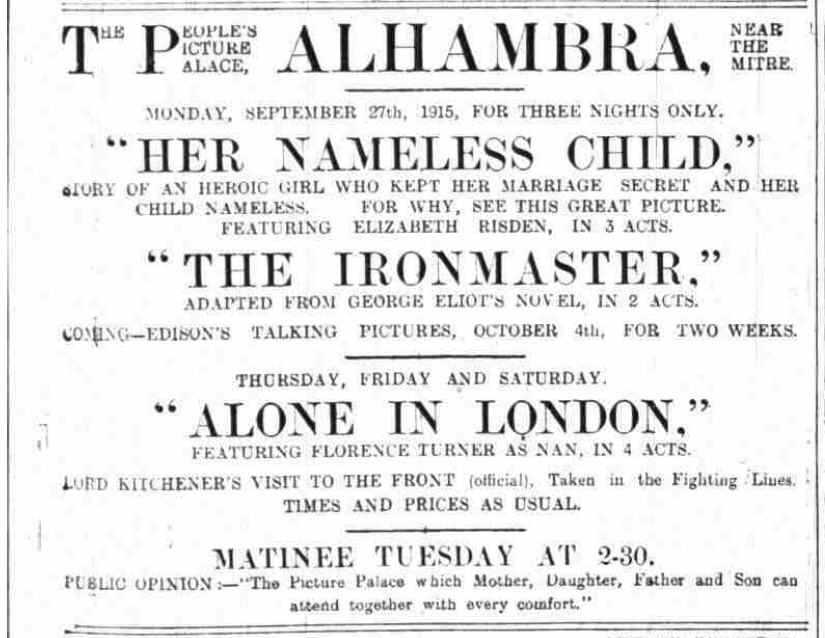
The Hull Daily Mail (21 September, 1915 - p.3) PLAYHOUSE’S METROPOLITAN STORY. For the provinces, as much as for London, stories having the capital as their milieu never seem to pall. The Picture Playhouse has for the first three days of this week an exceptionally fine film in this genre. It is a version of the melodrama, “Alone in London,” and crowded houses were the order throughout yesterday, at least. Miss Florence Turner is seen in the leading role as Nan. The picture tells how through the loss of her father she is left to wage her warfare singly. One day she unknowingly makes the acquaintance of the leader of a gang of criminals, and they are subsequently married, she throwing over her former lover, a miller, in the district. Some time afterwards her husband continues his life of crime, and Nan is thrown on the streets of London to make her living by selling flowers. However, one day she meets a gentleman in the city, who eventually takes her into his service, and there happiness is gained once again, until, by exceptional circumstances, her husband appears on the scene, and she is carried away to the den in Drury-lane. Her former lover succeeds in rescuing her from his grip, and with the aid of the police he eventually runs down the gang and brings them to justice. The picture, as will be seen, is in the traditional line of Dickens, Wilkie Collins, and G. R. Sims. The chief item is supported by a variety of fare. “Cupid Puts One Over” introduced Wally Van, a comedian whose popularity has outstayed many reputations. Drama, with its deeper hold, returned in “Destiny’s Trump Card” and “The Summoning Shot,” from the American Biograph Studios. Interesting items in the topical budget complete a programme that should please visitors. For the latter half of the week an exclusive drama in three parts, “The Victim,” will form the principal attraction. The management regret that a number of patrons were unable to gain admission last night. ___
The Burnley News (25 September, 1915 - p.1) |
|||||||||||||||||||||
|
|
 |
|
|
|
|
|
|
|
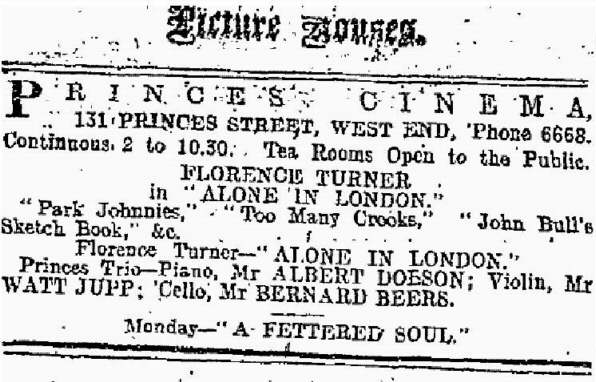
The Scotsman (28 October, 1915) |
|||||
 |
|||||
|
Edinburgh Evening News (2 November, 1915 - p.4) A good all-round programme is presented at the Coliseum this week, a great attraction to cinema-lovers being the appearance of Miss Florence Turner in “Alone in London.” The film, which is intensely interesting, is in four parts and adapted from the play by Robert Buchanan. The third instalment of the “Exploits of Elaine” is shown under the title of “The Vanishing Jewels,” while a good selection of comedy is presented. “Swell Mobsmen” will be the principal picture for Thursday and the remainder of the week. ___
Angus Evening Telegraph (7 March, 1916 - p.5) THE PAVILION CINEMA. The patrons of this theatre are usually well provided for, and this week a splendid programme is submitted. ___
The Bioscope (6 April, 1916 - pp.51-52) THE MANAGER’S BUREAU. . . . From the North. ALTHOUGH the cost of printing and paper has increased in some instances as much as fifteen per cent., the majority of managers who issue little four-page leaflets, carrying “weekly chats” and programme, have wisely accepted the inevitable and continue publishing their little publications. This, in itself, supports my contention that these managerial chats to patrons pay. Where the expense of a house organ cannot be met, they are admirable substitutes. They breath personality, and are a medium for direct appeal. IN THE BARBER’S CHAIR. Good morning, sir! Shave, sir? ’Air cutting! Right yew are, sir! This chair, please sir, thank you. ’Orrible weather! Yes, it is, sir; and wot with them darkened streets, I am that fed up, sir, that, blow me, sir, if it wern’t for them pitcher palises, sir, I dunno wot I should do at nights. A better effect would be given to the little advertiser if it were printed on better paper. A cheap appearance is always a big handicap to any form of advertising. The phrase “What are YOU going to do about it?” at the foot of the front and last page does not quite fit, and is decidedly not happy. ___
The Bioscope (27 July, 1916 - p.5) A STRIKING record of bookings is given by the Ideal Company in a delightfully novel and interesting booklet, piquantly entitled “The Ideal’s Confession,” of which Mr. H. Rowson is kind enough to send us an advance copy. So far, the list is headed by “My Old Dutch,” which has been booked to 795 theatres. “Caste” comes second with 646 books, and “Alone in London” is a close third with 632. The booklet is worth reading. It is the wonderful history of a wonderful firm. [More information in the Alone in London section. And also here’s a bit more on Florence Turner.] _____
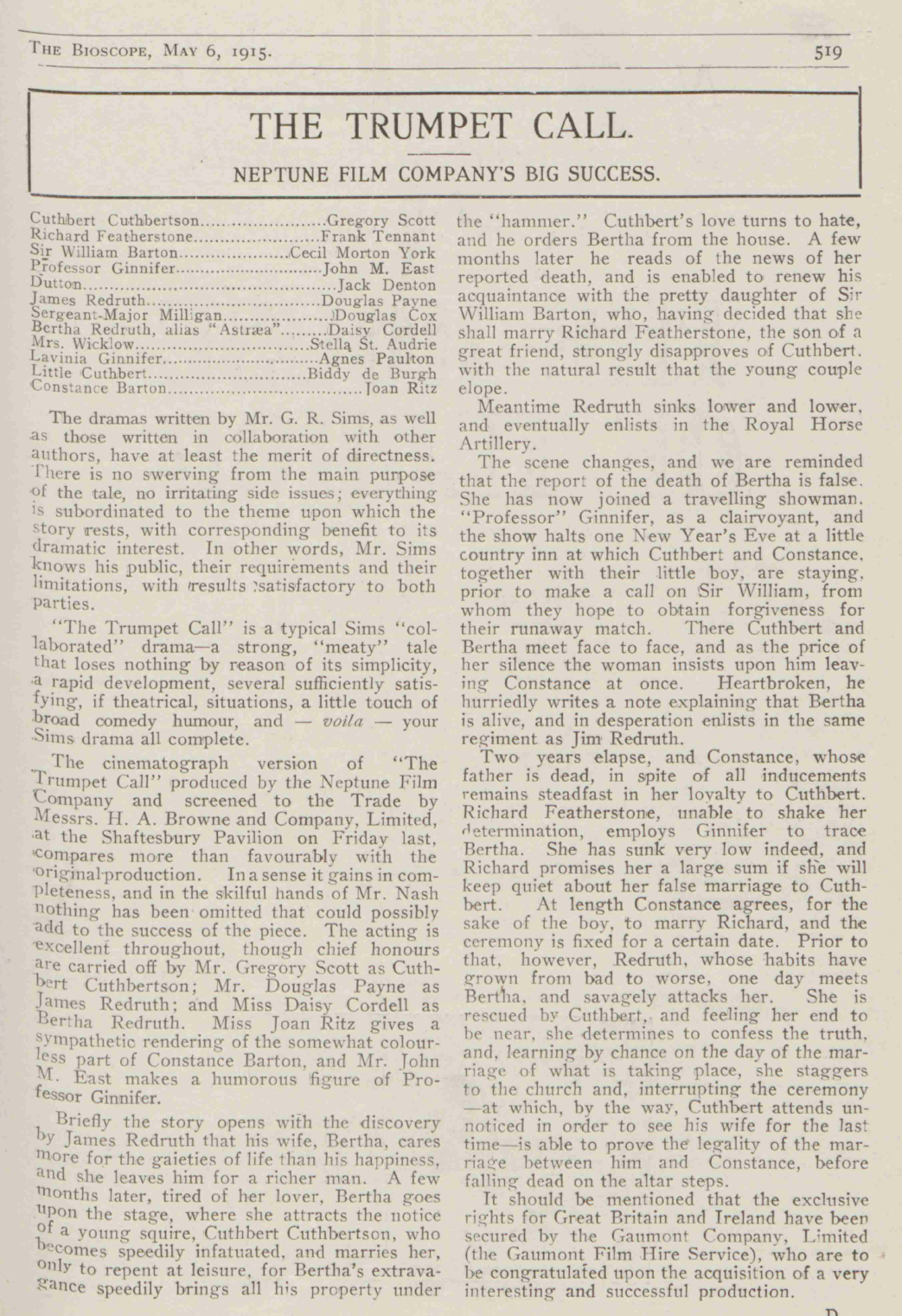
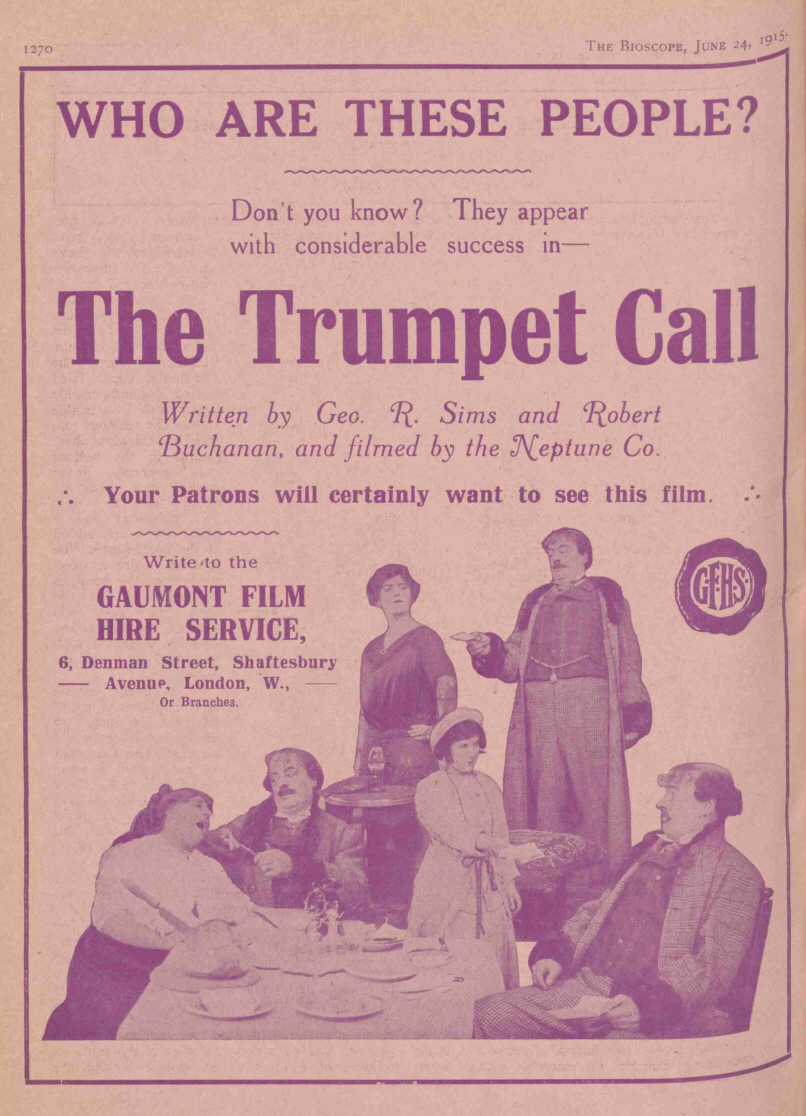
THE TRUMPET CALL (1915) The Bioscope (22 April, 1915 - p.14) “The Trumpet Call,” the well-known drama by Messrs. Geo. R. Sims and Robert Buchanan, of which there is a Trade show at the Shaftesbury Pavilion, on April 30th, at 11.30 a.m., should be welcomed by a great many London and provincial picture-goers. It was this celebrated drama that made one of the biggest successes, financially, for the late Mr. Robert Arthur, who had several companies touring for a good many years. It formed a great attraction at many of the principal theatres in the kingdom, and was continually rebooked as a great holiday attraction. “The Trumpet Call” is said to be one of the best British dramas that has ever been filmed, and the Neptune Film Company ought to do well with it. ___
The Bioscope (6 May, 1915 - p.519) |
|||||
 |
|||||
|
Pictures and the Picturegoer (8 May, 1915) Better than the Play. ___
The Bioscope (24 June, 1915 - p.1270) |
|||||
|
|
 |
|
|
|
|
|
|||
|
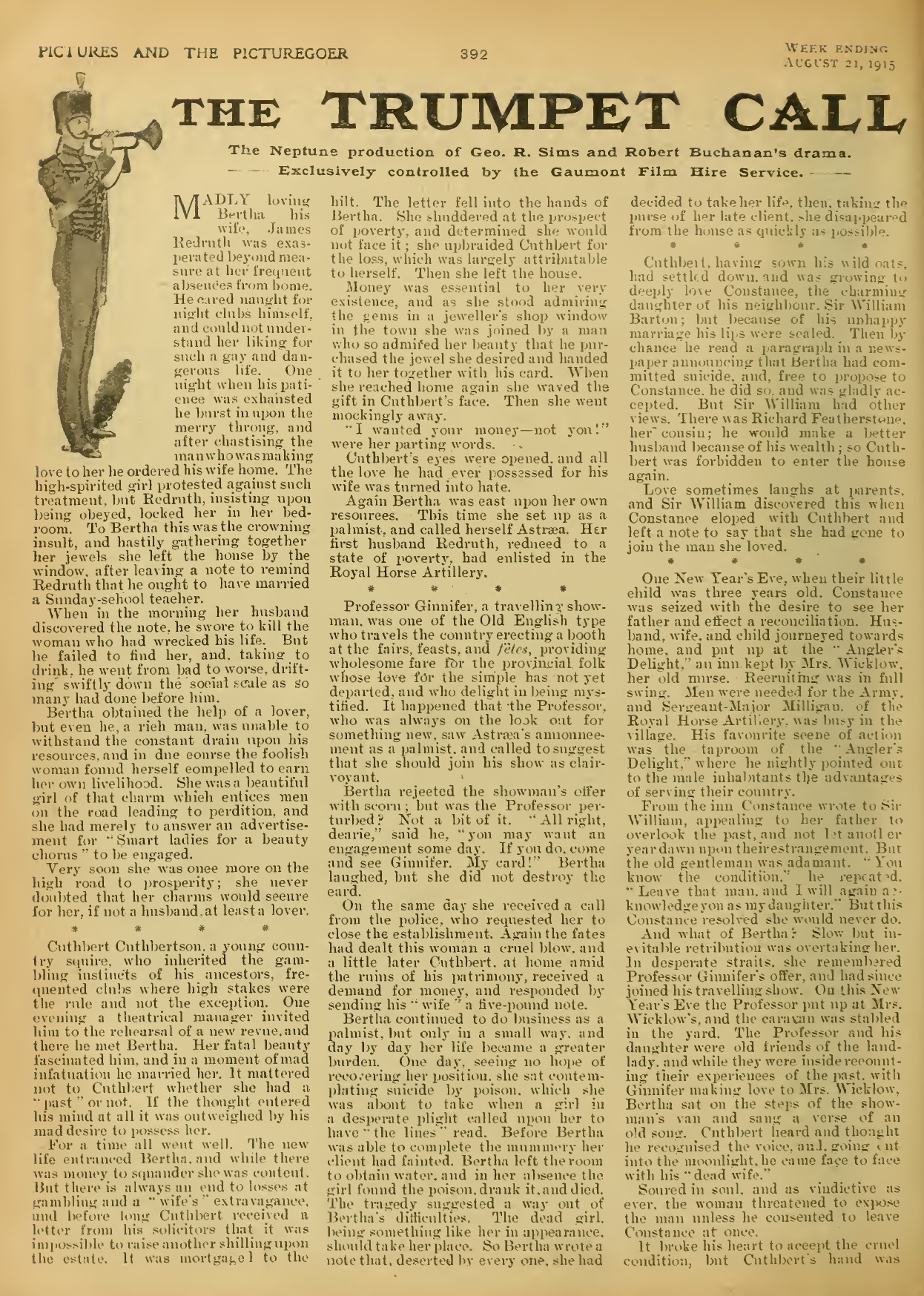
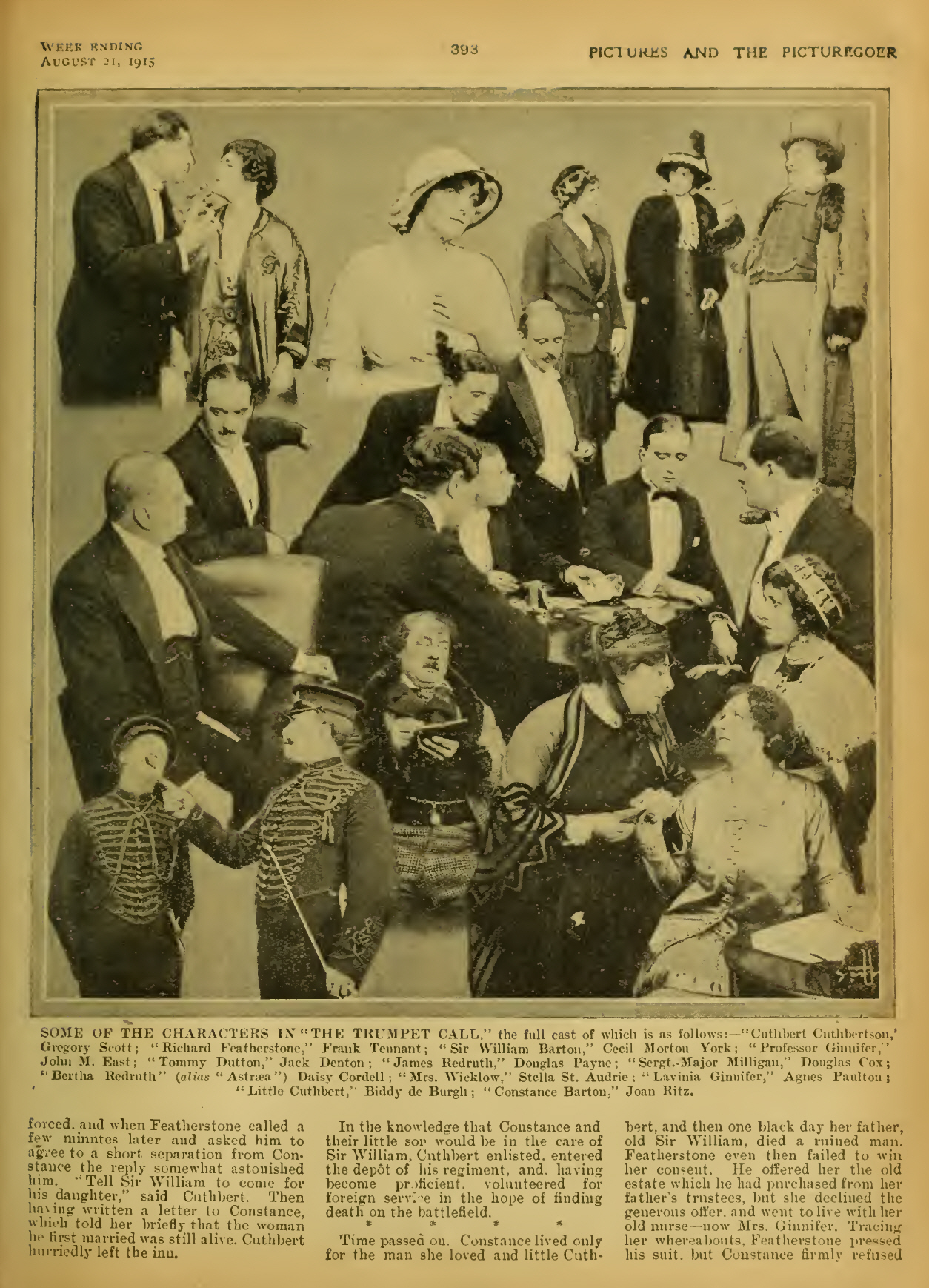
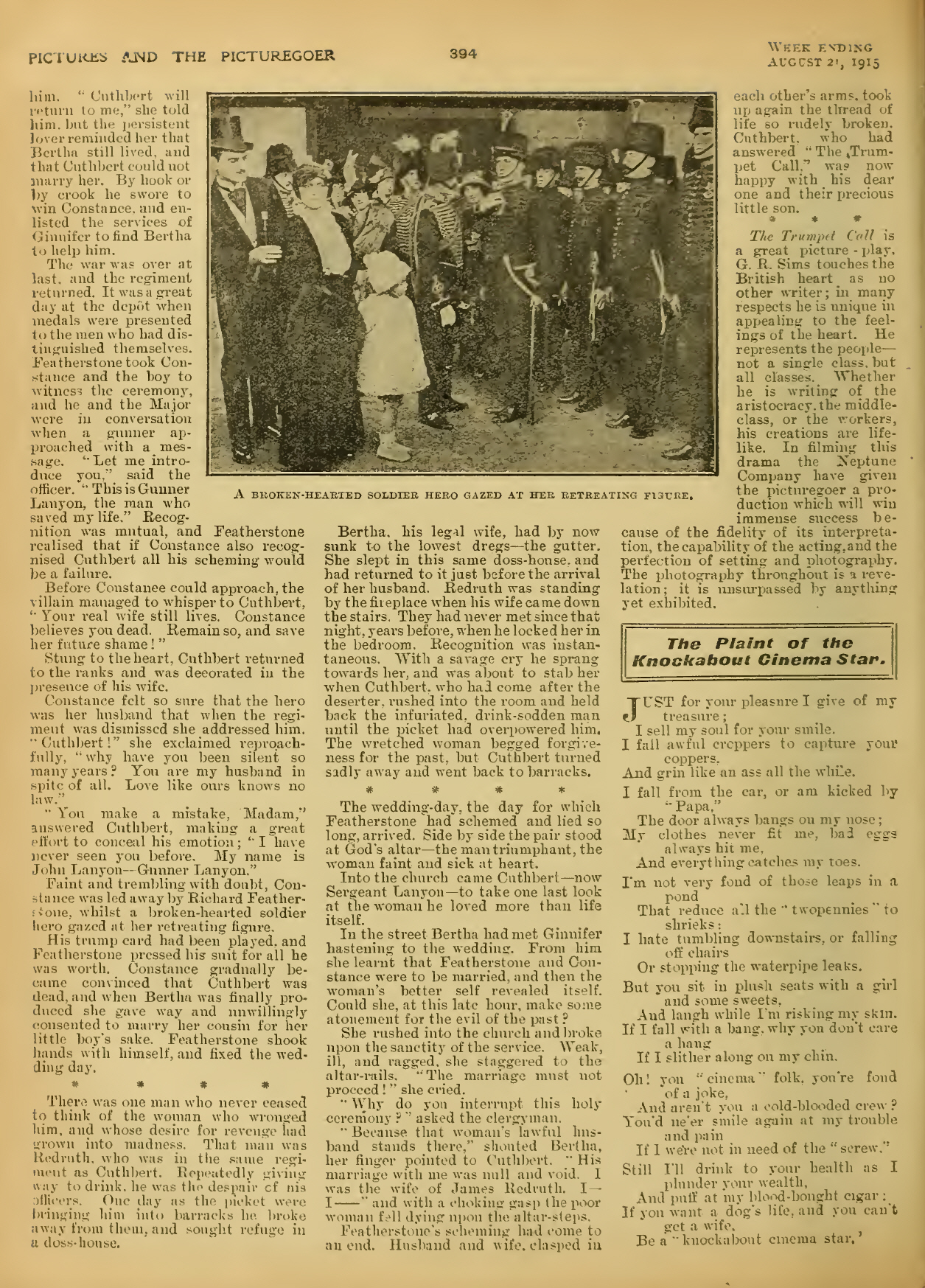
Pictures and the Picturegoer (14 August, 1915) THE TRUMPET CALL.—If you want to see the best in melodrama, make a note to enjoy, when it arrives, this photo-drama by George R. Sims and Robert Buchanan. Filmed by the Neptune Film Company, it is one of the “tit-bits” of the year. British in sentiment, in treatment, and in the spirit it breathes. We hope to publish the story next week. ___
The August 21st issue of Pictures and the Picturegoer included a three-page feature on The Trumpet Call, which is available below: |
|||||||
 |
 |
 |
|||||
|
Dover Express (17 September, 1915 - p.4) |
|||||||
|
|
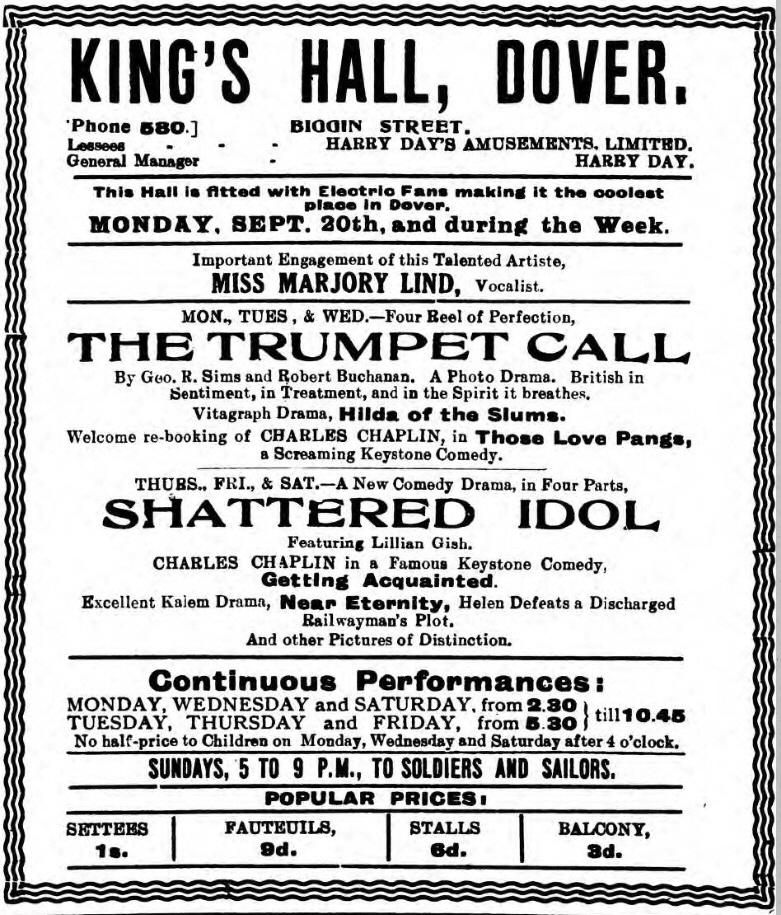 |
|
|
|
|
|
Coventry Evening Telegraph (21 September, 1915 - p.4) THE GLOBE. “The Trumpet Call,” a four-part drama by Neptune, is the chief item on the bill at the Globe Theatre for the first part of the week. Filmed after the drama by G. R. Sims and Robert Buchanan, it is being shown by arrangement with the Gaumont Film Hire Service. Many thrilling episodes are included, whilst there is also a touch of humour about it. As the title suggests, there is some military items included. It is an entirely British production, and should not fail to please all who see it. “The Three Roses,” an absorbing drama, is also shown, and shows how a girl marries against her father’s wish, and is banished by him for ever. However, circumstances force him to seek refuge with her as years roll by, and a happy reunion is witnessed. “Fair, Fat and Saucy” is a screaming comic, and was much appreciated on Monday, as was the latest war and general news, which is depicted on the Gaumont’s Graphic. ___
The Hull Daily Mail (29 September, 1915 - p.3) |
|||
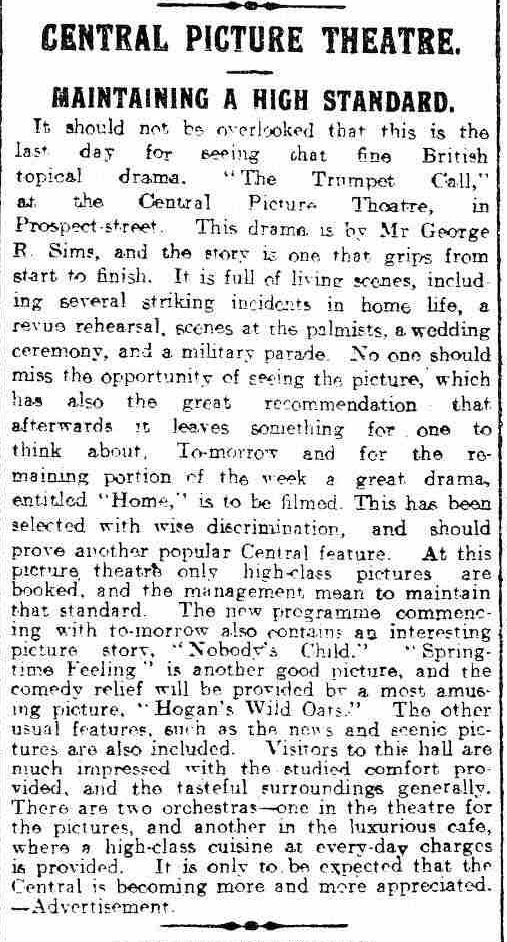 |
|||
|
Western Daily Press (23 March, 1916 - p.5) The screening of “The Trumpet Call” at the family picture house of Zetland Road is particularly noteworthy. It is a photo-drama, thoroughly British in sentiment and treatment. It is by Geo. R. Sims and Robert Buchanan, a guarantee of its sterling quality. This exclusive will be accompanied by the 11th instalment of the grand serial, “The Broken Coin,” the 19th episode of the new “Exploits of Elaine,” &c. ___
The Whitstable Times and Tankerton Press (27 May, 1916 - p.2) |
|||
|
|
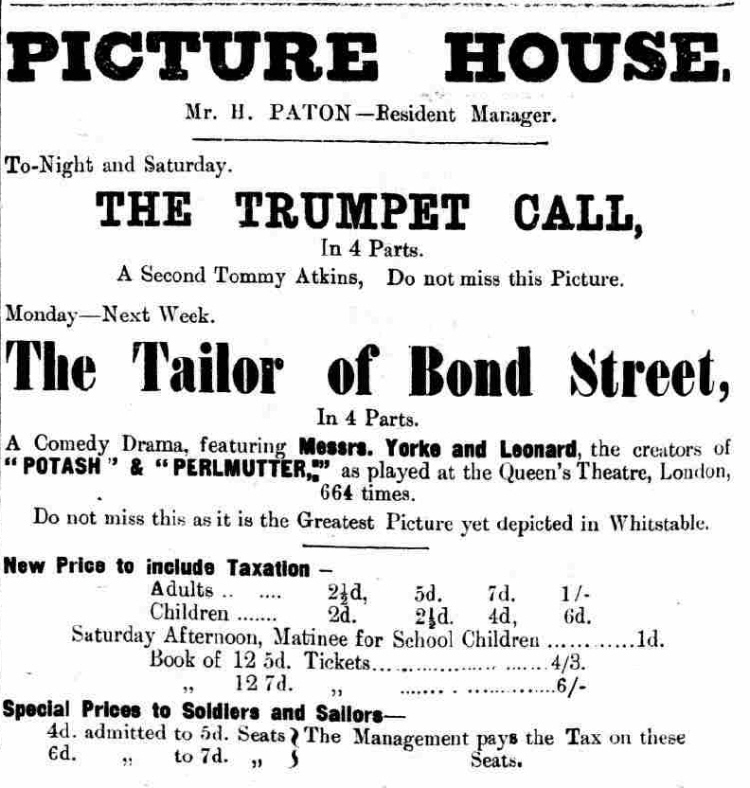 |
|
|
|
_____
A Robert Buchanan Filmography - continued
|
|
|
|
|
|
|