 |
|
|
Play List: 4. Corinne 7. The Mormons 9. Lucy Brandon 10. Storm-Beaten 11. Lady Clare 13. Bachelors 14. Constance 15. Lottie 16. Agnes 17. Alone in London 18. Sophia 19. Fascination 20. The Blue Bells of Scotland 21. Partners 24. Angelina! 25. The Old Home 26. A Man’s Shadow 27. Theodora 29. Clarissa 30. Miss Tomboy 32. Sweet Nancy 33. The English Rose 36. Marmion 37. The Gifted Lady 38. The Trumpet Call 39. Squire Kate 40. The White Rose 42. The Black Domino 44. The Charlatan 45. Dick Sheridan 47. Lady Gladys 48. The Strange Adventures of Miss Brown 49. The Romance of the Shopwalker 52. Two Little Maids from School ___ |
|
|
|
ROBERT WILLIAMS BUCHANAN (1841 - 1901) |
|
|
|
|
|
|
|
|
|
ALONE IN LONDON IN AMERICA
From Harriett Jay’s biography of Robert Buchanan: Chapter XXIII: “The City of Dream”: Buchanan’s account of the origins of Alone in London (printed in the programme of the Olympic production) are similarly vague. In fact, the only mention of how Buchanan managed to finance that first production in Philadelphia that I’ve come across so far, is in the following obituary: The Atlanta Constitution (Georgia) (4, August 1901) Robert Buchanan, who died in London the day after Sir Walter Besant’s passing but who had been bed-ridden for some time was a born fighter and always involved in a struggle with some one. He made money and lost it, enjoyed himself in his own way and died in poverty and almost forgotten save by a few faithful friends. Buchanan inherited his socialistic notions from his father as also his ideas of a future earthly paradise. Born in 1841 he graduated from the University of Glasgow, and journeyed to London with David Gray, arriving penniless, their sole asset a poem by Gray which no one would buy. They struggled hard for food and lived in an attic room whose furniture was so meager that they used the floor as a desk lying at full length when writing. His great talent was not long unrecognized for “Undertones,” a study of the poor and erring of the great city was a financial success. From 1862 to 1872 he produced many books of poems and novels, the more popular being “God and the Man,” “The Shadow of the Sword” and “Napoleon Fallen,” a lyric drama. Then he took to writing plays and in 1884 came to New York to sell “Alone in London.” General Lloyd Bryce was invited to hear it read. He found the author in an attic room off the Bowery, unkempt, collarless, vestless and looking like a typical anarchist as he is painted by the press. Bryce heard the play read and invested $3,000 in its production. Buchanan selected the caste and the play ran for several years, clearing over $100,000 for its proprietors and author. _____
From The Olympic Programme and Looker-On (7 November, 1885) “ALONE IN LONDON,” ALONE IN LONDON was produced by the authors for the first time on any stage at the Chestnut Street Theatre, Philadelphia, on Monday evening, March 30, 1885, being performed simultaneously in England for the purpose of preserving copyright. Its success in America was so unmistakeable and instantaneous that within a few days it was secured by the well-known entrepreneur, Colonel William E. Sinn, of Brooklyn, for a two years’ tour of the United States and Canada. The entire Company, a remarkably strong one, was re-engaged for that purpose, with the single exception of Miss Harriett Jay, who had created the part of Tom Chickweed for that occasion only, and who shortly afterwards left to produce the play in England. After the summer recess Colonel Sinn’s Company opened, August 31st, at the Park Theatre, Boston, playing for two weeks to receipts of over fourteen thousand dollars; thence to the People’s Theatre, New York, with a week’s business of seven thousand dollars; thence to Brooklyn and Williamsburg, with similar results; thence to the Grand Opera House, New York, with a weekly total of eight thousand dollars. The play is now running every week to phenomenal business. Its popular success is peculiarly interesting, as it destroys the managerial fallacy that a drama, to secure success in America and the colonies, must first have secured a long London run, or possess a London reputation. The Boston Daily Globe says:— The favours bestowed on the piece was deserved. “Alone in London” is essentially a melo-drama. It does not pretend to be anything else, but it is generally fresh and interesting; the materials are well handled, the construction is excellent, and the auditor is swept along by the intense and rapid action. The dialogue is natural and strong in the most legitimate way. It pleased an immense audience last night, and will continue to do so during its stay with us. __________ “Alone in London,” in Philadelphia. The Philadelphia Sunday Mercury says:—Melo-drama has no more shining example to justify its existence than Charles Dickens. I am glad, therefore, that an author so conspicuous as a poet as Robert Buchanan has not turned with disdain from the simple annals of the poor. His play, “Alone in London,” is the strongest and most impressive play of English life we have had for years. It is compact in structure, vigorous in tone, faithful in heroism, expressive in language. Mr. Buchanan has charged his play with a dramatic force and interest, which neither the “Lights o’ London” nor “The Silver King” possesses in the same degree. The echoes that came from the audience showed how well the heart-chords had been struck. “Alone in London” is a better play than “Storm Beaten,” by the same author. The author gauges himself on a level with the popular heart. __________ “Alone in London,” in Brooklyn. The Argus says:—Its success is not problematical, it is certain. The company is an excellent one, and does full justice to this new work of Robert Buchanan, who made his mark in drama as the author of “Storm Beaten” now in its third prosperous season, and the great Wallack’s success, “Lady Clare.” __________ N.B.—At the Olympic Theatre, London, the play will be produced on a scale unexampled in the history of the Theatre. One of the scenes alone (by Mr. Bruce Smith) will entail a cost adequate to the entire expenses of getting up an ordinary play. The artistes engaged are all of more or less established London reputation. Miss Amy Roselle will play the heroine; Miss Harriett Jay, her original character of the gipsy waif; Mr. Leonard Boyne the rural lover; Mr. Percy Bell and Mr. Fred Desmond (both admirable comedians) will bear the weight of the comic and character business, and Mr. Herbert Standing has been specially engaged for the adventurer, Richard Redcliffe. The other characters are all in competent hands, and, in addition to them, there will be a crowd of well-drilled auxiliaries. For the better convenience of the general public the Pit of the Theatre has been enlarged, and the entire building re-arranged and re- decorated for the occasion. |
|
|
|
|
|
|
|
|
|
|
|
|
|
|
 |
|||||||||||||
|
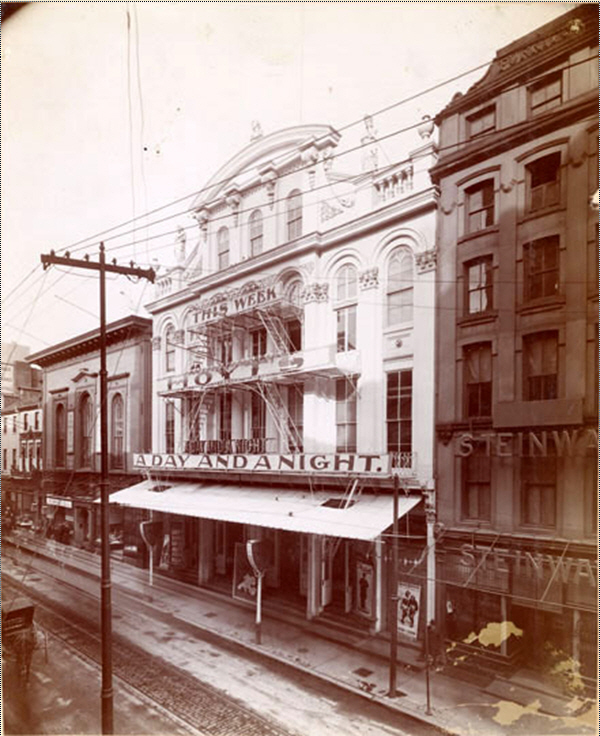
[The Chestnut Street Theatre, Philadelphia, where Alone in London premiered.
The New York Times (12 March, 1885) Mr. Robert Buchanan has succeeded in disposing of one more play in this country. This piece is called “Alone in London,” and it is to be tried on in Philadelphia some time in May next. If “Alone in London” proves successful it will be brought out in New-York at the beginning of the following season, and after that it will be sent through the general country. “Alone in London” has a material attachment in the shape of Miss Harriet Jay, who appears to be generously thrown in with the most of Mr. Buchanan’s theatrical bargains. Miss Jay is regarded by Mr. Buchanan as the most beautiful woman and the most accomplished actress in the world, and this fact indicates the degree of generosity which induces him to insist that managers who accept his plays shall also receive the further boon of having them performed by the radiant and accomplished Miss Jay. ___
The Evening Critic (Washington, D.C.) (23 March, 1885 - p.2) Mr. Robert Buchanan says: “My new play, ‘Alone in London,’ will be produced in London and Philadelphia on the same day, March 30. I don’t know how American authors feel, but I look with no little envy on the enormous field of life and character lying open before them in this country. In England it is very difficult to hit on anything new. In a talk I had some time ago with Mr. Palmer, that gentleman said that it would amply repay any English dramatist to reside for a time in America and study the vast social material which native dramatists, for some inscrutable reason, persistently neglect; and I have been acting to some extent on his advice. Since I came to America I have been overwhelmed with offers for dramatic work, most of which I have had to decline on account of the pressure of my more important literary avocations. Mr. Daly has made me a liberal offer for the production of an original comedy next season at his theatre, and as soon as I can find time I shall complete a new play for Mr. Wallack.” ___
The New York Clipper (4 April, 1885 - p.38) PENNSYLVANIA. Philadelphia.—At the Chestnut-street Theatre Robert Buchanan’s drama “Alone in London” was given March 30 for the first time on any stage. It is the story of a simple country girl fascinated by a member of the London “swell mob,” who takes her to the city, where she is alone among thieves. Her husband, Richard Redcliffe is the most villainous villain put on the stage in modern melodrama. His cruelties to his wife, Annie Meadows, his attempt to murder her, her despairing efforts to reclaim him, and his final crime of burglary form the successive climaxes of the prologue and the four acts. The curtain fell on 30 at 11.35 o’clock, which indicates the necessity of pruning away a great deal of talk. The climax of the third act—the attempted drowning of Annie Meadows—fell flat, and was poorly set. The climax of the last act—the detection of her husband in the act of robbing her benefactors—was also feeble. Earlier scenes had already shown more dramatic power. The house was crowded, and the author sat in a proscenium-box. He was not called for. Interest flagged at critical moments all through. It was possible to anticipate the most effective coups. Walter Reynolds as John Biddlecomb, and Charles Coote as Jenkinson carried off the honors. I give the complete cast, merely adding that Harriett Jay made her Philadelphia debut, and was engaged with the play because she was the author’s sister-in-law. In the prologue—John Biddlecomb, a wealthy miller, Walter Reynolds; Annie Meadows, the keeper’s daughter, Cora Tanner; Jack Wood, under-keeper, Mr. Roberts; Richard Redcliffe, a Londoner, Herbert Archer; Spriggins, his friend, Mr. Seabrooke; Tom Chickweed, a waif and a stray, Harriett Jay; Jenkinson, an innkeeper, Charles Coote; Matt, a laborer, Mr. Dorset. In the drama—Mr. Burnaby of Burnaby Brothers, near London, William Herbert; Walter Burnaby, his son, Robert Coote Jr.; Ruth Clifden, his cousin, Jenny Williams; Richard Redcliffe, an adventurer, Herbert Archer; Spriggins, his friend, a swell, Mr. Seabrooke; Jenkinson, thief and philosopher, Charles Coote; Liz Jenkinson, his daughter, Maggie Holloway; Dick Johnson, a humble “professional,” Alf. L. Fisher; Nan, a flower-girl, Cora Tanner; Tom Chickweed, seller of chickweed and grundsell, Harriett Jay; Mrs. Moloney, from County Cork, Grace Hathaway; Blind Billie, The Lame Duck, Jim the Larker, Ballad-singer, outcasts and mendicants, Mr. Harlowe, J. Smith, R. Clarke, Mr. Williams; John Biddlecomb, “Up from Suffolk,” Walter Reynolds; Isaacs, keeper of a low lodging-house, S. Wellington; Robert, a policeman, Mr. Hawley; Inspector of Police, Walter Benson; David, a potboy, J. C. Pitt. |
|||||||||||||
 |
 |
||||||||||||
|
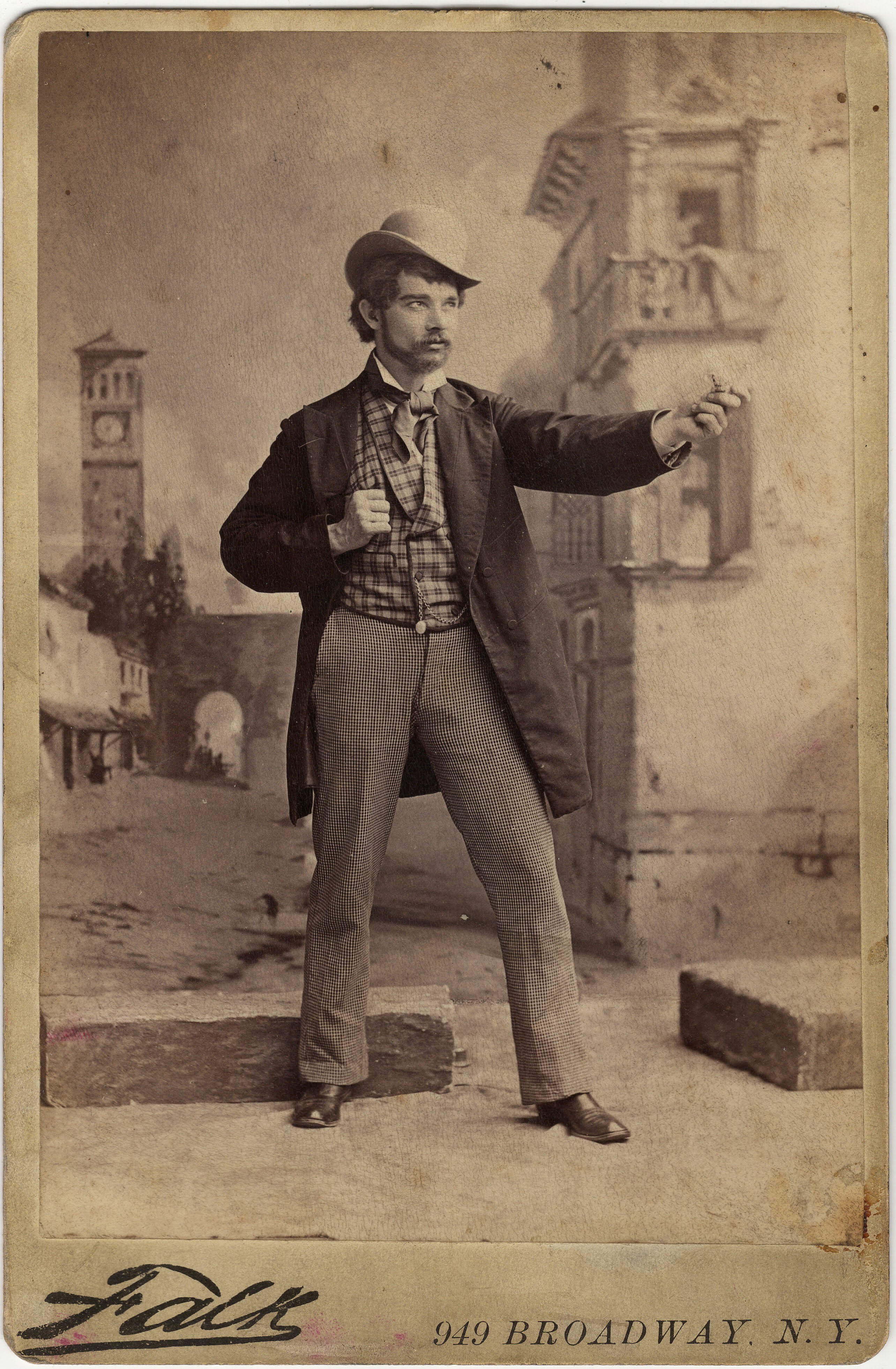
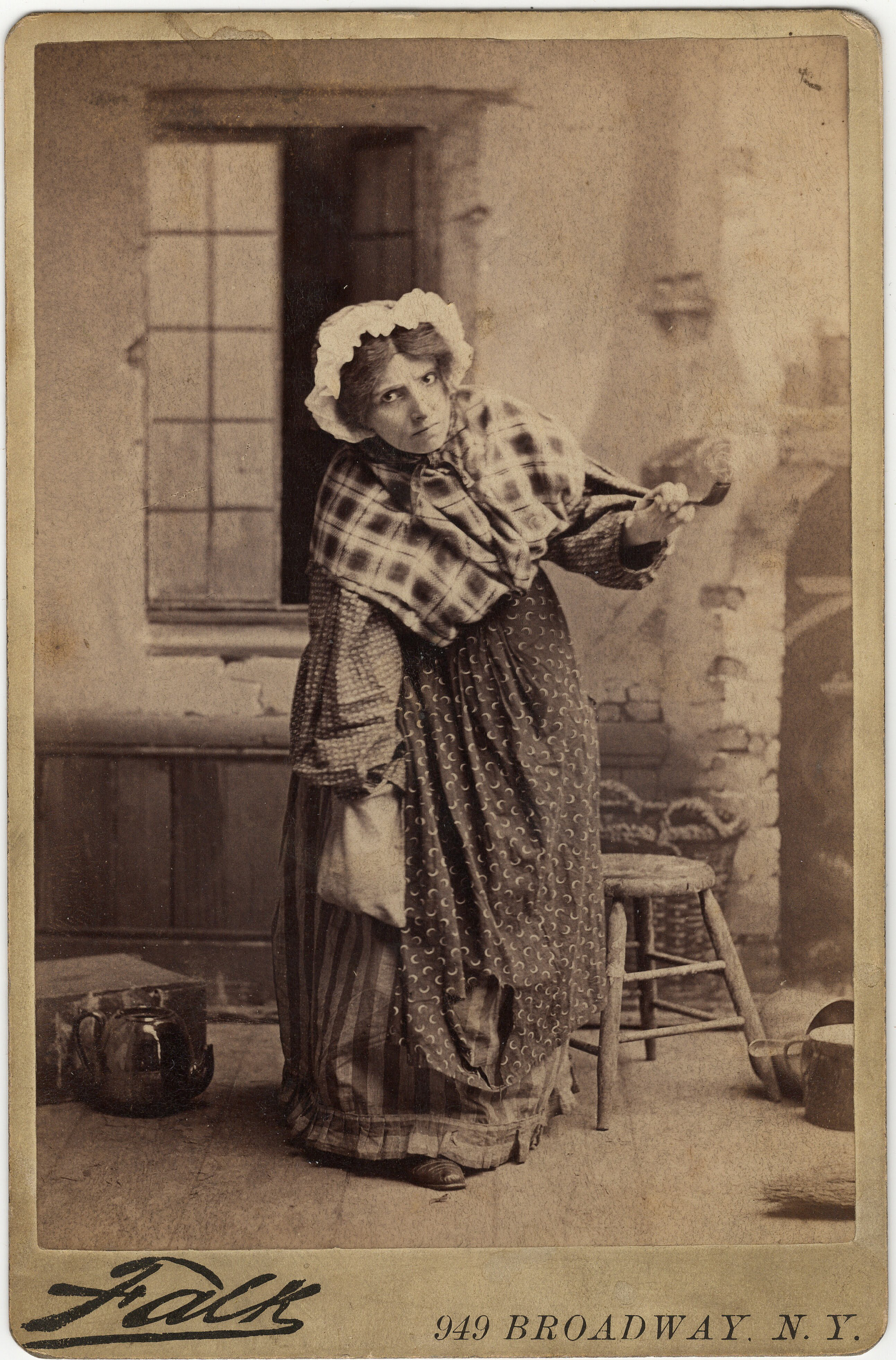
[The original John Biddlecomb and Biddy Maloney, as portrayed by Walter Reynolds and Grace Hathaway. I must thank Charles Bell for sending me these images of his great-great grandparents, Walter and Sarah Reynolds (aka Miss Grace Hathaway). Charles also added the following information about Walter: “Walter was by 1885 a playwright and theatre manager in his own right having had some success in Australia and New Zealand before going to America. He later became a theatre owner and politician in the UK (London County Council) and lived to a ripe old age. Very late in his career he returned to theatre production and had a great success on the West End in the 1930s with his play ‘Young England’ which is famously also known as the worst play in history.” More information on Young England is available here.] ___
New York Herald (5 April, 1885 - p.13) Mr. Robert Buchanan, a Scotch versifier, and his sister-in-law, Miss Harriet Jay, have an odd way of seeking their fortunes in this country. They seem to be getting into newspaper quarrels wherever they go. Thus, in Philadelphia, one of them has written and the other has acted in what the Philadelphia press declares to be a pretty bad play, called “Alone in London.” So Mr. Buchanan accuses one of his critics of being “a brother dramatic author,” and the critic retorts that Mr. Buchanan is “impertinent.” Polemics of this sort may be effective in England. In America they are apt to hurt the author. ___
The New York Mirror (11 April, 1885 - p.4) PHILADELPHIA. Holy week, much to the joy of our managers, is a thing of the past, and with the close of the Lenten season, all look forward to at least four weeks of prosperous business. If any of the houses cleared expenses last week they were especially fortunate. ___
The New York Times (19 April, 1885) Col. William E. Sinn, of the Brooklyn Park Theatre, will launch out next season as the manager of a heavy traveling combination, in addition to continuing to conduct the establishment with which he has been long connected. To this end Col. Sinn has purchased the American rights in Mr. Robert Buchanan’s melodrama called “Alone in London.” The play was produced a few weeks ago in Philadelphia, and it made enough of a success to warrant Col. Sinn in expending a large amount of money in getting it up to take through the country. He will start out early in September with a strong company and a carload of new scenery, possibly securing a run for his play in New-York in the interval. The company will be headed by Miss Cora Tanner, a young lady of many graces, who long ago established herself as a painstaking and effective actress. Col. Sinn speaks of his new enterprise with enthusiasm, and believes he has secured a play which will prove fully as popular as the “Silver King” or the “Lights o’ London.” ___
The New York Mirror (2 May, 1885 - p.3) —Alone in London, by Robert Buchanan, has been purchased for America by Colonel William E. Sinn, who is already busy with preparations for the coming season. The play was given its American baptism in America on March 30, and was warmly praised by the press. Colonel Sinn is very sanguine that Alone in London will prove to be one of the most attractive of English importations of recent seasons. He will personally superintend its production, and equip it with the strongest company obtainable. The scenery will be of a description that will almost make it a showpiece. The scenery and accessories will be so cumbersome that only week stands will be played. Alone in London will open the season of ’85-’86 at the Park Theatre, Boston, on August 31, and play there two weeks. ___
The Brooklyn Daily Eagle (18 May, 1885 - p.5) A preliminary performance of Robert Buchanan’s melodrama. “Alone in London,” was given yesterday at the Park Theater in the presence of a limited number of invited guests of the management. Although partaking of the nature of a dress rehearsal, and therefore subject to frequent interruptions, Mr. Buchanan’s drama disclosed itself to be a play of undoubted power and strength. The waning interest in melodrama is quite likely to be revived by the production of this piece, which commends itself to favorable consideration for the straightforwardness of its plot, the wholesomeness of its sentiment, the rapidity and interest of its action, the excellent manner in which it is acted and the elaborateness of its scenic attire. “Alone in London” is to have its first public presentation at the Park Theater to-night. |
|||||||||||||
 |
|||||||||||||
|
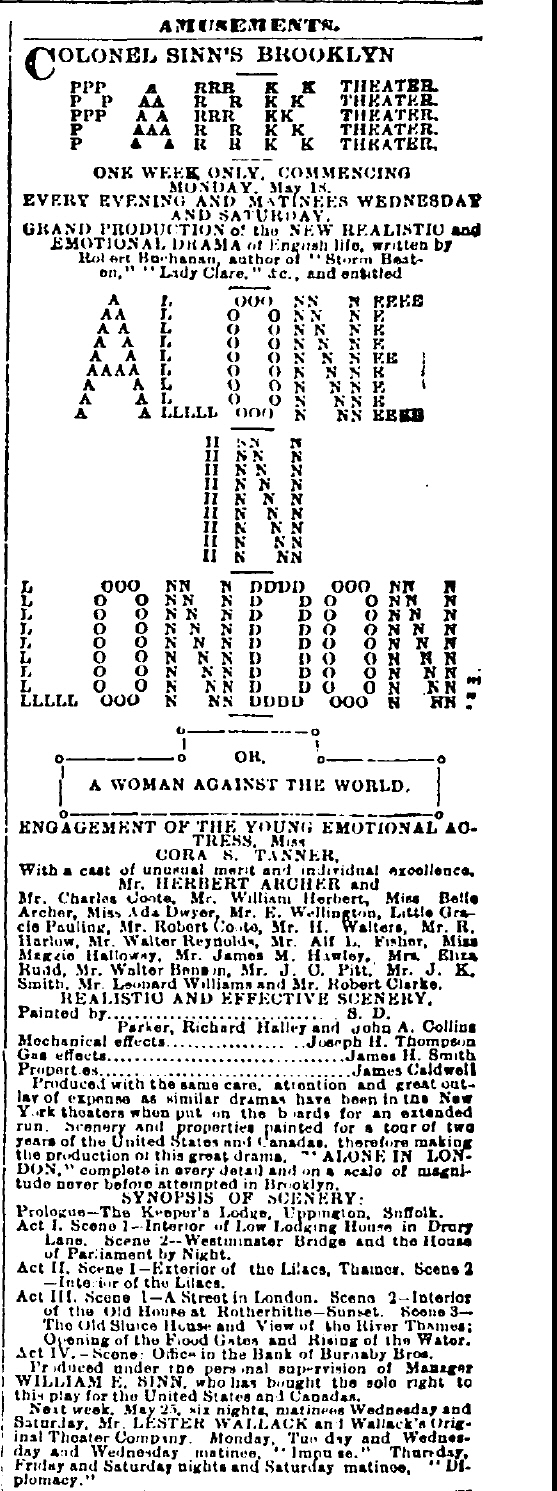
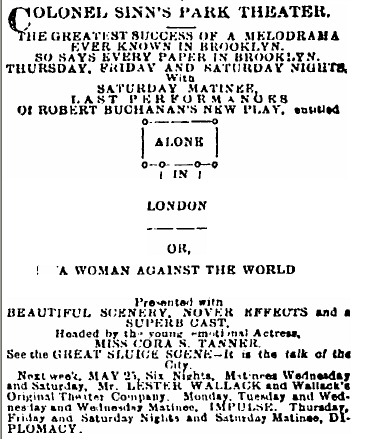
[Advert from The Brooklyn Eagle (18 May, 1885 - p.3).]
Brooklyn Eagle (19 May, 1885 - p.5) PARK—“ALONE IN LONDON.” Mr. Robert Buchanan’s new play, “Alone in London,” the proprietary rights in which have been purchased by Manager William E. Sinn, had its first production at the Park Theater last night. Few melodramas shown on this stage have produced a more favorable impression—an impression which promises to be enduring. Mr. Buchanan in this his latest effort at playwrighting has set forward nothing that is startlingly novel or original. The story which he tells, and the material employed in its telling, is the old and familiar one of woman’s trust and man’s perfidy. An innocent country girl, lured by the wiles of a smooth tongued villain, rejects the love of an honest rustic and links her fortunes with those of a criminal by becoming his wife. Removed to London, she is compelled to become the associate of thieves and outcasts. She struggles against adversity and rises superior to her surroundings through love for her child and the determination to bring him up to lead an honest life. Kind Providence sends friends to her assistance and help in her hour of need. She is hounded by her rascally husband, who, failing in his efforts at degradation, makes an attempt upon her life. She is confined in a sluice house by him, and the waters of the Thames turned upon her. But rescue in the person of her faithful rustic lover appears at the crucial moment; she is saved in time to foil the plans of her husband and his associates to rob the bank of her benefactors. The villain seeks to stab her to death, but is seized, and in the struggle which ensues inflicts a mortal wound upon himself. He falls dead at the feet of his wronged wife; the clouds dissolve and the way is made clear for the future happiness of the virtuous through the punishment of the vicious. While the author has not been distinctly creative in the construction of his plot and story—and indeed a careful analysis would disclose the source of derivation of a majority of the scenes and incidents and of the characters employed by him—he has utilized his material in so skillfully that the unfolding of the play tells strongly upon an audience. Mr. Buchanan is to be credited with having first of all produced a play which is pure and wholesome. It is possessed of human interest to a degree; it is theatrically effective without being forced or incongruous; its action is rapid and at all times interesting; it is essentially picturesque, and its general atmosphere of sombreness is lightened by flashes of comedy that have a distinctly Turneresque effect upon the observers. The scenic attire of the piece is unusually elaborate, and two of the pictures shown—an illuminated scene in the neighborhood of Westminster bridge, with the Houses of Parliament in the distance, and the old Sluice house and the River Thames by moonlight—have not been surpassed for artistic beauty and ingenious mechanism by anything heretofore disclosed on this stage. Of the acting of the play brief mention need only be made. Miss Cora S. Tanner has a congenial part in Annie Meadows, the wronged wife, which she fills to the full extent of her ability. The hit of the performance was made by Miss Belle Archer in the character of Tom Chickweed, a role of the Poor Joe order, which was played by Miss Archer in a manner to win all hearts. Mr. Herbert Archer was a capital villain as Richard Redcliffe, and the comedy parts of Liz Jenkinson and Dick Johnson were admirably supported by Miss Maggie Holloway and Mr. A. H. Fisher. Mr. Charles Coote reproduced the Private Secretary in the person of Jenkinson, a philosophical thief, and the small part of Ruth Clifden was competently borne by Miss Ada Dwyer. “Alone in London” is likely to make its way with the play going public. Its success last night was undoubted. It may be observed at a matinee performance to-morrow afternoon. |
|||||||||||||
 |
|||||||||||||
|
|
|
[Advert from The Brooklyn Eagle (22 May, 1885 - p.3).]
The New York Mirror (23 May, 1885 - p.4) BROOKLYN. Robert Buchanan’s new play Alone in London, was brought out at the Park Theatre Monday evening, before an immense audience. The principal sensation in the play was the scene which represents a sluice-house on the Thames. The heroine is imprisoned by the villain, who chances to be her husband. Wishing to dispose of her, he throws open the flood-doors, and but for the timely aid of a man and a boy, who have a boat, the supposed husband would have accomplished his murderous purpose. The scene is very realistic, and outdoes anything seen here in some time. Cora Tanner a very comely and intelligent actress assumed the leading character and gave entire satisfaction. The remainder of the co. were well suited to their parts. The play itself is far superior to The Lights o’ London, and if properly handled will certainly be successful. Lester Wallack in Impulse and Diplomacy next week. ___
Boston Daily Globe (1 September, 1885) BUCHANAN’S NEW PLAY The initial performance in this city of Robert Buchanan’s new melodrama, “Alone in London,” was witnessed at the Park Theatre last night by an audience which crowded the house in every part. From the first the play was well received, the dialogue was frequently interrupted by applause, and altogether it proved a most successful first performance. The favor bestowed upon the piece was deserved. “Alone In London” is essentially a melodrama, it does not pretend to be anything else. It is the old story of the villain who for a time seems to triumph over virtue, but in the end is defeated; but it is not told in exactly the same way. It must, in truth, be said of the play that it is generally fresh and interesting. The materials are well handled, the construction is excellent and the auditor is inevitably swept along by the intense and rapid action. It does not abound in incongruities so striking as to make one smile in places where it was intended that he should weep. There are only one or two of these inevitable blemishes to be found, and that is certainly an exceptional fact. The dialogue is natural and strong for the major part in the most legitimate way. The story, as has already been said, is that of a young country girl who is lured into marrying an adventurer, who ill-treats her because she refuses to fall into his dishonest mode of life. She does her best to reclaim her husband, but at the last, realizing the futility of such an attempt, she takes active measures to defeat his schemes. This arouses his vindictiveness, and partly through this, partly on self- protection, he seeks to take her life. The method he uses to secure this end is novel, and forms the basis of one of the most thrillingly realistic and effective scenes which is to be found in this class of plays. Because she has threatened to follow him and denounce him he ties her up in a fainting condition to a post in an old sluice house near the miserable retreat in which she lives. As he is turning away the thought comes to him that an easy means out of all his difficulties will be to open the flood-gates upon her. The inrushing of the water, engulfing the helpless girl, is one of the finest pieces of stage mechanism which has lately been seen here. The play from beginning to end was unusually well mounted, and the stage-setting was everything that could be desired. So much for the play and the manner of its production. ___
The New York Times (6 September, 1885) “Alone in London,” a play by Robert Buchanan, which was acted in Philadelphia and Brooklyn last Spring, will be presented in this city Sept. 14, with Miss Cora Tanner in the part written for Miss Harriet Jay. ___
The New York Times (13 September, 1885) Miss Cora Tanner, the statuesque young actress who is being made a star of in connection with Robert Buchanan’s play called “Alone in London,” comes over from Boston to-night to begin her series of appearances at the People’s Theatre to-morrow evening. Col. W. E. Sinn, of Brooklyn, who is the manager of this enterprise, is filled with the glow of enthusiasm regarding the play, the star, and the company, and he observes that if he could have been allowed to continue his engagement in Boston he would have remained there at least four weeks—the houses having been very large. This is Miss Tanner’s first appearance in New-York as a star, though she has been known for a long time as an actress of excellent quality. ___
The New York Times (15 September, 1885) An audience that crowded the People’s Theatre witnessed the first performance there of Mr. Robert Buchanan’s “Alone in London” last evening. This play, which admits of the exhibition of some showy scenery, treats a familiar subject in a commonplace manner, but it has exciting incidents and telling “lines” for nearly all the characters. Applause of no moderate description emphasized all its principal scenes. Miss Cora S. Tanner acted in a lachrymose but not ineffective manner as the unfortunate heroine, while adequate support was furnished by Mr. Herbert Archer, Mr. H. B. Phillips, and other competent actors. Mr. W. J. Scanlan, in an Irish piece, “Shane na Lawn,” will be at the People’s next week. ___
The Brooklyn Daily Eagle (18 September, 1885 - p.5) GENERAL MENTION. The presentation of “Alone in London” at the Park Theater next week promises to be a red letter event. In Boston and New York the success of the play has far exceeded expectation, and has impelled Manager Sinn to unusual exertions when it is again brought forward before the Brooklyn public. The piece is accordingly to be presented at the Park on a scale of splendor far outrivaling any previous melodramatic production shown on this stage. “Alone in London” is a play possessing intrinsic merit. The exalted standing of its author, Mr. Robert Buchanan, in the world of letters assumes its literary worth; it is caparisoned scenically with lavish hand; its pictorial and realistic effects are quite considerably beyond the average; it is played by a company of actors prominent among whom are Miss Cora S. Tanner and Mr. Herbert Archer, and it cannot fail, therefore, of compelling a measure of public approval during the coming week which will serve to crowd the Park at every performance. ___
The World (New York) (20 September, 1885) Just before the close of last season Col. Sinn produced at the Park Theatre a melodrama by Robert Buchanan called “Alone in London.” The piece had shortly before been given its initial performance in Philadelphia, where its excellence commanded immediate success. Col. Sinn immediately purchased it and brought it out at his own theatre with his own company and new scenery. Despite the fact that warm weather was setting in and the theatrical season was waning, “Alone in London” attained even a greater success. Preparations were at once made for an extended tour of the play and the season opened in Boston, where for two weeks it attracted the largest audience of the season. An efficient company, elegant scenery and ingenious mechanical effects combined to bring out the beauties of the play, and when it was produced in New York last week the metropolis at once indorsed the judgment of Philadelphia, Brooklyn and Boston. To-morrow night “Alone in London” will come back to Brooklyn for a week. Previous engagements prevent a longer stay, and it will be seen even under better auspices than the first production. Miss Cora Tanner and Mr. Herbert Archer head the company, which has been carefully selected. The mounting is excellent, the scenes of Westminster Bridge and the old Sluice House being particularly fine. In the latter a novel mechanical effect, the opening of the flood-gates and the rising of the waters form a feature of the production. “Alone in London” is to be presented at all the leading theatres throughout the United States and Canada as a Brooklyn attraction, and it is a worthy representative. ___
The Brooklyn Daily Eagle (22 September, 1885 - p.5) PARK—“ALONE IN LONDON.” That the melodrama purchased by Colonel William E. Sinn from Mr. Robert Buchanan is on the high tide of prosperity and popular favor was shown at the Park Theater last evening, when a completely filled house witnessed the reproduction of “Alone in London.” In his selection of a play for an outside venture the astute manager of the Park Theater has chosen wisely. “Alone in London” is destined to take rank alongside the most successful melodramatic successes known to the American stage; and, indeed, it is an open question whether the measure of its artistic and pecuniary success will not far outrun that of “The World,” the “Lights o’ London,” or a score of others that might be named. The piece has been so recently reviewed at length in this place that extended allusion to its merits does not require to be made at this time. A word, however, should be said in regard to the improvements which have been effected in its presentation. It may be premised that the management has got together a company which for individual and collective strength is not surpassed, if it may be held to be equalled, by any body of actors now before the public. Long association together has made of these people a perfect working and acting organization. A completely satisfying performance is thus far assured. Miss Tanner discloses marked advancement in the part of Annie Meadows. Several of the Boston journals were good enough to call attention to the similarity in appearance and method of Miss Tanner and Miss Ellen Terry, and observation of the former will disclose that the comparison is a just one. Mr. Herbert Archer’s Redcliffe is a portraiture of accomplished villainy which it is a treat to look upon; Mr. Walter Reynolds gives a model impersonation of the bluff and honest countryman Biddlecourt; Miss Belle Archer wins all hearts by her artistic acting in the pathetic part of Tom Chickweed, and Miss Grace Hathaway approves herself an artist in the role of Mrs. Moloney. These are but a few of the good people bearing conspicuous parts in “Alone in London.” Further than this the scenic embellishments of the piece have been amplified to a degree. The famous “sluice scene” is now so arranged as to convey the impression that the ill fated heroine of the play is struggling in real water, and the picturesque effects of the Houses of Parliament and Westminster Bridge have been sensibly enhanced. Amusement seekers in quest of an interesting play, well acted and finely mounted, will make it a point to witness “Alone in London” at the Park. A matinee representation is appointed for to-morrow afternoon. ___
The New York Times (4 October, 1885) Col. Sinn regards his melodrama called “Alone in London” as a distinct bonanza. He told me yesterday that he had been playing to enormous receipts wherever the piece had been produced, and that he had every reason to expect heavy returns during the rest of its career. He is anxious to get into a New-York theatre for a long run, and will probably succeed in doing so later on. The indications at the Grand Opera House, where he plays this week, are in favor of large audiences. ___
The World (New York) (7 October, 1885 - p.5) “Alone in London” was produced at the Grand Opera-House Monday night, with Miss Cora S. Tanner as the star. The house was crowded and the applause was vigorous and enthusiastic. Miss Tanner gave a winsome interpretation of the leading part and was intelligently assisted by Herbert Archer, Walter Reynolds and Miss Belle Archer. ___
The New York Times (8 October, 1885) Col. Sinn’s play, called “Alone in London,” is reported by the management of the Grand Opera House to be enormously successful. It opened there on Monday night to the largest first night audience ever seen in the theatre since the building came into Mr. Abbey’s possession, and the business since then has been immense. The success of this play is a good illustration of some of the odd things which happen in connection with the stage. When Mr. Buchanan, the author, was in this country, he had with him a large heap of manuscripts, together with Miss Harriet Jay, and he experienced equal difficulty in disposing either of the manuscripts or the actress. “Alone in London” was sent from one manager to another without satisfactory result, and was finally offered to Mr. John B. Shoeffel for the munificent sum of $200. That astute manager, however, did not care to invest, and the play subsequently came into the hands of Col. Sinn, who produced it, and who stands to win a very large sum of money on it during the next two seasons. Col. Sinn did not pay for it outright, but gives the author a royalty for its use. He is naturally very regretful of the fact that he can remain only one week at the Grand Opera House. The engagements of that theatre rarely contemplate a season of more than a single week for any one attraction, and the house has been bespoken for next week by the management of Mme. Janish, who will open on Monday night in “Anselma.” ___
The New York Times (10 November, 1885) NIBLO’S GARDEN. Miss Cora S. Tanner is a very pretty and graceful young lady, with handsome, white arms, which she uses very effectively to emphasize the anguish and despair of the suffering heroine of Mr. Robert Buchanan’s newest melodrama, “Alone in London.” This piece, which is already known to New-York playgoers, was given at Niblo’s last evening, with Miss Tanner as Nan, before a large and demonstrative audience. This young woman, Nan, is a simple country girl, who rejects an honest suitor and weds a gay chap from London. Hinc illæ lacrimæ! The gay chap is very bad indeed. He is a swindler, thief, and murderer. He reduces his pretty wife to penury, and she lives in a nasty garret; but she is prettier than ever in the garret. She sells flowers in the street, and teaches her little boy to say his prayers. Why do the gallery boys always applaud when an allusion is made on the stage to the habit of saying prayers? The boy’s wicked father wants him to be a thief, and when the mother objects he ties her in an old sluice house on the banks of the Thames and opens the floodgates. Just as the water is rushing in, along comes her old lover in a boat and—well, the bank is not robbed that night. “Alone In London” is not a bad piece of its kind, and it is cleverly acted in nearly all the characters. besides Miss Tanner there is Mr. Herbert Archer as the villain, Miss Belle Archer as a street boy, Mr. Walter Reynolds as the rustic lover, and Mr. William Herbert as a comic old rascal. The scenery is very good. ___
The World (New York) (12 November, 1885 - p.5) Miss Cora Tanner, a pretty and statuesque actress, began her third engagement in this city Monday night at Niblo’s Garden, in “Alone in London,” and was welcomed by an audience that crowded the theatre in every part. Those present appeared to enjoy the performance and applauded vigorously all of the effective scenes for which this play is noted. Miss Tanner increased the success which she has already attained in the part of Nan, and was summoned before the curtain several times during the evening. “Alone in London” is a picturesque story of English life and is cleverly acted by the supporting company. Next week it will be transferred to the new Theatre Comique in Harlem, where it will be given with the same cast and all its realistic scenic effects. ___
The World (New York) (17 November, 1885 - p.5) “Alone in London,” the powerful picture of low life in the British metropolis, by Robert Buchanan, was presented last night in the new Comique Theatre in Harlem. Miss Cora S. Tanner’s performance as Nan, the persecuted wife, and that of Miss Belle Archer, the London waif, were particularly good and won the applause and sympathy of the large audience. The scenery of the old sluice-house caused a murmur of astonishment to be heard throughout the theatre, after which there was complete silence until the thrilling finale of the act. “Alone in London” will be continued all the week at this theatre, which is now patronized by the best people of Harlem, who find that by waiting a few weeks they can enjoy all successes of the city without leaving their own neighborhood. ___
The Spirit of the Times (New York) (28 November, 1885) ROBERT BUCHANAN’S play, Alone in London, has met with the same criticism in London as it received here. It is called “a melodramatic jumble.” The scenery is praised. Of Harriet Jay, whose name is on the bills as part author, the audience are said to see too much. This is unkind, as she plays the good genius of the piece. Of course, when his play was condemned, Mr. Buchanan complained of “organized opposition.” The opposition must be well organized and widely spread, for it extends to this side of the Atlantic. ___
Evening Journal (Albany, New York) (7 December, 1885) —Not a very flattering account of Robert Buchanan, the author, is given by To-Day. It says: When Robert Buchanan came to America he was the most cordially detested literary man that ever left London. When he returned he was the most cordially detested literary man that ever left New York. Personally I found Mr. Buchanan a by no means unamiable or unpleasant companion. But he possessed an exasperatingly arrogant bumptiousness and an unconcealed contempt for all men who write for a living but himself, safe to make enemies rise up around him wherever he goes. The worst trait in his character is his greed for money. He is insatiably hungry for it, and if the experience of those who dealt with him in business is credible, is about as tricky as a Twenty-fourth street horse dealer. His latest exploit is one of the most contemptible recorded against him. He has taken the newspaper criticisms of “Alone in London” and deliberately cut and garbled them so as to form the most really favorable notices of his play. One article stated that the play “Is full of clever ideas, but as a rule they are wasted.” Mr. Buchanan quotes that his play is full of clever ideas and ignores the rest. The other criticisms, none of which are at all favorable, are thus equally distorted out of their true meaning. The practice of manufacturing bricks without straw in this way is a common one here. Mr. Buchanan probably picked it up on his travels. It is painful that a man so undeniably strong in style and gifted in fancy as the author of “God and the Man” should descend to the tricks of the sideshowman; but he is not the first whom hunger for gold has dragged into the mire. |
|
|
|
|
 |
|||
|
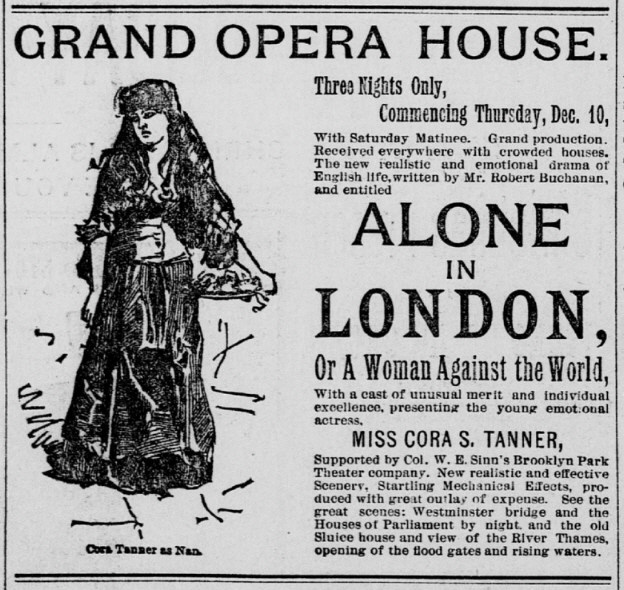
[Advert from The St. Paul Daily Globe (6 December, 1885 -p.8).]
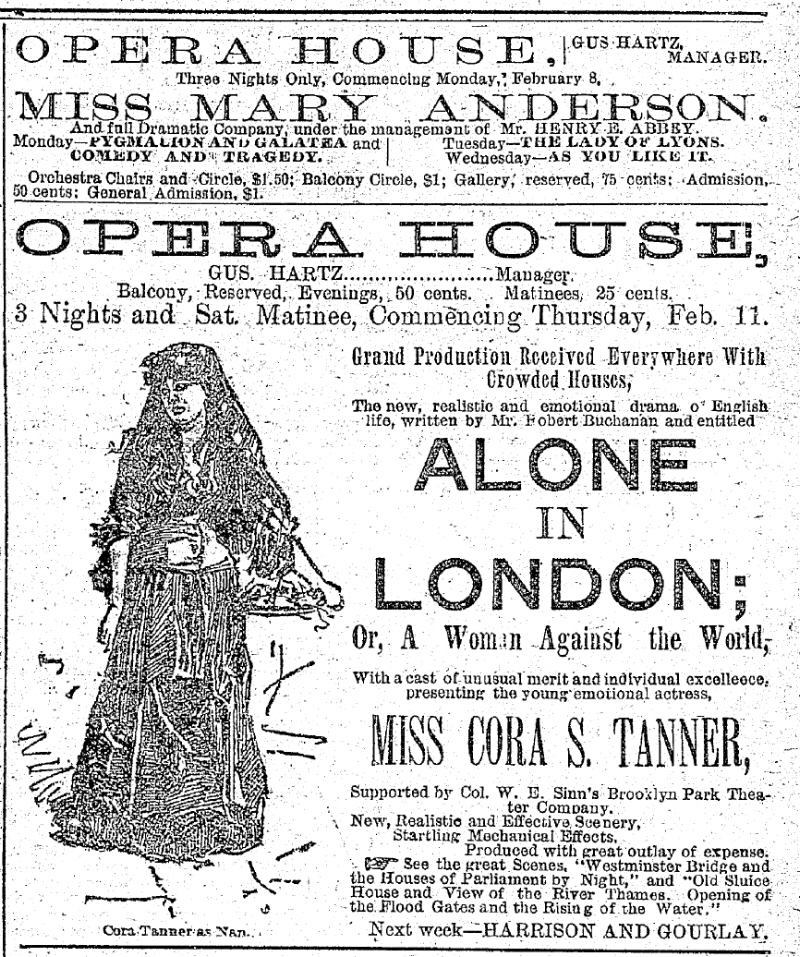
Cleveland Plain Dealer (7 February, 1886 - p.5) ROBERT BUCHANAN’S “ALONE IN LONDON.” “Alone in London” is a melodrama illustrative of English life, written by Robert Buchanan, author of “Storm Beaten” and “Lady Clare.” It will be played at the Euclid avenue opera house the last three nights of the present week, opening Thursday by Miss Cora S. Tanner, supported by Sinn’s Brooklyn park theater company. The New York Mirror speaks of it as follows: “Robert Buchanan relates in very dramatic form a story of deep human interest, and intersperses it with bits of English low life that remind the observer of Dickens. Considering the purpose Mr. Buchanan set out to achieve—that of providing a piece full of moving incident, such as appeals to the popular sympathies—it must be said that he has succeeded admirably. The moral air of the play is pure. Without the slightest attempt to secure applause by novel methods, it teaches a good old lesson in a wholesome yet impressive fashion. There are plenty of dramatic situations, pictures of life in the London slums and sensational effects of a startling character. ‘Alone in London’ introduces as a star Cora S. Tanner, who acts Annie Meadows, the woman about whom clusters the interest of the story. Miss Tanner is young, beautiful and gifted with dramatic ability of an effective order. She depicted the sufferings of the wife and mother, who, in the darkest hour, is strengthened by principles of right, with unvarying power. We know of no actress better qualified to represent the heroine of a domestic drama like this. Her endeavors were rewarded with close attention.” |
|||
|
|
 |
|
|
|
Cleveland Plain Dealer (12 February, 1886 - p.5) AMUSEMENTS. “ALONE IN LONDON” AT THE OPERA HOUSE. After “The World,” “Lights o’ London,” “Romany Rye,” and other melodramas of the same type introduced into this country from England, American theater goers probably imagined that the limit of inventive power has been reached and melodrama was dying a slow, but sure death. But it remained for Robert Buchanan to invent several new mechanical effects and melodramatic surprises—some of them original and thrilling—around which he wrote a play entitled “Alone in London,” or “A Woman Against the World,” which was produced the first time in this city at the opera house last evening. The gallery was crowded, the balcony well filled, and about one-half of the lower part of the house was occupied by what proved to be quite an enthusiastic audience. The title of the play almost tells its story. Annie Meadows, a young country girl, is loved by John Biddlecomb, a wealthy miller. Like all melodramatic heroines she liked John as a friend, but prefers for a husband Richard Redcliffe, a handsome young Londoner and adventurer. Redcliffe marries her, takes her to the great city, and after the expiration of a few years she is found in rags and utter destitution, deserted and abused by the man she loved. Redcliffe is about as confirmed a villain as dramatic license will permit and does not stop short of anything, even at murder. By a series of cleverly arranged situations he is finally trapped, dies a desperate death, and “a cloud turns forth its silver lining on the night.” The play is put on with excellent scenic and mechanical effects, which, however, never overshadow the story, which moves along briskly and smoothly and does not lag an instant in all the five acts. The plot is not strikingly original, as any one can gather from the above brief synopsis, but many of the effects and climaxes are, which is a great point in its favor. The scenery is beautiful, especially the Westminster bridge and the houses of parliament, but one of the most realistic stage pictures recently seen on the opera house stage is the old sluice house and view of the river Thames by moonlight. The heroine is tied to a post, her villainous husband pulls back the lever which opens the flood doors. The waves dash and splash on all sides; in another moment the heroine is surrounded by the angry waves and the rescuers arrive just in time to save her from a terrible death. ___
The New York Times (15 February, 1886) COL. SINN MARRIED. MISS CORA S. TANNER TO MANAGE HIM IN THE FUTURE. CLEVELAND, Ohio, Feb. 14.—Col. William E. Sinn, manager of the “Alone in London” company, which closed a three nights’ engagement at the opera house last evening, and Miss Cora S. Tanner, leading lady of the company, were quietly married here to-day. Miss Tanner was born in this city and has many relatives here. She has been under the management of Col. Sinn for the past five years, while their acquaintance extends over a much longer period. The ceremony took place in the parlors of the Hollenden at 1 o’clock this afternoon in the presence of Manager Gus Hartz, of the opera house, and wife, two members of the company, the mother of the bride, and a few other near relatives of Miss Tanner. After the wedding, at which the Rev. F. L. Hosmer, of the Church of the Unity, officiated, a lunch was served in the Hollenden Café, and Col. Sinn, his bride, and company left on the 3 o’clock train for Pittsburg, where they will begin an engagement to-morrow night. Soon after his arrival here on Thursday, Col. Sinn said to Manager Hartz that he would surprise him before the week was out, but gave no further hint of how it was to be done until late last evening. ___
The New York Times (28 February, 1886) Miss Cora S. Tanner, who has recently become Mrs. W. E. Sinn, will not retire from the stage. She is still appearing as the afflicted heroine of Mr. Buchanan’s “Alone in London.” The principal male character in this drama, Richard Radcliffe, the bland thief and cutthroat, is now taken by that popular and gifted actor, Mr. W. J. Ferguson. Mr. Ferguson, in his boyhood, sold newspapers on the trains of the Baltimore and Ohio Railroad. His father, a Scotchman, was a baker in Baltimore. Mr. John T. Ford gave the lad his first engagement at Ford’s Theatre. ___
The Trenton Times (3 March, 1886 - p.1) “Alone in London.” A large and delighted audience witnessed this new emotional drama at the Opera House last evening. “Alone in London” was written by Robert Buchanan, the author of “Storm Beaten,” and it is generally agreed that his new work is even superior to that popular play. It was presented last evening by that very competent young actress, Miss Cora S. Tanner, supported by Col. Sinn’s Brooklyn Park Theater Company. As Anna Meadows, the guileless farmer’s daughter, who is deceived into marrying a London scoundrel of the worst description, Miss Tanner won the sympathies of the audience from the rising of the curtain. Perfectly natural in every situation, with no straining after effect, the audience at once discovered that she was an actress who thoroughly understood her part and was able to present it in an intelligent manner. In a word she was equal to every occasion. Richard Redcliffe, her rascally husband, presented the character in such dark colors that he earned the hearty detestation of the audience. His acting could receive no higher compliment. John Biddlecomb, the rejected suitor, was “slow but sure,” and presented his part admirably. Tom Chickweed, a waif, Paul, Anna’s little son, Jenkinson, an innkeeper, Liz, his daughter, and her husband, Charlie Johnson, gave an intelligent rendering of their parts, as did each and every member of the company. There are no “sticks” in the troupe. The scenery is of the most elaborate and beautiful description, the “Westminster bridge and the Houses of Parliament by night,” and the “Old Sluice House and view of the river Thames,” being worthy of especial commendation. ___
The New York Times (9 March, 1886) “Alone in London” was seen again at the Grand Opera House last evening, where the same play was well received earlier in the season. An audience filling every part of the house was more kind than descriminative in the bestowal of its favors, every rebuff to vice and every assertion of virtue winning round after round of applause. Miss Cora S. Tanner sustained with her usual grace the taxing part of Nan, while Mr. W. J. Ferguson as the villainous husband was so effective that his acting frequently provoked from the audience expressions of resentment. The sluice house and Thames River moonlight scene were as vociferously admired as ever. |
|
|
|
|
|
The Omaha Daily Bee (16 October, 1886 - p.8) Talks With Travelers. Cora Tanner, star “Alone in London” company.—“I commenced at the age of fourteen and have been on the stage nearly ten years. The first six years I appeared in a broad range of characters, from low comedy to Shakesperean tragedy. Then I went to London with McKee Rankin, where we played a long engagement in the Danites. The next year I took the part of Alice Verney in Genevieve Ward’s play, ‘Forget Me Not,’ and the next year rejoined McKee Rankin, with whom I did ‘Billy Piper,’ in the Danites, until the close of the season. I interpreted the title role in ‘Claire, the Forgemaster,’ also played ‘Lady Claire’ several weeks with Wallack’s New York company, and many of the Shakesperean roles, such as ‘Desdemonia,’ ‘Ophelia,’ ‘Portia,’ etc. By the way, I appeared in comic opera for ten weeks at the Fifth Avenue theatre, New York. I was engaged there to create the leading character, the ‘Princess Ida,’ in Gilbert & Sullivan’s opera of that name.” _____
Alone in London in America - continued or back to Alone in London main menu
|
|
|
|
|
|
|