|
|
 |
|
|
ROBERT WILLIAMS BUCHANAN (1841 - 1901)
|
|
|
|
THEATRE REVIEWS
19. Fascination (1887)
Fascination
by Robert Buchanan and Harriett Jay.
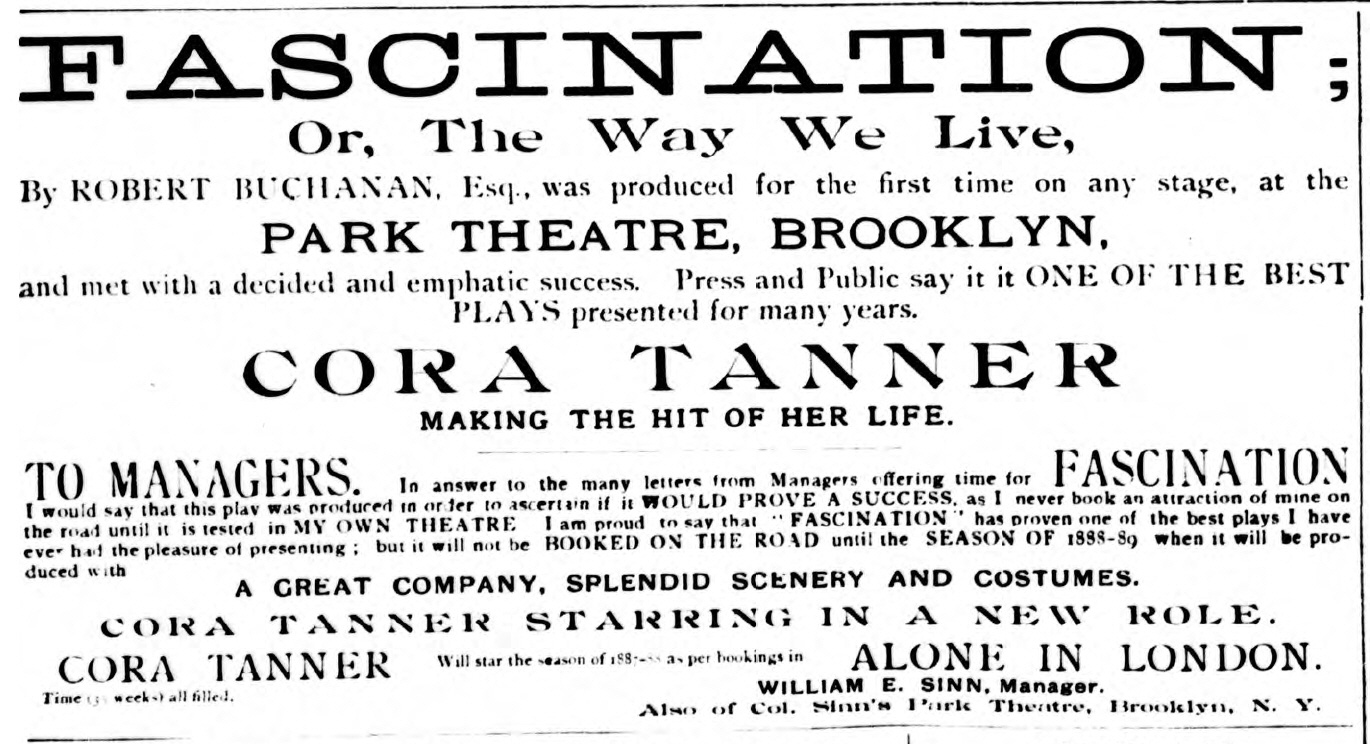
New York: Park Theater, Brooklyn. 30 May, 1887 (one week trial).
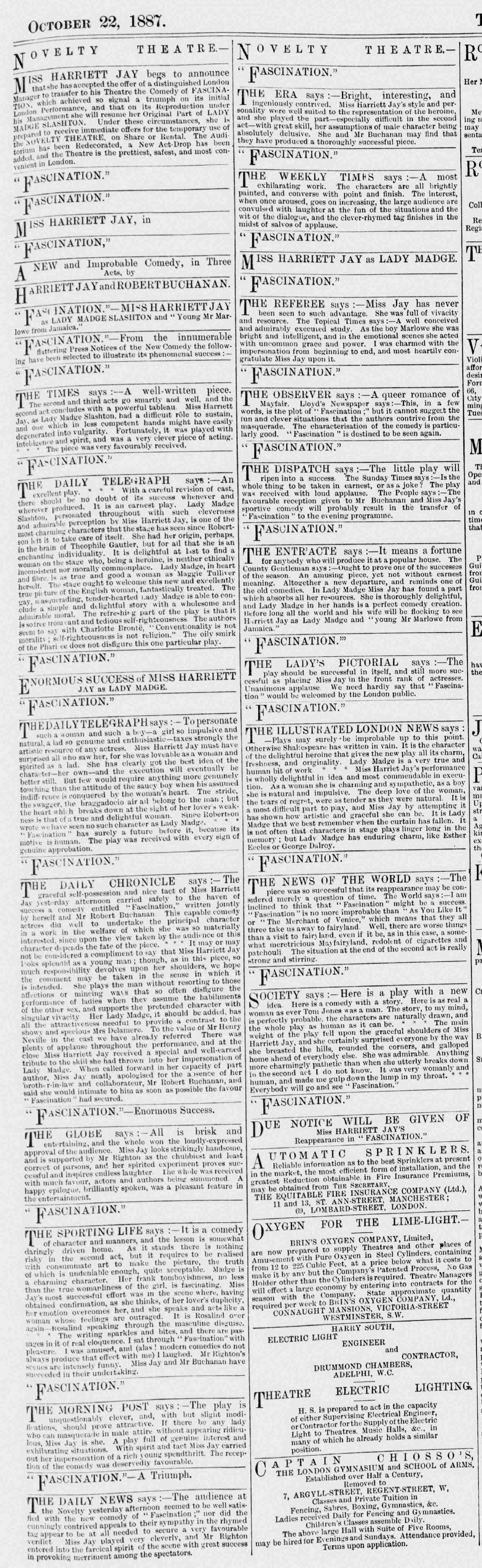
London: Novelty Theatre. 6 October, 1887 (matinée).
London: Vaudeville Theatre. 19 January to 29 February, 1888.
New York: Fourteenth Street Theatre. 10 September to 27 October, 1888 (56th performance).
Followed by American tours until April 1890.
[The earliest reference to Fascination is the item in The New York Times of January 11th 1885, and there is also a letter from Buchanan to Augustin Daly, written while he was in New York on April 17th 1885, in which Buchanan asks Daly to help arrange a production of the play at the Standard Theatre, to star Harriett Jay and Charles Coote.
The latest mention of the play is an Associated Press report in the St. Paul Sunday Globe of 15 July, 1894 referring to a performance of Fascination under the title, Lady Madge, at the Opera Comique, London on Saturday, 7 July. This would have been during the early stages of Buchanan’s bankruptcy proceedings, following the disaster of A Society Butterfly, which was withdrawn from the Opera Comique on 22 June. So far, I have found no other details of this performance.]
(Harriett Jay played the dual role of Lady Madge Slashton and Charles Marlowe.)
The New York Times (11 January, 1885)
Mr. Robert Buchanan has just finished a new piece which he calls “Fascination, or, The Way We Live Now.” The piece is in the line of comedy, and negotiations are in progress for its production in New-York during the present season. Mr. Buchanan on Wednesday sent a pleasant letter to Miss Cora Tanner, the handsome young actress who played Lady Clare during the week at Niblo’s, thanking her for the care and skill she bestowed upon the work. Miss Tanner had not been previously seen in New-York for some time. Elsewhere she has a fine reputation for the accomplishment of earnest and effective work upon the stage.
___
New-York Daily Tribune (6 June, 1886 - p.11)
Walter Sinn, the business manager of Colonel Sinn’s theatre and the son of that doughty warrior, will sail for England shortly to complete the arrangements for the purchase by his father of a new play by Robert Buchanan. Part of the $6,000 demanded for the American rights has already been paid, and the prospective owner is satisfied that he has a right good property. The play is a high comedy of the same order as “The Jilt” and deals with modern society. The principal woman’s part will be played by Mrs. Sinn and an exceptionally strong company will be needed for the rest of the cast. The play is the result of collaboration between Mr. Buchanan and his sister-in-law, Miss Harriet Jay. When received it will be carefully laid away in Mr. Sinn’s safe and will probably not be produced until September of next year, when it will be put on at a New-York theatre for a run.
___
The Brooklyn Daily Eagle (6 August, 1886 - p.4)
MR. WALTER SINN’S TRIP TO EUROPE.
_____
A New Play by Robert Buchanan to be
Produced at the Park Next Season.
Mr. Walter L. Sinn, son and business partner of Colonel Sinn, of the Park Theater, was seen by an EAGLE reporter to-day in regard to his recent trip to Europe. Mr. Sinn, who reached Brooklyn on Sunday last from England on the steamer Adriatic, looks bronzed and hearty, and expressed himself as being in the best of health and much pleased with his experiences while abroad. He said: “Beside visiting England and France I made a three weeks’ tour of Ireland, and enjoyed myself immensely. I combined business with pleasure while away, and made arrangements with Robert Buchanan for the production of a play from his pen, entitled ‘Fascination.’ It is a high comedy on the order of the ‘Jilt’ and ‘School for Scandal.’ The play will be produced at the Park in September, 1887, with the strongest cast that can be procured, and I am convinced that it will cause a genuine sensation. I do not think the theaters of Europe can compare in point of completeness with ours, with the exception of the Grand Opera House in Paris. Wilson Barrett, the great English actor, compares favorably with Henry Irving, and his theater is crowded from pit to dome at each performance. His strongest play is ‘Claudian,’ which he will produce at the Star Theater in September. It is one of the most powerful classical plays ever produced, and the stage mounting is perfect. ‘Adonis’ Dixey when I left was playing to crowded houses and is a big success, I might say an immense success socially. The reports regarding the non payment of salaries of his company are false, and before I left the engagement of the company had been extended two weeks. No dramatic company, either European or American, has ever met with the success that has attended Daly’s Fifth Avenue Company, of which Edith Kingdon, of Brooklyn, is a member. Each member of the company is a great favorite, especially Miss Ada Rehan and Miss Kingdon. Mr. Daly is to take his company to Paris in September for a week and before I left every seat had been sold for the entire engagement. The play of ‘Sophia,’ by Robert Buchanan, which will be produced at Wallack’s in October, I think will prove a great success.”
___
The Brooklyn Daily Eagle (31 May, 1887 - p.2)
BUCHANAN’S “FASCINATION.”
The new play, “Fascination,” written by Robert Buchanan for Cora Tanner is a swallow tail comedy—this as distinct from work of such rude manfulness as his “Storm Beaten,” and such sensational matter as his “Alone in London.” A certain manager said the other day: “I shall have no more plays in my house except such as will enable me to show elegant interiors and to dress my company in swallow tails and Worth costumes.” A large contingent of support in this resolution has exerted an influence on the stage of late, for fine passions and frank deeds have been smothered under broadcloth and millinery, and people who used to act have become drawling fops and dressmakers’ advertisements. Buchanan has not proceeded to extremes in this respect, but in going into society he has gone out of his element, and in spite of his facility and cleverness he has shown a good deal or hack work in “Fascination.” There is but a slender motive and there is a need of concentration. The people engage in dialogue that delays, rather than urges the action of the play; incidents like that of the barber’s interview with Rosa Delamere are wholly irrelevant, and there is a good half hour too much of talk. As played at the Park Theater last night it moved with a fair speed until the third act was reached, when Misses Tanner and Conway became involved in a series of repetitions that would have grown tedious but for the timely and audible interference of the prompter. The idea of “Fascination” is this: Lady Madge Slashton learning that her affianced, an officer in the guards, is carrying on a desperate and expensive flirtation with Rosa Delamere, a professional beauty, dresses in man’s clothes, represents herself as one Charles Marlowe, goes to the beauty’s house, gambles and drinks champagne, discovers that her lover is fascinated by the beauty, but that no harm has been done, secures the notes with which he pays his gambling debts, giving a worthless check in exchange and accepts him again when the disguise is off to quick music and a rapid curtain. On this easy theme are rung variations and accompaniments, and the inevitable comedy is furnished by the Duke of Hurlingham, an attenuated reprobate, who goes to the professional beauty’s picnics and champagne suppers unknown to his wife, and a most innocent little country curate—a bold crib from “The Private Secretary”—whose simperings and embarrassments, and whose catch phrase, “I like it so much,” were very taking upstairs. There is also a young swell who is a fairly exact copy of the detective in “Jim, the Penman,” but whose vocabulary consists in a parrot like “How do you do?” This gentleman was also entertaining. Miss Tanner eked out the interest of her part by numerous changes of costume and as the young man about town she closely resembled the “old chappie,” of London lobbies—a handsome “chappie” she made. In emotional scenes she was earnest; in the rollicking introduction, where she gives an account of a boat race in the same manner that Lady Gay Spanker tells of her steeple chase, the similarity of intent was so marked that the auditor at once deplored the lack of nervous force and of vivacity that makes Lady Gay’s narrative so telling. Minnie Conway was received with a welcome not less cordial than Miss Tanner’s and she played the professional beauty well, though, as in Miss Tanner’s case, the want of dash and brilliancy was felt. Virginia Buchanan imparted the needful severity to the Duchess of Hurlingham, and Carrie Coote made a simple and engaging Arabella. Lionel Bland, in make up and action as the duke, proved himself a careful actor with a sense of humor not too coarse, and Charles Coote, who has played comedy curates so long that he assumes them as easily as white neckties, was always welcome on the stage, for he made the part amusing without being offensive or ridiculous. P. A. Anderson, mauger his straddling gait and perks of the head, was a boding villain who brought his badness with him on his first entrance as who should say: “Behold, I am a dark, designing person. Watch me and I will prove it.” Hal Clarendon as the lover was conventional; Augustus Cooke, as Lady Madge’s brother, was robustious and deep lunged, and the other folks, of whom there was a needless number, were ordinary. Robert Edeson, son of the well known comedian, made his debut in a small part which he carried off with the coolness of a veteran. There was a better setting to the piece than is commonly afforded to plays at this house, and the string force in the orchestra was increased to advantage.
___
New York Herald (31 May, 1887 - p.4)
THE RESULTS OF “FASCINATION.”
A new three act play by Mr. Robert Buchanan was brought out for the first time in this country at the Brooklyn Park Theatre last night. It is called “Fascination,” and scored a decided popular success, and, with some reservations, as artistic one as well. It was well acted and capitally staged. The costumes of both the men and the women were especially good and appropriate to the characters, who were supposed to be types of those in English high life.
The play, whose full title is, “Fashion; or, the Way We Live,” is stated to have been written for Miss Cora Tanner, who appeared to great advantage in the male and female costumes which the interesting, though improbable plot required. The comedy is exceedingly clever in all its dialogues, but the emotional portions, which are rather poor. The characters, allowing for the improbability already spoken of, are well drawn, the eccentric ones being delightfully set forth.
The simple story is directly told and there are some quite strong as well as several highly amusing scenes. One between the true love and the adventuress was very weak last night, possibly because the actresses got rather mixed in it, and another of the forced proposal of a young clergyman to an ingenué was very funny.
The part assigned to Miss Tanner was that of Lady Madge Slashton, who, disguised in men’s clothes, goes to London to find out how much her futur is really fascinated by the adventuress, Mrs. Rosa Delamere. As Charles Marlowe, of Jamaica, Lady Madge makes love to her rival and quarrels with and finally insults her lover. Everything ends happily, of course, and Lady Madge gets her guardsman, who is a pretty poor specimen, after all.
Miss Tanner played her part exceedingly well, though it was a rather vulgar thing for her to eat an apple in the most simple style when in company. She was charming as a very hoydenish girl, was toned down after her London experiences and inimitable in both her costumes as a man, though her assumed drawl was rather tiresome.
Miss Minnie Conway, who played Mrs. Delamere, looked very handsome and was exceedingly effective. Mr. Hal Clarendon did fairly as the weak lover, Lord Islay, who, strangely enough for an English officer, wore his uniform when off duty. A remarkably clever sketch of the old but giddy Duke of Hurlingham was furnished by Mr. Lionel Bland, Mr. Charles Coote was very funny in his part of the Rev. Mr. Colley, Miss Carrie Coote very good in the small rôle of Arabella Armhurst, Mr. Augustus Cook excellent as the Hon. Sam Slashton, who had a bulldog in the first act; Mr. P. A. Anderson, a capital French villain called Count La Grange; Miss Virginia Buchanan, a good Duchess of Hurlingham, and Mr. Edwin Percival, an amusing swell, Captain Vane. The remainder of the twenty characters were in fairly competent hands.
___
The New York Mirror (4 June, 1887 - p.4)
BROOKLYN.
Robert Buchanan’s new comedy, Fascination, was produced at the Park Theatre on Monday evening with this cast:
Lady Madge Slashton ....................................
Charles Marlowe ...........................................} Cora Tanner
Duchess of Hurlingham ................................... Virginia Buchanan
Rosa Delamere .............................................. Minnie Conway
Arabella Armhurst ......................................... Carrie Coote
Dottie Destrange ........................................... Helen Ten Broeck
Connie Wilmore .............................................. Georgie Levardi
Mrs. Isaacson ............................................... Lottie Campbell
Adel ............................................................. Helen Mowat
Duke of Hurlingham ...................................... Lionel Bland
Lord Islay ..................................................... Hal Clarendon
The Hon. Sam Slashton ................................ Augustus Cook
Count La Grange .......................................... P. A. Anderson
Captain Vane ................................................ Edwin Percival
Earle Sparks ................................................. Robert Edeson
Rev. Mr. Colley ............................................ Charles Coote
Mr. Isaacson ................................................ Leslie Edmunds
James ........................................................... Ed. Welcot
Mirliton ........................................................ George Windson
Windsor ....................................................... Robert Edeson
Thomas ........................................................ K. Matthews
Attendant ..................................................... Frank Fauham
The story of the play is that of a young girl who in order to convince herself of the truth of reports reflecting upon her lover’s character which has been brought to her, dons male habiliments and follows him to the home of an adventuress by whom he has been fascinated. She succeeds in reclaiming him; and in the last act virtue triumphs and vice is confounded in that charming manner so familiar to playgoers, and with which we must all regret that we are not more familiar with in real life. The play scored a decided success, and at the close of the second act all the leading people were called before the curtain. As Lady Madge Slashton Miss Tanner was all that could have been desired; and in the role of Rosa Delamere, the adventuress, Miss Conway played with force and intelligence. Hal Clarendon did some fair work as the recreant lover, and Charles Coote as an utterly impossible clergyman of the Private Secretary type, provoked a good deal of laughter. The setting of the play was unusually good. Fascination will undoubtedly prove a “go.” Rosina Vokes comes next week.
___
The Era (18 June, 1887)
THE DRAMA IN AMERICA.
(FROM OUR OWN CORRESPONDENT.)
NEW YORK, JUNE 3.—The week has been devoid of novelty in the metropolis, although two other cities—one only across the river, and the other over 400 miles away—have witnessed the production of two new plays. Mr Robert Buchanan’s three-act comedy of Fascination was given its first production in this country at the New Park Theatre, Brooklyn, on Monday night, May 30th, and on the same evening Mr Steele Mackaye’s five-act melodrama Anarchy, which was presented for copyright purposes at the Elephant and Castle Theatre, London, on Wednesday afternoon, May 27th, was given its first production here at the Academy of Music, Buffalo. Of the latter representation, which was by far the most important, I shall speak first.
. . .
MR ROBERT BUCHANAN has not given us anything remarkably strong in Fascination, although, as in other of his plays, he has shifted upon us a cast of a score of people. It stated on the bills of the play that Fascination had been written expressly for Miss Cora Tanner, who played the leading rôle—a dual one. Miss Tanner is the wife of the manager of the Park Theatre, Brooklyn, where the play was produced, and made a hit several seasons ago in Alone in London. Whether she will be as successful in Fascination I doubt. Her character—Lady Madge Slashton—is that of a young girl who wishes to convince herself either of the truth or the falsity of reports that she has heard which reflect on the character of the young man, Lord Islay, who is seeking her hand in marriage. To this end she dons male habiliments and another name—that of Charles Marlowe. As Mr Marlowe Lady Madge follows her recreant lover to the home of Rosa Delamere, an adventuress. Once there, she makes love to her rival and quarrels with and insults her lover. There are a number of other incidents, the final curtain falling on the reclaimed lover and his happy bride, the adventuress confounded, vice crushed, and virtue given a new lease of life. Miss Tanner did about as well with her part as could have been expected. As the young girl she was charming, and as the man she was fairly good. The fault of the comedy lies in its emotion, or rather its attempt at it. The comedy portions are good. The part of the Rev. Mr Colley, an English clergyman of the private Secretary type, was excellently portrayed by Mr Charles Coote; while Miss Minnie Conway was very effective as the adventuress, Mrs Delamere. Mr Lionel Brand gave a clever portraiture of an old and senile Duke; while as the recreant lover, Lord Islay, Mr Hal Clarendon looked well and acted fairly. The rest of the cast were given abundant opportunity for good work, and in the main played well their parts.
|
|
|
|
 |
|
|
|
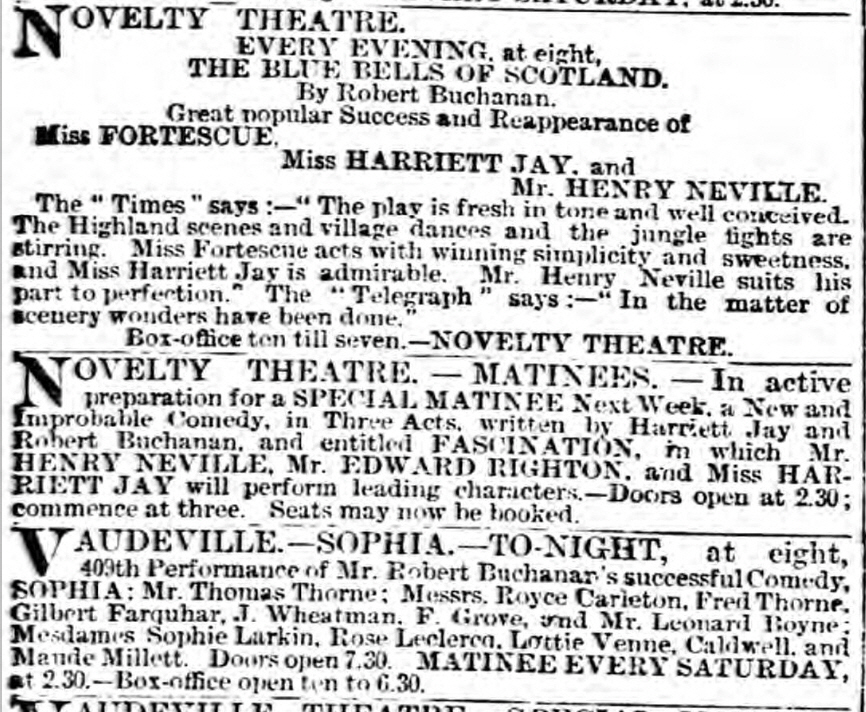
[Advert for Fascination, The Blue Bells of Scotland and Sophia
from The Morning Post (28 September, 1887 - p.4).]
The Graphic (1 October, 1887 - p.9)
A “new and improbable” comedy, in three acts (we are adopting the official description), will be produced shortly at a matinée at the NOVELTY, under the title of Fascination. Miss Harriett Jay, who is part author of the new piece, in association with Mr. Robert Buchanan, will play a leading character. If the piece should be favourably received, it will probably take the place of The Bluebells of Scotland in the evening bill.
___
The Referee (2 October, 1887 - p.3)
Miss Harriett Jay and Robert Buchanan have gone in for “Fascination,” which they describe as “an improbable comedy,” and which they have determined to produce next Thursday at a Novelty matinée. Miss Jay, Neville, and Righton will be in the cast. It is not true that in this piece there will be “A Carol to Critics,” based on W. S. Gilbert’s eccentric effusion, “Pooh, pooh, to you!”
___
The Daily News (7 October, 1887)
NOVELTY THEATRE.
_____
The audience at the Novelty Theatre yesterday afternoon seemed to be well satisfied with the new comedy entitled “Fascination”; nor did the cunningly-contrived appeals to their sympathy in the rhymed tag spoken by Miss Harriett Jay, Mr. Henry Neville, Mr. Righton, and other members of the company appear to be at all needed to secure a very favourable verdict. Candid criticism, however, compels us once more to warn the playgoer that the vociferous applause of afternoon audiences is not to be trusted. The piece to which Mr. Robert Buchanan and Miss Jay have appended their names is officially described as “an improbable comedy,” and “improbable” it undoubtedly is; but its gravest fault is that, while we are supposed to be presented with a love story of serious interest, the characters and the treatment in general belong very decidedly to the domain of caricature. Miss Jay, who is called upon to play a young lady of noble birth who disguises herself in coat and trousers in order to spy the proceedings of her lover in the house of a woman of profligate habits and associates, undoubtedly played very cleverly; and Mr. Righton as a clergyman who somehow finds himself in the same questionable society, and is generally not very solicitous to sustain the dignity of his calling, entered into the farcical spirit of the scene with great success in provoking merriment among the spectators. An outrageously silly and frivolous nobleman, described in the bill as the Duke of Hurlingham, was impersonated by Mr. Eardly Turner with not less decided success. Beyond this it would not be easy to say much in praise either of the play or the acting.
___
The Morning Post (7 October, 1887 - p.5)
NOVELTY THEATRE.
_____
The “new and improbable” comedy of “Fascination,” produced yesterday afternoon at the Novelty, merits, in a measure, the description applied to it by the authors, Miss Harriett Jay and Robert Buchanan. Criticism is disarmed with respect to certain incidents by this frank confession of improbability. In the main, however, the play is unquestionably clever, and, with but slight modification, should prove attractive. If there be any lady on the London stage who can masquerade in male attire without appearing ridiculous, Miss Jay is she. To play the spy upon a lover by assuming the garb of a man, and mixing in the society of questionable beauties, is a course which even such a high-spirited girl as Lady Madge Slashton might well hesitate to adopt. With no further facial disguise than is effected by a pince-nez, discovery would, in real life, be instantaneous. This initial weakness once condoned, all other minor defects in the way of unlikely incidents are passed over by the greater act of clemency, and “Fascination” remains a play full of genuine interest and exhilarating situations. Lord Islay sails rather close to the wind in his relationship with Mrs. Delamere, a fashionable beauty of more than doubtful character, but happily he disentangles himself from the mesh before it is too late. Lady Madge sees more of “fast society” during the evening spent at Mrs. Delamere’s house than most innocent women meet with in a life time; and were it not for the spirit and tact with which Miss Jay carried out her impersonation of a rich young spendthrift, the unpleasantness of the spectacle presented by a pure-minded girl associating with the companions of profligates would assert itself somewhat strongly. As it is, the brighter side of the picture prevails, and every one is glad that Mr. Henry Neville does not entirely forfeit the respect of the audience, so genial and frank a fellow does he make of the easily-influenced Lord Islay. It is to be wished that “Fascination” will be repeated, if only to afford another opportunity of witnessing Mr. Edward Righton’s quaint creation of the Rev. Mr. Colley, a curate who is laughed at and liked by everyone. The harmless good-natured little cleric is drawn by force of circumstances into the presence of Ms. Delamere and her companion syrens, the beaming bashfulness and not altogether displeased perplexity he exhibits in their society being intensely diverting. Miss Alice Yorke made an imposing and handsome Mrs. Delamere, and acted with commendable moderation, if without much power. The play has been carefully rehearsed, and is strongly cast. Mr. Eardley Turner, Mr. Scott Buist, Mr. George Canninge, and Miss Adah Barton appearing to advantage in effectively drawn characters of lesser importance. The reception of the comedy was deservedly favourable.
___
St. James’s Gazette (7 October, 1887 - p.7)
THE THEATRE.
“FASCINATION,” the new piece by Miss Harriett Jay and Mr. Robert Buchanan, presented for the first time in London at the Novelty yesterday afternoon, is officially classified on the programme as an “improbable comedy.” It is satisfactory to find that the authors of this extraordinary story do not intend their romance to be taken seriously; but it is difficult to see where the point or interest of their impossible plot is expected to come in. They make Lady Madge Slashton, the daughter of the Duke of Hurlingham and the betrothed wife of Lord Islay dress herself in man’s clothes in order that she may play the spy upon her lover, whom she has reason to suspect of infidelity. The Lady Madge’s mission takes her in trousers and swallow-tail coat to a very fast supper-party at the house of her rival, a gay widow, where. as she expects, she finds Lord Islay; but where, as she does not expect, she also meets the Duke, her father. Neither recognizes her, and she holds her own with some success in the scenes of shady dissipation which follow. She even manages to detach the venal affections of the widow from her lover, and she actually poses for a while as his successful rival. All these doings are most unlikely; but this would not matter much in three-act farce if they were also inoffensive. Unless, however, the surroundings and proceedings of the gay widow mean nothing at all, there is something altogether repulsive in the far-fetched strategy which brings father, daughter, and lover under the influence of her questionable “fascination.” And the better Miss Jay, as Lady Madge, acted her part, the more painful was the impression she produced.
___
The Globe (7 October, 1887 - p.6)
“FASCINATION” AT THE NOVELTY.
The new play of Miss Harriett Jay and Mr. Robert Buchanan, produced yesterday afternoon at the Novelty, is described as an improbable comedy. Dramatists are put to extreme shifts duly to classify the kind of works which have of late sprung into favour, and the description given by the authors of “Fascination,” may be allowed to pass. As the improbability is, however, as much in characterisation as in incident, the piece might almost be qualified as farce, with a leaven of serious interest. In some respects, indeed, the plot resembles that of opéra bouffe. Outside the wide limits of that very elastic form of composition, it is not easy to find a Duke and Duchess so coarse as Miss Jay and Mr. Buchanan have put on the stage; and, even within that range, we seldom see a young nobleman taking his sister, disguised as a boy, into the association of women with whom it is difficult to imagine her having a casual encounter. Granting the premises, however, all is brisk and entertaining, and as in two or three principal characters the piece is well acted, the whole won the loudly expressed approval of the audience. Practically the unconventional proceedings depicted are taken by a young lady of rank to rescue a lover who has fallen into the clutches of an adventuress. Unlike the daring maid of the old ballad, Lady Madge Slashton does not cut her kirtle “an inch aboon her knee.” She dons full masculine gear, and thus attired goes into the haunts of dissipation, where she studies manly proceedings, if not at their worst, at least, under not very satisfactory conditions. Miss Jay looks, however, strikingly handsome in her unwonted attire, and is supported by Mr. Righton as the chubbiest and least correct of parsons, and her spirited, if reprehensible, experiment proves successful and inspires endless laughter. Mr. henry Neville plays in his most gallant fashion as he lover. Mr. George Canninge is a wicked foreigner, and Miss Alice Yorke is the adventuress. The whole was received with much favour, actors and authors being summoned. A happy epilogue, brilliantly spoken, was a pleasant feature in the entertainment.
___
The Daily Telegraph (7 October, 1887 - p.5)
NOVELTY THEATRE.
With a careful revision of cast, a fastidious attention to detail, and a serious desire to make “Fascination” appear—what it really is—an excellent play, there ought to be no question of its success whenever and wherever played. It looks as if Robert Buchanan and Miss Harriett Jay had put their clever heads together and schemed out a plot after the perusal of “Mademoiselle de Maupin.” They would have liked both of them, no doubt, to treat such a subject ideally, to place the pith of it in a romantic form; but they feared the age; they decided that to please “the people” they must give them impossible dukes, incredible duchesses, a burlesque of society, adventuresses in dowdy satin, and an atmosphere that is wholly unbearable. Regretfully but earnestly let us assure the authors that they have made a mistake. This play is, as Browning says, “already too good to lose, and seems in the way of improvement yet.” “Fascination” is far too good a piece of stage work to be wasted. But the authors must be serious, not frivolous. It is an earnest play if anything. We don’t want in it dukes who dance about the stage like crazy mountebanks, nor peers of the realm who ingratiate themselves with society beauties by a couple of pint bottles of cheap champagne tucked under their arms, nor scenes of revelry in Mayfair that would astonish Pimlico, nor a crowd of impossible people doing impossible things. The play is a comedy; not a farce. It has a serious object, not a frivolous one. The story is so human and, in a measure, so true that we who listen resent it as an insult that the nature of the idea is so often crushed by the frivolity and, occasionally, the abject imbecility of the execution.
Lady Madge Slashton, personated throughout with such cleverness and admirable perception by Miss Harriett Jay, is one of the most charming characters, if correctly analysed, that the stage has seen since Robertson left it to take care of itself. She had her origin, perhaps, in the brain of Theophile Gautier, but for all that she is an enchanting individuality. It is delightful at last to find a woman on the stage who, being a heroine, is neither ethically inconsistent nor morally commonplace. Lady Madge, in heart and fibre, is as true and good a woman as Maggie Tulliver herself. She is original, and she is faithful; she is eccentric, and she is pure. She loves a man heart and soul, with true and genuine womanly devotion, and she does not turn round and nag at him when he slips, as most modern stage heroines do. Regarded as a noble and animated specimen of womanhood, bright, girlish, sensible, with plenty of fun about her, ready to take a joke and to suggest one, but with an ever-present and abiding love softening her nature, the stage ought to welcome this new and excellently true picture of the Englishwoman, fantastically treated. Well, Lady Madge is engaged to her cousin Lord Islay, and she loves him with the kind of love that she knows will, if she can touch his heart, save him from perdition. When she hears that the man she is devoted to is going to the dogs, that he is the prey of swindlers and adventuresses; when she wants to know, with her keen womanly instinct, whether her lover is really false, she in her impetuous and girlish fashion takes her pet brother into her confidence, dresses up as a lad, and follows her betrothed into the scenes of his folly and temptation. She deceives everybody, is unrecognised by her dearest friends, rouses her cousin lover to a frenzy of jealousy by making love to the silly woman who is bribed to betray him, probes deeply the charlatanism and deceit which exist in society, and after a series of incidents and surprises full of tact and ingenuity, discovers that the man she loves is weak but not sinful, that the woman who has enmeshed him has a good heart and is penitent, so that the gay, masquerading, tender-hearted Lady Madge is able to conclude a simple and delightful story with a wholesome and admirable moral. The refreshing part of the play is that it is so free from cant and tedious self-righteousness. The authors seem to say with Charlotte Bronté: “Conventionality is not morality; self-righteousness is not religion.” The oily smirk of the Pharisee does not disfigure this one particular play.
To personate such a woman and such a boy—a girl so impulsive and natural, a lad so genuine and enthusiastic—taxes strongly the artistic resource of any actress. Miss Harriett Jay must have surprised all who saw her, for she was loveable as a woman and spirited as a lad. She has clearly got the best idea of the character—her own—and the execution will eventually be better still. But few would require anything more genuinely touching than the attitude of the saucy boy when his assumed indifference is conquered by the woman’s heart. The stride, the swagger, the braggadocio air all belong to the man; but the heart which breaks down at the sight of her lover’s weakness is that of a true and delightful woman. Since Robertson wrote we have seen no such character as Lady Madge and it might be made as influential as Robertson made his boys and girls, his men and women, if the management will only determine to correct the cast and strive after the success the play deserves.
With this end in view we propose to speak pretty plainly. The play, as we have already said, is too good to lose; but unless corrected it cannot possibly succeed. In the first place, Mr. henry Neville, clever actor as he is, and leading man as he is, is not the Lord Islay of this play. The part does not require the bold, vigorous touch of a Henry Neville. It is a part that in old days would have been played by H. J. Montague. It is the boy lover of a charming English girl, and nothing short of a fascinating boy-lover will do. The adventuress should be played by an actress of singular physical charm and persuasiveness, otherwise there is no meaning whatever in the character. The gentleman who plays the Duke should study the finished art of Mr. Hare or Mr. Beerbohm-Tree, not the foolery of a circus clown. The ladies and gentlemen, the guests and attendants, should be those who have studied manners. The days of “Adelphi guests” are over, and it is astonishing that they should be revived in such a work as this. The only two in the whole cast who may be most advantageously retained are Mr. Edward Righton the comic clergyman, who gives us comedy, and good comedy, in the right place; and Mr. W. Scott Buist, who plays the young brother in a genuinely natural and manly fashion. The scene in the last act, where Lady Madge, having rejected the curate, makes him will-nilly marry her friend, is most excellent fooling, and excellently played by Miss Jay and Mr. Righton. The fate of this play—and it should be no uncertain one—wholly depends on the management. Middle-aged lovers, pantomimic dukes, and Adelphi guests are wholly out of place here. Exposed to such treatment “Caste” and “Ours” would not have run a week. But taken well in hand, revised, corrected with taste and discretion, “Fascination” has surely a future before it, because its motive is human. Its chief female-character is delightful, and its development is amusing without being either gaudy, over-coloured, or aggressive. The play was received with every sign of genuine approval, and Miss Jay made a pretty little speech, regretting the absence of her collaborateur and brother-in-law Mr. Robert Buchanan.
___
The Sheffield Daily Telegraph (7 October, 1887 - p.4)
Mr. Robert Buchanan is the most persevering of playwrights. Having realised that the drama is the most lucrative branch of the literary art, he pens plays instead of poems, and abandons the calling of a novelist for that of acting-manager. It is possible, therefore, that the second volume of his “Earthquake” may not be forthcoming for some time. His drama, “The Blue Bells of Scotland,” has not proved the attraction which it might have done. We are told, however, that Scottish reformers are encouraging the play with a view of kindling the crofter question. This afternoon the Novelty Theatre was thronged with what are known, in theatrical circles, as dead heads, to witness the experimental performance of “Fascination,” a light comedy by Mr. Buchanan. This play was palpably written with a view of enabling the poet’s sister-in-law, Miss Harriet Jay, to romp in boy’s attire. Miss Jay scored in a part of the kind in Mr. Buchanan’s adaptation of the “Ironmaster” some two years ago.
___
The Times (8 October, 1887 - p.4)
THE NOVELTY THEATRE.
Fascination is the title of a three-act piece, written by Harriett Jay and Robert Buchanan, which was produced on Thursday for the first time in London at a matinée at the Novelty Theatre. It is described as “a new and improbable comedy,” and although unquestionably possessing considerable merit, it cannot be denied that the piece certainly deserves the latter epithet. Briefly told the story is that of two lovers, Lord Islay and Lady Madge Slashton, who tread the uneven paths proverbially pursued by true affection. Lady Madge, a charming but rather “slangy” girl, is devoted to her lover; but her jealousy is aroused by a foreign gentleman masquerading in society under the title of the Comte de la Grange. This gentleman persuades her that her lover, Lord Islay, has fallen a victim to the fascinations of a beautiful widow of doubtful reputation and antecedents, named Mrs. Delamere. Maddened by her suspicions, Lady Madge decides to play a bold and dangerous part, in which she is aided by her brother. Attired in male costume she obtains an introduction to Mrs. Delamere, at whose house she meets Lord Islay, and is a witness of his flirtations. Determined to find out the truth concerning his relations with the widow, Lady Madge makes desperate love to Mrs. Delamere, who is quickly smitten by the rich young gentleman “from Jamaica.” Mrs. Delamere is the creature of the Comte de la Grange, who, in his turn, aspires to the hand of Lady Madge. In order to further his suit he insists that Mrs. Delamere shall obtain from Lord Islay a signet ring given to him by Lady Madge. A dinner party takes place at the house of the widow, and after dinner the gentlemen play cards in the drawing-room. While they are playing Lord Islay takes advantage of the opportunity for a tête-à-tête with Mrs. Delamere, who borrows his signet ring, and when he redemands it declares that he had given it to her. High words ensue, and Lady Madge, who had witnessed the incident from the card-table, declares that she saw Lord Islay give the ring, accuses him of cowardice, and strikes him, having previously bought from the Comte Lord Islay’s “paper” for the money lost to the former at play. This closes the second act with a powerful tableau. During all this time the secret of Lady Madge’s disguise has been safely kept, and the third act, which takes place in a morning-room in Berkeley-square, is one of explanation. For the rest it is sufficient to say that Lord Islay is forgiven when it transpires that he has been guilty of nothing worse than folly and indiscretion. The rascality of the Comte de la Grange, who is a swindler and a card-sharper, is duly demonstrated, and all ends happily. Fascination is a well- written piece, but the first act, the scene of which is laid at Hurlingham-lodge, Sunbury-on-Thames, is inferior to the second and third acts, both of which go smartly and well. Miss Harriett Jay, as Lady Madge Slashton, had a difficult rôle to sustain, and one which in less competent hands might easily have degenerated into vulgarity. Fortunately, however, it was played with intelligence and spirit and was a clever piece of acting. The part of Lord Islay was Played by Mr. Henry Neville, that of Mrs. Delamere by Miss Alice Yorke, and that of the Comte de la Grange by Mr. George Canninge. Mr. Edward Righton was amusing as the Rev. Mr. Colley, a curate, but on the whole the cast was not a strong one. The piece was very favourably received.
___
The Era (8 October, 1887)
“FASCINATION.”
_____
A New and Improbable Comedy, in Three Acts, by Harriett Jay
and Robert Buchanan, played for the First Time at the
Novelty Theatre, on Thursday Afternoon, Oct. 6th, 1887.
Lord Islay ... Mr HENRY NEVILLE
The Reverend Mr Colley Mr EDWARD RIGHTON
The Duke of Hurlingham Mr EARDLEY TURNER
The Duchess of Hurlingham Miss ETHEL HOPE
Captain Vane ... Mr A FERRAND
Mr Isaacson ... Mr FRANK GREEN
Mrs Isaacson ... Miss E. WINGFIELD
Comte de la Grange ... Mr GEORGE CANNINGE
Fotheringay ... Mr F. VIVIAN
Mrs Delamere ... Miss ALICE YORKE
Miss Dottie Destrange ... Miss G. WARRINGTON
Miss Cora Wilmore ... Miss D. KERR
Mirliton ... Mr G. B. PHILLIPS
Adele ... Miss FLORENCE GORDON
Arabella Armhurst ... Miss ADAH BARTON
Servant ... Mr H. DRUCE
Perkins ... Miss K. CUBITT
Lord Jack Slashton ... Mr W. SCOTT BUIST
Lady Madge Slashton ... Miss HARRIETT JAY
Mr Buchanan and Miss Jay are making a plucky effort to raise the reputation of the unlucky Novelty Theatre; and it would only be a fair reward for their perseverance and courage if their last experiment should “turn up trumps.” Plays with less “good stuff” in them than Fascination have become successes; and if certain weak places in its cast be strengthened, we see no reason why the drama should not prove attractive to the public. It is certainly bright, interesting, and ingeniously contrived.
At Hurlingham Lodge, Sunbury-on-Thames, we are introduced to the heroine of Fascination, Lady Madge Slashton, who is engaged to Lord Islay, a rather roué peer, who cannot find much time to spend with his fiancée, most of his leisure being devoted to the cultivation of his acquaintance with Mrs Delamere, a fascinating widow of doubtful reputation. Lady Madge is a healthy English girl, has a taste for athletics, and even indulges at times in a cigarette. Her faith in Lord Islay’s virtues is a little shaken by the insinuations of the Comte de la Grange, a visitor at Hurlingham Lodge, who is smitten by Lady Madge, and endeavours thus to advance himself in her favour; and her suspicions are confirmed by the appearance in the neighbourhood of “the Delamere” herself, who passes down the river on her way to an island picnic. Lady Madge, therefore, resolves to employ a strange means of testing Lord Islay’s fidelity.
This plan is nothing less than a “male impersonation” à la Mademoiselle de Maupin, and it is put into practice in the second act, which takes place at Mrs Delamere’s house in Mayfair, where a merry party, including Lord Islay, the Duke of Hurlingham, and the Comte de la Grange is assembled. Madge enters, disguised as “Young Mr Marlow from Jamaica,” and proceeds to make love to Mrs Delamere in order to carry out the detective scheme. Islay not only does not recognise his fiancée, but is even jealous of “Mr Marlow’s” progress in the good graces of Mrs Delamere, to whom he (Islay) has just before announced his desire to sever the relations between them, confessing that his love for his cousin is the reason of his wish. Mrs Delamere gratifies her vanity by telling “Mr Marlow” that Islay has proposed marriage to her, and she has rejected him; and this statement is apparently corroborated by what follows. The siren, who has been induced by La Grange to obtain from Islay Madge’s engagement ring, borrows it on pretence of wanting to seal a letter, and then retains it, telling her friends that the ring was Islay’s free gift to her, and that he is now mean enough to ask for it back again. Madge, who has seen the ring given, but not heard the conversation which would have explained Islay’s parting with it, denounces him as “no gentleman,” and throws a glass of champagne in his face, the act-drop falling on an effective “curtain.”
In the last act Mrs Delamere presents herself at the Duke of Hurlingham’s house in Berkeley-square, where, in an interview with Madge, who again assumes the “unmentionables,” the adventuress confesses the whole truth, and adds the information that La Grange is a criminal who is “wanted” by the French police. Madge, still in male attire, meets Lord Islay, and extracts from him a lecture on the perils of fascination and the excellence of pure love, and a confession of his affection for herself. Then comes the clearing up, which, by-the-way, might be made a little more brief. La Grange is exposed and handed over to the police; Islay is pardoned, and the lovers are united. Some amusing touches of comedy are introduced at intervals by the sayings and doings of a funny little curate, the Rev. Mr Colley, some of whose lines are capital.
The play was capitally cast so far as the principal characters were concerned. Mr Henry Neville’s firm and finished style was valuable in the character of Lord Islay, and he played throughout with well-bred ease and manly earnestness. Mr Edward Righton as the Rev. Mr Colley was highly amusing and created roars of laughter by his prim delivery of the line “I like it exceedingly.” The character was one which required much tact in the handling, and Mr Colley’s part in some of the scenes in which the clergyman appears might easily have been made “risky,” but Mr Righton was careful not to overstep the modesty of art. Mr Eardley Turner’s Duke of Hurlingham was marred by a crude make-up and a tendency to caricature, both of which defects may be easily removed. Miss Ethel Hope as the mild Duchess was sufficiently smooth and calm; and Mr George Canninge gave a strongly marked and effective impersonation of the Comte de la Grange. Mr W. Scott Buist, who continues to improve, was a satisfactory representative of the part of Lord Jack Slashton, and Mr G. B. Phillips appeared with credit in the little rôle of a hair-dresser. Miss Harriet Jay’s style and personality were well suited to the representation of the heroine, and she played the part, especially difficult in the second act, with great skill, her assumption of male character being adequately delusive. Miss Alice Yorke was capital as the adventuress, her fine presence greatly assisting her in her embodiment of the character, which she played admirably throughout. The mounting was neat and not gaudy, and if the “winding-up” be made more rapid, and the tedious and stilted rhymed “tag” at the close be “cut,” Miss Jay may find that she and Mr Buchanan have produced a thoroughly successful piece.
___
The Saturday Review (8 October, 1887)
At the Novelty Theatre a “new and improbable comedy,” called Fascination, was produced on Thursday afternoon by its authors, Miss Harriett Jay and Mr. Robert Buchanan. The fact that it is termed an “improbable” comedy disarms criticism. As a farce in one act it would be perhaps amusing; but running as it does upon the theme so often used in the last century, of a lady disguising herself as a man and mixing in questionable society in order to watch the proceedings of her lover, it has the misfortune of being hampered from the start with an objectionable feature which we had hoped was now entirely removed from the modern stage. The spectacle of a lady in male attire, smoking, drinking, and gambling, and otherwise “carrying on,” is not edifying. There is one impersonation, however, in this piece which is so excellent as to deserve special notice. Nothing funnier has been seen for a long time than Mr. Edward Righton’s droll performance of a good-natured innocent little curate whom everybody likes and everybody laughs at, but who is drawn by force of circumstances into fast society. The bashfulness, the evident desire to please, and the intense gratification when, to his surprise, the young ladies accost him as “dear,” provoked uncontrolled laughter, and made one regret that so amusing an impersonation had not been introduced into a better play.
___
The Sheffield Daily Telegraph (8 October, 1887 - p.5)
The drama “as she is criticised” forms a constant topic of talk among literary men. Gentlemen who neither write plays nor dramatic criticisms complain that those who have to do both are engaged in a somewhat hazardous occupation. It is contended that a dramatist who has plays to sell and managers to manage is not altogether a free agent when he plays the part of critic. Mr. Robert Buchanan, the poet, has waged war with the critics. It is not surprising therefore that there should be a strange diversity of opinion among those who review the play “Fascination,” produced experimentally yesterday at the Novelty.
___
The Sporting Life (8 October, 1887 - p.7)
On Thursday afternoon a new and improbable comedy in three acts, written by Harriet Jay and Robert Buchanan, and entitled “Fascination,” was produced at the Novelty Theatre. The story admits of being briefly told. Lady Madge Slashton (Miss Harriett Jay) is engaged to Lord Islay (Mr. Henry Neville), and, hearing that he is “mixed up” with a society beauty, a Mrs. Delamere (Miss Alice Yorke), determines to investigate for herself. She assumes male attire, and accompanies her brother, Lord Jack Slashton (Mr. W. Scott Buist), to the house of the gay widow. There she is introduced as young Mr. Marlow from Jamaica, and immensely rich. She meets her lover and other friends of hers at Mrs. Delamere’s. The Duke of Hurlingham (Mr. Eardley Turner) is of the party, and the Reverend Mr. Colley (Mr. Edward Righton) a meek little curate, who in search of the duke, joins it. Comte de la Grange (Mr. George Canninge), an adventurer, and cheat at cards, and a society journalist, who has Mrs. Delamere under his thumb, is likewise one of Mrs. Delamere’s guests. Threatened by him, she undertakes to obtain a ring from the finger of Lord Islay, and accordingly this is done. It is a signet ring and a gift from Lady Madge. She borrows the ring and declines to restore it to the owner, alleging that he has given it to her. The first act is entitled “Fascination,” the second “mystification,” and the third “explanation.” Lady Madge learns the truth, Lord Islay is restored to favour, the Comte handed over to the French police, the society beauty pardoned and admonished, and the meek little curate provided with a wife. The improbably comedy ends with a neatly written tag.
Since the authors admit the improbability of their story, it would be a waste of words to take exception to the work on that ground. It is a comedy of character and manners, and the lesson is somewhat daringly driven home. As it stands there is nothing risky in the second act, but it requires to be realised with consummate art to make the picture, the truth of which is undeniable enough, quite acceptable. Madge is a charming character. Her frank tomboyishness, no less than the true womanliness of the girl, is fascinating. Miss Jay’s most successful effort was in the scene where, having obtained confirmation as she thinks of her lover’s duplicity, her emotion overcomes her, and she speaks and acts like a woman whose feelings are outraged. It is Rosalind over again—Rosalind speaking through the masculine disguise. Mr. Neville cannot do anything ill, but he might, with advantage to the comedy, have played the part at a greater pace. Not but that it was an agreeable performance. Mr. Edward Righton was deliciously droll as the Curate, and good character sketches were presented by Mr. Eardley Turner (the Duke of Hurlingham), Miss Ethel Hope (the Duchess), and Mr. G. B. Phillips (Mirliton, a hairdresser). Mr. Canninge’s was more than a sketch; it was a careful study, and exceedingly good. Mrs. Delamere both looked and played the society beauty admirably. The writing sparkles and bites, and there are passages in it of real eloquence. I confess that I sat through “Fascination” with pleasure. I was amused, and (alas! modern comedies do not always produce that effect with me) I laughed. Mr. Righton’s scenes are intensely funny. If the end and aim of the playwright who produces a comedy be to amuse, then Miss Jay and Mr. Buchanan have succeeded in their undertaking. Polish of the most consummate description will have to be given to the acting of “Fascination” if the piece is to prosper, but once that polish is bestowed there should be no doubt about the prosperity. On the conclusion of the comedy there were loud calls for the author, to which Miss Jay responded by stating that she as part author would inform Mr. Buchanan of the verdict.
___
Lloyd’s Weekly London Newspaper (9 October, 1887 - p.5)
PUBLIC AMUSEMENTS.
_____
NOVELTY THEATRE.
Miss Harriett Jay and Mr. Robert Buchanan overcame in very ingenious fashion a vital objection to Fascination, when they described it as “a new and improbable comedy,” and the audience at Thursday’s matinée, thus prepared for an eccentric kind of work, were enabled to enjoy its vagaries and be well entertained. All the same the play is not a farce, and has even a serious interest; but modern playgoers would not accept with readiness in a professed serious work the idea of the good young lady donning male attire and in the flimsy disguise of a pair of pince-nez glasses watching over her weak lover. This in a few words is the plot of Fascination, but it cannot suggest the fun and clever situations that the authors contrive from the masquerade. The characterisation of the comedy is particularly good. Lady Madge Slashton, the wilful heroine, is a capital picture of a high-spirited girl, which Miss Jay in the acting skilfully carries out, and thereby scores considerably. The unappreciative and reckless lover, for ever extravagant because “everybody does it,” is a modern type of the Charles Surface that always proves attractive on the stage; and the dangerous, bewitching siren whose influence the heroine is chiefly engaged in battling against may be somewhat familiar just now, but is none the less to one’s liking. Mr. Henry Neville—unrivalled stage lover that he is—unfortunately is rendered by time somewhat too robust for the representative of the extravagant boy, but his excellent judgment of opportunities and perfect self-possession are invaluable in every scene. The handsome adventuress of Miss Alice Yorke, and Mr. Edward Righton’s “admirable fooling” as a comic clergyman, did much for the comedy on Thursday, and contributed largely to the warmth of its reception. Fascination is destined to be seen again.
___
The Referee (9 October, 1887 - pp.2-3)
On Thursday afternoon the deadhead division again surged forth in multitudes and packed the vestibule of the Novelty to overflowing, while they besought opportunities to indulge in “Fascination.” This is a new piece—new, that is, to our stage, but no stranger to “Amurrican” audiences. It is in three acts, and is described by its authors, Miss Harriett Jay and Mr. Buchanan, as a “new and improbable comedy.” The “improbable” part of this description is perhaps more strictly accurate than the “new,” for the chief incident—that of the heroine masquerading in male attire—has been used in many plays ancient and modern from the days of the Great Shakespeare down to those of the Great Macdermott, whose “Racing” the other day showed us something similar.
What I complained of chiefly in “Fascination” is that, after describing it as improbable, and giving it several extravagant and improbable characters to fit, the authors, after a while, change their minds, and spring upon us certain bits of probability, pathetic and otherwise. The heroine is Lady Madge Slashton, a gay—in fact, a Lady Gay—young thing, who is addicted to rowing, amateur acting, slanging, smoking, and other more or less manly sports. She is betrothed to Lord Islay, who is all but “broke” by reason of betting and buying costly presents for Mrs. Delamere, a fascinating, fashionable beauty of shady reputation. When Madge discovers this she gets real mad, and threatens to track down her recreant lover to the Delamere’s lair. Act II. shows us the fascinatress’s drawing-room in Mayfair. Here we find several free-and-easy damsels smoking vigorously; but this does not shock us to that extent which one might suppose, for have we not already seen the moral Madge doing likewise? Here Madge turns up in trousers, pince-nez, and other male garments. She is accompanied by her brother, who introduces her as young Mr. Marlow from Jamaica. She proceeds to work several delicate stratagems—such as buying up with a bogus cheque all Islay’s bills from a Darned Mounseer, to whom he has lost money at cards. Also, she causes the disingenuous Delamere to fall in love with her. The force of improbability could surely go no further than this, for a lady as experienced as the Delamere might be expected to tell a man from a woman pretty quickly. Madge learns that Islay is about to marry Mrs. D.; also, that he has given her the engaged ring Madge gave him. At this she waxes furious, and when Islay later charges Mrs. D. with stealing the ring (which she did, mark you), Madge, professing to champion the beauty, challenges Islay to mortal combat.
The combat, however, doesn’t come off, for soon we find Madge back in her own house and petticoats, and bent on renouncing Islay for ever. Anon, Islay comes repentant, and prepared to quit England and seek a soldier’s death. He grows pathetic, and in a couple of splendid speeches warns Madge (who is by this time back in breeches again) to mark the difference between fascination and true love. This same theme is also set forth on the bill of the play in some capital, albeit often Cockney-rhymed, verses by Bard B. But to resume: ere long Islay is forgiven, the adventuress and the Darned Mounseer are exposed, and all ends happily with a rhymed tag, which is spoiled by an appeal to kind critics in front. “Fascination” has much in it of good, together with much that is of the most extravagant order. But when the true comedy tap is turned on, you can’t help fancying that it would all be better if the nonsensical element had been subdued somewhat. Perhaps Harriett and Robert will treat the piece as if it were “Basingstoke”—and “make it so.”
The acting in “Fascination” (which might, by the way, be described as a three-act comedy of catchwords) was, on the whole, excellent. Miss Jay as Madge has never since she adopted the profession been seen to such advantage as at this matinée. She was full of vivacity and resource in the petticoated portion of the part, and when in male, evening, or morning dress, she proved to possess what old-time actors used to call a faultless breeches figure. Henry Neville gave a hearty and breezy representation of the volatile but not vicious Lord Islay, scoring heavily whenever occasion served. Another who showed great improvement was Mr. George Canninge, who, as the Wicked Foreigner, was careful and consistent. A hit was made by Edward Righton as a Comical Curate. His performance was not over brimful of drollery, but free from his customary exaggeration—wherefore he had his reward.
___
The People (9 October, 1887 - p.6)
What a crowd there was, to be sure, at the matinée of “Fascination!” How the applicants for seats did push and surge round the box office! But I fear they were mostly of the genus deadhead. “The profession,” as usual, was largely represented in the auditorium. In the stalls I noted Miss Fanny Brough and her husband (Mr. R. S. Boleyn), Miss Marie De Grey, Miss Helen Kinnaird, Miss Lindley, Mr. John Coleman, Mr. Lionel Rignold and his wife (Miss Marie d’Altra), Miss Maud Milton, and Mr. Bernard Gould (who, you may not know, is identical with Mr. Bernard Partridge, the illustrator). In a box was Miss Rose Leclercq, with Mr. Fuller Mellish, and among many others I saw was Miss Maud Brennan, late of the Adelphi.
They do say that the duke in “Fascination” is drawn from the life, but I venture to doubt if any English duke ever looked quite so like our old friend Ally Sloper. Much laughter was caused by the extraordinarily bad “Make-up” of one of the performers, who had put the paint on very inartistically. But he seemed quite unconscious of his maladresse. “Fascination,” it may be stated, was originally brought out in America, with Miss Cora Tanner in the part played on Thursday by Miss Harriet Jay.
___
The Glasgow Herald (10 October, 1887 - p.4)
The “improbable comedy” entitled “Fascination,” by Mr Robert Buchanan and Miss Harriet Jay, produced at the Novelty Theatre on Thursday afternoon, disarms criticism by the very modest description given of it by the authors. A young lady of position, believing her affianced to be associating with bad company, borrows her brother’s clothes, and dressed as a man, herself mixes in the self-same society. Very questionable company it is, with its association of peers, clergymen, and demireps. All the while we are asked to believe that, like Orlando and Rosalind, her lover fails to recognise the lady, that a whole troupe of more or less abandoned characters have no suspicion of her real sex, and that she is able without hindrance to carry on a desperate flirtation with the girl who has fascinated her sweetheart, and thereby to make her lover mortally jealous. That such a comedy is “improbable” may therefore very readily be granted. But for all that it is exceedingly amusing, the fun runs fast and furious, and the audience were delighted. The part of the disguised lady was taken by Miss Harriett Jay herself, Mr Henry Neville was the lover, and Mr Righton, a clergyman. The cast, therefore, was a strong one, and it is not surprising that arrangements are being made to place the work in the evening programme at a very early date.
Meanwhile “The Blue Bells of Scotland” was last evening withdrawn from the Novelty. Mr Robert Buchanan, in a public notice, announces that a syndicate has been formed by Highland gentlemen (including eight members of Parliament, whose names are not disclosed) for the purchase of the play, which it will be recollected deals to a certain extent with the crofter question. The drama will be revived, and will be produced at the Grand Theatre, Islington, later on.
___
The Magnet, Agricultural, Commercial, and Family Gazette (10 October, 1887 - p.3)
THE DRAMA.
_____
NOVELTY.—On Thursday afternoon Miss Harriett Jay produced an “improbable comedy” (we quote the programme), written by herself and Mr. Robert Buchanan, entitled Fascination. Candour as a principle is always to be commended, and in this instance it does much to excuse the introduction, into “fast” society of a virtuous young lady who dons man’s clothes in order to personally witness her lover’s relations with a female passing as Mrs. Delamere. Lady Madge Slashton devotedly loves her betrothed Lord Islay, but she knows that he is fascinated by a woman whose name is frequently in the mouths of men. Having already acquitted herself well in private theatricals she feels confident of success in masquerading as a man if her brother will take her to the salon of the adventuress. Her experiences there are not such as would be altogether agreeable to a modest English girl of good family and education, but she meets her rival, and without much difficulty contrives to deceive Mrs. Delamere and Lord Islay as to her sex. Pretending to be a wealthy young man from Jamaica she enters into a desperate flirtation with Mrs. Delamere, who is anxious to punish Lord Islay for his desire to break with her. Lord Islay is not exactly jealous, but he is made to assume a false and somewhat ridiculous position. However, by her ruse, Lady Madge is enabled to turn the tables upon her lover’s enemies, principal among whom is the crafty Comte de la Grange, a thorough swindler, and to give further proof of her worth by pardoning her errant lover. Miss Harriett Jay played the sharp-witted Lady Madge with rare comedy skill and finesse, and was so excellently made-up as a young man that the audience might for a few moments have been in doubt had they not guessed beforehand what Lady Madge’s freak was to be. Mr. Henry Neville was the Lord Islay—not a very thankful character, and Mr. Edward Righton made much comic capital out of a diffident clergyman. The piece was so successful that its re-appearance on these boards may be considered merely a question of time.
___
Truth (13 October, 1887 - pp.16-17)
“FASCINATION.”
Modesty is not one of the strong points of the poet Buchanan. He is one of the “cock-sure” school. He alternately cringes to and abuses his critics, and bolster-up ever failure with bunkum and bombast. If ever man were treated well by those he habitually libels it is the poet Buchanan, whose “Sophia” has been justly praised as a capable and enduring bit of stage work, and whose recently-produced “improbable comedy” has been treated in many quarters with exceptional charity. It is only necessary to read a recently-published “interview,” full of gratuitous impertinence towards the profession by which he lives, and the journalists who advertise him beyond his merits, to see how ignorant the man is of everything connected with stage work. “Fascination” is a case in point. A good idea is hopelessly spoiled by vulgarity of treatment and ignorance of what the stage really requires. The poet Buchanan, as a humourist, is as clumsy as a bull in a china shop. His boy-lover should have been given to one of the good-looking and capable young men who have left the professions for which they have been trained in order to hang about stage-doors, drink at Strand bars, and cringe for seats at theatrical matinées. A clever manager could soon find another Montague for a part that means nothing except it is played by a boyish and headstrong young fellow. To see Mr. Scott Buist lecturing Mr. Henry Neville on his youthful indiscretion is sufficiently ludicrous. The wicked, fascinating siren should be a creature of the Lena Despard type, a woman in society, a grass widow, a lady of experience and tact, not an unbecoming and unbewitching member of the demi-monde. Mr. Robert Buchanan’s dukes and dudes and guests are all absurd, and he may at once be told that, unless the new play be radically altered, it cannot possibly succeed. Miss Harriett Jay acts well and in excellent taste as a high-spirited girl who masquerades in boy’s clothes in order to test the fidelity of her runaway lover. If the play be ever revived for evening production, Miss Jay should go to a first-class tailor and get a new suit of dress clothes. The waistcoat she wears is not cut nearly low enough, and could only be worn by a High Church parson. Mr. Edward Righton is also capital as a comic clergyman as blindly attached to Miss Jay as a puppy-dog to its master. Talking of Mr. Buchanan and his play, I am curious to know the names of the Scotch M.P.’s and the Highland gentleman who have insisted upon “The Blue Bells of Scotland” being withdrawn, in order to bring it out at some future day with becoming splendour. It would have been more sensible frankly to admit that the withdrawal was due to so few persons being prepared to pay to see it acted.
___
The Athenæum (15 October, 1887)
DRAMA
_____
THE WEEK.
NOVELTY.—Morning Performance: ‘Fascination,’ a Play
in Three Acts. By Miss Harriett Jay and Robert Buchanan.
GAIETY.—‘Miss Esmeralda,’ a Melodramatic Burlesque.
By A. C. Torr and Horace Mills.
A PIECE more nondescript than ‘Fascination,’ produced at a morning performance last week at the Novelty, and destined soon to enter the regular bills at that house, has not often been put upon the stage. It may perhaps best be described as an opéra bouffe stripped of its music and charged with moral purpose. Only in opéra bouffe can a high- bred and modest heroine be supposed to don masculine attire, and in charge of her brother visit the haunts of those who, to use a customary euphemism, constitute the demi-monde. In no other form of composition can we imagine a senile duke, charged with a huge bouquet, dancing on tiptoe after a woman whom he chances to see pass his riverside house in a boat. If he would only don his robes in so doing we should recognize a Gilbertian touch. As an opéra bouffe, indeed, the whole would be satisfactory. As broad farce even, as that form of entertainment is sometimes seen at the Criterion, it might win a favourable verdict. When, however, Miss Jay in the dress of a modern “masher” indulges in sentiment, and allows the scalding tears to fall upon her black pantaloons, and when, to the lady of supremely easy virtue whom he persistently follows, Mr. Neville talks with manly depth and sincerity of his betrothed whom he persistently neglects, the spectator feels bewildered. Before a piece which has much smartness and some merit appeals to the public as a regular entertainment at a theatre, it is expedient that the style of acting or the nature of the incidents should be changed. As a plausible and epicurean clergyman, Mr. Righton catches the spirit in which the whole can be rendered acceptable. His performance, however, seems out of place in presence of the desolation of the heroine over a lover apparently lost. The fact that Miss Jay, both in male and female costume, acts well, makes the futility of the whole only the more apparent. Mr. Neville, too, must be less in earnest, and must substitute perplexity and confusion for devotion. Thus altered, the piece may meet with favour. The best course of all would, however, be to put it aside until it can be furnished with music.
___
The Illustrated London News (15 October, 1887 - p.2)
THE PLAYHOUSES.
“Critics know not what they say nor why they say it.” This is the latest reckless statement of Mr. Robert Buchanan, who, forgetting all that is kind, generous, and encouraging that has been spoken about his “Sophia,” and innumerable other works that are destined to live, coolly states that the “fourth estate” is destined to become “a more terrible social tyranny than the priesthood.” We are not bound, however, to pace much faith in the intemperate frenzied of the poet-dramatist, who is so ready to contradict and explain away the follies of his tongue and the fallacies of his pen. It will be sufficient for the present to dwell on the excellence of much of the work contained in his new “improbable” comedy called “Fascination.” There is not much in a name, it is true; but, for all that, “Fascination” is a bad title. It sounds like a ballet at a music-hall. It conveys nothing to the mind of the intending playgoer suggestive of the fact that it contains good comedy and sound common-sense. A few girls pirouetting in pink stockings, under paper roses, would instantly be called “Fascination” by an uninventive ballet-master; but very few looking at the word on the bills would imagine that there lay the idea of a pretty and pathetic love-story.
“Lady Madge” would mean something: such a title would lead the thoughts, even of the careless, to the personal side of this pleasing romance; for, after all, it is the character of the delightful heroine that gives the new play all its charm, freshness, and originality. Lady Madge is a very true and human piece of work, and it is a great pity that she cannot be rescued from her preposterous and improbably surroundings; it is sad that the artist who conceived her should think fit to ruin her by such vulgar and tawdry associations and companions. Lady Madge Slashton—another horrible name destructive of the very grace that the author evidently desires to suggest—is a bonny, brave, and true-hearted girl, who is as honest as she is lovable. Her deep affection for her brother places her at once in a very favourable light. She is a bit of a tomboy, it is true; she is not particularly strait-laced, she is fond of athletic exercises and field sports, and chaffs the comical little Curate; but the frivolity of Lady Madge is only skin-deep, and her love for the boyish, impetuous Lord Islay is a beautiful trait in the girl’s character. Everyone is down on Lord Islay; they say that he is this, that, and the other, that he is fickle and false, that he gambles and dissipates, and is beneath her kindly sympathy. For all that, Lady Madge loves her handsome young kinsman with feminine unreason, and before she doubts him she is determined to be convinced. So she takes her favourite brother into her confidence, persuades him to allow her to dress up as a boy, and accompanies him to the doubtful society into which her feeble cousin has been entrapped. If this is the part of the story that is supposed to be improbable, then there is an end of stage romance. Plays must not be unnatural; but they may surely be improbable up to this point. Otherwise, Shakspeare has written in vain. A situation like this need not be inartistic, unless it is made so by its dramatic embroidery. Well, Lady Madge to her deep sorrow, discovers that her loyal lover is no hero. He is in the hands of dangerous sirens, he is far too weak to resist temptation, and the girl is forced to the dangerous expedient of making love in her character of boy to the fashionable and flaunting Mrs. Delamere, in order to arouse her silly cousin’s jealousy. She succeeds only too well, but the dangerous expedient is not so perilous after all. The singular devotion of Lady Madge to her cousin results in the unmasking of several hypocrites, the detection of a formidable plot against her lover’s honour, the repentance of a vain, silly, unscrupulous woman, and the restitution to faith and honour of the man whose sin was only skin deep, and who was led astray far more by boyish vanity than any serious moral turpitude.
The delightful part about Lady Madge is her truly feminine nature, and her persistent loyalty. Modern women on the stage are conspicuously disloyal. They “do as the world doth, say what it saith.” They are seldom true to their convictions; but Lady Madge in her nature is wholly sympathetic, a model heroine, a pure sweet woman. She is not saint or hypocrite, but has an opinion of her own and sticks to it. She believes in a man and says so. Why, then, for the sake of raising an idle laugh, why, for the sake of pandering to the supposed taste for noisy farce, should such a pretty, homely, refreshing story be surrounded by such a cloud of absurdities. Why should a Duke be introduced who would be absurd in a pantomime? Why should the wicked woman of the world be shown without refinement and as an abandoned reprobate beyond our interest and sympathies? She is a victim of circumstances, nothing more. She is a Zicka not a Lais. The repentance of this Mrs. Delamere might be made a charming scene in comedy if the authors would only consent not to gratuitously vulgarise their subject. The inability of the authors to see the value of their story is at once shown by the way in which they have cast their play. Mr. Henry Neville is an admirable actor in his own line—few better; he sustains the spirit of acting, he is the best protest against the modern “lardy-dardy” drawling school; but he is nothing like Lord Islay, and could not be if he tried. Lord Islay is a headstrong, loving, irresponsible boy, not a man of the world. He is a lad lectured by a lad, and there are scores of young actors who would have played such a part to perfection. Again, the character of Mrs. Delamere was misunderstood, though here the authors are at fault. She is not a vulgar, flashy woman, but a seductive siren. She should be modestly and beautifully dressed, quiet to a fault; the kind of simple-looking, attractive woman that women see “nothing in at all,” but who take all the men from their sides: a clever adventuress, not an overdressed horror with whom no man would dare to be seen.
Parsimony or poverty probably suggested the guests, male and female—the ladies and gentlemen who add to the improbability whilst decreasing the value of the work in hand. Is the lesson taught by the Bancroft régime so soon forgotten? Is the hunger for improbability to doom us to a revival of “Adelphi guests.” Miss Harriett Jay’s performance of Lady Madge is wholly delightful in idea, and most commendable in execution. As a woman she is charming and sympathetic, as a boy she is natural and impulsive. The deep love of the woman bubbling up and putting out the boy’s impetuosity, the tears of regret choking the lad’s assumed voice, were as tender as they were natural. It is a most difficult part to play, and Miss Jay, who is part author of the play, by attempting it has shown how artistic and graceful she can be. The play should have been called “Lady Madge,” for it is Lady Madge that we best remember when the curtain has fallen and all is over. It is not often that characters in stage plays linger long on the memory: but Lady Madge has abiding charm. like Esther Eccles or George D’Alroy. Mr. Edward Righton, in a most tempting character in which to attract the applause of the groundlings, never once exaggerated the comic curate by even a hair’s breadth. It was a legitimate and admirable comic personation, with a humour and style of its own quite distinct from any other curate who has ever been made popular on the stage. There were observation and humour in Mr. Righton’s funny little love-sick parson. Wholly revised, recast, and played as a comedy, the new play has every chance of success: repeated as a farce, it must as inevitably fail. But probably Mr. Buchanan, who holds critics in such abhorrence, knows better than they do, or that their experience teaches them to predict.
___
The Illustrated Sporting and Dramatic News (15 October, 1887 - p.13)
NOVELTY THEATRE.
The Blue Bells of Scotland has been such a success at the Novelty that that theatre is closed, the play having been purchased by a syndicate of Highland gentlemen who think it worthy of a bigger stage. These sanguine entrepreneurs are, it is said, about to introduce real Crofters among the dramatis personæ, and to try and make up for the dramatic deficiencies of the piece by its political significance. If they succeed they will be clever fellows, and ought at once to embark their capital in some theatrical speculation—say in the neighbourhood of the Caledonian-road. As legislators they must be altogether wasted.
The Novelty, as we have said, remains closed, Mr. Buchanan’s melodrama being found too fine and large for its limited stage. It will, however, be opened again before very long, and with another play in the authorship of which Mr. Buchanan has had a hand. This is Fascination, a new piece by Mr. Buchanan and Miss Jay, who described their work as an “improbable” comedy on trying it publicly one morning last week. Unfortunately the particular improbability with which Fascination deals is both silly and offensive. It is the disguise of a certain Lady Madge Slashton in the masculine evening dress of the period—a costume which enables her throughout a whole evening to defy detection by the lover whose movements she is jealously watching. The unworthiness and utter unmaidenliness of the whole proceeding do not seem to have struck the authors, who seem to think it quite possible that the prying heroine in her coat and trousers may win and keep her audience’s sympathy throughout the disagreeable scenes in which she figures. These scenes occur at the house in Mayfair of Mrs. Delamere, a shady adventuress, whom Lady Madge justly suspects of having “fascinated” her fiancé, Lord Islay. Mrs. Delamere appears to act as decoy to a gambling sharp, who calls himself the Count de la Grange; and amongst the pigeons over whom she has established the strongest hold is Lord Islay. who has evidently drunk more champagne and smoked more cigars in her cosy drawing- room than is good for him. To this very fast circle Lady Madge gets herself introduced, and as neither Mrs. Delamere not any of her guests discovers that they are entertaining a woman unawares, her ladyship has an opportunity of studying some very questionable society indeed, including that of the idiotic Duke of Hurlingham, and of an ingenuous curate, the Rev. Mr. Colley, both of whom she knows intimately in other surroundings. All this provides her with much the same fun as a man might get by successfully disguising himself in petticoats—though it is not, of course, of fun that she comes in search. She soon satisfies herself of Lord Islay’s infatuation for Mrs. Delamere, whereupon she does the last thing that a woman would be likely to do under the circumstances. She sets to work, still in her male attire, to cut out her lover with her rival, and this rusée woman of the world actually accepts her flattering attentions and ardent lovemaking without guessing her real sex. More preposterous still is the episode of Lady Madge’s quarrel with Islay, in whose face she throws a glass of wine. It seems a thousand pities that a scheme boasting so little delicacy as this should be rewarded with success. Lady Madge is, however, allowed to regain her inconstant lover, and to read him a not undeserved, but rather unbecoming lecture upon the perils of “fascination.” That there are smart and telling passages in the comedy we do not deny, nor need we underrate the fresh unconventionality of its invention. But its leading situation is—if it means anything at all—too serious to be really funny, whilst the sentiment throughout is treated too lightly to be sympathetic. Moreover, the trail of bad taste is over it all.
The acting in Fascination had two really strong points in the Lady Madge of Miss Jay and the comic parson of Mr. Edward Righton. For ourselves we cannot profess to care either for comic parsons or for Mesdemoiselles de Maupin on the stage. But in each of these cases the possible—nay, inevitable—offence is minimised, and there is much to like both in the winning frankness of the “too curious” heroine and in the simple good faith of the ridiculous little clergyman. As De la Grange Mr. G. Canninge made an Irving-and-water rogue, and Mr. E. Turner was perhaps more amusing than he meant to be as the Duke of Hurlingham. Of the small parts the best played was Lady Madge’s brother Jack by Mr. Scott Buist. As the unheroic hero, Lord Islay, Mr. Henry Neville was not at all well place, and his work seemed quite against the grain, whilst Miss Yorke made Mrs. Delamere a siren of massive charm.
___
The Era (15 October, 1887)
WITHIN a few hours after the falling of the curtain Miss Harriett Jay and Mr Buchanan received half a dozen distinct offers for the country rights of Fascination, and accepted the most favourable, that made by Messrs Miller and Elliston. Miss Jay will play in the comedy during its London run, and afterwards tour with it in the chief provincial towns, previous to which, however, she will appear at the Grand Theatre, Islington, with Mr Henry Neville, in The Blue Bells of Scotland.
|
|
|
|
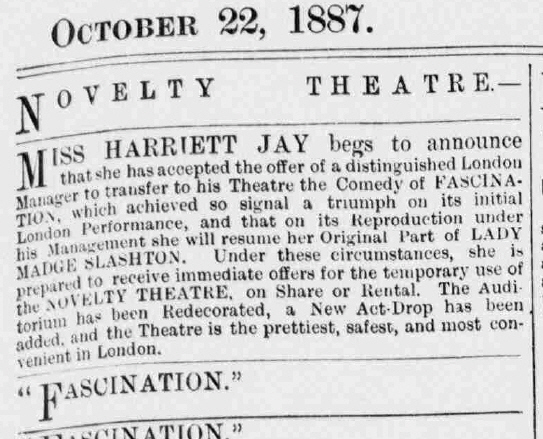 |
|
|
|
[Two column advert for Fascination in The Era (22 October, 1887 - p.13). Click image for full advert.]
The Manchester Courier and Lancashire General Advertiser (24 October, 1887 - p.5)
As usual on the approach of winter there is great activity in the theatrical world. Never at any time in the history of the drama in London were managers more successful than at present. Excellent business is being done at almost every house in London. At three or four theatres a change of programme was in contemplation weeks and weeks ago, but it has never taken place because of the unexpected success of the plays already running in the houses in question. The long-looked for change in the Vaudeville will come soon. Sophia, if I am not mistaken, will be followed by Mr. Robert Buchanan’s comedy Fascination. Miss Jay is to appear in that piece, either at the Vaudeville or at some other house, her connection with the Novelty having been severed. Although the Red Lamp is still drawing people to the Haymarket, it is to be replaced at once by Mr. B uchanan’s new comedy.
___
The Stage (28 October, 1887 - p.13)
It was rumoured at the time of its production that Fascination had been bid for by Mr. Thomas Thorne. This may account for the published statements that the comedy will shortly be produced at the Vaudeville. I don’t think anything has been settled with regard to the future of the Novelty play, but I do know that Heart of Hearts is down for presentation at Mr. Thorne’s theatre. Nothing, however, is so certain as the unexpected; so, after all, Fascination may find a home in the Strand. If so, Miss Harriett Jay will sustain her original character that she played so admirably at the matinée in Great Queen-street.
___
The New York Mirror (29 October, 1887 - p.10)
London News and Gossip.
LONDON, Oct. 12.
When I cast my eagle eye over the matter which I have mapped out for mailing THE MIRROR this week, I am astounded to find that it is nearly all of an American character. For instance, the best thing that demanded my distinguished consideration, after my last letter, was the production last Thursday at a Novelty Theatre matinee of a play by Robert Buchanan and his sister-in-law, Harriet Jay. This was Fascination, which long ago, I am told, sought the suffrages of American audiences. Under these circs. I need only point out to your and my readers that Fascination (I forget whether that was the title in which it appeared before you) is a play of the so-called “society” type, and that it deals chiefly with a dashing and determined heroine dressing in masculine garb in order to visit a bagnio where her betrothed husband is wont to go, because he is “fascinated” (but quite platonically, mind you,) by the fair mistress thereof, a certain Mrs. Delamere. Of course, this strange act on the part of the heroine, who is called Lady Madge Slashton (but who might in some scenes be called Lady Gay Spanker) leads to many alarums and excursions before harmony is restored.
* * *
Fascination was described by its author and authoress as an “improbable” comedy; but after a good deal of improbability the writers somewhat complicated matters by turning on a “probable” tap. Still, with all its defects, Fascination proved to possess a good deal of really good and amusing work. So much so that it will be presently put on at the Novelty in place of the non-paying Blue Bells of Scotland which, you will remember from my previous jottings, is also by the Bard Buchanan.
* * *
The trousers-donning heroine was cleverly played by Harriet Jay. Henry Neville (the original Ticket-of-Leave Man twenty-four years ago) was hearty and earnest as the “fascinated” lover, and Edward Righton (who was wont to play “drag” parts in America with Lydia Thompson’s blondes) scored heavily as a muddle-headed but merry curate.
___
The Theatre (1 November, 1887)
“FASCINATION.”
A New and Improbable Comedy, in three acts, written by HARRIETT JAY and ROBERT BUCHANAN.
First produced at the Novelty Theatre, on Thursday afternoon, October 6th, 1887.
|
|
|
|
“Fascination” has been noticed by some writers on its merits as an impossible play; without going quite as far as this (for women have so frequently passed as males for a considerable time without detection that Lady Madge’s assumption of a masculine garb and in it mixing in men’s society in men’s haunts may be excused) the authors have described it as an improbable one. The fault that may be found with it seems to me to be that one of the most beautiful ideas, that of a pure woman, risking everything, including her good name, to discover her lover’s perfidy or truth, and to endeavour to win him back to a right path, has been treated in a great measure in a farcical manner, while containing the elements of the most exquisite comedy. Lord Islay, belonging to a crack regiment, lives the life of many of his order, and has become entangled with a Mrs. Delamere, who is at least an adventuress. His better nature is stifled by her wiles of fascination, and he forgets the duty he owes to Lady Madge Slashton, to whom he is engaged. She is something of a flirt, but yet true-hearted and brave, and hearing the scandal connected with her lover’s name, she persuades her brother to take her to Mrs. Delamere’s, where as a rich young West Indian gentleman, and under the name of Marlow, she almost makes the hostess fall in love with her, plays cards and wins, buys up Lord Islay’s acceptances from a creditor of his, and eventually insults Lord Islay publicly most grossly. She is almost led to believe in her lover’s faithlessness through his having parted with the engagement ring which she gave him, to Mrs. Delamere, but this has been obtained from him by fraud at the instigation of the captivating widow’s fellow adventurer and tyrant, Count de la Grange, who wishes to part the lovers that he may prefer his suit with success to Lady Madge. But Mrs. Delamere is not all bad, and she confesses how she has endeavoured to lure Lord Islay on, but has never succeeded in touching his heart, and so Lady Madge forgives him, puts all his escapades down to the “fascination” exercised over him by the syren, and accepts the plea that “everybody does it” as the excuse for his other misdemeanours of gambling, &c. Miss Harriett Jay played with such consummate tact and judgment as Lady Madge Slashton as to secure the success of her character. Never for one moment did she lose sight of the fact that she was a high-born lady, and her assumption of the male impersonation was original and highly finished, whilst every now and then, when she fancied she had wasted her deepest affection on a worthless object, her uncontrollable bursts of womanly feeling were powerful yet full of tenderness. Mr. Henry Neville did his best to portray in a favourable light the weak and almost despicable Lord Islay, but did not thoroughly succeed in his thankless task. Miss Alice Yorke as Mrs. Delamere played with considerable point, but was not refined enough in her conception of her part. Mr. Edward Righton as the obliging, simple curate, the Rev. Mr. Colley, was entertaining, and Mr. W. Scott Buist again distinguished himself as a manly young English nobleman, devoted to his sister. And even as “Fascination” stands at present I should not be much surprised if it took its place in a regular evening bill, and secure a considerable measure of success.
QUASIMODO.
|
|
|
|
 |
|
|
|
[Miller and Elliston advert from The Era (19 November, 1887 p.4). Click image for full advert.]
The Daily Telegraph (6 January, 1888 - p.3)
In the event of a change of programme becoming necessary at the Vaudeville, where “Heart of Hearts” is still popular, it has been decided by Mr. Thorne to produce Robert Buchanan’s curious and semi-satirical comedy, “Fascination,” that was successfully performed at a recent matinée at the Novelty. Miss Harriett Jay, who is part authoress of the work, has been engaged for the character of Lady Maude Slashton that she “created” and acted originally with such vigour and skill; but with the exception of Mr. W. Scott Buist very few of the original cast remain. Miss vane will play the wicked Mrs. Delamere; Mr. H. B. Conway will come back to the Vaudeville to play Lord Islay; Mr. F. Thorne will be the eccentric Duke of Hurlingham, and the comic bashful clergyman, the Rev. Mr. Colley, first performed by Mr. Righton, has been chosen by Mr. Thomas Thorne himself. The cast will be further strengthened by Mrs. Canninge, Mr. Royce Carleton, Miss Gertrude Warden, and Miss Gifford.
___
The Illustrated Sporting and Dramatic News (7 January, 1888 - p.16)
A RUMOUR, which seems hardly worthy of credence, has it that Mr. Buchanan’s Novelty piece, Fascination, will shortly replace Heart of Hearts at the Vaudeville. We certainly should not have thought that Mr. Jones’s play, with all its admitted faults, was such a failure as this desperate measure seems to suggest.
___
The Era (14 January, 1888 - p.8)
WHEN Heart of Hearts is withdrawn from the programme at the Vaudeville Theatre, as it will be directly, its place will be taken by Mr Robert Buchanan’s comedy Fascination, recently produced at a matinée at the Novelty. Miss Harriett Jay, who is part authoress of the work, has been engaged for Lady Maude Slashton, the part created by her; Miss Vane will play the wicked Mrs Delamere; Mr H. B. Conway will return to the Vaudeville to play Lord Islay; Mr F. Thorne will be the eccentric Duke of Hurlingham; and the comic, bashful clergyman, the Rev. Mr Colley, will be represented by Mr Thomas Thorne. The cast will be further strengthened by Mrs Canninge, Mr Royce Carleton, Miss Gertrude Warden, and Miss Giffard. A bevy of pretty girls has been selected for the syrens who figure in the second act. The first scene, a view on the banks of the Thames, is being painted by Mr Perkins, and carte blanche has been given to Messrs Maple for the upholstery and decorations of the two characteristic interiors.
___
The People (15 January, 1888 - p.4)
——“Fascination” will be acted on Thursday at the Vaudeville, where great preparations are being made for its production. Something unique may be expected in the way of mounting, as Messrs. Maple have received carte blanche for the decorations of the two interiors—the bower of the syrens in Act II., and the morning-room of Lady Madge in Act III.
___
The Morning Post (16 January, 1888 - p.2)
On Thursday Mr. Robert Buchanan’s eccentric comedy, “Fascination,” will be substituted at the Vaudeville for “Heart of Hearts.” Miss Harriet Jay, who is part author of the piece, has been engaged for her original character of Lady Madge Slashton. Mr. H. B. Conway will be the new Lord Islay, and Mr. Thomas Thorne is to impersonate the Rev. Mr. Colley, a cleric with whom the name of Mr. Righton is pleasantly associated. Miss Vane, Miss Gertrude Warden, Miss Giffard, Mrs. Canninge, Mr. Fred. Thorne, and Mr. Royce Carleton are included in the cast.
___
The Times (20 January, 1888 - p.9)
VAUDEVILLE THEATRE.
Miss Harriett Jay and Mr. Robert Buchanan’s comedy of Fascination, which was produced at a matinée at the Novelty Theatre a few months ago, was transferred last night to the Vaudeville, where, despite its avowedly “improbable” character, for so it is described by the authors, it met with a generally favourable reception. The improbability of Fascination is supposed to lie in the fact that a young lady of society, Lady Madge Slashton, believing her lover, Lord Islay, to be faithless, puts on male attire and follows him into certain haunts of dissipation in Mayfair without being recognized. Such a motive is frequently employed in old comedy, to say nothing of As You Like It, with excellent effect, but in applying it to the conditions of modern society Miss Jay and Mr. Buchanan have rightly assumed that they trench upon the limits of the acceptable. Modern audiences, encouraged by the realistic stage manager, who assures them that every button on his costumes is correct, and that every article of stage furniture is guaranteed by some eminent cabinet maker, scrutinize very closely the proceedings of the dramatis personæ, and are apt to condemn anything that does not happen to be reconcilable with the experience of everyday life. It is true that there is nothing more inherently improbable than a love story which, beginning, say, at 9 p.m., culminates in marriage long before midnight, and is moreover repeated nightly for an entire season; but if this is to be objected to, upon logical grounds, there is of course an end of the drama altogether. The public, somewhat illogically, direct their attention to smaller matters. To bring forward a third party to overhear some important conversation on the assumption that while visible to the house he is invisible to his fellow characters, is a device which the boldest dramatic author now hesitates to resort to. “Asides,” another time-honoured conventionality, are all but banished from modern dialogue, the prosaic auditor being of opinion that they are as likely to be heard by the characters on the stage as by the public; and, generally speaking, an actor is expected to demean himself pretty much as he would in the street or in a private house.
In these circumstances it certainly needed some degree of courage on the part of the authors of Fascination to put their heroine into the dress-coat of the present day and to allow her under that transparent disguise to meet her lover with impunity in a London drawing-room, but the experiment has happily been successful. There is hope for the drama when we find that, while so many conventionalities of the stage are being abandoned under stress of the matter-of-fact spirit of the age, the playgoing public accept, almost without a murmur, one of the boldest devices of the old dramatists. No doubt if Fascination were a better constructed piece than it is, the slight disposition shown by the first-night public to find fault with the author’s dramatic scheme would not have been manifested at all. On the other hand, it may be observed that a more plausible representative of the heroine in her dual capacity could hardly be found than Miss Harriett Jay. In her most feminine moments this versatile actress is never quite free from a suspicion of mannishness, and she wears a coat and trousers as though to the manner born. The piece owes much, therefore, to the presence of Miss Harriett Jay in the cast. Whether without her aid or that of some actress of similar physique the public would accept a modern Hippolyta or Rosalind is a question. In other respects the cast has been changed since the matinée performance. Mr. Thomas Thorne finds a congenial part in the amorously disposed but somewhat bashful clergyman; the adventuress, Mrs. Delamere, is strikingly impersonated by Miss Vane, who has to fill the trying rôle of a “fashionable beauty;” and Mr. Conway plays with sufficient sincerity the purblind Lord Islay. Miss Barton makes a graceful ingénue; and there is quite a galaxy of beauty in the demi-mondain drawing-room, redolent of patchouli, where the principal incidents of the story are enacted.
___
The Morning Post (20 January, 1888 - p.5)
VAUDEVILLE THEATRE.
_____
Some months ago an eccentric play was produced at a matinée at the Novelty Theatre which caused no little discussion. Mr. Robert Buchanan and Miss Harriett Jay presented a comedy called “Fascination,” which they boldly and honestly described as “improbable” as well as new, and it was an opinion generally expressed by those who witnessed the performance, that the piece was not destined to share the fate of the majority of morning-born dramas. In spite of its manifest incongruities, its glaring improbabilities, and its exaggerated situations, it was felt that if played by an equally strong company as that by which it was first enacted, it would probably prove successful by virtue of the many undoubtedly good points it possessed. That judgment was upheld last night when “Fascination” was submitted to the verdict of a Vaudeville audience as the staple attraction of the regular evening bill. But whatever merits the madcap masque may possess, it must rely almost entirely upon the efforts of the actors for any claims it may make on popular favour. From the first line to the last there is an ever-present danger of fiasco in the spectacle of a girl defying the rules of decorum by appearing in male attire, and if Miss Harriett Jay contrives, as she certainly does, to render her escapade in a man’s dress in most dubious society endurable and even interesting, it is by her ability as an actress rather than by her discrimination as part author of the play. Of the original cast, she and Mr. Scott Buist are the only prominent members remaining, and one misses the drolleries of Mr. Edward Righton, who as the demure-looking but somewhat naughtily- inclined curate, the Rev. Mr. Colley, set the house in a roar. Fortunately, in Mr. Thomas Thorne an admirable substitute has been found. So experienced a comedian could hardly fail to make the points in the most amusing character in the piece, and Mr. Thorne did full justice to the absurd situations in which the good-hearted cleric found himself when surrounded by sirens whose personal attractions were more evident than their refinement of character. Mr. Conway is hardly well suited as Lord Islay, the worldly lover upon whose actions in fast town life Lady Madge Slashton plays the spy in the guise of a rich young rake from Jamaica. Herein is the central motive of the plot, and it can hardly be deemed other than a dangerous and unpleasant one. There is something eminently unlovely in the spectacle of a pure, high-spirited girl mixing with demi-mondaines, smoking, gambling, and swaggering as a merry Jack with more money than brains. Desperate diseases require desperate remedies, but there is hardly the remotest probability that any right-minded woman would indulge in such a trick as that by which Lady Madge obtained the entrée of Mrs. Delamere’s house, or that having once involved herself in so risky a course she could avoid discovery. When so simple minded a person as the curate penetrates her disguise, it is inconceivable that Lord Islay and the Count de Lagrange, the men who the same afternoon have been paying their addresses should fail to recognise her. But inasmuch as the authors openly confess the improbability of the idea upon which the play is founded it would be ungracious to condemn too severely a fault which they contrive in a great measure to atone. The best lines in the comedy are allotted to the Rev. Mr. Colley, and Mr. Thorne represents him as a most diverting, if unconventional ecclesiastic. The irresistible humour he throws into the part causes laughter which does not stop to question the utter absurdity of his proceedings, and it is chiefly due to his art and that of Miss Jay that the play tides safely over the dangers which surround it, and reaches a successful termination. The plot of “Fascination” has so recently been described in these columns, that it is not necessary to refer more particularly to it at present. The difficult and thankless part of the adventuress, Mrs. Delamere, to whose wiles Lord Islay so nearly fell a victim, was played with a tact much to be commended by Miss Vane, who kept the unpleasant aspect of the character well within bounds. Mr. H. B. Conway lacked intensity and romance as the erring lover, and he failed to convince the audience of the earnestness of his protestations or the depth of his affections. Mr. Royce Carleton hardly realised the breadth of style associated with such a man of the world as the intriguing Count de Lagrange. The quiet, ill-natured youth, with his faultless frock-coat and meaningless scowl, was surely not the desperate roué, full of resource, keen in encounter and polished in manner and conversation that could hold so accomplished a woman as Mrs. Delamere under his influence and at the same time appear at ease in society of a totally different stamp. The Duke of Hurlingham is among the most improbable of the authors’ characters, but as rendered by Mr. Fred Thorne, he resembled rather a retired member of the petite bourgeoisie than the head of a noble house. Mrs. Canninge was a satisfactory Duchess, and the Lord Jack Slashton of Mr. Scott Buist was a bright and vigorous impersonation. A clever little sketch was given by Mr. F. Grove of a Jew financier, Mr. Isaacson. The audience seemed much diverted by the piece, judging from the continuous laughter and applause with which they greeted it. The inevitable first night hooter made his unwelcome voice heard at the fall of the curtain, but the judgment of the majority was unquestionably favourable.
___
The Standard (20 January, 1888 - p.3)
VAUDEVILLE THEATRE.
_____
At a matinée some time since, a play called Fascination, “a new and improbable comedy,” written by Miss Harriet Jay and Mr. Robert Buchanan, was received with favour, and last night Mr. Thorne transferred it to his theatre. A piece may be welcomed with enthusiasm at a matinée, and may nevertheless be entirely unsuitable for the entertainment of an audience of average intelligence when acted in the regular way at a theatre which is open in the evenings. Fascination is an exceedingly bad play, for several reasons, one of these being that the authors profess to exhibit a society with which it is evident that they have not even an elementary acquaintance. This assertion may be easily proved. A duke, a duchess, and other personages of high degree are introduced, but how little is known of the manners and customs of such society the play soon shows. Lady Madge Slashton, sister of a person who seems to be indifferently “Lord Slashton” and Lord John, loves Lord Islay, who has an entanglement with a Mrs. Delamere, a woman of questionable character, and in order to investigate his proceedings Lady Madge assumes men’s clothes and goes to a dinner at Mrs. Delamere’s house. It is a very strange dinner, seeing that it only lasts about four minutes: at least, after this lapse of time the ladies—there are several of them—return to the drawing-room, accompanied by the disguised Lady Madge, introduced as Mr. Marlow, and the men who are at a table in the background behind some curtains begin to play cards on the uncleared dinner table. Mrs. Delamere, recognising the inconvenience of the position, suggests their adjournment to the drawing-room and the game is continued, but it is still oddly conducted, for “Mr. Marlow”—that is, Lady Madge—takes a hand, but pays no sort of attention to her cards, turning round and watching her lover and the perfidious Mrs. Delamere. It might be urged, in extenuation of the absurdity, that Miss Jay, who attempts the part of Lady Madge, may here do injustice to her author, but then she is the author, or at least one of the two authors. The young man whom she presents is an extremely feminine personage, but when in the petticoats proper to her sex Miss Jay acts some of her scenes not without judgment, though the desirable refinement of manner is wanting. Mr. Thorne plays a curate, the Rev. Mr. Colley, who has a taste for fast life. These satires on clergymen have been somewhat too common since the success of The Private Secretary, and they are in doubtful taste, but Mr. Thorne’s quiet humour is certainly amusing in its way. Mr. H. B. Conway’s Lord Islay is, however, in all respects excellent. He understands the nature of the part he assumes, and is perfectly true to life in the first place, and to the individual character of such a man as Lord Islay in the second. Miss Vane also plays with force and discretion as Mrs. Delamere. Mr. F. Thorne’s Duke of Hurlingham is a caricature. Fascination is, on the whole, a feeble and clumsy piece of work; to what extent the author’s admission of its improbability excuses its weaknesses must be left for audiences to decide, if they care to undertake the task.
___
The Evening News (20 January, 1888 - p.4)
VAUDEVILLE THEATRE.
_____
“Fascination,” an “improbable comedy,” by Robert Buchanan and Harriet Jay, was produced at the Vaudeville Theatre last night. The piece first saw the light at a matinée some months ago, when it was rather favourably received by an indulgent afternoon audience. But it will not stand the practical test of being played every night to people who pay for their seats. The authors, to a certain extent, forestalled criticism when they christened it an “improbable comedy.” It is improbable enough, in all conscience. But it has a much worse fault—it is weak. There is no fault to be found with the dialogue, which is seldom dull, and sometimes very bright and witty. The first act is amusing; the second not ill-conceived and giving opportunity for some forcible acting; the third intolerably dull—a tissue of tiresome explanations, postponing the inevitable reconciliation and happy ending, the coming of which is made certain within the first five minutes of it. The piece plays about two hours and a quarter; it could be compressed into about an hour. There are not many characters, and not much plot. A hoydenish young lady is engaged to her cousin, a Guardsman, who loves her, but is allured into a temporary fancy for a society beauty. The latter is an adventuress, who is driven into leading him on by the villain, a card-sharper who poses as a count, who wants to marry the hoyden himself and get her fortune. The hoyden suspects her lover, and in order to watch him dresses up as a man, comes to London, and gets introduced to the society beauty. At the latter’s house she meets her lover, and concludes from what she sees there that he is false. By a series of rather clumsy devices, the society beauty and the erring lover each confess to the hoyden, still in her boy’s clothes, all the circumstances of their rather innocent liaison, and everything ends right. The moral of the piece is decidedly confused. The authors, to judge by the virtuous sentiments enunciated at considerable length and at various times by the lover, in intervals of repentance, and by the general intent of the piece, which shows love and truth triumphing over wickedness, and impresses the lesson that pure love for an honest woman is better than the “fascination ” of a siren, meant the piece to be correct and instructive. The ostensible tenour of it is to back the “lilies and languors of virtue,” against the “roses and raptures of vice,” and to make the former win. But if this be the object of the play, the character of the Reverend Mr. Colley, a plump clergyman with humorous lines, who carries the sympathies of the audience with him throughout, is a bit off the line. He poses as a good young man, and becomes engaged in the last act (by a bit of outrageously burlesque business) to an innocent little country girl, yet he runs after every petticoat he sees, speaks suggestive lines, makes himself perfectly happy in the drawing room of the society beauty (which has a much stronger flavour of St. John’s-wood than Mayfair, by the way), and lies like a trooper to gain the goodwill of the Duke of Hurlingham, who has promised him a living. After all, the play is scarcely worth detailed criticism. The authors intended the “improbable” to apply to the leading idea, but it is equally applicable to every scene in the piece. It was fairly well acted last night. Miss Vane as Mrs. Delamere, the society beauty, was particularly good, and so was Mr. F. Thorne as the senile old roué, the Duke of Hurlingham. Mr. Thomas Thorne was quietly humorous as the Rev. Mr. Colley, though his catchword, “I should like it exceedingly,” smacks (as does the rhymed “tag” at the end) of the pantomime “wheeze.” Mr. H. B. Conway was very natural in the part of Lord lslay, the doubtful lover; Miss Harriet Jay as the hoyden, Lady Madge Slashton, was thoroughly in earnest, and showed a good deal of power.
___
The Pall Mall Gazette (20 January, 1888)
A HEROINE IN BREECHES.
We have read somewhere the confessions of Miss Harriet Jay. She wished to appear in breeches, and studied the art of wearing them assiduously. Slang she acquired from an Eton boy, if we remember rightly. In the comedy which was produced at the Vaudeville last night, after a preliminary canter at a matinée, Miss Jay plays the part of a young lady who masquerades as a young gentleman in order to satisfy herself as to her lover’s fidelity. Although this lover is in the Guards and is a conspicuous figure among men about town, he is at heart a very good young man, who might easily develop into a light of Exeter Hall, for even in his raffish days he sermonizes dreadfully. His fiancée, Miss Jay in petticoats, hears of a dashing adventuress of Curzon-street who has inveigled him, and is naturally jealous. With the courage of despair she determines to learn the whole truth and nothing but the truth, and induces her brother to introduce her to this Mrs. Delamere as a young sheep from Jamaica all ready to be fleeced. Off go the petticoats and on come the breeches, evening ones. To be candid Miss Jay was a little overcome by man’s attire. If Mrs. Delamere’s drawing-room had been filled with blind men and women she might have passed muster, though even with the blind her voice might have betrayed her. This modern Rosalind, as presented by Miss Jay, is of course an impossible person. In the play she learns the truth, foils the villain, brings the erring Delamere to repentance, and carries off her lover. Mr. Buchanan may, indeed, be able to give a practical demonstration that a roomfull of men and women have really been deceived by Miss Jay’s assumption of man’s attire; he may be able to quote cases to the point, and he may add that men have deceived the world as to their sex within recent years. All we can say is, that Miss Jay’s forte does not lie in these sartorial vagaries, for which she has such a predilection. Accepting Miss Jay as an ideal representative of a young blood, whether from Jamaica or elsewhere, “Fascination” is fairly interesting. The second act is stirring, and the dialogue is well written. Mr. Buchanan has evidently sketched from life his part as a dog-like and bland curate, who lies like a trooper, sings comic songs about the “good young man who died,” smokes cigarettes behind his wideawake, admires photographs of burlesque beauties, and gets his friend and patron, the Duke, out of his innocent escapades. The breeches seem to us to be fatal to the slight modicum of human interest which this play possesses. The last act is rather chaotic, and the rhymed tag is ludicrous.
___
Birmingham Daily Post (20 January, 1888)
“Fascination,” which was given a trial trip at a matinée at the Novelty early last October, took the place at the Vaudeville to-night of Mr. H. A. Jones’s “Heart of Hearts,” which has had an unexpectedly short run. Mr. Robert Buchanan describes his comedy as “improbable,” and no one who saw its first representation will dispute the accuracy of the epithet. He appears to have written it largely with view to displaying that phase of her acting talent of which Miss Harriet Jay—sister-in-law of the author, and herself a novelist, as “The Queen of Connaught” lives to testify—is obviously most proud. For in the second act the heroine has to don male attire, and it in “trouser parts” that Miss Jay loves to appear. When Mr. Buchanan freely adapted “Le Maitre de Forges” as “Lady Clare” he introduced the part of an Eton boy, so as to give Miss Jay her opportunity; and when he wrote a rhyming introduction for the old Adelphi drama, “The Flowers of the Forest,” it was in order to give a chance to the revival in which the lady played the gipsy boy Lemuel. The change from the sentimental “Heart of Hearts” to the improbable “Fascination” was a very striking one for the habitués of the Vaudeville. Notwithstanding this, the piece was received until the third act, when it became distinctly weaker, with much applause, amid which there would have been no dissentient voices had it not been for the persistent efforts of a claque which justified opposition by such absurdities as shouting for the author at the end of the first act, and again in the middle of the piece. The acting on the whole sustained the Vaudeville traditions. Miss Jay, when masquerading as the boy, was at her best; and Mr. Conway, as the somewhat fickle lover, though not possessed of as good a part as usual, filled it well. Mr. Thomas Thorne played a preternaturally mild clergyman of a type of which we have lately been having a surfeit, but dexterously avoided comparison with similar characters in other pieces; but Miss Vane was unduly artificial as Mrs. Delamere, the woman about town, who causes all the mischief. A rhymed “tag” of an exceedingly old-fashioned sort provoked much derision; and though all the performers were loudly cheered, determined cries of about half a dozen for the author met with such hisses and cat-calls that Mr Buchanan did not appear, and his absence was unexplained.
_____
Fascination - continued
|
|