 |
|
|
Play List: 4. Corinne 7. The Mormons 9. Lucy Brandon 10. Storm-Beaten 11. Lady Clare 13. Bachelors 14. Constance 15. Lottie 16. Agnes 17. Alone in London 18. Sophia 19. Fascination 20. The Blue Bells of Scotland 21. Partners 24. Angelina! 25. The Old Home 26. A Man’s Shadow 27. Theodora 29. Clarissa 30. Miss Tomboy 32. Sweet Nancy 33. The English Rose 36. Marmion 37. The Gifted Lady 38. The Trumpet Call 39. Squire Kate 40. The White Rose 42. The Black Domino 44. The Charlatan 45. Dick Sheridan 47. Lady Gladys 48. The Strange Adventures of Miss Brown 49. The Romance of the Shopwalker 52. Two Little Maids from School ___ |
|
|
|
ROBERT WILLIAMS BUCHANAN (1841 - 1901) |
|
|
|
|
|
|
|
|
|
THEATRE REVIEWS 30. Miss Tomboy (1890)
Miss Tomboy
The Derby Daily Telegraph (3 March, 1890 - p.2) Surely Mr. Robert Buchanan imagines he has some right divine to resuscitate the literature of past centuries. His adaptations from Richardson and Fielding have been pronounced successes, interesting not as dramatic curios, but as stage plays, witty and vigorous; he has been quick to see, able to grasp, the strong humanistic elements in the old novels he has tackled; and he has vivified the life of a past generation only brought home to latterday playgoers with Goldsmith revivals. He is now doing a bold thing in paring and trimming Vanbrugh’s somewhat immoral “Relapse” for production at a series of Vaudeville matinées. Considering Sheridan tried his hand unsuccessfully at the same comedy, and that yet another version failed at the Gaiety 20 years back, I think Mr. Buchanan might have ventured his luck elsewhere. ___
Pall Mall Gazette (4 March, 1890 - p.1) AFTER “CLARISSA,” “THE RELAPSE.” The version of Sir John Vanbrugh’s comedy “The Relapse,” which is being prepared by Robert Buchanan for the Vaudeville, will see the light—at a matinée of course—as soon as it is ready. If successful, you may expect to see it oust “Clarissa” from her place in the evening bills, as this drama has not done all that the management anticipated. I should have liked to see so sound and artistic a play—for with all its faults it never lacks true art—become a really popular “triumph.” But the average theatre-goer is a strange creature. You may make him laugh in almost any way you please; but he is very particular as to the precise method in which you extract tears from his critical eyes. Presumably, he does not find sufficient enjoyment in weeping over the woes of the unfortunate Miss Harlowe. ___
The Stage (7 March, 1890 - p.11) The Relapse, revised by Robert Buchanan, is promised at a series of morning performances to be given at the Vaudeville, where, I am told, Clarissa is attracting good business every evening. ===== Should The Relapse prove successful you may expect to see it go into the night bill, for it is Mr. Thomas Thorne’s plan to produce new plays at matinées before risking them in the evening. ___
The Athenæum (8 March, 1890 - No. 3254, p.318) Dramatic Gossip. AN adaptation by Mr. Robert Buchanan of ‘The Relapse’ of Sir John Vanbrugh is promised by Mr. Thorne at afternoon representations at the Vaudeville. A play more strongly imbued with the spirit of Restoration comedy, and more difficult to fit to modern requirements, cannot easily be found, and success in this experiment will open a new mine to managers and a new vista to lovers of the stage. ___
The Bristol Mercury (18 March, 1890 - p.3) “The Tomboy” is the title selected for what Mr Robert Buchanan is pleased to call his “new comedy adapted from” Vanbrugh’s “Relapse.” It is to be produced at the Vaudeville on Thursday afternoon. ___
The Times (21 March, 1890 - p.11) VAUDEVILLE THEATRE. To furbish up old comedy and present it in a fresh form to a later generation of playgoers than that for which it was written is not so much a new as a revived branch of theatrical enterprise. It was a common enough industry in the last century, when Shakespeare himself was thought to require adaptation. Now that classics are viewed with the same veneration as old monuments, it requires, perhaps, as much courage to renovate an old dramatist as it would do to whitewash Stonehenge; but where courage is needed Mr. Robert Buchanan is never found wanting, and it is he, accordingly, who is responsible for the modernized version of Vanbrugh’s famous comedy The Relapse, which was played yesterday afternoon at the Vaudeville, under the title of Miss Tomboy. Adapters are much given to the use of the phrase “founded upon,” which no doubt expresses as little obligation to the work in question, whatever it may be, as is compatible with the mention of the original author’s name. In the present instance the words, for once, are appropriately employed in the playbill, since they convey a tolerably exact impression of the relation of the new to the old piece. Mr. Robert Buchanan has not adapted Vanbrugh; he is hardly indebted to him, indeed, for a line of dialogue. What he has done has been to borrow the underplot of The Relapse, with its characters, sacrificing all the incidents in which Loveless, Amanda, and Berinthia, are concerned, and to present in a quick and well-ordered succession of scenes the device by which Tom Fashion cuts out Lord Foppington in the scheme for winning the hand of Miss Hoyden, the rustic heiress. A considerable group of Vanbrugh’s dramatis personæ are thus retained, though why Coupler should now be disguised as Sir George Matcham, while Sir Tunbelly Clumsey is not ashamed of his patronymic, it is hard to understand. As Tom Fashion’s adventure in personating his elder brother is of an entirely proper character from the modern point of view, Mr. Robert Buchanan’s task, within the limits he has assigned himself, has been one of suppression chiefly; and, all things considered, this is no doubt the least objectionable form in which a revival of Vanbrugh’s comedy could be attempted. The action becomes somewhat attenuated, it is true; but, on the other hand, it is commendably free from the vices of its period, resolving itself mainly into an illustration of the character of the scented dandy of the 17th century, Lord Foppington. This personage is now amusingly portrayed by Mr. Thomas Thorne even to the lisping affectation of speech conveyed by the substitution of “a” for “o” in such words as “apalagize” and “Tam;” and his follies and fatuities may, perhaps, be found to compensate for what must be described as a lack of plot, seeing that the wooing and winning of Miss Hoyden remains what it originally was—a rather meagre dramatic incident. Miss Hoyden herself, who naturally gives the piece its title, now that Loveless and his “relapse” from conjugal fidelity are suppressed, has been modernized into a frolicsome boarding-school miss, and is winsomely played on such lines by Miss Winifred Emery, Mr. Frank Gillmore appears as the dashing young Tom Fashion, Mr. Fred Thorne as Sir Tunbelly, Mr. Cyril Maude as a foppish man-servant, and Mr. J. S. Blythe as the matchmaker. The curiously hybrid work to which Mr. Robert Buchanan has put his name in conjunction with that of Sir John Vanburgh was yesterday well received, and it may, perhaps, obtain something more than a succès de curiosité. ___
The Echo (21 March, 1890 - p.1) VAUDEVILLE THEATRE. The industrious Mr. Robert Buchanan is very greatly beholden to Miss Winifred Emery. She it is who nightly takes his gloomy play, Clarissa, in hand, and by the radiancy of her sensitive genius so ennobles its central character that she brings it back to the high ideal of a woman’s spirit—pure, proud, chaste, and sinless, fettered in a dishonoured body—which makes the original Clarissa Harlowe of Richardson one of the most beautiful conceptions in our national literature. Yesterday afternoon we were called to see how Mr. Buchanan had fared in his effort to stitch together a three- act-up-to-date farcical comedy, or farce, called Miss Tomboy, out of Vanbrugh’s Relapse and Sheridan’s Trip to Scarborough, a feat, by-the-bye, of playwrighting sartorialism last successfully performed by Mr. John Hollingshead, who called his production The Man of Quality. We found Mr. Buchanan in the sermonising vein, reproving in a note in the programme the seventeenth and eighteenth centuries for the “heartlessness” of their “artificial period,” and explaining how, having banished their “tawdry mock-heroic blank verse,” he hoped he had “humanised” the play into “essentially a new comedy.” We discovered that the “heart” of Buchanan beating in the bodies of his illustrious predecessors gave us something of the rattling farce order, rapid and laughable, but utterly devoid of the artificiality, wit, and glitter of the older works. But what was infinitely more delightful was the revelation that Miss Emery, in a totally different character—that of a trick-playing, rough-and-tumble, reckless, unsophisticated tomboy, full of animal spirits and noisy, riotous roguery—was once more willing and able to take the burden of the performance on her shoulders, and bring it to a merry and successful issue. It came as a surprise. There is very little in Miss Emery personally to suggest the hoyden; her delicate face and features, rather tearful voice, and soft, entwining manners, are all against her. But all these she overcame; she burst upon us as the rollicking, restless torment, the ever-in-hot-water enfant terrible, naive beyond belief, capable of much duplicity in the scene in which she acts imbecility, but beautiful and graceful despite it all. The story, as it stands, is simple. Tom Fashion, Lord Foppington’s younger brother, appeals to his Lordship for funds. His Lordship angrily refuses. But Tom, learning that the Peer is about to proceed into the country to win an heiress, forestalls him, and has himself announced to the girl and her rustic father as “My Lord,” and carries the maiden’s heart by storm. My Lord himself, coming later, is treated as an impostor, placed in durance vile, baited by the household, and fooled by the hoyden, who affects to be of “weak intellect.” Tom then seals the bond by a hasty secret marriage. After that disclosure and forgiveness. Mr. Frank Gilmore as Tom Fashion was a gay young spark, but lacked “devil.” Mr. T. Thorne, of the monotonous voice, wanted distinction in the great part of Lord Foppington, a man whose affectations make the “live air sick.” Miss Mary Collette made a merry little servant; Mr. Fred. Thorne was much at home as a bucolic squire; Mr. Cyril Maude was clever as the valet; Miss Sylvia Hodson, Mr. Blythe, Mr. Grove, and Mr. York successfully filled minor parts. ___
The Morning Post (21 March, 1890 - p.3) VAUDEVILLE THEATRE. Mr. Robert Buchanan has, under the title of “Miss Tomboy,” founded a pleasant comedy upon “The Relapse,” by Sir John Vanbrugh, one of the celebrated trio of dramatists who flourished two centuries ago. Congreve, Vanbrugh, and Farquhar produced excellent comedies, those of Vanbrugh having, perhaps, the most backbone and reality, although not so witty as those of the other two dramatists. Vanbrugh depends upon humour and situation to a greater extent than they do. He wrote a dozen comedies. “The Relapse” produced in 1697, was one of the most successful but “The Provoked Wife,” “The Confederacy,” and “The Journey to London” (left unfinished, and completed by Colley Cibber), were also very popular. Mr. Buchanan’s “Miss Tomboy” owes little to Vanbrugh in respect of dialogue, for the adapter has entirely rewritten it, and has somewhat modernised the comedy by dating it 1750. The story is that of a peer who has just come into his title, and who is inclined to hold aloof from his younger brother, a much more manly fellow, but a bit of a scapegrace. Lord Foppington is advised by his friend Sir George Matcham to marry a bright young country girl, only seventeen, resident near St. Albans with her stepfather, Sir Tunbelly Clumsy. The younger brother, seeing that Lord Foppington intends to cast him off, and being informed by his valet that his lordship intends to go down to St. Albans to propose to the lady, starts off with the intention of personating his brother. He does so with such success that the maiden is enchanted with him, and consents to a secret marriage. Meanwhile the real Lord Foppington arrives, and meets with an astounding reception. He is treated as an impostor, his servants are sent away, and when he becomes indignant his lordship is locked up. The younger brother makes the best of his time and induces a country clergyman to perform the marriage ceremony, but he first confesses to the girl the trick he has played. She has a little fortune of her own and is quite willing to share it with the handsome young fellow whose brother good-naturedly forgives him, as also does the stepfather of the heroine. The comedy, which is in three acts, went extremely well, and requires but little alteration to make it acceptable in the evening programme. The only changes that appear necessary are in the first act, which is somewhat thin, and the want of feminine interest is also a drawback. From the moment Miss Tomboy appears there is nothing but hilarity, for the character has been admirably conceived and well written, and it was played by Miss Winifred Emery with such grace, humour, and buoyancy as to completely captivate the audience. In look, manner, and tone Miss Emery perfectly realised the idea of the author. Nothing could be prettier or more engaging than the young girl’s notions on the subject of matrimony. She simply regards the ceremony as good fun, and when she discovers that the union is with a young, lively, and good-humoured partner, all idea of wealth and position vanishes, and she is quite content to take her lover penniless as he is. One of the most charming scenes is that in which Miss Tomboy, understanding that Lord Foppington imagines he has got into a lunatic asylum, pretends herself to be a little mad. Miss Emery does this in such an attractive and amusing way that Lord Foppington can hardly resist her. Several other characters are well played, and Mr. Thomas Thorne makes a very amusing personage of Lord Foppington, the town dandy. His scene with the heroine in the second act was capitally played, and throughout his rendering was consistent and clever. Mr. Fred. Thorne as the old county baronet, Sir Tunbelly Clumsy, was droll and eccentric in his comedy, without exaggeration, and Mr. Gillmore was an animated representative of the penniless brother. His love-making was carried on in a spirit unknown to more modern days, and it caused infinite amusement. Mr. Blythe as the old match-maker was amusing, and a very clever performance of an artful valet did Mr. Cyril Maude great credit. This young actor has the faculty of imparting interest to the slightest sketch of character. The subordinate parts were well filled, and excellent aid was given by Miss Sylvia Hodson, and Miss Mary Collette as a lively waiting maid. “Miss Tomboy” was greeted with hearty laughter throughout. The delightful comedy acting of Miss Winifred Emery would have made a far inferior piece successful, and together with other good qualities in the play will help to bring it more prominently before the public. Mr. Buchanan was warmly complimented at the fall of the curtain. ___
The Standard (21 March, 1890 - p.3) VAUDEVILLE THEATRE. If peals of laughter, almost continuous, during three acts may be regarded as evidence of success, then Mr. Robert Buchanan’s farcical comedy Miss Tomboy, performed at the first of a series of special matinées yesterday, justifies its author’s labour. At the same time, it is permissible to doubt whether another adaptation of Sir John Vanbrugh’s Relapse; or, Virtue in Danger was needed at the present moment. Few examples of the witty, but cynical, and wholly licentious drama of the Restoration have undergone a larger number of modifications at the hands of later playwrights. Sheridan’s version, A Trip to Scarborough, produced in 1777, just eighty years after the original at Drury-Lane, kept the stage for a long period, and even as late as 1850 The Relapse, in a condensed and purified form, was presented at the Olympic. The farcical element in the comedy was discovered by Voltaire, who utilised some of the principal scenes in a piece produced at Sceaux. But the utter heartlessness and artificiality of the main plot in which Loveless and Berinthia figure are repugnant to Nineteenth Century ideas, and in Mr. Hollingshead’s version, called The Man of Quality, performed at the Gaiety in 1870, the ruse played upon Lord Foppington forms the central feature of the action. The late Alfred Wigan was the ridiculous Peer, and Miss Nelly Farren displayed her customary vivacity as Miss Hoyden. Mr. Buchanan claims for his adaptation that, “beyond portions of Lord Foppington’s admirable scenes in Act 1, and a stray line here and there, throughout the dialogue is original; while the characters, especially that of Miss Hoyden, have been greatly altered, and in some respects, it is hoped, humanised.” This implies that, in Mr. Buchanan’s opinion, the characters and the language of the old play were artificial, and, if we compare Vanbrugh’s comedy with the work of present-day dramatists, there is nothing to be said on the other side. But surely this is unfair. It is impossible to speak positively on matters of this nature, but to the careful reader of the comedies of the period the dialogue of Vanbrugh must appear more natural and genial than that of Wycherley or Congreve. This question, however, is not of vast importance: the main point at present is a record of the fact that Mr. Buchanan has put together some scenes suggested by, rather than adapted from, The Relapse, and has shown that it is possible to place a farcical comedy in the era of powder, periwig, and patches. ___
The Yorkshire Post (21 March, 1890 - p.4) Mr. Robert Buchanan has shown on several occasions recently—notably in his Joseph’s Sweetheart and Clarissa—that there is an abundance of useful material in the literature of the last century for the construction of a modern drama. His Miss Tomboy, which was produced at a special matinée at the Vaudeville Theatre yesterday, goes a step further, and proves that with a little modernisation the drama of the same period will afford at least as much amusement as most of the adaptations that come to us of pieces across the Channel. Miss Tomboy, as Mr. Buchanan is careful to state in a note on the programme, is based on Sir John Vanbrugh’s comedy The Relapse and Sheridan’s Trip to Scarborough, but beyond portions of the scenes in the first of the three acts and a stray line here and there, the dialogue is original, while the characters, especially that of Miss Hoyden, have been greatly altered, and, the author hopes, humanised. It is certainly a most admirable play that Mr. Buchanan has produced from these sources. The main idea of a younger brother, who personates the head of his house, Lord Foppington, and palms himself off upon an unsuspecting country squire as the suitor in a marriage of convenience that has been arranged with his daughter, is excellently worked out, and the audience is kept in a roar of laughter by the ridiculous situations which are produced. Perhaps the only fault that is to be found with the piece is that Mr. Buchanan, in trying to preserve the spirit of the original productions, has allowed here and there a little coarseness to peep out; but, after all, this is not very glaring, and it is readily condoned by an audience whose sense of humour is so continuously appealed to by Mr. Buchanan’s racy dialogue. With Mr. Thomas Thorne in the character of Lord Foppington, Miss Winifred Emery as Miss Hoyden, and the other parts in competent hands, the piece played with remarkable smoothness, and the hearty demonstrations of approval at the end showed that the performance had been an unequivocal success. ___
The Nottingham Evening Post (21 March, 1890 - p.2) Mr. Robert Buchanan, having apparently exhausted the adaptable novels of last century, has turned his attention to 17th century comedy, and produced at the Vaudeville this afternoon an adaptation of Sir John Vanbrugh’s “Relapse,” under the title of “Miss Tomboy.” He has entirely suppressed the main plot of Vanbrugh’s play—the Loveless and Amanda intrigue—and has rewritten the underplot, which deals with the adventures of Lord Foppington and his brother Tom Fashion at the house of Sir Tunbelly Clumsy. ___
The Dundee Advertiser (21 March, 1890 - p.5) Mr Robert Buchanan’s three act comedy “Miss Tomboy,” founded on Sir John Vanbrugh’s “The Relapse” and on Sheridan’s “Trip to Scarborough,” was brought out at the Vaudeville Theatre this afternoon. As most people are aware, the chief incident in these plays is the impersonation of a nobleman by a younger brother, who manages to marry his Lordship’s bride by a clever ruse, while the real bridegroom, who has never seen the lady, is treated by her and her father as an impostor. Many farcical scenes arise out of this, but they are very much of one sort, and considerable padding is necessary to stretch the play into three acts. There is no originality whatever in the plot, which has been “conveyed” en bloc, and the dialogue, though smartly written, is a long way behind Sheridan’s. Miss Emery played the hoydenish part of the Tomboy, and played it with much spirit. The other leading characters were taken by the Messrs Thorne, Mr. F. Gillmore, and Mr J. S. Blythe. The play wants breadth and strength, and in its present form is not likely to obtain permanent popularity. ___
The Birmingham Daily Post (21 March, 1890 - p.5) A large and extremely friendly audience assembled at the Vaudeville Theatre this afternoon to witness the production of a comedy founded on Sir John Vanbrugh’s “The Release,” by Robert Buchanan, and entitled “Miss Tomboy.” The adaptor also acknowledges his indebtedness to Sheridan’s “Trip to Scarborough.” The piece was announced as the first of a series of special matinées, and as far as I know there is no idea of putting it in the evening bill. Its main object was presumably to show the wonderful versatility of Miss Winifred Emery, who appears as the Tomboy. It is a performance in every way admirable, and in most striking contrast to her Clarissa Harlowe. She entered thoroughly into the spirit of the part, and it was chiefly due to her efforts that the play had such a favourable reception—indeed, the first act when she was not on the stage seemed to drag a good deal. Certainly the interest of the audience increased as the piece wore on, but there are hardly materials enough out of which to form a three-act comedy. Mr. Thomas Thorne appears as Lord Foppington, but though he has some clever moments, the part is not in his line, for he lacks the refined airs and graces of the eighteenth-century fop. The character of Tom Fashion is creditably filled by Mr. Frank Gilmore, who, however, wants more repose; and, as in “Clarissa,” the talents of that excellent actor, Mr. Cyril Maude, are thrown away. Mr. Blythe and Mr. Frederick Thorne were seen to advantage in small parts. Mr. Buchanan was called at the finish, and there were all the outward signs of success. ___
The Illustrated London News (22 March, 1890 - p.3) THE PLAYHOUSES. . . . Mr. Robert Buchanan’s new version of Sir John Vanbrugh’s “Relapse,” called “The Tomboy,” at the Vaudeville, will be presented at a Thursday matinée, too late for review this week. But, of course, he has been anticipated by others, even in our lifetime. The elder Farren produced a version of this naughty old play when he was manager of the Strand in the year 1850; but the very last version was that of Mr. John Hollingshead at the Gaiety, in May 1870—twenty years ago, and it only seems yesterday!—called “The Man of Quality,” in which Alfred Wigan appeared as Lord Foppington, Nellie Farren as Miss Hoyden, and poor John Maclean—just dead—as Sir Tunbelly Clumsy. Mr. Lin Rayne and Mrs. Henry Leigh were also in the cast of this last abridged version. Vanbrugh’s “Relapse” was written as a sequel to Cibber’s “Fool in Fashion.” It was first performed at Drury-Lane in 1697. Sheridan made an adaptation of it in 1877, and called it “The Trip to Scarborough.” In Mr. Hollingshead’s Gaiety version he only availed himself of one of the two distinct plots used by Vanbrugh, but preserved faithfully everything that belonged to the character of Lord Foppington. Nellie Farren’s Miss Hoyden was an admirable performance, but I own I thought very little at the time of Alfred Wigan’s Lord Foppington. ___
The Daily Telegraph (22 March, 1890 - p.3) VAUDEVILLE THEATRE. The complete success which fell to Mr. Robert Buchanan’s bright and enjoyable version of Sir John Vanbrugh’s naughty old comedy, “The Relapse,” on Thursday afternoon, opens up to the playgoer a delightful prospect. If a clever dramatist—following in the footsteps of Sheridan, who gave us the famous “Trip to Scarborough”—can so preserve the buoyant spirit of comedy and discard the boisterous freedom and coarse plain-speaking of a licentious age, and make the result so exhilarating, then there is at his service a vast library of enchanting and witty plays. Mr. Buchanan has picked the plums out of “The Relapse”; he has discarded the secondary plot that deals with Amanda and that wicked widow Berinthia and Loveless; he has treated Sir John and his adapter Sheridan with the freest hand; he has borrowed from Mr. Ashby Sterry—the poet of the school-room—an excellent title in “Miss Tomboy”; and he has very sensibly retained all that he could of Lord Foppington and gay Tom Fashion, and, best of all, that delightful creature, Miss Fanny Hoyden, who was played with surprising gaiety and infinite cleverness by Miss Winifred Emery. In Mr. Buchanan’s desire to keep all that was funny and to reject all that was objectionable in this old play he was anticipated by Mr. John Hollingshead just twenty years ago. Many present yesterday afternoon could easily recall “The Man of Quality,” produced at the Gaiety in May, 1870, with Alfred Wigan as Lord Foppington, Miss Nellie Farren as Miss Hoyden, Lin Rayne as Young Fashion, and Mr. J. Maclean—whose recent death we have to deplore—as Sir Tunbelly Clumsy. Older playgoers still can remember old Farren as Lord Foppington at the Strand, and may, perchance, have seen Sheridan’s “Trip to Scarborough,” which, strange to say, has long since vanished from the acting stage. ___
The Era (22 March, 1890) “MISS TOMBOY.” A Comedy, in Three Acts, by Robert Buchanan, Lord Foppington ... Mr THOMAS THORNE Those present at the Vaudeville Theatre on Thursday afternoon who remembered Macaulay’s strictures on The Relapse, and who were aware that, in its original form, Sir John Vanbrugh’s play was very naughty indeed, must have wondered, after seeing Mr Buchanan’s adaptation thereof, entitled Miss Tomboy, how the indecency of the original was introduced. The explanation, of course, is that in The Relapse there are two plots—a principal and an under-plot, the former of which is immoral, whilst the latter is innocent. Mr Buchanan has rewritten the decent and funny part of the play and eliminated the improper portion. He claims, indeed, to have written what is essentially a new comedy. “Beyond portions of Lord Foppington’s admirable scenes in act one, and a stray line here and there throughout, the dialogue,” he says, “is original, while the characters, especially that of Miss Hoyden, have been greatly altered, and in some respects, it is hoped, humanised. The main plot of The Relapse, with its style of tawdry, mock-heroic blank verse, and its vein of heartlessness so characteristic of an artificial period, has been abandoned altogether; while the excellent under-plot, full of those germs of broad humanity which afterwards reached perfection in the robust and sunny genius of Farquhar, becomes the mainspring and motif of the present play.” Mr Buchanan has, in fact, done very much the same as did Mr John Hollingshead when he adapted Vanbrugh’s comedy in 1870. The recollection of this version has a melancholy interest at the present date, the late Mr John Maclean having sustained the part of Sir Tunbelly Clumsy in the production of The Man of Quality at the Gaiety Theatre in the May of that year, Mr Alfred Wigan playing Lord Foppington, Miss Nellie Farren, Miss Hoyden, and Mr Lin Rayne, Tom Fashion. The result of the process of deodorisation has been in both cases somewhat the same. The principal motive of the piece being removed, and what was originally intended to be a secondary and subordinate portion called upon to take its place, weakness of interest and inadequacy of intrigue make themselves uncomfortably felt. The amount of story in Miss Tomboy would be sufficient to furnish out an excellent one- act farce, but it is not enough to serve as foundation for a three-act comedy. We are first introduced, in Mr Buchanan’s version, to Lord Foppington at his house in London. He has recently come into a fortune, purchased a peerage, and launched out into all the follies and fopperies of the day. His younger brother, Tom Fashion, comes and endeavours to borrow £500 in order to redeem his annuity, which he has mortgaged. Lord Foppington refuses to grant the loan; indeed, he himself is somewhat impoverished by the purchase of his title, and an elderly go-between, Sir George Matcham, has found out for him a young, unsophisticated country beauty, with a considerable fortune in her own right. Enraged at his brother’s unkindness, Tom determines to go down to the young lady’s residence, Brambletree House, St. Albans, and, presenting himself as Lord Foppington, woo and win Miss Hoyden, the heiress. Carrying out his intention, he finds her to be a rustic romp, and soon succeeds in securing her favour. In order to prepare himself against interference on the part of his brother, Tom warns Sir Tunbelly Clumsy, Miss Hoyden’s step-father, that a younger brother of his lordship’s may be expected to arrive and make an attempt to impersonate him. Sir Tunbelly determines to give the impostor a warm welcome; and when the real Lord Foppington comes he is treated with various indignities and made fun of by Sir Tunbelly and his guests. Miss Hoyden joins gaily in the plot to persuade the new arrival that he is in a house full of lunatics, and he is tied hand and foot with ropes, and for a time kept close prisoner. Tom, seeing that there is no time to be lost, persuades a mercenary parson to wed him to Fanny; and when at last Lord Foppington’s identity is proved by the arrival of Sir George Matcham, his lordship is so disgusted with his treatment at Brambletree House that he refuses to marry Fanny, although the ceremony just performed is declared invalid, and Sir Tunbelly accepts Tom Fashion as the husband of his step-daughter. This is all that Mr Buchanan has taken from his original, and what there is in Miss Tomboy is extremely funny, though not, perhaps, quite in the comedy key. Lord Foppington, with his wig on fire and threatened with extinction by menials with wooden buckets; stabbed in the thigh with Miss Hoyden’s bodkin, and tied up with ropes like a “Davenport brother,” seems rather to be taking part in old-fashioned farce than old-fashioned comedy. ___
Reynolds’s Newspaper (23 March, 1890) PUBLIC AMUSEMENTS. VAUDEVILLE. Once more, from Mr. Robert Buchanan’s prolific pen, a new adaptation of an old play has been presented at this theatre. “Miss Tomboy” is the somewhat fanciful title of the latest version of Sir John Vanbrugh’s once famous comedy, “The Relapse; or, Virtue in Danger.” Two out of the three acts, to which the play extends, the author claims as practically original. No useful purpose, therefore, would be served by drawing a comparison between the old and the new productions. The plot, in Mr. Buchanan’s hands, is made exceedingly simple. Sir George Matcham, whose name indicates his character, induces Miss Fanny Hoyden, a young country damsel, step-daughter to Sir Tunbelly Clumsy, a country squire, to consent to marry an aged beau, Lord Foppington. Enraged at his refusal to lend him money, Tom Fashion, the peer’s brother, proceeds to the squire’s house, pretends to be Lord Foppington, and marries the girl. When the real lord arrives, he is treated as an impostor, bound, imprisoned, and subjected to various comical indignities. In the end, all goes well, and the curtain falls on the company dancing “Sir Roger De Coverley.” Out of these materials a play is constructed in which there is plenty of fun and bustle, romping and ridicule. But the wit is Vanbrugh’s; Mr. Buchanan’s share is his effective arrangement of the two concluding acts of broad farce. The acting was a highly creditable performance, in the old comedy style. Mr. T. Thorne’s Lord Foppington was a finished representation of the vain, selfish, heartless, rickety man of the world of his period, who spends his mornings in interviewing his costume makers and his evenings with his boon companions. The mincing mode of speaking, the affected gestures and gait, the ridiculous assumption of superiority, were all given with great point by this versatile actor. Miss Winifred Emery, who took the part of Miss Fanny Hoyden, has been showing herself an actress of the very first rank. No two characters could be more unlike than Clarissa and Fanny Hoyden—the one grave and pathetic, the other boisterously exploding with animal spirits—yet in both Miss Emery excels. Fanny is a mischievous imp of seventeen, with a sound heart, and she at once falls in love with the younger brother, the assumed Lord Foppington. Her love stands the test of his declaration that he has deceived her as to his position, and they are secretly married by a drunken domestic chaplain. In her interview with the real lord, she leaves him with the impression of her and the household’s somewhat dangerous lunacy by a series of amusing Puck-like tricks. Sir Tunbelly Clumsy, the boorish squire, rude but hospitable, coarse but fond of his joke, fell to Mr. Fred Thorne, who gave a very effective picture of bucolic manners of the period of Squire Western and Parson Adams. Sir George Matcham is not a very conspicuous figure, but his rough vigour was well rendered by Mr. J. S. Blythe. In the minor parts, Mr. O. Yorke as Lavarole, Mr. Cyril Maude as Lory (two gentlemen’s servants), and Miss Collette as Dolly Primrose, a waiting-maid, were able studies of parts too frequently entrusted to inferior actors. The scene takes place first in London, and afterwards at Brambletree House, St. Albans. There was plenty of laughter in the course of the play; and, at the end, in response to repeated calls, the players and the playwright bowed their acknowledgments from the stage. A little compression here and there ought to make “Miss Tomboy” one of the most popular romps in London. The modernizing of ancient plays may not be a particularly high kind of art, but it requires at least as much ability as adapting from the French. It is a useful work, too, that someone should explore the mines of dramatic wealth, unacted and unread, in the works of our old playwrights, and present such portions as are presentable to modern audiences. ___
The Referee (23 March, 1890 - p.2) DRAMATIC & MUSICAL GOSSIP. IN 1696 Colley Cibber, theatrical manager, gamester, pimp, player, playwright, poet laureate, and subsequent Apologist, nailed up for himself a play entitled “Love’s Last Shift; or, the Fool in Fashion,” in which he appeared with tremendous success as Sir Novelty Fashion. In this play was shown, primarily, the reform of young Mr. Loveless (erst debauchee) on his marriage with the virtuous Amanda; and, secondly, the humours and vapours of a brainless beau of the period—a line of business in which the ingenious Colley excelled. All this being thus, Colley’s friend and collaborator, Sir John Vanbrugh, about a year afterwards devised a sort of sequel to “Love’s Last Shift,” and called it “The Relapse; or, Virtue in Danger.” This set forth somewhat clumsily, according to Van’s wont, Loveless’s backsliding into vicious courses—his intrigue with his wife’s friend Berinthia, harlot of his own friend Worthy, who (with Berinthia’s connivance) would seduce Mrs. L., who is meanwhile sought to the same end by Lord Foppington, &c., &c. Truly a nice little family party. This Lord Foppington is Cibber’s Sir Novelty—now become a peer by purchase, and with all his former affectations accentuated tenfold. The underplot, I may remind you, showed how Foppington’s younger brother, Tom Fashion, secured for himself his brother’s fiancée, Miss Hoyden (described as a “great fortune”) by disguising himself as his lordship. “The Relapse” was a deucedly dirty play, so much so that, even in its own day its extreme licence excited sharp censure—much to the chagrin of its “heavy” architect-author, who declared that his detractors had too much zeal to have any charity, and that they were as quarrelsome in their religion as other people in their drink. All the same, “The Relapse” has always been deemed so darned unpleasant that it has generally been presented in all sorts of guises except its original one. Among those who “altered” it from time to time were John Lee (an inferior actor, who also “altered” the plays entitled “Macbeth,” “The Country Wife,” and “Romeo and Juliet”), Richard Brinsley Sheridan, and, about a hundred years later, Confident John, otherwise Hollingshead. The best known version is, of course, Sheridan’s, which is called “A Trip to Scarborough.” As was usually the case with Sheridan when he stole anything (which he often did), he attributed the authorship of his conveyance to himself. The latest deodoriser of “The Relapse” is Mr. Robert Buchanan, whose version of what, with naïf North Britishness, he calls Vanbrugh’s “famous” comedy has been named “Miss Tomboy.” This was tried at the Vaudeville on Thursday afternoon, and I may at once say that Buchanan came through his difficult task with considerable success. Like Deodoriser Hollingshead, Buchanan shunts Loveless, his wife, his woman, and his friend en bloc, and elaborates the so-called underplot, which, after all, was the original play’s only claim to recognition. The result of Buchanan’s labours is that Vanbrugh’s sequel to Cibber now appears in a cleaner and more amusing form than any of the previous versions with which I am acquainted. Buchanan’s second act is especially clever, and it is wonderful how much of the real little Miss Hoyden and her lively surroundings he has managed to retain with the slightest possible amount of offensiveness. He has also written in a rollicking scene, wherein Hoyden simulates madness, and well-nigh frightens the foolish Foppington out of what he deems to be his wits. After all this practice, and his more than partial success as an adapter and reconstructor, we may find Buchanan presently coming out, after all, as a great and original dramatic author. The business of the new scene is well contrived. Other alterations for the better are that Sir Tunbelly Clumsy has been made Hoyden’s stepfather; and Fashion’s confession to Hoyden (before marriage) of the deception he has practised. By this device the mercenary scoundrel Tom is transmogrified into a mere high-spirited practical joker, who is at heart the soul of honour. To sum up “Miss Tomboy,” it may be said that though the first act is weak and sketchy, and the second and third trench narrowly upon the domain of pantomime, the whole is both interesting and amusing, and would be more so if an adequate Foppington were forthcoming. The finest feature of the Vaudeville cast is the Miss Hoyden of Winifred Emery, a performance that can hardly be praised too highly. Few would have expected that the same actress who is so solemn and tearful in “Clarissa” could have jumped so successfully to the opposite extreme, and so revel in Hoyden’s never-ending frolics and gamesomeness. The least satisfactory of the principal impersonations is the Lord Foppington of Thomas Thorne. This character is right out of Thorne’s range. I should like to see Cyril Maude (who is droll and artistic as the impudent Valet Lory) attempt it. The two most likely Foppingtons, as I have said before, are Irving and Tree—but this by the way. One of the best things in the piece is Fred Thorne’s Sir Tunbelly Clumsy. For the rest, Frank Gillmore is a handsome and right merry, if not altogether finished, Fashion, and little Miss Mary Collette is bright as a serving wench. There will be another matinée of “Miss Tomboy” next Friday. ___
The Daily News (24 March, 1890 - p.3) How completely Sir John Vanbrugh’s once famous comedies have faded from the stage could not be more strikingly shown than by the treatment which “The Relapse” has received at the hands of Mr. Robert Buchanan. In the piece in which Mr. Thorne and company appeared at the Vaudeville matinée last week everything that the author deemed essential has absolutely vanished. This is proved by a passage in Vanbrugh’s “Short Vindication,” a pamphlet—a now extremely rare pamphlet—which was published in 1698 in reply to Jeremy Collier’s severe attack upon that piece. “In short,” says the dramatist, “my Lord Foppington and the Bridegroom and the Bride, and the Justice and the Matchmaker, and the Nurse and the Parson at the rear of ’em, are the inferior persons of the play—I mean as to their business. What they do is more to divert the audience by something particular and whimsical in their humours. This is as distinct from the main intention of the play as the business of Gomez in ‘The Spanish Friar.’” Nevertheless, it is these inferior characters who practically exhaust the list of Mr. Buchanan’s personages; and it is simply on the basis of the underplot in which they are concerned that Mr. Buchanan has constructed the three-act farce in which Miss Winifred Emery as the “Tomboy” bride so greatly amused the audience. ___
The Stage (28 March, 1890 - p.14) THE VAUDEVILLE. On Thursday afternoon, March 20, 1890, was produced here a comedy in three acts, by Robert Buchanan, founded on Sir John Vanbrugh’s The Relapse, entitled:— Miss Tomboy. Lord Foppington ... Mr. Thomas Thorne It is not a matter for comment here as to what Mr. Buchanan has done or not done with the original version of Miss Tomboy; the value of the present play concerns our readers first. It may, however, be interesting to some to learn what the dramatist himself says on the subject. At the foot of the Vaudeville programmes is the following author’s note:— Those who are familiar alike with Sir John Vanbrugh’s famous play, The Relapse; or, Virtue in Danger, as well as Sheridan’s Trip to Scarborough (in all important features the same play) will understand the present dramatist’s motive in attempting to construct out of such materials what is essentially a new comedy. Beyond portions of Lord Foppington’s admirable scenes in Act I. and a stray line here and there throughout, the dialogue is original, while the characters, especially that of Miss Hoyden, have been greatly altered, and in some respects, it is hoped, humanized. The main plot of The Relapse, with its style of tawdry, mock-heroic blank verse, and its vein of heartlessness so characteristic of an artificial period, has been abandoned altogether; while the excellent under-plot, full of those germs of broad humanity which afterwards reached perfection in the robust and sunny genius of Farquhar, becomes the mainspring and motif of the present play. Miss Tomboy is a broad and breezy comedy, slender in plot, farcical to a degree in one stage of its career, and written in a fairly good but not brilliant manner. Its principal characters are well defined, its minor ones but sketches; its incidents fairly interesting. Here and there a line might with advantage to the play be cut out. The first act might be considerably improved, and the final act should have a better conclusion, for, in its present state, it approaches dangerously near to an anti-climax. Sir George Matcham has arranged two matrimonial matches. For Lord Foppington he has secured a pretty young girl with money, Miss Fanny Hoyden, The Tomboy. For Foppington’s penniless brother, Tom Fashion, an elderly, wealthy widow. Tom Fashion’s servant, Lory, persuades his master to impersonate Lord Foppington, to reach Fanny Hoyden’s abode first, and secure the young, pretty, and well-to-do maiden. This is done, and when the real Lord Foppington arrives to woo his promised bride, he is treated as an impostor, and insulted in every possible manner. In the meantime, Tom Fashion, with the aid of a drunken parson, the Rev. Quiverwit, is married to Fanny, to whom he confesses the imposition he has practised upon her and her stepfather, Sir Tunbelly Clumsy. Fanny, having fallen desperately in love with Tom, readily forgives, and when at last, through the arrival of Sir George Matcham on the scene, the real Lord Foppington is discovered, matters are soon brought to a happy ending. The elder brother forgives the young couple more on account of his fear of Fanny, who has simulated madness before him, than for any love of Tom Fashion. Sir Tunbelly Clumsy also forgives, and all ends in a satisfactory manner. From this brief description it will be seen that there is hardly sufficient plot to carry the piece through three acts, hence the weakness of the whole. Generally speaking, the comedy was well played by those concerned, but it was soon discovered that a mistake had been made in casting Mr. Thomas Thorne for the part of Lord Foppington. He was totally unsuited to the character, and failed in every way to realize the author’s work. Mr. Thorne’s method is that of the ponderous order; it is jerky, also, and certainly wanting in polish and elegance. Foppington should be the very acme of dandyism, polished and elegant to a degree; selfish in his pleasures, wrapped up in the contemplation of his own glorious person. There was no indication of this; Mr. Thorne was monotonous, slow, and laboured in speech and action. Mr. Fred Thorne as Clumsy had a part similar to many he has played, and his performance of it was quite satisfactory. Mr. F. Gillmore is a young actor of much promise, and were he able to go through a course of training such as that gained in the old stock-business days he would prove invaluable on the London stage. His chief faults are restlessness of manner and unnatural gaiety. However, Mr. Gillmore played the part of Tom Fashion with much spirit and go, and certainly earned the goodwill of his audience. Mr. J. S. Blythe was acceptable as Sir George, and Mr. O. Yorke gave a satisfactory impersonation of a French valet. Mr. Cyril Maude made much out of poor material as Lory. Mr. T. Grove was commendably careful as the drunken parson, and stood out well in the little he had to do. Mr. Harbury was capital as a shoemaker, and the remaining small male characters were adequately filled by those whose names appear in the cast. The surprise and triumph of the afternoon was Miss Winifred Emery’s Fanny Hoyden. Miss Emery’s style has never suggested capabilities required by such a part as this. Her appearance and voice have both assisted her in quite another line of business, and therefore her success is the more praiseworthy. She was thoroughly in keeping with the character, and played with such spirit and animation, introduced such well thought-out and effective business so naturally, that she contrived to carry the play head and shoulders out of danger’s way, and brought it to a brilliant conclusion. Her mad scene was most artistically worked out, and resulted in a storm of well-earned applause. Miss Hodson did good service as the nurse. Miss Hanbury, looking as pretty and attractive as could well be imagined, was a quiet and modest Nancy, and Miss Collette in a part twin of that she is playing in Clarissa was bright and fresh. At the conclusion Mr. Buchanan bowed his thanks in response to cried of “Author.” ___
The Athenæum (29 March, 1890 - No. 3257, p.414) DRAMA THE WEEK. VAUDEVILLE.—Afternoon Representation: ‘Miss Tomboy,’ a Comedy in Three Acts, SHOULD success attend the experiment of Mr. Buchanan in his ‘Miss Tomboy’ of converting into farcical comedies the pieces of the Restoration dramatists, a new and rich mine will be opened to the adapter. Of seventeenth century plays none is fouler than ‘The Relapse.’ In Amanda Vanbrugh shows us a moderately virtuous woman sadly out of place in the company she frequents. The proceedings of Loveless and Berinthia, however, are scandalous enough for Mrs. Behn, the very name of one of the characters is an outrage, and the conception of Coupler would shame the worst annals of the French Regency. So much cleverness is there, nevertheless, in the characters and so much art in the dialogue that the play has offered a constant attraction to succeeding dramatists. Sheridan in ‘The Trip to Scarborough’ achieved an excellent adaptation, retaining all that was brilliant in the dialogue, and confining within the limits of suggestion the rampant obscenity of the original. The production of this piece had been anticipated by that of ‘The Man of Quality,’ a poor farce by John Lee, the actor, extracted from the comic scenes of ‘The Relapse,’ and was followed after a long period by an adaptation by Mr. John Hollingshead, also called ‘The Man of Quality,’ produced at the Gaiety. In this version Mr. Alfred Wigan was Lord Foppington and Miss Ellen Farren was Miss Hoyden. None of these adaptations has failed. In the first prologue to ‘The Relapse,’ spoken only on the first two days of its production in 1697, it is stated of the play that ’Twas got, conceiv’d, and born in six weeks’ space. This seems probable enough. The more serious scenes, if such a phrase may in this case be pardoned, are written in irregular and mongrel verse, and the character of Lord Foppington, the conception of which is Colley Cibber’s, is the only brilliant thing in the play. How brilliant, however, this character is! It is scarcely going too far to say he is the best comic creation in the English drama since Shakspeare. His affectations are enchanting, his “strange oaths” have inspired Sheridan, and his wit in the midst of its impertinence is so genuine that we are almost sorry for his defeat. His penultimate speech, which should mark his exit, addressed in congratulation to his brother and successful rival, contains the quintessence of Restoration comedy. To appreciate it one must know the character of Miss Hoyden. “Dear Tam,” says the defeated and hoodwinked peer, “since things are thus fallen out, prithee give me leave to wish the(e) jay. I do it de bon cœur, strike me dumb. You have married a woman beautiful in her person, charming in her airs, prudent in her conduct, constant in her inclinations, and of a nice morality, split my windpipe.” ___
The Academy (29 March, 1890 - No. 934, p.228-229) THE STAGE. VANBRUGH AT THE VAUDEVILLE. WHEN the successful practitioner of one art engages in the performance of another, he is apt to think very seriously of his newer love—to hold that it was in the first instance only that he mistook his vocation. Ingres, after excelling in design and draughtsmanship, fancied himself very much as a performer on the fiddle; and many another instance might be given of the artist’s determination to accept himself in the art in which the public has omitted to applaud him. Perhaps it was just because the public did not omit to applaud as a dramatist the great architect who built Blenheim and Castle Howard, that Vanbrugh himself spoke but slightingly of his literature. Of one among his plays he protested that it lacked everything except length. Yet for “The Relapse” he was particular to claim at least one quality. He was hurt or surprised if it was suggested that impropriety had any place in it. Only the unduly demure could object to that which he therein set forth. We are to-day, however, too squeamish to receive the food he proffered to the robust. But it is a mistake when, in addition to this infirmity, we add—as Mr. Buchanan seems to add—the implication that Vanbrugh was heartless. Vanbrugh was not heartless at all; nor are the offices of Mr. Buchanan needed to give him what he is supposed to have lacked in this respect. His heart was in the right place; but his method in literature was essentially virile. The young lady in the dress circle was not known in his day. In our day, however, she, or the maturer relative who watches over her interests, is alarmingly influential; and such a piece as “The Relapse” has unquestionably to be treated by the adapter with no tender hand if her admirers are to be conciliated. FREDERICK WEDMORE. ___
The Graphic (29 March, 1890) THEATRES. IN dealing with Sir John Vanbrugh’s comedy of The Relapse, Mr. Buchanan has gone even farther than his predecessor Sheridan in supplementing the main element of the story of the original piece. The Tomboy, produced at a matinée at the VAUDEVILLE last week, is, as its name indicates, confined to the story of Miss Hoyden’s lovers, Lord Foppington and his brother Tom Fashion, and ends with the triumph of the latter in securing the hand of Sir Tunbelly Clumsy’s wild colt of a daughter, whom he has wooed in his brother’s name. Out of these materials a piece almost purely farcical has been constructed, and a great deal of rough sort of entertainment provided for the audience. Mr. Buchanan has not treated Vanbrugh with any particular reverence; nor is that a thing to be deprecated as it might be if the author of The Relapse had been as great a master of dialogue as the author of The Way of the World. It is not a very extravagant compliment to say that Mr. Buchanan’s dialogue which, save some of the best passages of the original, has been substituted, entails no loss, while it suits better the purposes of the adaptor. Mr. Buchanan is further to be credited with one or two ingenious new incidents—that for example of making Tom Fashion assume the foppish aspect of his brother in support of his counter charge that it is his brother who is the imitator and impostor. The idea of treating his lordship as a lunatic, and feigning that he has found himself in a madhouse, serves still more the farcical objects of the piece, and gives to Miss Winifred Emery further opportunities for the development of Miss Hoyden’s ceaseless tricks and wayward humours. If to make audiences laugh is the chief end of farce, then never was greater success achieved than by the scenes in which this clever young lady appears. Mr. Thomas Thorne, on the other hand, is ill-suited to sustain the gay and superfine traditions of Cibber’s Lord Foppington. The rest of the piece was fairly well played; Mr. Gillmore making a lively and gallant Tom Fashion, Mr. F. Thorne a sturdy Sir Tunbelly, and Mr. Cyril Maude a sprightly Lorry. The Tomboy is repeated this week at a matinée; but there are as yet no indications of its being promoted to the evening bill. ___
The Illustrated London News (29 March, 1890 - p.15) THE PLAYHOUSES. How often it has been said to me, and no doubt to many others interested in the theatre, “My dear friend, there is a mine of wealth under your very feet, if you only take the trouble to dig in it. Read the old dramatists, pick out the plums from their plays, utilise their plots, edit their often ‘curious’ dialogue, and success is assured!” Yes, it is all very well, and easy talking, but it requires a very peculiar gift to borrow advantageously—to discard the bad and impossible without injuring the good and profitable. There is nothing that succeeds like success. Scores of dramatists have tried their hands on Sir John Vanbrugh’s “relapse.” There have been plenty of adaptations and corrections of the famous work between the days of Sheridan and John Hollingshead, Drury-Lane and the Gaiety. Why, the original Vanbrugh comedy was only a continuation or sequel of Cibber’s “Love’s Last Shift.” Cibber in his play had laudably endeavoured to fashion the stage into something like decency by bringing back a rakish husband to reason, to happiness, and to his family. Vanbrugh, seeming to think it a scandal to polite manners to leave him there, makes him relapse, as if it were disgraceful to a man of the world to be honourable. “The taste, however, of the age Sir John Vanbrugh lived in,” observes the writer of “Biographia Dramatica,” “alone could justify his committing such violence on the chastity of the Comic Muse; and whoever will peruse Cibber’s prologue to the “Provoked Husband” will be satisfied, from the testimony of one who certainly was well acquainted with this gentleman’s sentiments, that he was, before his death, not only convinced of, but determined to reform, this error of taste.” ___
The Illustrated Sporting and Dramatic News (29 March, 1890 - p.13) DRAMA. VAUDEVILLE THEATRE. MR. BUCHANAN’S new version of The Relapse, successfully played at a Vaudeville matinée last week, and not unlikely to go before long into the regular bill, is one of those dramatic efforts concerning which there is sure to be a difference of opinion. Those who hope to see in it an ingenious purification of an original very hard to cleanse must inevitably be disappointed, since very little of the original in question is handled at all. So, too, will Miss Tomboy fail to meet the expectations of those who seek in it an eighteenth century comedy, for its treatment is farcical and its subject barely sufficient to fill out the three acts to which it is reduced. On the other hand the farce is decidedly funny, and the part of its heroine affords a clever actress a capital chance of making her mark in a new line of business. Mr. Buchanan himself is evidently one of those who are very pleased with his work, for this is how he ingenuously described his dealings with Sir John Vanbrugh’s creation: “The main plot,” he says, “with its style of tawdry, mock-heroic blank verse, and its vein of heartlessness so characteristic of an artificial period, has been abandoned altogether; while the excellent under-plot, full of those germs of broad humanity which afterwards reached perfection in the robust and sunny genius of Farquhar, becomes the mainspring and motif of the present play.” Mr. Buchanan also modestly expresses the hope that he has “humanised” the characters borrowed for Sheridan’s Trip to Scarborough from The Relapse; and he flatters himself that in these ways Miss Tomboy becomes “what is essentially a new comedy.” Up to a certain point all this is satisfactory enough, and we certainly have no mind to complain of the disappearance of the coarsely treated double intrigue, wherein the virtuous Amanda’s debauched husband and her friend Berinthia figure with such painful prominence. But the place of this motive is surely filled somewhat inadequately by elaborating the rude humours of Lord Foppington’s reception as an impostor by Sir Tunbelly and his guests at Brambletree House. The pretence that Sir Tunbelly’s house is a lunatic asylum, and the consequent bewilderment of the ill-used beau during his visit, really afford the be-all and end-all of the comic interest in the new piece. The first act, which promises better things, is devoted to a sketch of the selfish dandy, and an explanation of the strained relationship between him and his bankrupt brother, Tom Fashion. If Mr. Thomas Thorne could play the part of Lord Foppington—which, as a matter of fact, is quite beyond his reach—these scenes would possess the interest of a comedy of manners, whereas at the best the scenes which follow could claim attention only in right of their boisterous incident and almost pantomimic fun. Egged on by her lover and her stepfather, Miss Fanny Hoyden simulates lunacy when Foppington pays his languid court to her and her money bags. After winning his admiration by her natural charms, the lively damsel rebuffs his lordship with the screams and grimaces of a mad woman. She sticks her bodkin in his leg, and she winds up by setting his wig on fire. The episode is entertaining in its way, but its way is at the best somewhat incongruous and unworthy. It is needless to describe in detail how these high-spirited proceedings end with Tom’s triumph in securing the hoyden bride destined for the elder brother whom he has so impudently personated. A word of praise must, however, be given en passant to the playwright’s sound tact in making Tom Fashion confess his deception before his hurried marriage. The maxim “All’s fair in love and war” is accepted nowadays only with reservations unknown in the days of Vanbrugh; and Tom could not remain a sympathetic hero if he tricked the heiress into actually becoming his wife under a misapprehension as to his identity. ___
The Penny Illustrated Paper (29 March, 1890) |
|
|
 |
|
|
|
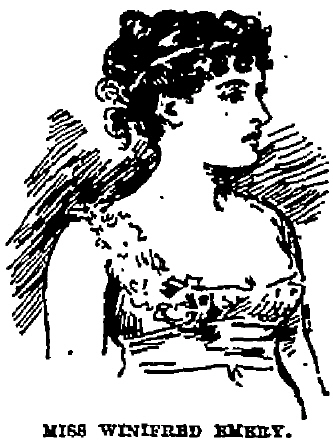
Very fortunate is Mr. Wilson Barrett, if it be the fact that he has engaged Miss Winifred Emery for the new Olympic. This attractive and talented member of Mr. Thomas Thorne’s Comedy Company at the Vaudeville has proved a most popular successor to Miss Kate Rorke. Miss Emery improves with each new part she sustains. An incomparably sweet Clarissa in the old-fashioned romance of seduction now being played o’ nights at the Vaudeville, Miss Emery may be said to have made the fortune of Mr. Robert Buchanan’s latest adaptation for the Vaudeville, “Miss Tomboy,” “conveyed” from Sir John Vanrugh’s play “The Relapse.” Given a most difficult part to play, one requiring the utmost lightness of touch and delicacy of treatment, Miss Emery may be said to have created a fresh Fanny Hoyden, a kittenish, playful, high-spirited lass, only too willing to be won by the adventurous Tom Fashion (capitally embodied by Mr. Frank Gillmore), the light-hearted foil to his elder brother, Lord Foppington (Mr. Thomas Thorne). Mr. Cyril Maude and Mr. Fred. Thorne likewise capably support Mr. Thomas Thorne as Lory and the old Squire. “Least said, soonest mended” with regard to the Vaudeville matinée of “Andromeda” and “No. 2” on Monday. ___
The Daily Gleaner (Kingston, Jamaica) (24 April, 1890) Mr. Robert Buchanan has scored another emphatic success in the production of “Miss Tomboy” an adaptation of Sir John Vanbrugh’s “Relapse or virtue in danger” at Mr. Thorne’s elegant little Theatre the Vaudeville. In his note of the play, Mr. Buchanan says “those who are familiar alike with Vanbrugh’s story as well as with Sheridan’s “Trip to Scarborough” (in all important features the same play) will understand the present dramatist’s motive in attempting to construct out of such materials what is essentially a new comedy. Beyond portions of Lord Foppington’s admirable scene in Act 1 and a stray line here and there throughout, the dialogue is original, while the characters especially that of Miss Hoyden (charmingly delineated now by Miss Winifred Emery) have been greatly altered, and in some respects, it is hoped humanized. The main plot of the Relapse with its style of mock heroic blank verse and vein of heartlessness, so characteristic of an artificial period, has been abandoned altogether while the excellent under plot full of those germs of broad humanity which afterwards reached perfection in the robust and sunny genius of Farquhar, becomes the mainspring and motif of the present play.” Vanbrugh’s comedy was produced in 1697, and Sheridan’s just 80 years later. The farcical element was discovered and utilised subsequently by Voltaire. Since his time other adaptations of the story have been played notably in 1870 when under the title of “The Man of Quality” Mr. Hollingshead produced his version at the Gaiety with the talented Nelly Farren as Miss Hoyden. It will be seen, therefore, that the story deals with an era of powder, periwig, pomposity and patches, and having undergone so many revivals, is a classical work of a very high order. It never can have enjoyed a revival under brighter circumstances than now with a most skilful playwright superintending the art and of the dialogue and the best, and with most compact of talented London companies to share in the impersonation. ___
The Theatre (1 May, 1890) “MISS TOMBOY.” Comedy in three acts, by ROBERT BUCHANAN (founded on Sir John Vanbrugh’s famous comedy, |
|
|
|
|
|
Sir John Vanbrugh’s “The Relapse, or Virtue in Danger,” is announced in a life of the author as “being the Sequel of ‘The Fool in Fashion,’” and was first played at Drury Lane in 1696 with Cibber as Lord Foppington—the Sir George Matcham of the present play was then called Coupler. An adaptation of the play was made by the actor Lee, and under the title of “The Man of Quality” was produced at Covent Garden in 1773, and in 1777 Richard Brinsley Sheridan formed on it another play entitled “A Trip to Scarborough,” which was acted in that year at Drury Lane. In 1846 “The Relapse,” was played at the Olympic with Mr. Walter Lacy as Lord Foppington, Mrs. Walter Lacy as Miss Hoyden, and Leigh Murray as Loveless. It was seen at the Strand in 1850. Mr. John Hollingshead’s version, also named “The Man of Quality,” was done at the Gaiety May 7, 1870, with Mr. Alfred Wigan as Lord Foppington, and Miss Nellie Farren as Miss Hoyden, and the late John Maclean was Sir Tunbelly Clumsy—I think Mrs. Cross was the original Hoyden. Mrs. Jordan was also great in the part, and Mrs. Abington played the character in Sheridan’s adaptation. Mr. Buchanan has done away completely with the objectionable characters, and the intrigue of Loveless and Berinthia. He says in a foot note “that the vein of heartlessness so characteristic of an artificial period has been abandoned altogether” (in this I scarce agree, witness the characters of Foppington and Tom Fashion), and has written almost entirely fresh dialogue. His very great improvement, however, is that he has transformed the vicious Miss Hoyden into a thoughtless, sunny, and impulsive “tomboy,” who romps and kisses and owns to a sweetheart or two, but is guileless all the while. Of course, with the excision of the characters of Loveless and Berinthia goes “the relapse from virtue” on the former’s part. The play now turns on the selfishness of Lord Foppington, who refuses his younger brother Tom Fashion any assistance. Tom’s valet Lory, by spying and eavesdropping, discovers that a marriage has been arranged by Sir George Matcham, a professional “coupler,” between my Lord and Miss Fanny Hoyden, a wealthy heiress of some seventeen summers. The prospective bridegroom is unknown to his intended spouse and her belongings, and so Lory suggests that his master shall steal a march on his brother, purloin the letter of introduction, and go down to Brambletree House, introduce himself as Lord Foppington, and win the bride. Fashion consents, arrives and is duly honoured by Sir Tunbelly Clumsy, Fanny’s stepfather, as the peer he expected, and quickly wins the heart of the girl. Troubles come on him suddenly, for Lory intercepts a messenger announcing the speedy coming of the real Lord, Fashion puts a bold face on it and warns Clumsy that the man who is at hand is none other than young Fashion, who is trying to pass himself off as the nobleman. So when Lord Foppington appears, Sir Tunbelly determines to “roast” him, plays on him all manner of tricks, Fanny pretends to be insane, and the poor lord fancies he has got into a lunatic asylum. He is locked up in the strong room as an impostor, but is brought out to be confronted with Sir George Matcham, who soon proves his identity. In the meantime Tom Fashion has persuaded the parson, the Rev. Mr. Quiverwit, to marry him secretly to the very willing Fanny Hoyden, Tom first confessing to her who he really is; and when his imposture is discovered, he and his new-made wife throw themselves on Sir Tunbelly’s mercy. As he finds that Lord Foppington would not consent to wed Fanny at any price (for there is a salutary doubt as to the legality of the marriage ceremony she has gone through), Sir Tunbelly forgives the young couple, and the curtain falls on a merry dance of Sir Roger de Coverley. The success of the piece was due to Miss Winifred Emery. No one, I am sure, gave her credit for the power to so naturally delineate the high spirit and mischief-loving fun of the “Tomboy,” who loves kissing, but without any arriere pensée of harm or of there being anything unmaidenly in it. Hoydenish, full of antics and frolicsome she might be, but with it all she was a lady and a pure little maiden. Miss Emery has proved herself possessed of the highest comic powers. Mr. Frank Gillmore was also very successful as Tom Fashion; his aping of the manners of his vain coxcomb of a brother was excellent, and in his own proper character he was easy and yet full of a rollicking, happy-go-lucky temperament, but one in which the sense of chivalry was not forgotten. Mr. Tom Thorne had caught the tone of the fop, whose only idea of greatness is to shine before the world of fashion, hold a levee of tradespeople whom he can bully, but whose excuses he will accept when they assure him that the garments are such as are worn by my lord this or the duke of that. Mr. Fred Thorne was good as the fox-hunting, hard-drinking country squire; Mr. Cyril Maude subtle as the valet Lory, and Mr. F. Grove did well as the sycophantic Rev. Mr. Quiverwit. I do not think that “Miss Tomboy” is the most cleverly written of Mr. Buchanan’s plays, but he was called for at the end of the piece, which will be seen at a series of matinée’s, and would have a great chance of success in the evening bill were the first act played closer and the third act strengthened—rather a difficult thing to do after the excellence of the second. ___
The Daily News (7 May, 1890 - p.6) VAUDEVILLE THEATRE. Mr. Robert Buchanan’s clever adaptation of the more farcical elements of Vanbrugh’s famous comedy of the “Relapse,” which has been given for some weeks past at matinées at the Vaudeville Theatre, under the title of “Miss Tomboy,” has proved so successful that the management have decided to place it in the evening programme in lieu of the revival of “She Stoops to Conquer” at this house, which proved less attractive. Accordingly it was given for the first time last evening at the evening performance, with Miss Winifred Emery in her delightful impersonation of Miss Fanny Hoyden, and the other members of the original cast, including Mr. Thomas Thorne as Lord Foppington, Mr. Fred Thorne as Mr. Tunbelly Clumsy, Mr. Cyril Maude as Lory, Mr. Frank Gillmore as Tom Fashion, Miss Sylvia Hodson as Mrs. Sentry, and Mr. J. S. Blythe as Sir George Matcham. The house was well filled in every part, and the performance was received with much laughter and applause. ___
The Globe (7 May, 1890 - p.6) VAUDEVILLE THEATRE. After being very successfully performed at a number of well-attended matinées, Mr. Robert Buchanan’s “Miss Tomboy” has been put into the evening bill at this theatre, where it was welcomed last night by a large and evidently well-pleased audience. The representation has, of course, gained much by repetition. It now goes with a smoothness not possible at the first performance, enjoyable as that was. The artists have had time to develop and consummate their creations. Miss Emery’s admirable Miss Hoyden has gained an added vivacity, and at the same time more finish in detail. Its brightness and charm could not well be surpassed. A similar growth in ease and finesse is notable in the ingenious Lord Foppington of Mr. Thorne, in the Tom Fashion of Mr. Gillmore, in the Sir Tunbelly of Mr. Fred Thorne, and in the Lory of Mr. Cyril Maude. Altogether, every justice is done to Mr. Buchanan’s effective treatment of a diverting theme. ___
The Stage (9 May, 1890 - p.11) Miss Tomboy, Robert Buchanan’s three-act comedy, founded on Sir John Vanbrugh’s play, The Relapse, was placed in the evening bill of the Vaudeville on Tuesday. A full account of this comedy was given in THE STAGE after its initial production at a matinee on March 20. The third act still requires strengthening, as does the first in a lesser degree. It was impossible for Miss Winifred Emery to improve on her conception or execution of the part of Miss Fanny Hoyden, and she carries the piece along on the top of the wave. Mr. Tom Thorne is still very far from what Lord Foppington should be, but now imparts to it a greater air of distinction, and is more refined. The several representations that have taken place at matinées have improved Mr. Frank Gillmore’s Tom Fashion; he is not so restless, and his rollicking humour is more subdued and natural. He certainly had the audience with him throughout the evening. Mr. Cyril Maude must also be complimented on the little additional touches with which he still further brightens the poor part of Lory. The remainder of the company are the same as have all along been seen, and all are satisfactory. From the applause and laughter with which Miss Tomboy was received on Tuesday evening, the piece appeared to be thoroughly to the liking of the audience. The Principals were called and re-called, and there seems to be every prospect of a lengthened run. ___
The Era (10 May, 1890 - p.14) THE VAUDEVILLE. As the cast of Miss Tomboy, on its transference to the evening bill at the Vaudeville Theatre on Tuesday evening, was identically the same as that upon the production of Mr Buchanan’s amusing adaptation from Vanbrugh at a matinée on March 20th last, we have only to record the substitution of Miss Tomboy for She Stoops to Conquer, and to repeat our praise of the excellent all-round acting of Mr Thomas Thorne’s company. Mr Thorne has added here and there a fresh touch to his Lord Foppington, but the performance retains the dry, almost demure, flavour, which is so characteristic of this actor’s work. Repeated performance has added ease and confidence to Mr Frank Gillmore’s spirited impersonation of Tom Fashion. Mr Fred. Thorne’s droll solidity as Sir Tunbelly Clumsy was duly appreciated by Tuesday’s audience. Mr J. S. Blythe repeated his fine old-fashioned portraiture of Sir George Matcham, and we had a welcome opportunity of seeing Miss Winifred Emery ripple joyously through her rôle of Miss Hoyden. Mr Cyril Maude’s Lory had lost nothing of its former crispness, and the representatives of the minor parts were again unimpeachable. Miss Tomboy proved very amusing, and was received with cordial approval by a good house. ___
The Illustrated Sporting and Dramatic News (10 May, 1890 - p.7) She Stoops to Conquer is soon done with at the Vaudeville, where Mr. Buchanan’s farcical adaptation of Vanbrugh’s Relapse took its place on Tuesday evening. Miss Tomboy, as Mr. Buchanan calls his play, was fully noticed on its recent morning production, and as the cast is not changed in any important particular there is little more to be said on the subject. It should be stated, however, that the performance is quite as keenly appreciated by its evening as by its afternoon audiences, that the somewhat unlikely Lord Foppington of Mr. Thomas Thorne is found highly entertaining, and that Miss Emery ‘s bright embodiment of the ingenuous rustic heroine is felt to compensate for any artistic shortcomings on the part of her supporters. But we shall not be surprised to see another revival at the Vaudeville before long. ____
The Graphic (13 September, 1890) Last week Mr. Thomas Thorne and his company received at the Hastings Gaiety Theatre, where they have been playing in a round of popular pieces from the VAUDEVILLE repertory, a noteworthy compliment. The piece on the occasion was Miss Tomboy, and among the audience present were forty of the lady cricketers engaged just then in playing a two days’ match there, who appeared in their cricketing costumes. ___
The Stage (19 September, 1890 - p.5) BRIGHTON—ROYAL (Managing Directress, Mrs. Nye Chart).—The Judge again attracted a fairly large matinee audience on Thursday week. Miss Tomboy, that admixture of Sheridan, and Robert Buchanan opened Mr. Thomas Thorne’s week on Monday. Mr. Thomas Thorne as My Lord Foppington affords considerable amusement. In the arduous rôle of Fanny Hoyden, Miss Ella Barrister acquits herself with great credit, playing the part with untiring energy and vivacity. Miss Mary Collette is an engaging little Dolly primrose, Mr. F. Thorne as Sir Tunbelly Clumsy, gives one of his well-known character sketches. Mr. Frank Gillmore as Tom Fashion, if not perfect, imparts much go to the character. His servant, Lory, received capital treatment in Mr. J. Wheatman’s hands. Mr. F. Grove, as The Rev. Mr. Quiverwit, makes a decided success. A capital delineation of Lavarole is that given by Mr. O. Yorke. Mrs. Sentry is cleverly played by Miss Sylvia Hodson; Sir George Matcham, finds a very capable representative in Mr. J. S. Blythe. The remaining parts are in good hands. ___
The Derby Daily Telegraph (9 October, 1890 - p.3) DERBY GRAND THEATRE. “MISS TOMBOY.” Amid a constant ripple of laughter “Miss Tomboy” made her bow to a Derby audience last night. She is a comely, vivacious maiden, and her high spirits are curiously contagious. The uninitiated peruser of the programme might suppose that prolific playwright, Robert Buchanan, to be responsible for her existence. Scarcely so. Mr. Buchanan’s legitimate progeny are a numerous and sprightly lot, but he cannot fairly lay claim to be the parent of “Miss Tomboy.” To be candid, the hoydenish damsel would be somewhat puzzled to answer a cynical interrogator as to her pedigree. Sir John Vanbrugh, could he be called to give evidence, should know something about her origin; although, it is to be feared, his Fanny Hoyden was a giggling, brazen thing, full of horse-play, and replete with coarse jests. The brilliant Richard Brinsley Sheridan, too, might, if the opportunity were given him, set up a claim to parental authority, since he undertook to reform (after a fashion) the wayward hussy whose pranks had pleased a former generation. But, notwithstanding the recognised rights of these dead-and-gone giants, Mr. Buchanan is entitled to be heard, if not as parent, at least as judicious guardian. He has transformed Miss Tomboy into a really engaging young thing; and, moreover, has purified the atmosphere in which she moves and has her being. There is nothing repulsive about her now. The discriminating Mrs. Grundy may decline to accept her as a gushing child of nature, but she is no longer shocked—on the contrary, she is amused—by her boisterous fun and daring practical jokes. The story of “Miss Tomboy” need not be narrated at length, because, to tell the truth, it has been borrowed, wholly or in part, by numerous modern dramatists. The rich, supercilious elder brother, anticipated and “sold” by his impecunious junior in the race for a rich bride, has been the theme of many a recent stage story. Of course a great deal of the dialogue of “Miss Tomboy” is Mr. Buchanan’s; and it is everlastingly to his credit that in presenting a version of Vanbrugh’s “Relapse,” and Sheridan’s “Trip to Scarborough,” he has turned his back alike upon equivocal situations and suggestive dialogue, and given us a hearty bustling picture of old English life and manners. ___
The Morning Post (27 May, 1891- p.4) VAUDEVILLE THEATRE. Mr. Robert Buchanan’s play, “Miss Tomboy,” founded upon Vanbrugh’s “Relapse,” was performed yesterday afternoon, Miss Ella Bannister undertaking the character of Fanny Hoyden, originally played by Miss Winifred Emery. Miss Bannister, although taking a somewhat more farcical view of the part than Miss Emery, was decidedly successful, and displayed abilities deserving to be warmly commended. In the scene of Fanny Hoyden’s pretended madness Miss Bannister acted uncommonly well, and the girlish enthusiasm of the maiden who looks upon marriage as a merry jest was assumed in a diverting manner. Mr. Thomas Thorne always played Lord Toffington well, and he has improved in his rendering of that character, making it very amusing while keeping within the limits of legitimate comedy. Mr. H. B. Conway was an excellent representative of Tom Fashion, playing the young gallant who robs his brother of a bride with great effect; Mr. Fred Thorne, as the stolid Sir Tunbelly, had a part that suited him well, and the minor characters were fairly well sustained by Miss Annie Hill, Miss C. Owen, Mr. Wheatman, and others. “Miss Tomboy” was well received by the audience, justice being done to a comedy which is sprightly and full of character. ___
The Stage (28 May, 1891 - p.12) THE VAUDEVILLE. On Tuesday morning, May 26, was revived here Robert Buchanan’s three-act comedy Miss Tomboy, founded on Sir John Vanbrugh’s play The Relapse. Mr. Buchanan’s modernisation of a famous eighteenth-century drama was, it will be remembered, originally produced at a Vaudeville matinée on March 20, 1890, and was, after a while, placed in the evening bill on May 6, running thenceforward throughout the summer. Thinking, no doubt, that the drawing powers of Miss Tomboy are not exhausted, Mr. Thomas Thorne has conceived the idea of including this amusing piece among his present series of revivals, and the abundant mirth of the audience on Tuesday proved that the manager had not reckoned without his host. Mr. Thorne and his brother resume their old rôles, and several other parts are assigned to their former representatives, but the two very important characters of Tom Fashion and Fanny Hoyden are now played by Mr. H. B. Conway and Miss Ella Bannister, in lieu of Mr. Frank Gillmore and Miss Winifred Emery. Tom Fashion is a part after Mr. Conway’s own heart. Mr. Conway once more appears as a gay, dashing, irresistible stage lover, and plays with all his wonted spirit and entrain. He was not perfectly at home with his words on Tuesday, but his Tom Fashion was such as no Fanny Hoyden in the world could very long withstand; while his imitation of the appearance, gait, bearing, and mannerisms of the real Lord Foppington was so close as to give vraisemblance to the piece of imposture that is practised upon Sir Tunbelly Clumsy. “Comparisons are odorous,” they say, and, with the triumph of Miss Emery as Fanny still fresh in the memory, it would be unfair to place in too close juxtaposition her impersonation of Miss Tomboy and Miss Ella Bannister’s. Miss Bannister’s Fanny is a delightful example of pure comedy acting, brimming over with mirth and high spirits, full of la joie de vivre. She dances and skips about the hall of Brambletree House with kittenish agility, and the loose blue frock and flaxen hair are just suited to the character. We are not sure whether in her “coming- on disposition” Miss Bannister was not a trifle too much like a nineteenth century school miss, more especially when Miss Fanny blurts out “Yes, please,” to Tom, on his asking whether she wants to be married. However, this is but a small point. In the mad scene with Lord Foppington Fanny behaves just like an elf, as she is often called, and wears in her hair a couple of long, red feathers that inconveniently get into the peer’s face when he is disposed to be amorous. Mr. Thomas Thorne’s Lord Foppington remains much about what it was—an amusing but slightly heavy impersonation. His best scenes are the toilet episode in act one, and the close of the second act, where the unfortunate old beau is hauled off amidst a veritable pandemonium of howling rustics. Both this “curtain” and the Sir Roger de Coverley that brings the play to an end are stage-managed with skill. Mr. Fred Thorne repeats his performance of the drunken, gross, but nevertheless shrewd, country knight; Mr. Oswald Yorke again gives a clever bit of character acting as the French valet, Lavarole; and Mr. F. Grove makes a very great deal out of the part of the parson. Mr. Ramsey and Mr. Terric are capitally made up, and act well as Sir Tunbelly’s servants; Mr. J. Wheatman and Miss C. Owen are satisfactory enough as Sir George Matcham and Mrs. Sentry; Miss Annie Hill is a comely and attractive Polly Primrose, and the small part of Nancy is prettily played by Miss Hilda Hanbury. Mr. Lawrence D’Orsay succeeds Mr. Cyril Maude as Lory, Tom fashion’s ready-witted manservant, and on the whole gives a clever and well-studied impersonation, though he begins rather stiffly. The dresses and scenery are quite up to the mark. Miss Tomboy should certainly appear again upon the Vaudeville stage. ___
The Times (28 May, 1891 - p.14) Mr. Thorne revived on Tuesday at the Vaudeville Mr. Robert Buchanan’s adaptation of Vanburgh, known as Miss Tomboy. In the title character Miss Ella Bannister succeeds Miss Winifred Emery, and gives a spirited embodiment of the hoyden, though she is not, perhaps, quite so spontaneous in her frolics as might be desired. Mr. Conway is also new to the cast, appearing as Tam Fashion. ___
The Era (16 May, 1896 - p.8) VICTORIA HOME MATINEE. There was a large and fashionable audience present at the matinée given at the Haymarket Theatre on Tuesday, in aid of the Victoria Home for Invalid Children, Margate; and the proceeds of the performance amounted to the handsome sum of £340. . . . The performance concluded with the second act of the comedy, by Robert Buchanan, entitled “MISS TOMBOY.” Lord Foppington ... Mr CYRIL MAUDE Miss Winifred Emery and Mr Cyril Maude were again seen in the characters which they played when the piece was produced at the Vaudeville Theatre in March, 1890. Miss Emery enacted the skittish country lass to the life, and Mr Maude made the most of his opportunities as the foppish lord, who is so disconcerted by his strange reception at Bramble Tree Hall. Mr Frank Gillmore was quite successful in his rendering of the part of Tom Fashion. Mr William Wyes portrayed Sir Tunbelly Clumsy with much humour; Mr Quiverwit had a capital exponent in Mr Fred Grove; the French servant Lavarole was neatly impersonated by Mr Cosmo Stuart; and Mr Howard Sturge did very well as Lory. The grinning country bumpkins Jabez and Jacob were ably represented by Mr Blakiston and Mr Anning. The part of Mrs Sentry was quite safe in the hands of Mrs E. H. Brooke; Miss Hilda Hanbury was a good-looking Nanny Ditch; and Miss Mary Collette was brisk and bright as Dolly. _____
Next: The Bride of Love (1890) Back to the Bibliography or the Plays
|
|
|
|
|
|
|