|
|
 |
|
|
ROBERT WILLIAMS BUCHANAN (1841 - 1901)
|
|
|
|
THEATRE REVIEWS
27. Theodora (1889)
Theodora
by Robert Buchanan (adapted from the play, Théodora by Victorien Sardou).
Brighton: Theatre Royal. 18 November, 1889. Followed by provincial tour.
London: Princess’s Theatre. 5 May to 21 June, 1890. Followed by provincial tour.
London: New Olympic Theatre. 1 August to 8 September, 1891.
A letter from Buchanan to The Pall Mall Gazette sheds some light on his method of adapting Sardou’s original.
|
|
|
|
|
|
|
|
|
|
 |
|
|
|
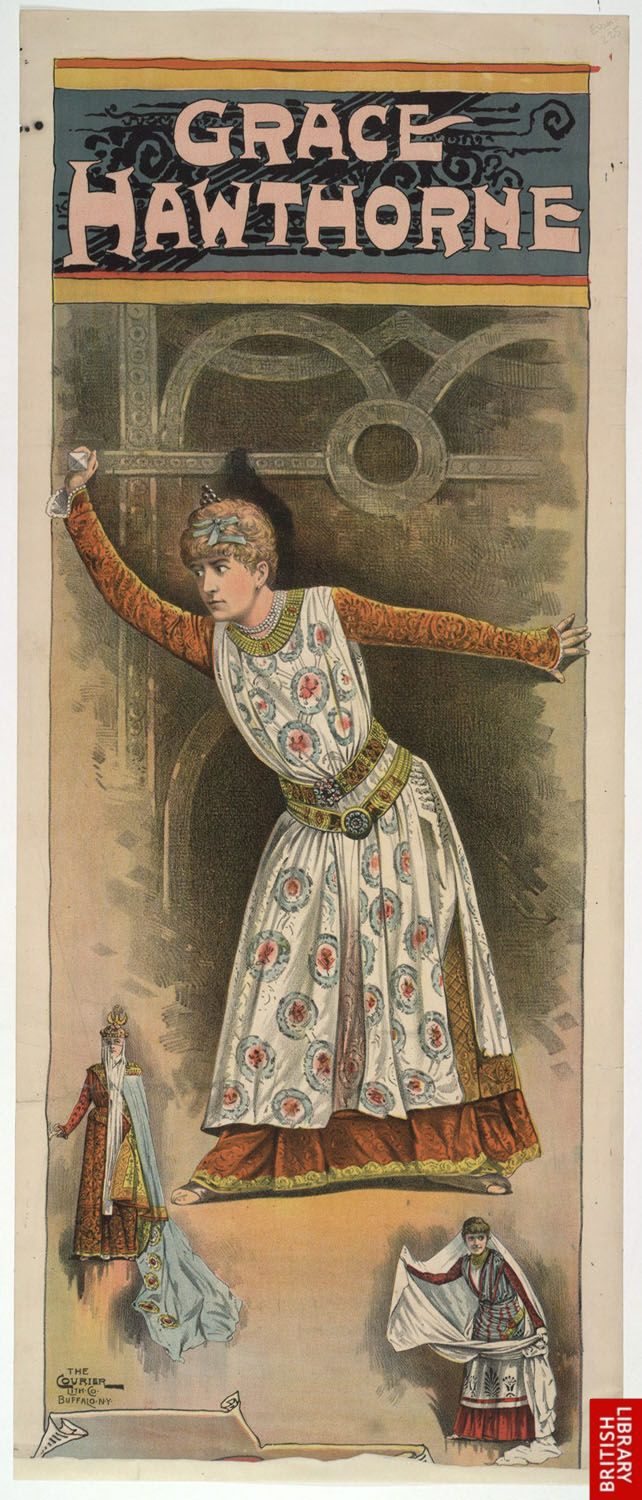
[Poster of Grace Hawthorne in Theodora.]
The Penny Illustrated Paper (29 January, 1887 - p.65)
I congratulate the clever and charming niece of Nathaniel Hawthorne—Miss Grace Hawthorne—upon her pluck and enterprise. This accomplished young American actress (who has proved successful in management where Mrs. Conover failed: at the Olympic) has taken a lease of the Princess’s from Mrs. Gooch on the same terms and conditions as the Wilson Barrett lease, which expires on May 17. “The Noble Vagabond” is running under a sub-lease. Miss Grace Hawthorne’s first production at the Princess’s will be a magnificently mounted English version of Sarah Bernhardt’s great drama of “Théodora,” the rights of which Miss Hawthorne has secured from M. Sardou. I apprehend, however, that after the Summer run of “Théodora,” Mr. Wilson Barrett will on his return from the States resume his lesseeship, inasmuch as he has arranged with Mr. G. R. Sims to provide him with a new drama at the Princess’s in the early autumn.
|
|
|
 |
|
|
|
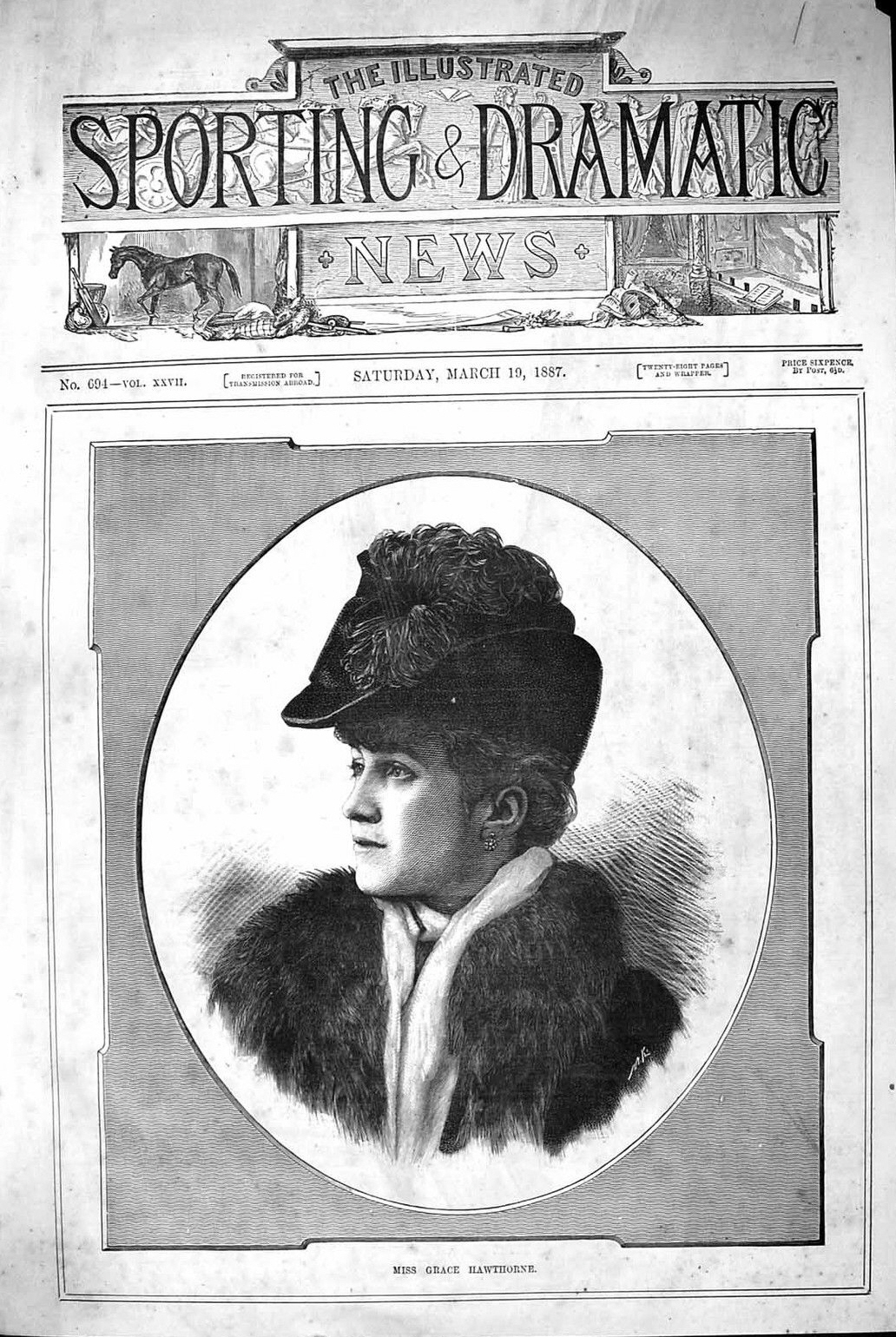
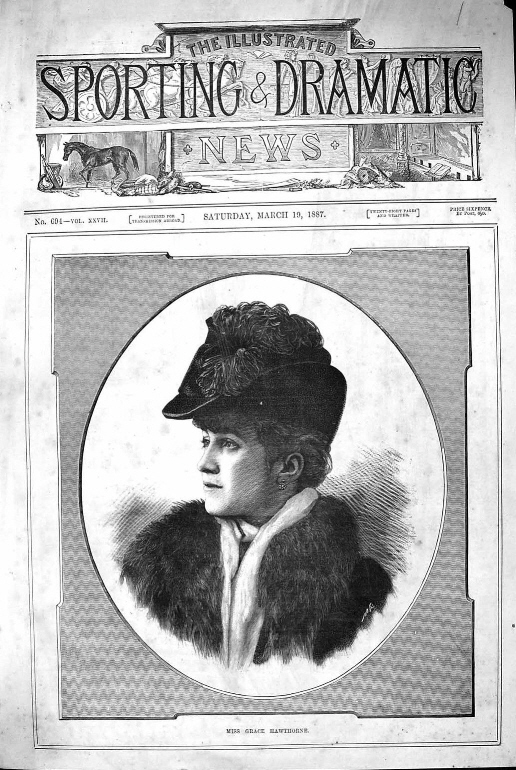
[Grace Hawthorne on the cover of The Illustrated Sporting & Dramatic News (19 March, 1887).
Click the picture for a larger version.]
The Referee (20 March, 1887 - p.3)
A statement made by a contemporary this (Saturday) morning that Mr. Clement Scott is “trying to arrange with Miss Grace Hawthorne to adapt for her a well-known French play, but that a difficulty had arisen in consequence of his terms being unusually high,” has brought me two letters and one visitor to-night. Mr. Clement Scott writes requesting me to say that the statement is “absolutely, unequivocally, and inexcusably false.” Mr. Samuel French, who is Mr. Scott’s business representative, writes that he has had no communication with Miss Hawthorne on the subject; and Miss Hawthorne herself has called at this office to say that there is no foundation whatever for the statement seeing that Mr. Scott has never even mentioned such a matter to her, nor she to him.
___
Boston Evening Transcript (22 April, 1887 - p.6)
GRACE HAWTHORNE.
_____
If the world were really as dark as it looks to us in our darker days, life would indeed be not worth living, and we could only pray to pass through the night in the hope of awaking somewhere to the light of a better morning.
I wonder if to the latest manifestation of American genius, with whom the inhabitants of staid London appear to be captivated, there ever returns the remembrance of a passage through the sombre shades of Ethiopia? In this case, however, that name stands not for a continental division, but for the saloon of a transatlantic steamer.
It was the twenty-second day of August, 1886, the second day out from New York for Glasgow. No long-continued bad weather can be expected at such season, yet the sea may be terrible for a few hours, when a West Indian cyclone is expending its death agony in our Northern latitudes. Born from Caribbean and Mexican parents, cradled in the warm bed of the Gulf Stream, the life of these storms is short and fierce, and the farther north they are encountered the more expanded, and therefore the less, their power.
But I have known bad weather in many seas, and it blew hard that day from two until ten after meridian. Probably the captain was of the same opinion, for the heavy tarpaulins were battened over the skylights, adding to the general gloom. A comfortable-looking Irish woman was saying her prayers on one of the seats, dressed as for a promenade, thinking, doubtless, that we might be called to leave for some indefinite locality without much warning. I addressed a few words of consolation to her, for which I received the customary national benedictions, and then, with rather more hesitation, comforted at my best a younger lady who had scarce moved from one position since she came on board.
She was not seasick then nor during the whole passage, but she was a glad and merry soul, banished from the light of the West into the thunder and darkness of the infernal regions. And none but strangers were near her. The sense of loneliness was more poignant because the express steamship City of Rome was just ahead of us, bearing toward England those near and dear to her heart.
An actress without her baggage is like a ship without her rigging. From successful experiences in the far West, Miss Hawthorne arrived in New York just in time to take a certain steamer, but her baggage train was delayed. So, as it was important that she should be represented in London at a given time, the others had gone without her and she followed alone on the Ethiopia.
How successful that move on the English capital has been no one can realize unless after reading the comments of the metropolitan journals. While a much-heralded lady, patronized by royalty, displaying her aristocratic self before the footlights has scarcely held the boards, this Western girl has won a triumph which is fairly unprecedented in the history of the stage.
She now controls for Great Britain Sardou’s “Theodora,” is exclusive lessee of the Royal Princess’s Theatre (Oxford street) and the Olympic Theatre (Strand), besides having purchased some half-dozen new plays from standard authors. Nor has she neglected those rôles in which her impersonations could be compared with other actresses of her own school.
When the London Times contrasts her with Mme. Bernhardt by saying that her representation of Dumas’s heroine was touching and true, and that her acting in this piece was more winning and sympathetic throughout than that of the great French artist, it is fair to conclude that it means something. To the Daily Chronicle she made the less agreeable elements of this play temporarily forgotten, reminding the critic forcibly of Modjeska. The Saturday Review, Post and Telegraph, as well as the leading dramatic journals of the day, are unanimous in the expression of similar sentiments. To quote their criticisms would simply be to transcribe from some dozen or fifteen newspapers as many favorable criticisms.
Now, whenever there is apparent an unequivocal and marked success, most persons regard it as simple good luck, causeless or from unexplained origin, and there they let the question rest.
With the reservation that there is a Divine and over-ruling power, I do not believe anything ever happens to a person in this world other than as the consequence of their own action. Napoleon III. stepped into an imperial chair, and filled it well for twenty years, but his apprenticeship was six years’ solitary study with that one object before him in the fortress of Ham. I think it was one hundred and eighty-three leading rôles which Grace Hawthorne told me she had studied and learned in less than one year.
But it is not alone study which gives the element of success to one who would touch the popular heart.
Miss Hawthorne knows that heart from experience and keen observation in those parts of our country where Nature allows it to beat unrestrained by art. Through many a Western State, in many a little mining town, she has been a dream of beauty and a vision of the miraculous to audiences for whom she was an idol. And knowledge of the hidden springs which move the soul is acquired, not in vapid New York drawing-rooms or aimless Washington society, but by contact with natures which love and hate, enjoy and suffer, showing those emotions on the surface as they are felt.
Such has been one of Miss Hawthorne’s schools, but it has not been the only one. She is not a stage-struck girl, with powerful friends or skilful managers. No. She is a hard-working actress, who has passed through the ranks of the stock company, playing inferior parts in the Eastern States, always a student, always hard at work. Of these experiences her present position is but the natural result. It is no miracle—it is a consequence. Others might have had a like opportunity and failed for want of a similar training.
In person, Miss Hawthorne is winning, sympathetic and without the least affectation. A slight, rather fragile form, clear complexion, naturally blonde hair, and a blue eye whose twinkle lasts but a moment ere the whole face beams with a merry smile. She was a most delightful addition to any circle, and although she studied her French books persistently all through the voyage, she was voted, without a dissenting voice, a most agreeable member of our company, and I know they all rejoice in her prosperity.
JULIUS A. PALMER, JR.
No. 97 State street, Boston, April 12, 1887.
___
The (Carnarvon and Denbigh) Herald (14 October, 1887 - p.7)
(Reprinted from The Illustrated Sporting & Dramatic News (17 September, 1887 - p.26)
[Note: WARNING. Contains product placement.]
AN AMERICAN GIRL.
HER EMOTIONAL TROUBLES AND HER FINAL TRIUMPHS.
HOW SHE OVERCAME NATURE’S OBSTACLES.
GRACE HAWTHORNE is a woman that would attract attention in any assemblage, not alone by reason of her personal attractiveness, but because of that bright, intelligent look and determined eye with which she is gifted.
Early in the spring the British public were startled by the announcement that Grace Hawthorne had leased the Princess’s Theatre for a long term of years, and that Mr. Wilson Barrett would no longer control the destinies of that most popular of London theatres. At first the announcement was not believed, but when it was supplemented by a statement that Miss Hawthorne was an American girl who had a few years ago adopted the stage as a profession, and who had ample capital to see her through with any engagements she might make, the general public at once accepted all statements, and prepared to watch the managerial career in London of the plucky American girl.
The first move of Miss Hawthorne on assuming the reins was to arrange for a summer season at the Princess’s by the production of a melodrama by L. R. Shewel and Joseph Jefferson (“Rip Van Winkle”). The success of this venture is as great as was that of Mr. Barrett in producing the “Lights of London,” and it will no doubt hold the boards until the regular season begins, when Miss Hawthorne will appear in the title rôle of Sardou’s wonderful emotional spectacular drama, “Theodora,” already made familiar by Bernhardt.
Miss Hawthorne has by her performances become as familiar to the London theatre-goers as she has been for some years past to the patrons of the drama in the States, and with an idea of learning more of her history in the past a reporter called on her at her cosy offices in the Princess’s Theatre the other day. He found the lady actually in tears, reading a letter from “home” congratulating her on her English successes, while the table before which she sat was piled up with business letters that had been cast aside for the one from “home.” As the reporter entered, Miss Hawthorne brushed away her tears, and, with a friendly nod and catching smile, welcomed the visitor with the real Yankee “How’de do. Take a seat.”
A glance at Miss Hawthorne is sufficient to enable a keen observer to see wherein lies her power as an actress. Emotion is written in every lineament and nervous force in every feature. Nature and art have combined to make the lady a true Queen of the Stage, and after her American triumphs her decision to come to England was natural, but was viewed with distrust by her most intimate friends and ardent admirers. Her success has justified the step, and now nothing but congratulations and favours are showered on her.
“Miss Hawthorne,” asked the reporter, “will you give the public some idea of your professional careers.”
“With pleasure. Well, to start, you must know that it is only of my life on the stage that I will speak, and regarding that there is not much of interest to the public. As a girl I felt a strong desire to be an actress, and as soon as circumstances would permit I went on the stage. It soon became evident that whatever power as an actress I possessed was of an emotional kind, and I have made a speciality of such rôles as Heron, Bernhardt, and Clara Morris have played.”
“Is not such acting very trying to your nervous system?”
“Oh, yes. You can hardly imagine how hard it is to constantly be playing what are known as the ‘weeping women’ of the stage. Why, I have played ‘Heartsease’ (Camille) in America for two years, occasionally alternating it with ‘The Lady of Lyons,’ ‘Miss Multon,’ ‘The New Magdalen,’ and other like characters, and my health was almost entirely destroyed, and now I am preparing for the production in the fall at the Princess’s of Sardou’s ‘Theodora,’ which will be the most trying rôle I have ever undertaken, for you know that Bernhardt is not able to stand playing it more than two successive nights, and yet I expect to play it for the entire winter.”
“With your past experience, do you think you will be able to stand such a strain?”
“Certainly. I don’t look strong, but I work my power now. Few people can understand the strain a conscientious actress undergoes in essaying an emotional part. It is necessary to put one’s whole soul into the work in order to rightly portray the character. This necessitates an utter abandonment of one’s personality, and an assumption of the character portrayed. It is necessary to feel the same emotions the part is supposed to feel. In ‘Heartsease’ and similar rôles I actually cry at certain passages. Audiences call it art. It may be, but they are none the less real tears, and the effect is just as wearing on the health.
“You must be aware that by their very natures women are subject to troubles and afflictions unknown to the sterner sex. The name of these troubles is legion, and in whatever form they come they interfere with every hope and ambition of life, and it makes me sad to think of the untold numbers of women that are thus suffering agonies of which their relatives and friends know nothing. I speak from a bitter experience, but I am thankful I know the means of restoration, and how to remain in perfect health, notwithstanding the nervous strain I have to nightly endure while playing.”
“Please explain more fully.”
“Well, I have found a remedy which seems specially adapted for this very purpose. It is pure and palatable, and controls health and life as nothing else will. If all suffering women were made familiar with its merits, many more well women would be met with in a short time.”
“What is this wonderful remedy?”
“Warner’s Safe Cure.”
“And you use it?”
“All the time.”
“And hence believe you will be able to stand the strain of an entire season with ‘Theodora’?”
“I am quite certain of it.”
In reply to other questions Miss Hawthorne stated that she had commenced her career as an actress in a very humble capacity in Chicago, and had been brought up in a fine school of art where merit only told. She had supported some of the leading actors of America appearing in almost the entire range of what are called legitimate rôles. About five years ago she became an emotional star, and under the intelligent and energetic management of Mr. W. W. Kelly, she had met with the most gratifying success and had established herself in America. When she came to England it was only with the intention of making a short stay, but she had been so well received that the stay had been lengthened, her interests had grown so, and having taken a long lease of the Princess’s it looked now as though she would soon become a thorough Englishwoman.—Illustrated Sporting and Dramatic News. Sept. 17th.
___
The Era (9 November, 1889 - p.10)
MISS GRACE HAWTHORNE is at last rehearsing Sardou’s Theodora, with which she opens her provincial tour at Brighton, Nov. 18th. She has been for the past month studying the great rôle in Paris, under the immediate instruction of the author, M. Victorien Sardou. The English adaptation of this play is by Mr Robert Buchanan, and the entire production is to be staged under the personal direction of Mr W. H. Vernon. The dresses, jewels, armour, &c., have been manufactured by M. Duquesnel, the director of the Porte St. Martin Theatre in Paris, and are said to be very elaborate and expensive.
___
The Stage (15 November, 1889 - p.9)
Miss Grace Hawthorne commences a four weeks’ tour with Theodora, adapted by Robert Buchanan, on Monday next at the Royal, Brighton. I am informed by the management that much money and labour have been spent over the piece, Miss Hawthorne’s dresses alone being valued at £1,500. Mr. Fuller Mellish will play the principal male character. Miss Hawthorne tells me she has been in Paris for the past month studying her character under the immediate instruction of the author of the play, Sardou. Mr. W. H. Vernon will be responsible for the stage management. The cast is long, so more about the others in the piece next week.
___
The Stage (22 November, 1889 - p.10)
“THEODORA.”
On Monday, November 18, 1889, at the Royal, Brighton, was produced an adaptation, in five acts, by Robert Buchanan, of Victorien Sardou’s play, entitled:—
Théodora.
Justinian ... ... ... Mr. Arthur Lyle
Belisarius ... ... ... Mr. Cecil Morton Yorke
Euphratas ... ... ... Mr. T. P. Haynes
Marcellus ... ... ... Mr. Thalberg
Caribert ... ... ... Mr. Charles Macdona
Andreas ... ... ... Mr. Fuller Mellish
Michael ... ... ... Miss Rosie Lewis
Timocles ... ... ... Mr. Harcourt Beatty
Agathon ... ... ... Mr. Geo. W. Cockburn
Taber ... ... ... Mr. Thos. Blacklock
Styrax ... ... ... Mr. Henry Gray Dalby
Executioner ... ... ... Mr. Charles Forsey
Mundus ... ... ... Mr. John Drummond
Priscus ... ... ... Mr. Henry Ludlow
Orytties ... ... ... Mr. James Ferguson
Amron ... ... ... Mr. George Luke Grange
Calchas ... ... ... Mr. Valentine Ostlere
1st Lord ... ... ... Mr. Harris Lawrence
2nd Lord ... ... ... Mr. Charles Anson
3rd Lord ... ... ... Mr. Frank Pierson
4th Lord ... ... ... Mr. William Bruce
Chief of the Ostiaries ... Mr. Gerald Harley
Antonina ... ... ... Miss Clarice Trevor
Tamyris ... ... ... Miss Dolores Drummond
Macedonia ... ... ... Miss Annie Lloyd
Callerhoe ... ... ... Miss Katie Rayne
Iphis ... ... ... Miss Marie Stuart
Ixia ... ... ... Miss Dora De Wynton
Columba ... ... ... Miss Alice De Wynton
Zena ... ... ... Miss Walner
Theodora ... ... ... Miss Grace Hawthorne
Mr. Buchanan remarked at the close of the performance on Monday, that he had merely “adapted Sardou’s great play to the English stage.” He need not, however, have been so modest. The adaptation is exceedingly clever indeed; the adaptor of Tom Jones and Joseph’s Sweetheart is to be congratulated on having scored another success out of quite as difficult materials. In its present form Théodora is a drama ingeniously constructed of strong dramatic interest and considerable literary merit. Théodora cannot be said to be an elevating subject for stage treatment, but Mr. Buchanan has divested her of much that would be odious, and has given us instead a woman, if a bad one, tender and passionate in love, bitter in hate, sensual to an extent, and greatly diplomatic. Such is his Théodora. Another strongly-drawn character is the young Greek, Andreas, full of patriotic fire and athirst for vengeance. On the shoulders of these two falls the burden of the play, which in its present form may be briefly described as follows:—The scene opens in a reception room in the palace of Justinian, where his consort Théodora, holds audience. She dismisses her court, converses with Antonina, her friend, who acknowledges to the Empress that she has gained her love by the use of magic philtres, concerning which old Tamyris knows the secret. Théodora, longing to be back in her old haunts, visits Tamyris at the hippodrome, and obtains from her a promise to supply her (Théodora) with the magic philtres which shall revive her husband’s love for her. The house of Andreas is the next scene, where a conspiracy is ripe for dethroning the Emperor. It is here that Andreas tells them of a woman he has saved from death during an earthquake—a woman whom he loves, and who visits him nightly, one Myrta by name. To her he partly discloses the plans of the conspirators. Myrta (or Théodora, for such she is) rushes off. The next scene is the palace. The Empress warns the Emperor of his danger, and all preparations are made for the arrest of the conspirators. Marcellus enters, is immediately seized; he shouts to Andreas to fly. Théodora, hearing Andreas coming, rushes to the door, tells Antonina to shout that Marcellus is dead, and stops anyone from leaving the chamber; thus Andreas escapes. Marcellus is dragged forth, and is about to undergo the torture when Théodora interferes. Marcellus begs her to stab him, which she, fearful lest he should betray her lover, in a fit of frenzy, does. The fourth act shows us their majesties at the hippodrome, where Andreas openly insults Théodora; he is arrested and thrown down at her feet. Again the Empress saves him, only, however, to be reviled by him. She, determined to regain his love, administers the magic philtres to him, not knowing that Tamyris, thinking they were to be given to the Emperor, had poisoned them. Thus Théodora kills her old lover. The Emperor, now fully conscious of his Consort’s guilt, accuses her of her faithlessness, which she acknowledges, and the executioner is about to despatch her when she drains the poisoned philtres and falls dead over Andreas’ body.
The piece is admirably mounted, the scenery being described as that used at the original production at the Porte St. Martin Theatre, whilst the dressing is rich in the extreme. Of the acting, Miss Grace Hawthorne’s Théodora is at all points carefully studied, and generally artistic, although wanting in power and tragic depth. It is undoubtedly her best effort up to the present time. Mr. Fuller Mellish makes a decided hit as the young Greek, Andreas; on Monday he carried several scenes shoulder high to success. Miss Dolores Drummond is a characteristic Tamyris, and Antonina is pleasingly portrayed by Miss Clarice Trevor. Mr. Thalberg will doubtless make more of his Marcellus. Mr. T. P. Haynes as Euphratas evidently has not quite caught the spirit of the part. Mr. Arthur Lyle has a fine stage presence, and when he gets settled down into the rôle of the Emperor he will no doubt make a sound impersonation of it. Belisarius, in Mr. Cecil Morton Yorke’s hands, receives good treatment, whilst a line of praise must be accorded Mr. Harcourt Beatty as Timocles, Mr. G. W. Cockburn as Agathon, and Mr. Charles Macdona as Caribert, for making small parts, stand out well and firmly. The remaining characters are in safe hands. It should be mentioned that the second act was so vigorously played by the conspirators on Monday that it drew forth the most hearty applause of the evening.
___
The Era (23 November, 1889)
“THEODORA” AT BRIGHTON.
_____
Adapted from M. Victorien Sardou’s Masterpiece,
by Mr Robert Buchanan, produced for the First Time in
English at the Brighton Theatre, on Monday, Nov. 18th, 1889.
Justinian ... ... ... Mr ARTHUR STYE
Belisarius ... ... ... Mr CECIL MORTON YORKE
Euphratas ... ... ... Mr T. P. HAYNES
Marcellus ... ... ... Mr THALBERG
Caribert ... ... ... Mr CHARLES MACDONA
Andreas ... ... ... Mr FULLER MELLISH
Michael ... ... ... Miss ROSIE LEWIS
Timocles ... ... ... Mr HARCOURT BEATTY
Agathon ... ... ... Mr GEO. W. COCKBURN
Taber ... ... ... Mr THOS. BLACKLOCK
Styrax ... ... ... Mr HENRY GRAY DOLBY
The Executioner ... Mr CHARLES FORSEY
Mundus ... ... ... Mr JOHN DRUMMOND
Priscus ... ... ... Mr HENRY LUDLOW
Orythes ... ... ... Mr JAMES FERGUSON
Amron ... ... ... Mr GEO. LAKE GRANGE
Calchas ... ... ... Mr VALENTINE OSTLERE
First Lord ... ... ... Mr HARRIS LAWRENCE
Second Lord ... ... Mr CHARLES ANSON
Third Lord ... ... ... Mr FRANK PIERSON
Fourth Lord ... ... Mr WILLIAM BRUCE
Chief of the Ostiaires ... Mr GERALD HARLEY
Antonina ... ... ... Miss CLARICE TREVOR
Tamyris ... ... ... Miss DOLORES DRUMMOND
Macedonia ... ... ... Miss ANNIE LLOYD
Callerhoe ... ... ... Miss KATIE RAYNE
Iphis ... ... ... Miss MARIE STUART
Ixia ... ... ... Miss DORA DE WYNTON
Columba ... ... ... Miss ALICE DE WYNTON
Zena ... ... ... Miss WALNER
Theodora ... ... ... Miss GRACE HAWTHORNE
(FROM OUR OWN CORRESPONDENT.)
A large audience in the Brighton Theatre on Monday evening gave an enthusiastic reception to Mr Robert Buchanan’s version of Théodora, as represented by Miss Grace Hawthorne and her company. The work was splendidly staged; the scenery may justly be termed magnificent; while the costumes have never, in richness and elaborate workmanship, been excelled on the Brighton stage. Mr Robert Buchanan has displayed his best powers in his adaptation. The story, which has been rendered familiar by the inimitable representations in French by Madame Sarah Bernhardt and company, is worked out in five acts, the last and third of which comprise two tableaux. In the opening tableau, the passionate and unscrupulous Théodora, formerly a circus performer, and now wife of the Emperor Justinian, holds a reception in the palace. Here, in the midst of barbaric splendour, and surrounded by all the attributes of power and wealth, it is at once evident that she is an autocrat. In strong and effective contrast comes the second tableau—the Home of the Gladiators—where Théodora, visiting the witch, Tamyris, renews her acquaintance with her former Bohemian friends. The main purpose of her visit is, however, to secure from Tamyris a potion that shall enable her to strengthen the love of Justinian for her. Still greater is the dramatic interest in the second act, where, in the house of Andreas, a young Greek, it is seen that a plot is being concocted for the dethronement of the Emperor and the destruction of his hated consort. Andreas reveals to his co-conspirators his intense love for one Myrta, whom he regards as a young widow, and one—she is no less than Théodora—whom he has saved from the perils of an earthquake. Théodora visits him, and the two lovers plight their troth, only, however, to be disturbed by a ribald song, sung by passing conspirators, having for its theme the execration of the Empress herself. In the third act, at the Emperor’s palace, Andreas and his friend Marcellus, an officer of the bodyguard, enter the royal chamber, hoping to seize the monarch. Théodora had, however, taken measures to surprise the conspirators. Marcellus is overpowered, but Andreas, whose voice is recognised by Théodora, is enabled to escape. Justinian, determined to learn, by torture, the name of Marcellus’s accomplice, is frustrated by Théodora, who, undertaking to privately interview the captured conspirator, stabs him, at his own request, to the heart with the stiletto she wears in her hair. Andreas learns from the stiletto the identity of the Empress with the murderess of his friend; and when Théodora, whom he still regards as Myrta, visits him in the gardens of Styrax, she learns that her lover has determined to avenge Marcellus’s death. The Empress induces him to promise he will not leave his house till she again calls upon him; but, learning from his associates that Myrta and the Empress are one and the same person, he resolves to visit the Hippodrome. There, in the fourth act, the accusations of his co-conspirators are verified, and Andreas proclaims the Empress, who raises her veil before the assembled thousands, as an adulteress. He is seized and is about to be executed when Théodora contrives his escape. In the last act, at the palace, Tamyris gives Théodora the promised potion. The witch, sharing the hatred of the mob for the Emperor, has poisoned the potion. Andreas is immediately afterwards brought wounded into Théodora’s presence. Her old love for the young Greek manifests itself, but Andreas repels her advances. Believing the potion will restore his affection to her, she administers it to him and, while she is horrified to find she has killed him, Justinian arrives. The Emperor, who has discovered the unfaithfulness of his wife, orders her strangulation, when Théodora also partakes of the potion and falls dead upon the body of Andreas. The piece, for a first night’s performance, ran with smoothness, and there was a manifest improvement on the second night.
Miss Grace Hawthorne gave us some fairly good acting as Théodora. Vigorous and impassioned fervour were at times wanting, but, in the lighter portions of her trying impersonations, she achieved a moderate success. In the second tableau of the first act, when visiting Tamyris at the home of the gladiators she showed vivacity fully in harmony with the Bohemian surroundings. She was perhaps seen at her best in the second act, when, in her love passages with Andreas, she unfolded her wealth of affection for the young Greek, and raised doubts in his mind only to quell them by the warmest protestations of undying love. She was also seen to advantage in her hurried interview with the captured Marcellus, and aroused the enthusiasm of the audience by her acting in the closing death scene. Mr Fuller Mellish was highly successful as Andreas. The contrasts of deep love for Myrta and intense hatred for the faithless Empress were admirably given. His impassioned fervour when winning the love of the unknown Myrta, no less than his strong emotional acting when learning the identity of his unscrupulous charmer with the faithless Empress, won enthusiastic applause. Mr Arthur Stye lacked dignity as Justinian the Emperor. Mr Thalberg was effective as Marcellus. Mr Cecil Morton Yorke proved a capable Belisarius. Miss Dolores Drummond was admirable as Tamyris. Miss Clarice Trevor made the most of the part of Antonina. Mr Charles Macdona was a praiseworthy Caribert. On the fall of the curtain Mr Robert Buchanan, in response to calls for the “author,” came before the footlights and briefly said, “I have merely adapted the work to the English stage, but I shall at once acquaint M. Sardou with the generous recognition which you have given his play.”
___
The Brighton Herald (23 November, 1889 - p.3)
THE THEATRE.
AN ENGLISH VERSION OF “THEODORA.”
The Brighton Theatre has been selected this week for the production for the first time in England of a version in English of M. Sardou’s great play, Théodora, in which Madame Bernhardt achieved in Paris one of her many striking successes. The English adaptation is by Mr Robert Buchanan, whose services to the English stage entitle him always to respectful consideration; whilst the Company is led by Miss Grace Hawthorne. The piece has won a succès d’estime,—nothing more. The enterprise doubtless was well-meant, and in many respects is a dramatic achievement creditable to all concerned in it. Mr Buchanan has done his part with signal ability; the scenic accessories and dresses are on a sumptuous scale; the acting is meritorious. These things go a long way towards winning success, but they do not surmount the foremost objection to the play that, as a reflection of human emotions, it is destitute of any redeeming quality. It is not easy to think that such a drama will long remain on the English stage. Those who have witnessed it this week, and have been fascinated by the gorgeous scenery, the sensuous lights of the Bosphorus and the arabesques and prodigality of colour and ornament of the Byzantium of the sixth century, or have been moved by the voluptuous desires of the chief figures, or have been stirred by the exciting scenes of the revolt of the Greeks, have wondered whether this, indeed, was a play worthy of the efforts that have been made to place it on the stage with lavish magnificence and worthy also of the reputation of so distinguished a playwright as M. Sardou. The answer must, we fancy, be in the negative. As a splendid pageant, as a wonderful re-creation of a long past era, Théodora is of great interest. As a play it is remarkable as an audacious effort of realism, but marred by the absence, if we except the patriotic instinct of the conspirators, by any quality of innocence or graciousness. From beginning to end it reeks with licentiousness, frivolity, and turbulence. There is absolutely no relief. It is a sinister picture in which human passions are shown at their worst. Théodora herself, as M. Sardou pictures her, has some moments of a better sense. She delights to imagine herself loved for herself alone, and the seeming purity of her passion for Andreas, the Greek, might be held (though it is a dangerous proposition to lay down) to sanctify it. She talks, indeed, a good deal about “love,” and hints that with other opportunities she might have been a better woman. This form of reasoning is in vogue with French writers just now. It is their application of the doctrine of environment to the human subject, and it is specious enough to make an audience somewhat unmindful of the fact that such language is a little out-of-place in the mouth of a married woman who seeks midnight adventures and gives herself the luxury of being embraced by a man who is not her husband. Under certain circumstances Théodora’s defence of herself might be acceptable. But in her case, even as presented by M. Sardou, it savours of a very pernicious form of cant. The Théodora of history, most infamous of women, even if her least severe critics are to be believed, would never have dreamt of resorting to it. It is needless to say that even a French playwright, with a keen sense of realism in human emotion, shrinks from picturing Théodora exactly as she has been painted. Nevertheless, even in the modified form in which she is brought on the stage, the arguments of a woman who has been “betrayed” sound strangely when coming from the lips of a character who cheerfully relinquishes herself to the fascination of an intrigue of the kind that is found in M. Sardou’s startling and sombre drama. Théodora’s passion, therefore, which might on some theories be a bright and innocent flower in the desert, does not afford any real relief, and we look elsewhere, but in vain, for anything that can be used as a set-off to an odious, if brilliant, reflection of the vice, ferocity, and bloodshed displayed in this portentous drama. This defect, we imagine, will be fatal to its success. Cynical people may tell us that a drama can manage without such a contrast, that the new drama will present life as it is without the restraint of the conventional types of virtue and villainy, that it is enough to paint people as they are or were. That remains to be proved. Dramatic conventionalities of this sort may be put aside when some powerful motives are forthcoming to set the play going. But the bizarre wickedness in Théodora, the guilty passion of the chief figure, the not less guilty passion of the Greek, who sacrifices his mistress, not because she is the wife of Justinian the Emperor, but because she is the wife of Justinian the Tyrant, the scenes of cruelty, the suggestion of wholesale butchery, and the pervading atmosphere of intrigue and debauchery,—in none of this can be found motives sufficient to establish a drama of this kind. The audience may be amazed at its splendour and impressed by its sense of size and magnificence (the former cleverly suggested, the latter real and unmistakeable), but when all is over, when Théodora falls, self-poisoned, on the corpse of her lover, it is not with feelings of compassion or sympathy that the audience sees the end of the drama, but rather with a feeling of relief as if a brilliant nightmare had been dissipated. There are points of likeness between Théodora and Claudian, which justify a comparison or a contrast between the two. These points will suggest themselves readily, but it enough to claim here that the reason why Claudian succeeded was because it contained those very qualities which we contend are absent from this newer play.
Though we can scarcely believe that Théodora will add much to M. Sardou’s reputation, or be specially welcomed on the English stage, it contains some powerful situations. The play opens in a reception room in the Palace of Justinian, where Théodora, the young and beautiful Empress, raised from the arena of the hippodrome to share the throne of the Emperor, gives audience to Caribert, an emissary from the Franks, and assists in hoodwinking the General Belisarius about the misconduct of his wife, one of the Empress’s favourite women. The next scene passes in the home of the gladiators, in the arches beneath the Imperial box at the hippodrome, where in the course of her nightly search for adventures Théodora presents herself to an old circus woman, an Egyptian, Tamyris by name, from whom she asks for a magic potion to win back the love of her husband. These two scenes, “tableaux” they are called in the programme, serve as a prologue. The real action starts in the house of Andreas, the Greek, where a group of conspirators meet to arrange a rising against the Emperor. Before the sterner business of politics is discussed, the conversation turns on the love affair in which the friends of Andreas are amused to find he has become entangled. Making no denial of it, he frankly tells them how one night, when an earthquake rent the city, a woman, young and beautiful, a widow whose name she said was Myrta, clung to him for protection, and how their acquaintance had ripened into love. Before they part, the friends find that the time for revolt is hastening; a faction fight between the Blues and the Greens had ended in the death of one of the partisans, whose corpse is being even then carried round the city amid insulting songs aimed at the dissolute Théodora. It is arranged that the blow shall be struck at once. Marcellus, one of the conspirators, an officer in Justinian’s body-guard, arranges that he and Andreas, disguised as a soldier, shall make their way to the Emperor’s sleeping-room, gag him, and carry him off. Even as the conspirators disperse, Théodora, the Myrta of the earthquake, enters the Greek’s garden. The love-making which follows resembles in some degree a critical passage before the catastrophe in Fédora. Théodora asks Andreas to suppose this and to suppose that, to imagine that she is no widow but a wife,—would he love her still? Like better and worse men before and after him, Andreas at first hesitates and then abandons himself to the pleasure of loving. The descent of Avernus is so easy when the blood is young and women are beautiful. Wife or widow, maid or matron, it is all one to him, and the pair are locked in each other’s arms. Théodora gives herself up to the intoxication of the moment. They will go to Greece, to Athens, and spend their days in idyllic dreams of love. Then comes a murmur from the streets. There is danger in the air. Infected by the fever of the conspiracy, Andreas has already hinted that a desperate enterprise is on foot, but checks himself before saying too much even to the woman he adores. But the noise in the street recalls the stern business that is to be done. He launches into a denunciation of the tyrant Emperor and his adulterous wife. It is a complex picture, for he has the woman in his arms, whilst he curses the Empress with his lips. As for Théodora, she rests on his arm in mute bewilderment. The vision of idyllic days in Athens is dispelled at a blow, and in its place rises the vision of a revolted capital, thirsting for vengeance,. The whispers of love are hushed in the shouts of a ribald chorus, with the mocking desperate refrain of “Théodora-ra-ra,” sounding like a death-knell. And Andreas sits there, all unconscious. It is a powerful situation, very perfectly presented. Later on comes the attack on the Emperor. It fails, of course. Théodora has learned enough to put the Palace on its guard. Marcellus is caught red-handed. The alarm is given, but Théodora saves her lover by bolting the door through which he is to enter. Marcellus is brought in gagged and senseless. He is to be put to the torture in order that his accomplices may be known. The name of “Andreas” has been heard. What does he know of him? The torturers are ready with pins of red-hot steel to be thrust into his neck. Desperate to gain time, Théodora undertakes to make him speak if he is left with her alone. Marcellus is determined to perish with the secret of the plot. Théodora warns him that he cannot possibly endure the agonies of the torture that awaits him. “Then,” says Marcellus, “kill me yourself; if not, I denounce you and your lover.” Théodora protests that she has no weapon, and to seek one would arouse suspicion. Marcellus tells her she has a stiletto in her hair. Yes, that is so; her hand wanders to her head, and then pauses,—it is a moment of terrific irresolution. Marcellus dead, her secret is safe; Marcellus living, her secret will be extorted from him and his own life wrung from him by the fiendish practices of the torture-chamber. Other women might shrink from the desperate alternative, but Théodora is not as other women are. She asks Marcellus where she shall strike, and he guides her hand to his left breast and asks her if she can feel where his heart beats. A flash of metal, and Théodora has stabbed him dead. A hideous incident, probably unparalleled on the stage. The failure to kidnap the Emperor does not end the rising. Next day there is a great festival at the hippodrome. A hundred thousand of the citizens are present. The Emperor and his wife are received in ominous silence; then comes a murmur, and at last a hoarse demand that the Empress shall unveil. Driven to bay, Théodora tears the veil from her, and faces the multitude. There is a yell of execration, the tumult becomes articulate, and loud above the hoarse roar of voices comes the stinging taunt of “Adulteress.” Théodora has heard it before and can endure it again, but now there is something worse than hard words. The populace is bent on mischief. The arena is overrun. Foremost in the outbreak is Andreas. The Imperial Guards are at work, killing and wounding, the arena runs with blood, Andreas is cut down. In a state of panic Justinian orders the gates of the Imperial box to be closed. Then Andreas is brought forth. Théodora in her real colours is at last before him, and he denounces her. Justinian orders the executioner to advance, Andreas is thrown down, and the gigantic axe of the headsman is poised over him. Again Théodora interposes. Andreas had assailed her, let her, she asks, find his punishment; and so the Greek is saved once more. The story hastens to a close. The revolt is crushed out with merciless severity. Andreas is brought to the Palace by Théodora’s orders. She is still madly in love with him, if such a passion as her’s is “love” at all, but he loathes her very presence. There is one resource left. The Egyptian has supplied her with a love potion; she will use it on Andreas. But Tamyris has had her own game to play. Maddened by her son being put to death by Justinian’s orders, she has given Théodora a flask of poison. The “love potion” does its work quickly, and Andreas falls dead on the couch. Desperate at losing her lover, and doubly desperate at her husband ordering her to be strangled, Théodora recognises that the end has come, and, swallowing a dose of poison, falls dead across the body of the ill-fated Andreas.
Such is the story in little, and it will, we think, be admitted that a more gloomy piece of work has rarely been provided for the stage. It affords magnificent but morbid opportunities for the leading character. To say that Miss Grace Hawthorne fully rose to all of these would be incorrect. She played at times with conspicuous sensibility, considerable spirit, and not a little power, but the laborious effort, involving a wide variety of emotional display, was somewhat beyond her range of expression. In the scene in the gladiators’ home she was successful, still more so in the scene with Andreas in the second act, particularly in the inarticulate play of feeling when she hears the revolutionary chorus, and again at the death of Marcellus, in which the hesitation and ultimate decision were adequately expressed. The closing scene was less successful. Taken altogether, Miss Hawthorne showed a fine appreciation of the character, and, if she did not always convey an adequate impression, she deserves no little praise for a gallant attempt to master an ambitious and a most difficult part. She is supported by a very efficient Company. Mr Fuller Mellish impersonates Andreas with spirit and intelligence. If he can, he must learn the art of sitting with more grace, no doubt a little difficult for an Englishman in a Greek dress. The other conspirators were represented by Mr H. Beatty, Mr Geo. W. Cockburn (especially good), and Mr T. Blacklock, those who had most to do doing it best. They worked well together, and their scenes (notably in the second act) have been warmly and deservedly applauded. The Emperor is well played by Mr Arthur Stye; Mr C. M. Yorke gives a vigorous representation of Belisarius; Mr T. P. Haynes supplies a modicum of humour as Euphratas, chief of the Palace eunuchs; and Mr Thalberg is excellent as Marcellus. The other characters of a heavy cast have been adequately filled; indeed, the acting throughout is, with some minor exceptions, spirited and intelligent. We understand that on the first night the play was so cordially received that Mr Buchanan came forward and promised that news of the success of the drama should be sent to M. Sardou.
_____
Another writer says:—Ancient history is now so seldom used for dramatic purposes that a brilliant tragedy such as Théodora should be interesting to all students both of literature and of history. It is only within the present century that the Byzantine Empire has received the attention it deserves, and that its services to civilisation during the descent of the northern nations upon the Roman Empire have been appreciated. The tone of Mr E. A. Freeman’s references to the Byzantine Empire, compared with the part of Gibbon’s History devoted to the same subject, is very much more favourable. This is partly due to the revived appreciation of early mediæval Art, which sprang directly from Constantinople and Ravenna. But even yet, comparatively few know more than the vaguest outlines of that remarkable history, and it is to be feared that the allusions in the drama to the rebuilding of St. Sophia, and to the factions of the Blues and the Greens, were not understood by many. The historical material has been very freely dealt with, and modern sentiments have, of course, been introduced, but on the whole the drama gives an instructive and a correct view of the age of Justinian. The idea of a Gaulish warrior of the period (Caribert) refusing to participate in a massacre was doubtless welcome to the Parisian audiences for whom Sardou wrote Théodora, but it is not in keeping with the character of Gaulish or any other warriors till the last two or three centuries. The quality of mercy, unknown in Europe till the introduction of Christianity, and not very effective for ages subsequently, disappeared whenever a town was stormed or a revolt crushed, whether at Durham or Jerusalem, at Limoges or Rotterdam, at Magdeburg or Drogheda. But it is now almost impossible for an European to realise the idea of a conqueror continuing merciless towards defeated enemies; and this change of feeling renders it almost impossible to use ancient history as dramatic material without the introduction of palpably incongruous sentiments, such as the one we have instanced. Perhaps the modern belief in “the struggle for existence” and “the survival of the fittest” may bring about a return to the old pitiless cruelty, even as it may still be seen in China and Ashantee.
The character of Justinian’s low-born Empress has been painted in the blackest colours by Procopius (we beg Mr Freeman’s pardon, Prokôpius), and her adventures both before and after she attained the throne have brought upon her the foulest accusations ever breathed against a woman. Faction, heightened by sectarian animosity, was always rampant in the early ages of the Byzantine Empire; and the historian of the period was Théodora’s political opponent. She has thus acquired a reputation which she doubtless did not entirely deserve. Some one may feel it his duty to represent her as a grossly maligned, well-meaning person, a fate which has lately happened to many who have hitherto been regarded as monsters, to Nero and Robespierre, and Henry VIII. However, her legendary character, true or untrue, is a grand subject for a really great writer; and a clever, practical dramatist, as M. Sardou is, could hardly miss making a most effective tragedy on this theme. He has naturally neglected every other historical personage for the purpose of concentrating interest on the heroine. The Emperor Justinian is but vaguely and slightly drawn, and still less attention has been devoted to that hero who was known to Mr Boffin as “Bully Sawyers,” but to the world in general as Belisarius. Every opportunity is given for splendour of scenery and decoration, and the piece is lavishly mounted, at a cost, it has been stated, of £5,000. The first performance on Monday night was an unqualified success, most parts of the Theatre being crowded; and, as the piece had been very thoroughly rehearsed, nothing was wanting to ensure a most favourable reception.
Mr. J. L. Toole will appear next week in a round of his favourite characters.
|
|
|
 |
|
|
|
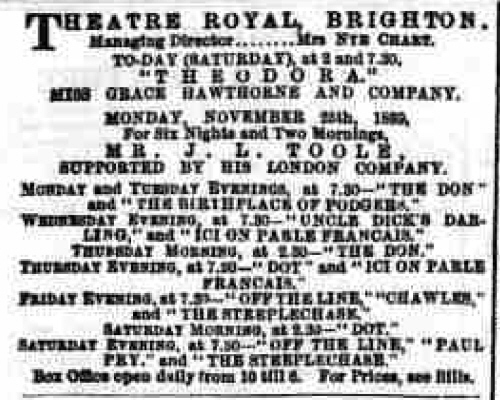
[Advert from The Brighton Herald (23 November, 1889 - p.3).]
The Northampton Mercury (23 November, 1889 - p.9)
LADIES’ COLUMN.
_____
. . .
This week Miss Grace Hawthorne is giving the Brighton public the first representation of Sardou’s “Théodora,” the English translation of which has been written by Mr. Robert Buchanan. Miss Hawthorne studied the part in Paris, under the author while she was having the dresses prepared for her début in England. Of these dresses a whole chapter might be written, for nothing that has yet been produced on the English stage approaches the costumes prepared for “Théodora.” They are two hundred in number, and have cost nearly £5,000. Ladies will be interested to know that many of the bodices are made of silk stockingette, a material hitherto considered outside all considerations for evening bodices. The effect of perfect moulding given by stockingette could scarcely be produced in any other textile. Over the bodices the gauze draperies, heavily covered with embroidery in gold, silver, and pearls, hangs artistically. The stuffs for the dresses were in some instances specially woven for the purpose, but all that are embroidered were carefully thought out and worked to order. Formerly all embroidery was done on heavy, solid stuffs, thick silks, velvet, or plush. Now it is done on the softest, most clinging of gauzy materials, chiefly crêpe. All the brides of recent days had the fronts of their dresses draped with these beautiful embroideries done in silver, white silk, and pearls. Instead of Chinese crêpe Miss Hawthorne’s dresses are worked upon and hung with Japanese, which has greater staying power, and upholds the embroidery without looking heavy or less diaphanous. The dresses worn by the Princess of Wales, which dazzled the eyes of the simple Athenians, were not only embroidered in silver, but draped in these thin crêpes, all sparkling with crystal and silver. The pale blue dress worn at the nuptial ball, and the wonderful diamond tiara, necklet, and bracelets worn with it, will be talked of in Greece for many a day to come when the story of the wedding of the heir to the Throne with the German Princess has passed into history.
___
The Referee (24 November, 1889 - pp.2-3)
Before a full and favourable house Miss Grace Hawthorne and company started the new “Théodora” at Brighton on Monday. Mr. Robert Buchanan, who seems to be a sort of adapter-in-chief for the English stage just now, has prepared a version of what is called on the programme “M. Victorien Sardou’s masterpiece.” This is much better suited for English tastes and sympathies than said masterpiece would be if translated to the letter. "“Théodora” is a tragedy of Byzantium, after the “Lower Empire” period—temp. between 500 and 600 A.D.—and as played at Mrs. Nye Chart’s theatre is not without its memories and suggestions of Sheridan Knowles rather than Shakespeare, of Tobin, Fitzball, and various others who have gone to the periods of antiquity for their inspiration. Singularly enough, now that Watts Phillips’s merits are under discussion, Surreyside theatregoers may remember his play of “Theodora, Actress and Empress,” which, in point of date at all events, was a long way in front of Sardou. At Drury Lane or Her Majesty’s, with every advantage of spectacular effect, and the dazzling illusion peculiar to the richly-dressed and gorgeously-mounted pieces of modern days, the new “Théodora” would have great prospect of success. When produced at the Porte St. Martin all but five years ago, many critics were of opinion that magnificence of mise en scène had at least as much to do with its success as either the brilliance of M. Sardou’s dialogue or the greatness of Mme. Bernhardt’s acting. Great as this latter was, and always is, there were not wanting those who said it was scarcely equal to the demand made by any true portrayal of one of the most terrible creatures history possesses, the soft smooth wanton, the cruel blood-seeking tigress, Théodora, Justinian’s adulterous empress. Whether when the adaptation comes to London in its present comparatively simple and subdued guise it will astonish the Londoners, can be but matter of conjecture. Miss Grace Hawthorne plays the Bernhardt’s great part, and struggles bravely under the difficulties of so colossal an undertaking. Mr. Fuller Mellish is the Andreas of whom Théodora becomes desperately enamoured after having picked him up in one of her nightly rambles in search of the sort of amusement description of which is generally confined to the pages of Procopius and Theophanes, and in our own tongue to such outspoken historians as Mr. Silas Wegg’s great friend, the portly Gibbon. To keep to the classics while one’s hand is in, and snatch a metaphor therefrom, it may be said that Mr. Mellish in so important and heroic a part as that of Andreas resembles nothing so much as Patroclus when clad in the armour of Achilles. There are twenty-nine other name-parts in the play, besides a large number of “officers, lords-in-waiting, ostiaires, eunuchs,” &c., &c., which reminds me that Euphrates, chief of the eunuchs, is played with much unction by our old friend Tippy Haynes, who, I thought, had deserted the theatre to travel the music-halls. The short but powerful part of Tamyris, mother of Amron, the lion tamer (a sort of theatric Sandow-cum-Peter Jackson), is admirably well played by Miss Dolores Drummond. “Théodora” was very cleverly staged under the direction of Mr. W. H. Vernon.
___
The Pall Mall Gazette (26 November, 1889 - p.1)
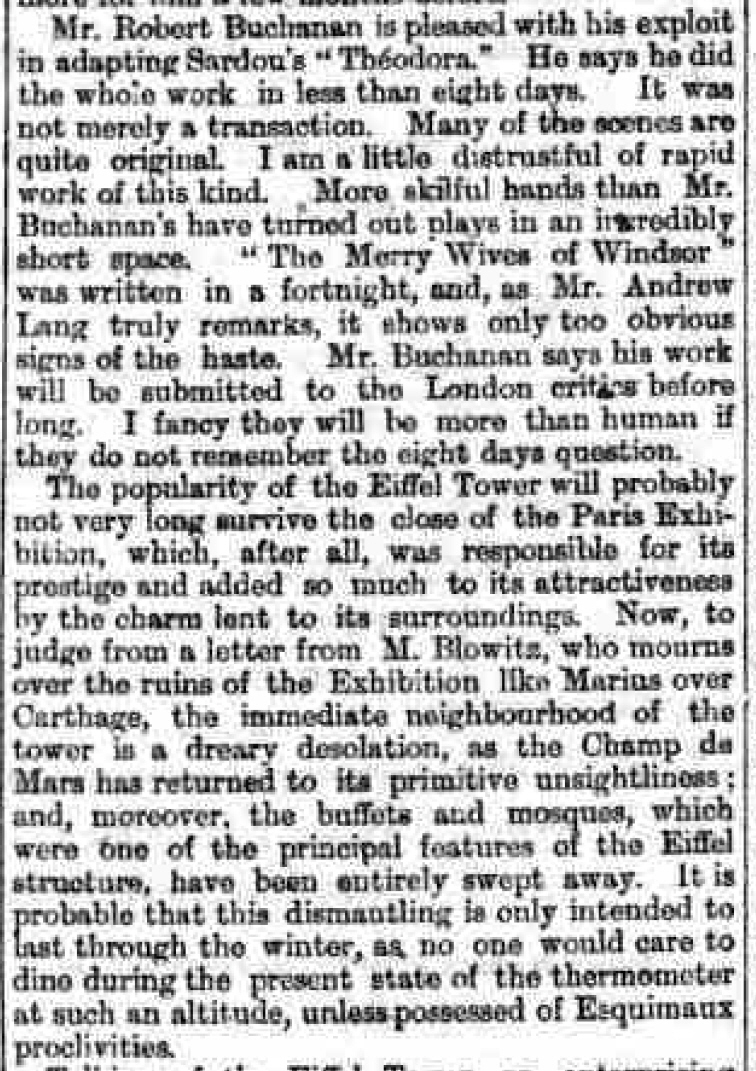
I am told that Mr. Robert Buchanan accomplished one of the quickest poetic feats on record when he took “Theodora” in hand the other day. A prose translation of the play was handed to him, and he proceeded to turn it into blank verse in the short space of five days. I shall be curious to see the result of this lightning literary performance.
___
The Stage (29 November, 1889 - p.7)
MANCHESTER
PRINCE’S (Manager, Mr. T. W. Charles; Acting Manager, Mr. Tom Manchester).—A very large and appreciative audience gathered here on Monday to witness the first performance in Manchester of Robert Buchanan’s adaptation, Theodora. The production is on a grand scale. Miss Grace Hawthorne’s impersonation is a meritorious one. In many ways her acting displays grace and power. Miss Clarice Trevor makes as much as may be of Antonina. Miss Dolores Drummond evinces much discretion in her rendering of Tamyris. Callirhoe is very well played by Miss Marie Stuart, Mr. Arthur Lyle is powerful and effective as Justinian. Belisarius is admirably rendered by Mr. Cecil Morton Yorke. Mr. T. P. Haynes gives a capable performance as Euphratas. Mr. Thalberg displays ability as the centurion Marcellus. Caribert is played with success by Mr. Charles Macdona. As the young Greek Andreas Mr. Fuller Mellish distinguished himself in no slight degree. His acting throughout is of high merit, and repeatedly secures the decided approval of the audience. Timocles, Agathon, and Taber are all well played by Messrs. Harcourt Beatty, George W. Cockburn, and Thomas Backlock. Other characters are efficiently represented. The scenery, &c., is also very effective.
___
The Lancashire Evening Post (29 November, 1889 - p.2)
|
|
|
|
 |
|
|
|
|
|
The Stage (21 March, 1890 - p.5)
LEEDS—GRAND (Sole Lessee, Mr. Wilson Barrett; Manager, Mr. Henry Hastings).—On Monday a full and enthusiastic house witnessed the performance of Robert Buchanan’s adaptation of M. Victorien Sardou’s Theodora, with Miss Grace Hawthorne in the title-rôle. No expense seems to have been spared in staging it, the scenery is beautiful and effective, the dresses are superb and appropriate, and the more prominent artists show ability far above the average. It is scarcely to be expected that Miss Hawthorne can throw into the piece that warmth of feeling or genuine self- abandonment characteristic of Sarah Bernhardt. Yet there were not wanting evidences of a true appreciation of the character of Theodora, and occasional flashes of true art manifested themselves to those who carefully watched Miss Hawthorne’s delineation. The visit to and the interview with the witch Tamyris, the love scene with Andreas, the death- scene of Marcellus, her imperious bearing before the Emperor when the secret of her illicit love was unmistakably proved, and the death of Andreas, and her self, were undoubtedly Miss Hawthorne’s best and most telling efforts, and won for her considerable applause. It is no easy task to delineate a character so pleasing in some aspects, so repulsive in others, as that of Theodora, and Miss Hawthorne may be congratulated on the success which marked her efforts. Mr. Cecil Morton York brings to the representation of his character of Justinian experience and wisdom, and depicted the imperious monarch with consummate taste and judgment. Mr. Alfred Harding’s Belisarius was exceedingly good. Mr. D. G. Longworth’s Euphratus (Chief of the Eunuchs) lost much of its good effect through the actor’s use of a nasal twang, which was most distressing. Mr. Charles Lander’s Marcellus was a marked success. Mr. Alfred B. Cross soon won the confidence and appreciation of the house, which he certainly earned by his delineation of Andreas. Mr. Cross has more than once shown undoubted ability on the stage, but never has he displayed his powers to such advantage as on Monday night. Tamyris was very ably portrayed by Miss Dolores Drummond, and the remaining parts were well filled.
___
The Scotsman (25 March, 1890 - p.4)
THEATRES.
The production of “Theodora” at the Theatre Royal, with Miss Grace Hawthorne as the heroine, drew out a large audience last evening. As adapted by Mr Robert Buchanan, the classic play of M. Sardou is one of absorbing interest, if at times somewhat repulsive in its tone. Miss Hawthorne’s Theodora is a wonderfully powerful delineation of a difficult part. The company supporting Miss Hawthorne is a very clever one. Theodora was very cordially received last night.
___
The Glasgow Herald (25 March, 1890 - p.4)
THE THEATRES.
___
ROYAL - “THEODORA.”
The English version, adapted by Mr Robert Buchanan, of M. Sardou’s “Theodora” was presented at the Royal last night by Miss Grace Hawthorne and a company specially selected to support her. When first produced in England a few months ago the play attracted considerable attention, and the very large audience that assembled in the theatre last night testified to the interest it has awakened on this side of the Border. The name of Madame Sarah Bernhardt is associated with the title rôle, and there was no doubt a widespread desire to witness the portrayal by an English actress of a character which the great French tragedienne has made one of her greatest creations. It is unnecessary to describe the play otherwise than briefly. The interest with which it abounds from the opening to the final scene centres around the career of a girl who, from her lowly origin as the child of a circus performer, has attained to the exalted position of wife of the Emperor Justinian. She wins the highest prize in the game of her infamous life, but even then she is unscrupulous, and in the end brings disaster to her husband, and a violent death to her lover and herself. The part, it is thus evident, is surrounded with difficulty. It is indeed an almost impossible creation, and to give it adequate embodiment in its multifarious lights and shadows—now delicate and sparkling as a summer sunbeam, anon shrouded in the depths of tragic gloom—is well-nigh an impossible task. Miss Hawthorne has set herself to it with a determination to do it at least approximate justice. And she succeeds to a degree which commands unbounded admiration. She has thought out and she presents a wonderfully complex and yet consistent character, and in its representation she impresses the audience not only with her ability to realise her own conception of the vicious and imperious woman, swayed by contending passions and emotions, but with the comprehensiveness of the study she seeks to develop. Her weakest point is her comedy. It was occasionally too flippant, with the result that the incisive sarcasm of the text was reduced to something akin to meaningless burlesque. Otherwise her acting was admirable. In the more intense scenes she excelled, and in the striking finale of the third act, where she strikes a fatal blow to save her lover from capture, and again at the close of the play, where she falls dead upon her lover’s bier, she reached a very high range of tragic power. Miss Hawthorne is ably supported. As Andreas, the lover of the Empress, Mr A. B. Cross takes a heavy share of the work, and performs it excellently well. Mr Lauder as Marcellus, Mr York as Justinian, and Mr Harding as Belisarius, also play their respective parts very creditably. Special mention must also be made of the part of Tamyris, splendidly represented by Miss Dolores Drummond. The piece was elaborately mounted and staged, and the richness of the dresses is also a noteworthy feature in the production. The play, which was received with great enthusiasm, will remain at the Royal for a fortnight.
___
The Times (6 May, 1890 - p.9)
PRINCESS’S THEATRE.
As Theodora was written expressly for Madame Sarah Bernhardt, it is not without a certain temerity that any English actress can attempt an embodiment of M. Sardou’s title character. Mrs. Bernard Beere has of late years acquired a sort of prescriptive right to enter upon such hazardous undertakings, and she has in general acquitted herself of her task remarkably well. It is now the turn of Miss Grace Hawthorne to array herself in the défroque of the great French actress. Last night an English version of Theodora was brought out at the Princess’s Theatre with Miss Hawthorne as the courtesan queen. Rashness was probably the mildest term which the experienced playgoer was prepared to apply to this enterprise, more especially as the play has not been in any sense adapted to the measure of the English actress, but bristles with situations designed to throw the personal characteristics of Madame Sarah Bernhardt into the strongest relief. The result was, however, a pleasant surprise. Miss Hawthorne grappled very successfully with her trying character, and earned the cordial applause of the house. In the more passionate scenes some indebtedness to her predecessor could be traced in her acting, but her impersonation was, on the whole, consistent, well-studied, and impressive. The closing incident has been altered. In the French play, the executioner enters with the bow-string in his hand, and Theodora bends her neck to her fate as the curtain falls. In the English version, the Empress defeats the purpose of her enemies by swallowing a dose of poison after the manner of M. Sardou’s heroines in other plays. A more picturesque, although more conventional, climax is thus provided. It enables Miss Hawthorne to lie down and die pathetically by the side of her dead lover Andreas. With Mr. Vernon as Justinian, and Mr. Leonard Boyne as Andreas, the general representation has ample justice done to it. The mounting is also appropriate. In fine, the performance is interesting and agreeable throughout.
___
The Standard (6 May, 1890 - p.3)
PRINCESS’S THEATRE.
It would certainly not occur to any one who had no very special interest in the work to describe Theodora as “M. Sardou’s masterpiece.” M. Sardou has written most admirable plays, but this is not one of them, it being, indeed, rather a study of character set in picturesque surroundings, than a drama constructed as the exceedingly ingenious French author can construct his works when he pleases. All the power of Madame Sarah Bernhardt could not save this long composition from becoming tedious at times, and it is a most daring venture for an English actress to follow in her steps. Miss Grace Hawthorne, however, last night essayed the character in a version prepared by Mr. Robert Buchanan, a play that has been talked of for a long time past, and was lately given at Brighton and elsewhere as a species of public rehearsal. On the whole, the experiment came out better than there had been any sound reason to anticipate. Miss Hawthorne had previously done nothing to give solid ground for the hope that she could come near to a realisation of the character of the vicious Empress; and though it is impossible conscientiously to advise her to pursue a line of Madame Bernhardt’s parts, at least it may be admitted that many things in last night’s performance were very creditably accomplished. Miss Hawthorne lacks the dignity which it must be assumed that Theodora had acquired at the date of the action of the play. The dramatist evidently intends that her Imperial greatness should be perceptible in the reception scene of the first act (or, to adopt the phraseology of the playbill, in the first tableau), and it is for the sake of contrast that he makes the Empress visit the humble home of the Sorceress, Tamyris, and share her frugal meal; but in truth, the companionship of these old friends suits the actress better than the stateliness of the palace life, and Mr. Buchanan has not hesitated to make his dialogue as colloquial as he supposes the situation requires, for from the blank verse of the former and subsequent scenes he makes Theodora drop to current vulgarism.
Some of the other broadly marked incidents Miss Hawthorne represents not without skill. Her love of Andreas has not, of course, the absorbing intensity that was exhibited by the original Theodora—a remark, perhaps, scarcely worth making; but she is earnest, if not so tragic as she should be, in the very forcible episode where, lest under the influence of the torture Marcellus should betray his friend and accomplice, she yields to his entreaties and stabs him with the pointed ornament worn in her hair. The English actress has not the art to lend sufficient variety to Theodora’s expression of love for Andreas and pleadings to him for pardon, and in the fifth act, the Imperial box at the Hippodrome, she fails to make clear the real nature of her sentiments towards her lover—the spectator unacquainted with the story would be unable to tell whether she was incensed and ready to let him die, or pitiful and eager to save. It is not altogether the fault of Mr. Leonard Boyne that Andreas should appear so half-hearted a lover. He is less occupied with the disguised Empress who visits him than with her plots and rebellions, always seeming in the most unflattering manner to be deeply occupied with something else when she is present. Mr. Boyne is over-vigorous in some of the scenes, notably in the series of shouts to which he gives vent on discovering the identity of the woman he is represented as loving; but altogether he plays with considerable power. Mr. Vernon presents a careful if not a very striking study of Justinian, and Mr. Cockburn is an effective Charibert. Mr. Charles Cartwright, though not well fitted as Marcellus, acts convincingly in his death scene of the third act. The play is very picturesquely mounted, the scenery has artistic merit, and the crowds are well-drilled and appropriately dressed. The audience showed an occasional tendency to accept certain episodes in other than a serious spirit; but, on the whole, the reception was very favourable.
___
The Morning Post (6 May, 1890 p.3)
PRINCESS’S THEATRE.
_____
The “Theodora” of M. Victorien Sardou was a bold venture on the English stage, but Mr. Robert Buchanan is not the dramatic author to be deterred by stage difficulties. He has successfully carried through enterprises in which many would have failed, and he has attacked the complications of M. Sardou’s “Theodora” with unquestionable courage and not without corresponding success. Some of the scenes in this play are calculated to dismay an adapter for the English stage; but Mr. Buchanan has accomplished an arduous task with credit to himself and advantage to the theatre. The conventional forms of stage work are so well worn, that playgoers must be glad to welcome novelty, even if it comes in the somewhat startling shape in which some of the incidents in “Theodora” present themselves. It is understood, of course, that Mr. Buchanan’s chief duty was to provide a striking character for Miss Grace Hawthorne, who, no longer contented with those domestic heroines she has hitherto played, aspired to follow in the footsteps of Madame Sarah Bernhardt herself. The Theodora of that gifted actress is well known, and, however strange and even repulsive the character of the heroine may appear, according to modern ideas, the remarkable ability of the great French tragedienne carried all before her, and made the most daring conception of M. Sardou enthralling, exciting, and even fascinating by the power and variety of effect introduced. The latest representative of the heroine must not be judged by the first. There are things Madame Sarah Bernhardt may say and do which would not be equally acceptable from an English actress, who is necessarily under greater restraint in working out her ideas of a character like this. The French actress thinks only of her part, and the effect she intends to produce in it. The English actress remembers her audience as well. This essential difference is well to be remembered in any estimate we form of the “Theodora” at the Princess’s. The play is given in six acts and seven tableaux, a formidable affair indeed, and made still more so by elaborate and picturesque scenery, processions, and other spectacular effects, dances, &c., a great effort being made to dazzle the spectator by the splendour and magnificence of the stage setting. The real dramatic matter of “Theodora” does not occupy so much of the play as might be imagined, but the incidents have all a picturesque setting, and the chief scenes are worked up into a series of tableaux very captivating to the lover of stage illusions. An outline of the chief situations introduces first of all the reception in the Palace of the Emperor Justinian, whose Empress was formerly a performer in the circus. Theodora has the fierce passions and the unscrupulous desires of one whose physical rather than mental attractions have raised her to the throne, and in the second tableau we have a glimpse of her real nature when, among the gladiators and other performers in the arena, Theodora revives the associations of her past life. Her chief object in thus visiting her old companions is to obtain from Tamyris, a sorceress, a love potion to increase the passion of Justinian. The second act takes place in the house of a Greek, Andreas, where a plot is being prepared to overthrow the Emperor and Theodora, who is hated by the people. Andreas is in love with a supposed widow, Myrta—no other than Theodora herself. He has saved her life during an earthquake. An interview takes place between the lovers, Andreas being still ignorant of Theodora’s real position, and in the third act he joins his friend Marcellus in an attempt to seize Justinian. It is defeated by Theodora, who recognising the voice of Andreas, permits him to escape, but Marcellus is taken captive. The Emperor endeavours to discover the companion of Marcellus, but this is prevented by Theodora, who, in an interview with the prisoner, kills him with the stiletto she carries in her hair. By means of this weapon Andreas discovers who has killed his friend, and he declares to the supposed Myrta his intention to avenge him. Discovering who Myrta really is, Andreas visits the arena and denounces Theodora in presence of the spectators. He is seized, but Theodora connives at his escape. The last act is again in the Palace of the Emperor, and the sorceress Tamyris brings the love potion Theodora had requested. But it is poisoned. An interview takes place between Theodora and Andreas, who treats her with disdain, and in the hope of regaining his love she gives him the potion. At this juncture the Emperor comes, and, discovering the infidelity of Theodora, orders her to be strangled; but the heroine takes the poisoned cup, and falls dead upon the body of her lover. In these passionate and tragic incidents the ability of Miss Grace Hawthorne was turned to good account. If there was not always the physical power to make the most of the strongest situations as a tragic actress of the highest gifts might have done, Miss Hawthorne, by her intelligence and judicious management, succeeded in giving an interesting study of the character; and the less exacting emotional scenes were rendered with much effect. The forced gaiety of the circus performer when among her old companions was natural and consistent, and Miss Hawthorne gave no little tenderness and passion to the scenes with Andreas. In the death scene Miss Hawthorne was seen to greater advantage than in any other character she has played. The actress takes her own view of the scene and situation, and makes it fairly impressive. As Andreas Mr. Leonard Boyne acted with the requisite sentiment and passion. The impulsive nature of the young Greek, the most heroic personage in the play, was well depicted, and few actors of the day would have made so much of the character. Mr. W. H. Vernon represented the Emperor with force and dignity, and he had also done the management good service in personally superintending the production of the play. The counsel of so intelligent and experienced an actor was of great value. Mr. Cartwright played the ill-fated Marcellus with considerable effect, and Mr. Cecil Morton York deserved praise as Belisarius. As Tamyris, the Sorceress, Miss Dolores Drummond acted with the force and energy she has so often displayed in parts of this kind. Miss Clarice Trevor successfully represented Antonina, and the same may be said of Miss Marie Stuart’s Callirhoe; and many of the smaller characters were efficiently sustained. The splendid stage pictures were greeted with enthusiastic applause, and the efforts of the performers were fully acknowledged. At the fall of the curtain Mr. Vernon first addressed the house, not being aware that Mr. Buchanan was present. That gentleman, however, came forward and briefly thanked the audience on behalf, as he explained, of M. Sardou, he being only the adapter.
___
Pall Mall Gazette (6 May, 1890 - p.1)
The most amusing incident at the Princess’s Theatre last night occurred after the curtain had fallen. Vague and indistinct shouts were heard from the pit and gallery, and it was an open question whether “Hawthorne!” or “Author!”—emphasized with an aspirate—was the cry. Matters were eventually compromised by both Mr. Robert Buchanan and “Theodora” taking a well-earned “call.”
___
(p.2)
Music and the Theatres.
“THEODORA” AT THE PRINCESS’S.
Surely those who are responsible for the management of the Princess’s theatre may be congratulated on their new departure. They have deserted, for a time, at any rate, the beaten track of conventional melodrama, and have led us from the regions of sensationalism and threadbare sentiment into a dramatic atmosphere which, if it is not absolutely ethereal, is at least genuinely invigorating. Whether or not “Theodora” is Victorien Sardou’s “masterpiece” is a point upon which many playgoers will be inclined to differ with the compiler of the Princess’s programme. But apart from this question, there can be no doubt whatever that the French author fully attained the object which he had in view when he set himself to draw a series of pictures of the turbulent reign of Justinian and his wanton wife. M. Sardou evidently intended his play to be a framework for a number of effective incidents and situations, rather than a carefully-dovetailed homogeneous drama. Each scene, with the exception of the two tableaux in the first act, is complete enough in itself with its own starting-point, crescendo, and climax, though, perhaps, the whole sequence of highly-wrought episodes does not arouse the keenest interest. The play as a whole is, to a certain extent, sacrificed to its central figure. Theodora herself is everything in the drama that bears her name. Andreas, her Greek lover, is the only other personage with any pretensions to prominence. The character of Justinian is very slightly sketched; while Marcellus, attractive as he is, is “killed off” when he has appeared in only two scenes. The crowd of subordinates are merely so much necessary padding. In his English adaptation Mr. Buchanan has not seen his way to alter this position of affairs nor diminish in any respect the supreme importance of the principal rôle by “writing up” the secondary characters to any extent. In this he has certainly shown his wisdom; for it must be quite clear to any one who mentally analyzes the case for a moment that the play rests upon two strong supporting pillars—namely, the various phases and contrasts of the leading rôle, and the intense and irresistible force of the successive situations round which M. Sardou has built his plot in his own ingenious style. In the English version, as well as in the original play, the key-note of Theodora’s passions and propensities is struck at the outset, when we see the abandoned Empress first holding court in all the glory of her jewel-embroidered robes, and then flying off to sup in Bohemian fashion with an old harridan of the hippodrome who has known her in the days when she danced and juggled for her daily bread. After this exordium we are speedily introduced to Andreas, the Greek who loves Theodora, believing her to be one of the people to Marcellus, the self-sacrificing young conspirator, who perishes in his attempt to bring about a coup d’état, and to all the surroundings of these personages. The death of Marcellus, the disillusionment of Andreas, the denunciation of the Empress in the amphitheatre, and the final catastrophe which makes Theodora and her former lover share the same poison-cup, are among the most impressive and striking points of a drama the nervous energy and power of which must rouse the most lethargic spectator to something like enthusiasm. Mr. Buchanan’s lines are for the most part appropriate and picturesque, though he occasionally lapses into phrases which sound somewhat too modern and colloquial. “Theodora” is beautifully mounted, and should certainly hold the Oxford-street boards for many months to come.
Miss Grace Hawthorne’s performance of the principal character came as an agreeable surprise to those who had anticipated complete failure. Her gesture is by far her weakest point, just as her facial expression is her strongest. She is not always certain in her control over her voice, but there were many quiet moments last night when she was heard to particular advantage. The part is, of course, an intensely difficult one for any actress to essay, and Miss Hawthorne is fairly entitled to no small amount of credit for her careful and artistic work. Mr. Leonard Boyne as Andreas shows no lack of power or manliness; but, if anything, he is too earnest. The actor is doubtless carried a trifle too far by his anxiety to do justice to the rôle. He is quite capable, however, of obtaining the same degree of effect with a smaller amount of physical exertion. At the same time, it cannot be denied that, generally speaking, his performance carried full conviction to the minds of his audience. Mr. W. H. Vernon has but few opportunities of distinguishing himself as Justinian; all that can be done with the part, though, he does conscientiously and successfully. The Marcellus of Mr. Charles Cartwright is not quite impetuous enough. As a matter of fact, the actor’s methods seem far better suited to parts of the slow and sardonic order, and he does not strike one as being quite at his ease in the rôle of the rebellious young soldier. Apart from these drawbacks, his death-scene was remarkably artistic in conception and complete in detail.
|
|
|
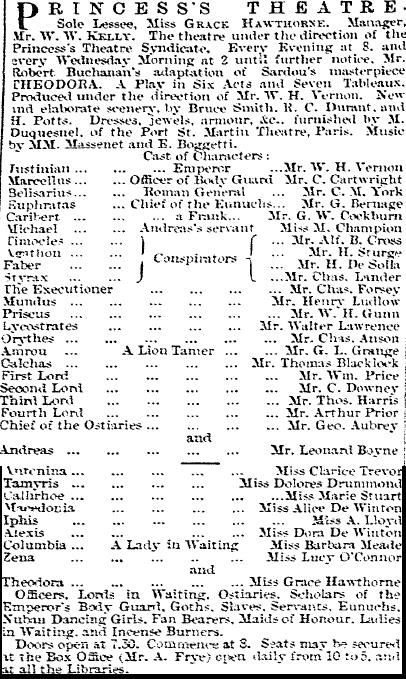 |
|
|
|
[Advert from The Stage (9 May, 1890 - p.10) for the Princess’s Theatre, London.]
The Penny Illustrated Paper (10 May, 1890)
Miss Grace Hawthorne last Monday night fulfilled the promise she pluckily made at the commencement of her management of the Princess’s Theatre. This clever American actress appeared at the Princess’s in Mr. Robert Buchanan’s effective adaptation of Sardou’s powerful drama of “Théodora,” especially written for Madame Bernhardt. Handsomely mounted and beautifully costumed, the dresses worn by Miss Hawthorne herself being of regal splendour, “Theodora” presents a series of lustrous tableaux of the ancient Byzantium where the Emperor Justinian and the frolicsome and vicious circus-girl he made his Empress played their parts. I had heard of the success Miss Hawthorne had achieved in this arduous part in the provinces, but was wholly unprepared for the remarkable power she displayed in the strong passages of the romantic play. It was from first to last an excellent performance on the part of Grace Hawthorne—playful in the rencontre with her old Show mistress at the Hippodrome; full of soft amour in the moments of dalliance with her lover, Andreas; impassioned in her quarrel with the Emperor; and frenzied in the scenes in which she kills Marcellus at his own request and saves her lover against himself; and touching in the last scene of all, where she poisons herself and droops on the couch, where Andreas lies dead. As Andreas, Mr. Leonard Boyne acted with rare spirit. Mr. W. H. Vernon was admirable as Justinian; and so was Mr. Charles Cartwright as Marcellus; and the like may be said of Miss Dolores Drummond as Tamyris, and Miss A. Lloyd as Iphis. Miss Hawthorne and Mr. Buchanan were enthusiastically called before the curtain. “Theodora” was an unmistakable success.
___
The Graphic (10 May, 1890)
THEATRES.
MISS GRACE HAWTHORNE, at the PRINCESS’S, has courageously undertaken the part of the profligate Empress Theodora in M. Sardou’s historical play—the part with which Madame Sarah Bernhardt electrified the Parisians at the Porte St. Martin five years ago; and, what is more, she has achieved in this arduous character a substantial triumph. To compare her with an actress of such superlative genius as her illustrious predecessor would of course be absurd; but there was nevertheless enough, and more than enough, of passionate energy and variety of expression in her impersonation to extort the admiration of those who can appreciate a really powerful and artistic performance. Miss Hawthorne is, on the whole, fortunate in her supporters; though Mr. Leonard Boyne’s Andreas falls something short of excellence, not because his performance does not aim at what is known as “natural acting”—for high colouring is not only permissible, but absolutely needful, in a historical melodrama so elaborately planned and worked out—but because his extravagances of tone and gesture tend somewhat to overstep the line that divides tragic intensity from burlesque. One of the best pieces of acting was that of Mr. Cartwright as the patriot, Marcellus. In the great scene in which he prevails on the Empress to stab him to the heart lest the name of her lover, who has conspired against the Emperor’s life, should be extorted from him by torture, Mr. Cartwright played with genuine tragic force; and praise is due to Mr. Vernon’s grave and weighty portrait of the Emperor. The effect of the performance is much enhanced by the beauty and splendour of the mounting—the picturesque scenery, the gorgeous pageantry, and the rich historical costumes and armour which are brought to bear in illustration of life in Constantinople when the Empire of the East was in the zenith of its power and grandeur. As a feast for the eye alone, Theodora would be worth seeing; as a historical melodrama, in which dramatic situations wrought to the highest pitch of intensity follow each other in almost inexhaustible succession, it is really without a parallel in the repertory of the modern stage.
___
The Era (10 May, 1890 - p.14)
THE LONDON THEATRES.
_____
THE PRINCESS’S.
On Monday, May 5th, 1890, Mr Robert Buchanan’s Adaptation
(in Six Acts and Seven Tableaux) of Sardou’s Play
“THEODORA.”
Justinian ... ... ... Mr W. H. VERNON
Belisarius ... ... ... Mr CECIL MORTON YORK
Euphratas ... ... ... Mr GEO. BERNAGE
Marcellus ... ... ... Mr CHAS. CARTWRIGHT
Caribert ... ... ... Mr GEO. W. COCKBURN
Andreas ... ... ... Mr LEONARD BOYNE
Michael ... ... ... Miss MABEL CHAMPION
Timocles ... ... ... Mr ALFRED B. CROSS
Agathon ... ... ... Mr HOWARD STURGE
Faber ... ... ... Mr HENRY DE SOLLA
Styrax ... ... ... Mr CHARLES LANDER
The Executioner ... Mr CHAS. FORSEY
Mundus ... ... ... Mr HENRY LUDLOW
Priscus ... ... ... Mr W. H. GUNN
Lycostrates ... ... ... Mr WALTER LAWRENCE
Orythes ... ... ... Mr CHAS. ANSON
Amron ... ... ... Mr GEORGE LAKE GRANGE
Calchas ... ... ... Mr THOMAS BLACKLOCK
First Lord ... ... ... Mr WM. PRICE
Second Lord ... ... Mr C. DOWNEY
Third Lord ... ... ... Mr THOMAS HARRIS
Fourth Lord ... ... Mr ARTHUR PRIOR
Chief of the Ostiaries ... Mr GEORGE AUBREY
Antonina ... ... ... Miss CLARICE TREVOR
Tamyris ... ... ... Miss DOLORES DRUMMOND
Callirhoe ... ... ... Miss MARIE STUART
Macedonia ... ... ... Miss ALICE DE WYNTON
Iphis ... ... ... Miss A. LLOYD
Alexis ... ... ... Miss DORA DE WYNTON
Columba ... ... ... Miss BARBARA MEADE
Zena ... ... ... Miss LUCY O’CONNOR
Theodora ... ... ... Miss GRACE HAWTHORNE
Everything, it is said, comes at last to those who know how to wait, but candidly we may admit that even faith in that piece of proverbial philosophy had not sustained the expectation of ever seeing the promised production of Théodora, as “Englished” by Mr Robert Buchanan, on the London stage. No modern play has been so much talked about without being seen. Its location and the date of its representation have been announced again and again, but ever some difficulty arose, and Théodora and procrastination became at length almost synonymous terms. But the proverb after all has been justified, and London playgoers have a chance of coming face to face with Théodora in an English dress, Miss Grace Hawthorne acted wisely in first trying the production on provincial audiences, and she must have been in no small degree encouraged by the encomiums lavished by country critics upon her own attempt to rival the great Sarah Bernhardt in the all important and most arduous character, upon the efforts of her associates, and upon the general sumptuousness and completeness of the dressing and staging of Sardou’s play. When Théodora was first brought out at the Porte-St.-Martin in Paris towards the close of 1884, and in the following summer when Sarah Bernhardt appeared in it at the London Gaiety, its story was set forth in detail and its merits were fully discussed in these columns, and there were few to contest our verdict that as it was one of the longest, so it was one of the most wearisome of modern pseudo-historical stage productions, and that, while offering a mass of archæological detail and lavish decoration, it had but the thinnest possible vein of dramatic interest. Théodora, as we have shown, has in this play a three-fold personality. We see her first as Théodora the Empress, dominating her weak and cowardly consort Justinian by her masculine courage and iron will. Then there is the Théodora in whom the old vagabond instincts of the circus girl and courtesan still live and break out afresh upon her visit to Tamyris, the Egyptian fortune teller. Lastly we have Théodora filled with a consuming passion for the handsome young Greek Andreas, one of the leaders of the faction whose purpose it is to overthrow her husband, and more especially to work vengeance upon her. Unfortunately, there is no one feature of her character that commands the sympathy of the spectator. Even in the moment of her great despair, when her scheme to save her loved one’s life, and by the magic philtre to win his love, results only in his death, and, cheating the executioner with what is left of the fatal draught supplied by Tamyris, she falls a corpse by Andreas’ outstretched body, it is impossible to fan into existence even one spark of pity. Weep and wail as she may, the very ardour of her adulterous love but excites our loathing. We rejoice to be rid of her, for her career as depicted by the dramatist is redolent from beginning to end of lust and of blood. As we have before remarked, the whole play reeks of the shambles, and we rise from its contemplation, inclined to cry in the words of the lepers of old, “Unclean! unclean!” Mr Buchanan, doubtless out of his great respect for Sardou, has hesitated to mangle the “masterpiece” too much, and has retained scenes and incidents that could well have been spared, and that, being sacrificed, would have lightened the play and relieved the spectator. The first act certainly gives opportunity to see how grandly the low-born Zoe can play the Empress, but altogether superfluous is the whole scene of the enforced reconciliation between the angry, because dishonoured, Belisarius and his young wife. The business leads to nothing; the audience is, as it were, put upon a false scent, which we may again observe is a blunder the playwright should avoid. The introduction of Théodora to the Home of the Gladiators is valuable only by way of contrast. There will be some, doubtless, to say that among the vulgar surroundings here Théodora is at home—quite at home—and this idea the principal actress on Monday certainly strove to emphasise. The hippodrome scene, though not valuable in itself from a dramatic point of view, supplies a stage picture that the adaptor has wisely retained, and, although we may still think the tragic denouement brought about by the poisoned love-philtre a conventional stage trick hardly worthy of a Sardou, we cannot blame Mr Buchanan for retaining it; and we may even commend him for the alteration by which Théodora is made to share her adored one’s fate and not to die by the strangulation cord of “the executioner.” Not even so clever an adaptor as he has proved himself to be could be expected in this instance to supply that “happy ending” so dear to English playgoers, and patrons of the Princess’s during Théodora’s run must be content as they prepare to leave their seats to see the curtain descending upon what, without exaggeration, we may call an imperial butcher’s shop with two human carcases upon the counter. Through the details of the gloomy story it is not necessary again to take the reader. They must be familiar to all who are interested in affairs of the stage. Curiosity on Monday evening was directed not so much to the discovery of what the play was like, as to the manner and method of the new Théodora—of the actress whose ambition has led her to challenge comparisons with the great French actress who “created” the part. There were not a few to predict disaster. Nothing previously done by Miss Grace Hawthorne since her advent to the London boards seemed to justify so bold an attempt as this. Remembering the nature of the part, the “infinite variety,” the passion and the power necessary to do it full justice, it seemed impossible that the actress could succeed. Failure seemed inevitable. But it has been well remarked that it is never safe to prophecy unless one knows. Miss Hawthorne has evidently laid to heart the great Cardinal’s teaching—“There’s no such word as fail.” Her impersonation was not great; but it was in many respects good. It was by no means satisfying, but it was commended even to enthusiasm, because it was so much better than was expected. In the first act this Théodora bore herself right regally, and we had before us the royal tigress, not without suspicion of the claws concealed within the velvet paws. In the home of Tamyris, as we have suggested, the actress somewhat emphasised—over emphasised—the vulgarity of the scene, but later, in the loving interview between Andreas and the supposed guileless Myrtea, she made her best effect, and with excellent skill suggested the depth of Théodora’s passion for the young Greek, the yearning to gauge his affection for her, the resolve to wring from him the confession that he must still love her, and love continually, even though she were infamous instead of innocent and pure. If in the terrible scene of the killing of Marcellus—Théodora, it will be remembered, stabs him to the heart by his own request to save him from torture and the confession which would endanger her beloved Andreas—if here, we say, the effect was not all that could have been desired, it was not so much because the actress failed to rise to the requirements of the situation as because of that very awkward arrangement which repeatedly brings to Théodora’s side the impatient Justinian to know how long it will be ere she has finished with his intended victim. Miss Hawthorne made an imposing figure in the scene of the imperial box at the hippodrome as, with foot pressed upon her prostrate loved one’s throat, she, with intent to save him, cried, “this man belongs to me,” and her share of the final catastrophe was performed with something of dramatic intensity. Altogether it was a matter for surprise and congratulation that Miss Hawthorne succeeded so well where Failure was anticipated, and there could have been none in the theatre to grudge her the many compliments that, in the way of flowers and plaudits, were heaped upon her. The Andreas of Mr Leonard Boyne was a really masterly performance. Here, indeed, we had a lover about whose love there was no mistake. It was an all-consuming love; it was in the burning eloquence of his tongue; it blazed out from his eyes; it was in those fond embraces; it was love, pure, unrestrained, truthful, unsuspecting. And when the crash came, and the idol was shattered—when Andreas learnt that he had lavished his love upon a wanton, that his kisses had been given to the wretch who had climbed from a circus to a throne to play the tyrant, that his arms had cherished the viper that had stung and killed his dearest friend—then for Andreas did the actor command the warmest pity, the most heartfelt sympathy. Here we had what, to our thinking, is the finest scene in the whole play. Andreas, convinced by his friends of his folly, and of the treachery of the woman he has loved and trusted, moved the house, and when, awaking to the necessity for immediate action in order to ensure a swift and sure revenge, their cries were hushed and they bowed the knee as the solemn funeral hymn of poor Marcellus was heard in the distance, there was something of awe in the silence that prevailed, and it was clear that a deep impression had been made upon the audience. Mr W. H. Vernon did good service as Justinian, admirably indicating the weakness, the cowardice, and cruelty of the Emperor’s character. He did service still more valuable in directing the production of the piece, which, to his credit be it said, though tremendously heavy and complex in its arrangements, went throughout without one noticeable hitch. Mr Charles Cartwright bore himself with such distinction and spoke with such excellent emphasis as Marcellus that the cutting short of his career with the third act was a matter for regret with more than his befooled companion Andreas. A stalwart and outspoken Belisarius was found in Mr Cecil Morton York, and a very good impression was made by Mr Alfred B. Cross as Timocles, the brave rebel, who convinces Andreas of the treachery of which his love has made him the victim. Miss Dolores Drummond is also entitled to special mention for her careful treatment of the part of Tamyris. The gorgeous costumes, and the newly-painted and thoroughly effective scenery by R. C. Durant, H. Potts, and Bruce Smith, contributed in non small measure to the success achieved on Monday evening. We should not like to predict that the success will be prolonged, for we have yet to be convinced that a play so generally unwholesome as Théodora, is to the taste of any large section of the playgoers of the metropolis.
___
The Entr’acte (10 May, 1890 - p.11)
THE THEATRES.
PRINCESS’S.—For a long time it has been said that Miss Grace Hawthorne would play “Theodora” in London. This was made an accomplished fact on Monday at the Princess’s Theatre, when Mr. Robert Buchanan’s adaptation of Sardou’s play was launched. Let it be said that the English cutter and trimmer has done his work well; that in places he has absolutely improved upon the inventor, and that the piece, in spite of signs of slovenliness here and there, has been creditably staged. It must be conceded that the chief faults of construction come at the beginning of the play, so that time is given for their redemption to be worked out. The first act is drawn out very unnecessarily, and its incident compares very poorly with a plethora of purposeless soliloquy and dialogue. The pruning-knife will have to be liberally used here. The motif is tragic, and it must be kept in a tragic key, not disfigured by flippant commonplaces which help to inordinately spin out the story and furnish Miss Grace Hawthorne with opportunities for showing what she can do with low comedy. Uninteresting to a degree was “Theodora” until Marcellus came upon the scene, and by his earnest acting invested the structure with a substantiality it had not previously enjoyed. The right key was then first struck, and it was then that the audience began to be concerned. As the story is well known, we need not here dwell upon it, except to state that Theodora effects her quietus in a different manner to that employed by the Bohemian Empress in the original play. Miss Grace Hawthorne has, of course, had many opportunities of studying Madame Bernhardt in the part of Theodora, and her present essay cannot be regarded as a creation. Miss Hawthorne is apt, and knows how to turn the power of observation to account. She has not the natural gifts of a Bernhardt, but she knows how to profit by example. Her Theodora is a most creditable essay, and with a few of those excrescences obliterated that were manifest on Monday, her newest venture may possibly develop into a positive triumph. The part of the lover Andreas fell to the lot of Mr. Leonard Boyne, who looked quite spick, span, and without blemish. Mr. Boyne was well intentioned, but he made his usual mistake of laying on too generous a coating of accent. His love-making is somewhat cloying. While we call attention to this fault, we gladly acknowledge this actor’s earnestness. Mr. W. H. Vernon cannot be said to be thoroughly at home in this kind of piece; but he is too good an artist to do anything badly, and though his Justinian is not characterised by the strident and mouthing customs suggestive of a bygone period, his acting, if kept to a subdued key, impresses by its quiet force. Mr. Cartwright’s Marcellus is excellent, and gives weight to the fabric. The special recall that was awarded this gentleman was thoroughly well deserved. Miss Dolores Drummond as the show-woman was praiseworthy; and a small part was somewhat effectively played by a Miss Lloyd. If “Theodora” can be reduced to a three-hours’ limit, there is no reason why it should not prosper. The preamble is wordy, and its curtailment would greatly improve the play.
___
Reynolds’s Newspaper (11 May, 1890 - p.6)
PUBLIC AMUSEMENTS.
_____
PRINCESS’S THEATRE.
On Monday evening the long-promised English version of M. Sardou’s historical melodrama, “Theodora,” was produced at this house. “Theodora,” written expressly for Madame Bernhardt, and produced in 1884 at the Porte St. Martin, was first seen in London at the Gaiety Theatre during the French dramatic season of 1885, and was followed immediately—two days only elapsing—by a burlesque written by Mr. F. C. Burnand, entitled “The O’Dora; or, the Wrong Accent,” since which time an English version has been promised, but not until Monday evening has the promise been fulfilled. Mr. Robert Buchanan, who in the programme describes the play as Sardou’s masterpiece, is responsible for the adaptation, which follows very closely the French original, the most notable deviation from the text being in the last act, when the courtesan Empress, instead of submitting herself to the executioner to be strangled by the cord of scarlet silk, dies by a draught of the love philtre—intended for her husband, the Emperor Justinian, by the old hag who holds the craven monarch responsible for her son’s death—with which she has unwittingly poisoned her lover, and, still dignified and defiant towards her cowardly spouse, Justinian, expires by the side of Andreas. The drama, somewhat fragmentary as it is in the French, becomes still more so in the Anglicized edition, which fault might in a measure be remedied by curtailment, the first scene—or, to speak by the card, the first tableau—serving no purpose as regards the action of the play, it being wholly spectacular, and the judicious pruning of the love scene in the second act, which is decidedly too talky, and by which means the play, which lasted for over three and a half hours, might be brought within reasonable limits. Miss Grace Hawthorne, it was evident from the outset, has taken the talented Madame Bernhardt as her model. Imitation, we are told, is the sincerest form of flattery, and the great French actress has every reason to be proud—and rightly, too—of her gifts, taking into consideration Mrs. Bernard Beere’s imperfect copy of her grand impersonation of Fedora, and the still more imperfect one of Theodora by Miss Grace Hawthorne, who showed—although she did her level best, and surprised those who came to scoff by the general improvement in her histrionic powers—that there was wanting the dramatic force and vigour, the dignity, the commanding force, and the physical power required by such a part. At times Miss Hawthorne showed signs of great promise, which were, however, never fully realized. By far her best scene was when the conspirator Marcellus beseeches her to kill him rather than betray his friend and her lover Andreas. Miss Hawthorne, who during the performance wore a series of elegant and gorgeous dresses, was recalled at the termination of each act, and made the recipient of many floral tributes. Mr. W. H. Vernon, as the vacillating and cowardly Emperor, was perfect; but Mr. Leonard Boyne, though a picturesque Andreas, was too mechanical in action and modern in manner to make the part acceptable. The chief honours of the evening were awarded to Mr. Charles Cartwright, whose impersonation of Marcellus was excellent, both from a dramatic and elocutionary point of view, and which should have stimulated others to finer work. Miss Dolores Drummond (Tamyris), Miss Marie Stuart (Callirhoe), Miss Clarice Trevor (Antonina), and Mr. George Cockburn were satisfactory in the parts allotted them. The drama is splendidly mounted, the dresses are magnificent, and the scenery charming, but although everything has been done so far as money and taste are concerned the play is unimpressive and dull at times, requiring something to lighten the gloom of such a revolting tale of human nature, and if “Theodora” is to be a success in England, it can only be by the admirable mounting and the pretty stage pictures presented, rather than by Miss Hawthorne’s impersonation of the woman who rose by stratagem and murder from a circus to a throne. The production made it painfully apparent that as yet we have not found an actress that can satisfactorily attack and efficiently pourtray the characters written expressly for and around Madame Sarah Bernhardt. At the conclusion the principal performers were called, as was also Mr. Robert Buchanan. The house was crowded in every part.
___
The Daily Telegraph (16 May, 1890 - p.3)
Mr. Buchanan writes as follows: “Permit me to state, in reply to certain criticisms which have appeared in a weekly contemporary, that I am not personally responsible for all the so-called vulgarisms and colloquialisms which have found their way into my English version of ‘Theodora.’ Several of them have been added, not by me, from the original. I plead guilty, however, to the line, ‘He’s very nice, indeed, for a Barbarian!’ which so offends the ‘very nice’ ear of my critic, and I think the words fairly suggest the decadent vocabulary of Byzantium. The greater part of the play is written in verse, but I have Shakespeare’s authority for dropping into prose, and even into colloquialism, when expedient. It is not necessary, as my critic suggests, to ‘crawl backward’ to the Elizabethan period, in order to justify oneself for trying to render the vulgarisms of one period by the argot of another. To crawl backward to that period, however, would be to escape from the present one, when every slip of the actor’s tongue, and every error of the actor’s memory during the excitement of a first production, is credited to the author, or the adapter, of a stage play.”
|
|
|
|
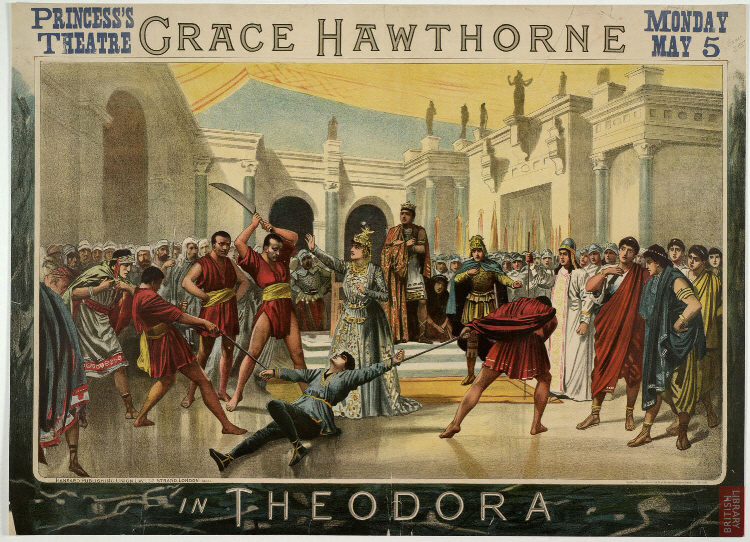 |
|
|
|
[Poster for Theodora at the Princess’s Theatre - click the image for a larger version.]
Theodora - continued
|
|