 |
|
|
Play List: 4. Corinne 7. The Mormons 9. Lucy Brandon 10. Storm-Beaten 11. Lady Clare 13. Bachelors 14. Constance 15. Lottie 16. Agnes 17. Alone in London 18. Sophia 19. Fascination 20. The Blue Bells of Scotland 21. Partners 24. Angelina! 25. The Old Home 26. A Man’s Shadow 27. Theodora 29. Clarissa 30. Miss Tomboy 32. Sweet Nancy 33. The English Rose 36. Marmion 37. The Gifted Lady 38. The Trumpet Call 39. Squire Kate 40. The White Rose 42. The Black Domino 44. The Charlatan 45. Dick Sheridan 47. Lady Gladys 48. The Strange Adventures of Miss Brown 49. The Romance of the Shopwalker 52. Two Little Maids from School ___ |
|
|
|
ROBERT WILLIAMS BUCHANAN (1841 - 1901) |
|
|
|
|
|
|
|
|
|
THEATRE REVIEWS 43. The Piper of Hamelin (1893)
The Piper of Hamelin - A Fantastic Opera Published: The Piper of Hamelin: a fantastic Opera in two acts. (London: William Heinemann, 1893.
The Derby Daily Telegraph (17 November, 1893 - p.2) Great minds think alike. There seems to have been a simultaneous prepossession for “The Pied Piper” as a subject for stage treatment. Mr. Robert Buchanan was first in the field, for his version of the legend is to be seen at the Comedy Theatre shortly. Mr. Albert Chevallier has collaborated with Mr. Brian Daly in transmogrifying the poem for production at a music-hall. It is understood, too, that at another hall it is to serve as the theme of a big ballet. I wonder, by the way, what Taglioni and her like would think of the change that has made the leading music-halls the home of the ballet. There are three great London theatres of varieties, the Empire, Alhambra, and Palace, at which ballet can be seen just now in perfection. At the first “The Girl I Left Behind Me” is very much “up-to-date.” It deals neither with tragedies or legends in Italian villages, but with the career of a scapegrace, his ruin on race-courses, and his rehabilitation as a soldier in the ranks. ___
Pall Mall Gazette (25 November, 1893 - p.8) Mr. Comyns Carr announces that a series of special matinées for children will be given at the Comedy Theatre during the Christmas holidays, commencing on Wednesday, December 20. These entertainments will, he tells us, be designed with a view to catering for the taste of those of our young folk whose minds are not yet prepared for the riper humour of the music-hall, and who still preserve their faith in the unspoiled beauty of a fairy legend and the natural fun and frolic of a boyish story. It will hardly seem an exaggeration (Mr. Carr continues) to suggest that some at least of the entertainments professedly provided for the enjoyment of the young are now too richly overlaid with illusions to topics suited only to the educated taste of maturer years. They are of a class, in short, to which indulgent children amy fitly consent to take their parents; and, without affecting to compete with the more splendid spectacular displays which attract deserved popularity at this season, the manager of the Comedy Theatre feels that there is still room for a simpler sort of entertainment, to which parents may occasionally care to take their children. In this belief he has secured for his opening programme a new poetical version, by Mr. Robert Buchanan, of “The Piper of Hamelin,” with music by Mr. Allwood, which will be followed by “Sandford and Merton,” by Mr. F. C. Burnand, with music by Mr. Edward Solomon. These matinées will in no way interfere with the successful run of “Sowing the Wind” at the Comedy, which will be given in the evening and on Saturday afternoons as Before. It was played, by the way, to an enormous house at the Theatre Royal, Brighton, on Thursday. This was the second special matinée, and arrangements for a third visit are pending. ___
The Era (25 November, 1893 - p.10) Mr Comyns Carr will give a series of children’s matinées during the Christmas holidays, Sowing the Wind continuing its prosperous career in the evenings. The “bill” will consist of Mr Robert Buchanan’s version of Browning’s “Piper of Hamelin,” with music by Mr Allwood; followed by an operetta, by Messrs F. C. Burnand and Edward Solomon, on the subject of Sandford and Merton. Mr Frank Wyatt will play the Piper in the first-named piece, and, in the operetta, Mr Leonard Russell, Miss Lena Ashwell, Mr E. M. Robson, and Mr Usher will undertake parts. ___
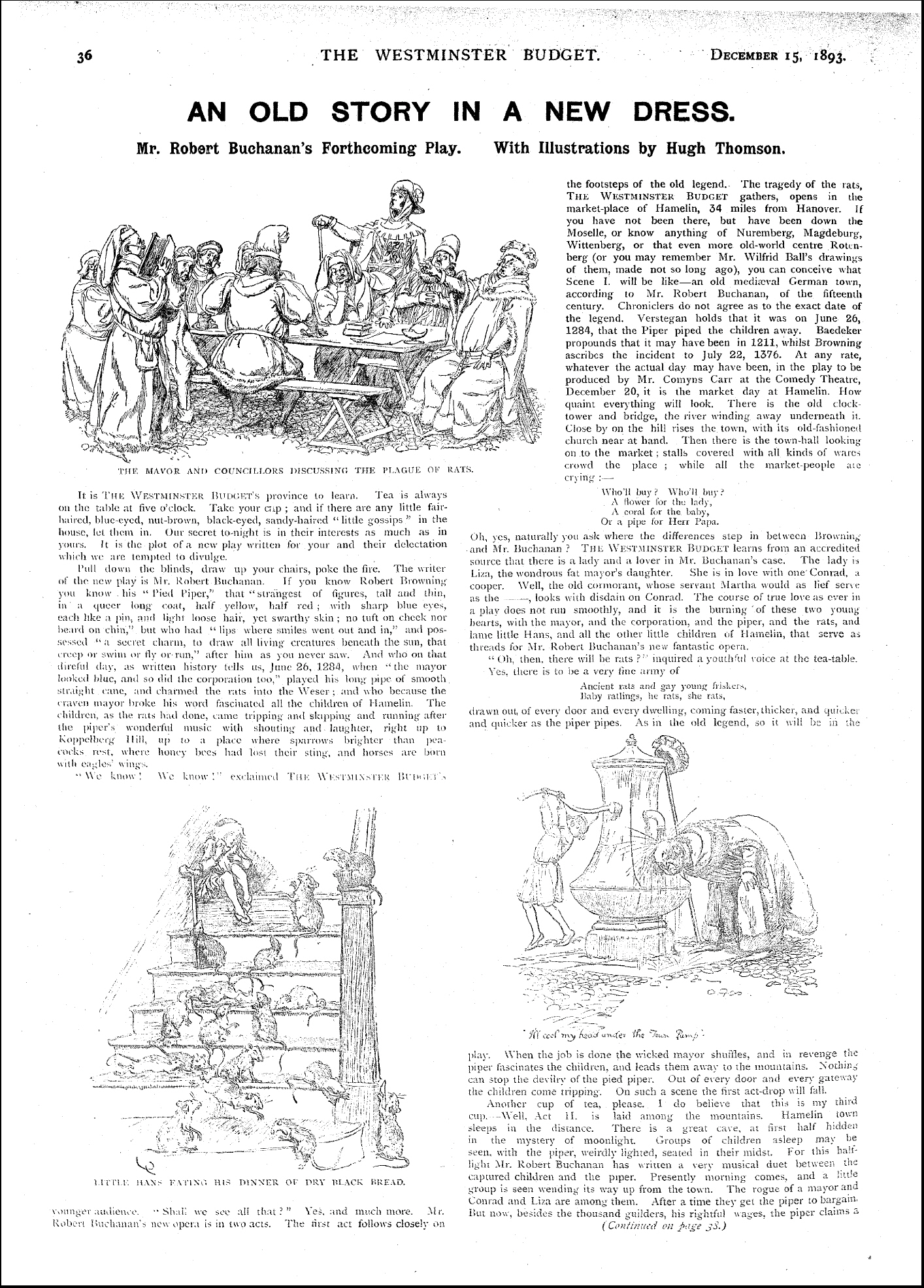
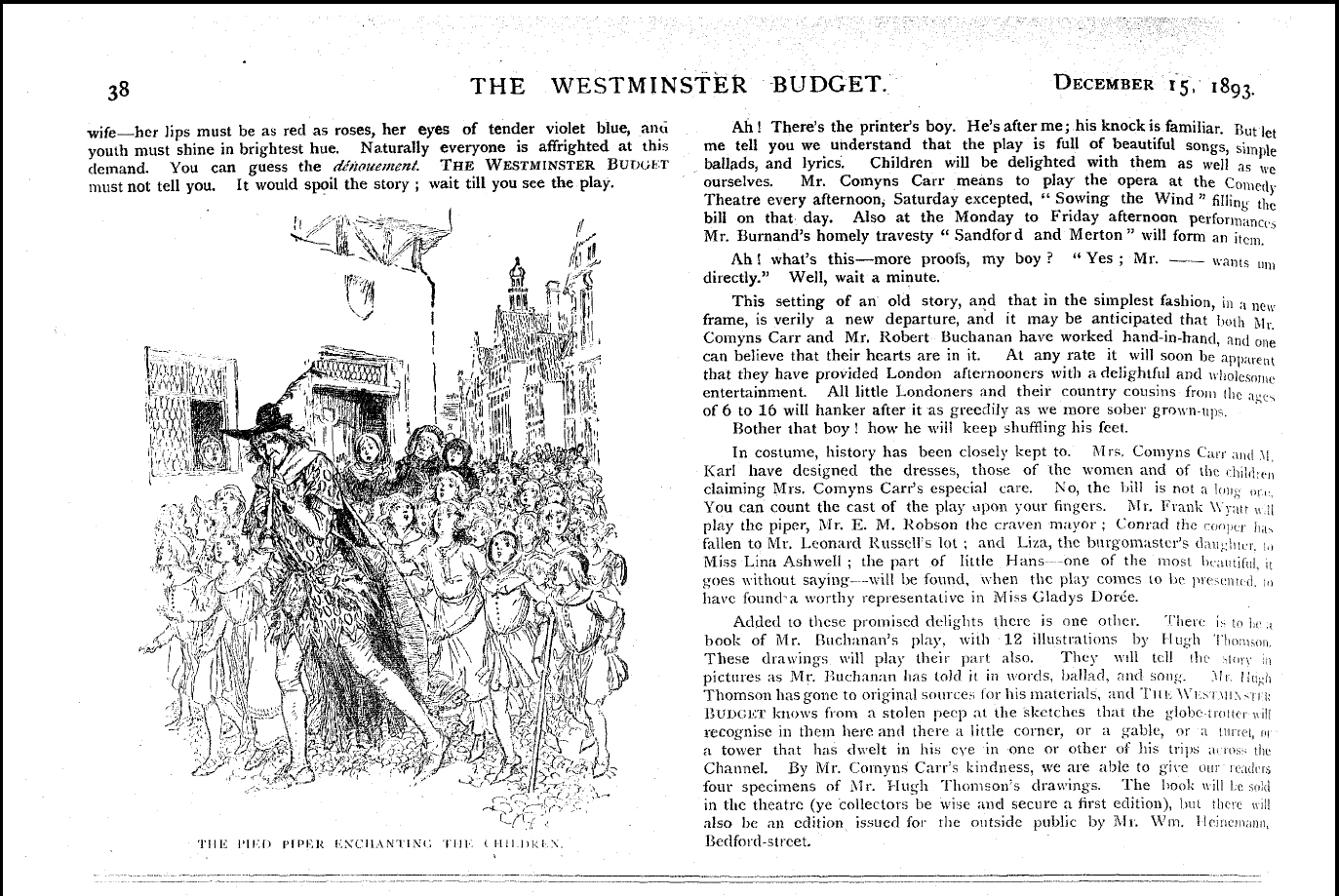
The Westminster Budget (15 December, 1893) [Click the pictures for a readable version.] Page 1 Page 2 |
|
|
|
|
|
|
|
|
|
|
|
|
|
|
 |
 |
||||||||||||
|
The Times (21 December, 1893 - p.8) COMEDY THEATRE. The season’s Christmas entertainment, began yesterday afternoon with the production of a version of The Pied Piper of Hamelin, by Mr. Robert Buchanan, especially intended for children, to be given every afternoon except Saturday, while Sowing the Wind keeps its place in the evening bill. Children both old and young will welcome the pretty realization of the familiar legend, which, however, occupies only the first act of the piece; for at its close we have seen not only the rats, but the children, lured away, and there can be no doubt that the impression made would be far stronger, though of course sadder, than it is if the single act were all. But a “happy ending” must be brought about somehow, and accordingly a new bargain is agreed to between the Mayor and the Piper, that the children are to be exchanged for the Mayor’s pretty daughter, who is to be torn from her lover’s arms and wedded to the Piper. To make all quite comfortable, this mysterious personage appears finally to be a benevolent character set upon doing well by the young lovers, and willing to restore the children for nothing; for he gives back the money ransom that is ultimately forthcoming, as the maiden’s dowry, so that his performance with the rats goes completely unrewarded. Mr. Buchanan has furnished the story with jingling rhymes and some bright dialogue. The music to which the lyrics, &c., are set is from the pen of Mr. F. W. Allwood, and is curiously deficient in “go.” As it is neither original nor very melodious, the success of the piece will rest entirely on the mounting and general effect of the spectacle. Here there is nothing that does not call for praise. In Mr. Frank Wyatt exactly the right exponent of the Piper’s whimsical figure is found, and when he has mastered the words of the part his performance will leave little to desire. Mr. E. M. Robson is a delightfully pompous little Mayor, and Miss Lena Ashwell a very winsome representative of his daughter, though the nervousness of a first appearance made it impossible for her to do justice to such merit as the music of the part possesses. There is in the present version no particular reason for the figure of the little lame boy, who tells, in Browning’s poem, of the effect of the music on the children themselves. The picturesque character is, however, retained, and most cleverly played by Miss Gladys Dorée, who is made up in exact reproduction of the figure in Pinwell’s picture. The dresses and scenery are most artistic, and the entertainment has the crowning merit of being entirely clear from the taint of burlesque, as at present understood. The swarming of the rats is cleverly devised, and the whole wonderfully effective. ___
The Guardian (21 December, 1893 - p.5) A charming afternoon entertainment for the children during the holidays has been devised by Mr. Comyns Carr at the Comedy Theatre, where it was given for the first time to-day with decided success. The programme consists of two pieces, both musical and both dealing with familiar subjects, the more important, which comes first, being a new version of “The Piper of Hamelin” from the pen of Mr. Robert Buchanan. This is described as a “fantastic opera in two acts.” It treats the old German legend with admirable spirit and humour, and the ending is, of course, a happy one, the children being duly restored to their relations, while Liza, the Mayor’s daughter, is ultimately betrothed to her faithful Conrad. Mr. F. Allwood’s music has little to recommend it beyond its appropriate simplicity; but the mounting is exquisitely artistic and picturesque, and Mr. Frank Wyatt makes an interesting and even weird figure of the Pied Piper. In the second piece, “Sandford and Merton” Mr. F. C. Burnand has furnished merely a brief sketch for the purpose of extracting fun out of the practical jokes played upon Mr. Barlow by his lively young pupils. But if short it is exceedingly merry, and Mr. Edward Solomon has added to the mirth of the various incidents by some “numbers” in his most tuneful and whimsical vein. Mr. Barlow’s mock solemnity is capitally realised by Mr. Lionel Brough, Messrs. E. M. Robson and Clarence Hunt being excellent as the boys. The dances and concerted pieces went splendidly, and Mr. Burnand’s smart puns evoked plenty of laughter. After each production the author and composer were “called.” ___
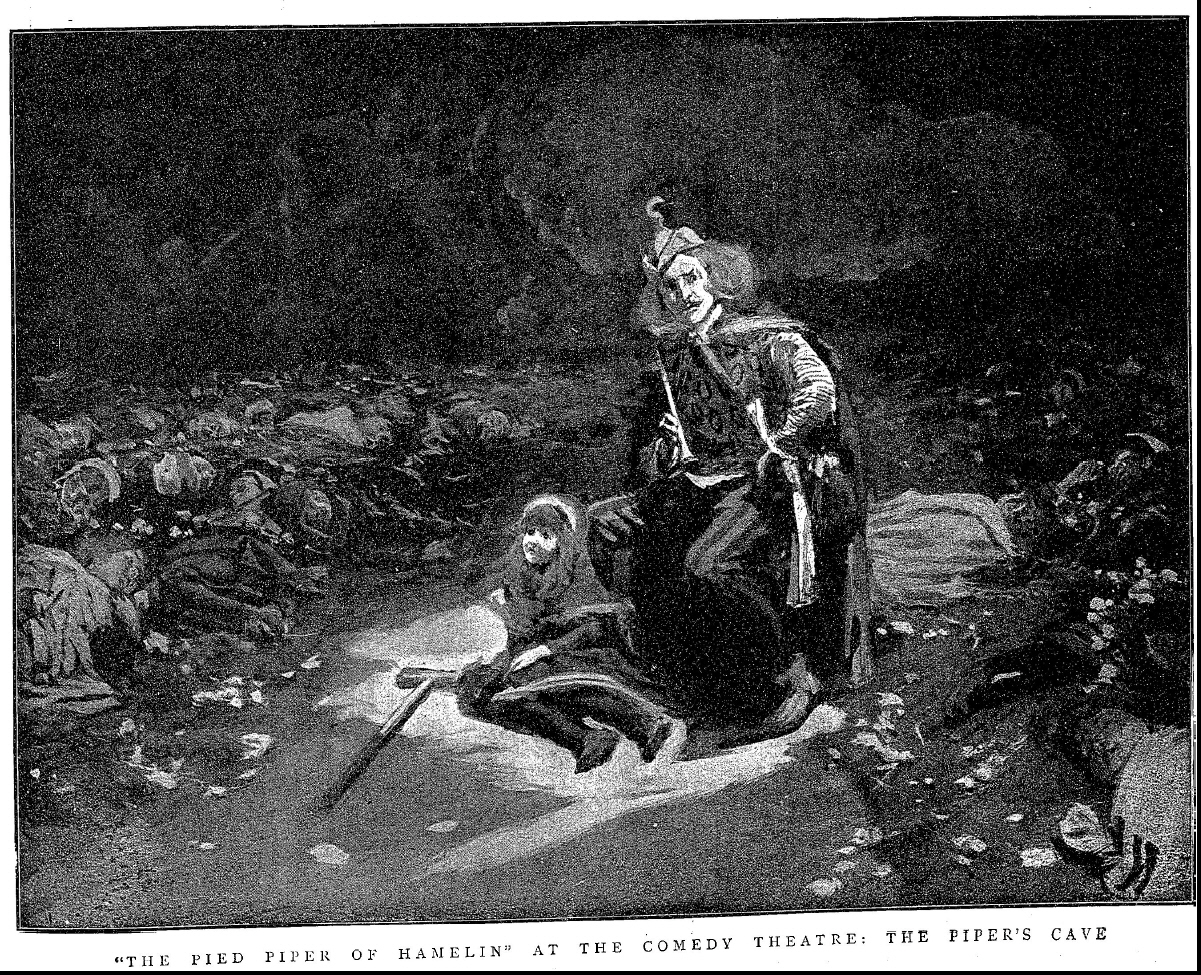
The Morning Post (21 December, 1893 - p.3) COMEDY THEATRE. It was a happy idea of Mr. Comyns Carr to have a series of afternoon performances for children, the first of these being given yesterday with very great success. Readers of Mr. Robert Browning’s poem, “The Pied Piper of Hamelin,” will know that Mr. Robert Buchanan, in adapting it as a “fantastic opera,” had a difficult task, but he has accomplished it with brilliant results. The piece is charming in every way, and not only the little folks, but “children of a larger growth” cannot fail to be delighted with a subject so poetical and picturesque, and so admirably worked out. The first scene is in the quaint old town of Hamelin, the period being the fourteenth century. The daughter of the Mayor is beloved by Conrad the Cooper; but the father objects, of course. This supplies the operatic love story, but soon we have the town in a commotion owing to the plague of rats, and at length the parsimonious Mayor is induced to offer a reward of a thousand guilders to any person who is able to conquer the vermin. Soon the piper appears just as the rats are becoming unbearable. They have eaten up the town records, they have destroyed the bell ropes of the churches, they have consumed all the food, and the inhabitants are in despair. The piper declares he can drive them away, and in proof of his power sings a song describing his exploits with vermin in various parts of the world. The Mayor, urged by the Town Council, agrees for the Piper to have the three thousand guilders if successful. Then comes a weird incantation scene in which the Piper calls “spirits from the vasty deep,” or elsewhere, to do his bidding. Presently the rats are seen creeping over the ramparts and into the river. The Mayor, finding the rats are all gone, refuses payment, and the Piper in revenge plays on his magic pipe and lures all the children to follow him to the mountains. The town is in a state of revolt, and the life of the Mayor is threatened. In the second act the children are seen in a cave, where the piper threatens to keep them until he is paid. But when his demand is met he insists upon taking the Mayor’s daughter as his bride. The maiden consents to the sacrifice for the sake of the children, but the piper is not so black as he is painted, and yields up the money to the poor and the maiden to her lover. Mr. Frank Wyatt was a capital representative of the Piper. Mr. Leonard Russell sang agreeably as the lover Conrad, and Mr. E. M. Robson played with delightful humour as the perverse Mayor. Mr. Clarence Hunt was amusing as a democratic citizen. Miss Lena Ashwell as the Mayor’s daughter made a pleasing heroine, and Miss Gladys Doree was a charming representative of a little lame boy. Other characters were efficiently acted, and the piece was received with enthusiasm, the author, composer, and the manager being called to the front. Respecting the music of Mr. F. W. Allwood, it may be commended as thoroughly suitable for its purpose, being tuneful and flowing if not ambitious. Some of the concerted music had much of the character of German part songs. The second item was Mr. F. C. Burnand’s extremely droll version of “Sandford and Merton.” Our old friends reappear most laughably transformed. They are the naughtiest of naughty boys, but their pranks are so diverting as to evoke incessant laughter. Mr. William Barlow has an awful time of it owing to the tricks of his young pupils. But he is far from being the immaculate gentleman we formerly knew. In fact he has sown a great many wild oats in his youth, but an old flame, a Frenchwoman with whom he flirted in the past, reappears, and he determines to settle down. After much business of a most amusing kind the curtain falls upon the announcement of Mr. Barlow’s intended marriage. As the boys, Mr. E. M. Robson and Mr. Clarence Hunt were full of drollery; and Mr. Lionel Brough, as Mr. Barlow, employed his humorous talent to the great satisfaction of the audience. Mr. Leonard Russell, as Tommy’s black servant, was another comic character; and Madame Ada Dorée represented the Frenchwoman. Miss Olga Garland and Miss Ethel Morton, as her pupils, cleverly sustained their parts. The music of Mr. Edward Solomon, who conducted the little piece, was well written and had many ingenious touches of humour. Hearty applause was awarded, and the composer and Mr. Burnand were called before the curtain. ___
The Standard (21 December, 1893 - p.3) COMEDY THEATRE. The familiar proverb that coming events cast their shadows before received an illustration yesterday afternoon at the theatre in Panton-street, now under the intelligent direction of Mr. Comyns Carr. Christmas is still a few days ahead, but the entertainment which has been prepared for afternoon performances, and was offered for approval yesterday, is suitable in every respect for Yuletide, and when properly worked up should prove acceptable not only to the little ones home for the holidays, but to children of a larger growth. The first item, a fantastic opera in two acts, founded on the story of “The Pied Piper of Hamelin,” arranged by Mr. Robert Buchanan, with music by Mr. F. W. Allwood, is a new version of an old legend, which appears in the folk-lore of several countries. It forms the basis of a striking poem by Browning, and it was utilised by the late composer, Victor Nessler, for an opera which had much success in Germany, though it was coldly received at Covent Garden some years ago, perhaps in consequence of an indifferent performance. The story is simplicity itself. The picturesque town of Hamelin is infested by rats, and a reward of a thousand guilders is offered to anyone who will exterminate them. The challenge is accepted by an itinerant piper, who, merely by the charm of his music, entices the vermin into the river, where they are drowned. The stingy Mayor, however, declines to pay the money, and the piper, who possesses supernatural powers, plays on his instrument to such effect that the children of the village follow him into the recesses of a mountain and are lost for ever. This is the original tragic tale, which dates from 1234, the place, of course, being Hamelin, in Hanover, where the River Weser joins the Hamel. Other authors than those named, among them being Julius Wolff, have dealt with the subject, and those of an inquiring frame of mind should consult Baring Gould’s “Curious Myths of the Middle Ages” and Sprenger’s “History of Hamelin.” Mr. Buchanan provides a pair of young lovers, with the Mayor as a prospective but by no means agreeable father-in-law, and makes the piper a benevolent demon, who eventually restores the children to their sorrowing parents, and compels the miserly and unscrupulous burgomaster to consent to the union of his daughter Liza with Conrad, a cooper by trade, and the man of her choice. ___
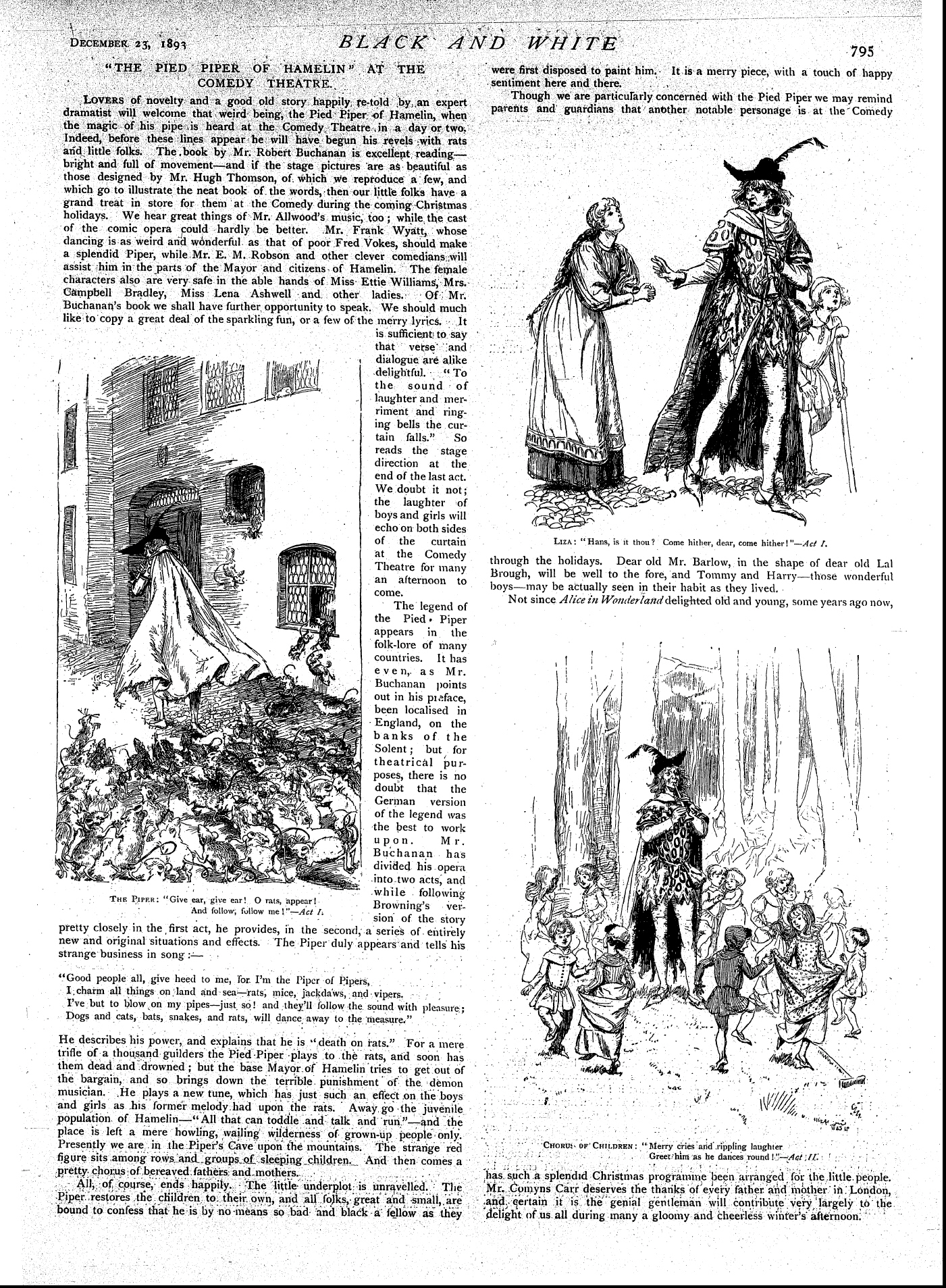
The Glasgow Herald (21 December, 1893 - p.7) THE new afternoon entertainment presented by Mr Comyns Carr at the Comedy to-day is supposed to be primarily for children; but the young folks must have advanced pretty considerably since the days when the present generation had just escaped from the nursery, or else the management have endeavoured to interest old as well as young. The first piece, described as a fantastic opera, entitled “The Piper of Hamelin,” is from the pen of Mr Robert Buchanan, with music by Mr F. W. Allwood. The familiar legend, which has so often done duty in poetry and opera, is in the main adhered to, but the denouement is different, and although the story contains a modicum of fun, a serious dramatic interest permeates it throughout. The version of the legend which places the scene on the banks of the Solent is not adhered to, and the play is localised in Germany, the first act following to a considerable extent the “Pied Piper” of Browning. In the old market place of Hamelin, after various choruses and other matter, the news is told of the invasion of the rats, and the Piper agrees to allure them away for the reward of a thousand guilders, which, after the rats have been got rid of, the Mayor refuses to pay. Here arises a slight variation from the original legend. The Piper pipes the children to the cave, and for ransom demands for wife the burgomaster’s daughter Liza, who is betrothed to Conrad the Cooper. To these terms the greedy townspeople are bound to agree, but the Piper is not so bad as he is painted. The Piper, in short, is a decent sort of a fellow when treated fairly. He thereupon joins the hands of Conrad and Liza, and gives them the thousand guilders for dowry. The piece is interspersed with music of various kinds, some of the choruses being particularly good; while the song of Liza, sung by Miss Ashwell, and duly provided with violin obligato, is very taking. In the last act, also, there is a capital series of choruses of children, besides a chorus of the townsfolk unaccompanied, the music of which runs throughout the scene. Mr Frank Wyatt played the part of the Piper, Mr Leonard Russell was the Cooper, and Miss Doree was excellent as a little lame boy whom the Piper befriends. The libretto, which is far above the average from the point of view of literary merit, is published by Mr Hugh Thomson. ___ Black and White (23 December, 1893) [Click the picture for a readable version.] |
|||||||||||||
 |
|||||||||||||
|
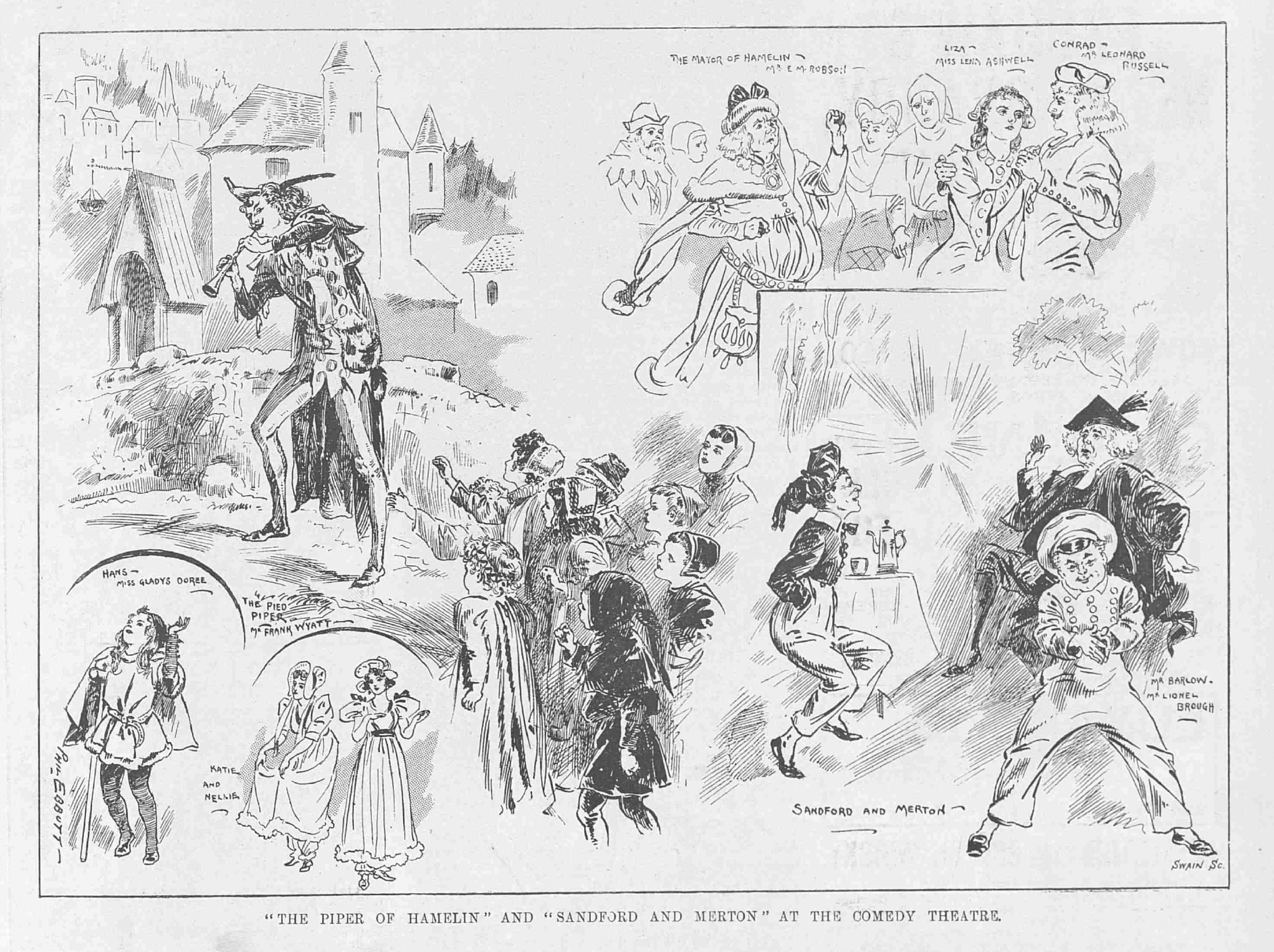
The Penny Illustrated Paper (23 December, 1893) “THE PIPER OF HAMELIN” AND “SANDFORD AND MERTON.” A Delightful Christmas Entertainment. MR. COMYNS CARR provides at the Comedy a completely novel entertainment, which heads of families will hasten to treat the children to. Mr. Robert Buchanan and his musical collaborator lead the way with “The Piper of Hamelin.” In the first act this charming little opera follows pretty well the widely known poem of Robert Browning, except that there is interwoven some love-passages between a passionate but penniless swain, Conrad (Mr. Leonard Russell), and a sweet tender maiden, Liza (Miss Lena Ashwell). Their mutual regard is, however, discovered by her father, the Mayor (Mr. E. M. Robson), a little rotund, rubicund individual, who has a corporation of his own especial growth as well as the town’s. Their meeting is prohibited, but their attachment, together with the sympathy they show for the shabby way in which the Piper (Mr. Frank Wyatt, the most attractive and graceful of pipers) is treated after delivering the town of the pest of rats, causes the latter to determine to help them. I want to marry if you please, The tender-hearted Liza offers herself as a sacrifice for the children, when the Pied Piper—who, although it would be difficult to find a more handsome or good fairy of the rougher sex, says he is not so bad as he seems—restores her to her lover with the heap of wealth that should have been his own reward as a wedding gift. ___
The Saturday Review (23 December, 1893) THE holiday season may be said to have begun with the series of matinée performances instituted by Mr. Comyns Carr at the Comedy Theatre, in addition to the evening and Saturday afternoon representations of Sowing the Wind. The afternoon programme is made up of two items, both of them meant for youthful audiences, though there is much in both calculated to amuse an older generation. Mr. Robert Buchanan has made a welcome departure from his usual style in preparing The Piper of Hamelin, a mixed version of the legend most familiar to us through the poem by Browning, to which, including the incident of the lame child, the adapter has adhered pretty faithfully, the finish, of course, being a happy one, as the Piper calls back the children, and leaves Conrad and Liza, if not with such an orthodox thing as a blessing, at least with an apparently sincere expression of goodwill. This story is told with suitable directness and simplicity, Mr. F. W. Allwood’s music is particularly well adapted to the children’s voices, and the mounting and costumes are extremely tasteful. Mr. Frank Wyatt was a sprightly Piper, and Miss Lena Ashwell an engaging Liza. A word of praise must be given to the intelligent and expressive rendering of the lame child by Miss Gladys Dorée. Mr. F. C. Burnand’s Sandford and Merton does not come to us as an absolute novelty. With lightly humorous music by Mr. Edward Solomon, the absurdities of Tommy, Harry, Mr. Barlow, Sambo, and Mme. Aurélie are palatable enough— though one or two little points might have been omitted with advantage in an entertainment meant largely, if not exclusively, for children. It is needless to say that no serious attempt has been made to keep up, or even in any true sense to burlesque, the original characters. It is simply a well-maintained piece of rather boisterous fun, not the least effective piece of drollery in which is the more or less French duet between Mr. Lionel Brough as Barlow, and Mme Ada Dorée as Mme. Aurélie. Altogether, it makes a capital entertainment for children. ___
The Era (23 December, 1893) “THE PIPER OF HAMELIN.” A Fantastic Opera, in Two Acts, by Robert Buchanan, The Pied Piper ... Mr FRANK WYATT It is difficult to imagine what is most likely to please the jaded appetite of the “up-to-date” juvenile. It is a moot point whether he cares for modern pantomime; he is certainly too blasé for the old-fashioned harlequinade; and some such entertainment as Mr Comyns Carr has secured for his “holiday matinées” at the Comedy Theatre is, perhaps, calculated to give him the greatest amount of satisfaction. Children are always interested in the adventures of other children; and Browning’s “Pied Piper of Hamelin” is a simple, fanciful fairy story of the kind which can be told to infants of all ages. The additions which Mr Robert Buchanan has made to the original narrative tend to tediousness; and yet it is hard to say how they could have been dispensed with. To have left the people of Hamelin mourning for their lost ones, with the lame boy only remaining outside the mountain to tell the tale, as runs the story in Robert Browning’s verse, would have outraged all ideas of poetical justice, and might have seemed to preach the doctrine—which some children already consider orthodox—that, whatever happens, the juveniles must always be the scapegoats of the errors of their elders. So some excuse has to be found for the restoration of the lost ones to their anxious relatives. This is arranged in the following manner:—At the beginning of the piece we are in the Market-place of the town of Hamelin. Conrad, a cooper, is enamoured of Liza, the daughter of the Mayor of the city; but, as he is poor, her father refuses his consent to the match. Driven to desperation by the plague of rats—the vermin invade every house and shop, and have even gnawed the town records to tatters—the burghers impeach the Mayor and Corporation until the former is compelled to proclaim that a reward of 1,000 guilders will be given to anyone who will rid the town of the troublesome rodents. The Piper, an eccentric personage of semi-Satanic mien, arrives, and undertakes to kill all the rats on condition of receiving the reward. After an invocation, he plays on his pipe, and the rats come rushing out and are drowned in the river. But when the Piper demands his reward neither the people nor the Mayor will remunerate their benefactor, who thereupon, waxing wroth, decoys all the children away with his magical instrument of music. In the second act they are seen sleeping in a cavern, haunted by the weird Piper, who finally promises to give them up to their parents if the fair Liza will become his bride. After a struggle she consents, to save the children, but at the last moment the Piper relents, and restores the little ones safe and sound on payment of his reward, one of the children, a lame boy, being cured of his defect during his residence in the bowels of the earth. It was the second act which dragged on Wednesday, the altercation arising from the Piper’s demands being too long dwelt upon. “SANDFORD AND MERTON.” Mr William Barlow ... Mr LIONEL BROUGH There is fine fun in this for the juveniles. Boys home from school may snatch a fearful joy from the pranks played by Harry Sandford and Tommy Merton upon their tutor. Sandford and Merton will be found by many of them better than a pantomime. Sambo, the black servant, is pestered with squirts and peashooters; a needle is placed in the cushion of Mr Barlow’s chair; and, when he goes to receive a visitor, a deposit of meal which the boys have placed in his cap, falls upon his hair and garments. Then there are merry musical numbers, in which Mr Edward Solomon has supplied some of his brightest and liveliest music to Mr Burnand’s lightly tripping verses. A duet between Tommy and Harry is followed by a comical dance, and Mdlle. Aurélie, who comes to claim Mr Barlow as her long-lost fiancée, has a share in a mock sentimental French duet with the Doctor beginning “T’en souviens-tu? Ces belles journées,” the humour of which is irresistible. The cleverness of Mr Burnand’s constantly crackling puns will, perhaps, be more appreciated by the elders who accompany the children than by their charges, but some consideration is surely due to these guardians. Sandford and Merton was played with great spirit. Mr E. M. Robson and Mr Clarence Hunt were very funny indeed as the two boys, and their practical jokes, songs, and dances met with hearty response from an appreciative audience. Mr Lionel Brough was grimly humorous as Mr Barlow, and Madame Ada Dorée as Aurélie was most amusing, her share in the French duet being done with great spirit. Mr Leonard Russell seemed quite at home in the “black cork” make-up of Sambo, and the only pity was that he had not more to do. Miss Olga Garland and Miss Ethel Norton made two pretty pupils, but their singing left something to be desired. Sandford and Merton was received with warm favour by an audience which included a large number of juveniles. ___
The Illustrated Sporting and Dramatic News (23 December, 1893 - p.30) COMEDY THEATRE. MR. COMYNS CARR had what will, we hope, prove to be a happy thought in arranging the Christmas entertainment which he presented at the Comedy Theatre last Wednesday afternoon. It is notorious that the music-hall element which has swamped so many pantomimes is little to the taste of the average youthful playgoer, however much it may be enjoyed by his elders. There is nothing of this kind either in Mr. Robert Buchanan’s unsophisticated version of the legend of the Piper of Hamelin, with its illustrative music by Mr. F. W. Allwood, nor in the adaptation of Mr. Burnand’s delightful skit upon Sandford and Merton, for which Mr. Edward Solomon has officiated as composer. It has of course been held for a long time by experts that theatrical productions which, like these, appeal principally to children, appeal in vain so far as “money” is concerned, the children not being strong enough either to bring their parents and guardians with them, or to come by themselves. If that be the rule, this will, we trust, prove the exception; for the grown-up playgoer who cannot find in Mr. Comyns Carr’s afternoon programme plenty to reward him for his visit must be very hard to please. The eye, the ear, the fancy, and the understanding, are equally well provided for, and the entertainment, refined without dulness, and spirited without vulgarity, thoroughly deserved the encouraging reception accorded to it on Wednesday afternoon. ___
The Aberdeen Journal (23 December, 1893 - p.5) Every afternoon for some little time to come we may expect that the Comedy Theatre will have a great proportion of Children in its audience, for yesterday Mr Comyns Carr began a courageous attempt to restore the old form of Christmas operatic play, which adheres fairly close to some well-known story, without any of the modern burlesque additions which make an ordinary pantomime. Mr Carr has begun well with two short operas from the pens of Mr Robert Buchanan and Mr F. C. Burnand. It is to be feared, however, that he will neither displace the present form of pantomime nor make a success of his present venture. “The Piper of Hamelin” is, as its name implies, founded on the well-known ballad of Robert Browning. It would be an injustice to Mr Buchanan’s earlier works to say that he was at his best in this short opera. His songs are sometimes sweet, and the music of Mr Allwood is happy, but they are very, very far below Browning. The representation of the play, too, is far from first class. The size of the stage at the Comedy must, in some degree, be held accountable for this, for it is too small for the accommodation of anything like a large group of people. |
|||||||||||||
 |
|||||||||||||
|
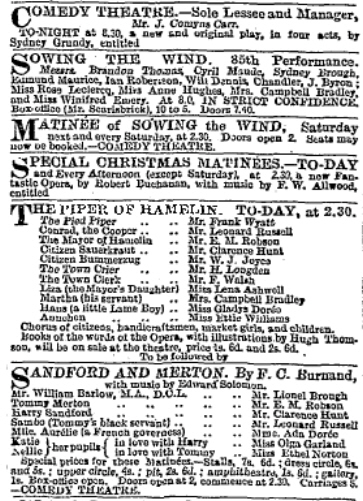
[Advert for The Piper of Hamelin from The Times (Tuesday, 26 December, 1893 p.6).] |
|||||||||||||
 |
|||||||||||||
|
[Illustration from The Graphic (30 December, 1893) - click the picture for a larger image.]
The Illustrated London News (30 December, 1893 - pp.27, 29) THE PLAYHOUSES. BY CLEMENT SCOTT. The children are in luck this year. In addition to the beautiful pantomimes, and circuses, and Noah’s Arks, and Constantinoples with which the world of amusements is flooded, there has been prepared for them at the Comedy Theatre the prettiest and merriest entertainment ever prepared in London for the amusement of clever, art-loving, natural, and unpriggish little ones. Mr. Comyns Carr’s afternoons are the outcome of a truly artistic and sympathetic nature. Assisted by his clever wife, with whom beauty and colour are the dominant chords, the popular manager of the Comedy, like the good fellow that he is, wishes to enlist the youngest of recruits into the army of art. They cannot learn their goose-step too soon. For them are given every year the most beautiful picture-books, for them a Caldecott and a Kate Greenaway have toiled successfully, so why should they not feast their eyes on the beautiful when they are taken to the Christmas Theatre? Mr. Robert Buchanan has dramatised the “Pied Piper of Hamelin” admirably, and I don’t myself care a straw for the opinions of the many objectors who are angry because the little German children are not shut up for evermore in the dark and desolate mountain. Of course the children had to come back, and Mr. Robert Buchanan was quite right to bring them back, and give the youngsters their time-honoured formula, “And so they returned and lived happily ever afterwards.” Fancy a Christmas entertainment with a miserable ending! Why, only old Scrooge could have written it. If anyone had to return to the recesses of the mountain it was the fantastic Piper himself; and I can picture nothing more fanciful than this strange creature, who had won the love of little children, half detained on earth by their twined rose garlands and tendrils. On the first afternoon I heard many strange objections to the Piper, but all I know is that the play deeply affected me, and gave the keenest delight to the hundreds of children who were sitting around me. The pessimists, who would poison a plum pudding, complained that the happy ending and the return of the children were all wrong; the scientific musicians quarrelled with the music, because it was tuneful, I suppose; and all the time the audience, for whom the entertainment had been prepared, was lost in admiration. That is quite enough. Mr. Comyns Carr’s clients were satisfied, and therefore there is no more to be said. At any rate, if it is a crime to be sentimental at Christmas time, the downright tomboy who loves mischief and practical jokes had a regular field-day when Mr. Frank Burnand’s new version of “Sandford and Merton” came on for discussion. How the boys just home from school roared when Tommy and Harry put squibs into their tutor’s morning egg, and darning-needles into his professional cushion, and pelted Sambo with apples! Mr. Burnand and Mr. Edward Solomon, who have so often worked well together, are here in their best vein, and so, what with them and the poet Buchanan, the sentimental and the funny child are alike satisfied. All I can say is that we never had such dramatic feasts as these when we were children, and all the youngsters should pass a unanimous vote of thanks to Mr. Comyns Carr, who, I doubt not, before the holidays are over, will ask the children to some to a special matinée in aid of all the children’s hospitals in London. Now, would not that be a good idea? On that occasion the Little Lame Boy, played so charmingly by Miss Doree, would be voted to the chair, or, better still, go round with his crutch and cap, and humbly beg for some contributions. ___
The Illustrated Sporting and Dramatic News (30 December, 1893 - p.11) |
|||||||||||||
 |
|||||||||||||
|
Lloyd’s Weekly Newspaper (31 December, 1893 - p.2) COMEDY THEATRE. With the addition devised by Mr. Robert Buchanan, there is much in the legend of The Pied Piper of Hamelin to please children of all ages. The youngest will be interested in the fate of the juveniles lured by the weird musician into the mountains, in retaliation for the deceit practised upon him by the Mayor after exterminating the rats; and for the elders there are pretty love passages, ending in self-sacrifice. Liza, the Mayor’s daughter, volunteers to pay the price demanded by the Piper for the release of the imprisoned children by giving him her hand. But not being quite such a malignant being as the citizens supposed, the Piper abandons his pretensions and gives Liza back to her lover, besides setting the little ones free. There is no particular claim to literary merit in the dialogue, but the whole is plainly told and effective from the stage point of view; whilst Mr. F. W. Allwood’s music is tuneful without being in the least degree ambitious. Mr. FrankWyatt plays the Piper in a fantastic spirit, Miss Lena Ashwell and Mr. Leonard Russell are the lovers, and Mr. E. M. Robson is quaint as the Mayor. The little lame boy Hans, upon whom the Piper works a miracle, is ably played by Miss Gladys Doree. A large juvenile and adult chorus has been engaged, and in the mounting of the piece much finish is displayed. The after-piece Sandford and Merton, by Mr. Burnand, is somewhat pantomimic in its fun, and the author is fortunate in securing as interpreters such comedians as Mr. Lionel Brough for Dr. Barlow, and Messrs. Robson and Clarence Hunt for the two pupils. Mr. E. Solomon has written some lively music for the trifle. ___
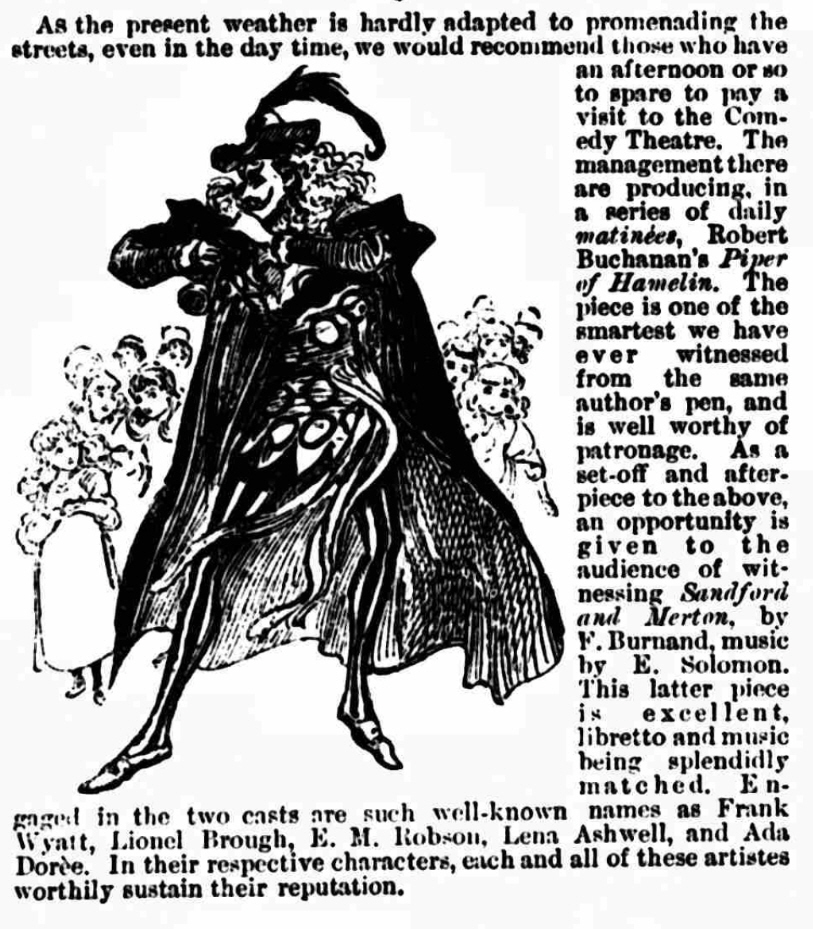
Ally Sloper’s Half Holiday (20 January, 1894 - p.6) |
|||||||||||||
|
|
 |
|
|
 |
|
|
|
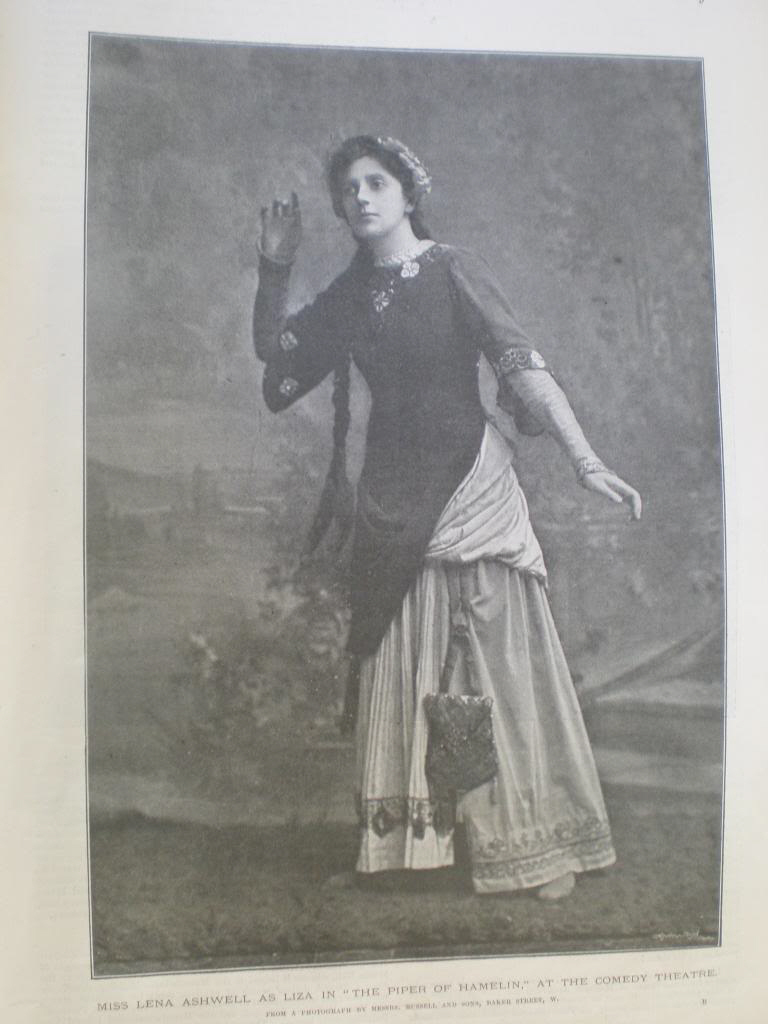
[Lena Ashwell as Liza in The Piper of Hamelin from The Sketch (31 January, 1894).]
The Theatre (1 February, 1894) “THE PIPER OF HAMELIN.” A Fantastic Opera, by Robert Buchanan, with Music by F. W. Allwood. |
|
|
|
|
|
followed by SANDFORD AND MERTON, By F. C. Burnand, with Music by Edward Solomon. |
|
|
|
|
|
What Carlyle did for Cromwell, Mr. Buchanan has done for the Piper, that weird musician who charmed the rats of Hamelin into the Weser, and when the Mayor withheld his fee, with a malicious chuckle piped the children into the mountain, and the result is a pleasing picture of a much misunderstood man. Outwardly the Piper is just what he was. Very tall, and very thin, he wears a cynical smile on his handsome face. A diabolic atmosphere surrounds him. When he charms the rats the lights grow dim, thunder rumbles, and a lurid haze enfolds him. He mutters and mumbles magic words, his eyeballs roll, his long arms wave in awful incantations. And still more terrible does he appear when piping the children away from their homes. The mothers’ sobs and tears, the prayers of Liza, avail nothing. He will spare not even the wee cripple Hans, who hobbles along on his little crutch a—second Tiny Tim—spellbound by the magic music. But the Piper is really a kindly man. He will restore the little ones if the Mayor will give him the fee and his daughter in marriage, and no sooner is Liza his than he makes her and his thousand guilders over to Conrad, whose suit the Mayor has rejected. Then forth comes the magic pipe again, and out from the gloomy rock the children dance, laden with roses, shining with gladness, little Hans at their head without his crutch, for in the fairy world his lameness has been cured, and he can leap and run. The piece is just what it should be—a fairy tale in action—a fairy tale that the pictures tell, and that children, little and big, are glad to be told. The pretty story is prettily told. Mr. Buchanan’s verse flows freely, and makes music as it ripples along. It is prettily acted also. Mr. Wyatt is the Piper, and looks him to perfection. Miss Lena Ashwell, a pretty young actress with a pretty style and a gift of pathos, is Liza the self-sacrificing. And clever Mr. E. M. Robson and Mr. Leonard Russell are at their best as the Mayor and the Cooper. But a child is the hero, as it should be in a child’s play. The little lame boy, played by Gladys Dorée, makes a wonderfully touching little figure, and one hardly knows which to admire the most, the touch of poetry due to Mr. Buchanan or the little one’s irresistible charm. ___
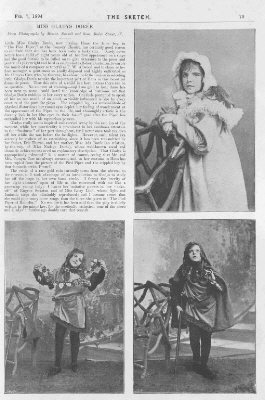
The Sketch (7 February, 1894 - p.21) |
|
|
 |
|
|
|
Next: The Charlatan (1894) Back to the Bibliography or the Plays
|
|
|
|
|
|
|