 |
|
|
Play List: 4. Corinne 7. The Mormons 9. Lucy Brandon 10. Storm-Beaten 11. Lady Clare 13. Bachelors 14. Constance 15. Lottie 16. Agnes 17. Alone in London 18. Sophia 19. Fascination 20. The Blue Bells of Scotland 21. Partners 24. Angelina! 25. The Old Home 26. A Man’s Shadow 27. Theodora 29. Clarissa 30. Miss Tomboy 32. Sweet Nancy 33. The English Rose 36. Marmion 37. The Gifted Lady 38. The Trumpet Call 39. Squire Kate 40. The White Rose 42. The Black Domino 44. The Charlatan 45. Dick Sheridan 47. Lady Gladys 48. The Strange Adventures of Miss Brown 49. The Romance of the Shopwalker 52. Two Little Maids from School ___ |
|
|
|
ROBERT WILLIAMS BUCHANAN (1841 - 1901) |
|
|
|
|
|
|
|
|
|
REVIEWS OF POETRY READINGS
1. Robert Buchanan’s Poetry Readings 2. Other Performances of Buchanan’s Poems: ii. Nell iv. Fra Giacomo v. Tiger Bay vi. The Ballad of Judas Iscariot vii. The Lights of Leith viii The Green Gnome
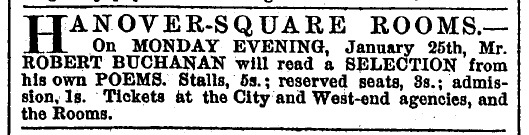
1. Robert Buchanan’s Poetry Readings In Chapter XV of her biography of Robert Buchanan, Harriett Jay gives the reasons why Buchanan embarked on a series of Public Readings and why he then abandoned the practice: “Up to this time (1868) five years had elapsed since the publication of his first volume of poems, and during those five years he had published many more, yet in spite of the large sums which he received from these volumes, and in spite of much ignoble pot-boiling, he found himself at the close of the year 1868 in such monetary difficulties that he was compelled to face the situation and cast about in his mind for some kind of work which would be more lucrative than that of literature, with the result that after a good deal of deliberation he determined to follow in the footsteps of Dickens—to emerge from his solitude and give readings from his own works on the public platform. This he did, on January 25, 1869, appearing at the Queen’s Concert Rooms, Hanover Square. His appearance in public created no little stir, and the audience which he drew was an exceptional one. “In front of him sat Lord Houghton, on his right was Robert Browning, near him Dr. Westland Marston and the Rev. Newman Hall. The body of the room was full of literary men, critics, editors, publishers, but he was not afraid of his critical audience; he faced them boldly, read manfully and well, and wrung from them for his best passages the tribute of enthusiastic applause.” There cannot be a doubt that he was in every way well fitted to succeed in the path which he had elected to tread; “he had a pleasing and distinct delivery, a voice of compass and power, and a prepossessing appearance.” “ If all our writers” (said the Examiner) “were as capable as he of doing histrionic justice to their works, we should consider them not only unwise but positively culpable in not treading the same path as that so manfully traversed by Charles Dickens and Robert Buchanan.” Harriett Jay does not mention the first reading in Glasgow on December 10th, 1868, or the second on January 5th, 1869. Buchanan was living in Scotland at the time, so these were presumably rehearsals for the main event in London. Although she gives Buchanan’s ill health as the reason for abandoning the money-making scheme, the mention in the review of the first London reading in The Era that “The audience was not large”, might give another clue as to why Buchanan, despite the complimentary reviews, did not continue to perform his own work. Further information is available in Andrew M. Stauffer’s essay, ‘Another Cause for the “Fleshly School” Controversy: Buchanan Versus Ellis’. Buchanan had several creditors in London, among them the publisher and bookseller, Frederick Startridge Ellis. On 21st January, 1869, Ellis issed a writ against Buchanan for unpaid debts. On 22nd January, Charles Shea (solicitor) wrote to Ellis: “The ‘arrangement’ with ‘his creditors’ is doubtless only a dodge to allow the B to appear on Monday safely.” Following the first London reading, Shea writes: “He was not to be found at the address from which he dated his letter to you [23 Newman Street], & he managed so well at the Reading that altho’ a very experienced Writ-server was after him he managed to get into the Hanover Square Rooms & out again without detection, with some sort of disguise the server believes.” |
|
|
 |
|
|
|
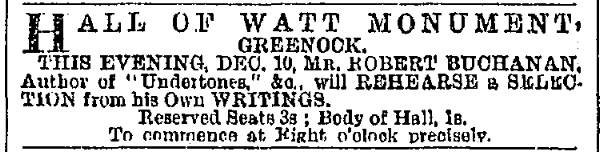
[Advert in the Glasgow Herald (10 December, 1868).]
Glasgow Herald (12 December, 1868) MR ROBERT BUCHANAN’S READINGS.—On Thursday night, Mr Robert Buchanan, of London, rehearsed, in presence of a numerous and appreciative audience, selections from his poetical works, in the hall of the Watt Institute, Greenock. The pieces chosen were well suited for testing the histrionic powers of the poet, and in some degree it may be stated he passed the ordeal satisfactorily. The audience frequently testified heir appreciation of the subject matter, and the manner in which Mr Buchanan interpreted the thoughts of the characters represented. At the close, on the motion of the Rev. Dr. Gunion, a cordial vote of thanks was voted to Mr Buchanan. We understand that Mr Buchanan purposes giving a series of readings from his own works in London on an early day. ___
Illustrated Times (12 December, 1868) One of the most striking effects of the printing press has been the very decided form which it has given to the change in the relations between the poet and those to whom he sings. Nothing is more natural than that a poet should recite his own verses, yet when Mr. Dickens began to read his own writings (which are all of the poetic order) it was thought an undignified innovation. It seems Mr. Robert Buchanan, who has been publicly reciting in Scotland extracts from his own works, is going to try the experiment in London immediately. I suppose curiosity will take a good many people outside of literature to see a man who has written so much and been so much written about, and literary people proper will, of course, gather in numbers to greet the reciter; but, apart from this, a poet ought to be able to read his own verses in such a manner as to make us like them and him better. Professional readers are most of them coarse in their renderings, and the man who sings the song must know a hundred secrets of meaning in it which no one else can know. Undoubtedly the step is a daring one for Mr. Buchanan to take; but, of course, that will not lessen the interest of seeing him take it! ___
The Penny Illustrated Paper (19 December, 1868 - p.11) MR. ROBERT BUCHANAN, the poet, following the example of other authors, is about to read, in London and elsewhere, a selection from his own writings, entitled “Voices of the Fate-Stricken.” ___
The Guardian (22 December, 1868 - p.7) The Scotch papers announce that Mr. Robert Buchanan has made a successful first appearance as a reader of his own poems. ___
Glasgow Herald (7 January, 1869) MR BUCHANAN’S READINGS.—On Tuesday evening Mr Robert Buchanan, of London, rehearsed selections from his works in the hall of the Watt Institute, in presence of a numerous audience. Provost Morton presided. The readings were favouably received, and at the close the usual complimentary votes terminated the proceedings. |
|
|
 |
|
|
 |
|
|
|
(p.279) |
|
|
 |
|
|
|
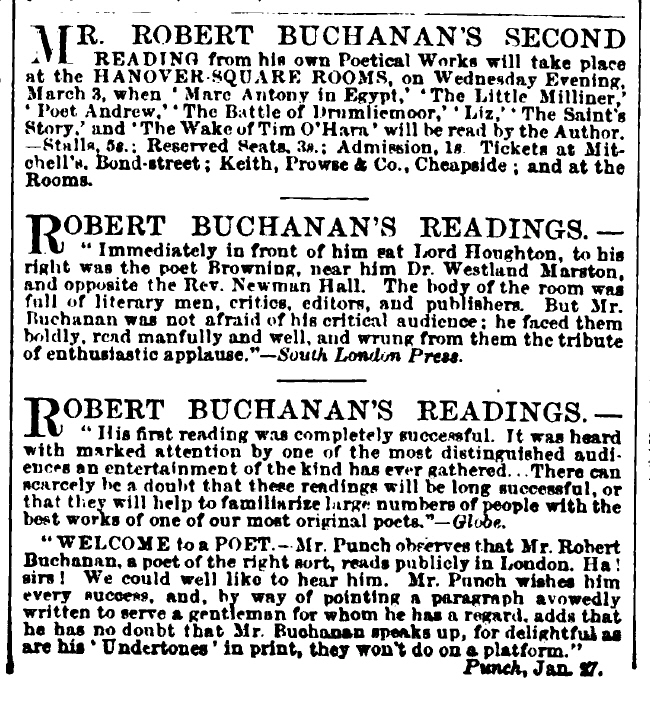
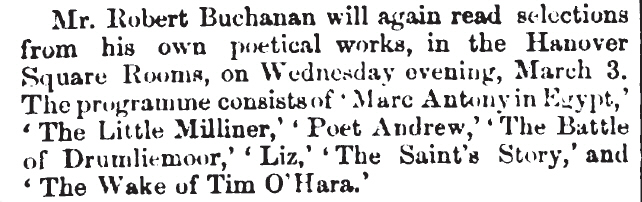
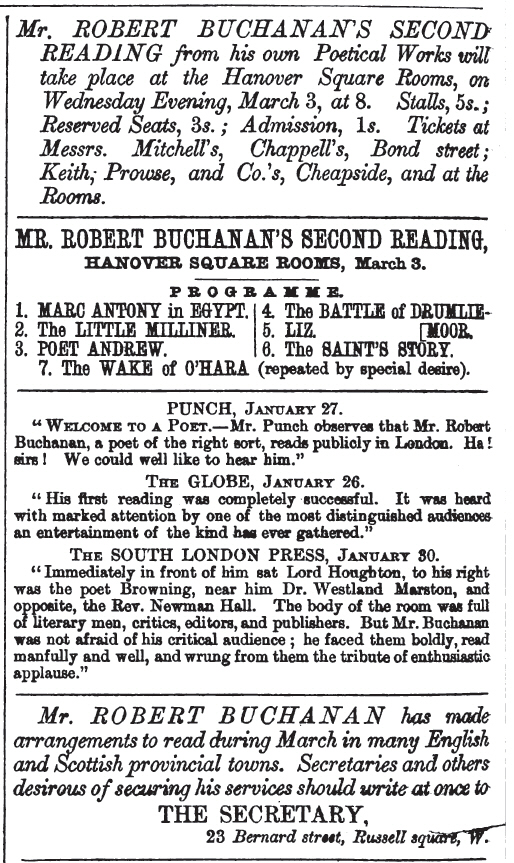
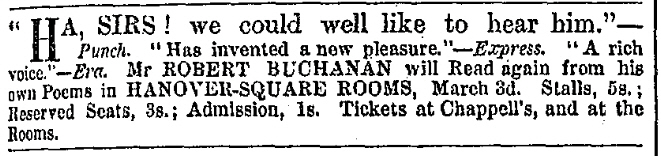
Illustrated Times (27 February, 1869) The place to see literary great guns, or, as Mr. Hannay calls them, “those big cocks, you know,” was the Hanover- square Rooms, on the occasion of Mr. Robert Buchanan’s first public reading in London. From Mr. Robert Browning and Lord Houghton downwards, or laterally, or as you please, since Literature is a Republic, the room was full of faces more or less known in the world of letters and of art. Mr. Buchanan is going to give another reading on Wednesday, March 3; and, as London is now full, it is to be expected that the place will again be all ablaze with beauty and brains (I flatter myself that is rather sensational!), especially as the programme is new—except that “Tim O’Hara’s Wake” is to be retained, because it is such a “hit.” |
|
|
 |
|
|
|
[Advert for Buchanan’s second London Reading in The Spectator (27 February, 1869).] |
|
|
 |
|
|
|
[Advert in The Era (28 February, 1869).]
The Spectator (6 March, 1869 - p.3) Mr. Robert Buchanan’s second reading of selections from his own poems at the Hanover Square Rooms took place on Wednesday, and in spite of many harshnesses, and many faults arising from what seems to the hearer, especially in particular parts of particular poems, a painful amount of effort and self-consciousness, was certainly a remarkable performance, of which none who heard it could have failed to appreciate the power. Mr. Buchanan, indeed, when aiming at prettiness of manner, and sprinkling his emphatic and somewhat artificial bass-tones over sentences wherein he makes a. violent. rush at feminine sensibilities, and misses, is not attractive. “Liz”—perhaps the finest of his poems—was to us a suffering, especially where she dwelt on the baby; and “The Little Milliner” with her burning chestnuts was well nigh making us wish to vanish into the floor. But “Poet Andrew” was read with a great deal of strong pathos, and “The Battle of Drumliemoor,” in spite of a little too much of the ‘set-teeth’ enunciation, carried us entirely away, before the close, with the solemn but lucid rapidity of its movement,—the reciter bringing every feature of the scene before us with a new force and vividness, and sometimes entirely losing himself in the stern rapture of the tragedy. This was the more striking, that to an ordinary reader the metre and rhythm, though exceedingly fine, are less simple, and need more art to bring them out, than those of any other of the pieces recited. Besides this, the reading of “The Starling,”—a most original poem, gruff, simple, humorous, melancholy in conception,—and “The Wake of Tim O’Hara”—an unpublished poem, among Mr. Buchanan’s best, for precisely the. same qualities,—was very simple and telling, an unmixed pleasure to the audience, and a new light to the student of the author’s poetry. Mr. Buchanan’s voice is very powerful, and rich when it is not harsh. ___
Lloyd's Weekly Newspaper (7 March, 1869) MR. BUCHANAN’S READINGS. Precedents are rare in modern times in which poets have come before the public as readers of their own works; and when Mr. Robert Buchanan, who had achieved a great reputation by his “London Poems,” “Undertones,” &c., first mounted the platform, considerable interest was awakened. After a probationary tour in the provinces Mr. Buchanan appeared before a metropolitan audience at the Queen’s Concert-rooms, Hanover-square, a few weeks since, and having met with an enthusiastic reception he gave a second reading in the same hall on Wednesday evening last. There is, of course, always a natural curiosity to see and hear a popular author, but Mr. Buchanan has far higher claims on public attention. His poetic genius is combined with an elocutionary power which enables him to do full justice to his beautiful poems. The dramatic intensity which characterises many of these charming creations is vividly realised, and the pathetic portions are rendered with an earnestness and depth of feeling which commands the sympathies of his audience. In the lighter pieces Mr. Buchanan exhibits the keenest appreciation of humour, and he reads them off with a heartiness and freedom that provokes continual laughter. The first part of the programme on Wednesday evening comprised the historic sketch from “Undertones,” “Marc Antony in Egypt;” the charming love poem, “The Little Milliner,” “Poet Andrew,” the deeply pathetic story of the life and early death of David Gray, a young Scotch poet, which was read in the most touching manner; and the description of the sanguinary “Battle of Drumliemoor.” The second part opened with “Liz,” and that forcible story of the neglected career and sad end of the poor street fruit-seller appealed strongly to the feelings of all present. After this came the grimly-humorous composition, “The Starling.” The bird and his master, an old tailor, are both dissatisfied with their treatment by the world, and vent their indignation in swearing. In the reading the climax of each stanza was worked up to very cleverly, and the piece was loudly applauded. “Agnes and the Merman,” a highly poetic piece, but not effective enough for a public reading, followed, and the reading concluded with an unpublished poem, “The Wake of Tim O’Hara,” a droll composition in which the whining, drinking, fighting, praying, and other incongruities of an Irish wake are described with much force and vigour. This was also very successful, and Mr. Buchanan retired amidst loud applause. ___
As well as inviting Browning to his London readings (see Letters), Buchanan also invited Swinburne. The University of Michigan has the following letter from Swinburne to Buchanan, regretting that the invitation to the first reading arrived too late to be used. From The Swinburne Letters edited by Cecil Y. Lang (Volumes 1-6) (Yale University Press, 1959-1962), Vol. 6, Letter 286A, p. 264: Arts Club, Hanover Square, Dear Sir Yours sincerely, Robert Buchanan, Esq.
However, Swinburne did attend the second reading, which is mentioned in the following piece: Appletons’ Journal (21 August, 1875 - Vol. 14, Issue: 335, p.252) OUR LONDON LETTER. . . . Mr. Swinburne is one of the most nervous men—he is very slightly built, and not more than five feet two in height—you could possibly imagine. I shall never forget seeing him at the poetic readings given by the poet Buchanan, some years ago, in the Hanover-Square Rooms. There, in a corner, his intellectual face now wearing a scowl, now a beatific expression, as he was pleased or displeased with his brother poet’s elocution, did he sit twirling his fingers and thumbs in a ludicrously-excited way. Ere long he became the observed of every one. “Who is that?” whispered a mercantile friend to me, nodding toward him. “That,” replied I, wishing to surprise the man of figures, “is one of our greatest poets, Mr. Swinburne.” “Indeed!” was the reply. “Well, I’ve always heard that poets were a rum lot; now I’ve no doubt about it!” . . . WILL WILLIAMS. _____
2. Other Performances of Buchanan’s Poems.
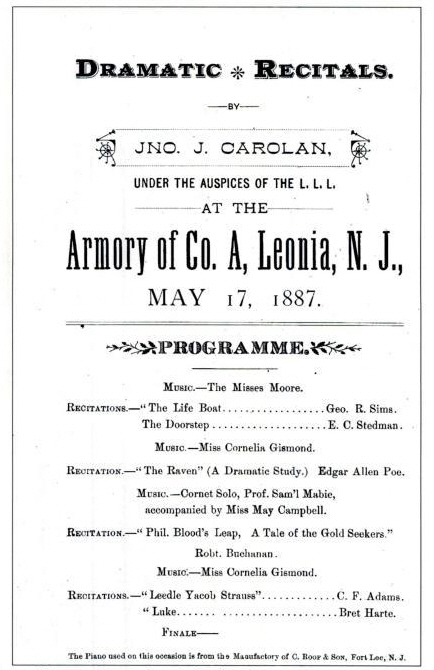
Several of Buchanan’s poems became popular recitation items. ‘Fra Giacomo’ was also adapted into a short play as well as being filmed in 1913 by the Eric Williams Speaking Pictures company. ‘Phil Blood’s Leap’ received the same treatment from Clarendon Speaking Pictures the same year - more information in the Robert Buchanan Filmography section.
Glasgow Herald (28 October,1874) DR LEO ROSS IN THE QUEEN’S ROOMS. Dr Leo Ross, the now famous reader, appeared in the Queen’s Rooms last night, and gave a selection of readings from various authors. In spite of “Clancarty” and “The Italian Opera,” the audience was good, fashionable, and discriminative. Regarding the merits of most of the readings we had occasion to speak on Dr Ross’ former visit; and we may as well say here that it might have been better had a larger sprinkling of new pieces been selected—a hint which may be utilised in making the programme for the series promised in November. Dr Ross’ skill and power as a reader were signally displayed in Longfellow’s “King Robert of Sicily,” Thackeray’s “Cane-Bottomed Chair,” and “The Closet Scene” from Hamlet—all of which were read during the former visit, when they produced a profound effect, as they did on the present occasion. The only new reading in the first portion of the programme was “My First and Last Play,” from Moir’s “Mansie Waugh,” a bit of Scotch humour which will be familiar to most of our readers. This piece Dr Ross read like a native of Dalkeith, and drew forth roars of laughter and hearty applause. We incline to think, however, that the introduction to the subject proper, although exceedingly interesting in itself, was too long, and helped somewhat to mar the effect of the scene in the travelling show. Concentration is indispensable to the perfect success of elocutionary efforts. Expansion is a waste of power. Of course, as the reading was capitally executed, it could not help to be immensely popular with the audience. In the second part of the programme we had “Clarence’s Dream” from “Richard III.,” which was read before. While the “Dream” is one of the Doctor’s most powerful displays, a slight economy of voice would, here and there, be a benefit. It certainly seemed to us to be a degree louder than when first we heard the reader thrill his audience with the awful pictures of the vision. Even last night its effect was unmistakably great. “Love in a Balloon,” another piece formerly read, as an effusion of Irish humour, was altogether irresistible. “The Indian’s Leap” and “Beautiful Snow” were read for the first time in Glasgow. The latter piece is set down in the programme to the credit of Mrs Sigourney. We suppose that Dr Ross is quite certain as to the authorship of the lines. It may be remembered, however, that some time ago a controversy arose on the subject. The piece is not without merit; but its matter is sentimentally spongy, and its success as a reading was by no means remarkable. “The Indian’s Leap,” or, as it originally appeared, “Phil Blood’s Leap,” is a tale of the Texan Gold-seekers, and is set down as anonymous. Mr Robert Buchanan is the author. The piece is graphic and thrilling in the highest degree, and Dr Ross did it ample justice. It relates how Phil Blood, flourishing a bowie knife, pursues an Indian for the purpose of murdering him. The Indian successfully leaps a wide chasm; while Phil, who follows, misses his footing, but catches some frail shrubs, and hangs between heaven and earth in a gorge hundreds of feet deep. The audience held their breath, and were only relieved from a state of terror as the reader went on to relate how the Indian saves Phil, so to speak, by the skin of his teeth. The reading was an undoubted success. Indeed, the whole night’s entertainment was one of which we can only speak in the highest praise, serving as it did to prove, what we have already stated, that Rd Ross is one of our best living elocutionists—no doubt, the ablest, now that Mr Bellew is dead. ___
The Examiner (8 April, 1876) Dr. Leo Ross, who has attained some distinction as an elocutionist in the provinces, gave a reading at Willis’s Rooms last Friday evening. Dr. Ross read from Shakespeare, Longfellow, and other authors, and was, perhaps, especially effective in his delivery of Longfellow’s “King Robert of Sicily” and Mr. Robert Buchanan’s “Phil Blood’s Leap,” which latter he rendered with considerable vigour of expression. His delivery is very impressive, though occasionally, it may be, he oversteps the limit which ought to divide reading from acting. |
|
|
 |
|
|
|
[Advert from The Times (28 March, 1878 - p.8).]
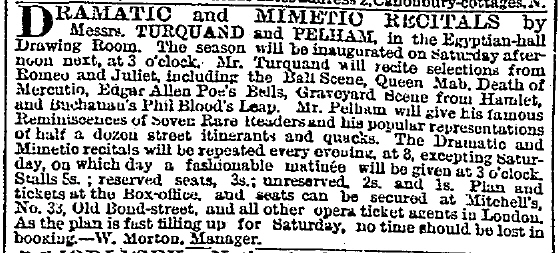
The Graphic (6 April, 1878) On Saturday Messrs. Turquand and Pelham inaugurated their “Dramatic and Mimetic Recitals” in the Drawing Room, EGYPTIAN HALL. The former gentleman exhibits considerable artistic power in the delineation of character, in selections from Romeo and Juliet, Hamlet, &c.; and there is a rugged force in his recitation of “Phil Blood’s Leap” which is very effective. But his talent shines most conspicuously in a really fine rendering of E. A. Poe’s “Bells,” the last stanza being given with rare pathos and expression. Mr. Pelham, whose mimetic powers, both of face and voice, are of no mean order, gives some amusing character sketches with much humour. A young lady, whose name is not mentioned, plays some selections on the pianoforte with pleasing taste—a thing we have very seldom met with on such occasions. ___
Brooklyn Eagle (2 December, 1884 - p.2) AIDING THE REBEKAHS. The Amaranth’s Entertainment at the The Academy was well filled last evening with the friends of Olive Branch Lodge, No. 19, Daughters of Rebekah, and a faint sprinkle of society people, gathered to enjoy the benefit tendered the lodge by the Amaranth Society. . . . The full Amaranth orchestra, S. F. O. Smith, leader, rendered an agreeable musical programme between the acts. Their efforts to drown the shuffling of the supers’ feet were seconded by Professor Robert Houston, elocutionist, of New York, who recited with much spirit a rhythmical narrative concerning a gentleman from Maine, astray for the moment on the Western prairies, who was as willing to kill as to be killed, and who was deeply prejudiced against what Mr. Robert Buchanan, author of the poem, calls “Injuns.” The adventures of the six foot down East exile moved the sympathies of the audience so deeply that they clamored for more. The professor then recited with much pathos the effect of a stray pin properly bent and placed where it would do the most good. The curtain dropped at eleven. ___
Brooklyn Eagle (1 June, 1889 - p.1) THE MONTAUK CLUB. A Welcome to president Charles A. The members of the Montauk Club gathered in full force in the parlors of the club house, 34 Eighth avenue, last evening, to welcome their president, Mr. Charles A. Moore, upon his return from a prolonged trip to the Pacific Coast. . . . The Committee of Arrangements had prepared an attractive programme, which included “Chalk Talk,” by Mr. S. M. Spedon, who presented a series of brilliant and admirable crayon sketches, accompanied with a running fire of witticisms. Mr. Charles H. Thompson sang a number of tenor solos, among them Blumenthal’s “My Queen,” Adams’ “Pilgrim,” an old Scotch ballad, “Mary of Argyle,” and “Sally in Our Alley.” Mr. Thompson’s share of the programme was especially attractive to lovers of good vocal music. Mr. Alfred Young recited “Phil Blood’s Leap,” from Robert Buchanan’s “Gold Seeker,” and Owen Meredith’s “Aux Italiens,” the latter with a vocal accompaniment by Mr. Thompson. The Committee of Arrangements were heartily congratulated upon the success of their programme. An elegant collation was an appreciated feature later in the evening. |
|
|
 |
|
|
|
[A programme featuring a performance of ‘Phil Blood’s Leap’ at a meeting of the _____
The Morning Post (30 May, 1872 - p.2) NATIONAL TEMPERANCE LEAGUE. The annual conversazione of this association took place at the City Terminus Hotel, Cannon-street, last evening. In the afternoon a ladies’ conference was held in the same place, when papers were read by a number of ladies who have been personally engaged in works of Christian benevolence in connection with the temperance movement. . . . These proceedings lasted from half-past three till about six o’clock, when tea and coffee were served in the refreshment-rooms, and the conference began to take the form of the conversazione. The latter was much more numerously attended than the former—the number of persons of both sexes present in the course of the evening being between 700 and 800. The programme of the evening’s proceedings was of a varied character. After a musical performance by the Duke of York’s band (about 40 strong), Dr. W. B. Carpenter, F.R.S., gave an interesting lecture, illustrated with diagrams, on the “Gulf Stream,” a subject on which he entertains views somewhat at variance with the generally received doctrines, more especially as to the effect of the stream upon the climate of our island. The next items of the programme were a pianoforte performance by Mr. R. H. F. Rippon, a fine exhibition of dioramic views of Switzerland, by Mr. B. J. Malden, and a series of readings by Mr. Charles A. Ferrier, who called forth much applause by his rendering of Robert Buchanan’s “Nell,” and Delta’s “Mansie Waugh goes out volunteering”—the former piece being of a pathetic nature, whilst the latter excited roars of laughter. ... ___
The Era (22 June, 1879) THE SWANBOROUGH BENEFIT. This interesting event “came off” at the Haymarket Theatre on the morning of Thursday last, and was attended by an amount of success—both financial and artistic—that must have proved eminently gratifying, not only to the beneficiaire but to the members of the Committee, with Lord Londesborough at their head, who have worked so assiduously to bring about the result and to ensure that the intended token of esteem should be complete in every respect. The benefit, as we may have already stated, was in honour of the completion of twenty-one years of the Swanborough management of the popular little Strand Theatre. . . . Miss Genevieve Ward now made her first appearance since her return from America, and gave a graphic recital of Robert Buchanan’s story of “Nell.” She was assisted by Mrs Vere, late of the Olympic Theatre— for Miss Ward appeared in character, and Mrs Vere acted as the friend who had to listen to the terrible narration of the incidents which robbed Nell of “dear Ned.” The effect was sadly marred by the noise behind the scenes and by the incoming and outgoing of the restless ones. ___
The Era (7 March, 1880) Miss Cowen’s Dramatic Recitals. A large and fashionable audience assembled at Steinway Hall, Lower Seymour-street, on the evening of Tuesday last, and evidently, if we may judge by the repeated outbursts of applause derived considerable enjoyment from the dramatic recitals of Miss Cowen and from the musical doings of her companions—Mr Frederic H. Cowen, who presided at the pianoforte; Miss Damian, whose beautiful contralto voice was heard to great advantage in Madame Sainton-Dolby’s “I cannot forget” and Hullah’s “Three Fishers;” and Mr Walter Clifford, who sang N. Ferri’s new song “Gladys” and the old and popular “Friar of Orders Grey.” Miss Cowen made a start with an anonymous composition called “As Old Giles Saw It,” which was followed by Oliver Wendell Holmes’s “The Old Man Dreams.” In Mr Robert Buchanan’s “Nell,” one of the “London Poems” published originally in the Fortnightly, Miss Cowen showed great dramatic intensity, and fairly conjured up before the mental vision of the listener the squalid room which formed Nell’s Home; the startling appearance of the husband driven to crime by drink, and bearing the murderer’s brand on his hands and in his face; the arrest; and her sad, sad journey on the morning of the execution; Waterloo-bridge and the dark cold river beneath; the falling rain, the passers by; the coffee stall and its keeper’s curious stare; the gathering crowds; the whispers of the coming dreadful scene; the sound of the hammers and the booking of the bell which announced that the fatal hour had come; and that Nell’s loved one was about to be ushered into eternity, and that she was alone in the world. In all this Miss Cowen had firm hold of the interest and the sympathies of her hearers, and at the end she was most cordially and most deservedly applauded. With the recital of Mr Knight Summers’s little story, written expressly for Miss Cowen, and called “My First and Last Proposal,” the entertainer displayed comedy powers of no mean order. Mr Summers, before writing the story, had, we presume, heard or read of Captain Absolute and Lydia Languish and Mrs Malaprop; but Miss Cowen must not be held responsible for anything in the shape of plagiarism. She told the story—or rather, we should say she impersonated its heroine—in most diverting fashion, and much merriment was the result. In “The Convict’s Escape,” by Re Henry, there was shown more dramatic power, but we may just hint a fault in the occasional misplacing of emphasis, and in a persistence in dropping the voice at the end of every line when the delivery became at all rapid. Mr Sydney M. Samuel’s story of the Neapolitan flower girl, “Nina”—who took the life of her English betrayer—was well told, and Austin Dobson’s “Cupid’s Alley” was given in a style to exact further appreciation, Miss Cowen’s concluding recital being Re Henry’s “Simple-Minded Tabitha.” Altogether, as we have hinted, the entertainment was of a very enjoyable nature, and Miss Cowen may be said to have fully deserved the many and hearty compliments awarded by those present. ___
The Era (29 October, 1887) MR. W. H. PENNINGTON’S MATINEE. It was quite in accordance with the eternal fitness of things that Mr Pennington, an able actor, and one of the surviving heroes of the famous Balaclava Charge, should have a complimentary benefit on Tuesday, the anniversary of the said charge; but it was quite out of accord with any fitness at all that the public announcement should have given two o’clock as the time of commencement, while the programmes put it at a quarter past that hour. Time nowadays is precious, and he who is led by misrepresentation into wasting fifteen minutes has some reason to grumble. The theatre had been kindly lent for the occasion by Mr J. F. Sheridan, and there was a fair attendance. . . . In the concluding part of the programme Mr Hayden Coffin sang “Queen of my Heart,” and was encored. Mr Charles Collette provoked laughter with some jaw-graphical patter; Miss Harriett Jay gave with much feeling, but hardly sufficient force, Mr Robert Buchanan’s touching poem called “Nell;” Miss Letty Lind won enthusiastic applause for her clever rendering of the well-known “polyglot Love” song and of “En Revenant de la Revue;” and Mr E. J. Lonnen obliged with his funny interpretation of Mr Robert Martin’s funny song from Miss Esmeralda, “Killaloe.” Miss Marion Hood, Mr J. L. Shine, and the Two Macs were announced, but did not appear. _____
The Janesville Gazette (Wisconsin) (17 February, 1880) REV. T. P. SAWIN’S LECTURE. There was a goodly sized audience at Cannon’s hall last evening to hear Rev. T. P. Sawin’s lecture on the Zulu war. For the average American to pick out anything of a clear conception of these foreign matters, by a hasty glance over the cablegrams, and a hurried stumbling amid a lot of unintelligible and unpronounceable names of places and persons, is almost an impossibility. It was therefore with some fear and trembling that some brought themselves to face what promised to be an uninteresting theme, but the reverend gentleman’s reputation as a speaker and thinker was a sufficient guarantee against any dullness, and so it proved. He picked up the subject from the start with a freshness, as though he was talking of something that had occurred just outside of the city limits, and by his graphic descriptions of the customs and peculiarities of the people, and the vivid narration of the events and causes preceding the war, brought South Africa so near that it all seemed real, and seeming so, held the attention of all. It was an instructive, practical lecture, and was tinged with just enough of humor and sarcasm to season it spicily. The speaker censured severely the British policy in South Africa, and gave good reasons, therefore, and in support of his criticism brought to bear facts and words culled only from Englishmen themselves. He showed how the greed of acquisition of territory, how injustice in the courts, and how various acts of injustice had led to trouble and to war. He clearly outlined the subject in hand, and handled it admirably. At the close of his lecture he read Robert Buchanan’s “Battle of Isandula,” which is one of the grandest pieces of lyric lately produced. It was well rendered, and was a fitting crown to such an able lecture. _____
The Stage (13 April, 1883 - p.9) GAIETY On Monday afternoon, April 9, 1883, was produced a dramatic sketch in three tableaux, by Edward Rose, entitled:— Vice Versâ; or, a Lesson to Fathers. . . . The first piece on the programme was Mr. Sydney Grundy’s excellent one-act play, In Honour Bound. This was represented by Mr. Edgar Bruce, Mr. Philip Beck, Miss Myra Holme, and Miss Stella Brereton. Mr. George Grossmith then gave an entertainment, Mr. H. Beerbohm-Tree recited a ghastly poem by Mr. Robert Buchanan, entitled “Friar Giachomo,” and Miss E. Farren sang, in costume, several verses of the popular song, “My Boy,” from Mr. Burnand’s burlesque of Blue-Beard. ___
The New York Times (2 February, 1888) MR. HILL’S MATINEE. Mr. J. M. Hill invited the Nineteenth Century Club and other friends of his to a pleasant entertainment at the Union- Square Theatre yesterday afternoon. The house was crowded; many popular actors were there, as well as manu prominent members of the club. Mr. Courtlandt Palmer made a speech; Mr. Courtlandt Palmer, Jr., made his début as a pianist; Mr. Joseph Haworth and Miss Lillie Eldridge did the closet scene of “Hamlet;” Mr. Marshall wilder told how people make love in Newark, and was recalled to give his famous imitation of a telephone. There was vocal music provided by Miss Mary Dunn and Mr. George C. Hall; Miss Bertha Behrens played the violin and Mrs. Alice J. Shaw whistled. Miss Lelia Wolstran presented, in her inimitable way, that quaint combination of dance and speech called “the minuet.” To crown it all, there was Mr. Robert C. Hilliard as a Spanish nobleman in white silk tights to recite Mr. Robert Buchanan’s characteristic verses entitled “Fra Giacamo.” This was the most striking feature of the entertainment, for not only did Mr. Hilliard render the poem with fervor, but he was allowed to exhibit his ability as an actor as well, the characters of the murdered Countess, the false priest and the page being represented in dumb show by Miss Lulu Darling, Mr. Charles Kent, and Miss Marion Lee. Mr. Hilliard also read a Texas romance by Frank Duprez called “Lasca,” and this selection also had a unique charm of its own, for a musical accompaniment was furnished to the verses by Mr. C. P. Flockton, who played the zither as skillfully as he acts Daniel Robins in “Heart of Hearts” at the Madison- Square Theatre. Mr. Hill’s entertainment, therefore, was very successful. ___
The Stage (7 February, 1890 - p.11) GLASGOW. GRAND—The pantomime of Sinbad has now entered upon its last week, and Monday evening was devoted to the benefit of the Misses Alice and Harriett Brookes, respectively the Sinbad and Haidee of the cast. . . . Several special attractions were provided for the occasion. Miss Eva Bell sang, “Why don’t the girls propose?” with great success. Mr. Charles Hildesley, late principal tenor in the D’Oyly Carte Opera Co. was warmly encored for his spirited singing of “Let me like a soldier fall. “Mr. J. C. Macdonald was excruciatingly funny, and the audience would not rest satisfied until he had sung a second song. Miss Hettie Lund sang “The Garden of Sleep,” with admirable taste and expression, and was vary warmly applauded. The most remarkable performance was that given by Mr. Dickson Moffat, who did one of these exceptionally risky things, which are only excused by complete success. To hold a pantomime audience in the middle of the pantomime, spellbound for the space of twelve minutes, while he recited a poem so solemn and tragic as Robert Buchanan’s “Fra Giacomo,” is a tour de force which could only be attempted by an elocutionist of rare ability. The piece was entirely unannounced, and the audience were totally unprepared for it, but their attention was quickly riveted, and the splendid reading was followed with close attention to the close, when Mr. Moffat received an enthusiastic burst of applause, and an insistent encore, which, however, he did not take. ___
The Stage (30 May, 1890 - p.13) PRINCE’S HALL.—On Tuesday afternoon last, May 27, Miss Amy Roselle and Mr. Arthur Dacre gave the second of their recitals at Prince’s Hall. We should have mentioned last week that for these recitals the hall is placed in semi-darkness—that is to say, the lights are turned down and the blinds and curtains pulled to, a footlight arrangement in front of the platform and two clusters of gas lights at the back concentrating all the rays upon the faces of the performers. . . . Mr. Dacre was, if anything, a little too vehement in Bret Harte’s “Caldwell of Springfield,” a thrilling episode taken from the “American War of Independence,” but played with biting irony and concentrated force as the husband, whose seeming saintly wife has been seduced by the wiles of Robert Buchanan’s “Fra Giacomo.” Mr. Cuthbert Clark, as before, acted as accompanist. ___
The Stage (9 March, 1893 - p.13) STEINWAY HALL. Mr. Valentine Osborne’s fifth annual dramatic and musical recital, held here last Thursday evening, proved most successful, and was well attended. . . . During the evening Mr. Osborne gave a powerful recital of Robert Buchanan’s “Fra Giacomo,” and was heard to considerable advantage in “One More” (Overton), in which the varied phrases of the old salt’s narrative were cleverly contrasted. At the conclusion of this piece, in response to a determined demand for an encore, the reciter obliged with Tennyson’s “The Revenge,” delivered in excellent style. ___
The New York Times (31 October, 1893) “The Nominee” at the Bijou Theatre. Perhaps Robert Hilliard and Paul Arthur think “The Nominee” is too funny, and that the edge should be taken off by something serious. Therefore it was preceded at the Bijou Theatre last night by an adaptation by Mr. Hilliard of Robert Buchanan’s poem, “Fra Giacomo,” in which Mr. Hilliard acts and recites the poem, Theodore Babcock is the Friar, Olive May Pietro, and Emily Craig the poisoned Countess. “The Nominee,” Leander Richardson’s successful adaptation of “Le Depute de Bornbignac,” has all the “go” in it that it had when Mr. N. C. Goodwin drew crowds to laugh at, perhaps, more because Mr. Hilliard does not know the value of restraint. But if he is a boisterous Jack Medford, “wot’s the odds as long as we’re ’appy?” Everybody was happy last night, and it was a cordial audience Mr. Hilliard and Mr. Arthur faced. Associated with them are Mr. Babcock as Col. Murray; Walter B. Woodall as Vane, Miss May as Mrs. Medford, Jeanette Ferrill as her sister, Rose; Miss Estelle Mortimer as the mother-in-law, and Miss Ida Bell as the adventuress. ___
The Stage (28 March, 1895 - p.9) LADBROKE HALL.—At the fourth of the Bayswater Subscription Concerts, which was given here on Thursday evening, March 21, in the presence of a large audience, there was a disappointment of some magnitude. Miss Esther Palliser, who was the most distinguished of the performers advertised, had so bad a cold that she was “quite unable to sing,” although she listened to the concert from the hall. . . . In his recital of Robert Buchanan’s rather hackneyed “Fra Giacomo,” Mr. Norman V. Norman acted dramatically, but took the piece in very slow time, and broke up the delivery of the verse far too much. ___
The Era (25 May, 1895 - p.15) THE EDMUND PAYNE MATINEE. The matinée given at the Gaiety Theatre on Thursday for the benefit of Mr Edmund Payne, who has been seriously ill for the last six months, was in every respect a complete success. . . . Mr William Terriss recited Robert Buchanan’s “Fra Giacomo,” the dramatic effect of which was enhanced by a musical accompaniment. ___
The Stage (18 May, 1899 - p.17) POLYTECHNIC SCHOOL OF ELOCUTION. Mr. and Mrs. Hasluck’s pupils have given as many as a hundred public recitals, and this circumstance was celebrated in a very agreeable manner at the Institute on Wednesday evening of last week. . . . Mr. Charles E. Mooney was dramatically effective in Robert Buchanan’s “Fra Giacomo.” ___
The Brooklyn Eagle (10 December, 1901 - p.12) VAUDEVILLE HOUSES Robert Hilliard essayed a new role last night at the Orpheum in his own dramatization of Robert Buchanan’s tragic poem, “Fra Giacomo,” and he scored a handsome success, in which he was materially assisted by the fine stage setting prepared by Manager Williams. The pith of the poem’s story is told in practically the poet’s own words and, if any criticism can be offered in their shortening by Mr. Hilliard, it can only be that the scene is too short; but it still remains in the mind as a beautiful picture. With every incentive and opportunity for overdrawing the role of D’Arco, Mr. Hilliard cleverly refrains and paints the tragic scene wherein he reveals to the monk his knowledge of his relations to his wife and takes his vengeance with an intenseness that is as natural as dramatic art will permit. His elocution is clear and effective and his acting reveals the man torn between his love for his dead wife and his torment of his victim, who is dramatically, if silently, impersonated by Brandon Hurst. The scene of the short act is fine and the tableaux is beautiful. Mr. Hilliard deserved the curtain call which was insisted upon by his many friends. ___
The Stage (21 August, 1902 - p.17) Mr. Philip Yorke has in preparation a new sketch based on Robert Buchanan’s “Fra Giacomo,” in which Mr. Bransby Williams will appear. A young lady represents a corpse in this. ___
The Referee (24 August, 1902 - p.4) Mr. Philip Yorke is nothing if not daring in his new experiments at The Tivoli. His latest production, billed for to-morrow, but really tried on the last three days of this week, is a dramatisation of the late Robert Buchanan’s gory and gruesome poem “Fra Giacomo.” In this poem—so often recited by Mr. Waller, Mr. Willard, and other leading elocutionary actors—it is shown how a jealous husband, having disguised himself as a monk, confesses his wife, and finding that she has been unfaithful to him with her priest, lures him on to “have a drink” out of a poisoned bowl, and finally stabs him to the heart to make assurance doubly sure. Thanks in some measure to the powerful elocution of Mr. Bransby Williams as the homicidal husband, this tiny tragedy holds the attention of the audience during its eight minutes’ traffic of the stage. So much so that when one scoffer in the audience murmured (after the fashion of Browning) “Rats!” all the other Tivolians “h’sh’d” him into silence. Mr. Charles Raymond is in his best dumb-show manner as the guilty monk, and Miss Emmie Hall makes a beautiful corpse. Comic alternatives to the new tragic “turn” are very drolly provided by Little Tich, Vesta Tilley, R. G. Knowles, and other favourite comedians. ___
Daily Express (27 August, 1902 - p.2) The Tivoli Novelty. Hot on the touch-and-go “revue” we have what is a serious and even tragic interlude at the Tivoli. The stage is set for “Fra Giacomo,” and Robert Buchanan’s painful little story is well played by Mr. Bransby Williams. In an alcove at the back lies the body of the dead wife, and in the foreground we have the gruesome poisoning by the husband of the monk who has won her love. It is a startling innovation in a music-hall, but it is well received and thoroughly interesting. Mr. Philip Yorke, the young manager here, has ideas, and they are generally good ones. “Fra Giacomo” and Dickens. Mr. Bransby Williams, who has for so long been doing his best to make Dickens’s characters familiar to us all, has passed by way of Shakespeare and Beecher Stowe on to Robert Buchanan. At the Tivoli he is appearing, as we have said, in “Fra Giacomo,” while at the other halls where he is appearing he wisely varies his show—giving a bit of “Henry V.” in one hand and imitations in another. “I Suggest by Face Only.” Mr. Williams has written us an interesting account of his work. He says: “I wear the tight-fitting dress of the period of ‘David Copperfield’ because it is easy to suggest most of the characters of Dickens in that dress—nearly all black, so that nothing stands out too much to be noticed in another character. As a rule I suggest all characters by face only. But sometimes in cases such as Bill Sikes or Sydney Carton the rest is suggested by a change of coat only.” “I Meet Dickens’s Characters.” But Mr. Williams “composes” his characters with care. “I first gather,” he continues, “the full descriptions given by Dickens, then I search for all the pictures by the various artists, pick the most salient points, and then design the wig, whiskers, etc. As a rule when alone I try to imagine the man, his walk, expression, manner. Often when out I meet people who strike me as being fine character studies. Some people say Dickens was so overdrawn. I see day after day characters to fit many of Dickens’s.” A Half-minute Make-up. Mr. Seymour Hicks will do an elaborate make-up in eight minutes. Mr. Bransby Williams has to content himself with less than one. “I use,” he concludes,” no more than an actor in his dressing-room—in fact, much less. A few strokes of grease-paint—spirit gum—powder—wig. As a rule I am before the audience when making-up, never taking as long as a minute for the heaviest of make-ups. Then I turn to the audience, realising to the best of my ability some published picture in the works of Dickens.” Mr. Williams, in fact, is saturated with the master. ___
The Times (28 August, 1902 - p.8) THE TIVOLI.—Though a music-hall can reckon on a large selection of performers to choose from in this interval between the season of summer provincial “starring” and the Christmas pantomimes, and can command a large number of patrons, the management of the Tivoli have been enterprising enough to make a new departure this week in the sketch “Fra Giacomo.” This is a genuine attempt to provide something of a higher dramatic and literary character than is usually offered, or to be candid demanded. Mr. Robert Buchanan’s poem serves this purpose excellently, being short, well knit, and full of dramatic inspiration. Poetic merit is less conspicuous, nor in the circumstances is it so necessary, but several monologues and ballads, such as those of Rossetti, suggest themselves, which might be effectively dramatized in this way. Mr. Bransby Williams as the husband, though tending at times to err on the side of treating his lines as a mere recitation, gives a well-considered representation. If not quite rising to the purple patches of emotion, he prevents the more solid groundwork from being uninteresting. Mr. Charles Raymond, on the other hand, who plays the silent part of the monk, errs on the side of exaggeration, lacking the true touch of the pantomimist. As already suggested, there is no lack of material with which to follow up this innovation, and provided the pieces selected show emotional grip there is no reason why Mr. Williams should not make these artistic trifles as popular as he has already done his sketches from Dickens and Shakespeare. Other “turns” include Happy Fanny Fields, Miss Ray Wallace, a mimic of no mean ability, Little Tich, Mdlle. Diane de Fontenoy in a series of graceful tableaux entitled “Bijouterie Moderne,” Miss Vesta Tilley, and Mr. R. G. Knowles. ___
The Entr’acte (30 August, 1902 - p.6) The sketch entitled “Fra Giacomo,” produced by Mr. Philip Yorke at the Tivoli, is a thriller. The leading personage of the story is the husband of a woman who has been betrayed by her confessor, her husband discovering her guilt by means of personating a monk, and obtaining from her a confession of her unworthiness. The way of the transgressor is hard, and she meets her death by being poisoned by the wronged husband, who not content with killing his wife, invites her betrayer to drink with him out of a poisoned chalice. He is determined to make a clean job of it, and fearing that the poisoned liquor may not fulfil its deadly mission he, in addition, stabs the miscreant. Mr. Bransby Williams gives every value to this tragical adaptation of the late Robert Buchanan’s poem, and by his powerful and impressive acting keeps the audience on the tip-toe of expectation and excitement. To him is allotted the only speaking part in the scheme, the other participators being entrusted with duties which are expressed in pantomime. As the guilty priest, Mr. Charles Raymond renders this little drama able support. Mr. Philip Yorke, who is very much on the alert in all that concerns the welfare of the Tivoli, has staged the venture very adequately. ___
The Staffordshire Sentinel (22 January, 1912 - p.6) INFIRMARY SUNDAY CONCERT. Great Success in Hanley Grand Theatre. Crowded House & Fine Programme. . . . ... Mr. Eric Campbell, an important member of the pantomime company, interested the audience very considerably with a dramatic recitation, the “Fra Jacomo” of Mr. Robert Buchanan, a literary worthy who passes as a Scotchman, but who really was born at Caverswall. ___
The Stage (4 December, 1924 - p.18) Mr. Owen Nares on Acting. ___
The Bath Chronicle and Herald (6 May, 1933 - p.15) Brilliant Matinee at Bath Theatre Royal . . . “DEAR OLD BATH.” Owing to the illness of Viscount French, who has developed laryngitis, the series of selected recitations in which he was to have appeared with his sister, Lady Patricia French, had to be omitted. The Countess of Ypres, who made this announcement from the stage, took the opportunity of expressing her pleasure at re-visiting “dear old Bath” where the residents had always received her and her dramatic productions with such kindness. ___
Perhaps not up to the standard of Mr. Bransby Williams but ‘Fra Giacomo’ has survived into the 21st century and is available on youtube: More information about ‘Fra Giacomo’ is available here.
|
|
|
|
The Brooklyn Eagle (10 February,1884 - p.12) AT THE ADELPHI ACADEMY An Evening of Musical and Literary The semi annual entertainment of the pupils of the Adelphi Academy occurred last evening in the chapel on St. James place. The programme consisted of musical and literary selections. There was a large attendance of the friends of the pupils who greeted the various selections with well deserved applause. . . . Miss Grace A. Sweeny followed with a reading by Robert Buchanan, “Tiger Bay.” ___
The Graphic (23 June, 1894) A DRAMATIC RECITAL.—On Monday evening, at the little theatre in QUEEN’S HALL, Langham Place, Miss Bass gave a dramatic recital before a large and appreciative audience. The programme embraced a wide field of subjects, and Miss Bass showed herself equally effective in sentimental as in comic recitation. Among the principal selections were Mr. Buchanan’s “Tiger Bay,” Alfred Austin’s “In the Month when Sings the Cuckoo,” Christina Rossetti’s “A Royal Princess,” Mr. Anstey’s “Picture Sunday,” and Mrs. Gaskell’s “Sally’s Sweethearts.” _____
6. The Ballad of Judas Iscariot
The Stage (27 February, 1885 - p.13) I am glad to note that nearly £900 were subscribed in aid of the Dramatic and Musical Sick Fund at the dinner on Ash Wednesday. The “smoking concert” which followed the dinner was most enjoyable. The best feature of the entertainment was the recitation by Mr. E. S. Willard, of Robert Buchanan’s fine poem, “The Ballad of the Soul of Judas Iscariot.” It was a difficult task to attempt on such an occasion, but Mr. Willard thrilled his audience, and completely took the wind out of the sails of those who followed him on the platform. Mr. Hermann Vezin recited “The Spanish Mother;” Mr. Walter Speakman gave the Ingoldsby legend, “The Execution,” with ease and power; Mr. E. J. Odell delivered a quaint parody of “Eugene Aram;” and Mr. Brandon Thomas recited “Over the Hills from the Poorhouse.” Mr. Charles Warner, Mr. J. Maclean, Mr. Furneaux Cook, and Mr. H. Walsham were also heard to advantage in recitation and song. Songs were also furnished by Mr. George Grossmith, Mr. Walter Bolton, Mr. George Barrett, and Mr. Walter Clifford. During dinner Miss Constance Loseby charmed all hearers by her sympathetic singing. Miss Lucy Franklein and Miss Camille d’Arville also obliged with songs. Altogether, a most enjoyable evening was spent, but the questionable song given by the “Great” Vance was decidedly out of place, and had an unpleasant effect upon the hearers. Mr. Vance may be in his element in a music-hall, but that fact is no qualification for the introduction of his songs to a miscellaneous after-dinner audience. ___
The Brooklyn Eagle (18 May, 1897 - p.7) PROF. ROBERTS READS AGAIN Varied Programme Heard by a Large Professor Charles Roberts, jr., again showed himself the careful and pleasing artist that he is at a second appearance before the members of the Brooklyn institute last night. News of Mr. Roberts’ excellence had spread, and the result was that the spacious Art rooms were hardly large enough to hold the people that came. Professor Roberts opened the reading with Bret Harte’s “Selina Sedilia,” a bit of satire on the modern female novelist. This was followed by the “Ballad of Judas Iscariot,” in which Robert Buchanan has developed a story somewhat similar to that of the “Wandering Jew.” “Brer Fox and Brer Rabbit,” by Joel Chandler Harris, gave the reader good opportunities in negro dialect. The next number, rather incongruously, was Wordsworth’s beautiful “Ode on Intimations of Immortality from Recollections of Early Childhood.” Lovers of the poem must have felt that it lost something of its charm in recitation, sincere and helpful as Mr. Roberts was in his rendering. The humorous side of the reader’s art came out cleverly in a Holmes prologue (written by the breakfast table autocrat for a play given by his young friends) and the ridiculous “Ballad of Walham Green,” wherein fun is made of the microbe fad. The gem of the evening, from the reader’s standpoint was “Aux Italiens.” Mr. Roberts should not attempt to rival or even suggest Marlo, but otherwise this number was beyond praise. The hope that Professor Roberts will be heard in a course of readings before the institute next year will be general. _____
Aberdeen Weekly Journal (25 January,1890) ABERDEEN TONIC SOL-FA INSTITUTE CONCERT. Among the various modes of celebrating the natal day of Scotia’s noblest bard, perhaps none are more appropriate than the Burns concerts of the Tonic Sol-fa Institute. Certainly none are more enjoyable or more widely appreciated, and last night’s gathering in the Music Hall was equal in numbers and enthusiasm to those of former years. As a means of keeping green the memory of the poet, as well as of fostering that love for his legacy of song which is every year becoming more intense and widespread, nothing could be better conceived than these concerts, and the success which has attended them must be very gratifying to the members of the Institute. The programme was eminently attractive and varied, and although most of it was from the works of Burns, one or two selections were, in response to numerous requests, culled from other sources. . . . In the course of the evening Mr Ross Campbell recited “Willie Wastle” and “Tam o’Shanter.” Being recalled for the former, he gave “The Lights o’ Leith,” by R. Buchanan. By the kind permission of Colonel Ogston, the band of the Aberdeen Artillery Volunteers, under Mr J. Wood, played an excellent selection of music while the audience was assembling. Mr W. Litster conducted with his well-known ability. The concert is to be repeated this evening. _____
The Morning Post (4 March, 1895 - p.6) MRS. ALBERT BARKER’S RECITAL.—Mrs. Albert Barker gave, at the Steinway Hall on Saturday afternoon, the first of a series of four consecutive Saturday recitals. The programme was, as usual with her, well selected and well arranged. It consisted of good material, varied in character, and placed in effective juxtaposition. Opening with Tennyson’s spirited and impressive “Revenge,” it included a couple of pieces by Longfellow, one by Mr. Robert Buchanan, one by Miss Procter, and three “lullabies” by Mr. Rudyard Kipling, Mr. Eugene Field, and Miss Wheeler Wilcox respectively. It also comprised “The Tell Tale,” embracing the bird songs in whose interpretation Mrs. Barker is unsurpassed. It was doubtless her evident love of bird life and ways which induced the reciter to select for one of her performances, Longfellow’s “Birds of Killingworth.” Mrs. Barker’s idiosyncrasies as a reciter are well-known. Keen intellectual and spiritual appreciation finds expression in a voice of rich and useful quality, over which its owner has entire control. Mrs. barker’s method of tone-production is as skilful as her enunciation and her emphasis, which are admirable in their perfect naturalness. She was so invariably applauded on Saturday that it would be difficult to say in which pieces she gave most pleasure; but as an example of sustained and graphic elocution nothing could be better than “The Revenge,” while as an instance of wholly sympathetic exposition we should select the dainty “Wynken, Blynken, and Nod.” In Buchanan’s “Green Gnome” Mrs. Barker’s bell-like notes were agreeably conspicuous. _____
Back to the Plays
|
|
|
|
|
|
|