|
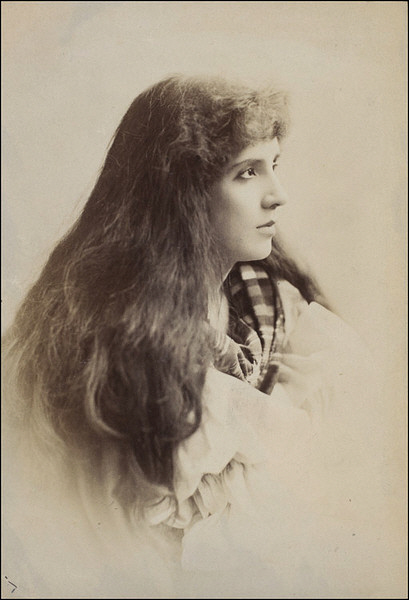
[Mrs. Patrick Campbell as Astræa in The Trumpet Call.]
The Referee (2 August, 1891 - p.3)
ADELPHI—SATURDAY NIGHT.
The tone of melodrama has been raised in this generation, and first and foremost among the dramatists who have effected the change is Mr. George R. Sims, whose early work, “The Lights o’ London,” is a memorable example of the New Melodrama in which literary quality is not altogether sacrificed to violent sensations. Mr. Sims has kept pace with the times, and in the new drama, “The Trumpet Call,” which was represented for the first time to-night at the Adelphi, he and Mr. Robert Buchanan between them have a play that is neither behind the age nor in front of it, but of “the latest seed of time.” “The Trumpet Call,” which has an excellent, stirring title to recommend it, is a drama of surprises and vivid contrasts of character, and if some old friends may be recognised by inveterate playgoers, alive to every move on “the boards,” it must be allowed that they are presented in novel and exciting combinations. There is, to be sure, nothing new, either on the stage or in real life, in the position of a husband finding that his first wife, whom he had reason to believe was dead, is still living; and it has happened before, as it happens in the case of Cuthbert Cuthbertson, that it is subsequently discovered that the first wife had committed bigamy and was never legally the hero’s wife after all. But many a new turn is given by Messrs. Sims and Buchanan to a story that has often been told in real life as well as in fiction. The authors of “The Trumpet Call” have so devised it that the two men whose lives have been crossed by the one woman are brought into the closest relation. They are brothers in arms in the Royal Horse Artillery. Cuthbertson has carried off the daughter of Sir William Barton from under the very nose of his rival, Richard Featherston; who desires, from no unworthy motive, to marry her himself, for the villain of the piece is, for once, guilty of nothing worse than loving her for her own sake alone, though he hesitates at nothing short of actual criminality to make her his own. On the eve of the New Year, Cuthbert and his wife return to claim her stern father’s forgiveness, but Sir William, with never an inkling of what is coming, refuses to recognise his daughter as Cuthbert’s wife. Events follow fast on one another; troubles come not single spies, but in battalions, and at the moment when the wife’s affection for her husband is put to this test, the woman Bertha appears upon the scene, and the young husband in despair goes off with a recruiting sergeant to join the army, leaving his wife and child to the tender mercies—using the term in not satiric sense—of Sir William Barton and the cousin. After an interval of six years, which is supposed to elapse between the first act and the second, we find Richard Featherston still pressing his suit upon the unwilling Constance, and on the parade-ground of the Woolwich barracks Cuthbert, who has won the Victoria Cross under the assumed name of Lanyon, is recognised by Constance. who has been brought there with her prattling child by the persistent Richard. At the instigation of Richard, Cuthbert denies his identity when his wife recognises him. The first husband of the woman who is the origin of all the mischief tries to kill his wife in a “doss-house,” and, happily enough for all concerned, is prevented from doing so by the hero, who is her second victim. Richard, who has done everything a gentleman could do to prevent man and wife coming together, is about to be rewarded for his patience, when Bertha, grateful to Cuthbert for having saved her life from the vengeance of her husband, appears at the very nick of time in the church itself to prevent Constance from committing bigamy, and to restore Cuthbert to his lawful wedded wife. The piece is exciting. but situation is not everything in “The Trumpet Call.” There is fun in plenty and to spare, and the authors’ mastery of the physiology of poverty is illustrated in some realistic scenes wherein pathos and humour are skilfully commingled. The piece is well acted, even the minor parts. It is enough to say that the hero is represented by Mr. Leonard Boyne, said Mr. Charles Dalton is highly successful as the cousin who may be described as the unsuccessful lover rather than as the villain of the piece. As the heroine, Miss Elizabeth Robins acts with sensibility, though she has not yet put off the manner of Hedda Gabler; and Mrs. Patrick Campbell, as the wife who was mistress of two husbands and master of none, exhibited striking talent, and showed uncommon presence of mind in an untoward slip of an unmentionable sort. By sheer force of her acting she carried the audience away in a trying moment that would have disconcerted most actresses. Mr. Lionel Rignold is a special favourite at the Adelphi, and his performance of a showy entertainment caterer, with “Twiggy-voo?” for his catch-word, keeps the laughter bubbling all through the piece. Mr. James East takes the part of the husband, a brave soldier who owes his ruin indirectly to his wife; Mr. Beveridge appears as a jovial sergeant; and Miss Jecks, a valuable member of the Adelphi company, takes the part of a music-hall singer who is courted by a comical little trumpeter, represented with a deal of native humour by Mr. R. Douglass. The leading members of the company were called before the curtain again and again during the evening, the authors being called for and appearing together at the end of the performance. There is no doubt about the complete success of “The Trumpet Call.”
___
The Times (3 August, 1891 - p.6)
ADELPHI THEATRE.
The Trumpet Call! Such is the stirring title of the new play which has been written for the Adelphi by Messrs. George R. Sims and Robert Buchanan, and the story it prefaces, we may say at once, is fully equal to it, being, in fact, one of the best to which these cunning masters of melodrama have set their sign and seal. Superfine criticism of this piece, as of its many predecessors of the same stamp, would, no doubt, be easy, but it would also be futile. An Adelphi play must be judged by its own standard. It has its canons and conventions, from which the author departs at his peril. Although Messrs. Sims and Buchanan will not find their names emblazoned on the same scroll of fame as Bunyan they, too, nevertheless, are accustomed to give us, under varying forms, a sort of “Pilgrim’s Progress,” in which a faithful band of wayfarers contrive to reach their land of Beulah, after passing through the Valley of the Shadow of Death, and overcoming giants and other adversaries in their path. For, as custom fixes a starting point, so it also fixes a destination for the typical travellers of Adelphi drama; it is enough for the purposes of novelty if on each successive journey the authors change the route. Fortunately, in their latest production, which was received with tumultuous applause on Saturday night, Messrs. Sims and Buchanan are able to offer an itinerary of more than usual variety and interest. Some day it may be well perhaps to change the system or the formula of Adelphi drama altogether—to give us a hero who is not all nobility of soul, a heroine who has sinned, a villain who has other aims than the lady and the property, an ending which is not the triumph of virtue at the expense of vice. But that time is not yet; nor is it ever to be desired, so long as the old story is told well, with such capital variations and with such a freshness of effect as in The Trumpet Call.
That men are not all cast into half a dozen unvarying moulds we know, but for the time being, at least, the Adelphi public in their collective capacity will have it so; for them there is only the grand distinction of the sheep and the goats, no hybrid specimens of humanity being acknowledged. And such dexterous craftsmen as the authors of The Trumpet Call are too wise in their generation, of course, to disturb unnecessarily the foundations of this simple faith. So, in this new play, we have once more undeniably a well-known, not to say familiar, set of dramatis personæ. But, while thus adhering to the scheme of melodrama, which for the past ten years has been so much in vogue, and of which the two most prominent examples are The Lights o’ London and The Silver King—that, namely, in which a pair of highly sympathetic and deserving lovers are torn from each other’s embraces, but reunited, happily, after a period of trial and tribulation—Messrs. Sims and Buchanan are sufficiently clever and adroit to avoid anything like commonplace. The details of their plot are worked out with an ingenuity and fertility of resource little short of remarkable, when we consider how often, and by how many expert hands, the same material has been treated before. They have achieved happier strokes of invention, doubtless, than to separate their lovers, who when the curtain rises are already husband and wife, by the device of a supposed antecedent marriage on the hero’s part, and the return of a soi-disant first wife whom he has believed to be dead; but, this incident being accepted, the authors must be credited with turning it to excellent account, inasmuch as the hero enlists, and with the least possible delay (as represented by a lapse of six years between the acts) brings us into touch with the glorious bustle and movement attendant upon the close of a successful campaign.
As its title implies, the play is distinctively military in spirit, and it excites consequently that patriotic thrill which never fails to stir the Adelphi public to enthusiasm. The military element, one observes, is carefully brought up to date. When the hero joins the Royal Horse Artillery we hear nothing of the traditional, but now obsolete, Queen’s shilling, and the reward of his bravery is that from the ranks he is promoted to a commission, the announcement of his good fortune being made the occasion of a picturesque massing of troops on the stage, most of whom, we believe, are really drawn from the service. Admirably managed as it is, both scenically and dramatically, this stirring episode would alone make the success of the enterprise. Many other happy touches are to be found in the action, however, notably in the portrayal of those pathetic and humorous aspects of low life for which Mr. Sims seems to have a predilection, and here the services of Mr. Lionel Rignold and Mrs. H. Leigh are just as valuable in their way as are those of Mr. Leonard Boyne and Miss Elizabeth Robins in the motional passages. The “first wife” is a gipsy woman picturesquely embodied, though somewhat amateurishly acted, by Mrs. Patrick Campbell. Besides being responsible for the parting of the two characters who chiefly claim our sympathy, this sinister individual fulfils the important function of introducing us to the interior of an East- end “doss-house,” or low lodging, and this, with its realistic squalor and its strangely mixed company, is another striking feature of the play. It is, perhaps, needless to explain that the supposed first marriage proves to be no marriage at all, the picturesque gipsy having had herself a previous partner. But this important revelation is withheld till the final scene—the interior of the Chapel Royal, Savoy—when the heroine, despairing of ever seeing her true love, who is reported dead, is reluctantly about to give her hand to the cousin who has persecuted her with his attentions (as only the villains of melodrama do) for so many long years. Thus, a crowning incident of no less sensational a character than those that have gone before is found for the story, which, in the reunion of the much-enduring hero and heroine, ends as happily as could be desired. At one previous point in the story—namely, the momentous military scene—the lovers do indeed meet, but he is serving in the ranks under an assumed name, and when, in an agony of doubt, she, being there as a spectator, half- recognizes him, he denies his identity. Here, perhaps, occurs just a little straining of the probabilities of the case, but it is only such a straining as an Adelphi audience are always very willing to condone for the sake of the dramatic issues hanging upon it.
From the Adelphi company the new play receives, on the whole, the worthiest treatment. There could not tread the boards a more gallant soldier than Mr. Leonard Boyne, and in Miss Robins he has a partner of his own emotional capacity. Perhaps there is still clinging to Miss Robins something of the Hedda Gabler keenness and intellectuality; but these qualities, if unusual in melodrama, are not unwelcome. Mr. Dalton plays the scheming cousin with a robust manliness which is hardly typical of the villain; but the villainy of the character is not, after all, very pronounced—in fact, he approaches the hybrid who is so much more common in real life than on the stage. A fuller measure of wickedness is dealt out to the gipsy woman, who is the mainspring of the action, and who is becomingly invested by Mrs. Patrick Campbell with an uncanny, necromantic aspect. Among the minor characters of the piece Mr. Beveridge is conspicuous as a stalwart and manly sergeant-major of artillery, and Mr. R. H. Douglass amusing as a precocious bugler-boy, the latter supplementing, with the aid of Miss Clara Jecks, the broad cockney humours of Mr. Lionel Rignold.
__________
Bank Holiday sees comparatively little change of bill at the theatres, the Adelphi production above noticed being the only novelty. Miss Grace Hawthorne appears at the Olympic in Theodora; The Late Lamented is transferred from the Court Theatre to the Strand, where Miss Fanny Brough succeeds Mrs. John Wood, and Mr. Edouin Mr. Cecil; and the Shaftesbury re-opens, under the management of Mr. George Edwardes, with the lively summer bill of three one-act pieces lately seen at Terry’s.
___
The Echo (3 August, 1891 - p.1)
ADELPHI THEATRE.
_____
Messrs. Sims and Buchanan are altogether to be congratulated on their new melodrama The Trumpet Call. They move with the times. They do not permit themselves to zig-zag from thrilling sensation and breath-catching scenes to new blood-curdling crimes on the part of the villain, and fresh hair-breadth escapes on the part of the hero, totally disregarding the while all physical laws, all chronological restrictions, all conditions of probability, not to say possibility. On the contrary, their story is not by any means as “impossible” as many tales related during the past term in the Law Courts. Beside the Rorke-Thompson dispute, to say nothing of the Life and Adventures of Wilfred Murray, Esq., or the Future Earl of Orford, for instance, it would appear meagrely commonplace. But in other directions the able collaborators have exercised a restraint which is very much more artistic. They have given us grey characters, characters such as actually sat in the theatre and watched the play. They have produced their picture with higher art and greater style within a very much more limited range of tone. The hero is by no means so white that if he walked through a bed of arum lilies you would not see him; indeed, we opine that even a London November snowflake would be distinctly visible on him. What is even stranger, if the initials of the authors were painted in coal tar on the villain’s brow they would show. Above all the hero is not blatant in what virtue he may possess. But, though the writers have made all these concessions to commonsense, their play is as full of interest as the older melodramas; they have kept their hands all the time on the pulse of the sentiment of the pit and gallery, and their healthy work throbs with many an exhilarating thrill.
The Trumpet Call is an excellent title, and to live up to it many of the actors and supers wear the exceedingly handsome uniform of the Royal Horse Artillery, whilst some of the scenes are laid in barracks. Bigamy, and Who Committed It would, however, have been a more indicative choice. Bigamy is distinctly the matter. The curtain rises on the heroine Constance, and the hero, her husband, in a pleasant oaken inn parlour on New Year’s Eve. She has come to beg the forgiveness of her father, the neighbouring squire, for having eloped with Cuthbert Cuthbertson. The squire’s objection to Cuthbertson was certainly not unreasonable—the young man had been married before, had found his first wife betraying him, and his own behaviour apparently barring the Divorce Court door, had abandoned her; subsequently he had jumped with more alacrity than prudence at the rumour of her death, and bolted with Connie. The interview between father and daughter comes to nothing, though Richard, Connie’s cousin and ex-sweetheart, to do him justice, has a good square try at the rôle of peace-maker. After Dick and the Squire are gone, Cuthbertson strolls out in the midnight moonlight, and sees his first wife clambering into a caravan. An interview takes place, and the young lady Bertha by name, a maddish, gipsyish young person, turns out to be earning her living as Astrea, the clairvoyante and medium of old Ginnifer, the travelling conjuror. Cuthbertson instantly enlists, and so leaves Connie without a word, apprising Cousin Dick, however, of the state of affairs. After five years’ good shooting amongst the Burmese, Cuthbertson, alias Corporal Lanyon, returns to England, the one thing of note having been the discovery of a messmate, James Redruth, a half-mad, but valiant fellow, who has been ruined by a woman. Cousin Dick meanwhile has been working hard for Connie’s hand. He has spared her nothing, letting her know her dishonourable position, and the namelessness of her brat. Bertha Astrea since the first act has disappeared; but Dick has her traced, and interviews her. Then his grey villainy becomes black. Astrea, a most vengeful cat, tells him she was already married when she espoused Cuthbertson, but he persists. To convince Connie of Cuthbert’s former wedlock, Dick arranges an interview between herself and Bertha, in which both women employ vitriolic language. The scene changes to a doss-house in the Mint, a capital sketch full of Simsian humour and pathos, the different sorts of tramps carefully studied, from the old, ruined gambler and his wife, and the cheerful wretch who lives on his sickly wife, down to the parasite of parasites, a thief who robs thieves at doss-house baccarat. Cuthbertson, determined to wring the truth from Bertha, comes to the doss-house in disguise; Redruth too, puts in an appearance, and, meeting Astrea, sees the woman of his misery, and instantly badly knifes her, Cuthbertson just saving her life. Again the scene shifts—to the interior carefully reproduced, for rien n’est sacré aux mélodramaturges,— of the Savoy Chapel, surpliced choir singing hymns, one of the clergy of the Chapels Royal coming down the aisle, Cuthbertson sitting amongst the congregation, Cousin Duke leading reluctant Connie up to the altar, when suddenly enter Bertha Astrea, pallid and penitent!—and there you are, you know. Curtain, hearty applause, actors and authors called.
The Trumpet Call is exceedingly well played all round. We should be inclined to award the palm to Mr. Lionel Rignold for his marvellous broad comedy study of an old conjuror, subsequently entertainment- caterer. In greycoat, light trousers, claret plush waistcoat, huge diamonds, and heavy furred overcoat—in July—en route for the committee of a Primrose “feet,” he is inimitable. Miss Elizabeth Robins’s appearance on the melodramatic stage is somewhat noisily regretted by her friends. To a rising actress, as she is, all training and experience comes well. As the heroine, a part she plays with judgment and feeling, she has not many chances, it being essentially the adventuress’s play; but in her scene with the latter, she displayed great and admirably directed power; Bertha Astrea fell to Mrs. Patrick Campbell, to whom London was recently introduced as Rosalind at a matinée. It is not too much to say that on Saturday she made a reputation three hours, acting with intensity, earnestness, a close grip of the character, and dignified presence of mind on occasion. She has all before her—possessing an attractive and unusual appearance, and the power of passion. Mr. Boyne played hero in his usual popular and effective way. Mr. Beveridge’s Irish sergeant was a fine, honest, soldierly fellow—a credit to any actor. Miss Clara Jecks, assisted by Mr. R. H. Douglass, as the other comic lover, played with her invariable point and vivacity.
___
The Morning Post (3 August, 1891 - p.6)
ADELPHI THEATRE.
_____
Messrs. G. R. Sims and Robert Buchanan have exactly hit the mark in their new drama, “The Trumpet Call.” There is just enough of the sensational element to secure the approval of an Adelphi audience, but tragic horrors are not made the leading feature, the play having genuine human interest, pathos, and humour. The authors have been fully alive to the importance of setting forth a story of this kind with force and directness, and from the unfolding of the chief incidents to the dramatic close the interest never flags. The smart dialogue of Mr. Sims and the constructive skill of Mr. Buchanan have been happily blended, and these merits were enhanced by excellent acting and scenic effects of the most brilliant kind. Of the success of “The Trumpet Call” there could not be the slightest doubt when the curtain fell upon the first act, and the applause then bestowed was continually renewed until the final scene, and the enthusiastic call for the authors. The drama opens at a homely riverside inn near Windsor, where a young couple arrive, Cuthbert Cuthbertson and his wife. It has been a runaway match, and Sir William Barton, the father of the wife, has bitterly opposed it, for circumstances in the past history of Cuthbertson had prejudiced the baronet. The young man had led a wild and reckless life, and had married a woman of bad character. But on hearing of her death he had reformed, and the sincere affection for Constance had ennobled his character. They had come to the inn near Sir William’s residence, bringing their child, in the hope of a reconciliation; but Sir William, who visits the inn in response to the letter sent, is obdurate. He will take Constance and her child, but will have nothing to say to the husband. Soon after, Cuthbertson is astonished to hear a woman singing outside the hostelry. There can be no mistake in the tones, and upon going into the road the horror- stricken young man sees on the steps of a caravan the dissolute woman he had supposed to be dead. She mocks his entreaties and points to the ring on her finger, threatening to expose him. In his despair the young husband, to save Constance from disgrace, seeks a recruiting sergeant who was staying at the inn, and under an assumed name enters the Royal Horse Artillery for active service in India. Six years elapse and Constance hears nothing of her husband, but her cousin, Richard Featherston, who has always loved her, taking it for granted that Cuthbertson is dead, uses every argument in his power to win Constance from the memories of her lost husband. He points out that she is in reality no wife and that her son is illegitimate. While these events are proceeding Cuthbertson, made reckless by his grief, has fought with such heroic valour that when the regiment returns he is rewarded with the Victoria Cross. It happens that the wife and Featherston witness the parade at Woolwich Barracks, and Constance rushes forward to greet her husband. But he has been warned by Featherston that the first wife still lives, and although bitterly tried still conceals his identity. But there are hints of a “silver lining to the cloud,” which has held its black shadow so long over the fate of the hero. There is in the same regiment one James Redruth, whose bravery has won admiration, but whose dissolute conduct has prevented his advancement. Gradually the facts come out that Redruth’s moody and savage humour has been caused by the faithlessness of his wife, and ascertaining that she is living at a low lodging-house, Redruth, bent on vengeance, seeks her. Here occurs the most sensational incident in the drama. In a fit of ungovernable passion Redruth rushes forward and stabs his wife, and would have killed her outright but for the intervention of Cuthbertson. Redruth goes back to the barracks, but before he can be arrested dies by his own hand. The woman, although dangerously wounded, recovers, and on the day when Featherston has induced Constance to become his wife for the sake of her child, Bertha, who had been known in the caravan as “Astrea,” appears at the Chapel Royal, Savoy, where the marriage was to take place, and in gratitude to the hero for saving her life confesses that Redruth was her husband when she married Cuthbertson. Such incidents may lack novelty, but much depends on the dramatic treatment. Messrs. Sims and Buchanan are past-masters in the art of presenting domestic and sensational incidents effectively, and it is difficult to say how they could have done better work with the materials selected. The Adelphi audience welcomed the drama with “a trumpet call” of acclamation which will be echoed for many a night to come, and hearty congratulations may be given to the excellent company. There are no “square pegs in round holes,” but all appear well fitted with their respective characters. Mr. Leonard Boyne has seldom acted so well as in the character of Cuthbertson. His emotional power in the scene with the abandoned first wife, and in that of the barrack parade, where Constance recognises him, was thoroughly excellent. Mr. J. D. Beveridge made a capital recruiting sergeant, and Mr. James East, as the reckless soldier, Redruth, deserved great praise for his vigorous and effective acting. Mr. Richard H. Douglass as a lively trumpeter greatly pleased the audience. Mr. Lionel Rignold as Professor Ginnifer, a showman of a popular type, revelled in the Cockney drollery with which Mr. Sims has liberally supplied him. Mr. Charles Dalton as Richard Featherston was not exactly the villain of the piece, for there is no strictly melodramatic bête noir. He simply uses every effort to make Constance his wife, and does so in a more gentlemanly manner than is customary in pieces of the kind. Smaller masculine characters were well played. Miss Elizabeth Robins, whose Hedda Gabler was so remarkable, represents the heroine with womanly tenderness, and Mrs. Patrick Campbell achieved greater success than could have been anticipated as the fierce, abandoned “Astrea.” Her scene in the low lodging-house was powerful and picturesque. Mrs. H. Leigh as the wife of the showman, and vivacious Miss Clara Jecks as a music-hall star, gave animation to the lighter scenes. “The Trumpet Call” will summon hosts of playgoers to the Adelphi.
___
The Pall Mall Gazette (3 August, 1891)
The Theatres.
“THE TRUMPET CALL” AT THE ADELPHI.
Mr. George R. Sims and Mr. Robert Buchanan have in “The Trumpet Call” given the lovers of melodrama another ample and successful entertainment. “I know they errand,” said Harry of Monmouth to the “gentle herald” of the Constable of France. We long since learned the errand of the skilful and shrewd dramatists who had so enthusiastic a reception at the fall of the curtain on Saturday night, and whose play had all those familiar guarantees of a prosperous issue that have marked previous work from the same pens. Having established a reputation for a certain successful class of play, a dramatist has also created an audience which expects a continuance of the food on which it was nurtured. In “The Trumpet Call” we are face to face with a scheme of work that we can instantly assign to its proper place in the dramatic archives. The pattern not only as a whole but in part is like the refrain of an old song. A caravan, a barracks, a nefarious resort where virtue seeks to find the hiding-place of the villainy that holds the key to a defeating combination, an interrupted marriage ceremony, a separated husband and wife, an innocent child, an honest common soldier standing by his gentleman comrade, a proud, struggling—presumably widowed—wife, taking refuge with show-people, a repentant villain, if a woman, hateful to the last, if a man— —is it not all written in the book of drama which has delighted a great theatrical constituency for many a day? But let us in justice add, Do we not also recognize in “The Trumpet Call” the manly, honest, homely tone, the conventional soundness, the broad-shouldered sympathy with right, the good- natured preaching, the wholesome fervour of the dramatic temperament, the mental constitution that gave such plays as “The Lights of London” and “The English Rose” to the stage?
“The Trumpet Call” has not a fascinating story, but the plot is strong enough, whatever we may think of the validity and strength of the motives. It is safe to say that a motive should be illusively if not actually strong. If the motive be not such that the spectator acknowledges easily the harassing difficulties and dangers which the story conveys, the drama cannot be said to be absolutely strong, no matter how generally attractive it may be. And really when people assume that other people are dead because they have not been seen for five or six years, and who start new and very trying complications upon the basis of final departure, one begins to ask how reasonable a play is that is stayed and bulwarked and expanded in its parts by such devices. The central point in this story is a supposed but unintentional bigamous marriage. Cuthbert Cuthbertson eloped with Constance, the daughter of Sir William Barton, who was betrothed by her parents to her cousin, Richard Featherston, and Constance is therefore discarded by her father. Two years after the marriage the young husband discovers that his first wife, a wretched creature of umbrageous morals, is alive and not dead, as he and his friends thought—though apparently they thought so without sufficient reason. This first wife, Bertha or Astrea, who is a clairvoyant in the employ of Professor Ginnifer, hates Cuthbertson because when he found that she was vile he cast her off, and determines as a revenge to part the happy couple. But she promises secrecy on the condition that Cuthbertson leaves his wife for ever and at once. Cuthbertson agrees to this on the basis of her silence. But what in this connection is infinitely strange, and cavalierly daring on the part of the dramatists, is that Cuthbertson immediately after unfolds the tale both to his wife’s cousin, who is still in love with her, and also to his wife herself in a farewell letter, Then he takes “the shilling” from a sergeant, and “goes to be a sojer.” Eventually after many trials, and at the altar rails of the Chapel Royal, Savoy, where Constance is to be married to the very colourless cousin Featherston, the woman Astrea makes it known that she was already a wife with a husband living when Cuthbertson married her, and that, therefore, his marriage with Constance was quite legal. It needed all the excellence of the staging, the profuseness of the comic portion of the performance, and the earnest skill of the performers, to banish the intruding critical thoughts; but they were considerably driven away while the acts rolled a little cumbrously forward and the vigour of incident increased in interest to the final scene.
The acting all round was adequate. The production was especially notable for the appearance of Miss Elizabeth Robins as Constance, the unhappy but devoted wife. Miss Robins played with singular appreciation and intelligence. The part, however, was not a markedly strong one, and it is possible also that the robust and expansive methods of melodramatic acting are not so well suited to the subdued qualities of this gifted lady’s talent as other plays in which we have seen her. Mr. Leonard Boyne had a congenial part in Cuthbert Cuthbertson, and he did ample justice to it, playing with great feeling and effect. Mr. J. D. Beveridge was excellent as Sergeant-Major Milligan, and Mr. Lionel Rignold was effectively humorous as Professor Ginnifer, though we think that the play would be better for the elision of a good deal of the humorous dialogue, as of other unimportant matter that impedes the movement. Mrs. Patrick Campbell gave a sufficiently acrid rendering of the evil and sardonic Astrea, and Miss Clara Jecks was buoyant and amusing as Lavinia Ginnifer “of the music halls.” Miss Daisy Stratton deserves especial praise for her Little Cuthbert. Mr. Charles Dalton, Mr. Howard Russell, and Mr. Arthur Leigh played the parts of Richard Featherston, Colonel Englehardt, and Sir William Barton respectively with much acceptance, though Mr. Dalton was something heavy. Mr. Richard Douglas was seasonably placed as Tom Dutton, as was Mr. Anderson as Corporal Plummer. Altogether it needs no prophet to declare that “The Trumpet Call” will have a long and profitable life, whether or not its superfluities and its weaknesses are removed.
___
Daily News (3 August, 1891)
THE DRAMA.
_____
THE “TRUMPET CALL” AT THE ADELPHI.
As its title loudly proclaims, Messrs. Sims and Buchanan’s new drama, “The Trumpet Call,” which was produced before a representative first night audience at the Adelphi Theatre on Saturday, is largely concerned with the romantic aspect of a soldier’s life. Not that the authors represent their hero in the very act of storming the enemy’s position, or as taking part in extensive military operations, like the heroes of those military plays which found favour with a former generation at Astley’s Circus. It is with the stage in fact as with painting: huge battle pieces are out of fashion. The artist nowadays prefers to depict little isolated incidents of the camp and field, or still more often, perhaps, the picturesque side of the soldier’s everyday existence. This latter aim is precisely that which Messrs. Sims and Buchanan have had in view. They introduce us to the recruiting sergeant at work among the villagers at a little inn near Windsor; they take us inside the recreation room at Woolwich Barracks, and they show us the barrack yard and drill ground where the medals are pinned to the breasts of those who have deserved well of their country in foreign lands. All this, of course, gives colour and animation to the scene, while it has this advantage, that it does not entirely overshadow the story of the play. For, after all, although at the Adelphi scenic effects play an important part, and although Mr. Bruce Smith and Mr. Hann have equalled and even perhaps excelled all their former achievements in the wonderful revolving scene of the interior and exterior of the country inn on the Thames, and in their marvellously realistic presentment of a barrack yard, still these are really subsidiary attractions. The play, as Hamlet long ago said, is the thing. Messrs. Gatti’s patrons would certainly not be content if they did not share in imagination the woes of a young couple whom cruel fate drives asunder for the greater portion of four acts. The subject, it may be, is trite, but it will never lose its power to interest, and it is the peculiar pride and merit of the authors of “The Trumpet Call” that they have been able to give, even at this late hour, something like an original turn to it. He would be a shrewd observer indeed who could foresee the dénouement. Who could have supposed, for instance, for what purpose the vengeful soldier so admirably played by Mr. East had been introduced? The man sits apart from his comrades, and meditates upon the wrongs he has suffered at the hands of a certain woman in the piece, who is very much in the hero’s way. She is his wife, a bad woman whom he has married in the wild days of his youth. Believing her to be dead, he has married another woman, the heroine of the piece, by whom he has a little boy. Then the wicked woman turns up, and the hero not very logically, it must be confessed, deserts his second wife and his child, and enlists in the army. What more natural than to suppose that the moody, vindictive soldier has been a victim of the same woman, and that his function is to get her out of the hero’s way by killing her in a fit of frenzy? But it is not so, even though it does turn out that the soldier si the woman’s real husband, and although he does attempt to murder her in a low lodging house at the East-end. As a matter of fact she is rescued by the hero who recognises in her the woman to whom he is, as he supposes, legally married, and the real dénouement is brought about when the woman out of gratitude to her preserver publicly proclaims her marriage with him to be bigamous, and thus brings about the happy ending indispensable to melodrama.
Nor is this departure from the orthodox fable the only respect in which the authors have departed from the conventions of their craft. Like Mr. Jones in his “Judah,” they have dared to depict a hero who is not entirely spotless. Time was when Mr. Tom Taylor in adapting Messrs. Brisebarre and Nusa’s “Léonard” under the title of “The Ticket-of- Leave Man” was obliged to destroy the very moral of that fine play because he dared not represent his hero as doing anything wrong. Time was also when even a previous attachment on the part of the hero, such as that of Romeo for Rosaline, could not be as much as hinted at. Now a great change has taken place. Not only does Messrs. Sims and Buchanan’s hero commit in some sort an act of bigamy, but after he has deserted his second wife to go and join the army he meets her accidentally in the barrack-yard, and when she recognises him deliberately tells a falsehood to induce her to believe that he is another man. Curiously enough, coincidentally with this moral deterioration of the hero, the villain of the piece shows manifest symptoms of regeneration. He no longer lays deep-laid schemes for securing the unjust conviction of his rival on a criminal charge. His only fault, if fault it can be called, is the endeavouring to take advantage of a painful position which he has done nothing to create in order to marry the heroine. The audience on Saturday evening, in accordance with custom, hissed Mr. Charles Dalton, who played the part, but the demonstration was hardly so vigorous as usual. At the present rate of progress indeed, we may look confidently to the time when people will begin to think there is something to be said for the poor villain, just as the Scotch parson thought there was perhaps after all something to be said in favour of the “puir deevil.” The opportunities afforded for acting in the new piece are naturally many, the authors having, as it were, thoroughly taken the measure of the members of the numerous Adelphi company. Mr. Leonard Boyne, always earnest and painstaking, finds a congenial part in that of the hero, wherein his smart soldierly bearing stands him in good stead. As to the wisdom of the choice of Miss Elizabeth Robins for the heroine opinion will possibly be divided. This young lady’s reputation stands deservedly high, especially since her very remarkable performance in “Hedda Gabler,” but nature has not cast her in the mould of a trusting heroine of Adelphi melodrama, who is ready to entrust her destinies to the care of a young fellow with no prospect save that of joining the ranks as a private soldier. Nevertheless Miss Robins was very successful, especially in the more declamatory passages which fell to her to deliver. The humours of the piece are mainly sustained by Mr. Lionel Rignold as a showman and professor of mesmerism, who deplores the scepticism of a degenerate age, and by Mrs. Leigh as the Professor’s wife, but in order that the audience may, as it were, have bumping measure in this respect, the authors have thrown in a drummer boy and a young music-hall singer, his sweetheart, two characters played with much spirit by Mr. Richard H. Douglass and Miss Clara Jecks. Mr. Beveridge, who has apparently determined never more to “smile and smile and be a villain,” contributes a pleasant little sketch of an Irish recruiting sergeant. In brief, “The Trumpet Call” is an interesting play, well acted, and it should find favour for many months to come with a public which, like Offenbach’s Grand Duchess, “dotes on the military.”
___
Birmingham Daily Post (3 August, 1891)
Although none of the usual accompaniments of a success were wanting when the curtain fell at the Adelphi Theatre last night, it is very probable that “The Trumpet Call” will not attain any great degree of popularity. Supporters of Adelphi melodrama are nothing if not loyal, but in the latest production of Messrs. G. R. Sims and Robert Buchanan a greater call is made upon their allegiance than usual, and it will be nothing to their discredit if they fail to respond in their ordinarily enthusiastic fashion. Absolute novelty is neither expected nor perhaps desired, but in their new play the joint authors have not only once more used up the old materials, but have apparently made no effort to impart any variety into their treatment. The story is trite and commonplace enough, and the method employed in its evolution is by no means new. All this, however, might easily be forgiven if only the authors worked out their story in an interesting fashion, but as the play was presented last night it was difficult to follow with any degree of interest the fortunes of any of the characters, and the piece as a whole was far from convincing. It goes without saying that much of the characterisation was clever and that many of the lines evoked hearty laughter, but in spite of the merit of many of its component parts, there was a want of cohesion in the whole which is likely to prove fatal to the fortunes of the play.
With a view to giving the new piece adequate interpretation the Messrs. Gatti engaged a strong cast, which, besides containing many well-established favourites, introduced two ladies who made their first appearance upon the boards of this theatre. These were Miss Elizabeth Robins, who, it will be remembered, made so great a success in “Hedda Gabler,” and Mrs. Patrick Campbell, the latter of whom may be regarded as making her début upon the regular stage. The former had but few chances, and at present lacks the breadth necessary for success in a house as big as the Adelphi, but Mrs. Campbell gave evidence of great histrionic ability, and is likely to be seen to advantage in the future. In a part quite unworthy of her powers Miss Clara Jecks worked hard and loyally, and it was not her fault if she failed to succeed. Mr. Leonard Boyne played, as usual, with sincerity and conviction, and Messrs. Beveridge, Dalton, Douglass, and Lionel Rignold lent valuable assistance. But it is an unthankful task to be called upon to make bricks without straw, and do what they would the company entirely failed to lift the play from its dull level of mediocrity.
___
Glasgow Herald (3 August, 1891)
MUSIC AND THE DRAMA.
_____
(FROM OUR OWN CORRESPONDENT.)
London, Sunday Night.
Messrs Sims and Buchanan’s new piece “The Trumpet Call,” produced at the Adelphi last night, is exactly one of those stirring melodramas which so strongly appeal to the tastes of Adelphi audiences. No subtlety of plot, no fine writing in the dialogue, is absolutely necessary in such plays, although it should in fairness be stated that as a literary effort “The Trumpet Call” is considerably above the average of melodramas. On the other hand, the authors have avoided anything strikingly novel either in the story or the construction of the play. Hero and heroine, neither of them particularly well stocked with this world’s goods, have, two years before the play opens, eloped together and got married. They are now residing at a riverside inn, whither also come as Irish recruiting sergeant, a caravan with jugglers and other performers, and a gipsy fortune-teller, one Astrea. Cuthbert Cuthbertson, the hero, had been married before to an abandoned woman whom he believes to be dead. It need hardly be stated that Astrea is his first wife, and she confronts him and threatens exposure. He thereupon resolves to leave his second wife, and so enlists under a false name in the Royal Horse Artillery. For the last named step he has two reasons. His second wife’s father, Sir William Barton, may forgive his daughter when her husband is away; and, moreover, he is strongly urged to take a course which after all is no dishonourable one by his wife’s cousin, Reginald, the villain of the piece. Reginald, it should be said, is no ordinary villain. His only crime lies in the fact that he devotedly loves his cousin, and is a firm believer in the adage that states that all is fair in love. In the second act Sergeant Lanyon, as the hero is now called, has distinguished himself and is about to be decorated with the Victoria Cross on the parade ground at Woolwich. Thither come by one of those coincidences so common in melodrama his second wife Constance, her child Anne, and her cousin. To deny his identity in the presence of his wife and child is bitter even to the soldier; but it is done, and the situation is undoubtedly a strong one. Fortune, however, at last begins to smile on the hero. One of his fellow-soldiers, bearing an indifferent character, attributes his failure to the bad conduct of his wife, who has deserted him. To the dullest among the audience it is obvious that the plot is to be solved by the well-worn expedient of a previous marriage. Cuthbert tracks the worthless Astrea to an East-End lodging or “doss-house.” He enters just at the nick of time , for Astrea is upon the point of being murdered by her soldier husband, who immediately afterwards commits suicide. For the hero to leap over the table to the rescue is the work of a moment, and amidst thunders of applause from the Adelphi gallery Cuthbert saves the life of the woman who is the author of his misery. To do her justice, Astrea is not ungrateful. Constance and her cousin Richard are on the point of being married in the Chapel Royal, Savoy (a modern melodrama is nothing if not up to date), when Astrea appears, declares her own wedding to Cuthbert to be no marriage, and that Constance is the hero’s lawful wife. It seems a thousand pities that a suitable partner could not be found for the now jilted cousin, Richard, one of the most exemplary villains in the whole catalogue of the Adelphi dramas. Hero and heroine were played by Mr Leonard Boyne and Miss Elizabeth Robins, and the villain by Mr Dalton. The success of the piece was testified by last night’s audience by a very hearty call for the authors after the fall of the curtain.
___
The Globe (3 August, 1891 - p.5)
“THE TRUMPET CALL.”
In one of the Noctes Ambrosianæ Christopher North, addressing the Shepherd, says, apropos to the toddy he is drinking, “If it has a fault, it is that it’s a wee bit ower strang, and a wee bit ower sweet, and a wee bit ower het, but they’re gude faults a’.” A similar verdict may be passed upon “The Trumpet Call,” a four-act drama of Messrs. George R. Sims and Robert Buchanan, produced on Saturday night at the Adelphi. A hero who “gives himself away” so persistently and ingenuously as Mr. Cuthbert Cuthbertson is too sweet for human nature; the malignity of the fair Astrea is as purposeless as it is hot; and the general action proceeds from improbability to impossibility. The “brewage” proved, however, wholly to the taste of the Adelphi topers, who drained with delight their glasses to the dregs, and displayed a reckless hilarity attesting the potency of the spirit.
One melodrama differs little from another. Virtue in all goes through the same trials and conquers at the same point; villainy enjoys the same delusive triumph, to be followed by a kindred exposure; and the humblest and most comic of personalities are the invariable agents in the exaltation of goodness and the repression of wrong. What in “The Trumpet Call” is individualising or differentiating is the curiously complicated nature of the marriage relations which prevail. In the last act a wedding is on the point of being solemnised when it is fortunately interrupted. Had it been carried out the following, expressed for the sake of clearness by letters, would have been the result, all the persons indicated being, it is to be noted, alive. A marries B, who is already married to C, who in turn is married to D, who has ;previously married E. This is as far as the authors let us see, but the line may, for aught we know, stretch on to the “crack of doom.” these things signify nothing. They constitute the means by which the hero, who believes himself happily married, is compelled to leave his wife and enlist in the Royal Horse Artillery, and the deserted heroine becomes for a while exposed to the persecution of the “villain” of the piece, who is her cousin. The various phases of the contest between virtue and vice were watched on Saturday with enthusiasm. When virtue had for a moment the worst of it a stifled groan attested the sympathy of the public; when vice lifted its mask and showed its true face, it was greeted with a general hiss; and when the apotheosis of goodness was reached the gallery and pit shouted themselves hoarse with delight. This is the recognised aim of melodrama. When, as in the present case, the moral is exemplary, the story is cleanly, and the lessons inculcated are those of manliness and self-reliance, faults of improbability or confusedness of action may readily be forgiven. The “Trumpet Call” is, in fact, a good piece of its class, and will hold possession of the Adelphi stage for many a day to come.
Its comic characters have a certain amount of freshness, and Professor Ginnifer, an itinerant showman, played with much humour by Mr. Lionel Rignold, is decidedly effective. Some scenes of comic wooing between Miss Lavinia Ginnifer, brightly interpreted by Miss Clara Jecks, and a brisk young bugler, given by Mr. Richard H. Douglass, are entertaining; while the humours of a “doss house,” or cheap lodging house, are exhibited with a truth to nature due to Mr. Sims’ familiarity with the night side of London. Cuthbert Cuthbertson, the hero, is, as has been said, so expansive a gentleman that he tells his sorrows to everyone who approaches him, and is thus responsible for his own misfortunes. This much too confiding gentleman is played by Mr. Leonard Boyne with earnestness and ebulliency. Miss Elizabeth Robins displays as Constance, the heroine, distinct command of pathos. For her highest and most intellectual gifts, the part furnishes no opportunity. Mrs. Patrick Campbell acts with very genuine power as Astrea, a mad and vindictive woman, whose fanciful name lures the actors into strange eccentricities of pronunciation. Mr. Charles Dalton presents a new type of villain not half so black as the general villain of melodrama. Mr. J. D. Beveridge as Sergeant-Major Milligan, was the ideal of a soldier. Mrs. H. Leigh and Mr. Howard Russell made the most of other parts, and the precision of movement of some “real” soldiers adds to the pleasure of the public. The scenery, which is singularly elaborate, is generally of the revolving kind. Some of the changes are remarkable. Everything was received with rapture, and the success was incontestable and uproarious.
___
The Pall Mall Gazette (4 August, 1891)
Apropos of the recent melodramatic productions, there are two points which tend to “cause in the sinful a smile”— that is, in the sinfully critical. In “The Trumpet Call” and in “Fate and Fortune,” which follows the scheme of construction of the other, there is an inconsiderate and quite unpardonable use of front scenes— unpardonable in the prolixity and inconsequence of the dialogue or incident arranged for them, and showing a remarkable indifference on the part of the authors to the unity and movement of the piece. To hold back the action of a play by the baldest kind of humour or event quite at a tangent to the central interest of the story is not merely bad art: it is an offence. It would seem as if the authors worked upon the basis that to produce a new scene is a feat of more moment than to have a compact, well-knitted, full- blooded fabric of drama. Even in “The Trumpet Call” how ill a device this front-scene business seemed! Add to this a cavalier-like disregard of the time supposed to elapse between scenes, and one is disposed to ask whether leading writers of melodrama are not plucking their laurels at a loss to the stage. No one would question Mr. Sims’ power to produce a melodrama perfect after its kind; but is he quite fair to himself in “The Trumpet Call”?
___
The Stage (6 August, 1891 - p.9)
LONDON THEATRES
_____
THE ADELPHI.
On Saturday evening, August 1, 1891, was produced here a new and original melodrama in four acts, by George R. Sims and Robert Buchanan, entitled:—
The Trumpet Call
Cuthbert Cuthbertson ... Mr. Leonard Boyne
Sergeant-Major Milligan ... Mr. J. D. Beveridge
Professor Ginnifer ... Mr. Lionel Rignold
Richard Featherston ... Mr. Charles Dalton
Tom Dutton ... ... Mr. Richd. H. Douglass
Colonel Englehardt ... Mr. Howard Russell
Sir William Barton ... ... Mr. Arthur Leigh
Deputy of the Doss House ... Mr. J. Northcote
Captain Sparks ... ... Mr. W. Northcote
Spriggins ... ... Mr. H. Cooper
Plummy ... ... Mr. E. F. Saxon
Tompkins ... ... Mr. Willie Drew
James Redruth ... ... Mr. James East
Flash Bob ... ... Mr. Royston Keith
Corporal Plummer ... ... Mr. F. O. Anderson
Bill ... ... Mr. H. Cooper, Jun.
Constance ... ... Miss Elizabeth Robins
Bertha ... ... Mrs. Patrick Campbell
Mrs. Wicklow ... ... Mrs. H. Leigh
Lill ... ... Miss Vizitelly
Lucy ... ... Miss E. Heffer
Mary ... ... Miss Alice Bronse
Little Cuthbert ... ... Miss Daisy Stratton
Lavinia Ginnifer ... ... Miss Clara Jecks
Evidently Messrs. Sims and Buchanan have set another piece of their joint composition solidly in the bed-rock of popular success. The favour with which The Trumpet Call was received throughout Saturday evening, and the prolonged applause with which that favour was finally sealed in the presence of the collaborators, left little or no doubt upon the all-important point. Naturally, Messrs. Sims and Buchanan found in the scene of actual enthusiasm before them relief from one or two haunting misgivings. For truth to tell, and let it be told greatly to the credit of the authors, The Trumpet Call is rather out of the established vein of the “violent delights” of melodrama at the Adelphi. The piece bears a much more human semblance than has characterised most of it predecessors. The materials are much the same as before—where under the sun are the new materials? but the mood in which they are treated is more or less a fresh one at the House of Melodrama. It shows a wholesome diminution of elementary sensationalism, and a growth of sentiment and action not wholly impossible to reconcile with the feelings and the affairs of life. The authors have gone warily, for an Adelphi audience is tradition-bound: the measures they have adopted are not more than half-measures. Mode, too, has stopped short of mood. The fabric of the piece is neither better nor worse than what has gone before. The structure is on the old lines, with a good many loose places, and with front scenes of no very great art or even artifice in workmanship. But whatever the superficial defects, and even the fundamental ones, here is an effort, at the fountain head, for the humanization of melodrama—an effort which, as we have said, might well awaken anxiety in the minds of the playwrights who undertook to make it. The verdict of Saturday must have been a re-assurance, and ought to be an incentive.
Cuthbert and Constance Cuthbertson, are husband and wife. He is a young man, who in the past not only squandered much of his means, but contracted a mésalliance with a woman of gipsy blood, spoken of by him as Bertha. These passages in his life were known to Constance, daughter of Sir William Barton, before Cuthbert wooed and won her in the belief that Bertha, with whom he had gone through the marriage ceremony, was dead. But the old baronet would hear nothing of the spendthrift suitor, with whom he forbade his daughter to have intercourse under threat of home outlawry. “Love’s devoted flame” was not to be thus summarily extinguished: in defiance of her father, whose heart was set upon her union with her cousin, Richard Featherston, Constance became the bride of the man of her choice. When the dramatic action begins the young married pair, with their infant son, come in search of parental forgiveness. They are staying at the “Angler’s Delight,” near the Windsor seat of the family, whither the baronet, accompanied by his nephew, goes to have an interview with his daughter. He is inflexible. He will not accept the bitter fact of the marriage. All he will do is to take back Constance with her child on condition that Cuthbert shall consent to a final separation. The unnatural overture is of course rejected, and Sir William disappears from the scene, the nephew only lingering to bestow a somewhat dubious blessing. Cuthbert and Constance are not the only visitors to the neighbourhood. A detachment of soldiers is there, seemingly on recruiting work; and among the redcoats is a certain James Redruth, a moody misogynist, whose life has been marred by a woman’s falseness. And, what is of more immediate importance, Professor Ginnifer, showman, is there too, making love to the landlady of the inn by way of diversion from his duties of public caterer, which at this moment are centred in the feats of a certain clairvoyante marvel, one Astræa. Now here are the elements, if not of tragedy, at least of melodrama, in poignant expression. Astræa and Bertha are one, the real wife of Redruth, the bigamous wife of Cuthbertson. From the inn parlour Cuthbertson hears from without a voice as from the dead chanting evilly snatches of “Santa Lucia.” He rushes out in his horror, and there at a caravan’s edge is the woman he thought existed no longer, mockingly before him. The truth is soon out; and the fierce Bertha, spitting out his indignant words when he abandoned her years ago, says they shall be avenged now. Only one thing will move her: Cuthbert must leave for ever the woman who fills her place, else she will declare herself. He can do nothing but yield to the condition. He writes a letter to Constance; tells Featherston, whom he believes to be his friend, the dreadful truth; and hastens away, losing his old identity, as John Lanyon, private in the Royal Horse Artillery. Six years pass. Constance in the interval has not returned to her father, nor has she consented to Richard Featherston’s entreaties, for her own sake and her child’s, to fill the place of his wife. She is, or rather her child is, staying with the hospitable Ginnifer family; and she is ekeing out a scanty existence as governess. Featherston persuades her to go with him to see some medals bestowed at parade on soldiers belonging to a regiment just returned from foreign service. Among the soldiers, who have already been seen in a recreation room in Woolwich barracks, are both Cuthbertson and Redruth; Cuthbertson, who has saved his colonel’s life and otherwise made for himself a name in the regiment, and Redruth, who with his ruined life has gone from bad to worse. Featherston, a friend of Colonel Englehardt, has Gunner Lanyon brought to his notice by that grateful gentleman. The recognition is mutual. Cuthbertson eagerly inquires after his child and wife. Soon he sees them both among the knot of spectators on the drill ground. Constance’s quick eye singles out, even from the ranks, the husband she has mourned as dead; but when she is impelled forward, Cuthbertson denies himself; knowing that Bertha is still living, he answers to her that his name is Lanyon. But the new complexion which matters have assumed owing to Cuthbertson’s return causes Featherston to strengthen his hand, which he fears is not yet strong enough to win Constance. Through the instrumentality of the unsuspecting Ginnifer, whom he offers a sum of money, he has traced the whereabouts of Bertha. She, the former Astræa of the Professor’s show, has sunk to depths of degradation, from which the lively Ginnifer transports her to the gilded levels of the drawing-room of Featherston’s house in Kensington. In her ragged, besotten state she is concealed in the folds of some curtains. Featherston has directed her what to do, and she in return has confided to him, out of bravado, that her union with Cuthbertson was irregular, inasmuch as she had a husband living at the time. Constance comes in, and Featherston urges his suit without success, until Bertha declares herself, and, half-frenzied, heaps taunts on the wretched wife and mother. She reels off, and it only wants the persuasions of Featherston finally to wring consent from the distracted Constance. Meanwhile Bertha goes her way, which is to a “doss house” in the Mint. She has not long crawled to her bed when Cuthbertson appears, disguised, in search of her. Later, in the temporary absence of Cuthbertson, Redruth enters hurriedly, a deserter from his regiment, where his follies and passions have made his life unbearable. Bertha returns in quest of something; he sees her, recognises her, and, mad with his wrongs, springs upon her. But the knife in his hand is wrenched from him—by none other than Cuthbert Cuthbertson! And here is the best possible means to the end. Bertha, broken in her wild nature, will make what reparation she can to the man who, persecuted by her, has yet saved her from death. One day she learns that Richard Featherston is leading Constance to the altar of the Chapel Royal, Savoy. She reaches the church to find the ceremony in course of solemnisation. In one of the pews she sees Cuthbert Cuthbertson, silent, leaning heavily forward, suffering. She goes down the aisle, an impetuous, unkempt figure, and there, in the sudden hush of the arrested service she points to Cuthbertson as the real husband of the day’s bride. And so the piece comes to one of the “old odd ends” of melodrama.
The Trumpet Call does not boast of any specially strong or specially distinctive parts such as make for the individual conspicuousness in acting dear to the melodramatic stage. The performance is one of fairly level general merits. The members of the admirable Adelphi company, in whose constitution one or two important changes have been made, have abated something of the peculiar emphasis and accentuation of their school, not without a decided gain to the verisimilitude of an excellently smooth and even representation of the piece. Mr. Leonard Boyne is still en évidence as the hero, but there is a new heroine at the Adelphi in Miss Elizabeth Robins, as well as a new villain in chief in Mr. Charles Dalton and a new adventuress of the play in Mrs. Patrick Campbell. An actor of so sound a histrionic gift and so valuable an experience as Mr. Boyne of course comes well out of the character of Cuthbert Cuthbertson, which makes no excessive demands on the higher resources, and presents many more or less easily available opportunities for effective playing on the part of an actor of Mr. Boyne’s capacities. These opportunities Mr. Boyne seizes upon and employs to the full; nor is he any less successful in the more exigeant passages in his part. In the powerful scene with Bertha in the first act, and subsequently in the agonized moments of renunciation; in the parade scene in the second act, where Cuthbertson would blot himself out from the life of the woman he yearns for; and in the scene of searching pathos in the last act, where the father comes fugitively to get a glimpse of his child—in all these passages Mr. Boyne acts with a sincerity of feeling and a quality of artistic expression especially valuable, as they are especially rare, in association with the heroics of melodrama. His Cuthbert Cuthbertson cannot but enhance his fast-growing reputation at the Adelphi. Mr. Dalton deserves credit for his portrayal of Richard Featherston, whose villainous characteristics, somewhat lacking the conventional double-dyed complexion, and taking a rather subtle hue instead, he depicts with a good deal of apposite art. Here and there he might with advantage heighten the crafty, Iago-like nature of the man who, posing for his goodness, consistently plays the hypocrite to Cuthbert, and strenuously drives Constance to solemnize a marriage with him that he knows to be bigamous: otherwise Mr. Dalton’s performance is quite efficient. Both Miss Robins and Mrs. Campbell make first steps of considerable promise at the Adelphi. It is doubtful whether the house is the best possible one for them; it is certain they are not yet fully qualified for it. Miss Robins is wanting in breadth, and her Constance in style is a figure of comedy-drama rather than melodrama; very delicate, and keen and finely wrought, but with little of the simple directness, force, and fulness belonging to the Adelphi genre of acting. Mrs. Campbell, a comparative novice, has in Bertha a part which would tax the abilities of a skilled actress. She does surprisingly well in the circumstances, but well as she does, she fails to endow the character with its due proportions. Her delivery is prone to be monotonous, her action to be stagey, and a surrounding crudeness to her admittedly forcible playing just gives the character the air of unreality and artificiality by which the authors can least afford to have it marked. Mr. J. D. Beveridge and Mr. Lionel Rignold are very happily provided for in the parts of Sergeant-major Milligan and Professor Ginnifer respectively. Both artists are seen at their best: Mr. Beveridge presenting with delightful appreciation a brusque-spoked, tender-hearted Irish sergeant, and Mr. Rignold revelling in the eccentric traits of an aspiring showman, full of nervous bustle and rich in humour, conscious and unconscious. Mr. R. H. Douglass makes a clever study of Tom Dutton, susceptible of a little toning down here and there. Sir William Barton in his brief appearance is capably played by Mr. Arthur Leigh. A vivid piece of acting comes from Mr. James East, whose strong depiction of Redruth, the embittered, turbulent soldier, may fairly be said to be a noteworthy feature in the performance. Various episodical characters are competently treated, including the Colonel Englehardt of Mr. Howard Russell and the Captain Sparks of Mr. W. Northcote. Mrs. H. Leigh and Miss Clara Jecks act with unfailing energy as Mrs. Wicklow and Lavinia Ginnifer, in which parts the authors have dealt them rather short measure of fun on which to expend their vivacious talents; and minor parts are undertaken suitably by Miss Vizitelly, Miss E. Heffer, and Miss Alice Bronse. Little Cuthbert is played with a pretty aptness by Daisy Stratton.
Good acting is, of course, with the Brothers Gatti at the head of management, set off with good staging. The play, with its bits of riparian scenery, with its glimpses of soldier life, with its realistic “doss house” scene, and with its Chapel interior, has afforded liberal scope in this direction, and therein the scenic artists, Messrs. Bruce Smith and W. Hann, have had free play with their brushes, with carpenters to their aid for four exceptionally heavy and exceptionally effective revolving scenes; while furnishers and costumiers have sumptuously completed the stage pictures. In fine, the drama is honest, hearty, and healthy, and its stirring scenes and wholesome humours ought indeed to be a “trumpet call” to the legion of playgoers who dote on the Adelphi.
___
The Graphic (8 August, 1891)
THEATRES.
“THE TRUMPET CALL” AT THE ADELPHI
MESSRS. SIMS AND BUCHANAN’S new drama of military life at the ADELPHI departs in some notable respects from the ancient way of romantic plays of the Adelphi type; but it maintains, nevertheless, the traditions in the picturesqueness of its incidents, in the “forward flowing tide” of excitement, and in the interchange of pathetic scenes and humorous episodes of that homely sort which appeals straight to the heart of English playgoers with a robust appetite for pieces of this class. The Trumpet Call is a decided success. Should the forthcoming nautical drama at DRURY LANE be equally well received, the army—or, to speak more precisely, the Royal Horse Artillery—and the navy will be well represented on our stage. It may then, perhaps, be deemed just and fair that the Volunteer forces should have a turn. And why should not the virtues that lurk in the breast of the Civil Service find a dramatic expositor? But perhaps we are looking too far into the mists of the future.
Truth to tell, there was no element in the long story unfolded on Saturday evening that was more manifestly welcome to the spectators than the prodigal introduction of scenes typical or illustrative of the everyday life of an English soldier, as distinguished from those sterner duties which are the ultimate object of his military training and routine. The barrack-yard and drill-ground, the little window near the headquarters of Mr. Beveridge as the handsome recruiting sergeant; the ceremony of pinning on the good-conduct medals, together with numerous other incidents of the sort, delighted certainly not less than the thrilling scene in the tramps’ night-house, or the interior church-scene which has now come to be almost an indispensable feature in plays of this romantic stamp. But the critics are agreed that the most striking departure from the conventional canons in this play is the absence of any false accusation against the hero, and the peculiar mildness of the villain of the piece; and they are right. The process of evolution is traceable in the modified forms of these old elements; but the innovation is nevertheless a notable sign of a change that is coming over dramatic fashions. The hero Cuthbertson, whom Mr. Leonard Boyne impersonates in his large and fervent manner, has committed an unwitting and, therefore, an innocent act of bigamy; and if he has abandoned his wife rather weakly, and even denied his own identity to defeat her claims upon him, it is only to escape from the pain and humiliation which a confession of the truth must bring upon this innocent partner of his joys and their offspring. As to the villain, he is little more than a moody rival who bides his time, and who hardly deserves the hisses that Mr. Dalton gets from the gallery—albeit, these hisses are uttered on moral as distinguished from æsthetic grounds. The cast is on the whole a powerful one. The Messrs. Gatti have not been slow to appreciate the power of Miss Elizabeth Robins’s recent performance, which almost rendered endurable one of Dr. Ibsen’s most unendurable plays; but they have hardly turned the talents of this remarkable actress to the best account. Her best would seem rather to lie in the delineation of passion, strong and deep, than in depicting the winning qualities of a heroine of romantic drama. On the other hand, Mrs. Patrick Campbell, whose style is boldly picturesque, is well fitted with the part of the dissolute strolling actress and vocalist Astrea, whose early but, as it proves in the end, unlawful marriage with the hero, is the source of the “woes unnumbered” of this long dramatic story. Both Mr. Lionel Rignold and Mrs. Leigh have enjoyed richer opportunities of low comedy humour than they secure in their respective parts of the Mesmerist showman and his wife; but there is a good deal of fun nevertheless in the sketch, allied with a freshness that is always welcome. A second pair of humorous personages gives good chances that are profitably treated by that bright and pleasing little actress, Miss Clara Jecks, in association with Mr. Richard Douglass. The play is admirably mounted—Messrs. Hann and Bruce Smith being more than ordinarily successful in their long succession of picturesque scenes and ingenious changes.
___
The Era (8 August, 1891)
“THE TRUMPET CALL.”
_____
A Drama, in Four Acts, by Geo. R. Sims and Robt. Buchanan,
first produced at the Adelphi, Aug. 1st.
Cuthbert Cuthbertson ... Mr LEONARD BOYNE
Sergeant-Major Milligan ... Mr J. D. BEVERIDGE
Professor Ginnifer ... Mr LIONEL RIGNOLD
Richard Featherston ... Mr CHARLES DALTON
Tom Dutton ... ... Mr RICHARD H. DOUGLASS
Colonel Englehardt ... Mr HOWARD RUSSELL
Sir William Barton ... ... Mr ARTHUR LEIGH
Deputy of the Doss House ... Mr J. NORTHCOTE
Captain Sparks ... ... Mr W. NORTHCOTE
Spriggins ... ... Mr H. COOPER
Plummy ... ... Mr E. F. SAXON
Tompkins ... ... Mr WILLIE DREW
James Redruth ... ... Mr JAMES EAST
Flash Bob ... ... Mr ROYSTON KEITH
Corporal Plummer ... ... Mr F. O. ANDERSON
Bill ... ... Mr H. COOPER, Jun.
Constance ... ... Miss ELIZABETH ROBINS
Bertha ... ... Mrs PATRICK CAMPBELL
Mrs. Wicklow ... ... Mrs H. LEIGH
Lill ... ... Miss VIZITELLY
Lucy ... ... Miss E. HEFFER
Mary ... ... Miss ALICE BRONSE
Little Cuthbert ... ... Miss DAISY STRATTON
Lavinia Ginnifer ... ... Miss CLARA JECKS
Everybody was pleased last Saturday night at the Adelphi, for the new drama of Messrs G. R. Sims and Robert Buchanan was one all could appreciate and enjoy. It was homely and domestic, dealing with true love and everyday humour, and the trials of a pure woman and a brave man as the central idea, and with a background not wanting in exciting features, but free from the vulgar horrors and brutality of the old form of melodrama. In fact, wonderful to relate, there is no “villain of the piece” in The Trumpet Call. No; Messrs Sims and Buchanan have come to the conclusion that we have had enough of the melodramatic villain with his sepulchral voice, his ponderous whiskers, his shaggy eyebrows, his propensity for murder and abduction. He will abandon those ancient pistols, throw aside his knives and daggers, unbutton his belt, discard his boots, cease from carrying innocent peasant maidens “aboard the lugger,” and sink down into an ordinary mortal. He will, as Wordsworth says, “fade into the light of common day,” and the stage that once knew him will know him no more. At first the pit and gallery seemed to be looking out for him. He must be hovering about in some dark corner they fancied, but the drama went briskly on, and eventually the audience seemed to think that their ancient friend could very well be spared. Messrs Sims and Buchanan have provided a personage to hinder the course of true love, but his mode of action is altogether of the modern school, as we shall see. Meanwhile let us describe the “why and wherefore” of The Trumpet Call. It is a capital titled, to begin with, and the military flavour enhances the interest and increases the picturesqueness of the drama. It is at a little hostelry on the riverside, near Windsor, on New Year’s Eve that the drama begins with the appearance of a young couple, Cuthbert Cuthbertson and his wife, Constance, daughter of Sir William Barton, who strongly objected to the match. Two years have elapsed, and now, bringing their child, they come in the hope of a reconciliation. A note is sent from the inn to the mansion, and Sir William answers it in person, but only to heap bitter reproaches on the husband and to make an offer to take Constance and her child to his home. There had been some reason for the anger of the baronet. Cuthbertson had been a “wild dog” in his youth, and had married a woman of dubious character. But he had sown his wild oats, the woman he married was dead, and, with reformed habits and sincere love for Constance, why should they not be happy? Sir William is not to be moved, and the young pair resolve to fight the battle of life without his assistance. But while Cuthbertson is thinking over what has passed and making resolves for the future, he hears a woman singing outside the inn in whose voice the bitterest memories are echoed. He rushes to the door, and there, sitting on the steps of a caravan, is Bertha, his former wife, not dead, but very much alive, for she sings and laughs alternately, and, seeing Cuthbertson, mocks his anguish, and reviles his pure wife. She points to the ring on her finger. She is his wife, and if he continues to live with Constance she will expose him and prove that she is no wife and that he child is illegitimate. The unhappy husband is in agonies. He knows too well the character of this shameless woman to suppose that she will show him any mercy. What is he to do to spare Constance? There is a recruiting sergeant of the Royal Horse Artillery staying at the inn. The regiment is just going to India on active service, and Cuthbertson, leaving a hasty note for his wife, enlists, and the curtain falls upon a first act which sets forth the main outline of the story with clearness and force.
An interval of six years divides the first act from the second, and we find that Constance has taken up her abode in the house of Professor Ginnifer, a showman of the modern type and a genuinely funny fellow, Mr Sims’s own creation, and speaking Mr Sims’s lively dialogue. Here the poor wife, refusing aid from her friends, tries to earn her own living, although her cousin Richard Featherston, whom she had rejected in favour of Cuthbertson, strives hard to convince her that her husband must be dead, and implores her for the sake of her child to become his wife. Constance, however, is faithful. Meanwhile, Featherston has ascertained that the first wife is living. She was performing in Professor Ginnifer’s caravan under the name of “Astrea” when Cuthbertson saw her, but she had sunk much lower since, and Featherston, determined if possible to make Constance his wife, offers the Professor £200 to find the woman, in order to prove tot eh poor wife the hopelessness of her position. But Cuthbertson, who has been fighting under the name of Lanyon, returns to England with honour. He has won the Victoria Cross, and on parade at Woolwich Barracks he is told by his colonel of the distinction to be conferred upon him. At that parade Constance and Featherston are lookers on. The wife in feverish haste is about to embrace her husband, but Cuthbertson has been informed by Featherston of “Astrea’s” existence, and, although sorely tried, masters his feelings, and says he is simply John Lanyon, and the curtain falls upon an effective and affecting situation.
Meanwhile the audience have had an inkling of something which points to a solution of Cuthbertson’s difficulties. There was a wild, reckless soldier, one James Redruth, a brave fellow, but drunken and insubordinate, defects caused, it is believed, by the conduct of a faithless wife. In the third act matters begin to clear up. Redruth has learned that his wife is the inmate of a “Doss-house” in the Mint, and there goes the husband bent on vengeance. He finds the woman and stabs her. He would have killed her but for the intervention of Cuthbertson, who wards off Redruth’s blow, and then discovers that the woman he has saved is “Astrea,” the wife who has ruined his happiness and driven him from home and love. Here is another striking situation for the fall of the curtain on the third act. The woman whose death would have restored him to happiness has been rescued by him. It is the irony of fate. After committing the deed Redruth has fled to the barracks, but before he could be arrested has killed himself.
In the fourth act we are again in professor Ginnifer’s house, where Richard Featherston comes, still urging Constance to become his wife. He uses every form of entreaty, but chiefly dwells upon the advantage it will be for her child. Reluctantly, she eventually yields, and the marriage is arranged to take place at the Chapel Royal, Savoy. Cuthbertson goes and joins the congregation; but just as the ceremony is about to take place, “Astrea,” barely recovered from the wound inflicted by Redruth, enters the chapel, and confesses that when she married Cuthbertson she was already the wife of Redruth, and upon the happy reunion of Constance and her husband the curtain falls.
There will be cynics who will say there is not much novelty in these incidents. Possibly the general tone of The Trumpet Call and the march of the incidents cannot be called strikingly new, but the drama is well put together. The characters stand out from the background in bold relief, and the dialogue is crisp, telling, and effective, pathos and humour being skilfully blended. In fact, the entire workmanship of the drama is that of able and experienced dramatists, who understand their business, and employ their talents with the happiest results. Applause hearty and continuous followed the progress of the drama, and when the end came the authors were summoned to the footlights, and greeted with a warmth that promised well for the future. We believe that it will prove one of the most successful dramas the Adelphi has had for many a year, for Messrs Gatti have liberally supported the authors by the manner in which they have placed The Trumpet Call on the stage, while the acting was admirable all round.
A more manly and vigorous hero than Mr Leonard Boyne could not be imagined. The scene of Cuthbertson’s despair and passionate pleading to the abandoned “Astrea,” in the first act, was a capital bit of acting, but it was in the second act that the greatest power of the actor was displayed. When the husband stands on parade known only as Gunner Lanyon and sees the anguish of the wife he loves, yet for her sake dares not reveal his identity, Mr Leonard Boyne’s command of emotional resources touched all hearts and filled all who saw his ability with warm admiration. Striking also was the scene in which Cuthbertson saves the woman who had caused all his misery. Altogether Mr Boyne has rarely, if ever, been seen to such advantage. Genial and manly as ever, and with a fine military style about him, Mr J. D. Beveridge was a most popular recruiting-sergeant, and Mr Lionel Rignold as Professor Ginnifer, with his worldly-wise maxims, his cockney phrases “up to the very latest date,” and his shrewd ideas of men and things, was greeted with shouts of laughter whenever he came upon the stage. Professor Ginnifer is a personage Dickens himself might have created; he is such a perfect type of the cockney of the period. Mr Lionel Rignold was brimful of drollery, and the comic character fits well into the drama. It is Mr Charles Dalton who has the most peculiar part to play, that of a rejected lover who bears no malice, but simply bides his time. He plays a “waiting game” in the mildest and most gentlemanly manner. He stands, as we have remarked, in the place of the “villain of the play;” but Richard Featherston is guilty of no act that a lady would object to, or a man condemn. He has set his heart on marrying Constance. He waits six years, but the cup is snatched from his lips at the last moment. Mr Dalton plays the part in a soft-spoken, gentle, pleading manner, that gives the character a certain originality. Mr Richard H. Douglass is an extremely jolly little trumpeter, who loves the daughter of the showman. He blends love and war in an admirable way when he tells the lady her face is a “trumpet call to arms”—his arms. Mr Douglass is excellent in this part. A capital representative of the Colonel is Mr Howard Russell. Some military men might get a hint from him how to speak to men on parade. Mr Arthur Leigh makes an efficient Sir William Barton, Mr Northcote is satisfactory as the man in charge of the doss house, and Mr James East merits great commendation for his very effective rendering of James Redruth. He shows with much skill the downward course some men’s lives take who have met with a faithless woman. In Redruth’s case it poisons his whole nature, and the actor shows the effect with genuine art. As The Trumpet Call dispenses with the traditional villain so also we are spared the conventional heroine. Miss Elizabeth Robins, whose ability could make Ibsen welcome, was not likely to fall short with Sims and Buchanan. She played the distressed wife with grace, tenderness, and pathos, making no effort to force the situations, but acting naturally and with due regard to reality, keeping in reserve her emotional effects. Miss Robins never “tore a passion to tatters” but aimed at truth and simplicity, with the result of winning the entire sympathy of the audience. Mrs Patrick Campbell was remarkably successful as “Astrea,” the dissolute wife and vagrant. Without making the character coarse or resorting to any melodramatic vehemence, Mrs Campbell gave an excellent and realistic picture of the character. The actress in voice and manner realised the effect aimed at completely, and overcame a very trying accident to her costume which would have unnerved some more experienced performers. Genial as ever, Mrs H. Leigh made a pleasant character of the showman’s wife; and Miss Clara Jecks never played with more animation than as Lavinia Ginnifer, beloved by the amiable trumpeter. The child was represented cleverly by Miss Daisy Stratton; and Miss Vizitelly, Miss Heffer, and Miss Alice Bronse took small parts efficiently.
Messrs Bruce Smith and W. Hann have painted excellent scenery, the last scene of the Chapel Royal, Savoy, being a triumph of stage illusion, and the efforts of Mr Frederick Glover as stage-manager may be commended, as there was not the slightest hitch during the performance.
Such a good, wholesome, and interesting play, with its well-marked characters and lively dialogue, acted as it is with so much ability, and so well placed upon the stage, cannot fail to attract large audiences to the Adelphi Theatre.
___
The Illustrated London News (8 August, 1891 - p.32)
THE PLAYHOUSES.
BY CLEMENT SCOTT.
Writing the other day of the jealousy of contemporaries, Mr. George R. Sims drew the well-known picture of the little boy contentedly sitting on the hind bar of the carriage while his envious companions cried out “Put the whip behind!” For many years past Mr. Sims himself has been sitting very safely and grinning contentedly behind the gay carriage of melodrama, and the wonder is to me that he should have budged one inch when the idle cry was raised “Whip behind!” He was hurting nobody, least of all those who for want of something better to do wanted to dislodge him from his comfortable post; but in the last Adelphi drama, written in collaboration with Mr. Robert Buchanan, both authors have shown a slight inclination to climb down when somebody started an idle and meaningless shout. This modern cry of conventionality in popular drama is the merest fudge. It has been raised by crotchet-mongers who, for the most part, have little experience of the art they criticise. They have never made plays or watched audiences. They are full of vague theory, and disdain practice. They can knock down, but they have not the skill to build up. What art in the world is there in which convention does not play a prominent part? The art of music is even more conventional than that of drama, and I really do not see that the Adelphi drama has lagged behind during the healthy dramatic period of reform that has been going on for many years past. Instead of sticking obstinately to convention, foolish convention, and the worst and most obvious tricks of old-world melodrama, there has been a tendency for many years past to elevate the tone of melodrama everywhere. Compare, for instance, such plays as “The Lights o’ London” and “The Silver King” with plays by Boucicault produced at the same theatre, such as “After Dark” and “The Streets of London.” Contrast them with a darker period still, of “Sweeney Todd” and “Margaret Catchpole,” or “Maria Martin: or, the Red Barn.” Are they not infinitely better from every point of view? Or take the case of modern and old Adelphi drama, and let me ask if the plays of Sims, and Pettitt and Grundy and Buchanan are not in every way superior to the old Adelphi plays written by Buckstone for Webster, when Wright and Paul Bedford and Madame Celeste were the stars in the dramatic firmament. Besides, who is it finds fault with the existing and improving state of things except the crochet-mongers? Certainly not the patrons of the Adelphi Theatre. They are quite content with the genuine humour of Sims—who is the bugbear of the iconoclasts—and have never turned their backs on the dramatic verve and impulse of Buchanan. Why then “climb down” when such very indifferent sportsmen take up the rifle? They could hit no one at a dozen yards’ distance. As well give up plays and play-writing altogether because Mr. Jerome K. Jerome has written a book chaffing stage types and turning the whole fabric of the drama into ridicule. It is the very easiest thing in the world, this kind of harmless but irreverent chaff. It can be done in music, it can be done in painting, it can be done in the drama. Quite as easy is it to ridicule conventional form in stagecraft as it is easy to laugh at a chord or a chromatic scale in music. Just as in music there are only a given number of notes to play upon, so in the drama there are only a given number of emotions to call into action. Let those who prate so glibly about convention on the stage set about writing a play and inventing a new passion.
I was quite prepared to hear that “The Trumpet Call” was vastly superior to its predecessors, that the authors were striking out a new line for themselves, that their work was more thoughtful and had a more conspicuously literary tone about it, simply because Mr. Sims and Mr. Buchanan elected to jump down when the cry was raised “Whip behind!” The new play may be all this and a great deal more, but I must own that it struck me, as I sat watching the new drama very carefully, that the scorners of convention had in this instance done what schoolboys call “established a funk.” There are many most admirable scenes in the new play emotional as well as humorous, many well-drawn characters, and much picturesque incident. But, as a whole, I do not find, as we were wont to do, the backbone of abiding interest. The colour is there, but the dramatic fibre is gone. It is a play of detached force: the limbs are strong, but the trunk is weak and tottery. In nearly every instance there is the germ of a good character, but it remains in the bud, and seldom bursts into blossom. They are all worked out to a certain point, but there they stop. The virtuous characters, the vicious characters, the comic characters. lack development. They are stunted in their growth, for directly they are developing beautifully our authors seem to say: “No! that is conventional! We shall have Mr. prig hauling us over the coals, and that will never do! Cave Prig!” and so, at odd moments, the drama falls flat and seems to want ginger. Believe me an Adelphi audience—and these are the people most concerned—does not care one brass farthing about Prig and all his tribe. They ignore his very existence. They are quite content with Sims and Buchanan, and they are not the envious lads who shout out “Whip behind!”
If anyone doubts the statement, let an instant visit be paid to the Adelphi in order to watch where our authors are at their best. Let them note the scene where Mrs. Patrick Campbell, as the Italian gipsy, sings “Santa Lucia,” sitting on the steps of the caravan, and the familiar voice falls on the ear of the luckless hero, Mr. Leonard Boyne; let them mark the stirring and eminently dramatic picture where the hero of the Royal Horse Artillery is decorated by his Colonel in the presence of the wife he dare not own; let them mark how the emotional chord is touched when the hero, for the best of all honourable reasons, denies himself to the wife he has accidentally ruined; let them listen to the peals of laughter whenever the Professor is on the stage and talking the wittiest things of Sims’s, and note how carefully the pathos is blended with the humour. If all this is conventional—well, all I can say is, let us have more of it, for it is honest good stuff and should be heartily encouraged. If the church scene is a sop in the pan thrown to the realists, I must candidly own that it is not to my taste at all. To me, instead of being real, it is the most unreal scene in the whole play. People don’t do such things. Once in a blue moon the banns of marriage are forbidden in church and the opponent is asked to interview the clergyman in the vestry; but I don’t suppose that any human being ever heard of a marriage ceremony being stopped in church in the fashion suggested by Mr. Pinero and our present authors. That which is intended to be dramatic and effective becomes bathos. It is an anticlimax, not a climax. When Claudio went up to the altar and denounced Hero it was a dramatic scene. The mad Mrs. Rochester’s shriek was dramatic during the nuptials of Rochester and Jane Eyre, but “There will be no wedding to-day” in “Lady Bountiful” and Astrea’s confession in “The Trumpet Call” stir no one. They are ineffective, and may read better than they act. As to the realism employed—well, the less said about that the better. If the sacred lamp before the altar, the tabernacle, and the statue of the Madonna are permissible in “Much Ado About Nothing” and “Faust and Marguerite,” it would not do to complain of the altar candles, and the painted windows, and the reredos, and the alms dish, and the sacred “table of affinities”—“a man may not marry his grandmother,” &c.—in the Savoy Chapel Anglican ritual. The only point is—and this I insist on—that the scene would have been just as effective in the Savoy Chapel churchyard as in front of the communion table. In fact, I think it might have been made a prettier scene.
The artists, one and all, did wonders with the new drama. Fettered, as they nearly all were, with very little chance given to anyone, I have seldom seen better all-round acting at the Adelphi. Let credit be given where credit is due. After all, is not the bombast and mere rhetoric of popular and domestic drama due to the performers quite as much as to the authors? The staginess and tawdriness of this class of play are due to the actors just as much as the writers. All this has carefully been avoided. There is not the suspicion of a conventional Adelphi heroine about Miss Elizabeth Robins. Try as he would, Mr. Jerome K. Jerome could not get a laugh out of her. She played it simply, naturally, and in a womanly, lovable manner. This is surely what the authors required. Miss Robins is too much of an artist to overstep the mark. To some it will seem tame, uneventful, undemonstrative. But that is the woman. Miss Robins can only make her what she is. It was a genuine and good piece of work. To try to make more of it than it is would be inartistic. Mrs. Patrick Campbell had every opportunity to exaggerate and adopt the Eccles vein. But with all its temptations it was a singularly unstagey performance, well considered, well disciplined, and effective withal. In the first and third acts Mrs. Campbell made a marked success, and her future career will be watched with considerable interest. She has a melodious voice, a good stage face, easy gestures, and a commanding presence. This is very fair material for an actress to begin upon. But, besides this, the lady has evidently the true dramatic instinct. Without it mere beauty would be nothing. Brains are better than beauty on the stage any day. No one could say that, hero though he be, Mr. Leonard Boyne has been provided with an effective part. But he plays it remarkably well. The villain having been doused in milk and water, the hero is bound to sing small. There are few actors on the stage more conscientious than Mr. Boyne. He never sulks with his work. He always does his best for his author. He sets a good example and gives a good lead over every difficult fence. In a word, he is as plucky on the stage as in the hunting field, and we seem to hear his cheery “Yoicks! forrard! Tally-ho!” all over the place. These are the actors who keep up the spirit of the play, and they deserve to be encouraged. Mr. Lionel Rignold, Mrs. Leigh, and Miss Clara Jecks are as clever and popular as ever, and both Mr. James East and Mr. Douglas have come to the front.
Some have pretended to believe that the Adelphi toddy was a trifle too strong and needed a little dilution. I am very sorry that Mr. Sims or Mr. Buchanan listened to these blue ribbonites. They have not deluged their good stuff with water, but they have put a lump of ice in it. This is apt to take away the flavour of the best spirit in the world.
___
Reynolds’s Newspaper (9 August, 1891 - p.5)
PUBLIC AMUSEMENTS.
_____
ADELPHI THEATRE.
The managers of the Adelphi take winter by the forelock. The new play, “The Trumpet Call,” by Messrs. G. R. Sims and R. Buchanan, produced the other night at this theatre, opens with a New Year’s Eve at the Angler’s Delight, near Windsor. We discover there two lovers who have eloped and married. They are of what is called “good families,” but, unfortunately, the husband has been already married, as he supposes. In his defence it must be said he believed his wife to be dead. But his reputed wife turns up in the shape of a very revengeful gipsy, who sings weird, melodious songs outside the inn where the wife of the second marriage is temporarily residing. The gipsy only promises to forego her jealous vengeance if her alleged husband forsakes the second wife. This, to save her, he promises to do, and the curtain falls on the request of the husband to be enrolled as a recruit by a very energetic recruiting sergeant, who is pursuing his avocation in these parts. In the second act we find the husband has distinguished himself in the army, and is about to be decorated at Woolwich Barracks as Sergeant Lanyon for distinguished services. His wife is a spectator. She recognises him, but he insists that he is not her husband, only Sergeant Lanyon, having ascertained that his first wife is still alive. This makes an effective finale for the second act. In the third act we are introduced to some scenes of low life in a common lodging-house, where the hero-husband comes to the rescue of his supposed first wife from the revenge of her real husband. This leads to the melodramatic happy ending. He was not married to this woman after all; he was really free to be the husband of the second wife. For the play, as a whole, what can be said of it except that it is an Adelphi melodrama? And what does that mean? It means that there is plenty of colour, life, situation, sensation, emotion, traits of humanity in the poorer life—in other words, the drama of humble life, intermingled with and in contrast with that of the more expansive life—no particular striving after literary or artistic expression. This is a form of drama at which the superior critic may sneer, but that it is appreciated by a wide audience anyone who was present at the Adelphi Theatre would be convinced. Mr. Leonard Boyne was the hero of the occasion, the well-worn stage hero, who, having run through a course of desperate dissipation, is supposed to make the model husband—in real life a generally impossible character. Mr. Boyne acts with the spirit and élan which always distinguishes him in these pieces of melodrama. The Sergeant-Major Milligan of Mr. Beveridge was a perfect picture of the Irish recruiting sergeant. Mr. Lionel Rignold was amusing as a show professor of monstrosities. Miss Elizabeth Robins, as Constance, the much-afflicted heroine, acted with great judgment. Miss Clara Jecks had an inadequate part as the daughter of the professor of entertainment. Mr. R. H. Douglass’s Tom Dutton was an amusing sketch of military lie. There were some elaborate set scenes in the play, which was received with great enthusiasm by a crowded audience.
_____
The Trumpet Call - continued
|