 |
|
|
Play List: 4. Corinne 7. The Mormons 9. Lucy Brandon 10. Storm-Beaten 11. Lady Clare 13. Bachelors 14. Constance 15. Lottie 16. Agnes 17. Alone in London 18. Sophia 19. Fascination 20. The Blue Bells of Scotland 21. Partners 24. Angelina! 25. The Old Home 26. A Man’s Shadow 27. Theodora 29. Clarissa 30. Miss Tomboy 32. Sweet Nancy 33. The English Rose 36. Marmion 37. The Gifted Lady 38. The Trumpet Call 39. Squire Kate 40. The White Rose 42. The Black Domino 44. The Charlatan 45. Dick Sheridan 47. Lady Gladys 48. The Strange Adventures of Miss Brown 49. The Romance of the Shopwalker 52. Two Little Maids from School ___ |
|
|
|
ROBERT WILLIAMS BUCHANAN (1841 - 1901) |
|
|
|
|
|
|
|
|
|
THEATRE REVIEWS 48. The Strange Adventures of Miss Brown (1895)
The Strange Adventures of Miss Brown Novelisation: The Strange Adventures of Miss Brown by Harriett Jay (London: R. Buchanan, 1897). A musical version, Tulip Time, was also produced in 1935 and had a successful run in London. An adaptation of The Strange Adventures of Miss Brown by Peggy Ann Wood of the Rapier Players was produced at Bristol’s Little Theatre for two weeks beginning 23rd December, 1958, under the title, The Amazing Adventures of Miss Brown. |
|
|
|
|
 |
|||
|
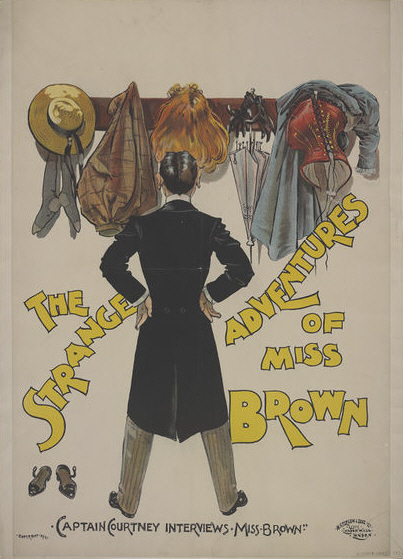
[Tour poster advertising The Strange Adventures of Miss Brown, 1895.]
The Yorkshire Evening Post (20 April, 1895 - p.3) Miss Brown is the striking title of a new farcical comedy by Robert Buchanan and Henry Murray. The intention of the authors is to exploit it themselves in London. ___
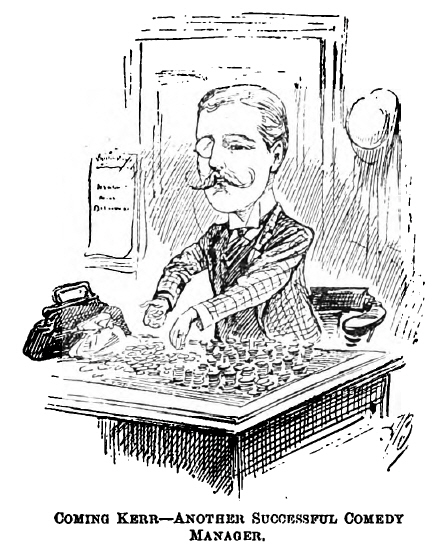
The Stage (6 June, 1895 - p.9) Referring to the vague paragraphs which have recently gone the round of the Press in regard to the plans of the Vaudeville, I am enabled to give you the true story. Mr. Weedon Grossmith, instead of going out of his way to give more or less uninteresting reasons for his decision, says frankly that his present play does not satisfy the box-office, and his new piece—concerning which he is not ready to give any detail for publication—not being ready, he has decided to close his season on Saturday, June 15, and has sub-let the theatre to Mr. Frederick Kerr, who will produce on Wednesday, the 19th, Robert Buchanan’s new farcical comedy Miss Brown, the existence of which I told you some weeks ago. Mr. Grossmith wishes it known that he has no intention of surrendering his lease, and will re-open later on with his new play. Meanwhile Mr. Henderson will, of course, remain in his present capacity during Mr. Kerr’s short season. ___
The Dundee Courier (6, June 1895 - p.3) Mr Robert Buchanan will furnish the inaugural piece for the new management of the Vaudeville Theatre. It will take the form of a farcical comedy, in which Mr Lionel Brough, Mr John Beauchamp, and Mr Fred Kerr will appear in conjunction with Miss May Palfrey (Mrs Weedon Grossmith). Although Mr Buchanan has hitherto worked mainly as an adapter of Fielding’s and Richardson’s novels, his power as a sarcastic writer was shown in that mordant satire of the Ibsenian drama, “A Gifted Lady,” produced at the Avenue Theatre two years ago. The result is partly that plays “made in Norway” no longer arouse interest in London. ___
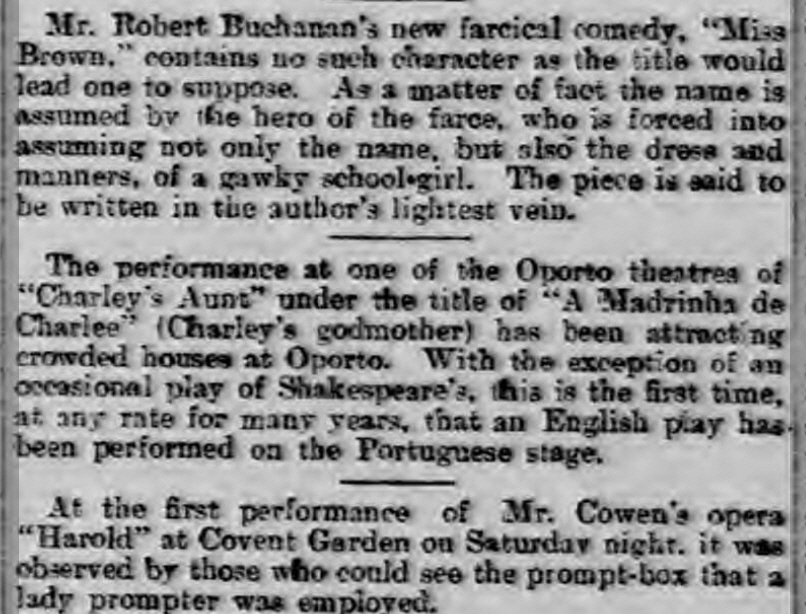
The Sheffield Evening Telegraph and Star (12 June, 1895 - p.2) |
|||
|
|
 |
|
|
|
The Dundee Evening Telegraph (13 June, 1895 - p.2) Mr Robert Buchanan’s name, which has not been since “The Charlatan” upon the bill of a London theatre, will shortly reappear attached to the new farcical comedy “Miss Brown,” which is to be produced at the Vaudeville about the middle of next week, with Mr Lionel Brough and Miss M. A. Victor in prominent parts. Mr Buchanan will shortly be seen in a new light as editor of a fresh monthly magazine devoted largely to literature and the stage. ___
The Stage (13 June, 1895 - p.9) The new piece by Robert Buchanan and Charles Marlowe originally called Miss Brown, of the production of which at the Vaudeville on June 20 I was the first to inform you, has been re-christened The Strange Adventures of Miss Brown. This reads as if the authors were taking a leaf out of Mr. H. A. Jones’s book of titles. The full cast is as follows, and Mr. Buchanan’s synopsis of the various acts is too good reading to be lost in a programme, so I find a place for it here:—Miss Romney (of Cicero House Academy), Miss M. A. Victor; Angela Brightwell (Miss May Palfrey), Euphemia Schwartz (Miss Esme Beringer), Matilda Jones (Miss Daisy Brough), Millicent Loveridge (Miss Ethel Watson) (borders at Cicero House), Clara Loveridge, Miss Grace Dudley; Mrs. O’Gallagher, Miss Gladys Homfrey; Emma, Miss Marion Murray; Major O’Gallagher (of the 41st Lancers), Mr. John Beauchamp; Private Docherty (of the 41st Lancers), Mr. L. Power; Herr von Moser (music master), Mr. Robb Harwood; Mr. Hibbertson (solicitor), Mr. Gilbert Farquhar; Sergeant Tanner (of Scotland Yard), Mr. Lionel Brough; Captain Courtenay (of the 41st Lancers), Mr. Frederick Kerr. Act one, in which Miss Brown makes an unexpected appearance at Major O’Gallagher’s quarters, Chelmsford—the Wedding. Act two, in which Miss Brown is guilty of most unladylike behaviour at Miss Romney’s academy, Cicero House, Chichester—the Honeymoon. Act three: Miss Brown makes a most astounding confession, and departs for ever from Cicero House—amazing apotheosis of Miss Brown. The business management will be in the hands of Mr. A. F. Henderson. ___
The Era (15 June, 1895) THE cast of Mr Robert Buchanan and Charles Marlowe’s new and original farcical play, The Strange Adventures of Miss Brown, to be produced by Mr Frederick Kerr at the Vaudeville Theatre on Thursday next, is as follows:—Miss Romney, Miss M. A. Victor; Angela Brightwell, Miss May Palfrey; Euphemia Schwartz, Miss Esme Beringer; Matilda Jones, Miss Daisy Brough; Millicent Loveridge, Miss Ethel Watson; Clara Loveridge, Miss Grace Dudley; Mrs O’Gallagher, Miss Gladys Homfrey; Emma, Miss Marion Murray; Major O’Gallagher, Mr John Beauchamp; Private Docherty, Mr L. Power; Herr Von Moser, Mr Robb Harwood; Mr Hibbertson, Mr Gilbert Farquhar; Sergeant Tanner, Mr Lionel Brough; and Captain Courtenay, Mr Frederick Kerr. In the first act Miss Brown makes an unexpected appearance at Major O’Gallagher’s quarters, Chelmsford; in the second she is guilty of most unladylike behaviour at Miss Romney’s Academy, Cicero House, Chichester; and in the third she makes a most astounding confession and departs for ever from Cicero House. The business management of the theatre will be in the hands of Mr A. F. Henderson. ___
The Daily News (15 June, 1895 - p.5) Mr. Frederick Kerr’s season at the Vaudeville will commence on Thursday evening next with a new and original farcical play in three acts, describing “The Strange Adventures of Miss Brown.” The authors, Mr. Robert Buchanan and Mr. Charles Marlowe, label their acts respectively “The Wedding,” “The Honeymoon,” and “Amazing Apotheosis of Miss Brown.” After the fashion of Fielding and Cervantes, they also provide each division of their work with a brief synopsis or “argument,” thus: “Act I. In which Miss Brown makes an unexpected appearance at Major O’Gallagher’s Quarters, Chelmsford.” “Act II. In which Miss Brown is guilty of most unladylike behaviour at Miss Romney’s Academy, Cicero House, Colchester;” and “Act III. In which Miss Brown makes an astounding confession, and departs for ever from Cicero House.” The circumstance that no “Miss Brown” figures in the list of personages is probably to be explained by the fact that “Miss Brown” is only an assumed name. The leading parts will be played by Miss M. A. Victor, Mr. Lionel Brough, Mr. John Beauchamp, Mr. Frederick Kerr, Miss Mary Palfrey, and Miss Esmé Beringer. ___
The Illustrated Sporting and Dramatic News (15 June, 1895 - p.14) IT is always a difficult matter to follow up a huge success like The New Boy, and Messrs. Arthur Lane and Weedon Grossmith have not quite accomplished the feat in The Ladies’ Idol, which accordingly comes off at the Vaudeville after a comparatively short career. But Mr. Grossmith, while taking a rest and holiday before his contemplated autumn production has readily found a sub-tenant for the popular little house, which temporarily passes into the hands of Mr. F. Kerr, a young actor-manager, who, with the usual small syndicate at his back, is to begin operations in a few days’ time with a new piece by Mr. Robert Buchanan. This piece is a light or farcical comedy, which was, we believe, written some time ago, and, under the title The Strange Adventures of Miss Brown illustrates the doings of a youth who through “circumstances over which he has no control” has to figure for awhile as a school-girl and gets mixed up in some awkward but harmless complications through the mistake as to Miss Brown’s sex. This, at any rate, is what gossip says of the plot, which will include among its exponents Mr. Lionel Brough, whom one would be very glad to see back in a good part, Mr. Gilbert Farquhar, Miss May Palfrey and Miss M. A. Victor, as well of course as Mr. Kerr himself. ___
Judy: The London Serio-Comic Journal (19 June, 1895 - p. 292) The warm weather having proved too much for The Ladies’ Idol, that entertaining entertainer (the distinction is a necessary one), has taken a holiday and let the Vaudeville for the period of his absence, to that drily amusing young actor, Mr. Fred Kerr, who opens the theatre to-morrow (Wednesday) evening with The Strange Adventures of Miss Brown, a farcical comedy by Messrs. Robert Buchanan and Charles Marlowe . . . . . Marlowe? Marlowe? Where have I heard that name before, in connection with theatricals! ___
The Daily News (21 June, 1895 - p.5) As already noted in our columns, Mr. Frederick Kerr was to have opened the Vaudeville Theatre last night with an original farcical comedy entitled “The Strange Adventures of Miss Brown,” by Messrs. Robert Buchanan and Charles Marlowe. Unfortunately yesterday morning it was found to be imperatively necessary to postpone the new play, Mr. Kerr being afflicted with a total loss of voice consequent upon a severe cold. ___
The Illustrated Sporting and Dramatic News (22 June, 1895 - p.11) TOO late for notice here the commencement of Mr. F. H. Kerr’s season at the Vaudeville was announced for Thursday, when, by way of first piece, there was underlined a comedietta deriving some interest from the fact that it was to re-introduce Miss Adela Measor and her husband, Mr. John Buckstone, after a long absence in the United States. Miss Measor will be remembered by many as a young actress who was giving a good deal of promise a few years ago. Of the nature of the piece of the evening, which is called The Strange Adventures of Miss Brown, it is not difficult to gain a fairly accurate idea from the statement that the supposed Miss Brown has Mr. Kerr for her representative, and from the official description of the several acts which show how “how Miss Brown makes an unexpected appearance at Major Gallagher’s quarters,” “how she is guilty of most unladylike behaviour at Miss Romney’s Academy,” and, finally, “how she makes a most astounding confession and departs for ever from Cicero House.” All this strongly suggests a variant of the Charley’s Aunt theme; and much must depend, of course, upon the delicacy of the humorous treatment of a motive which may either be as innocent as Lord Fancourt Babberly’s in his impersonation of the lady from the Brazils, or as risqué as Don Juan’s in his introduction as Juanna to Dudu. What Messrs. Buchanan and Marlowe have made of the matter remains to be discussed next week. ___
The Newcastle Courant (22 June, 1895 - p.5) Theatrical London, ever athirst for novelty, is now delighting itself in two new plays, “A Practical Joker” and “The Prude’s Progress,” both charmingly vacuous, and therefore pecuniarily successful. Mr Harry Nicholls returns from his illness to “The Girl he Left behind” at the Adelphi. Mr Hare is shortly to start for America with his “Pair of Spectacles” and a strong company. Madame Rehane prepares a French feast. Robert Buchanan seems to find the best palliative for his financial misfortunes in work, and, like a plucky Briton, returns to the fray with a new play to be mounted before long. Mr Clement Scott is industriously occupied in the discovery of genius. He has lighted his perspicuous candle and gone forth into the dramatic darkness for amateurs to supply the vital wants created by the insufficiencies of the established writers. And, truly, dramatic genius must be very scarce if wants so manifest are to remain permanently unsupplied. This rather constructive effort on the part of Mr Clement Scott is, whether conscious or unconscious, an effective piece of criticism. Mr Archer’s select “three acres” in the West-End, where the drama is grown, has been singularly sterile of serious product lately; and any effort to bring this home to the established cultivators is welcome. ___
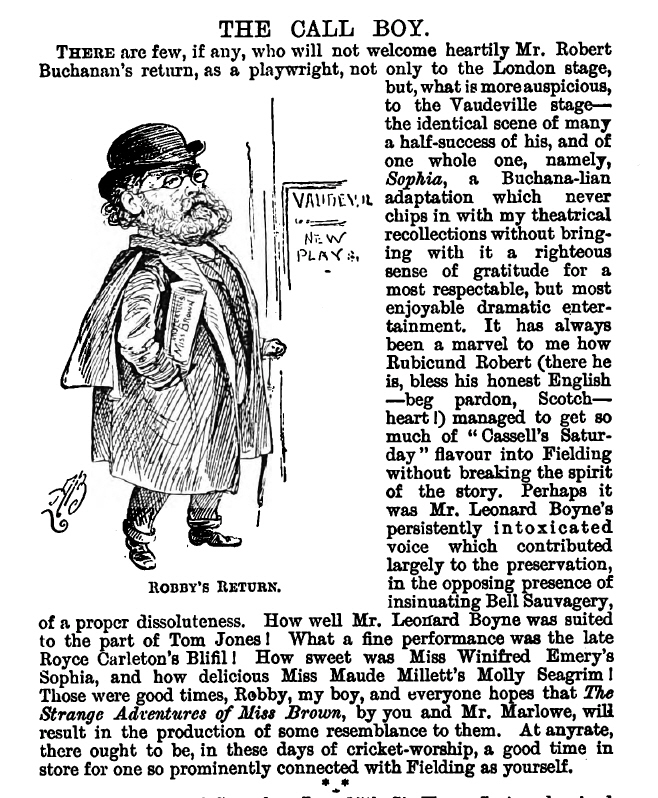
Judy: The London Serio-Comic Journal (26 June, 1895 - p. 304) |
|
|
 |
|
|
|
The Times (27 June, 1895 - p.6) VAUDEVILLE THEATRE. The humour of Charley’s Aunt has proved contagious. Another young gentleman is now masquerading in women’s clothes on the stage: for this is the theme of The Strange Adventures of Miss Brown, given last night at the Vaudeville at the instance of Mr. Robert Buchanan and Mr. Charles Marlowe. It is a theme necessarily bordering upon the vulgar or the risky, but it is handled by the authors, and by the false “Miss Brown” herself—namely, Mr. Frederick Kerr—with sufficient tact to pass muster; and the cordiality of its reception by the first-night public augurs a successful run for the piece. Among the young ladies attending a select boarding establishment is a certain ward in Chancery who has profited by some laxity of discipline to get married to a gallant captain in the Army. The escapade is almost immediately discovered, and Miss Angela—for such is the young lady’s name—brought back to school. The Lord Chancellor, however, has to be reckoned with, and a Scotland-yard detective is deputed to arrest the male offender. Meanwhile, the captain, with the connivance of a brother officer, makes up in female attire as “Miss Brown,” and obtains admission to the establishment as a boarder also, in order to be near his bride and to plan an escape for both. It is at this juncture that the somewhat broad fun of the piece attains its maximum. Mr. Kerr, who has the interim management of the theatre, adopts as his rather transparent disguise a ludicrous short-skirted school frock, with a sailor hat and a flaming head of red hair, and his movements are a source of continued merriment to the house. Although the bride has no difficulty in penetrating the secret, the other young ladies, together with the detective, are deceived, and even the lady principal of the school observes nothing amiss with the new pupil except that she is a little gauche. Eventually the nocturnal escape is planned, and so far carried out that both the detective and an amorous German music-master, who is on the watch to protect his favourite pupil, are overpowered in a scrimmage which brings all the inmates of the school upon the scene, with candles and in their night-dresses. In the third and last act the terrible “Miss Brown,” who has done prodigies of athleticism, is brought back to the school handcuffed but still undetected as to her sex, the charge being that of aiding and abetting the bride to escape; and when at last the dread discovery is made that “Miss Brown’s” box is full of male clothing, and that she is in truth the captain in disguise, it is reported that she or he has just succeeded to a peerage—a circumstance which it is thought will mollify the Lord Chancellor, and which consequently allows of a happy ending. Mr. Kerr’s disguise is humorous enough to dispense him from saying much, which is fortunate, seeing that he is quite unable to adapt his voice to the situation; but there is otherwise an abundance of dialogue, which, if not as polished as one might expect in a piece to which Mr. Buchanan had put his name, is at least on a level with the subject. Miss May Palfrey makes a bright and engaging bride, and the piece enjoys the services, further, of Mr. Lionel Brough as the detective; Miss M. A. Victor as the lady principal; Miss Esmé Beringer as an amorous pupil who unaccountably takes to the companionship of “Miss Brown,” thereby arousing the bride’s jealousy; Mr. Beauchamp as the brother officer; and Mr. Gilbert Farquhar as an elderly solicitor. ___
The Morning Post (27 June, 1895 - p.3) VAUDEVILLE THEATRE. In “The Strange Adventures of Miss Brown,” produced last night under the interim management of Mr. Frederick Kerr, Messrs. Robert Buchanan and Charles Marlowe, the authors, have presented us with a “farcical play” simple alike in plot and in humour. Captain Courtenay, a young officer of the Lancers, has fallen in love with and proposed to Angela Brightwell, a ward in Chancery and an inmate of Miss Romney’s boarding-school for young ladies. One day Angela eludes her teacher’s vigilance, and, with the aid of her uncle, Major O’Gallagher, gets married to Courtenay. Miss Romney and her legal adviser are, however, upon their track, and it is found advisable for the girl to return to Miss Romney’s establishment, the Captain having meanwhile, to escape detection, donned feminine attire, assumed the personality of a pseudo niece of O’Gallagher, and taken the name of Brown. Under that name and guise he is introduced into the school as a pupil, and then and there arranges to carry off his wife. Angela’s guardian has, however, called in the assistance of the law, and a detective from Scotland-yard spends the night at the school in order to ensnare and capture the captain. As it happens, Angela gets safe away, but the captain, in the character of Miss Brown, is caught by the detective, handcuffed, and brought back to the school. In the meantime, through the death of a relative, Courtenay has succeeded to a title and estates, and when the curtain falls it is understood that Angela’s guardian will regard her accession to the rank of Countess as excusing her defiance of legal enactments and requirements. Nothing could be clearer or more intelligible than all this, and though it is evolved without special ingenuity or comicality, it gave evident pleasure last night to a crowded audience. The authors were duly called, but it was announced that they were not in the house. The rôle of Captain Courtenay had been sustained by Mr. Kerr, who was more happy in his masculine than in his feminine habiliments. It cannot, in truth, be said that he looked the school-girl to the life; it is, indeed, doubtful whether in that guise he could have deceived anybody, male or female, for a moment. Much more successful was Miss May Palfrey, as Angela, in exciting the sympathy and approbation of the public; she played throughout with vivacity and aplomb, and infused spirit into every scene in which she appeared. Mr. Beauchamp made of the Major an effective character-sketch. Miss Gladys Homfrey was no less admirable in the smaller part of his wife, and Mr. Lionel Brough furnished a delightful portrait of a detective who thinks himself much more knowing than he is. The Miss Romney of Miss Victor and the solicitor of Mr. Gilbert Farquhar were excellent conceptions excellently carried out. Mr. Robb Harwood assigned individuality to a German music writer, in love with Angela, and Miss Esmé Beringer, as a hot-headed young foreigner who “takes” to the supposed Miss Brown showed once more how considerable is her versatility. The piece, in fact, has every justice done to it both as regards the acting and the scenic setting. ___
The Standard (27 June, 1895 - p.3) VAUDEVILLE THEATRE. When applied to a theatrical production, the words “new and original” may mean anything or nothing. The formula is used by Messrs. Robert Buchanan and Charles Marlowe to describe a farce brought out at the Vaudeville last night under the title of The Strange Adventures of Miss Brown; but, in truth, the only novelty or originality consists in the idea of mixing together three well-known pieces, and with the aid of one or two notions borrowed from French farces that have not yet come to London—the situation at the end of the second act, for instance—presenting the conglomeration with a fresh name. The success of Charley’s Aunt has, doubtless, led to the invention of Miss Brown. The authors have drawn liberally upon The New Boy, and they have freely helped themselves to the libretto of Messrs. Conan Doyle and J. M. Barrie’s Savoy opera, Jane Annie; and the result is set forth as new and original. The man who disguises himself in petticoats after the fashion of the hero of Mr. Brandon Thomas’s play is a Captain of Lancers; he goes to school, as the New Boy did in Mr. Law’s play, and there are attempts at abduction, alarums and excursions, as in the play of Messrs. Doyle and Barrie, the scene of which was also a girls’ school. It will be perceived that the authors cannot be congratulated on their imagination. Courtenay, the Captain of Lancers, has married a ward in Chancery—Mr. W. S. Gilbert, by the way, has dealt with the pains and penalties attaching to the offence—and is supposed to be in terror of the police, for a Sergeant invades the barracks, and treats the Major in command in a style that has no relation to real life. The bride is taken back to her school, and Courtenay, in female attire, goes to join her (the “new girl” instead of the “new boy”), instigated and supported by the Major, who is an Irishman, for no ascertainable reason except that it is customary to have Irishmen in farces. It has been so, indeed, for a century and more, notwithstanding the fact that for the last half of that period everyone has quite understood that the appearance of an Irishman when there is no motive for his nationality (as here) is a tacit admission that the author hopes by the employment of brogue to atone for the lack of wit. ___
St. James’s Gazette (27 June, 1895 - p.12) VAUDEVILLE THEATRE. MR. FRED KERR, the latest addition to the ever-growing and, it might be added, constantly diminishing number of London managers, has apparently the courage of his opinions. Dissolution may be in the air, the end of the season within easy distance, the weather at melting-point; but despite these untoward circumstances he boldly undertakes the production of a new piece upon the success of which he does not hesitate to stake his fortunes. And if subsequent audiences prove as enthusiastic as last night’s public at the Vaudeville, Mr. Kerr will certainly have no cause to regret his rashness. Farces more consistently amusing than “The Strange Adventures of Miss Brown” have, perhaps, been seen; but this is not to say that Messrs. Robert Buchanan and Charles Marlowe’s piece did not deserve the hearty reception accorded to it. The initial idea is sufficiently droll, if a trifle risky and not altogether novel. For “Miss Brown” is only too obviously a near relation of “Charley’s Aunt,” and may also claim as close connections “The Magistrate,” “Pickwick,” and other more or less celebrated characters. The authors, notwithstanding, have succeeded, after their patchwork fashion, in putting together a fairly ingenious and amusing piece, containing some really humorous ideas, and some that are not humorous. An exhaustive analysis would probably reveal that the latter are somewhat more numerous than the former; but, without entering upon such an invidious measure, it is sufficient to say that the whole provides a bright and exhilarating evening’s entertainment. The mere suggestion of a dashing cavalry officer, attired in girl’s clothes, forcing his way into a young ladies’ seminary and engaging the confidence of one of its inmates, has a certain unpalatable flavour about it. So discreetly, however, have the authors handled the subject that none need fear to find any offence in their manner of treatment. Be it said, also, that their hero, Captain Courtenay, has abundant justification for the step, inasmuch as he is bent upon rescuing his newly-made bride from the clutches of her jealous guardians. How he is pounced upon by a modernized Dogberry, how he breaks away only to be brought back ignominiously, and how finally he is permitted to take his pretty little wife to his arms, will be found by the curious duly set forth in “The Strange Adventures of Miss Brown.” For the interpretation of the story, Mr. Kerr, who is far too shrewd not to appreciate the importance of a capable cast, has got together an excellent company, whose bustling performance would alone justify a visit to the Vaudeville. Of its member, although the part assigned to her is comparatively a small one, we are disposed to give a prominent place to Miss Esme Beringer. By dint of hard work and natural intelligence, this young actress has won her way with exceptional rapidity to the front, and her acting last night fully confirms the impression created on previous occasions, that in her we have one of the most promising leading ladies of the future. Miss Beringer has a sweet and resonant voice; her cleverness is undeniable, and she thoroughly understands how to make her points. The two things she has to guard against at present are an excess of energy and a tendency towards over-expression. But these slight defects excepted, she possesses all the qualities required to make a fine emotional actress. As a muddle-headed Scotland-yard officer Mr. Lionel Brough, by his drily humorous manner, scored one of the chief successes of the evening; while Mr. Fred Kerr, as the supposititious Miss Brown, played with all necessary tact and discretion. Miss May Palfrey made so bright and charming a Ward in Chancery that even the most hard-hearted Lord Chancellor might have excused Captain Courtenay for running away with her. To Miss M. A. Victor, Miss Gladys Homfrey, Mr. J. Beauchamp, Mr. Robb Harwood (altogether admirable in a small character-part), and Mr. G. Farquhar, every credit is also due for their effective performances. In the absence of the authors, Mr. Kerr, appearing before the curtain, undertook to convey to them the gratifying news of the cordial reception given to their piece. ___
The Globe (27 June, 1895 - p.3) “MISS BROWN” AT THE VAUDEVILLE. A young military man, with nothing but his pay, falls in love with a school-girl, who is a ward in Chancery; the girl elopes with him, and they marry. They are pursued by the schoolmistress and the damsel’s guardian, and, to escape arrest, the husband shaves his moustache and dons feminine attire. In that guise, and as a “Miss Brown,” he is introduced by a sympathetic uncle into the school, to which his young wife has been sent back; the two arrange to run away that evening, but, though the girl gets clear off, her spouse, still dressed as “Miss Brown,” is captured. Then comes word that the husband has inherited a title and an income, and we are left to suppose that the wife’s guardian will now make no objection to the marriage. ___
The Guardian (27 June, 1895 - p.7) “The Strange Adventures of Miss Brown,” produced this evening at the Vaudeville Theatre, is an attempt by Messrs. Robert Buchanan and Charles Marlowe to “go one better” than “Charley’s Aunt.” Captain Courtenay, a cavalry officer, has married a ward in Chancery, but the minions of the law have got on his track on the very day of the wedding, and he has been obliged to disguise himself in female attire in order to elude them. The bride is sent back to the boarding school from which she has run away, and the success of the gallant captain’s disguise suggests the idea that he should assume it once more in order to rejoin his wife in the seclusion of Cicero House and carry her off therefrom. The style of situation which results from this imbroglio may readily be divined. The authors have steered tolerably clear of the offensive possibilities of such a theme, but on the other hand they have shown very little invention in the development of their idea. The audience, however, was in excellent humour, and laughed and applauded liberally. Mr. Fred Kerr, who has taken over the management of the theatre, played the supposed Miss Brown; Miss May Palfrey was very bright as the schoolgirl bride; Mr. Lionel Brough was good as an idiotic detective; and other parts were cleverly played by Mr. Beauchamp, Miss Gladys Homfrey, and Miss Esmé Beringer. ___
The Manchester Courier and Lancashire General Advertiser (27 June, 1895 - p.5) The warm greeting given to the new comedy, “The Strange Adventures of Mrs. Brown,” this evening, at the Vaudeville Theatre, was, I fancy, as much intended to mark the return of a popular author to stage work as a recognition of particular merit in the piece, which is an audacious farce, risky in tone, yet clever and extremely amusing throughout. Mr. Robert Buchanan has done very much better work, and the broadly farcical character of this production has not the merit of being sustained, for interest languishes considerably during the last act. The nature of the piece may be gathered from the fact that the amusement is derived from the presence of a handsome cavalry officer in a young ladies’ school, masquerading in female attire in order to be near a ward in Chancery whom he has secretly married. ___
The Dundee Courier (28 June, 1895 - p.3) “Charley’s Aunt” has found a promising rival in “Miss Brown.” “The Strange Adventures of Miss Brown” is the title of a three-act farce by Robert Buchanan, which I attended upon its production last night at the Vaudeville. The theatre so famous in connection with the four years’ run of “Our Boys” has been taken for this play by Mr Fred Kerr, who is even more unique as a comedian than Mr Penley. Miss Brown is really a young cavalry officer, who, having married a schoolgirl, a ward in Chancery, visits his wife at her school himself dressed as a new lady border. The complications, aided by an Irish major of Dragoons, and with Lionel Brough as a detective from Scotland Yard, are delightfully diverting. ___
The Era (29 June, 1895 - p.8) EVERYBODY knows Miss Schwartz in Vanity Fair; therefore Miss Schwartz in Vanity Fair is known to Mr Robert Buchanan and Mr Charles Marlow—or Mrs or Miss Charles Marlow, for sexes are not always what they seem, and to the public “Charles Marlow” is but the shadow of a name. No one can blame the newer authors for having taken a hint—even an entire personage—from the older; but why this needless candour? A name must be a simple thing for a writer of Mr Buchanan’s fertility to invent. The lady’s comely blackness might, with no great effort, have been suggested by some other means as simple and direct even as the employment of a German adjective for her surname. _____ (p.9) STRANGE ADVENTURES OF MISS BROWN. A New and Original Farcical Play, in Three Acts, Miss Romney .................... Miss M. A. VICTOR To say that The Strange Adventures of Miss Brown “proved acceptable” at the Vaudeville Theatre on Wednesday night is to exactly describe the impression produced. We have had, of late, rather a glut of serious plays; and a sad tale saddens doubly when it—the weather, not the narrative—is warm. We turned on Wednesday with cheerful alacrity and a certain feeling of relief to Messrs Buchanan and Marlowe’s adroit concoction, with its good, old-fashioned farcical business, its irresistible frivolity, and its pretty young ladies in creamy attire well suited to the prevailing temperature, and suggestive of an airy coolness much to be desired. Pleasing mystery is ever present to lend piquancy to scenes in the interior of a young ladies’ school, and what with the excellent acting, and the never-flagging if not particularly novel fun, we confess to spending a pleasantly hilarious evening with Miss Brown. This is the story:—A certain impulsive damsel named Angela Brightwell runs away from school to marry one Captain Courtenay, of the 41st Lancers, aided and abetted thereto by Major and Mrs O’Gallagher, at whose quarters the wedding breakfast takes place. In the middle of it Miss Angela’s school mistress, Miss Romney, arrives in pursuit of the fugitive, accompanied by Mr Hibbertson, a solicitor, and Sergeant Tanner, a detective from Scotland-yard—for Miss Brightwell is a ward in Chancery, and Captain Courtenay by wedding her has put himself within reach of his country’s laws. In order to escape capture by the police, he dresses up in the clothes of and is introduced to the detective as an imaginary “Miss Brown,” the Major’s niece. In the second act, which takes place at “Cicero Academy,” Courtenay, still in the disguise of “Miss Brown,” is left by the Major as a pupil at the school, and it is arranged that he shall elope with Angela that same evening. Tanner, who is on the premises, prepares for an attack from outside, and makes himself comfortable in an apartment communicating with the garden of the school through a conservatory. Now the music-master of the establishment, one Von Moser—no relation to the celebrated German dramatist—is watching in the garden outside, for he has conceived a violent passion for Angela, and is determined to prevent her loving husband from carrying her off. When “Miss Brown” and Angela come down into the sitting-room at eleven p.m. they find Tanner there, put him off his guard by their simple blandishments, and finally succeed in getting him to lock a pair of handcuffs on his wrists. They then turn out the lights, and escape in the confusion caused by the irruption of the young ladies and their preceptress in their nocturnal costumes. “BETWEEN THE POSTS.” Geoffrey Warburton .......... Mr JOHN BUCKSTONE How Mrs Bell’s play in French called L’Indécis was produced at the Royalty Theatre in the November of 1887, how it was adapted into English by her under the title of Between the Posts, and how a version by Mr G. W. Godfrey called The Man that Hesitates was performed at the St. George’s Hall in the February of 1889 need not be here retold. The interest in connection with the revival at the Vaudeville last Wednesday grew out of the appearance of Miss Measor, a charming actress who has been too long absent from the English stage, though what has been England’s loss has been Australia’s gain. She sustained the character of Edith Neville with her wonted delicacy, tact , and fine finish; and an effective contrast to her agreeable impersonation was the Geoffrey Warburton of Mr John Buckstone, which was a sound, careful, and humorous bit of acting. The little piece was evidently much enjoyed. Laughter was hearty and frequent during its representation; and Mr Kerr deserves the gratitude of the pit and gallery for supplying them with such a capital curtain-raiser. ___
The Saturday Review (29 June, 1895 - p.861) “The Strange Adventures of Miss Brown,” at the Vaudeville, is said to resemble a piece called “Charlie’s Aunt” (which I have not seen) in point of introducing a man disguised as a woman. Such disguises are usually more or less disagreeable; but this is not so in the present case. The piece, which is by Mr. Robert Buchanan and Mr. Charles Marlowe, offers itself unashamedly as pure fun and pastime for a couple of hours; and it succeeds perfectly. It is not silly or tedious, like most pieces with the same aim; it cannot tax the most ordinary brain, though the interest is kept up throughout; and it is irresistibly laughable. Mr. Frederick Kerr, as a huge schoolgirl in a red wig, is as pleasant and popular, and—to heighten the joke—as manly, as he usually is in the costume proper to his sex. Youth, good looks, and a pretty audacity serve Miss Palfrey’s turn better than the moderate degree of art she has so far acquired; Miss Esmé Beringer acts, and acts well, as the dark parlour boarder from Demerara; Mr. Robb Harwood made a hit as the German master; Mr. Beauchamp is a very Irish major struggling with a very English accent; and Miss Victor, Mr. Lionel Brough, and Miss Homfrey, assisted by half a dozen lesser lights, make up a cast that could hardly be improved. On the whole, I can recommend “Miss Brown,” even for the warmest nights. G. B. S. ___
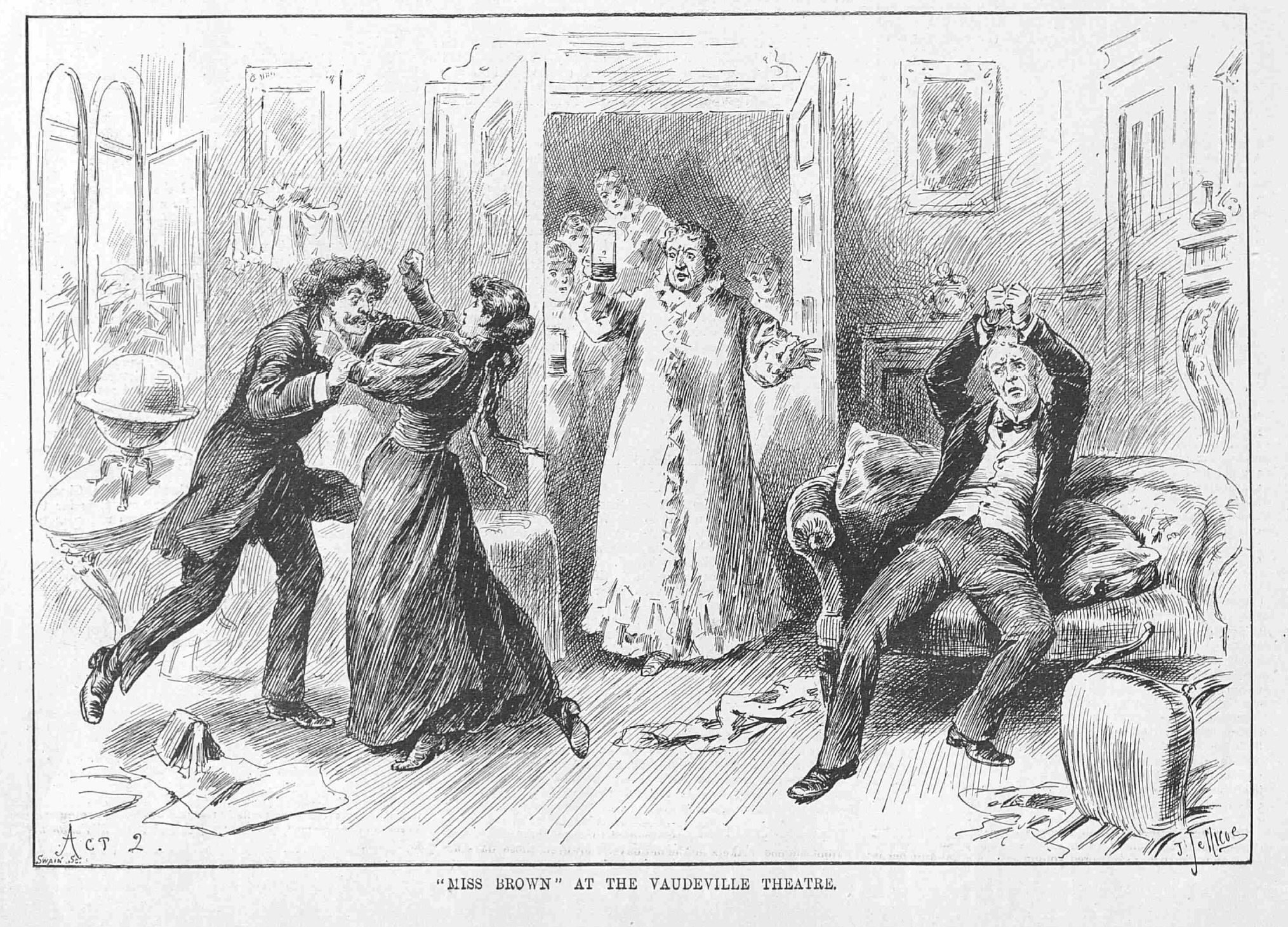
The Illustrated Sporting and Dramatic News (29 June, 1895 - p.12) “MISS BROWN” AT THE VAUDEVILLE THEATRE. OUR picture was taken at the rehearsal of this new piece for the vaudeville, which should have been produced on the 20th, but for the indisposition of Mr. F. Kerr. The scene is the one in which the young soldier Captain Courtenay, disguised as “Miss Brown,” is foiled in his attempt to abduct his wife by the jealous music-master. The wife, a ward in chancery, who had eloped, has been brought back to school by the mistress under threats of prison and the Lord Chancellor. The detective who has been put sentry to prevent her escaping a second time, has been inveigled into handcuffs, and is powerless. The scuffle with the music-master, who has made it his business to flirt with all the girls of the establishment, and considers himself personally wronged by the marriage of one of them, rouses the whole house, and as seen in our picture the mistress and the young ladies rush in in undress with night lamps. |
|
|
 |
|
|
|
The Referee (30 June, 1895 - p.3) If the authors of “The Strange Adventures of Miss Brown,” produced on Thursday night at the Vaudeville—Mr. Fred Kerr having recovered the use of his voice—have not racked their brains for new ideas, why should they, when such good fun as they have packed into their play, is to be easily found? It is as plentiful as strawberries. Messrs. Robert Buchanan and Charles Marlowe seem to have taken an idea from this and an idea from that. Seem, I say, for it is conceivable that Mr. Marlowe at least may never have heard of “Les Petits Brebis,” produced not long ago in Paris, or “Pickwick,” or “The New Boy,” or “Charley’s Aunt,” or “Vanity Fair”—the novel, not the play. (That it should be necessary to have to say so!) It is conceivable that Mr. Marlowe may never have heard of these things, as we have never heard of Mr. Marlowe, and if the ideas of the play are all his own I offer him my compliments, for with the help of Mr. Buchanan he has made of them a highly amusing “new and original” play—accepting the terms in the sense in which they are used in theatrical programmes—which fulfils its aim in keeping the house “on a roar.” The “Miss Brown,” with whose strange adventures the piece is concerned, is a young gentleman who marries a ward in Chancery, who takes French leave of her schoolmistress. The runaway, however, is sent back to school by the friends who had arranged the wedding, though it is not with the idea of separating the newly married couple that the young lady is given up to the dragon of Cicero House Academy. The bride is no sooner gone than her husband, dressed up as a girl, is packed off to the school after her. You may imagine what a life Charley, masquerading as “Miss Brown,” leads there. The strict discipline of Miss Romney is not more trying than the friendly attentions of “Miss Brown’s” companions, and the New Girl is about as awkwardly placed with regard to Charley’s Aunt—Charley’s bride, I should say—as Weedon Grossmith in “The New Boy,” or Penley in “Charley’s Aunt.” Affairs are complicated by the presence of a detective, who has obtained, by some summary legal process that has no relation to actual life, a warrant for Charley’s arrest, and the young husband’s attempt to carry off his wife creates a fine stir in Cicero House Academy. The detective and the German master—who is, by virtue of ancient right, in love with the pretty schoolgirl—receive each a pommelling from “Miss Brown”; and there is always laughter for the battered victims of the fray. Then Charley’s aunt, or uncle, or somebody dies, and “Miss Brown” succeeds to a peerage. Upon this everybody is satisfied, the Chancellor, I presume, included; but whether he is satisfied or not it does not matter. It is more to the point that the audience are, and they signified the same in the usual manner by calling vociferously for the authors at the fall of the curtain. The piece is capitally acted, though Mr. Kerr, who has recovered his voice, has not been successful in finding a girl’s voice. The piece would have had to be postponed for a long time it he had waited till he had, for his performance of Miss Brown does not show any change in the particular dry style of acting to which he has accustomed us. But Miss Brown is not everything in the play, and there is, indeed, very little for her to say. She has only to be, to do, and to suffer. Mr. Lionel Brough, whose comic acting as the detective is something rich, and Mr. J. Beauchamp, who is superb as Charley’s friend (Irish), and Miss M. A. Victor, who is the very type of the schoolmistress of the bygone days of woollen antimacassars and wax flowers; these three have the best part of the talking to do. Miss May Palfrey is delightfully girlish as the bride, who is simply the little flirt of “The New Boy” married; and that most interesting young actress Miss Esmé Beringer is simply sweet as the young lady from Demerara—the place the sugar comes from, as Charley’s Aunt might say. There will be a matinée of “The Strange Adventures of Miss Brown” next Wednesday. ___
The People (30 June, 1895 - p.6) VAUDEVILLE. Mr. Frederick Kerr has started well in his first venture at management, for so merry and enlivening a farcical play as “The Strange Adventures of Miss Brown” has not been seen since Mr. Weedon Grossmith opened the theatre with “The New Boy.” The phenomenal success of “Charley’s Aunt” at another, or rather at other playhouses, may possibly account for the circumstance of Messrs. Robert Buchanan and Charles Marlowe presenting a man in female attire as the leading character of their piece. But, as in the case of Mr. Brandon Thomas’s merry play, the disguise is contrived with such taste and tact as prevents the possibility of any unpleasant sexual suggestion. The story, starting with infinite spirit, maintained and intensified through a rapid succession of ludicrous scenes and comic surprises to the end, presents a runaway ward in Chancery bolting from boarding school with her soldier lover. But no sooner are the fugitives married from the quarters of the gallant captain’s brother officer than they are pursued by the bride’s guardian armed with an order from the court to arrest the chancellor-defying bridegroom. To baffle the guardian and the stolid detective accompanying him, the bridegroom disguises himself as a gawky girl, and in that character is introduced as a new scholar, by his friend and confederate, the Irish major, to the prim and prudish mistress of the boarding school to which the bride is taken back. The endearments of the young ladies of Cicero House Academy with the “new girl,” and the embarrassment of the recipient on perceiving the jealousy excited in his bride by these fond sisterly attentions created food for laughter, augmented from w ripple to a peal when the newly-married, having inveigled the detective set to spy on them into his own handcuffs, try to escape after the household has retired for the night, and, baffled in the attempt by the prying German music master of the school, are confronted with the lady principal and her maiden charges, who roused from their slumbers by the unwonted disturbance, suddenly appear upon the scene in their robes de nuit. To betray more of the ludicrous involvements of the plot might spoil for the reader his pleasure as spectator of this highly-diverting entertainment. Suffice it that a happy conclusion to the difficulty of the young couple is brought about by the condonement of the breach of law in consideration of the bridegroom suddenly proving a good match for the ward in Chancery through his sudden and unexpected succession to a peerage. Mr. Fred Kerr, quite recovered from the loss of voice which compelled his postponement of the performance for a week, played the bridegroom, taking refuge in female attire to escape detection, with the quaint dry humour invariably distinguishing his impersonations, which proved a capital artistic contrast to the vivacious skittishness of Miss May Palfrey as the pretty and innocent, but boldly self-assertive, girlish bride. Mr, J. Beauchamp and Miss Gladys Homfrey gave an excellent portrayal of the genial Irish major and his wife, and Miss M. A. Victor acted with a discreet sense of fun the prudish propriety of the extremely proper Miss Romney, the dragon of virtue at the head of Cicero House Academy. Mr. Lionel Brough impersonated with stolid fun the dunderheaded detective, and Mr. Robb Harwood and Miss Esmé Beringer, two young and promising players, severally made a decided hit, one as the crafty German music master, the other as a Creole schoolgirl, whose passionate nature prompts her to make a close friend and confidant of the “new girl” in the person of the disguised bridegroom. Finally, Mr. Gilbert Farquhar enacted with characteristic sincerity the pompous solicitor, guardian of the bride. The sincere and continuous laughter of the audience at the merry farce, acted as it was to perfection in every part, indicated for it the fairest promise of lasting success. ___
From The Theatrical ‘World’ of 1895 by William Archer (London: Walter Scott, Ltd., 1896 - p.233) “MISS BROWN.” 3rd July. The Strange Adventures of Miss Brown, a farce by Messrs. Robert Buchanan and Charles Marlowe, produced at the Vaudeville last week, amused the audience hugely, and in so far fulfilled its purposes. It is an ingenuous attempt to run Charlie's Aunt and The New Boy into one; but it is not nearly so clever as either of these farces, and quite as vulgar as both of them together. Still, as aforesaid, it went merrily enough, thanks to the bright acting of Miss May Palfrey and Miss Esme Beringer, and the red wig of Mr. Frederick Kerr. Mr. Kerr’s character called for no art whatever, except that of looking foolish—a task in which he succeeded to admiration. Mr. Lionel Brough, Mr. John Beauchamp, and Miss Gladys Homfrey also contributed to the success of the production. ___
The Sketch (3 July 1895 - p.43) NOTES FROM THE THEATRES. . . . It rarely happens that so many sources of origin have been suggested for a play as in the case of “The Strange Adventures of Miss Brown.” “Charley’s Aunt,” “The New Boy,” “The Magistrate,” “Le Petit Duc,” “School,” an episode in “Pickwick,” a canto of “Don Juan,” and “Jane Annie,” have been put forward as contributing to what has been called a “pot-pourri” and an “olla-podrida.” It would be difficult to pretend that Messrs. Robert Buchanan and Charles Marlowe really have consciously plagiarised from so many authors; it is not inconceivable that, although Mr. Buchanan doubtless is acquainted with all the works that I have named, he and his collaborateur have not wilfully borrowed at all. By-the-bye, I notice that the authors are even accused of borrowing notions from one or two French farces not yet seen in London, which seems to me a rather unfair way of making a charge of plagiarism. The accuser, unless he pretends that his accusation is founded upon a matter of common notoriety, ought, I think, to give fuller particulars. Now, no doubt, so far as actual merit in authorship is concerned, these charges of plagiarism, if well founded, are pertinent; for though much skill may be shown in making a “resurrection pie,” it is skill of a humble order. Yet it cannot be said that the audience were affected by the question of originality, while I fancy the critics quite enjoyed the game of seeking out parallel passages. “The Strange Adventures of Miss Brown” may, as a work of art, deserve all the censure that it has received, but it proved amusing to the house. Certainly the success was greatly due to the acting. Mr. Fred Kerr did not quite seem an ideal Miss Brown, though he was funny at times; Miss Palfrey was charming as Angela, the heroine; and Miss Esmé Beringer was delightful as the Demerara girl who caused some people to whisper “Vanity Fair,” and others to try, unsuccessfully, to find some phrase about Demerara sugar and Miss Beringer that might serve as an ingenious, truthful compliment. Mr. Lionel Brough was irresistibly funny as the detective, and hearty praise is due to Mrs. M. A. Victor and Mr. John Beauchamp. ___
The Stage (4 July, 1895 - p.11) THE VAUDEVILLE. On Wednesday evening, June 26, 1895, was produced for the first time a new and original farcical play, in three acts, written by Robert Buchanan and Charles Marlowe, entitled:— The Strange Adventures of Miss Brown. Miss Romney .................... Miss M. A. Victor Not for the first time by many, either in drama or in story, has a lover assumed female disguise to win or carry off his intended, but an old idea ably handled will always hold its own, and this is the case with The Strange Adventures of Miss Brown. Capt. Courtenay is very much in love with Angela Brightwell, but as she is a schoolgirl and a ward in Chancery, though he proposes he does not quite decide on marrying her there and then. Angela, however, is impulsive, adores her captain, and thinks that there should be no delay in the ceremony. So she arranges that they should meet at his great friend’s, Major O’Gallagher, quarters, the Major’s genial kindly wife being there to play proprietary, and that they should be joined together in matrimony by special license. The wedding comes off, but unfortunately Angela’s flight is discovered, and so her schoolmistress, Miss Romney, and Mr. Hibbertson, the solicitor appointed by the Lord Chancellor to see after the ward, arrive, accompanied by Sergeant Tanner, a detective from Scotland Yard, who is to arrest Capt. Courtenay for contempt. Mrs. O’Gallagher is equal to the occasion, for, when Tanner insists on searching the house, he is introduced to a rather plain-looking, red-haired lady as Miss Brown, the said Miss Brown being no other than the gallant Captain, who has assumed the female disguise. The Captain is naturally anxious to enjoy his honeymoon, and his wife, having been taken back to Miss Romney’s, the Major takes the pseudo Miss Brown there and places her under the schoolmistress’s charge. Sergeant Tanner, who has been watching the Captain’s movements, naturally imagines that he will make for the spot where his lady love is in durance, and so obtains permission from Miss Romney to watch through the night. Angela has another admirer in Herr von Moser, her music master, who, also believing that she will be carried off by Capt. Courtenay, is guarding the approaches to the house. Tanner, calmly smoking his cigar, is surprised by the entrance first of Angela, and then of one of her great friends, Euphemia Schwartz, a handsome Creole girl boarder; they beguile him into allowing them to put on himself the handcuffs which he intends for Capt. Courtenay’s wrists. The last-named gentleman appears in the garb of Miss Brown. Herr von Moser also comes on the scene, there is a general scrimmage, and the curtain falls on Miss Romney and her pupils appearing attired in white dressing-gowns, having been disturbed by the noise. The third act is a little weak, it is only the winding up of the thread. Angela has got away safely, but Capt. Courtenay has been captured after a sharp chase by the detective, and is brought back muddy and dishevelled. News arrives of the sudden death of his cousin, whose decease makes the Captain an Earl, and so (by a little stretch of author’s license, for we hardly think the Lord Chancellor would take matters quite so easily) no further opposition is offered, and Angela and her husband are supposed to start off together. The subject of the play, one can see, is a little risky and somewhat trite, but the authors have treated it with great skill, and made it very amusing and enjoyable. They certainly owe much of the success of Wednesday night’s performance to the excellence of the manner in which the principals realised their ideas. Capt. Courtenay, alias Miss Brown, as the title-rôle, must be taken first. Mr. Frederick Kerr, we thought, might have availed himself a little more of his opportunities, and disguised his voice better; but for a man to fill a part in petticoats in comedy or farce, and to bring some semblance to nature, is not an easy thing to do, and therefore we must give Mr. Kerr all due credit. Miss May Palfrey’s Angela Brightwell was one of the most charmingly natural and feminine pictures we have ever seen, buoyancy without giddiness, genuine fun without a tinge of vulgarity, and hers was a very risky part to play. Miss Victor thoroughly realised the prim decorous schoolmistress, but might have had better support from Mr. Farquhar as Mr. Hibbertson. Miss Esme Beringer made a very marked advance as Euphemia Schwartz: it was a very careful study, full of colour, but with the high tints not too much emphasized. Miss Daisy Brough was quaint as the romantic lovelorn Matilda Jones, and Miss Marion Murray was smart as the servant Emma. Miss Gladys Homfrey as Mrs. O’Gallagher was so genial and lovable in her part that we were quite sorry we did not see more of her, and Mr. Beauchamp was the realization of one of Lever’s Irish majors, which is paying him the best of compliments. Almost the hit of the evening was made by Mr. Robb Harwood—his Herr von Moser was replete with humour, and was never exaggerated. Mr. Power rendered excellent service as Private Docherty, the soldier servant. Of Mr. Lionel Brough’s performance as Sergeant Tanner there is no occasion for us to speak, his reputation is too well known, and all that need be said is, that whenever he was on the stage the enjoyment of the audience was at its highest. The Strange Adventures of Miss Brown was received with every mark of approval, the calls were numerous, and on the fall of the curtain Mr. Kerr announced that the authors were not in the house, but that he would convey to them the favourable reception accorded to their work. ___
Black and White (6 July, 1895 - p.16) THE LONDON THEATRES. The Strange Adventures of Miss Brown, by Mr. Robert Buchanan and Mr. Charles Marlowe, produced at the Vaudeville, is an amusing trifle of the Charley’s Aunt order which bids fair to win popularity. Of course, the theme of a young man masquerading in woman’s clothes comes perilously near the vulgar; but in this piece, as in its prototype, actual contact with it is avoided. Miss May Palfrey, Miss Esmé Beringer and Miss M. A. Victor act with grace and spirit. Mr. Frederick Kerr is extremely amusing as the false “Miss Brown,” and his representation is accompanied by a constant ripple of laughter. Other parts are capitally portrayed by Mr. Lionel Brough, Mr. Beauchamp and Mr.Gilbert Farquhar. ___
The Illustrated London News (6 July, 1895 - p.25) THE PLAYHOUSES. BY CLEMENT SCOTT. Mr. Robert Buchanan has made a success at the Vaudeville with a funny play, aided by a mysterious Mr. Charles Marlowe. It appears that certain of my brethren were impolite enough to say, concerning Mr. Buchanan’s partner, in the words of Mrs. Gamp, that “there was no sich person.” Whereupon, in order to keep up the joke, the authors of “The Adventures of Miss Brown” thought to clinch the matter by forwarding to the editor of a popular newspaper Mr. Charles Marlowe’s visiting card! But that does not prove much, for I have heard before now of visiting cards being printed bearing fictitious names. It really does not very much matter, however, whether the mysterious Marlowe exists in the flesh or not; but I should not be surprised to hear that, following the example of Mr. Fred Kerr, he occasionally wears petticoats—in fact, that this Mr. Marlowe is a very clever literary Miss! Messrs. Buchanan and Marlowe certainly owe a deep debt of gratitude to Mr. Kerr and his company for the admirable manner in which they skate over the many difficulties contained in the adventures of the aforesaid Miss Brown. One false step would have ruined the farce, and I really do not see how the man-woman could have been played with greater care, good taste, and judgment than by Mr. Kerr. A more difficult task was never presented to an actor, and this will be recognised if I briefly refer to the story. ___
Judy: The London Serio-Comic Journal (10 July, 1895 - p. 16) THE CALL BOY. MR. CHARLES “MARLOWE,” Mr. Robert Buchanan’s partner in the authorship of The Strange Adventures of Miss Brown, particularly wishes it to be known that he is familiar with the sensation of actual existence. If the name of Charles “Marlowe” had been associated with the art of bread-baking or the science of plumbing and gas-fitting, no one could reasonably have been expected to care a twopenny-halfpenny hang whether it belonged to a real or an imaginary person. As it happens, however, the name in question—which I humbly take leave to suppose is an assumed one, while leaving myself wide open to contradiction on the point—is the property of a gentleman who has helped another to invent and write an exceedingly clever and funny farcical play, and therefore the fact that Charles “Marlowe” lives and breathes, and is accessible to managers with commissions, is one of tremendous importance with a community which could easily do with a few more farcical plays of the same excellent quality as The Strange Adventures of Miss Brown. As for myself, I should not mourn or refuse to be comforted if the Laws of England and elsewhere spake and said that there should be no more farcical plays; but since the Laws of England and elsewhere have as yet been heard to make no such arbitrary declaration, and the industry of farce-making is everywhere commanding a large and mixed following, it is obviously to our advantage that the industry’s best results should be encouraged; wherefore I insist that the “actual existence” of Charles “Marlowe” is a matter which should furnish us with a most pleasing reflection, and I consider Mr. Robert Buchanan’s real friend deserves s large amount of credit for the generous way in which he has renounced the glorious notoriety of anonymity. If it were possible for me to be more grateful to Mr. Charles “Marlowe” than I am already, my increased indebtedness to him would be brought about by the discovery that he had communicated the fact of his “actual existence” to Mr. W. S. Penley, and given that funny little gentleman his address. |
|
|
 |
|
|
|
The acting in The Strange Adventures of Miss Brown is as good as the piece itself: and there you have a statement which involves the necessity (a most pleasing one, I can assure you) of congratulating the actors and actresses concerned upon very good performances indeed. Mr. Frederick Kerr acts faultlessly (as is necessary he should do, seeing that to him is entrusted the delicate business of passing as a girl at an Academy for Young Ladies) as the soldier-lover and husband (merely a farcical combination, of course) of Pretty Angela Brightwell; Miss May Palfrey looks an Angela without the concluding “a,” and plays the part of the married schoolgirl with an amount of stage tact and natural charm which is far in excess of what we were led to expect by the promise of May in The New Boy. Mr. Robb Harwood walks off with, and is unquestionably entitled to, a large amount of the evening’s applause for his excellently clever representation of a German music master; and Miss Esmé Beringer manages most wonderfully to show the authors that there is a good deal more in the character of Euphemia Schwartz than they ever dreamt of. Mr. Lionel Brough is true to the life, and naturally humorous into the bargain, as Detective Sergeant Tanner, of Scotland Yard—who, in accordance with the general rule of detectives, and as his name implies, is half the value of a Bobby; Mr. Hibbertson (a solicitor) plays Mr. Gilbert Farquhar with considerable imitative power; Miss M. A. Victor is first-rate (when is she not?) as the “all propriety” proprietress of the Academy for Young Ladies; and other good work is done for the good play by Miss Daisy Brough, Miss Gladys Homfrey, Mr. J. Beauchamp, Mr. Power, Miss Marion Murray, and Miss Grace Dudley. ___
The Sketch (17 July, 1895 - p.25-27). |
|
|
|
|||
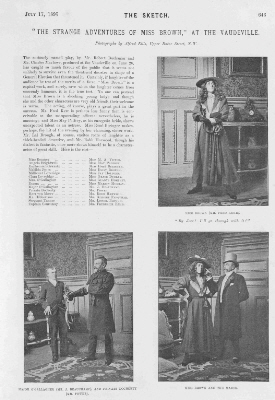 |
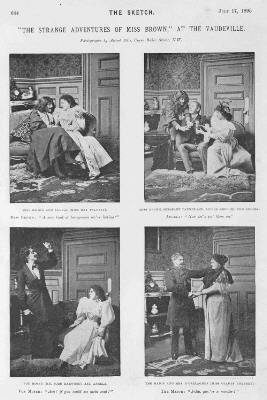 |
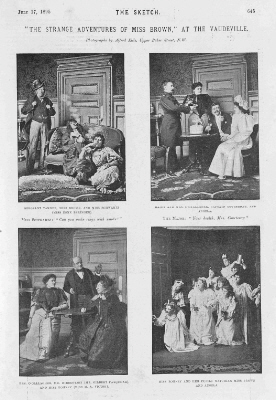 |
|
|
|
The Illustrated Sporting and Dramatic News (20 July, 1895 - p.20) OUR CAPTIOUS CRITIC. |
|
|
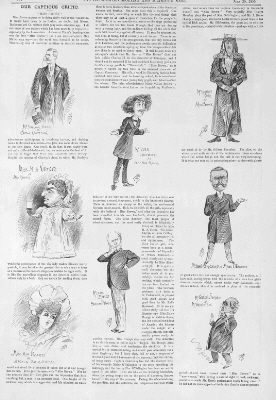 |
|
|
|
The Bury and Norwich Post and Suffolk Standard (23 July, 1895 - p.7) “THE STRANGE ADVENTURES OF MISS [BY EOTHEN.] The first piece, Between the Posts, by Hugh Bell, opens the ball in lively fashion. Smartly written and acted with vivacity by Mr. John Buckstone, as Geoffrey Warburton, a young barrister, and Miss Measor, as Edith Neville, it secured a heartier meed of applause than is usually given to its class. The subject matter is not racing, nor are the posts the starting and winning posts but those under the control of the Postmaster General. ___
The Theatre (1 August, 1895) THE STRANGE ADVENTURES OF MISS BROWN. A Farcical Play, in Three Acts, by ROBERT BUCHANAN and CHARLES MARLOWE. Produced at the |
|
|
|
|
|
The easiest and most comprehensive manner of describing Miss Brown is to say that the piece is fairly amusing. The fact is more than sufficient to secure for it the favour of a laughter-loving public, and the authors consequently may rely upon reaping a reward altogether disproportionate to the labour they have expended on their work. For, truth to tell, neither in the matter of originality nor of wit have they been too prodigal. Where invention failed, however, memory has come to the rescue, while any lack of humour is fully counterbalanced by a plentiful supply of horseplay. The result is more or less of a dramatic hotch-potch, in which one is continually encountering savoury little scraps conveyed by the purveyors from sources familiar to every playgoer. At one moment we have a suggestion of Don Juan, at another The Magistrate is recalled, while at every turn the unmistakable influence of Charley’s Aunt can be detected. This the merest sketch of the plot will serve to show. Captain Courtenay, a dashing young cavalry officer, has married Angela Brightwell, a ward in chancery, without first obtaining the necessary permission. Nemesis, in the shape of a fussy little solicitor and a muddle-headed detective, follows swiftly upon his track, and in order to elude those representatives of the law Courtenay shaves off his moustache and appears in the dress of a schoolgirl. So attired, he contrives to penetrate into Miss Romney’s academy, where his bride is held prisoner, with results which can easily be imagined. The situation is as old as the hills, and at this time of day hardly offers scope for anything like novel treatment. As it happens, the authors of Miss Brown have been content to take things as they found them, on the principle, doubtless, that what served to make our fathers and grandfathers laugh can scarcely fail to provoke merriment in a later generation. Frankly, however, they might have been at the pains to supply a last act a trifle more ingenious in construction and convincing in dénouement. But the average farce-writer is seldom too particular about the final unravelling of the various threads of his plot, preferring to cut the Gordian knot at one stroke, and in this respect Messrs. Buchanan and Marlowe are no better or worse than the majority of their fellow-workmen. In fairness it should be said that much of the success obtained by their piece on its first performance was due to the admirable interpretation given it by an excellent company. In selecting the title-part for himself, Mr. Fred Kerr, who has temporarily assumed the management of the Vaudeville, showed a degree of self-abnegation somewhat unusual in the actor-manager, for certainly no one could describe Captain Courtenay as a star part. With commendable tact and discretion, Mr. Kerr succeeded, however, in avoiding the dangers which invariably attend the appearance on the stage of a man in woman’s clothes. As Euphemia Schwartz, one of the schoolgirls, Miss Esmé Beringer gave a performance of remarkable merit, which proved conclusively that in Miss Beringer we have an actress who, given the opportunity, is capable of rising to a very high level. Let us hope that she will speedily be afforded the chance of showing what she can do with a really strong emotional part. Miss May Palfrey made a delightfully fresh and piquant bride; while, needless to say, Miss M. A. Victor and Mr. Lionel Brough extracted every ounce of fun from the characters assigned them. To the remaining members of the cast nothing but praise is due. ___
The Sheffield and Rotherham Independent (26 August, 1895 - p.5) “The Strange Adventures of Miss Brown” is having a very successful run at the Vaudeville Theatre. It is a farcical comedy, in the construction of which Mr. Robert Buchanan has had a share. It brims over with real fun; the dialogue is intensely witty; the situations comical in the extreme. This effect is brought about without vulgarity and without boisterous horse-play; and the piece impresses the spectator throughout by its novelty. The “Vaudeville” is only a small house, but it is extremely comfortable and convenient for London visitors staying in the West End. Mr. G. Hollingshead, manager, has scored a big success in “The Strange Adventures of Miss Brown.” ___
The Illustrated Sporting and Dramatic News (28 September, 1895 - p.18) THE 100th performance of The Strange Adventures of Miss Brown took place on Thursday, the 26th. The play is going very strong, and will be transferred to Terry’s Theatre on October 7th. _____
The Strange Adventures of Miss Brown - continued
|
|
|
|
|
|
|