 |
|
|
Play List: 4. Corinne 7. The Mormons 9. Lucy Brandon 10. Storm-Beaten 11. Lady Clare 13. Bachelors 14. Constance 15. Lottie 16. Agnes 17. Alone in London 18. Sophia 19. Fascination 20. The Blue Bells of Scotland 21. Partners 24. Angelina! 25. The Old Home 26. A Man’s Shadow 27. Theodora 29. Clarissa 30. Miss Tomboy 32. Sweet Nancy 33. The English Rose 36. Marmion 37. The Gifted Lady 38. The Trumpet Call 39. Squire Kate 40. The White Rose 42. The Black Domino 44. The Charlatan 45. Dick Sheridan 47. Lady Gladys 48. The Strange Adventures of Miss Brown 49. The Romance of the Shopwalker 52. Two Little Maids from School ___ |
|
|
|
ROBERT WILLIAMS BUCHANAN (1841 - 1901) |
|
|
|
|
|
|
|
|
|
THEATRE REVIEWS 31. The Bride of Love (1890)
The Bride of Love (Harriett Jay played the role of Psyche.)
The Era (26 May, 1888 - p.8) MISS HARRIETT JAY will produce at the Prince of Wales’s Theatre, on the afternoon of June 21st, a new poetical play, written expressly for her by Mr Robert Buchanan. In the drama, the subject of which is pure Greek, both mortals and immortals figure as characters. The performance will be under the immediate patronage of the Right Hon. the Countess of Dudley and other distinguished ladies, and the proceeds will be given to Dr. Eldridge Spratt’s Sanatorium for Diseases of the Heart at Brighton. At a fashionable concert for the same charitable purpose, to be given at Dudley House, Park-lane, on Wednesday evening, June 6th, Lady Randolph Churchill, Mrs Ronalds, the Countess Breda, Madame Samuell, Mdlle, de Lido, and Miss Harriett Jay will assist. ___
The Morning Post (28 May, 1888 - p.3) Mr. Robert Buchanan has written for Miss Harriett Jay a new drama upon a Grecian theme, which will be produced at a matinée at the Prince of Wales’ Theatre on June 21. The performance will be under the patronage of the Countess of Dudley, and the proceeds will be given to Dr. Eldridge Spratt’s Sanatorium for Diseases of the Heart at Brighton. ___
The Sheffield Evening Telegraph (28 May, 1888 - p.2) A VERSATILE GENIUS. Mr. Robert Buchanan is about to make an attempt to conquer a new world or two. He produced simultaneously a short while ago a successful novel, the poem of the season and a couple of comedies. Now, in co-operation with Dr. Mackenzie, he is about to produce an opera. Nor is this all. In consequence of the success of “Partners” at the Madison Theatre, New York, Mr. Buchanan has been commissioned to write another comedy to succeed that play. The poet-novelist-dramatist fought very hard to gain a footing on the stage. Now presumably he has secured a firm one. ___
The Stage (1 June, 1888 - p.9) The Bride of Love, a new poetical play, written by Robert Buchanan, and consisting of two acts, a prologue and an epilogue, will be produced by Miss Harriett Jay at a Prince of Wales’s Theatre matinée on June 21. An introduced bridal song, the words of which are translated from the Greek—the scene of the play is laid in Greece—has been specially composed by Dr. A. C. Mackenzie. Miss Jay will appear in the principal part, and the performance will be given in aid of Dr. Eldridge Spratt’s Brighton Sanatorium for Diseases of the Heart, and will be under the patronage of, among others, the Countess of Dudley. The Bride of Love will probably be played at a series of matinées following the date I have mentioned. ___
The Daily Telegraph (8 June, 1888 - p.3) DRAMATIC AND MUSICAL. Miss Harriett Jay, who had intended to produce Mr. Robert Buchanan’s dramatic poem on the subject of the loves of “Cupid and Psyche” this summer, has been compelled at the last moment to postpone her projected series of matinées until the autumn, as it was found that the play could not be mounted with any care or accuracy in the allotted time. ___
The Era (1 December, 1888) MISS HARRIETT JAY has been suffering with an affection of the eyes, which has compelled her to delay the rehearsals of Mr Buchanan’s Greek drama. The scenery, however, is in active preparation, and the play will very shortly be produced.
[Note: ___
The Era (1 March, 1890 - p.10) MR ROBERT BUCHANAN has in preparation a romantic Greek drama, which will shortly be produced, with Miss Harriet Jay in the principal part. ___
The Derby Daily Telegraph (3 March, 1890 - p.3) Mr. Robert Buchanan has signed a contract with Messrs. Gatti to collaborate with Mr. G. R. Sims in the new play for the Adelphi, which will be a departure from the pieces familiar at that home of successful melodrama. In the meantime, Mr. Buchanan is preparing for immediate production a romantic Greek drama, in which Miss Harriette Jay is to make her reappearance. The scenery is well advanced, and the play may be looked for about Easter. ___
The Manchester Weekly Times (22 March, 1890 - p.6) A new departure in theatrical adventures will be inaugurated by Mr. Robert Buchanan at the Prince of Wales’s about a fortnight after Easter. A Greek tragedy, entitled “The Bride of Love,” will be played, in the afternoons only. Miss Harriet Jay will take the part of Psyche, and Mr. Thalberg that of Eros. No trouble is being spared to make the costumes and scenery perfect. Dr. Mackenzie is writing the music for two songs. The chorus will be undertaken by pupils of the Royal Academy of Music. ___
The Stage (28 March, 1890 - p.11) In last week’s London appeared an interview with Miss Harriett Jay, during the course of which that clever lady confessed that before long she would undertake a part in Robert Buchanan’s new four-act blank verse play, The Bride of Love, promised at a matinée. In this Miss Jay has a character over which she went into raptures with her interviewer, for she said to him in answer to his question, “Have you a good part?”: “Such a one as it has been the dream of my life to play. It is a piece which one should play and be satisfied with having lived long enough to do so.” From which I take it that a rare intellectual treat is shortly to be placed before the critics. Mr. Buchanan does not say nasty things about the matinée; he is content to benefit by it. ___
The Sydney Morning Herald (30 April, 1890 - p.4) “The Bride of Love” is the title of a mythological play founded by Mr. Robert Buchanan on the Greek legend of “Eros and Psyche.” The play was written for Miss Harriett Jay, by whom it was to have been produced shortly after Easter. Two choric songs—“Love is Lord of All” and “O, thou, divine Urania’s Son” (the last freely translated from the famous epithalamium of Catullus)—have been set to music by Dr. A. C. Mackenzie. Mr. Buchanan, by the way, is greatly in demand just at present. Having been accused of hasty work of late, he explains that many of his pieces were written long ago. “When it is remembered that for nearly 15 years I produced nothing on the stage, although I wrote much with a view to ultimate production, my present seeming activity may be understood. ‘Sophia’ was offered to many managers years before an accident secured its production at the Vaudeville, and I have still by me plays which have been pronounced, as ‘Sophia’ was pronounced, unlikely to succeed in representation. These facts may, perhaps, encourage aspiring dramatists not to despair of ultimately overcoming the prejudices of many managers against any kind of dramatic experiment.” ___
The Glasgow Herald (2 May, 1890 - p.7) MR ROBERT BUCHANAN has now settled the cast for his new mythological play in verse, “The Bride of Love,” which will be produced at the Adelphi on May 21st. Miss Ada Cavendish (Mrs Frank Marshall), who since her widowhood has temporarily retired from the profession, will return to the stage to play Aphrodite (otherwise Venus). Miss Harriett Jay will be Psyche, Mr Thalberg Eros, Miss Letty Lind Euphrosyne, Miss Clara Jecks Eridon, Mr Bassett Roe Lycas, and Mr Leonard Outram Atalantia. For this performance Dr A. C. Mackenzie has consented to compose music especially for two choruses—“O Divine Urania,” and “Love is lord of all.” ___
The Era (3 May, 1890 - p.8) “THE BRIDE OF LOVE,” Mr Robert Buchanan’s Greek play, will be produced at a matinée at the Adelphi on the 21st inst. On this occasion Miss Ada Cavendish is announced to make her reappearance on the stage, and to sustain the part of the Goddess Aphrodite. The cast will include also Miss Harriett Jay as Psyche; Mr Thalberg as Eros; Mr Lionel Rignold, Zephyros; Miss Clara Jecks and Miss Marie Fraser as respectively Eridon and Erotim; and Miss Letty Lind, whose saltatory skill will be displayed in the character of Euphrosyne. ___
The Daily Telegraph (9 May, 1890 - p.3) Mr. Buchanan wishes to contradict the statement that the “Bride of Love,” to be brought out at the Adelphi on the 21st, is, if successful, to be produced by Miss Wallis. The play in question was written especially for Miss Harriett Jay, and is her sole property. The play for Miss Wallis, to be presented at the Shaftesbury in the early autumn, is of an entirely different character, and deals with an exciting story of modern life. The hero will, in all probability, be impersonated by Mr. Lewis Waller. ___
The Daily Telegraph (16 May, 1890 - p.3) Mr. Robert Buchanan’s poetical play, “The bride of Love,” is to be seen at the Adelphi next Wednesday afternoon. The whole of the incidental music—in addition to Dr. Mackenzie’s choral odes, to be sung by Mr. Stedman’s Choir—has been written by Mr. Walter Slaughter, who will personally conduct the orchestra. The origin of Mr. Buchanan’s story, already dramatised by Molière, is to be found in the “Golden Ass” of Apuleius. It may not be generally known that Molière’s “Psyche,” a so-called “tragedy ballet,” has a pathetic association, as the passion conceived by Madame Molière, who played Psyche for young Baron, who represented L’Amour, led to the fatal estrangement between the great actor-author and his wife. Molière himself wrote only the first act of the play, the first scene of the second act, and the first of the third. The rest was from the pen of Pierre Corneille, who was then 65 years of age. For his own treatment of the old Greek legend, Mr. Buchanan claims “strict originality.”
The Derby Daily Telegraph (17 May, 1890 - p.2) Mr. Robert Buchanan is a high-flyer. He has done everything worth doing in literature, and he intends to exploit the stage before he finishes with it. He has adapted, translated, written original dramas and comedies on safe and successful lines, and now he will have a turn at the topsey-turveydom, of which Mr. Gilbert is a past master. Next Wednesday afternoon will see the production of his “Bride of Love” at the Adelphi. The exact course of its whimsical plot is still a secret, but there is a prologue in the old mythological heaven in which Dan Cupid plays a big share. The Temple of Venus and the Garden of Psyche are among the scenes, and an epilogue points the moral. A very strong cast has been secured, including Miss Ada Cavendish (her first appearance since the death of her husband, the scholar and critic), Miss Letty Lind, Miss Clara Jecks, and Miss Harriet Jays. Some of the songs interspersed through the piece are very charming, I hear, having been composed for the occasion by Dr. A. C. Mackenzie. Mr. Buchanan has thrown himself into the melting pot with a vengeance, and everyone is very curious over the result. ___
The Referee (18 May, 1890 - p.3) “The Bride of Love,” a new Greek play, founded by Robert Buchanan on the legend of Eros and Psyche, will be played at the Adelphi on Wednesday afternoon. Psyche, Miss Harriett Jay; Eros, Mr. Thalberg; Aphrodite, Miss Ada Cavendish; Euphrosyne (with dance), Miss Letty Lind; and Zephyros, Mr. L. Rignold. Dr. Mackenzie has composed the choral odes, and Mr. Walter Slaughter is responsible for the “melos.” |
|
|
 |
|
|
|
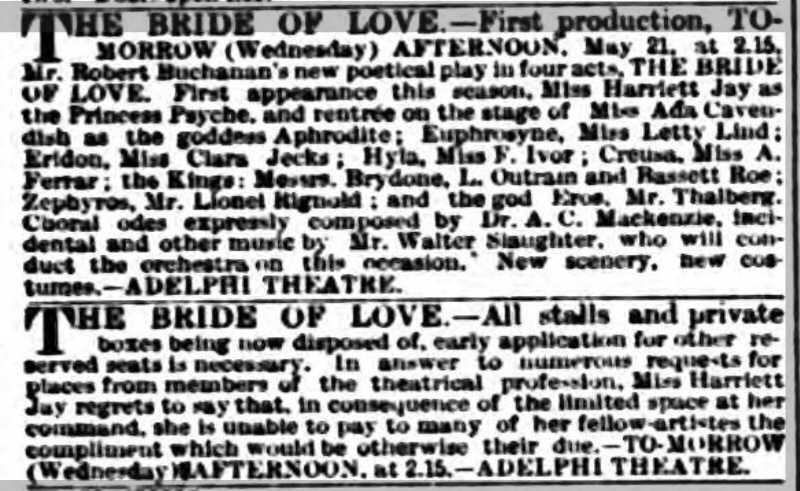
[Advert for The Bride of Love from The Daily Telegraph (20 May, 1890 - p.6).] |
|
|
 |
|
|
|
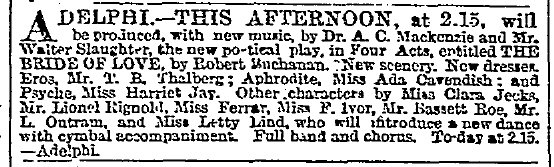
[Advert for The Bride of Love from The Times (21 May, 1890 - p.8).]
The Times (22 May, 1890 - p.8) ADELPHI THEATRE. The myth of Eros and Psyche, originally told by Apuleius and dramatized in later days by Molière and Corneille, has given an inspiring if difficult subject to a modern playwright. Mr. Robert Buchanan, whose play entitled The Bride of Love was produced at the Adelphi Theatre yesterday afternoon, has treated the classical story with a free hand, and the result is a piece which, although it leaves much to be desired and although it is capable of much improvement, has many pleasing features. In the first act, of which the scene is the summit of a mountain in Cyprus, Aphrodite (Miss Ada Cavendish), Eros (Mr. T. B. Thalberg), and Zephyros (Mr. Lionel Rignold) are introduced. Aphrodite is jealous because her worship on earth is neglected by reason of the charms of Psyche. Eros, by no means the mischievous Cupid of legend but a young divinity who is feeling his strength, appears in the guise of one wearied of celestial society. Zephyros is, so to speak, the clown of the piece. At the outset the play drags heavily and it is only after Aphrodite has left the scene that human interest is introduced. At the invitation of Zephyros, Eros looks down upon Psyche (Miss Harriet Jay) sleeping upon the hillside, and then commands Zephyros to waft her to the mountain. There follows a pretty passage, in which the god places a ring on the finger of the sleeping maiden. He then determines to woo her in mortal shape. The second act is no better than the first. At the outset a ludicrous row of Kings propose in turn for the hand of Psyche and are rejected. Her father, Methonos (Mr. A. Brydone), consults in his anger the oracle of Aphrodite, and Psyche is doomed to be chained to a rock at the edge of the sea awaiting the advent of a monster. The spiteful delight of her sisters, Creusa and Hyla, is well portrayed by Miss Ada Ferrar and Miss Frances Ivor. Psyche is duly chained to the rock and, with great promptitude, released by Eros; but up to the end of the act the weariness produced by the long succession of proposing Kings does not wear away. When the curtain rises there is a great and welcome change. In an enchanted garden Eros wooes Psyche, and the occasion becomes an excuse for an admirable cymbal dance by Miss Letty Lind in the character of Euphrosyne. In an evil moment Eros allows Methonos, Creusa, and Hyla, with two Kings, to be brought into the enchanted garden, and a bitter scene follows in which the sisters taunt Psyche because she avows herself the bride of Prince Nobody of No Man’s Land. On their departure Eros vows, by Styx and Acheron, to grant Psyche any prayer she may offer, and, in pursuance of the vow, reveals his divinity to her. Then the curse of blindness falls upon her. The final scene of the act is touching and effective. It evoked tumultuous applause from the crowded house. In the final act the repentance of Aphrodite is portrayed. Psyche wanders blind and groping on to the stage and dies in the arms of Eros; but in the meanwhile Aphrodite has interceded with Zeus and Psyche is brought to life, destined to be immortal, through the instrumentality of Euphrosyne, who strews her body with flowers. When the curtain dropped for the last time the audience showed its satisfaction by repeated calls for the actors and the author. On the whole, Mr. Buchanan has cause for satisfaction. Miss Harriet Jay played the part of Psyche admirably; Mr. Thalberg, aided by his looks, was a commendable Eros as soon as the play began to move. But there were plenty of mistakes. The part of Zephyros is somewhat coarsely conceived; Mr. Rignold did not improve upon the author’s conception. Errors in pronunciation were numerous, and it ought surely to have been possible to teach some of the actors beforehand that Creusa is not to be pronounced “cruiser,” that the first syllable in Eros is not quite the same as that in era. The music, by Mr. Walter Slaughter, is pleasing. In this connexion particular mention may be made of an epithalamium in the third act, and of a hymn, in the last act, composed expressly for the occasion by Dr. A. C. Mackenzie. ___
The Daily News (22 May, 1890) MUSIC. . . . MR. BUCHANAN’S “BRIDE OF LOVE.” Mr. Robert Buchanan’s play “The Bride of Love,” produced at the Adelphi yesterday, is a new version of the well- worn story of Eros and Psyche, invented by Apuleius, and already told in prose and verse by many a dramatist and poet. The legend now appears in the form of a four-act play, for the most part in scholarly blank verse, the monotony of which is relieved by a part-song and some less important incidental music from the pen of Mr. Walter Slaughter, who conducted, and two choral odes by Dr. A. C. Mackenzie. It is a part of Mr. Buchanan’s design to increase the interest of the story by investing his immortals with various mundane feelings and attributes. It is for this reason that, although the narrative of the sudden love of Eros for Psyche, their marriage, and the ill effects of that particular sin of feminine curiosity which proves as fatal to them as to Elsa and Lohengrin, is followed with tolerable fidelity; yet the character of the mortal- hating Aphrodite is softened down in maternal solicitude for her eldest son, while the Zephyr becomes a veritable Figaro in assisting the young couple in their courting; and gods and mortals alike are represented as impotent against the all- conquering power of love. By a beautiful allegory also Psyche is in the last act depicted as passing through the valley of death, and, having by the will of Zeus thus attained immortality, she is united for eternity to her earthly husband, the young god Eros. It is, indeed, upon the love of Psyche and Eros that the plot chiefly centres, and, despite a certain amount of redundancy and a few anachronisms which will doubtless disappear at subsequent performances, Mr. Buchanan has contrived to tell a very ancient story in an undoubtedly engaging and sympathetic manner. The play was admirably mounted; and although some of the performers were obviously unaccustomed to the delivery of blank verse, yet the principal artistes, who included Mrs. Harriett Jay as Psyche, Miss Ada Cavendish as Aphrodite, Mr. Thalberg as Eros, and Mr. Lionel Rignold as a comic Zephyr, were, together with the author, deservedly called to the front after the last act. In regard to the music, Mr. Walter Slaughter’s part-song of “Elemental Spirits” in the second act was unfortunately spoilt by a faulty performance. But more pains were taken by a choir of ladies with a two-part Epithalamic chorus in the second act, sung to a harp accompaniment, two flutes and cymbals filling up the intervals (Dr. Mackenzie thus replacing the trigonon and pipe of ancient Greece), and with a choric ode in praise of love, from the same pen. Unfortunately, the piece was not provided with an overture or entr’acte music, although it was generally felt by the musical members of the audience that a play so high in literary aim deserved something far better than the dance pieces which yesterday did duty in this respect. ___
St. James’s Gazette (22 May, 1890 - p.3-4) “THE BRIDE OF LOVE” AT THE ADELPHI. “The distinctive aim of tragedy,” Schlegel wrote, “is to establish the claims of the mind to a divine origin; to show that its earthly existence must be disregarded as vain and insignificant, all sorrows endured and all difficulties overcome.” A similar purpose is claimed by Mr. Robert Buchanan for his new poetical play “The Bride of Love,” produced yesterday afternoon at the Adelphi Theatre. For the basis of the piece he has had recourse to the old mythological legend dealing with the loves of Psyche and the immortal Eros. Lest, however, his treatment of the well-known story should be called in question, the author hastens to repudiate any intention of investing it with either the form or the spirit of Greek drama. By so doing he disarms criticism, which might otherwise be disposed to take exception to certain of his innovations. The public, however, will doubtless be content with the fact that Mr. Buchanan has provided a play not only interesting in itself but containing several scenes of considerable beauty. It is true that he never seems capable of entirely divesting himself of his nineteenth-century mantle. Only the other day it was observed in the palace of Justinian, and now we catch glimpses of it even among the Olympians. Zephyros, in “The Bride of Love,” who longs for “sport more spicy” and has a quick eye for a pretty maiden, is as modern as Lutin in Mr. Gilbert’s “Wicked World” or King Phanor in “The Palace of Truth.” Something, however, may be taken as conceded to the public desire for a due proportion of comedy in a piece, whether its introduction be consistent or not. More successful is Mr. Buchanan in his graver moments. The story of Eros’s descent to earth, his rescue of the despairing Psyche, their separation and final reunion, is told by him in verse which, if it does not quite touch the loftiest heights, runs trippingly and introduces not a few passages of much tenderness and passion. That it received yesterday fullest justice from all the performers can hardly be said. In form and bearing Mr. Thalberg makes an ideal Eros; but, whether from nervousness or some other cause, he spoke his words throughout the first two acts so hurriedly as to render them almost unintelligible. At the end of the third, however, when, prompted by woman’s curiosity, Psyche to her own undoing, demands and learns her lover’s name, Mr. Thalberg exhibited genuine force. Here, too, Miss Harriett Jay was seen at her best. Her Psyche, it may be admitted, does not possess all the qualities of an ideal conception, but within certain limits it is an excellent and well-balanced performance. To Miss Ada Cavendish, as Aphrodite, was extended a warm and generous welcome on her return to the stage, which she has deserted too long. Actresses of her calibre are, unfortunately, only too rare at present, and her playing yesterday showed that she is still in perfect possession of her old powers. To each word was given its full significance, and every gesture was charged with meaning. Space forbids more than the mere mention of Miss Clara Jecks, Miss F. Ivor, Miss Ferrar, and Messrs. L. Rignold, Bassett Roe, and L. Outram, who all lent strength to an otherwise admirable cast. But a special word of praise must be given to Miss Letty Lind for her graceful dancing. The music, which forms an important factor in the piece, is from the pens of Dr. A. C. Mackenzie and Mr. W. Slaughter, who have also to be congratulated on their melodious setting of the different songs and choruses, excellently interpreted by Mr. Stedman’s choir. It only remains to add that the play has been handsomely mounted, and obtained a very favourable reception from the large audience assembled. ___
The Daily Telegraph (22 May, 1890 - p.5) ADELPHI THEATRE. What with burlesque on the one hand, and the Gilbertian fairy plays on the other, any serious effort to revive a taste for the purely poetic drama is heavily handicapped. Mr. Robert Buchanan, however, enlisted yesterday afternoon the sympathy of an interested and intelligent audience to his graceful muse by the thoroughly successful production of “The bride of Love,” founded on the delightful myth of Eros and Psyche. The triumph was all the more remarkable because the author boldly scorned the ridicule and the silly susceptibilities of the frivolous, the sceptical, and the cynical. Careless of the fact that Mr. Buckstone, of the Haymarket, was the classical droll of Mr. Gilbert’s earliest topsy-turvy plays, he brought on a second Buckstone, in the shape of Mr. Lionel Rignold, to turn the gentle Zephyros into a comic character, and to remind those who were present that the low-comedian of the Adelphi had strayed into the Olympian regions. Ignoring altogether the traditions of the Gaiety, which year by year rings the death-knell of imaginative work, who should come to dance a Pyrrhic measure as Euphrosyne but Miss Letty Lind, with clinging, gauzy skirts and cymbals? Happily, the sneers of the irreverent were soon silenced, the scoffs were exchanged for smiles, and the transcendent beauty of the old legend conquered even ridicule itself. The novelty of a serious play in burlesque attire soon wore off, and, what with Mr. Buchanan’s poetry and Dr. A. C. Mackenzie’s melodious hymns and choruses, a success was won without so much as a dissentient voice. ___
The Scotsman (22 May, 1890 - p. 6) LONDON THEATRICALS. LONDON, Wednesday night.— A new poetical play—for that is the title of “The Bride of Love” on the programme, by Mr Robert Buchanan—was given at the Adelphi Theatre this afternoon. Before dealing with the plot it will be best to quote the author’s preliminary note, prefixed to certain excerpts from the play which were handed to the critics. Mr Buchanan says “The Bride of Love” is founded on the beautiful Greek legend of “Eros and Psyche,” preserved for posterity in the “Golden Ass” of Apuleius. Perhaps no subject is associated with so many illustrious names; for it has been versified by La Fontaine, dramatised by Molière with the assistance of Corneille (who at 65 years of age wrote the famous perfervid invocation of L’Amour), graced by the songs of Quinault and the music of Lulli. The original L’Amour was Baron; the original Psyche, Mademoiselle Molière; and the original Zephyr Molière himself. The passion conceived by La Molière for young Baron during the representations of “Psyche” led to the fatal estrangement between the great author-actor and his wife. Heigh O! I would I were some merry mortal, The play was competently acted. Miss Harriett Jay, as Psyche, has good intentions and is evidently an earnest student of acting, but her execution leaves a good deal to be desired. She has tenderness, but she lacks power. Miss Ada Cavendish, who has come back to the stage, was an imposing Aphrodite; and Miss Ada Ferrar, in a comparatively small part showed herself a charming actress and one of the most capable of young ladies who now throng the stage. Mr Thalberg was a competent Eros, and other characters were fairly sustained. Mr Walter Slaughter’s music was most tuneful, and Miss Letty Lind won much applause for her dancing. The whole performance was received with great applause. ___
The Glasgow Herald (22 May, 1890 - p.7) MR ROBERT BUCHANAN’S new poetical play, “The Bride of Love,” produced at the Adelphi to-day, is a classical work on practically new lines. The story is that of Eros and Psyche as told by Apuleius of old, and as versified by La Fontaine and dramatised by Moliére and others. In Mr Buchanan’s piece the immortals are, however, strongly endowed with human sympathies. In the first act, the scene of which is laid in the classical heaven, Aphrodite resides with her children, who include her eldest born, the god Eros. Eros is depicted as the embodiment of fully developed though still young god-head. His mother explains to her attendant Zephyr (who by the way throughout the play is a comic character) that she does not wish her eldest born “to contract all the wild errors of the elder gods.” Zephyr philosophically believes there are other reasons, and declares that Aphrodite has a purely mortal fear of growing old, and “is afraid of becoming a grandmother.” The act is chiefly taken up by a description of the gradually increasing manly feeling of Eros, his first vision of the beautiful Psyche, and his determination to secure her for his bride. His mother, Aphrodite, wills it otherwise, and in the second act, when six of the principal Kings of Greece and its neighbourhood come to claim Psyche for wife, the goddess causes her oracle to command Psyche, in accordance with the old legend, to be chained to a rock, and there to be wedded to the monster which shall come from the sea. A chorus of “elemental spirits,” the music of which is by Mr Walter Slaughter, is here interposed, and was sung behind the scenes. The monster proves to be Eros himself, who, in the next act, that is to say in the Garden of Love, is found married to Psyche. Here is sung a beautiful “Epithalamium,” or wedding ode, for female voices, written by Dr A. C. Mackenzie. Its melodious character is emphasised by its simple accompaniment from a harp, the interludes being filled in by two flutes and the cymbals, as typical of the pipe and lyre of ancient Greece. The ode is followed by the dance of Euphrosyne, undertaken by that graceful artist Miss Letty Lind. AFTER this some of Psyche’s former admirers and her jealous sisters are introduced, and induce the bride to ask the question of the origin and family of her husband. Female curiosity in the Greek play is no less fatal than in Wagner’s “Lohengrin.” Psyche having unknowingly set eyes upon a god is stricken with blindness and loses her husband, who returns to the Pagan paradise. In the last act, the scene of which is identical with that of the first, the disconsolate Eros has returned to heaven, and has gained the sympathy of his mother, who for her son’s sake proceeds to Mount Olympus in order to beseech the gods to save her eldest-born from his misery. Psyche, too, is introduced among the immortals, and with the graceful thought which appears in the old legend her human attributes die, thus rendering her an immortal who can be united to her beloved Eros for eternity. The Choric song in praise of love, again accompanied by harp and flute, has been contributed by Dr Mackenzie, and with the announcement of Psyche’s immortality the play closes. The serious interest of the piece is enlivened not only by the comic character of Zephyr, but also by an amusing scene in the Garden of Love, in which Eros, using his power of inspiring affection, causes the kings who were previously suitors for the hand of his wife to fall desperately in love with her two disagreeable sisters. The play, which is written in blank verse, is an admirable literary effort, and although some of the lengthy speeches must be abbreviated it is a worthy example of Mr Buchanan’s dramatic abilities at their best. The play was mounted with taste, and was on the whole admirably played, particularly as to the Aphrodite of Miss Ada Cavendish—who thus made her first appearance on the stage since her widowhood—and as to the Eros of Mr Thalberg and the comic Zephyr of Mr Lionel Rignold. Miss Harriet Jay, although somewhat overweighted in the trying scenes in the third and fourth acts, must also be commended for her very careful rendering of the engaging part of Psyche. At the end of the performance Mr Robert Buchanan was called to the footlights and was applauded by a very large audience. ___
The Morning Post (23 May, 1890 - p.3) ADELPHI THEATRE. Mr. Robert Buchanan’s new poetical play, “The Bride of Love,” in four acts, was produced on Wednesday afternoon, and proved to be in every way a remarkable dramatic work. The stage has so little association with poetry in these days, that a play of imagination is a welcome contrast to the devices of the stage carpenter and the mechanical characters of the sensational drama. Mr. Buchanan in his earlier days of authorship was better known as a poet than as a dramatist, and many of his old admirers will be disposed to welcome his return to poetic forms. There was something approaching to the classical in the representation of “The Bride of Love.” Scenic effects and music lent their aid, and choral odes were introduced, composed by Dr. A. C. Mackenzie, principal of the Royal Academy of Music, while other incidental music was composed by Mr. Walter Slaughter, who conducted the orchestra and chorus. The choral odes were given by Mr. Stedman’s choir, and new scenery and costumes enhanced the effect of Mr. Buchanan’s play, which is founded upon the Greek legend of Eros and Psyche, to be found in the “Golden Ass” of Apuleius. The subject has often tempted the dramatist and poet. Molière, assisted by Corneille, dramatised it, and songs of Quinault and music by Lulli were added. Molière took part in the piece, and became but too fascinated with the attractions of the representative of Love. Mr. Buchanan, while recalling these instances of the treatment of the story for the stage, claims that he has given a practically “new and original” treatment of the subject which has nothing in common with the Greek spirit or with the “tragedy-ballet” of Molière. The story of the love and fate of Psyche has served as an allegory of the human soul, and in the concluding act of the play the author has made an attempt to idealise the Greek legend by making Psyche actually pass through the shadow of death and arise glorified in accordance with Christian sentiment. In these passages we have the essence, so to speak, of the play, and the moral is that “Where Love abides Death hath no victory;” that beyond and above the power of the gods there is a law which attests that “Death is but the shadow of a dream.” This is the poetical side of the play, but Mr. Buchanan, in a manner not unlike that adopted by Mr. W. S. Gilbert in his “Pygmalion and Galatea,” mixes up some very mortal ideas and mortal personages with his Greek characters. They make effective scenes, and add life to the subject. With Mr. Fenton’s new scenery, Dr. Mackenzie’s expressive music, choral effects, beautiful costumes, and excellent acting, “The Bride of Love” is presented with attractions not likely to be ignored by the playgoer, especially by the frequenter of the theatre who has had enough and to spare of the commonplaces of modern drama. Varied degrees of merit marked the acting. Some performers naturally enough feel ill at ease in classic garb, but for the most part the performance was very satisfactory, and in many instances especially so. Miss Ada Cavendish was most warmly welcomed as the Goddess Aphrodite, her stately appearance being well suited to the character, and her delivery of Mr. Buchanan’s lines was worthy of their grace and tenderness. Miss Clara Jecks, sprightliest of modern actresses, represented Eridon with excellent effect. Mr. Lionel Rignold made a quaint figure of Zephyros, and pretty zephyrs and other fanciful figures were seen surrounded by a chorus of graces and elementary spirits. Mr. Bassett Roe, Mr. Leonard Outram, and Miss Ada Ferrar agreeably represented Lycas, Atalantos, and Creusa, and Miss Harriett Jay appeared as Psyche. Miss Jay has some of the best lines to deliver, and gave them with appropriate grace of diction and with ample fervour and passion. Mr. Thalberg, as Eros, was seen to advantage. He spoke the poetical lines with dignity and expression, and made a graceful and tender lover. Mr. Buchanan received the most cordial encouragement in his enterprise, being called for and greeted enthusiastically at the close. ___
The Stage (23 May, 1890 - p.12-13) THE ADELPHI. On Wednesday afternoon, May 21, 1890, was produced, for the first time, a new poetical play, in four acts, written by Robert Buchanan, entitled: The Bride of Love. IMMORTALS. The Goddess Aphrodite ... Miss Ada Cavendish MORTALS. Methonos, King of Cyprus Mr. Alfred Brydone In a small pamphlet issued by Mr. Buchanan, he tells us that The Bride of Love is founded on the beautiful Greek legend of Eros and Psyche, preserved for posterity in the Golden Ass of Apuleius, and refers to L’Amour of Molière and Corneille, in which the original l’Amour was Baron, Psyche Mdlle. Molière, and Molière himself Zephyr—and the representation of which piece led to such estrangement between the actor-author and his wife. But, as Mr. Buchanan goes on to say, his “treatment of the legend is practically new and original, and has nothing in common with either the form or the spirit of the Greek drama or with the tragedie-ballet of Molière......Eros is not the Cupid of popular imagination, but the embodiment of fully developed, though still young, godhead......the story of Psyche’s love and loss has been well described as an allegory of the Human Soul on its passage upward......Psyche actually passes through the Shadow of Death, and arising thence glorified, realizes not only the old Greek idea of apotheosis, but the modern Christian sentiment of the resurrection of the spiritualized body.” Should a god reveal himself Fate inspires Psyche to persevere in her request, and Eros is compelled to answer, for he has sworn by the Styx, an oath that even the gods may not take without fulfilment, that he will grant her every request, and so in heartrending accents he discloses his divinity and vanishes from her for ever as Psyche falls stricken to the ground with blindness. In the closing act Eros has returned to Venus’ abode—he prays for death, which, as an immortal, he cannot compass, and so he throws himself on the mercy of his mother. Venus hates Psyche, but maternal love conquers. She speeds her to Olympus to pray of the gods that Psyche may be made immortal. By her commands Zephyros lures her in her blindness to the mountain top. There she falls upon a bank, and revives at the sound of Eros’ voice. His kiss, however, is death to her, and as her mortal spirit passes away Eros mourns her loss; when Venus returns. Euphrosyne is summoned, she sheds upon the body of Psyche the re-animating flowers, and Psyche awakes again to immortality and eternal love with Eros. We have been able to give but the faintest outline of Mr. Buchanan’s play, which, from the rise to the final fall of the curtain, kept his audience in rapt attention. It is instinct with the most poetic feeling, relieved by the humours of Zephyros and the younger gods. EROS, surrounded by his sleeping brethren, apostrophizes the firmament as follows:— PSYCHE. And so I seemed—till, at my Lord’s first kiss, APHRO. Where love abides, EROS. She stirs, she breathes! Her eyes are opening! PSYCHE. Eros, my love, where art thou? Miss Ada Cavendish on her return to the stage was received with long-continued acclamation, and worthily she filled the rôle of the goddess, Aphrodite. Her splendid delivery was an intellectual treat; we must remember that it is as the vengeful, not the loving sensuous goddess she is presented to us. Mr. T. B. Thalberg was at first not at his best and hurried his lines, thus destroying their rhythm, but when he had overcome a pardonable nervousness, he threw himself boldly into his work, spoke well and acted with remarkable fervour and passion. The Zephyros of Mr. Lionel Rignold was modern but humorous; he had evidently rightly conceived the character, but was not quite in touch with his surroundings. Special mention must be made of Miss Letty Lind as Euphrosyne, not for her dancing only, which was encored, but for the clever and appropriate delivery of her text. Mr. Bassett Roe, Mr. Alfred Brydone, Mr. Leonard Outram, and Mr. E. Lennox were also much to be commended. Miss Frances Ivor as Hyla and Miss Ada Ferrar as Creusa, the malicious jealous sister, filled their rôles well. In fact, the cast was a good one. On Miss Harriett Jay, in the arduous part of Psyche, considerable praise must be bestowed; fault might have been found perhaps with her taking the second act in too subdued a key, but then we must bear in mind that she represented a comparatively passionless maiden, and this very same subdued manner gave the greater force to her really fine acting in the closing two acts. As the matinée was given by Miss Jay, and she superintended the production of the play, very great credit was due to her for everything going without a hitch. The incidental music and the song of elemental spirits composed by Mr. Walter Slaughter (who conducted) were most appropriate, and the choral odes by Dr. A. C. Mackenzie were harmonious, and in the best musical style (the one in the fourth act was so beautiful as to be re-demanded). The dresses from design by Karl, executed by Messrs. Nathan, were elegant and correct, and the scenery (which was provided by Mr. Oscar Barrett in anticipation of the production of The Bride of Love at the Crystal Palace on the 10th and 12th June) was beautifully painted by Mr. F. G. Fenton. The principals were honoured with calls at the end of each act, and Mr. Buchanan was heartily applauded on his appearance. ___
The Sheffield Daily Telegraph (23 May, 1890 - p.4) [FROM OUR LADY CORRESPONDENT.] LONDON, Thursday. A large audience, consisting chiefly of artistic celebrities and art critics, assembled yesterday afternoon in the Adelphi Theatre to give a warm greeting to Miss Harriet Jay, who, after a long absence from the stage, re-appeared in a new piece by Robert Buchanan, called “The Bride of Love.” The piece, a version of the well-known love story of Eros and Psyche, though it contains some beautiful writing, is too slow and of too classic an interest to please the jaded taste of nineteenth century playgoers, but as a series of picturesque and beautifully mounted scenes it cannot fail to delight artistic people. ___
The Athenæum (24 May, 1890 - No. 3265, p.683) THE WEEK. ADELPHI—Afternoon Performance: ‘The Bride of Love,’ ... MR. BUCHANAN has dramatic grip. Give him a skeleton and he can, as has been abundantly proven, clothe it with respectable flesh; but he has been scarcely wise in meddling with the legend of Cupid and Psyche. It is not, of course, his fault that legends concerning “Olympus’ faded hierarchy” when seen on the stage are associated with the idea of music by Offenbach or Gilbertian satire. One strong scene, in order to vindicate his reputation as a dramaturge, Mr. Buchanan has obtained. It is necessarily that in which Psyche, insisting upon the gratification of her wish, gazes on the unveiled godhead of her spouse, and shrinks back scorched into blindness by the dazzling presence. This portion of the play was powerful and stimulating. The remainder, though written in workmanlike style and not lacking either idea or expression, is as remote from Greek as it can well be. With the treatment of the subject we have no disposition to find fault. What is really wrong is the atmosphere. In spite of himself Mr. Buchanan has yielded to the influence of his predecessors. A Venus who has grown old and is expressly declared to be a bit of a shrew, and a Cupid who goes to bed early at night, having apparently to be up early in order to go to a board school, need the accompaniments of Offenbach rather than of Mr. Slaughter or Dr. Mackenzie; and a plump and indolent Zephyros, who indulges in comic asides and fulfils to Eros the functions which Mercury did not always scorn to render to Jupiter, comes out of the ‘Wicked World.’ During no inconsiderable portion of the play we seemed to be contemplating ‘Cinderella,’ and more than half the third and best act was a species of alteration in the love scenes in ‘A Midsummer Night’s Dream,’ with Zephyros for an elderly and obese Puck. Mr. Buchanan’s play was received with much favour. It has none the less, it is to be feared, few elements of enduring vitality. ___
The Era (24 May, 1890 - p.9) “THE BRIDE OF LOVE.” A New Poetical Play, in Four Acts, by Robert Buchanan. IMMORTALS. The Goddess Aphrodite ... Miss ADA CAVENDISH MORTALS. Methonos ... ... ... Mr ALFRED BRYDONE The Bride of Love, as a “note” from the author informed us prior to production, is founded on the beautiful Greek legend of “Eros and Psyche,” preserved for posterity in “The Golden Ass” of Apuleius, a subject already associated with the illustrious names of La Fontaine, Molière, and Corneille. Mr Buchanan claims on behalf of his treatment of the legend that it is practically new and original. In undertaking his task, however, he seems to have had in mind the Gilbertian style of fairy comedy, to have invented a comic god, and then to have repented of his work without finding courage enough to destroy it. How otherwise are we to account for the presence of that Zephyros, who, without any fault on the part of his representative, vulgarises every scene in which he appears, and makes a terrible blot upon a work which is replete with fancy and is rich in poetic feeling? The story of Psyche’s love and loss, as Mr Buchanan reminds us, has been well described as an allegory of the human soul in its passage upward. “In the fourth act of this play Psyche actually passes through the Shadow of Death, and, arising thence glorified, realises not only the old Greek idea of Apotheosis, but the modern Christian sentiment of the resurrection of the spiritualised body.” Well, so beautiful a theme, we take it, should not be marred by the introduction of the modern vulgarisms of a Zephyros with his comic make-up after the fashion of the late Mr Buckstone in burlesque, and his coarse satire directed at a “wicked world,” where wakeful wives learn husband’s secrets as they babble in their sleep, and slippered kings in palaces creep by night to kiss their saucy scullery maids. This introduction apart we have nothing but praise for Mr Buchanan’s play, which held the attention of a large audience on Wednesday, and caused them to forget the brilliant spring sunshine that had been left with something of regret. Eros, the eldest born of Aphrodite, says Mr Buchanan, “is the embodiment of fully-developed, though still young, godhead, and is not in any way to be confounded with the Cupid of popular imagination.” He is, however, the lord of love, though loveless, and we meet him on the cloud-surrounded summit of a mountain on the island of Cyprus. He is in mood impatient and almost angrily argues with Aphrodite, who rebukes his complainings by reminding him that “power and its privileges still are ours—to reign and to be feared.” It would be “better to reign not and be loved,” answers Eros. There’s not a herd-boy down in yonder dales In this mood Zephyros finds him; directs his attention to the beauteous mortal Psyche; obeys his bidding and brings her sleeping to his presence and restrains his new-found rapture by reminding him that— In the tablets of the gods Here is foreshadowed the catastrophe that forms the most powerful scene in the play. Psyche is returned to earth bearing upon her hand the ring there placed by Eros. She is wooed by kings and princes, but rejects them all, and in rejecting arouses the wrath of her father. The oracle is consulted; Psyche is condemned to be chained to a rock, and, like another Andromeda, to be threatened by a monster of the deep. “I am thy monster,” presently cries Eros, and Psyche, with chains unloosed, is clasped in his loving arms. In the “Garden of Eros” she should find a happy home; but misery comes of curiosity. Her wish to see her kinsfolk has been gratified, and they have taunted her with being the mistress of a Prince Nobody, and yet another boon she craves—the knowledge of her loved one’s name. Eros is bound to answer; to reveal to mortal the immortal. Psyche is stricken blind. In the fourth act Psyche is again enfolded in her lover’s arms, but dies. Then cries Eros— O Zeus, send down thy cruel thunderbolt, But hark! the spirit voices sing, Rejoice, for Love is Lord, for Love is Lord! Rejoice, for Day hath come, and Night hath fled! “Lord of all!” The words inspire Eros with hope afresh, hope that is encouraged by the words of Aphrodite. Where Love abides, And then the end. EROS. She stirs, she breathes! Her eyes are opening! The beauty of this story and the poetic charm of these scenes were heightened in no small degree by the incidental music, and notably in the instance of the introduction of Dr. Mackenzie’s epithalamium at the opening of the third act. The sweetly flowing melody of this hymn to Hymen fairly enchanted the house, and its repetition was demanded with an amount of enthusiasm that was not to be resisted. Other tuneful and telling numbers in the song of the elemental spirits and in the dance for Euphrosyne reflected credit on the musical skill of Mr Walter Slaughter, who conducted the orchestra. ___
Manchester Times (24 May, 1890) AFTERNOON CHAT. [BY OUR LADY CONTRIBUTORS.] . . . The most interesting dramatic event of the present week has been the reappearance, after a long absence from the stage, of Miss Harriet Jay, who received a warm welcome from a house packed with her many friends. The mythological drama, the “Bride of Love,” by Miss Jay’s friend and relative, Mr. Robert Buchanan, is a version of the world known story of Eros and Psyche. Though it contains some exquisite prose and verse—notably the songs which Dr. Mackenzie has set to music, and the pretty verses which Letty Lind, as Euphrosyne, repeated so prettily as she scattered flowers on the body of the dead Psyche—except as a series of charming pictures, beautifully mounted, the piece is little likely to please the taste of present day play-goers who crave for more sensation than there is in Mr. Buchanan’s drama. Nothing could be prettier than the pictures presented by the Princess Psyche (Miss Harriet Jay) and her fellow-actors in their artistic Greek dresses, among them being Miss Ada Cavendish (widow of the late Frank Marshall), who is returning to the stage, and will soon be seen in the provinces. The most charming scene was that in the garden of Eros, with the summer moon rising above the city towers and domes, and a crowd of graceful Greek girls treading a stately measure to the sound of a chorus composed by Dr. Mackenzie. Letty Lind never looked prettier or danced more gracefully than in the cymbal dance which followed the chorus. Wonderful was the skill with which she managed her clinging draperies of pale green, which fell to the ribbons that bound her green sandals round the shapely ankles. The loose bodice had bretelles of narrow white ribbon, which also girdled the fulness about the slim waist. Miss Annie Irish, prettily dressed in grey, with a grey plumed hat, Mrs. Horace Neville (Miss Annie Rose) in a fawn cloth dress with full lilac silk vest, Miss Rosina Filippi, in black silk and dark red, Mr. and Mrs. Oscar Wilde, Mr. Clement Scott, and Mr. and Mrs. Robert Buchanan were among those who applauded Princess Psyche from boxes, stalls, and circle. At the close of the performance bouquets were handed to Miss Jay and to Miss Ada Cavendish. ___
Reynolds’s Newspaper (25 May, 1890) ADELPHI THEATRE. Wednesday was a busy day in the London theatres, and a remarkable one, for it gave us, not only Mr. Jones’s interesting play of “Judah,” but something still more novel, the dramatization of a Greek myth by Mr. Robert Buchanan, at the Adelphi Theatre. In many respects nothing so beautiful has been seen on the stage in recent years. Had the acting been equal to the authorship, we should have had a most powerful representation. The story of Eros and Psyche is an exquisite legend preserved in the “Golden Ass” of Apuleius. Eros, the eldest-born of Aphrodite, falls in love with Psyche, a mortal. But, in Mr. Buchanan’s words, the eternal doom is that— In the tablets of the gods Impelled by doubt and curiosity, Psyche implores a revelation as to the identity of her lover. Eros can refuse her nothing. Psyche is struck blind and dies, but by the favour of Zeus is immortalized and given to Eros for ever. The scene opens on the summit of a mountain in Cyprus, the abode of Aphrodite. It is a pity more care was not taken with the furnishing of this scene. The clouds surrounding the abode of the goddess bear scarcely any resemblance to clouds, and two lumps of wood, plastered over with some artificial flowers, can hardly be taken to represent the Asphodel meads of Heaven. The spirit-sick Eros is induced to the love of Psyche by his comic and somewhat mischievous body-servant, Zephyros. Psyche having refused all lovers, her angry father, the King of Cyprus, consults the oracle. It is decreed, upon the instigation of Aphrodite, who is determined that her son shall now know love, that Psyche be chained to a rock, and devoured by a sea-monster. Chained she is; but Eros carries her away to his enchanted garden, where the fatal secret is revealed, and the destiny is fulfilled. It would be difficult to exceed the beauty of this scene. Before the curtain is drawn, the melodious sound of a flute and the occasional clash of a cymbal is heard. The curtain rises. Maidens in the moonlit garden of Eros are singing an epithalamium, or marriage song, composed by Dr. Mackenzie, principal of the Royal Academy of Music. They also tread a choral dance, weaving in and out and round about in graceful, stately measure. What a charming picture! How beautiful these many-coloured Greek costumes! How they grace and dignify the wearers! Then appears Miss Letty Lind, in the character of the mirth-giving Euphrosyne. Cymbals in hand, she dances a Greek measure to music composed by Mr. Slaughter, the composer of “Marjorie,” who conducted the orchestra. There is the scene as depicted on some old Greek vase. It melts away. The unseen fate moves forward to the impassioned cry of despair of the god as he reveals his fatal secret, and vanishes from the sight of his doomed bride, upon whose cry of woe the curtain falls. In the last act we are taken again to heaven, where, on the intercession of Aphrodite, life is restored to Psyche, and she is immortalized. Mr. Thalberg, who played Eros, looked the part to perfection, and after he recovered from a nervousness which made him monotonous in the first act, declaimed the beautiful lines of his part with rare elocutionary skill and grace. Miss Ada Cavendish was not seen to much advantage in the character of Aphrodite. Excellent actress as she is in many respects, her style was too ponderous and stagy for the conception of the goddess; nor, although she worked conscientiously and carefully, can Miss Harriett Jay be called an ideal Psyche, a part in sympathy with which so much depends. Miss Jay’s mode of delivery is not what could be desired, nor did she convey the notion of the half-spiritualized being whom she was intended to represent. The Zephyros was a somewhat incongruous element. A low comedy character amid serious and tragic surroundings, struck one as a little out of place and taste, Mr. Alfred Brydone, as the King of Cyprus, spoke his lines with great effect; and Miss Francis Ivor and Miss Ada Ferrar were effective as Hyla and Creusa, the jealous and cruel sisters of Psyche. Mr. Buchanan has composed a beautiful play. His blank verse is smooth, melodious, and at times highly poetical. He well deserved the ringing cheers which greeted his appearance on the stage in response to loud calls at the conclusion of the piece. ___
Lloyd’s Weekly London Newspaper (25 May, 1890 - p.6) ADELPHI THEATRE. Whatever theatrical respect may have once been entertained for the mythological residents of Olympus has been almost destroyed by the burlesque writer. Nowadays, when the gods appear upon the stage, they are expected to indulge in topical ditties or breakdowns. This was one of the many difficulties Mr. Robert Buchanan had to face in producing, on Wednesday afternoon, his poetical play The Bride of Love. To this spirit of ridicule indeed he made a slight concession in representing Zephyros as a species of comic commentator on the events of the play, and in entrusting the character to such a favourite comedian as Mr. Lionel Rignold has become since he played the Jew money-lender in London Day by Day. Miss Letty Lind, too, from the Gaiety, as Euphrosyne, had one of those dances in clinging drapery in which she excels, and the audience insisted on an encore. There are some exceedingly good poetic passages in the work for Psyche and Eros, and a vein of genuine dramatic interest is struck when the mortal who has become the bride of the God of Love, as the consequence of her persistent demand to know his name, is stricken with blindness and dies, to be afterwards restored to life, at the intercession of Aphrodite, as an immortal. To appease Aphrodite’s jealousy Psyche is, Andromeda-like, bound to a rock, but there is no monster to conquer when Eros appears as her deliverer. The third and fourth acts of the play on Wednesday went very well, the accessories here including, besides new scenery, a couple of choral odes for female voices, composed by Dr. A. C. Mackenzie. The remainder of the incidental music was by Mr. Slaughter. Psyche had a charming representative in Miss Harriet Jay, who more than realised anticipations. Miss Ada Cavendish (the Aphrodite) was warmly welcomed on her return to the stage; Miss Clara Jecks made much of the sprightly Eridon; Mr. T. B. Thalberg was the Eros, and in less important parts Miss Ada Ferrar, Mr. Bassett Roe, and Mr. Leonard Outram distinguished themselves. The play was well received throughout. ___
The Referee (25 May, 1890 - p.3) Mr. Robert Buchanan’s four-act poetical play, “The Bride of Love,” was presented to a large audience at an Adelphi matinée on Wednesday. It is founded on the beautiful Greek legend of “Eros and Psyche,” but, as the author declares, has nothing in common with either the form or spirit of Greek drama or with the “tragedie-ballet” of Molière. I would take very short odds that Buchanan began his play with what is now the third act, and that he started with the idea of turning out a serio-comic mythological concoction on the lines of Gilbert’s “Wicked World.” He must have had Buckstone’s Lutin, the “serving fairy,” in his mind’s eye when he invented Zephyros, and doubtless meant a lot of satire when he gave birth to Cinderella’s—I mean Psyche’s—two jealous sisters. When he altered his plan and got into the poetical tragical vein it is a pity he didn’t transform an old and ugly Zephyros into something young and beautiful. He could still have made him an instrument of mischief, and his picture would have been rid of the one big smudge that on Wednesday disfigured it. Even with the smudge there is a lot of beauty in the work, which commanded close attention and liberal admiration. The author of “The Bride of Love” has given us some lines of remarkable strength and beauty, and some of them have been wedded to lovely music by Dr. Mackenzie. It has been suggested that “The Bride of Love” might with profit be turned to the purposes of opera. The suggestion is a good one, and after the two promised performances at the Crystal Palace—the Palace scenery by Fenton was used at the Adelphi—Buchanan would do well to give it serious consideration. Miss Ada Cavendish came from her long retirement to play Aphrodite—in long clothes, be it understood—and showed her wonted fire. Miss Harriett Jay treated the character of Psyche with much delicacy, and with a full appreciation of the poetry of the part, but she didn’t look it. If Mr. Thalberg, as Eros, was a bit lifeless at first, it was perhaps because the author had made him loveless—also he bit his words up; but, warming to his work with the vision of Psyche, he got on splendidly. The incidental dance, introduced by Miss Letty Lind in the character of Euphrosyne, was voted very pretty and effective, and among those entitled to mention for the excellence of their support were Bassett Roe, Leonard Outram, Ada Ferrar, Frances Ivor, and Clara Jecks. The Zephyros was Mr. Lionel Rignold. Zephyros, as I have hinted, is not a very nice character in a play of this sort, but Mr. Rignold, strange to say, often spoke his blank verse better than his more serious confrères. Since I wrote the above I have been requested to state that “The Bride of Love” will be transferred, without delay, to the regular bill of London theatre. Buchanan has received offers from three West-end managers. ___
The People (25 May, 1890 - p.6) THE THEATRES. ADELPHI. The most prolific of modern English playwriters, Mr. Robert Buchanan, brought out at the Adelphi, on Wednesday afternoon, the blank verse play, in four acts, written by him for Miss Harriett Jay, entitled “The Bride of Love,” for which Mr. Walter Slaughter has composed the incidental music. The action of the piece, taking place among the classical gods on Mount Olympus, suggests that its author has consciously or otherwise, followed in the wake of Mr. Gilbert’s fairy comedies, an impression justified by a certain similarity of the chief incident in the plot to the scene in “Pygmalion and Galatea,” where the jealous Cynesca invokes Diana to strike her husband blind. To the great annoyance of his mother, Aphrodite, Eros, the god of love, a Cupid quite come to man’s estate, descending the sacred mountain into the plains below, encounters Psyche, for whom he is stricken with the passion he simultaneously incites in her for himself. Moved by female curiosity to learn the name and condition of the handsome prince of whom she is enamoured, Psyche entreats the stranger to reveal himself. Despite the solemn warning given by him in reply to her insistent request that his yielding to it can only bring calamity to herself, Psyche still importunes him to make the revelation. Compelled by a decree of fate to answer her question, Eros avows that he is immortal, while she, his bride, is born to die—here is the doom of those who look on gods, never to look upon the light again. With the knowledge comes the double curse imposed upon the seeker—first blindness, and then death. Eros, in despair, returns to the abode of the gods, at the summit of Olympus, where his mother, Aphrodite, after reproving his sorrow at losing a merely mortal bride, is so touched by the depth of its sincerity that, relenting, she intercedes with Jove to bring back the dead bride to life. The boon being granted, with Psyche’s revivification and joyful restoration to her husband’s arms the play closes. Though the piece is written in smooth and flowing verse, serving as a vehicle occasionally for graceful poetic imagery, nothing new or original is unfolded either in the plot or the characters. The best scene in the play is that in which the curse of blindness, provoked by Psyche’s importunity, suddenly falls on her, not only reminiscent of Mr. Gilbert’s “Pygmalion and Galatea,” as previously noted, but bears an even closer analogy to the scene in “Lohengrin” in which Else loses her sight under conditions precisely identical with those which darken Psyche. None the less the play, by its skilful stagecraft in respect of construction, won a favourable reception from the audience. Miss Jay, as Psyche, certainly showed more histrionic proficiency than she has previously exhibited. Her voice, hitherto hard and inexpressive of emotion, has become more musical and varied in its tones, and a corresponding improvement is also seen in her acting. Mr. Thalberg showed to advantage as Eros. Despite a certain monotony in his elocution, it is evident that his ability lies in passionate utterance in the exposition of romantic or poetical character rather than in the personation of the heroes of artificial comedy. Miss Ada Cavendish, by the brilliant elocution, gesticulative action, and facial play she brought to bear in personating the matronly Aphrodite, as seen in her sterner rather than her softer moods, well merited the ringing plaudits which welcomed her return after long absence to the stage. As Euphrosyne Miss Letty Lind quite realised the name she bore as one of the Three Charities, the representatives of grace and beauty, notably in her very original and characteristic dance, in which all the wild informal litheness and abandon of a joyous Bacchante were seen without a tinge of coarseness or indelicacy of movement. As Zephyros, a very solid incarnation of the West Wind, Mr. Lionel Rignold, though too modern in tone for the picture, acted with broad and lively humour, always well within the bounds of taste. Other parts were played with consistency, completing an effective cast, by Miss Clara Jecks, Miss Ada Ferrar, Messrs. A. Brydone, Bassett Roe, and Leonard Outram. Mr. W. Slaughter’s music, forming a valuable feature in the performance, was led by the composer. It is understood that “The Bride of Love” has been brought out in London prior to being taken on tour by Miss Harriett Jay. ___
The Derby Daily Telegraph (26 May, 1890 - p.3) Another new work that first saw light on Wednesday last, was the long promised poetical play by Mr. Robert Buchanan, entitled “The Bride of Love,” which was produced at a matinee at the Adelphi Theatre. Founded on the mythological story of “Eros and Psyche,” the play is written in exquisite language, and aided by Dr. A. C. Mackenzie’s melodious hymns and choruses, a success was won without so much as a dissentient voice. Unquestionably, writes one of the leading critics, Mr. Buchanan’s play was a relief after the recent surfeit of farcical absurdity and declassicised comedy with which the stage has been surfeited. It was a gala day for the imaginative, and surely the lovers of unadulterated fun will not grudge one afternoon among the flowers of poetry and under the green trees of culture. There must have been scores of dramatists, continues the same authority, who have gone to the beautiful Greek legend of “Eros and Psyche” for inspiration at the very fountain head. Here we find Perseus and Andromeda; here we trace Pygmalion and Galatea with the god-given blindness, except that the punishment falls here on the woman and not on the man; here is a distinct trace of King Lear perplexed by the vagaries of his daughters; here the germ of the child’s story of Cinderella, her spiteful sisters, and the amorous Prince; here suggestion after suggestion of “A Midsummer Night’s Dream,” and here also a dramatic position with associations which recall the modern scene in which the gardener’s son, Claude Melnotte, and the proud beauty of Lyons are discovered. ___
The Dover Express (30 May, 1890 - p.2) “THE Bride of Love” was most welcome in the person of Miss Harriet Jay, who has won fame for her genius as an actress, for her beauty, and last, and avowedly not least, for her lovely dresses. It is long since the Adelphi Theatre in London has displayed such attire on the stage, whatever it may do in front of the curtain. The play, albeit a powerful and well-acted one, was somewhat heavy, but Miss Harriet Jay was a thing of light and fascination. A propos of her dresses, one, who has a deft pen at describing womanly garbs fresh from the hands of Greek milliners, gives us these particulars: In the first act she appeared in a Greek dress of soft, creamy white material, the under-dress bordered with gold in a Greek pattern. Heavy gold balls were attached to the upper drapery, and a plain gold waistbelt, gold shoulder clasps, and a gold fillet in the wavy brown hair gave the finishing touches to the picturesque dress. Later, in the second act, Miss Jay laid aside her chiton or upper drapery, and appeared in the simple white under-dress, with a wreath of small white flowers instead of the fillet on her hair. In the third act in the garden she wore a Greek dress of the palest pink silk muslin, most artistically draped, with pointed sleeves reaching to the elbow, falling from the under part of the arm. Miss Ada Cavendish wore flowing draperies of white silk, with a gold key pattern, richly jewelled waist belt and shoulder clasps, and a scarf of pale blue muslin suspended from the shoulders. Miss Frances Ivor wore pale mauve draperies, the underdress being of soft silk in a lighter shade, the upper one trimmed with a pattern in silver. Hyla, whose hair was elaborately decorated with gold chains and fillets, wore an overdress of silk crape in a golden green shade, with broad stripes of red and other colours over an underdress of amber silk. ___
The Penny Illustrated Paper (31 May, 1890 - p. 3) Most notable of recent matinées was the Adelphi performance of Mr. Robert Buchanan’s mythological play “The Bride of Love,” which was so favourably received that Mr. Horace Sedger is anxious to run it at the Lyric till the provinces claim Miss Ada Cavendish. This proved a musical dramatic poem of signal merit, the music being composed by Dr. A. C. Mackenzie and Mr. Walter Slaughter, the clever composer of “Marjorie.” In “The Bride of Love” that talented and favourite actress Miss Ada Cavendish—far too long absent from the stage—met with an enthusiastic reception, which evidently stimulated her to deliver the stern lines of Aphrodite with the greatest possible artistic effect. In a word, Miss Ada Cavendish imbued the part with that touch of Nature which is the triumph of Art. Mr. Thalberg, the handsome Eros, would have done well to have studied the fine elocution of Miss Cavendish, then he would not have clipped his words and bitten his sentences as he did in the early acts. When this intelligent and rising young actor got into the full fling of his love-making with the beauteous Psyche, he improved materially. The third act was the most dramatic of the piece. It was here that Miss Letty Lind, personification of the poetry of motion, danced her seductive measures as Euphrosyne, and here that some of the most charming verse was spoken, such as this gem from the lips of Psyche:— Thus is Love born— Enjoying the advantage of being acted in its two principal parts by Miss Ada Cavendish and Miss Harriet Jay, “The Bride of Love” went admirably. The sparkling “Puck”-like Eridon of sprightly Miss Clara Jecks, the vivacious Hyla and Creusa of Miss Frances Ivor and Miss Ada Ferrar, and the Lycas and Atalantos of Mr. Bassett Roe and Mr. Leonard Outrum were also praiseworthy, as were the low-comedy and mirth-moving efforts of Mr. Lionel Rignold to assume the lightsome character of Zephyros. ___
The Graphic (31 May, 1890) THEATRES. IF Whitsun week is, as usual, barren of theatrical novelties, the week that precedes it has this year been at our theatres one of remarkable activity and enterprise. Mr. Henry Arthur Jones’s new play entitled Judah, at the SHAFTESBURY, would in itself be sufficient to give distinction to this brief period of the present dramatic season; but besides this we have had Mr. Robert Buchanan’s mythological verse play, The Bride of Love, at the ADELPHI; and Mrs. Bancroft’s first essay in the way of dramatic authorship, in the shape of a new two-act play, entitled A Riverside Story, at the HAYMARKET; not to speak of Mr. James Mortimer’s play, entitled Queen’s Counsel, at the COMEDY; or the two matinée productions of Tuesday last. The modern English drama may not yet have reached any very high level; but at all events it is not stagnating. The prizes held out to the successful are brilliant, the ambition of the younger school of dramatic workers is stimulated by the ample encouragement offered them through the constant increase in the number of high class theatres; and the time is clearly at hand when the answer to the Frenchman’s humiliating question, “Y-a-t-il un Théâtre Anglais?” will be too obviously in our favour, even for the readers of the Paris Figaro. . . . Mr. Buchanan’s mythological play in four acts is a pretty modification of the old story of how the Princess Psyche came to be numbered with the immortals through her love for the god Eros. Departing from the heathen view, the author treats this lovely fable as an allegory of the Christian doctrine of the progress of the soul through the Valley of Death to life eternal. It is a pity that he should have deemed it necessary to concede to the supposed tastes of modern audiences by introducing a low comedy immortal in the person of Mr. Lionel Rignold; but in other respects it must be allowed that his treatment of his theme is refined, and that some of the lyrics rise to a high level of poetical fervour. Miss Harriett Jay acquitted herself with grace and tact in the trying part of Psyche, and Miss Ada Cavendish, returning to the stage after a prolonged absence, maintained at least the dignified presence of Aphrodite, and spoke her lines with a due sense of their musical cadence. Mr. Thalberg, if he did not exactly “confess the god,” made a fervent and presentable Eros. Music of some merit was provided for the play by Mr. Walter Slaughter and Dr. Mackenzie. Miss Letty Lind’s graceful and elegant dance with cymbals was justly applauded; nothing more picturesque of its kind, indeed, has been seen on the modern stage. ___
The Theatre (1 June, 1890) In “The Bride of Love,” produced at an Adelphi matinée on May 21st, and which we can but here barely notice, Mr. Buchanan is at once true and false to his poetical and artistic instincts. Verbal beauties abound, and mythological intricacies are resolved with an ingenuity that is commendable. The low comedy of the play, however, rings false in its connection, and frequently verges on vulgarity, and the possible beauty of the whole is missed through a wilful writing- down to the smaller intellects of an audience. The piece was generally well rendered.
|
|
|
|
|
|
|