 |
|
|
Play List: 4. Corinne 7. The Mormons 9. Lucy Brandon 10. Storm-Beaten 11. Lady Clare 13. Bachelors 14. Constance 15. Lottie 16. Agnes 17. Alone in London 18. Sophia 19. Fascination 20. The Blue Bells of Scotland 21. Partners 24. Angelina! 25. The Old Home 26. A Man’s Shadow 27. Theodora 29. Clarissa 30. Miss Tomboy 32. Sweet Nancy 33. The English Rose 36. Marmion 37. The Gifted Lady 38. The Trumpet Call 39. Squire Kate 40. The White Rose 42. The Black Domino 44. The Charlatan 45. Dick Sheridan 47. Lady Gladys 48. The Strange Adventures of Miss Brown 49. The Romance of the Shopwalker 52. Two Little Maids from School ___ |
|
|
|
ROBERT WILLIAMS BUCHANAN (1841 - 1901) |
|
|
|
|
|
|
|
|
|
ROBERT BUCHANAN’S SHORT PLAYS
These are one-act dramas which were designed as curtain-raisers, to be performed prior to the main play.
Loosely based on Buchanan’s poem, ‘Attorney Sneak’ (published in London Poems, 1866), which was presented as an opener for The Nine Days’ Queen and Lady Clare.
The Graphic (19 February, 1881) Mr. Robert Buchanan’s historical drama, The Nine Days’ Queen, of which we gave some account on the occasion of its recent production at a matinée at the Gaiety, has been reproduced at the ROYAL CONNAUGHT Theatre. Miss Harriet Jay, the author of that clever novel, “The Queen of Connaught,” again sustains the character of the heroine. By way of introduction to the evening’s entertainment the management have produced a comic drama in two acts, entitled Only a Vagabond, founded on one of Mr. Robert Buchanan’s “London Poems.” The story of this little piece is somewhat extravagant. It represents a solicitor of position conspiring with his father, who is a tramp and a mendicant, to coerce a young lady into a marriage, while concealing from her the circumstance that she is an heiress under a will, which is to be fraudulently hidden for the purpose. The old tramp proves a marplot; and finally, his sympathies being aroused by the young lady’s appeal to his generosity, he declines to be a party to the deception, and assists in exposing the nefarious scheme. The moral seems to be that a generous ne’er-do-weel is morally superior to a smug solicitor of crafty and designing habits; but this is a thesis hardly worth maintaining in two acts. The story, such as it is, however, is skilfully set forth, and the dialogues and incidents amuse the audience; though Mr. Wood plays the part of the father with annoying exaggeration; and the representative of the young heroine is too manifestly a manifest novice. The best piece of acting in the play is Mr. Beaumont’s performance of the part of the wicked solicitor. ___
The Era (19 February, 1881) CONNAUGHT THEATRE. Mr Robert Buchanan’s historical play A Nine Days’ Queen, recently produced at the Gaiety, and fully noticed in these columns, has now taken the place of La Fille du Tambour Major here, and seems likely to attract considerable attention, and to win deserved favour. Miss Harriet Jay resumes her original character as Lady Jane Grey, and is well supported by Mr F. H. Macklin as Lord Dudley, Mr H. St. Maur as Earl of Hertford, and other competent artists. The drama is preceded by a two-act piece called Only a Vagabond, also from the pen of Mr Buchanan. It is not very original, but it is thoroughly interesting; and, having in Mr Arthur Wood a most competent exponent of the most prominent and most important part, it should command success. The part referred to is that of Elijah Sleek, a man who returns to England from America very poor and very shabby, and, in a word, a vagabond. Elijah has a son—a highly respectable son—Thomas, who is by no means proud of him. Indeed, he has given him money to keep at a distance. He has, however, returned, and Thomas must put up with him as best he can. Soon the vagabond father becomes the instrument for the frustrating of the rascally scheme of the son. He is once more disgusted with respectability, and back he goes to his wandering, shiftless, vagabond life. Mr Wood’s acting throughout is admirable, and he gets good support at the hands of Messrs Beaumont (as the son Thomas), Bauer, and Bindloss; and Misses Letty Lind, and Clifton.
Back to the Bibliography or the Plays _____
2. A Dark Night’s Bridal (1887)
Based on a story by Robert Louis Stevenson, presented as an opener for Sophia.
Lloyd’s Weekly Newspaper (10 April, 1887) VAUDEVILLE. Mr. Robert Buchanan’s new one-act poetical comedy, called A Dark Night’s Bridal, is a far-fetched, romantic little piece that is not long enough to be tedious, but fails to interest to any extent, for the reason that the issue can be perceived almost from the outset. An aged old tyrant living in the Middle Ages mistakes a knight who has sought shelter in his castle from a storm for a particularly ardent lover of his niece. The Sire de Chassaloup refuses to listen to any explanation, and offers him the hand of the lady or a noose, giving him half an hour to decide. The thought of being married on compulsion is at first repellant to both the young people, but in a short time they grow fond of each other and proceed to their bridal as the curtain falls. The dialogue is the best feature of the flimsy trifle, which is avowedly founded on a prose sketch by Mr. R. L. Stevenson. The piece was ably acted by Miss Kate Rorke and Messrs. Fuller Mellish and Royce Carleton; but the attitude of the audience was rather that of graceful toleration than of satisfaction. ___
The Referee (10 April, 1887 - p.3) VAUDEVILLE—SATURDAY NIGHT. “Sophia,” still in the pride of her youth, was preceded to-night by a new one-act piece, called a poetical comedy, by Mr. Robert Buchanan. Its name is “A Dark Night’s Bridal,” but the suggestion of tragedy in this is not borne out. On the contrary, Mr. Buchanan has donned the mantle of Gilbert, and unfortunately it has proved in this instance a terrible misfit. The groundwork of his trifle is thoroughly medieval and romantic. There is a fire-eating old baronial lord, who has a daughter. The latter has a lover, and the old gentleman, unlike most fathers of this kind, is over-anxious to help her into matrimony. On a stormy night a young gallant, Henri de St. Valéry, seeks refuge in the castellated mansion, and is promptly told by the aged parent that he must marry or hang. Even when he sees the attractive young lady he prefers the latter alternative, and it is only after a lengthy tête-à-tête that the pair take compassion upon one another and agree that to take one another for better or worse is better than death. The object of the author is obviously to caricature the high-flown old-world five-act romantic, plays, but his parody is clumsy, and misses fire. It will not compare, for example, with the late Arthur Matthison’s “More than Ever.” The author seems uncomfortable in the jester’s cloak, and more than once harks back into the serious vein. The audience seemed thoroughly mystified with the piece, and neither applauded nor hissed. A like feeling of embarrassment appeared to oppress the principal performers, Miss Kate Rorke, Mr. Fuller Mellish, and Mr. Royce Carleton. Mr. Buchanan may be advised to return to his own muttons. ___
The Times (11 April, 1887 - p.8) As a lever de rideau to Sophia there was produced at the Vaudeville on Saturday night a short one act piece in blank verse by Mr. Robert Buchanan, called A Dark Night’s Bridal. For the story of this the author confesses himself indebted to a “prose sketch” by Mr. R. L. Stevenson. The acknowledgment is well-meant, but, unfortunately, it associates a probably innocent writer with a very incoherent, not to say nonsensical, piece of work. The scene is laid at the Castle Chasseloup, in Burgundy in the 15th century, and the personages are three—Le Sire de Chasseloup (who is nameless), his niece Blanche, and a casual visitor, Henri de St. Valery. Le Sire de Chasseloup has intercepted some amorous correspondence between his niece and a certain captain of archers, who, it appears, has arranged a secret meeting with the young lady. As luck has it, Henri de St. Valery, a total stranger to the household, enters the castle about the time appointed for the rendezvous to seek shelter from a storm, and is mistaken by the irate châtelain for his niece’s lover. Explanations and protests are unavailing; Blanche’s uncle has resolved that she shall wed the intruder then and there, an altar and a priest being provided for the occasion, and the visitor is given a quarter of an hour to decide whether he shall marry the young lady or be hanged. After some haggling, the match is agreed upon and the curtain falls. There is not a glimmer of truth or common sense in the story, the absurdity of which, as here told, is accentuated by the conscientious and careful acting of Mr. Royce Carleton as the châtelain, and Miss Kate Rorke and Mr. Fuller Mellish as the lovers. ___
The Morning Post (11 April, 1887 - p.6) VAUDEVILLE THEATRE. For the working out of his new poetical comedy “A Dark Night’s Bridal,” Mr. Robert Buchanan goes back to the so-called good old times when bold barons who lived in castles surrounded by men-at-arms made their own laws, and did what seemed good in their own eyes. The scene is laid in a room in the Castle of Le Sire de Chasseloup—a gloomy, vaulted chamber, with a groined recess hidden by hangings. The storm is raging without, the snow falling, and it is nearly midnight. Chasseloup enters and summons one of the guards to give him instructions as to the gates being left open for any one to enter, but no one is to depart. He then has an interview with a priest. The audience see that an altar is behind the hangings and Chasseloup, the grey-bearded owner of the castle, after an allusion to a mousetrap, goes behind the hangings, for steps are heard without. The next minute Henri de St. Valéry, a handsome young gallant in whitened cloak, but whose showy bravery and ostrich feather seem rather to have come out of a glass case than a snowstorm, enters to announce that he had lost his way, found the doors open, and entered to take refuge from the terrible storm, and rejoicing in lights and the fire burning, he proceeds to make himself comfortable. His reveries, however, are interrupted by Chasseloup, who mockingly bids him welcome, tells him he was expected, and that everything is prepared. The Knight disclaims all knowledge of the owner of the castle, and tells his story of missing his way, but it is jeered at by Chasseloup, who calls him his dear nephew, and after informing him that he is to be married that night or else be hung, goes to the hangings and brings forth his niece, Blanche. In the scene which follows the lady declares she has never seen the Knight before, the Knight endorses her statement, but the old man derisively discredits all they say; tells the Knight that matters have gone far enough for the honour of his name, and persists with his intention of hanging his guest if, in a quarter of an hour, he does not consent to marry the beautiful niece. He then leaves the young couple together, and the lady confesses that a young Captain of Archers has been in the habit of writing to her; that after a time he once forced his way to her presence there, and threw himself at her feet, that he was seen and betrayed to the lady’s uncle, and that after a time, when he wrote saying that he should come and see her that night, the uncle had set a trap for him baited with the fair lady’s person, into which Henri de St. Valéry had unwittingly walked. The gentleman had previously tried to escape, but found the door guarded by armed men, and he had drawn his sword to attack Chasseloup to find two more armed men start out and present their arquebuses in a fashion wonderfully similar to the way in which Richelieu is defended from the attack of De Mauprat. And now that the young couple are left together for fifteen minutes’ reflection an amusing scene follows. Neither will marry for pity or for coercion, but by degrees matters follow the course exactly as they did in the old ballad of the knight and the lady who met in the grove. There is a great deal of Romeo and Juliet business, which is prenuptual and not so excusable as in the Shakespearean play, though the Knight pleads that the caresses he asks are a dying man’s requests. Finally, the lady confesses that Henri is far handsomer and more knightly than the archer captain, and the matrimonial is preferred to the hempen noose, the curtain falling just as the priest is ready to perform the ceremony of “A Dark Night’s Bridal.” The piece is founded on one of Mr. Robert Louis Stevenson’s mediæval sketches; and if poetical is made less so by the awkward manner in which Mr. Fuller Mellish delivered his lines. He was all that was manly and attractive-looking, and acted well, as did Mr. Royce Carleton as the Old Sire, but his delivery might be rather improved. The striking part of the piece was the extremely intelligent delineation of the character of the old tyrant’s niece. In this Miss Kate Rorke gave another example of her ready powers of adaptation, inasmuch as she raised what would have otherwise been very commonplace to a point of interest, which fell when she was not to the fore. The piece was greeted with some applause, but its reception was on the whole cold, and the public verdict must be endorsed. ___
The Athenæum (16 April, 1887 - No. 3103, p.521) ‘A DARK NIGHT’S BRIDAL,’ by Mr. Robert Buchanan, produced last Saturday at the Vaudeville, is a dramatic version of a fantasy by Mr. Robert Louis Stevenson, in which a man entering a château as a stranger in mediæval times finds himself compelled to choose between marriage with an unknown lady and death. Little of the quaintness of the original conception is retained in the dramatic version, nor is the acting suited to the piece. Miss Kate Rorke as the heroine, Mr. Fuller Mellish as the hero, and Mr. Royce Carleton as the tyrannical old uncle, by whose arbitrary decision marriage is forced upon two reluctant young people, played the whole in a style too modern and realistic. ___
The People (17 April, 1887 - p.6) VAUDEVILLE. “Sophia” still runs its successful course at the Vaudeville; but to mark the Easter festival a slight change was on Saturday made in the programme by the production, for the first time, as a lever de rideau, of a new blank verse comedy in one act, by Mr. Robert Buchanan—who thereby monopolises the bill—entitled, “A Dark Night’s bridal.” The piece, cast far back into the Middle Ages, curiously reminds old playgoers, alike in its motive and diction, of the plays of Sheridan Knowles in respect of the artifice of its mannerism rather than the nature of its genius. A clandestine love letter, addressed by her inamorata to Blanche de Chasseloup, a high born lady, not of middle age, but of the Middle Ages—which makes all the difference—is waylaid by the damsel’s father; who, lying in wait to interrupt the assignation made in the billet doux, confronts, instead of the writer of the note, a second lover of the lady, who, by a coincidence of Cupid, chances to obtrude himself into her chamber. Refusing to listen to any explanation, the father, very properly jealous of his daughter’s fair fame, and therewith of his family honour, gives the intruder the option of two ties—the hangman’s halter or the wedding noose. Left alone, with ten minutes’ “law” to decide, the young wooer and the lady thus suddenly imposed upon him begin by rising in anger to end by falling in love. The revulsion is brought about at a pace which either sets possibility at defiance or serves to show the fickleness of human affection. The former may be safely taken as the juster inference. Mr. Fuller Mellish as the adventurous cavalier, and Miss Kate Rorke as the damsel whose heart is an open door to the newest comer, galvanised by the correctness of their acting the mechanical parts allotted tot hem into a passing semblance of life, but that is all; there being no touch of humanity in the piece. It served its purpose, however, if only by force of contrast, in preparing the audience for their enjoyment at the nature expressed through art seen in “Sophia.” ___
The Theatre (1 May, 1887) A new poetical comedy, in one act, entitled “A Dark Night’s Bridal,” founded by Robert Buchanan on a story of R. L. Stevenson’s in “The New Arabian Nights,” was produced at the Vaudeville on 9th April. Henri de St. Valery, a young soldier, drawn in the romantic lines of mediævalism, finds himself overtaken by a storm in the neighbourhood of an old Burgundian castle, and seeks shelter there. The owner of the castle. Sire de Chasseloup, mistakes his guest for a lover of his niece, and very angrily demands that St. Valery shall marry the lady immediately, or submit to the ignominious process of strangulation. As only one course can be adopted, a lovemaking consequently ensues, at first of a rather stormy character, but ultimately maturing into a placid acceptance of the old sire’s requirements. As a book for the study, Mr. Buchanan’s little comedy would be most acceptable, but it seems rather out of place upon the stage. Miss Kate Rorke played the wayward Blanche in pretty, mock-coquettish manner. The Sire de Chasseloup of Mr. Royce Carleton was a somewhat stiff performance, and Mr. Wheatman and Mr. Fuller Mellish did not achieve any considerable measure of success.
Back to the Bibliography or the Plays _____
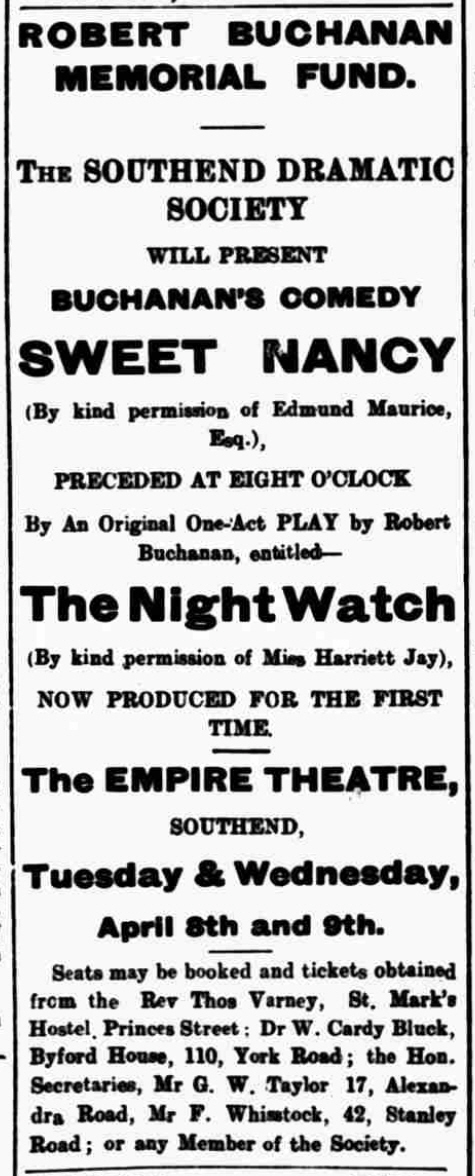
First produced after Buchanan’s death at a benefit for the Buchanan Memorial Fund in April, 1902. |
|
|
 |
|
|
|
The Stage (10 April, 1902 - p.10) SOUTHEND—EMPIRE.—The Southend Dramatic Society on Tuesday night gave a performance in aid of the Fund to provide a Permanent Memorial to the late Robert Buchanan, who had resided at Southend for a long period, and now rests in “God’s little acre by the sea,” beneath the sheltering wall of the Church of St. John. The local society decided to give performances on two nights—Tuesday and Wednesday—in aid of the Memorial Fund, and for such an occasion could not have presented a more attractive programme. Indeed, the curtain raiser was produced for the first time by permission of the author’s sister-in-law, Miss Harriett Jay. This was a poetical drama in one act, by Robert Buchanan, entitled:— The Night Watch. Heinrich von Auerbach . . . . Mr. Reginald Sewell This drama was admirably acted by a quintet of well-known amateurs; but it was not a cheerful opening for an evening’s entertainment. It was tragedy, as a contrast to the comedy to follow. Mrs. Reveirs-Hopkins cleverly interpreted the character of Irene de Grandfief, and Mr. Reginald Sewell appeared as Heinrich von Auerbach, who is supposed to have witnessed the death of the Vicomte de Lisle, to whom Irene is betrothed, and who, by a freak of fortune, is brought wounded to the chateau of which Irene is mistress. The participation of Heinrich in the events which led to the supposed death of her lover leads Irene to be tempted to allow Heinrich to die by neglect, but her better feelings hold sway, and as the curtain falls her lover returns well, and the scene closes with the usual conquest of meaner feelings with virtue triumphant. Buchanan’s Sweet Nancy was the chief feature of the programme. Mrs. Reveirs-Hopkins decidedly scored a success as an amateur in the part of Nancy; Mrs. Cardy Bluck made a charming Barbara, and the other sister, Teresa, became an admirable juvenile part in the hands of Miss Dora Seal. Mr. William Gray looked the character as Sir Roger Tempest, and acted admirably. Mr. Donald Gray was a very fair Frank Musgrave. ___
The Southend Standard (10 April, 1902 - p.5) SOUTHEND DRAMATIC SOCIETY. “SWEET NANCY” AND “THE NIGHT WATCH.” A FINE PERFORMANCE. Southend Dramatic Society did honour to the memory of a great playwright and, indeed, honoured itself when on Tuesday evening its members realistically pourtrayed at the Empire Theatre Robert Buchanan’s well-known work “Sweet Nancy,” and had the added privilege of placing before the public for the first time a poetical drama by the same writer, entitled “The Night Watch.” “THE NIGHT WATCH.” “The Night Watch,” which began to the tune of the “Marseillaise”—a play in one act—was suggested to Buchanan from a poem by François Coppée. The scene is laid at the Chateau of Grandfief, in Normandy and the time is put at the German Invasion of France in 1870. There are five characters: Irene de Grandfief (Mrs. Reveirs Hopkins); Vicomte de Lisle, a volunteer in the French Army (Mr. Picken); Heinrich von Auerbach, a German Officer (Mr. Sewell); Hubert, a servant (Mr. G. Taylor) and Doctor Marton, a surgeon (Mr. Reveirs Hopkins). Shortly described, this new and powerful play opens with an interior view of the Antique Chamber in the Chateau Grandfief, with Hubert, a clownish servant, looking out of the window, joyfully welcoming the fall of snow; which he wishes would fall quickly enough to swallow up the Germans. His soliloquy is broken by the sound of gun shots and Irene (the heroine) enters. She bids the servant discover the cause of the firing. While he is gone the lady’s thoughts dwell on the whereabouts of her soldier lover, the Vicomte, who is serving as a volunteer with the French Army. His expected letter has not arrived and in the passion of her love she kneels before the oratory praying “Spirit of Heaven spare him! Restore him in the blessed light of peace and bring him soon!” Hubert hastily enters and brings the news that a skirmish near by had ended in a victory for the French and the capture of a German Uhlan officer. Dr. Marton dresses the wound and is afforded opportunity of declaring the Vicomte to be “he who yielded rank, wealth, and privilege and seized a sword in France’s hour of danger”—an act which would peculiarly appeal to Buchanan’s instincts. Irene nurses the Uhlan through the night and a phial of medicine is given her in order that she may serve him with ten drops four times an hour, so to keep him alive. The officer rouses from unconsciousness ad tells Irene how “yonder in Germany there is one who waits like her; a little maid with sunny, golden hair.” The climax is reached when he tells her that a month ago at Metz he killed a Frenchman: “We saw one standing as a sentinel. On hands and knees I crept unto him. Then, up-springing, stabbed him. He fell with scarce a groan.” The dying Frenchman implored his assailant to forward to the one he left behind a medallion which he wore. This Auerbach swore to do and he now hands it over to the girl to fulfil the mission. She examines it and finds it to be her lover’s. Then through the long night hours she struggles with her frenzied desire to kill the sick man, but a low voice points her to her “Duty!” and she administers the saving draught. As he recovers, Raoul, the missing lover, pale but eager, enters and clasps the girl in his arms and peace is made ’twixt Gaul and Teuton. “SWEET NANCY.” “Sweet Nancy” runs to a livelier, merrier measure and the audience were at once in good humour with the first scene, wherein are found the sons and daughter of Mr. Gray (Mr. Reveirs-Hopkins) playing in approved tom-boyish fashion in a garden, until disturbed by their father. The sons were: Algernon Gray, Mr. Felis Seel; Bobby Gray, Mr. Fred Whisstock; James Gray, called “The Brat,” Master A. E. Lockington and the daughter, Teresa Gray, called “Tow, Tow,” Miss Dora Seel. Sir Roger Tempest (Mr. William Gray) quells a stormy scene between father and children and Mrs. Gray (Mrs. Read) also appears. “Nancy” (Mrs. Reveirs Hopkins) was greeted with cheers and she was pretty and girlish with her match-making father when he wanted her to lunch with him and Sir Roger “dressed in her best.” The obvious object of the ruse was quickly penetrated when she was chaffed by her brothers and sisters, who, with a keen eye to the main chance, bargained for shooting and hunting as their share of the spoil from the prospective union. The situation was, indeed charmingly amusing when Sir Roger discovered “Sweet Nancy” left stranded on a high wall by her mischievous brothers, but where, however, she progresses extremely well in her determination to marry a man with money and she and Sir Roger go in the fashion of “Darby and Joan” to lunch, preceded by Barbara (Mrs. W. Cardy Bluck) and Frank Musgrave, Sir Roger’s ward, (Mr. Donald Gray). The courtships cause great dismay among the children and Algernon gives his emphatic opinion upon the subject, preluded by the dramatic “Friends, Romans, countrymen—stand to attention!” In due time Sir Roger sues for Nancy’s hand and if the latter is seemingly coy, her secret intention is realised and she gives her promise. With seductive guile she gains the boys over to the alliance by promises of hunters and shooting galore. Scene 1 was most effective and the curtain descended to the hearty cheers of the audience. ___
Essex County Chronicle (11 April, 1902 - p.5) THE SOUTHEND DRAMATIC SOCIETY on Tuesday and Wednesday gave a performance in aid of the fund to provide a permanent memorial to the late Mr. Robert Buchanan, who resided at Southend for a long period, and is buried in St. John’s Churchyard. The curtain raiser, “The Night Watch,” by Robert Buchanan, was produced for the first time, by permission of the author’s sister-in-law, Miss Harriett Jay. Mrs. Reveirs-Hopkins cleverly interpreted the character of Irene de Grandfief, and Mr. Reginald Sewell appeared as Heinrich von Auerbach. Buchanan’s “Sweet Nancy” was the chief feature of the programme; and here Mrs. Hopkins scored a decided success in the title rôle. Mrs. Cardy Bluck made a charming Barbara, and the other sister, Teresa, was capably impersonated by Miss Dora Seel. Mr. William Gray did well as Sir Roger Tempest, Mr. Donald Gray as Frank Musgrave, and altogether the performance was one of merit.
Back to the Bibliography or the Plays _____
Next: Robert Buchanan’s Other (unproduced) Plays Back to the Bibliography or the Plays
|
|
|
|
|
|
|