|
|
 |
|
|
ROBERT WILLIAMS BUCHANAN (1841 - 1901)
|
|
|
|
THEATRE REVIEWS
6. The Nine Days’ Queen (1880)
The Nine Days’ Queen
by Robert Buchanan
London: Gaiety Theatre. 22 December, 1880 (matinée).
London: Royal Connaught Theatre 14 February to 12 March, 1881.
(Buchanan’s Only A Vagabond, a one-act curtain-raiser, is also on the bill.)
Other Performances:
Glasgow: Gaiety Theatre. Week beginning 21 March, 1881.
London: Gaiety Theatre. 29 November, 1882 (matinée).
(Harriett Jay played the role of Lady Jane Grey.)
The Daily News (13 December, 1880 - p.2)
Mr. Robert Buchanan’s poetical play called “The Nine Days’ Queen,” to be produced at the Gaiety Theatre on Wednesday afternoon the 22nd inst., is substantially an original work, though free use has been made by the author of Nicholas Rowe’s tragedy of “Lady Jane Grey,” originally brought out at Drury Lane Theatre in 1715. Rowe’s play had the advantage of the acting of the beautiful Mrs. Oldfield, then in the prime of her career, in the part of the heroine, with Barton Booth as Lord Guildford Dudley, and the other distinguished actors in the remaining characters. After the common fashion of dramatists, the author took liberties with history—representing Lady Jane as not married till after the death of Edward VI., and with a more questionable licence, representing Lord Pembroke, whose son was contracted to lady Jane’s sister, as in love with Lady Jane. Rowe’s tragedy was successful, and was frequently revived during the next sixty years, but it never became a stock piece like his “Jane Shore,” which has been revived in very recent times. Mr. Buchanan also avails himself of the dramatist’s licence, generally considered permissible within certain limits. Queen Mary, who does not figure among the personages of the older play, is, we believe, introduced by him and brought face to face with Lady Jane in the Tower, which may remind spectators of the apocryphal encounter between Elizabeth and Mary Stuart in Schiller’s play. “The Nine Days’ Queen” was originally written for Miss Neilson, who had studied the part of the heroine and intended to produce the piece in the United States. This character will now be sustained by Miss Harriet Jay, authoress of “The Queen of Connaught.” At matinée performances it is, for obvious reasons, not customary to go to any considerable expense for scenery or appointments. If Mr. Buchanan’s play should obtain a more permanent footing on the stage, the scenic artist would probably find some useful hints in Cruikshank’s vigorous and picturesque illustrations to Ainsworth’s novel of “The Tower of London.”
Lady Jane Grey has not attracted the attention of dramatists as often as might have been expected from her beauty and her tragic story; but there is extant at least one other play of which she is the heroine. This is John Banks’s “Innocent Usurper,” produced in 1694. Political associations, together with the proneness of audiences to apply allusions to contemporary events, seemed to have rendered the licencers unfavourably disposed. Banks complains in the preface to the published play that when it was on the point of being produced, the performers having studied their parts, the representation was forbidden, and only finally permitted—we may be sure with some modifications—after considerable delay. The received explanation is that King William III. objected to the title, a fact which is easier to understand than the final production of the piece with the title unchanged. Rowe probably took a hint from this; for his play, produced just after the accession of George I., was intensely loyal towards the House of Hanover—Lady Jane Grey in one scene beseeching Heaven, with prophetic eye, to send in due season “the hero who may save our altars from the rage of Rome,” besides which both prologue and epilogue spoken on the first night contained extravagant compliments to the King and Queen Caroline.
___
The Graphic (18 December, 1880)
Mr. Robert Buchanan’s historical drama, called A Nine Days’ Queen, will be produced at the GAIETY Theatre on Wednesday afternoon next. The character of Lady Jane Grey will be sustained by the author’s sister-in-law, Miss Harriet Jay, author of that remarkable novel of Irish life, “The Queen of Connaught.” The writer of the Monday article on the theatres in the Daily News states that Mr. Buchanan has made free use of Nicholas Rowe’s old play, though not to a degree to affect the substantial originality of his work. According to the same authority, Mr. Buchanan introduces a scene in the Tower between Queen Mary and Lady Jane which, like Schiller’s encounter between Mary Stuart and Queen Elizabeth, is without further warrant than the licence of the dramatist.
___
The Academy (18 December, 1880 - No. 450, p.450)
ONE of the most eminent of the “licensed dealers in short skirts, legs, Shakspere, and the musical glasses” is about to perform a heavy penance, and atone for his sins in familiarising a guileless public with the various graces of Miss Vaughan and Miss Gilchrist by producing a poetical play. Nay, more; not only is Mr. Hollingshead prepared to give us on Wednesday next the literary work of Robert Buchanan. He actually presented us this week with a specimen of Scandinavian drama; but the public of London, caring but little for Northern literature, cares but little for Ibsen, and we shall be content to address ourselves next week to the English poet. Next week, then, we may hope to see Mr. Buchanan’s play, in which a lady novelist of distinction—the authoress of The Queen of Connaught—will come before the public in her new career as an actress.
...
MR. J. W. BOULDING writes:—
“I have observed in the daily newspapers an announcement of the production, at the Gaiety Theatre on the 22nd inst., of a play entitled The Nine Days’ Queen. As I am at the present moment in negotiation for the production of a play on the same subject, entitled Nine Days a Queen, which was printed for private use in 1878, and has been read by many distinguished members of the dramatic profession, will you allow me to call attention to the fact?”
___
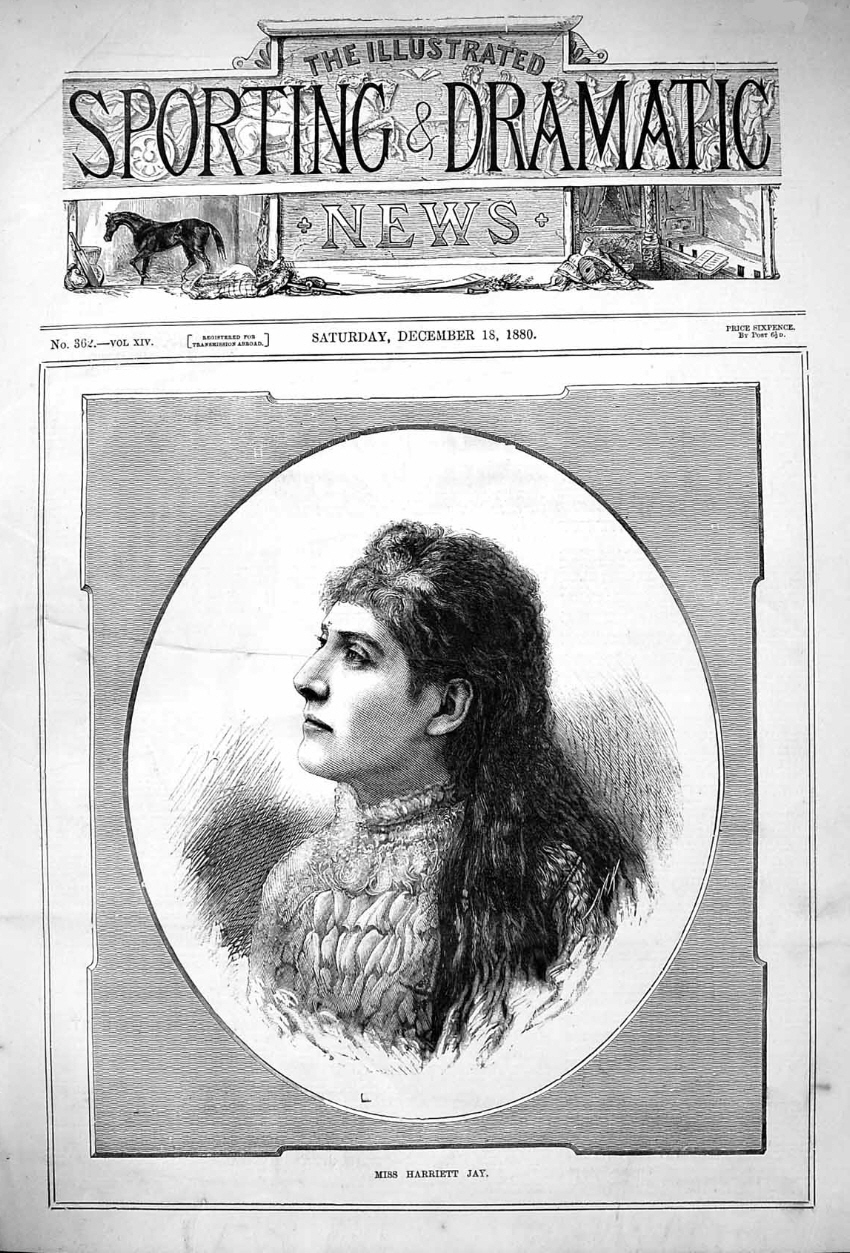
The Illustrated Sporting & Dramatic News (18 December, 1880 - p.1)
|
|
|
|
 |
|
|
|
The Scotsman (23 December, 1880 - p.5)
“THE NINE DAYS’ QUEEN”
LONDON, Wednesday night.—A romantic poetical drama in four acts, entitled “The Nine Days’ Queen,” by Mr Robert Buchanan, was produced at a morning performance at the Gaiety Theatre this afternoon. The play is founded on the life and death of Lady Jane Grey, and Mr Buchanan appends the following note to the programme:—
“Little pretension is made by the author to historical accuracy, but the romantic attachment of the Earl of Hertford for Lady Jane Grey is not without authentic foundation. The meeting of Queen Mary and Lady Jane Grey in the Tower is possibly as justifiable on historical grounds as the famous encounter of Queens in Schiller’s ‘Mary Stuart.’ Free use has been made of Nicholas Rowe’s play on the same subject.”
Taking, then, the salient points of Lady Jane Grey’s hapless career, the author has certainly given us a sufficiently romantic play, while he is also abundantly justified in claiming for it the epithet of poetical. “The Nine Days’ Queen” is written in vigorous and poetic blank verse, full of nervous English and admirable similes; indeed, the literary merit of the piece is exceptionally high. It may be questioned, however, whether the poet has not to some extent extinguished the playwright, for the piece would be much improved by wholesale excisions, and a general condensation, which would bring the dramatic situations closer together. Still, even with those faults, Mr Buchanan has written a really fine play, which, with due revision, should have a successful career on the stage. He deals with the life of his heroine in a masterly fashion, and the words he puts into the mouths of his various characters are invariably appropriate. We are shown Lady Jane Grey under all the trying circumstances of her life, and special stress is laid upon her love for Lord Guildford Dudley, as well as upon the romantic attachment conceived for her by Lord Hertford; while the latter’s treachery to her cause and subsequent repentance are used with skill and with good dramatic effect. The meeting above referred to of Queen Mary and Lady Jane in the Tower is well conceived, and with a little compression could be highly effective; and another strong situation shows us with much dramatic force the unhappy heroine’s acceptance of the crown which she would fain have refused. There is pathos, too, in the concluding scene, which was well managed, and indeed the whole play is a most welcome change from the adaptations from foreign sources which are now too common among us. It must be said, moreover, that it would have gained a great deal had the blank verse been spoken with more discretion by several of the actors who took part in it. The principal character, Lady Jane Grey, was played by Miss Harriet Jay, a lady who, as the authoress of “The Dark Colleen” and “The Queen of Connaught,” has won a high reputation as a novelist. Miss Jay has only once before made her appearance on the stage, and her performance was indubitably one of high promise. She has, as was only to be expected, much to learn, but still her acting is sympathetic and intelligent, and she evidently spares no pains to embody the author’s ideas. With more experience and confidence, and a more entire abandonment of herself to the situation, she will one day be an acquisition to the stage. Miss Louise Willes was a satisfactory Queen Mary, and Mr Beaumont played the Duke of Northumberland with sound art, and delivered his lines in welcome contrast to the elocution of Mr Arthur Dacre, who slurred them over as if he had never spoken blank verse before. The piece was effectively put upon the stage, and listened to with much attention, while all the principal characters were much applauded at the conclusion, and called before the curtain to receive the congratulations of the audience. In response to a loud demand for the author, Mr Buchanan made his appearance, and bowed his acknowledgments.
___
Glasgow Herald (23 December, 1880)
MR ROBERT BUCHANAN’S NEW PLAY.
_____
(FROM OUR OWN CORRESPONDENT.)
_____
London, Wednesday Night.
A “ROMANTIC POETICAL DRAMA” is now-a-days such a rarity that the production of Mr Buchanan’s four-act play, “The Nine Days’ Queen,” excited considerable interest, and a representative audience assembled at the Gaiety this afternoon to witness it. There was in addition the interest of a debut to attract the theatrical world, as Miss Harriet Jay, authoress of “The Queen of Connaught,” was announced to make her first appearance in London in the part of Lady Jane Grey, her only previous appearance on the Metropolitan stage having recently taken place at the Crystal Palace in a dramatisation of her own novel. We may say at once that Mr Buchanan’s play was listened to with respectful attention, and that several of the scenes were recognised as possessing genuine force and merit. Nevertheless, we cannot prophesy for the play any great success, even if it gets beyond the ephemeral existence of a morning performance.
The first act takes place in the Duke of Suffolk’s gardens at East Sheen, and we find the Duke of Northumberland and the Duke of Suffolk plotting to prevent the accession of Mary to the throne on the death of Edward VI., which is now impending. Meanwhile Lady Jane Grey, all unconscious of the ambitious views entertained by her father, half admits, half conceals her love for Lord Guildford Dudley, the son of Northumberland. She is also loved by the Earl of Hertford, who is astonished to find a rival in his friend Dudley. he two friends agree that their rivalry shall not mar their friendship, and that each shall woo her fairly and openly and let her own will decide between them. Meanwhile Northumberland has secured from Suffolk the promise of her hand for his son. When she learns that her love for Dudley has her father’s approval she no longer conceals it, and their betrothal is announced amid popular rejoicings. Hertford on learning of it concludes, through a misunderstanding rather beneath the dignity of the poetic drama, that Dudley has played him false, and the curtain falls upon an outburst of his jealous rage. The second act opens in Mary’s oratory. The death of Edward VI. is announced to her by Hertford, who, in his jealous fury, at the same time betrays to her Northumberland’s design of putting Lady Jane Grey upon the throne. By his counsel she takes flight, and thus escapes from the partisans of Northumberland, who had been sent to seize her. The scene then changes to the Palace of Westminster, immediately after the death of the King. Northumberland and Suffolk announce to Lady Jane Grey the elevation for which they destine her. She protests vehemently against the unlooked for and uncoveted greatness, but her entreaties are in vain. She is proclaimed Queen, and falls fainting to the ground while the assembled nobles, with swords waving in the air, are doing her their first homage. The third act takes place before the Tower to which Lady Jane is brought as Queen. The treacherous Hertford arrives repentant of his treachery; but he is too late. The power is in Mary’s hands, and the order for the arrest of Lady Jane is brought by an officer, who announces to his astonished prisoner that it is through Hertford’s treason that Mary has been enabled to seize the kingdom. The main matter of the fourth act is a powerful interview between Queen Mary and Lady Jane, in which the Queen offers her not only her own life, but also that of her consort Dudley, on condition that she will renounce the Protestant faith. This she refuses to do. She even refuses to see Dudley before their execution, saying “it would only disturb the holy tranquillity with which they had prepared themselves for death.” The curtain thus falls upon the tragic denouement which history had led us to expect. Mr Buchanan does not lay claim to historical accuracy. He admits that he has made free use of Rowe’s play on the same subject, and justifies the interview between the two Queens by a reference to Schiller’s still more flagrant violation of historical fact in “Marie Stuart.” It is not with his history, however, that criticism will quarrel, but with the lack of dramatic effect which mars most of his well-written scenes. Some of them, notably the scene between Dudley and Hertford in the first act, the conclusion of the second act, and the great scene of the third act, have genuine dramatic stuff in them, and under better circumstances would no doubt meet with thorough appreciation.
A certain air of intelligent amateurishness pervaded the representation. Miss Harriet Jay herself is still an unmistakable amateur, although an amateur of great promise. She has a fine and expressive face, an admirable presence, and an excellent voice, though she is untrained in the use of it. If she perseveres earnestly in her new profession, and is content with less ambitious efforts until she is more perfectly at home on the boards, she will be a genuine acquisition to the stage. Mr Arthur Dacre is too essentially modern in style to shine in a costume part, but his Dudley was manly and intelligent; while Mr Beerbohm Tree played the difficult part of Hertford with a certain amount of awkwardness, but still with some force and feeling. Mr A. Beaumont as Northumberland proved himself a thorough elocutionist and good actor; and Mr David Fisher was excellent as the rather weak-minded Suffolk. Miss Louise Willis played Queen Mary with all her unfailing earnestness and care. The piece, as is usual at Gaiety matinees, was very inadequately put upon the stage, and the author would have done well to suppress the unnecessary May-day merrymakings of the first act.
___
The Standard (23 December, 1880 - p.3)
GAIETY THEATRE.
_____
Mr. John Hollingshead is nothing if not comprehensive in his ideas with regard to the Gaiety matinées. Plays of all kinds are produced at these performances, ranging from the fine old spectral drama of the palmy past to the high-flown and “intense” poetic drama of to-day. It would perhaps be an illiberal view of the subject which pictured the Gaiety afternoon representations as a kind of practising ground for playwrights and actors; but they are nevertheless convenient opportunities for gauging the public taste with respect to the power of a play or the ability of a performer. Yesterday afternoon a new romantic, poetical drama, in four acts (to quote the programme), founded on the life and death of Lady Jane Grey, and entitled The Nine Days’ Queen, written by Mr. Robert Buchanan, was given for the first time on any stage. There were two special recommendations of the new piece to public notice—the first, the admitted ability of Mr. Buchanan as a man of letters; the second, the first appearance of the “distinguished novelist and actress,” Miss Harriet Jay. Miss Jay has certainly won her spurs as a clever novelist, but how she could be a distinguished actress if yesterday saw her first appearance, unless, of course, she has achieved fame as an amateur performer, must be left as a seasonable Christmas riddle. The Nine Days’ Queen is a drama, tragic in nature from the outset, and unrelieved by sentiment or humour—save where the band plays Schumann’s Joyous Peasant as an accompaniment to a May dance. Sometimes Mr. Buchanan’s smooth lines and polished imagery make us forget that the piece is tedious; but his present venture does not prove him to be a finished dramatist. Moreover, the author has not bound himself to historic accuracy, and says in a note affixed to the programme:—“The meeting of Queen Mary and Lady Jane Grey in the Tower is, possibly, as justifiable on historical grounds as the famous encounter of Queens in Schiller’s Mary Stuart.” Flabby logic like this is not worthy of Mr. Buchanan. Two blacks do not make a white, and the public will not be persuaded to the contrary.
The action of the play shows a rivalry existing between two bosom friends—Lord Guildford Dudley, heir of the Duke of Northumberland, and the Earl of Hertford—for the hand of Lady Jane Grey, daughter of the Duke of Suffolk. Dudley wins the day, and Hertford, smarting under his rebuff, at once hies to the Princess Mary to apprise her of a plot, set on foot by the Duke of Northumberland, to deprive her of her claim to the Crown. To do Hertford, who is a most imbecile conspirator, justice, he thinks that his foes wish to set Elizabeth upon the Throne, and not his beloved Jane. The wily Northumberland, and his fidus Achates Suffolk, persuade Lady Jane, as next by right of kin to the Crown, to take the sovereignty; but she, like the village maiden whom the Lord of Burleigh weds in the Laureate’s poem, feels all unsuited for the cares of state, and is only forced into acceptance of the Crown by her husband, who, in his turn, is coerced by his father. Then follows the procession of Queen Jane to the Tower to receive the keys as sovereign monarch of the Realm, and the brief spell of power is broken in upon by the advent of Mary, who, at the head of twenty thousand soldiers, and warned by the treacherous Hertford, marches in triumph upon London. The unhappy Lady Jane and her luckless husband are consigned to the Tower as captives, where they had entered but a short time before as supreme rulers. Hertford has a favour to prefer to Mary for the service he has rendered her, and he demands the release of Lady Jane and Dudley. Mary’s arch-prompter, the Romish Bishop Gardiner, advises her against this step; but eventually the Queen determines to see her prisoners. She visits the Tower, provided with pardons for both the offenders if they declare allegiance to the Pope. Both refuse this alternative, and the drama ends with the spectacle of Guildford going to the scaffold and Lady Jane expecting the summons to follow him.
There are many poetic ideas expressed in the dialogue, and certain situations are worked up to a point which is almost thrilling. But with all this The Nine Days’ Queen is not dramatic, though it is not dull. No skilled playwright could have produced such a scene as that in the third act, where Hertford is asked for his sword and has it returned, so that he can be asked for it and get it back again. There are other imperfections which need not be pointed out, but which must have been sufficiently evident to those who honoured yesterday’s performance with their presence. Miss Harriet Jay speaks clearly and articulates her words with rather pedantic distinctness; she moves, too, easily and gracefully upon the stage. Here, however, her claims to the title of actress end. The part of Lady Jane Grey in Mr. Buchanan’s piece might have been elevated into importance by a Modjeska or a Ristori; but it is out of the reach of clever young ladies who are not great actresses. Mr. Arthur Dacre, as Guildford Dudley; Mr. A. Beaumont, as the Duke of Northumberland; and Miss Louise Willes, as Queen Mary, were excellent. Mr. Beerbohm Tree was uncertain both as to words and style as the Earl of Hertford; and the players of the other parts did not provoke comment. Miss Jay was popular with her audience, and Mr. Buchanan came forward at the close.
___
The Daily News (23 December, 1880 - p.2)
GAIETY THEATRE.
_____
Historical plays in verse have so rarely been successful or even attempted on our stage in recent times that the production of Mr. Robert Buchanan’s drama called The Nine Days Queen at the Gaiety Theatre yesterday afternoon would deserve, even apart from the merits of the work, to be chronicled as an event of some interest. It is true that we had been forewarned that the writer had made free use of Rowe’s old and now almost forgotten play; and as it proved this is rather Rowe’s play rewritten than a new piece. For Pembroke, the rejected lover, the author has substituted the Earl of Hertford, eldest son of the Duke of Somerset; but the function of this personage in the story remains essentially the same. The romance and the conflict of passion necessary in all dramas, and above all in a piece with a heroine who must be depicted as somewhat weak and yielding unless authority is altogether to be disregarded, is still furnished by the antagonism between the loves of Lord Guilford Dudley and this personage; but Mr. Buchanan has contrived to sound the keynote of rivalry earlier and more distinctly, by which the subsequent really fine scene of the reconciliation between the two suitors, which is here also borrowed and improved from Rowe, becomes stronger in contrast and proportionately more effective. The notion of the old play that Pembroke’s jealous rage induced him to betray the Duke of Northumberland’s party, as his really noble nature, touched by the generosity of Lord Guilford in his momentary triumph, afterwards led him to repent and endeavour to save, is ingenious and dramatic. All that it produces of a really valuable kind Mr. Buchanan has retained, giving, however, the situations a clearer outline. Finally, he has introduced a scene between the Queen and Lady Jane in the Tower, which, though not historical, is not perhaps beyond the limits of the dramatist’s license, and, what is more to the point, is finely conceived and vigorously executed. Instead of her receiving the pardon indirectly, it is here handed to the prisoner by the Queen herself, after a fierce though not undignified invective, which is met by Lady Jane with characteristic piety and meekness, changing however at last, under the excitement of the occasion, to a fine outburst of Protestant zeal and defiance. The said pardon, of course, proves to be worthless, being conditional, as Gardiner with malignant glee observes, upon the recantation which the prisoner scornfully refuses. This situation is very ingeniously complicated by the previous entrance of the penitent Hertford, who conceals himself in an ante-chamber, promising to assassinate the Queen on a pre-concerted signal. That Lady Jane should give this signal is somewhat out of keeping with her habitual mock resignation; but the effect is striking. Fortunately for the Queen, her announcement that she had brought her prisoner a pardon with her own hands being overheard by him suddenly arrests his purpose; and it is not till a moment later that he discovers that the opportunity has been lost. These sudden developments in the situation are essentially dramatic. The play ends with the spectacle of Lord Guilford Dudley passing the window on his way to the scaffold, while his unhappy bride, after a pitiable appeal, falls on her knees in prayer—an ending less violent, and therefore more truly touching, than the old horror of the original play, in which she was seen to mount the scaffold. Rowe’s words, we may observe, are but little employed. Mr. Buchanan’s dialogue is free from merely descriptive passages, and is, as a rule, the language of true passion; many passages, indeed, are noble and spirited in a high degree. We wish that we could accord equal praise to the acting. Unfortunately Miss Harriet Jay brings to her performance of the heroine little more than the advantage of a handsome, intellectual countenance, a tall and graceful figure, and a good though not well-managed voice. Her monotone of plaintive sorrow is wearisome to the ear; her lack of command over inflexions of the voice in passionate outbursts is destructive of the effect of her words; her gestures are limited to one or two little actions often repeated, and of no real significance or value; and, in brief, her style is at present crude in the extreme. Of the representation in general we are unhappily not able to speak favourably; but, as we have before had occasion to observe, it is not apparently deemed necessary at the gaiety to bestow upon Wednesday afternoon performances adequate preparation. Even decent care is sometimes denied. Yesterday afternoon the spectators in the very centre of the stalls were favoured with a view of the interesting process of manufacturing stage lightning in the locality generally known as “behind the scenes,” and even with the still more unusual spectacle of “forest wings,” or representations of tall trees, intermingled with the draperies of an apartment in the Palace at Westminster.
___
The Globe (23 December, 1880 - p.3)
GAIETY THEATRE.
A blank verse historical drama of Mr. Robert Buchanan was produced yesterday afternoon at the Gaiety Theatre. The “Nine Days’ Queen,” as the new piece is called, adheres pretty closely to the lines of Rowe’s “Lady Jane Grey,” but is far more vigorous than that feeble and verbose production. It introduces, moreover, scenes and situations which are not in Rowe, and it furnishes some strong contrasts between the gentle piety of Lady Jane Grey and the fierce hysterical fervour of Mary Tudor. As a whole the play may be pronounced a vigorous and a striking work, well suited to the closet, and not incapable, with an interpretation stronger then is now afforded, of obtaining lasting success upon the stage.
The principal character—that of Lady Jane Grey—was played by Miss Harriett Jay, the well-known writer of “The Queen of Connaught.” Not wholly a stranger to the stage is the lady who now makes her first appearance upon the London boards. In addition to the reputation she has acquired as a reader, Miss Jay has won at the Crystal Palace some recognition as an actress. Her fitness to face the sterner ordeal of a West-end theatre may not be disputed. She has a fine expressive face, a tall and graceful figure, and a voice of distinct power. Her delivery is clear and correct, though her utterance is monotonous. What is wanting is the kind of knowledge experience alone can give. A rôle such as Mr. Buchanan has afforded in Lady Jane Grey imposes an arduous task upon an actress, and Miss Jay lacks as yet the practised strength which is necessary to its adequate exposition. Her reception, like that of the play, was, however, enthusiastic, and at the close of every act she was summoned before the curtain. There were moments in Miss Jay’s performance when a strong resemblance to the late Mrs. Rousby was evident. For the remainder of the cast, the Lord Guildford Dudley of Mr. Dacre, and the Earl of Hertford of Mr. Beerbohm Tree were pleasantly conspicuous. If in neither character there was displayed the kind of strength which is necessary to tragedy, there was apparent in both a very distinct and intelligent conception. Miss Louise Willes assigned no very striking physiognomy to Queen Mary; Mrs. Leigh Murray was the Duchess of Suffolk, and Mr. Beaumont Northumberland. A warm call for the author followed the descent of the curtain.
___
The Morning Post (24 December, 1880)
GAIETY THEATRE.
_____
Whether Lady Jane Grey was indeed as gentle and guileless as her admirers paint her, or as crafty and disloyal as her enemies would have us believe, certain it is that there is no darker page in English history than that which records her brief, sad story. It is as doleful a theme as any dramatist could choose for the burden of his play; and it acquires no fictitious brightness in Mr. Robert Buchanan’s “romantic and poetical drama,” entitled “The Nine Days’ Queen,” which was brought out at this theatre on Wednesday afternoon. The author, who admits that he has made free use of Nicholas Rowe’s play on the same subject, also avows that in the present work little pretension is made to historical accuracy. He justifies, as not without authentic foundation, the romantic attachment of the Earl of Hertford for Lady Jane Grey, and suggests that the meeting of the latter and Queen Mary in the Tower—one of the principal scenes of the piece—is possibly as justifiable on historic grounds as the famous encounter of the Queens in Schiller’s “Mary Stuart.” But what the apologists of Lady Jane Grey will hardly view with favour is that she is represented as willing enough to compass the death of Queen Mary. Hertford lies in wait during the interview, having previously suggested that if she should wish her rival to be set upon and slain Lady Jane shall utter certain words, which are to be interpreted as a signal to that effect. Armed men will then appear and do the deed. The words are uttered in no uncertain voice, though without apparent premeditation, at the close of a fierce tirade. The offer of a pardon, afterwards found to be conditional, prevents the wicked plot from being carried into practice, and Mary escapes unhurt. The play is excellently written, the diction being uniformly polished, graceful, and harmonious, but the plot lacks variety of action and dramatic interest. It is wearisome and disappointing to find that a drama having a good dialogue and several well-drawn characters should be so lifeless and lugubrious. But these afternoon plays acted by “scratch” companies and produced under circumstances which forbid sufficient rehearsal and proper stage management are seldom satisfactory. Something of the weakness of the general effect may have been chargeable yesterday rather on the performance than on the play itself. Want of practice and a consequent lack of executive power disqualified Miss Harriett Jay from carrying out the good intention often discernible in her attempts to impersonate the unhappy heroine. Nothing that the other actors could do—though some of them, and more particularly Mr. Beaumont as the Duke of Northumberland, Mr. A. Dacre as Lord Guildford Dudley, and Mr. H. B. Tree as Lord Hertford, played their parts with zeal and skill—could compensate for the inadequate representation of the personage in whom the interest of the story chiefly centres.
___
The Exeter and Plymouth Gazette (24 December, 1880 - p.8)
LONDON LETTER.
LONDON, Thursday Evening.
. . .
Mr. Robert Buchanan is, beyond doubt, a man of very great literary power, while his poetry has a charm about it which is irresistible, and which must one day push him more into the front rank of poets than he is at present. He must, however, have been born under an unlucky star, for, as one of his friends pointed out the other day, he is never successful. If it is true that nothing succeeds like success, I suppose the reverse is also true, and that to be once unsuccessful is to be practically for ever debarred from the pleasures of public applause. Mr. Buchanan has once again tried his hand as a dramatic author, and this time he has, at least, come within “measurable distance” of success. His new piece, called the “Nine-days’-Queen,” was produced yesterday afternoon at the Gaiety, and it was certainly most favourably received. The drama is admittedly founded on Rowe’s old dramatisation of the historical story of Lady Jane Grey, and in Mr. Buchanan’s version it is possibly even a more weird and melancholy story than the original warrants. But if the author has not handled it with the practiced skill of a dramatist, he has inspired it with all the depth of tragic poetry. It is, in fact, rather a poem than a play, but as a literary production it does honour to Mr. Buchanan’s reputation. I don’t think, after yesterday’s performance, the piece is likely to be played at any London theatre, or, if it is, that it is likely to meet with any large amount of success unless it is very much re-cast and some of the scenes re-arranged. But still, for all that, Mr. Buchanan may be said to have fairly deserved the enthusiastic applause with which the fall of the curtain was greeted.
The Gaiety performance was not alone interesting on account of the production of Mr. Buchanan’s play, for it was made the occasion for the debut of Miss Harriet Jay as an actress. Miss Jay took the leading character in the piece, and she evidently showed that she had made it a subject of deep study, but whatever one may be disposed to say of her novels, one could not at present, with justice, give a very favourable opinion of her as an actress. She has in her much that goes to make a good actress, and if she should apply herself to the task of completing her education, of what may be called the technique of histrionic art, she may yet win her laurels. On the whole, I should not be disposed to re-echo without qualification the advice gratuitously tendered to Miss Jay to keep to writing novels.
___
Bell’s Life in London (25 December 1880 - p.11)
“A NINE DAYS’ QUEEN,” AT THE GAIETY.
Mr Buchanan’s historical play, in four acts, dealing with the short and disastrous episode of the assumption of the Crown of England by Lady Jane Grey, was given for the first time in London at the Gaiety Theatre last Wednesday afternoon. The play, written in blank verse, treated the love and marriage of Lady Jane and Lord Guildford Dudley, and with the passion of the Earl of Hertford for the beautiful and unfortunate daughter of the Suffolks. Lady Jane Grey is represented as an unwilling tool in the hands of her ambitious and unscrupulous relatives. Over persuaded, she accepts the responsibilities, and with them the dangers, of an act of flagrant usurpation. For nine days she enjoys the doubtful privilege of titular royalty. Then Mary is proclaimed Queen, to the great joy of the nation; and the usurping bride and bridegroom are imprisoned in the Tower, and cast for execution. The situations in Mr Buchanan’s tragedy are ingeniously conceived; and, probably, in other hands the work might have achieved a fair measure of success. The author admits his obligation to the old English dramatist, Rowe, who composed a play on the same subject. Of the literary merits of “A Nine Days’ Queen” it is not possible to express an opinion, inasmuch as it cannot be conceived that the performers did justice to the text. Mr Buchanan is a practised man of letters, but if we were to allow that he wrote the slip-shod English spoken at the Gaiety he would have gained nothing more important than a triumph of tautology. The cast was in most respects unsuitable. Miss Louise Willes did fairly well as Queen Mary, and as the Duke of Northumberland Mr Arthur Beaumont bore himself with dignity, and spoke his lines with grace and propriety of elocution. Miss Harriet Jay, though intelligent and manifestly ambitious, has much to learn before she can pretend to the knowledge and experience requisite for the representation of such a difficult and arduous part as that of Lady Jane Grey. Though in herself neither unbeautiful nor ungraceful, yet her voice is thin, her by-play seems insufficient and unfinished, and her entire artistic range limited, and displaying signs of immaturity. Mr Beerbohm Tree and Mr Arthur Dacre are both clever and aspiring young comedians. They are, however, apparently not used to don the magnificent costumes of the Tudor period. Of the two, Mr Dacre seemed more at home and less nervous in his gay clothes. The author was called for at the end of the play, and a bouquet awkwardly flung at Miss Jay struck her severely in the eye.
___
The Era (26 December, 1880)
“THE NINE DAYS’ QUEEN.”
_____
On Wednesday Afternoon, December 22d, 1880, a Romantic, Poetical Drama, in Four Acts, by Robert Buchanan, Founded on the Life and Death of Lady Jane Grey, and entitled
“THE NINE DAYS’ QUEEN.”
The Princess Mary . . . . . . . . Miss LOUISE WILLES
Feckenham . . . . . . . . Mr GIRARDOT
Gardiner . . . . . . . . Mr BUTLER
Duke of Northumberland . . . . Mr A. BEAUMONT
Lord Guildford Dudley . . . . . . Mr ARTHUR DACRE
Lord Ambrose Dudley . . . . . . Mr T. BINDLOSS
Earl of Hertford . . . . . . . . Mr H. BEERBOHM TREE
Duke of Suffolk . . . . . . . . Mr DAVID FISHER
Duchess of Suffolk . . . . . . . . Mrs LEIGH MURRAY
Lady Jane Grey . . . . . . . . Miss HARRIET JAY
Sir John Brydges . . . . . . . . Mr R LANGFORD
Steward to Duke of Suffolk . . . Mr WILLIAM FIELD
Reuben . . . . . . . . Mr WILLIAMS
Hetherington . . . . . . . . Mr ARTHUR GRAHAM
May Queen . . . . . . . . Miss V. COSTELLO
In presence of a large and certainly a friendly audience was produced at the Gaiety Theatre on the morning of Wednesday last Mr Robert Buchanan’s romantic poetical drama, in four acts, entitled The Nine Days’ Queen. Mr Buchanan, in a note on the day’s programme, says “Little pretension is made by the author to historical accuracy; but the romantic attachment of the Earl of Hertford for Lady Jane Grey (when we come to the plot it will be seen this attachment forms a very important feature) is not without authentic foundation. The meeting of Queen Mary and Lady Jane Grey in the Tower is possibly as justifiable on historical grounds as the famous encounter of the Queens in Schiller’s Mary Stuart.” Mr Buchanan acknowledges that free use has been made of Nicholas Rowe’s play on the same subject. He does not acknowledge that he is also to some extent indebted to Mr Tom Taylor’s historical play called ’Twixt Axe and Crown. The Nine Days’ Queen is a play in which a host of faults are conspicuous; but it must also be conceded that it possesses many merits entitling it to better treatment than it had on Wednesday at the hands of some of those engaged. If the lines strike us now and again as being turgid, high-flown, and approaching very near to that narrow line which is said to divide the sublime from the ridiculous, there are not a few of singular beauty and breathing the true spirit of poetry. Indeed, there is so much that is good in the play that we should like to see it again played with all the characters in the hands of competent artists. The piece opens in the Duke of Suffolk’s Gardens at East Sheen, where a very mild and simpering young lady is, for some undiscoverable qualities, being hailed as “Queen of the May.” Handsome young Lord Guildford Dudley, son of the ambitious Duke of Northumberland, subsequently makes desperate love to Lady Jane Grey, and is referred to her father, the Duke of Suffolk. There presently comes upon the scene the young Earl of Hertford, who is much moved when he hears of what has been going on; for he too loves Jane Grey, and his mission now is to ask for her hand. Dudley and Hertford have been staunch and loving friends, and, avoiding the impending quarrel, they decide that who wins the lady shall wear her, and that the other shall stifle all envy and throw away all bitterness of feeling. In his interview with the lady, Hertford becomes, as she terms it, “passionately mad,” and his madness is made somewhat worse when, hearing later on that her hand is to be given to Dudley, he imagines that he has been tricked and befooled by his friend. With a curse upon his lips he leaves the spot, and, guessing the plot in which Northumberland is engaged to make his daughter the successor to young Edward, he determines to be revenged, and rides for Hudston, where the Princess Mary is in seclusion. He tells her of the young King’s death; he is the first to hail her queen, and he informs her of the schemes of those whose presence he has so recently left. Meantime, Northumberland has urged upon the Lady Jane the necessity of allowing herself to be proclaimed queen. She shrinks from the proposal almost with horror; her young husband—for Dudley has taken her to wife—pleads for her, for he foresees that she will become a victim to his father’s ambition; but he pleads in vain, and at length, as she accepts the dangerous honours, and as the nobles bow the knee and hail her as their Sovereign, overcome by the excitement springing from the novel and dreaded situation, she swoons at their feet. The business here bringing the second act to a close should, if well carried out, prove highly effective. The scene of the third act is the Tower Steps and View of Old London. Lady Jane Grey is offered and accepts the keys of the Tower, and suddenly Hertford, coming upon the scene, is ordered under arrest by Northumberland. By Dudley and by the new Queen herself he is saved from indignity; but he has news that Mary is marching on London with twenty thousand men behind her. He cares nothing for Northumberland, but he dreads now that the lady whom he has so loved will fall before Mary’s wrath. He would save her now if he could. But it is too late. Her own soldiers revolt. She resolves not to resist. She looks upon her brief aggrandisement as a foolish jest. Jane and her husband are presently arrested, and their mental anguish is enhanced when from Mary’s own lips they hear that it is Hertford who has betrayed them. The fourth and concluding act shows us first, an ante-room in Westminster Palace, and then Lady Jane’s apartments in the Tower. The young husband and wife are presently separated, and there follows what, without doubt, must be considered the finest feature of the play, viz., the interview between the deposed and the reigning Queens. Lady Jane Grey denounces Mary in bitter terms; Mary, retaining her self-possession, offers her rival for the throne a pardon. With her own hands she gives her the paper which promises life and freedom, and she takes her leave, Lady Jane’s curses resolving themselves into blessings. Alas! she knows not the condition upon which her pardon is to be granted. It is that she shall renounce the Protestant faith and give her adhesion to the Church of Rome. When she learns this she spurns the proposal; she rejoices to think that her husband has had strength to do the same; and, as the procession which takes young Dudley to the scaffold begins to move the curtain falls, leaving us assured that a similar fate is in store for the “Nine Days’ Queen.” The acting, as we have hinted, was by no means generally adequate, and, consequently, the play suffered much. To begin with, the “Nine Days’ Queen” had a very incompetent representative in Miss Harriett Jay. Miss Jay may be, and doubtless is, a very able writer, but the writing of novels is no training for the stage. Miss Jay, in a word, is a raw amateur. She has not yet learnt how to walk the stage, and her action is irritatingly angular—not to say awkward. In the quieter passages of the play Miss Jay progressed very well, and won deserved sympathy; but directly there was the slightest occasion for warmth or passion, for the expression of horror, as in the scene where Lady Jane Grey conjures up visions of murdered monarchs and the sound of the funeral bell, she failed completely; the musical voice became harsh and strident, and little jerky sentences were screamed forth in a way that was anything but edifying or satisfactory. That Miss Jay was applauded, and that flowers were piled at her feet was said when we chronicled the presence of a friendly audience. Miss Louise Willes must be complimented on a very excellent rendering of the part of Mary, her share of the interview in the last act being carried out in really admirable style. Miss V. Costello appeared as the May Queen referred to above. She seemed thoroughly overwhelmed by the novelty of the situation. She was altogether inaudible, and there seemed at one time some danger that she would collapse. Mrs Leigh Murray attempts nothing without doing it well, and it is hardly necessary to insist on the fact that her portraiture of the Duchess of Suffolk was beyond reproach. Coming to the gentlemen, we must give the warmest praise to Mr A. Beaumont, whose impersonation of the Duke of Northumberland was throughout marked by much vigour and intelligence. Mr Arthur Dacre, looking remarkably well in the courtly costume of the period, played with a good deal of earnestness as Lord Guildford Dudley, but he would have been still better had he imparted a little more spirit to his speech and action. Dulcet tones are all very well in love-making; but this Dudley has something more to do than to make love, and we longed for a little more fire from Mr Dacre. Mr Beerbohm-Tree, we think, stepped very much out of his line when he undertook to portray the Earl of Hertford. He started badly. He made his lordship unnecessarily hideous. He forgot the text; and twice, with handkerchief to mouth, he had to wander distractedly about the stage until the prompter could come to his assistance. Soon, however, Mr Tree warmed up to his work. Memory no more proved treacherous, and the actor arrived at the end without further mishap, but with no éclat. Mr Butler did very well as the Bishop of Winchester; but none of the other parts call for special mention. The author was called to the front at the end and cordially applauded.
___
Reynolds’s Newspaper (26 December, 1880)
PUBLIC AMUSEMENTS.
_____
GAIETY THEATRE.
Although lavish applause, floral tributes, and numerous calls marked Wednesday morning’s introduction of a new play and a new actress to the London public, it is very doubtful if a “Nine Days’ Queen” will become the proverbial nine days’ wonder, or if Miss Harriett Jay will ever attain that position on the stage which she has done as a writer of fiction. Judging by a single performance, the old saw of a cobbler sticking to his last is in this talented lady’s case singularly applicable. Mr. Buchanan’s “romantic, poetical drama,” whose action passes during the short period in Lady Jane Grey’s life elapsing between the death of Edward VI. and her execution, contains, without doubt, some good writing and strong situations; but these are smothered by what—so far as stage purposes are concerned—is a mass of verbiage. The author’s admirers will doubtless advise his revising his play, but Mr. Buchanan will do well to bear in mind that even the work of such skilful playwrights as Mr. W. G. Wills and Mr. W. S. Gilbert have not repaid the trouble of theatrical tinkerings, and having shown that he possesses poetic sentiment and dramatic power, let him give us as soon as possible a play fitted for the stage rather than the closet. A difficulty an author who writes blank verse has in the present day to contend with is finding actors capable of delivering it with due effect, and without impeding their natural action. In this respect Mr. Buchanan’s play decidedly suffered. The best and most forcible portraiture was that of the Princess, afterwards Queen, Mary, by Miss Louise Willes, who acted with a dignity and consistent conception of the part for which her previous efforts had not prepared us. Mr. A. Beaumont and Mr. David Fisher were most satisfactory as the Dukes of Northumberland and Suffolk, and the same may be said of the Duchess of Mrs. Leigh Murray; Mr. Dacre made a sufficiently handsome Lord to win the heart even of a queen; Mr. Beerbohm Tree, as the Earl of Hertford, was not up to his usual standard; and Miss Harriett Jay, in the trying part of Lady Jane Grey, if she never quite attained excellence, at least did not fall below mediocrity. Her most successful effort was in the last act, where the short-lived Queen sees her husband being led to the scaffold. Her agony, though somewhat hysterical, bore the stamp of truthfulness to nature. A word of praise is due to the prompter, but for whose distinct delivery a goodly portion of the dialogue would have been unheard.
___
The Pall Mall Gazette (27 December, 1880)
At a morning performance at the Gaiety on Wednesday an historical drama, entitled “The Nine Days’ Queen,” was produced with complete success. The author of this, Mr. Robert Buchanan, has taken as his acknowledged basis the “Lady Jane Grey” of Nicholas Rowe. This he has, however, greatly altered and entirely rewritten. From a windy and wearisome play he has extracted a drama of solid merit, and one that, were the circumstances of its production other than they are, might invite and even command full description and analysis. A piece produced for one day only scarcely calls for criticism. Mr. Buchanan’s play has some good situations and some instances of powerful versification. A scene in which Lady Jane Grey refuses the crown thrust upon her by Northumberland and Suffolk is a striking advance upon a similar scene in Rowe. A second, bringing together of Lady Jane Grey and Mary Tudor, though rather too closely resembling the great scene between Elizabeth and the Queen of Scots in Schiller’s “Mary Stuart,” places in very striking contrast the two women with whom it deals. Much of the dialogue has, of course, a distinctly theological flavour, and the characters of Bishop Gardiner and Bloody Mary are exhibited in a sufficiently unfavourable light. There is, however, no such arraignment as is indulged in by Rowe, and no such passages are given as the following, and others even stronger, which the earlier dramatist employs:—
Our foes, already
High in their hopes, devote us all to death.
The dronish monks, the scorn and shame of manhood,
Rouse and prepare once more to take possession,
To nestle in their ancient hives again.
Again they furbish up their holy trumpery—
Relics and wooden wonder-working saints,
Whole loads of lumber and religious rubbish;
In high procession mean to bring ’em back
And place the puppets in their shrines again, &c.
The feature of chief interest in the performance was the appearance of Miss Harriett Jay, the authoress of “The Queen of Connaught,” as Lady Jane Grey. The débutante has many distinct qualifications for the stage, but has as yet much of her art to learn.
___
The Nottingham Evening Post (29 December, 1880 - p.4)
A new actress in a new piece is a combination which at the Gaiety last Wednesday morning was not productive of peculiarly satisfactory results. I refer to the production of Mr. Robert Buchanan’s new poetic play, “A Nine Days’ Queen,” to which title, by the way, a third claimant has come forward. The general opinion seems to be that the play is in many respects excellent, that it is, however, of literary rather than practical dramatic merit, and that more might have been made of the principal part by an actress of greater experience. Miss Harriet jay has proved herself to be an exceedingly clever lady, possessing many of the necessary qualifications of a good actress. She is, however, hardly yet equal to such a part as that attempted by her last week, though it may be mentioned the reception accorded to her was most friendly.
___
Brief: the Week’s News (31 December, 1880)
Gaiety.—At a matinée last week a new romantic, poetical drama in four acts (to quote the programme), founded on the life and death of Lady Jane Grey, and entitled “The Nine Days’ Queen,” written by Mr. Robert Buchanan, was given for the first time on any stage. The action of the play shows a rivalry existing between two bosom friends—Lord Guilford Dudley, heir of the Duke of Northumberland, and the Earl of Hertford—for the hand of Lady Jane Gray, daughter of the Duke of Suffolk. Dudley wins the day, and Hertford, smarting under his rebuff, at once hies to the Princess Mary to apprise her of a plot, set on foot by the Duke of Northumberland, to deprive her of her claim to the Crown. There are many poetic ideas expressed in the dialogue. Miss Harriet Jay speaks clearly, she moves, too, gracefully upon the stage. Mr. Arthur Dacre, as Guilford Dudley; Mr. A. Beaumont, as the Duke of Northumberland; and Miss Louise Willes, as Queen Mary, were excellent. Miss Jay was popular with her audience, and Mr. Buchanan came forward at the close.
___
The Nottingham Evening Post (9 February, 1881 - p.4)
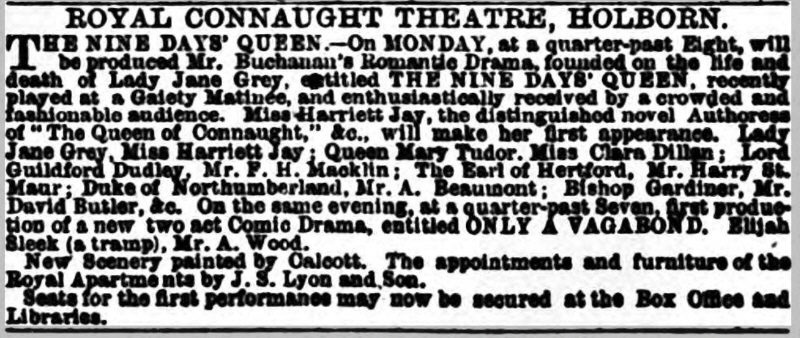
Mr. Robert Buchanan’s poetical play, “The Nine Days’ Queen,” originally produced a short time ago at a morning performance at the Gaiety Theatre, is shortly to be re-produced at the Royal Connaught Theatre, with new scenery by Mr. Albert Calcott, and an additional “tableau” introduced by the author representing the last farewell of Lady Jane Grey. This character will be resumed by Miss Harriett Jay, its original representative.
___
The Referee (13 February, 1881 - p.4)
|
|
|
|
 |
|
|
|
|
|
|
|
|
|
The Sheffield Daily Telegraph (15 February 1881 - p.2)
OUR PRIVATE LONDON
CORRESPONDENCE
_____
[EXCLUSIVELY TO THE “SHEFFIELD TELEGRAPH.”]
_____
LONDON, Monday Evening.
. . .
For to-night three novelties are promised to London playgoers. One called “Peggy” is described as a story from real life, dramatised by Mr. Joseph Mackay for the Royalty Theatre, where Miss Lawler, Miss Harriet Coveney, and Mr. Righton have been wasting their talents on a rubbishing burlesque. The second is Mr. Robert Buchanan’s “Nine Days’ Queen,” about which there was a good deal of talk in theatrical circles when it was tried at a Gaiety matinée some time ago. Put on the stage with a “scratch” company, and got through only with the continual aid of the prompter, the single afternoon performance gave one but an unfavourable impression of a play, which, if undertaken by a competent company, might hold the boards for some time. Miss Jay, the novelist, who made her first public appearance as an actress on that occasion, is again to take the part of Lady Jane Grey. Reminding one in appearance somewhat of the late Mrs. Rousby, she has a prepossessing stage appearance, but has not the genius to succeed without training and a knowledge which she has not yet acquired of the art of acting. The piece is to be mounted for another trial at the Connaught Theatre in Holborn, where I hear that the “Tambour Major” has not drawn very large audiences. The third novelty is the appearance of Mr. Booth as King Lear, a part which, excepting the veteran Mr. Creswick, no English actor of note has attempted in London for many years.
Miss Florence Marryat, whose father was the delight of many of us in our youthful days, is another authoress who is ambitious to become an actress. As a pleasant-looking, middle-aged woman, somewhat inclined to be self-assertive and stout, blunt of speech but kind of heart, she was the central character, and certainly the only perfectly natural personage in the play of “Her World Against a Lie,” which is a dramatic version of her novel. The piece, which was played on Saturday afternoon at the Adelphi, was inadequately performed, and the melodramatic and over-done acting of the principals made the want of interest in the dialogue and the improbabilities of the plot painfully apparent.
___
The Daily Telegraph (16 February, 1881 - p.3)
CONNAUGHT.
That a poetical historical play should be the immediate successor to “La Fille du Tambour Major,” and that an English drama in blank verse would so quickly thrust aside the lively tunes of a French comic opera, could hardly have been anticipated by the boldest forecaster of the future when the commodious theatre in Holborn, so curiously marked by chequered fortunes within the few years if its existence, passed under the management of Mr. Charles Morton. “The words of Mercury are harsh after the songs of Apollo,” exclaims the fantastical Spaniard Don Adriano de Armado as the curtain falls on Shakespeare’s comedy of “Love’s Labour’s Lost,” and his illustrative commentary immediately added, “You that way, we this way,” may be figuratively interpreted as indicating the existence of two distinct audiences whose tastes are to be gratified in opposite directions. Whatever may be the ultimate result of the entire change of programme so suddenly resolved upon at the Connaught, there is so far no reason to believe that the present playbill offers less attractive features than the one it has superseded. Mr. Robert Buchanan’s play of “The Nine Days’ Queen,” founded on Nicholas Rowe’s almost forgotten tragedy, illustrating the eventful life and early death of the unfortunate Lady Jane Grey, has already secured much favour from those who attend morning performances, and the transfer of a well-written and interesting historical drama to a stage where it can receive more careful and effective treatment ought to increase the chances of its obtaining a fair amount of popularity. Resuming her original character of the ill-fated heroine, Miss Harriett Jay, the well-known novelist, has now greatly improved on her earlier impersonation, and her earnest and impressive manner enables her to sway the sympathies of the spectators and give adequate effect to that stirring scene in which Lady Jane protests against her usurpation of the rights of Mary and Elizabeth. Mr. F. H. Macklin supplies an exceedingly intelligent rendering of Lord Guildford Dudley, and Mr. H. St. Maur appears to advantage as the Earl of Hertford. The earlier portion of the programmes is composed of a new and original two-act drama, also written by Mr. Robert Buchanan, and entitled “Only a Vagabond,” which at least serves the purpose of presenting in a prominent light the histrionic powers of Mr. A. Wood, an actor who achieves a marked success as the old tramp Elijah Sleek, whose peculiarities give a justification to the title of the piece, and whose stern defiance of the restrictions and bold denunciations of the hollow forms of society command apparently the fullest approval of the audience. In other respects the little drama, showing much originality of design, is fairly supported.
___
The Globe (17 February, 1881 - p.3)
CONNAUGHT THEATRE.
Mr. Robert Buchanan’s drama “The Nine Days’ Queen,” first produced a few weeks ago at a matinée at the Gaiety Theatre, now constitutes the regular entertainment at the Connaught. Miss Harriett Jay repeats her performance of Lady Jane Grey, and acts with increased power and with improved method. Mr. F. H. Macklin is now Lord Guildford Dudley, Mr. A Beaumont the Duke of Northumberland, and Mr. H. St. Maur the Earl of Hertford. The play is received with favour, and its tender termination tells very strongly upon the public. Its performance is prefaced by that of a two-act drama, entitled “Only a Vagabond,” founded upon one of Mr. Buchanan’s “London Poems.” Very simple is the story. A tramp returning in discreditably dirty attire from one of his customary rounds, finds his son, who is established as a London solicitor, on the point of committing a base action. After contriving to defeat this, and to restore happiness to a young lady who has trusted him, he doffs the conventional attire he has been induced temporarily to assume, and resumes his life of liberty. In the character of the old vagabond, Mr. A. Wood, an excellent comedian, of whom little is now seen, plays admirably. A performance finer in its line than his Elijah Sleek is not often witnessed.
|
|
|
 |
|
|
|
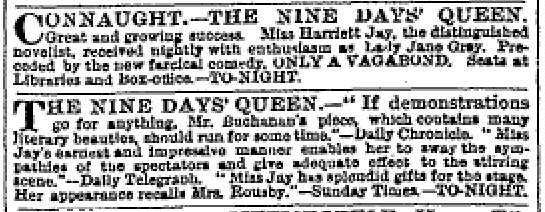
[Advert for The Nine Days’ Queen from The Times (19 February, 1881 - p.8).]
[Note:
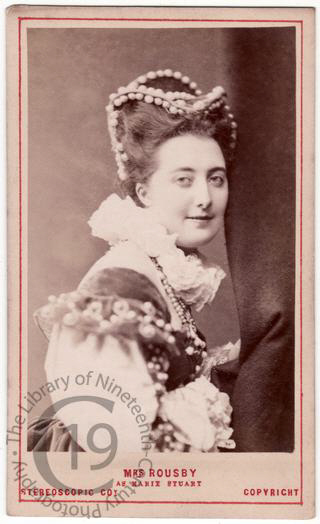
Since a couple of reviews mentioned the resemblance of Harriett Jay to Mrs. Rousby, I thought it might be helpful to add this photo of Mrs. Rousby here.]
|
|
|
 |
|
|
|
The Era (19 February, 1881 - p.8)
CONNAUGHT THEATRE.
Mr Robert Buchanan’s historical play A Nine Days’ Queen, recently produced at the Gaiety, and fully noticed in these columns, has now taken the place of La Fille du Tambour Major here, and seems likely to attract considerable attention, and to win deserved favour. Miss Harriet Jay resumes her original character as Lady Jane Grey, and is well supported by Mr F. H. Macklin as Lord Dudley, Mr H. St. Maur as Earl of Hertford, and other competent artists. The drama is preceded by a two-act piece called Only a Vagabond, also from the pen of Mr Buchanan. It is not very original, but it is thoroughly interesting; and, having in Mr Arthur Wood a most competent exponent of the most prominent and most important part, it should command success. The part referred to is that of Elijah Sleek, a man who returns to England from America very poor and very shabby, and, in a word, a vagabond. Elijah has a son—a highly respectable son—Thomas, who is by no means proud of him. Indeed, he has given him money to keep at a distance. He has, however, returned, and Thomas must put up with him as best he can. Soon the vagabond father becomes the instrument for the frustrating of the rascally scheme of the son. He is once more disgusted with respectability, and back he goes to his wandering, shiftless, vagabond life. Mr Wood’s acting throughout is admirable, and he gets good support at the hands of Messrs Beaumont (as the son Thomas), Bauer, and Bindloss; and Misses Letty Lind, and Clifton.
___
The Entr’acte (19 February, 1881 - p.13)
London Theatres.
CONNAUGHT.
A play by Mr. Buchanan, called, “A Nine Days’ Queen,” was produced at one of the Gaiety Theatre matinées some three weeks ago, and so much faith has the author in the piece, that he has taken it to the Connaught to make an experiment, and obtain a verdict from an average theatre-going public. The trial trip took place on Monday night, and the result was by no means unsatisfactory.
The story of “A Nine Days’ Queen” is made up of that historical episode in which Lady Jane Grey is tempted from comparative obscurity to claim the throne, and her subsequent martyrdom. The theme is a stirring one, and it may be said in favour of Mr. Buchanan’s play, that the interest is never allowed for a moment to flag. In the first scene we find that Lady Jane Grey is beloved by Lord Guildford Dudley, and by the Earl of Hertford. Each knows of the other’s passion, and agrees that he, of the twain who shall not be the fortunate suitor, shall uncomplainingly bear his lot. But Dudley’s father, the Duke of Northumberland, speaks in favour of his son to Lady Jane’s sire, the Duke of Suffolk, and the result is that Guildford Dudley is chosen as the affianced lover of the heroine. Hertford does not bear his disappointment with good grace, and when he knows that it is Northumberland’s intention to place Lady Jane upon the throne, does all in his power to frustrate the plan. He goes to the Princess Mary, acquaints her of the intended programme, and persuades her to claim the throne; a suggestion which the lady is not very loth to follow. From this time to the end Lady Jane Grey’s cause is a tottering one, and although a benign influence is introduced by the penitence of Hertford, who does all in his power to save the two young people against whom he has conspired, the tone of the play is decidedly lugubrious.
In the matter of acting “A Nine Days’ Queen” has fair though not great justice done to it. As a matter of course, the interest of the story is centred in Lady Jane Grey, whose representative is Miss Harriet Jay. This lady has good looks in her favour, and in the gentler phases of the play her acting is characterised by a tender sweetness. But she has no power; her walk and every gesture betoken delicacy of health, and her voice must be inaudible to the gallery folks. Her lack of power, however, is her greatest fault; she makes no mistakes in overacting, in trying to reach certain heights and failing; she does all she intends to do. As Lord Hertford, Mr. H. St. Maur shows to a greater advantage than he usually does. This is the most important male part of the piece, and it may be said, in spite of a few signs of insufficient strength given out by the actor, that he makes very good capital out of his material. Mr. F. H. Macklin, as Guildford Dudley, plays very creditably; Mr. A. Beaumont, as the Duke of Northumberland, is a little over-prim, but he gives a very good account of himself in a general way; Mr. Butler, as Gardiner, Bishop of Manchester, acquits himself well of an unpalatable kind of part, and Miss Clara Dillon, as Mary, gives that account of shrewishness to her impersonation as to assist in throwing up in necessary relief the gentleness and heroism of Lady Jane Grey.
The piece is fairly mounted, and there can be no doubt that it possesses an amount of interest which those people whose appetites are not thoroughly debauched by opera bouffe and leggy burlesque, can enjoy.
The opening piece here, “Only a Vagabond” is also founded on one of Mr. Buchanan’s poems, and it may be said to be ill-placed. A piece of two acts is not wanted as a prelude to the principal feature of the entertainment, which should terminate by eleven o’clock at the latest.
___
The Referee (20 February, 1881 - p.2)
The Connaught Theatre has got rid of the Daughter of the Tambour Major, and has gone from comic opera to historical drama. Robert Buchanan’s play, “The Nine Days’ Queen,” now occupies the boards, and is preceded by a little two-act piece, called “Only a Vagabond,” also by Mr. Buchanan, and founded on one of his poems descriptive of life in London. Mr. Arthur Wood represents, and that very ably, the Vagabond—a dirty, unclean person who tramps. Even in this vagabond state he has finer feelings of honesty and honour than has his son, who is established in business as a solicitor. The tramp, coming from one of his journeys, finds his son dabbling in something likely to bring him to disgrace. He stops his little game, and thus gives a fair lady the rights she has been in danger of losing. To do this he has donned respectable toggery. Having done it, he goes back to his rages, to his dirt, to his tramping, and to his liberty.
“The Nine Days’ Queen,” when I first saw it, was spoiled by the incompetency of some of the performers. Now I find Miss Jay, who represents Lady Jane Grey, much improved; and as her efforts are seconded by F. H. Macklin as Lord Guildford Dudley, and H. St. Maur as the Earl of Hartford, the play is worth seeing, and ought to enjoy a good run.
___
The Times (21 February, 1881 - p.4)
At the Connaught Theatre the entertainment is now entirely provided by Mr. Robert Buchanan. The evening opens with a play founded on one of Mr. Buchanan’s poems, in which a ne’er-do-well father, excellently played by Mr. Wood, shows his poetical superiority over a self-seeking and worldly son; and next comes the principal drama of the evening, the Nine Days’ Queen, a romantic play which tells the story of the short and unfortunate reign of the Lady Jane Grey. The play was produced at the Gaiety quite recently. As presented at the Connaught it is a series of effective tableaux, which tell with simplicity and force one of the most touching stories in English history. Miss Harriett Jay sympathetically represents the innocent usurper, and Mr. F. H. Macklin gives a manly impersonation of her husband. Miss Dillon as the persecutrix, Mary, and Mr. Edward Butler as Gardiner, the cruel Bishop of Winchester, earn the compliment of hearty hisses from the gallery.
___
The Standard (21 February, 1881 - p.3)
CONNAUGHT THEATRE.—Mr. Robert Buchanan’s poetical play The Nine Days’ Queen, which was noticed on its recent production at a Gaiety matinée, has been transferred to the Connaught Theatre, where the advantages of constant repetition bring out the points more favourably than they were brought out originally, notwithstanding that the Gaiety performance won considerable approbation. Experience of the stage strengthens Miss Harriet Jay’s representation of the Royal heroine, and Mr. Macklin’s assistance is of value. Only a Vagabond, also written by Mr. Buchanan, shows the author’s ability in a very different vein, and provides a character to which that clever actor Mr. A. Wood does ample justice.
___
The Otago Witness (New Zealand) (26 February, 1881 - p.20)
Robert Buchanan’s four-act play of “The Nine Days’ Queen,” which is founded on the life and death of Lady Jane Grey, was produced at the Gaiety, London, on December 22nd. Miss Harriet Jay was not a success in the principal role. Serious tragedy is evidently beyond her powers. The play was a failure.
___
The Clerkenwell Press (12 March, 1881 - p.3)
CONNAUGHT THEATRE.
THE “Nine Days’ Queen,” which is now drawing good houses at this theatre, is a romantic drama, illustrating a period in English History replete with material fashionable to the dramatist. The pitiful history and fate of the gentle, loving, pious, and much lamented Lady Jane Gray is the theme on which Mr. Robert Buchanan, a poet of considerable renown, has founded a drama touching in interest, striking in incident, and highly poetical in sentiment. The play opens with a very charming picture of peasants and “Queen of the May” in the Duke of Suffolk’s gardens at East Sheen. The plot begins with the successful wooing of Lady Jane by Guildford Dudley, son of the ambitious Duke of Northumberland, the detested lord who was instrumental in placing Jane on the soon after vacant throne. The young Lord Hertford arrives too late to declare his passion for the sweet Princess, and in bitterness of disappointment shows very debased feelings by savagely cursing the lovers as the act closes. It may be well here, before proceeding further with the engaging story of the plot, to note that the author makes “little pretension to historical accuracy,” which is nothing usual with dramatists, for the effect necessary to a stage play could very seldom be obtained if fact were too faithfully adhered to. License, therefore, is doubtless claimed for representing Guildford as the most noble character in the piece, a worthy partner, in fact, to such a beautiful and accomplished wife, which history tells us is far from truthful. We are introduced to Mary in the second act, engaged in Romish devotions, and Hertford, the disappointed suitor, is made the bearer to her of the warning which deprives Jane’s party of her capture. Lady Jane is apprised of Edward’s death, and forcibly persuaded to claim his crown. Subsequently she and her husband suffer arrest outside the Tower gates, as they learn, at the same time, through Hertford’s treachery. An effective scene follows, when Jane pleads for life to Mary, ending in that heartless woman granting a pardon on condition, as Jane soon after discovers, that “she adjures the faith heretical and swears allegiance to the Church of Rome,” which, as she declines the terms, does not save her from the headman’s axe, which is the ending of the play. So it will be seen a succession of episodes are well united into the continuity and coherency necessary to a dramatic poem. The spectator is never led away by bye plot, all being interwoven in the main thread of the story. The play could hardly be said to be of strong situations, still it abounds in effective scenes and tableaux well calculated to enlist the emotions and sympathies of an audience. A great deal might be said in favour of Miss Harriet Jay’s finished portrayal of the lovely heroine. In the first place, she is peculiarly suited physically for it. She appears to be just the soft, modest, patient and graceful girl we imagine that hapless maiden to have been. Her beauty, her innocence, her tenderness, and her piety are all in turn set forth, and it is easy to imagine her the “combination of a scholar’s learning to a woman’s wit.” Nor is Miss Jay in any respect deficient in historic ability for so important a character; her performance throughout showed signs of ripe cultivation of rare natural endowments. In the scenes where she swoons on hearing she is to be made a queen, where she takes her last farewell of Guildford, and where she pleads mercy of Mary, especially, there are powers displayed of a very high order of dramatic excellence indeed, and talents which would lead us to expect that this far from unsuccessful novelist may soon acquire a greater renown as an actress as well. Miss Jay is supported by Mr. F. H. Macklin, who imparts an air of true nobility to his picturesque character of Lord Guildford Dudley, Mr. H. St. Maur, who does not allow the part of Lord Hertford to lose any obtainable points, and a thoroughly efficient and well selected company. The “Nine Days’ Queen” is preceded by “Only a Vagabond,” a comedy drama, founded on one of Mr. Buchanan’s “London Poems,” in which Mr. Langford produces considerable merriment as an old tramp who turns up, to the chagrin of his son, an attorney.
___
The Daily News (14 March, 1881 - p.2)
The public announcement of the management of the Connaught Theatre that they have been compelled to withdraw Mr. Robert Buchanan’s historical play, “The Nine Days Queen,” “in spite of its growing popularity” owing to “a mandate of the Lord Chamberlain commanding the immediate erection of a wall between the stage and auditorium,” certainly seems at first sight to indicate a singularly cruel and capricious exercise of arbitrary power. Dramatic success in these days is surely difficult enough, but that the public should no sooner exhibit a growing desire to see Mr. Buchanan’s play than a despotic official should step in and order it to be immured, as it were alive, after the reputed fashion of punishing rebellious nuns in barbarous ages, is a piece of news that seems calculated to send a thrill of horror through the play-going world. Mr. Irving, in one of his dramatic essays, has reminded us that the spectator’s imagination is called upon to supply a “fourth wall” to all three-sided rooms represented on the stage; but nobody, we believe, has ever yet suggested that erecting a solid mass of brickwork between the stage and the auditorium would be other than an inconvenient arrangement, unless it were for those persons of miraculous powers of vision incidentally referred to by Mr. Weller while giving evidence in the celebrated cause of “Bardell v. Pickwick.” The case, however, is, we are glad to say, not so bad as it appears. What the Lord Chamberlain has ordered is, that a wall shall be erected on each side of the stage in the place of the mere partition set up when this house was suddenly converted from a circus into a theatre. The need of such an erection as a matter of precaution against the rapid spread of fire is generally acknowledged; and we believe the necessity for this improvement has in this instance been urged without any unreasonable precipitancy on the part of the Lord Chamberlain’s Office.
___
Glasgow Herald (14 March, 1881 - p.7)
MUSIC AND THE DRAMA.
_____
(FROM OUR OWN CORRESPONDENT.)
_____
London, Sunday Night.
. . .
The last performance of Mr Robert Buchanan’s “The Nine Days’ Queen” was given at the Connaught Theatre yesterday evening, the run having been broken partly because the Lord Chamberlain has ordered the immediate erection of a wall between the stage and the auditorium, partly because Mr Charles Bernard was unwilling longer to postpone Miss Harriet Jay’s appearance at the Gaiety Theatre, Glasgow. “The Nine Days’ Queen” will, however, it is stated, be reproduced in the English metropolis in the course of the London summer season.
___
The Scotsman (22 March, 1881 - p.4)
GLASGOW THEATRES. — Last night, Mr Buchanan’s new play, “The Nine Days’ Queen,” was produced, for the first time in Glasgow, at the Gaiety Theatre. Miss Harriet Jay, the authoress of several novels, appeared as Lady Jane Grey, and had a good reception, being twice recalled. She was, however, indifferently supported, particularly in one important character, to whose aid the prompter was too frequently in request.
___
Glasgow Herald (22 March, 1881)
THE THEATRES.
_____
GAIETY—“THE NINE DAYS’ QUEEN.”
Mr Robert Buchanan’s poetical drama “The Nine Days’ Queen” was produced at the Gaiety Theatre last evening. The audience was not as large as might have been wished, especially when it is remembered that the author is a Glasgow man, although now a citizen of the world, and that the play served to introduce Miss Harriet Jay, a young novelist, who has many readers, and an actress of whom report has said some flattering things. When “The Nine Days’ Queen” was first produced at the London Gaiety in December last, we referred to it at some length. Now that the drama has been brought to our own doors, it may be interesting again to indicate the general lines upon which it proceeds. When the play opens the death of Edward VI. is near at hand. The first act is carried through in the gardens attached to the residence of the Duke of Suffolk, who, in anticipation of the vacant throne, takes counsel with the Duke of Northumberland as to how the accession of Mary may best be prevented. They come to the conclusion that the most effective way of doing so is to place Lady Jane Grey on the throne, and it is part of their compact that this lady (the daughter of Suffolk) shall be given in marriage to Northumberland’s son, Lord Guildford Dudley. Only the matrimonial portion of their scheme is at first made known, and as the prospective union is entirely agreeable to the young people, the betrothal becomes the subject of general rejoicing. The Earl of Hertford, however, is also in love with Lady Jane, and when he learns that Dudley has been preferred, he concludes that that nobleman has wronged him, and the first act closes upon an outburst of his rage and jealousy. In the second act we are introduced to May’s oratory. Hertford, riding in hot haste from London, informs her of the death of Edward VI., and also acquaints her with the plot to prevent her accession to the throne. At his instigation she takes flight, and thus escapes from Northumberland’s emissaries who have been sent to seize her. Meanwhile the plot proceeds, and in the Palace of Westminster, Northumberland and Suffolk intimate to Lady Jane the elevation reserved for her. In a powerful scene Lady Jane rejects the crown, but her protestations are disregarded. She is proclaimed Queen, and falls fainting to the ground, while the assembled nobles render homage. In the third act Mary is in power, and the order is given for the arrest of Lady Jane; while the fourth act is chiefly taken up with an interview between the Queen and her prisoner, the latter being offered not only her own life, but that of her consort Dudley, if only she will renounce the Protestant faith. This she refuses to do. She even declines to see Dudley before their execution, since “an interview would only disturb the holy tranquillity with which they had prepared themselves for death.” The curtain falls on the tragic denouement. Mr Buchanan frankly acknowledges that he does not lay claim to historical accuracy, and that he has made free use of Nicholas Rowe’s play on the same subject. The poetical treatment of the drama is, of course, Mr Buchanan’s own, and the spirit he has infused into it is essentially tender and elevated. Poetic charm and dignity are the characteristics of the musical lines, which gain in flowing grace as spoken by Miss Jay. With a good figure and an expressive face, Miss Jay has also a sympathetic voice; but she still lacks stage experience, and in the more impassioned scenes we miss the needful tragic force. In the opening May-day rejoicings, before the young life of Lady Jane is shadowed by the crown, Miss Jay’s tuneful voice and sunny manner are in finest keeping with the situation; it is only in the later scenes, clouded by greatness, that we think the actress somewhat too careful in the exercise of her powers. The company brought together to support Miss Jay is not a first-class one, and the voice of the prompter was heard too frequently in the earlier scenes. “The Nine Days’ Queen” will be continued during the week.
|
|
|
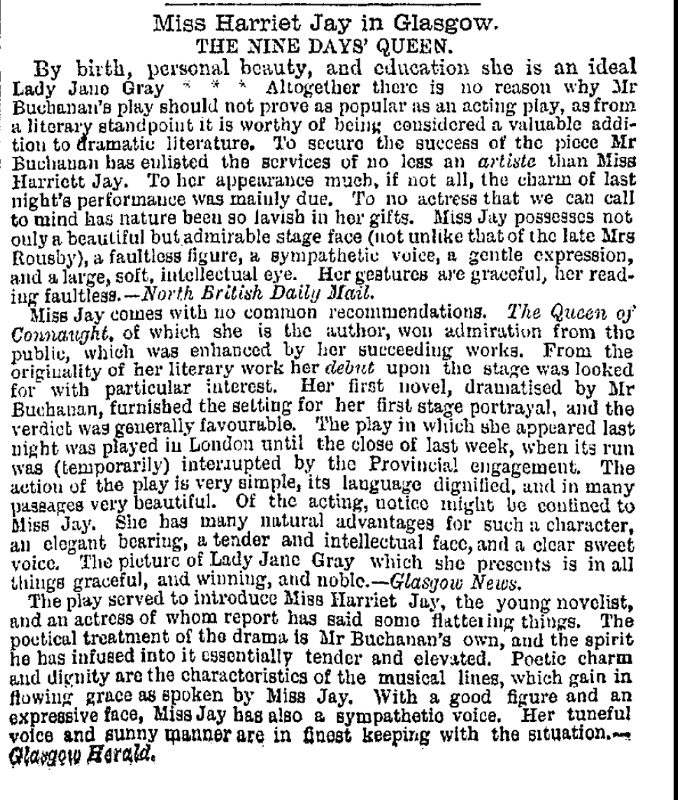 |
|
|
|
|
[Press notices of Harriett Jay in the Glasgow production of The Nine Days’ Queen from The Era (26 March, 1881).]
___
The Oban Times (26 March, 1881 - p.6)
THE COMING ACTRESS.
In view of the appearance in Glasgow to-night at the Gaiety Theatre of the gifted young lady who is best known to the world as the authoress of that famous novel, “The Queen of Connaught,” a few further particulars that are not yet generally known may interest our readers. Miss Harriet Jay was born in the neighbourhood of London in 1857. When a child of nine or ten she became an inmate of the house of her brother-in-law—Mr Robert Buchanan, the poet—and from that day forward has been the companion of the erratic poet’s wanderings. Her surroundings throughout have been romantic as well as literary. It is no mere conjecture which assures us that, apart from her own fine gifts, she is the centre of much that is best in Mr Buchanan’s poetry. She is the “Clari” of many well-known lyrics—“Clari in the Well,” for example, and “Will-o’-the-Wisp, a Ballad written for Clari in a Stormy Night,” which first appeared in Good Words—
And now you’ve the reason that Clari is gay,
As a bird on the bough or a brooklet at play;
And now you’ve the reason why Clari is bright,
Why she smiles all the day and is glad all the night;
For the light having entered her bosom remains,
Darts fire to her glances and warmth thro’ her veins,
Makes her tricksy and merry, yet full of the power
Of the wind and the rain, and the sun and the shower;
Half wise in the ways of the world, and half simple,
As sly as—a kiss is, as deep as—a dimple!
A spirit that sings like a bird on a tree,—
“I love my love, and my love loves me!”
Elsewhere, in the “Asrai,” she appears again:—
When Clari, from her chamber overhead,
Her bright hair glowing brighter from the brush,
Steals in, and peeps!
She commenced to write when very young, and her first effusions were in verse. It was not, however, until Mr Buchanan went to reside in Ireland, occupying a lonely lodge in one of the wildest parts of Connaught, that the young authoress began to discover her true bent. For years she studied Irish character. The result was at last seen in her first story, “The Queen of Connaught”—a book which took the world by surprise, and ran through many editions. Of the thousands who read it, not one guessed it to be the work of a young girl. It was attributed, at various times, to Mr Charles Reade, to a popular landed proprietor, and to a renegade Catholic priest. The very language was startling and fearless in its naturalism. “It has about it a strange fascination,” said the critic of the Morning Post; “quite unlike any other tale that has ever appeared.” The first success was followed rapidly by “The Dark Colleen,” a tale of deeper pathos and more perfect finish, containing descriptions that could scarcely be surpassed. From that time Miss Jay’s position as a novelist was assured. Little more than a year ago she resolved to gratify another ambition and go upon the stage, chiefly to realise her own heroines, and also those of Mr Buchanan’s play’s. For many months she acted in the country under another name; and then, when her novitiate was over, she appeared in London. Her success soon came, when, after a preliminary trial under disheartening conditions, “The Nine Days’ Queen” was produced, with Miss Jay in the title role. The chief metropolitan critics declared that it was many a day since such a face and form had appeared on the stage; and by more than one she was compared to the late Mrs Rousby. She appears to be fortunate in her choice of a first part. By birth, personal beauty, and education, she is an ideal Lady Jane Grey. The London press are unanimous in pronouncing Mr Buchanan’s play one of the most stirring dramas of recent years. One scene, that where Lady Jane refuses the crown in presence of the dead body of Edward VI., is said to have perfectly electrified the London audiences. It is to be hoped that before Miss Jay leaves Glasgow she may appear in the title role of the celebrated Olympic drama founded by Mr Buchanan on her own “Queen of Connaught”—a drama that ran for many months in London, but which has not yet been seen in Glasgow.—Daily Mail.
___
The Morning Post (26 September, 1881)
It is reported that Mr. Robert Buchanan’s historical play “A Nine Days’ Queen,” will be translated into French for Madlle. Sarah Bernhardt, who intends to play the heroine.
___
The Glasgow Herald (4 December, 1882 - p.8)
Miss Harriet Jay revived at the Gaiety matinee on Wednesday last Mr Robert Buchanan’s “The Nine-Day’s Queen.” A full description of this historical play was given when it was first produced some two or three years ago. Since then Miss Harriet Jay has gained further experience in her art, and the improvement upon some of her earlier efforts is manifest. In those situations in which dramatic force is necessary the lady’s physical means are not, perhaps, yet quite equal to her intentions; but in the quieter scenes, where the gentle touch of the womanly hand is needed, Miss Harriet Jay succeeded admirably. She was very cordially received by her audience, and was fairly well supported by Mr Beerbohm Tree as the Earl of Hertford, by Mr Courtney Thorpe as Lord Guildford Dudley, and by Misses Erskine and Letty Lind, Messrs Beaumont, Hatton, Fisher, and Nye in other characters.
___
The Illustrated London News (9 December, 1882 - p.6)
THE PLAYHOUSES.
. . .
For upwards of a quarter of a century books about the play were as useless as books about poetry, or professing to contain it. Recently a gentle reaction has set in, and, though the majority of our dramatic historians are not wholly to be trusted, it is, at any rate, a sign of the times that the drama is still to be considered literature, and to be chronicled as one of the fine arts. One of the best, most candid, and least bumptious of recent dramatic volumes is called “English Dramatists of To-day,” by William Archer. It has one good quality; it is sincere. With many of Mr. Archer’s conclusions I wholly differ, but he has given thought and intelligence to his study. Still the book is ludicrously incomplete. I see no sufficient tribute of the merit as a dramatist of Dr. Westland Marston, and no mention whatever of such purely literary dramatists as Mr. Frank Marshall, the clever lady who writes under the name of Ross Niel, or of Mr. Robert Buchanan. This last is the strangest omission of all, since Mr. Buchanan’s work should surely have been considered by an historian who has such a horror of vulgarity, puns, burlesque and frivolity, and who deplores the absence of literature in the drama. Mr. Robert Buchanan is, no doubt, extremely sensitive on the matter of criticism, and his published manifestoes against the critics may have alarmed Mr. Archer into discreet silence; but for all that his plays are too good to be ignored. One of the best of them is “The Nine Days’ Queen,” and it will live, which is more than can be said of many modern poetical plays. It was revived recently at the Gaiety—the favourite home of matinées—and the character of Lady Jane Grey was once more undertaken by Miss Harriett Jay, a picturesque lady and an actress of considerable intelligence, who has been working steadily at perfecting herself in her art. The revival, apparently, gave considerable satisfaction, and Miss Jay was supported by Miss R. Erskine, Mr. Beerbohm Tree, and Mr. Courtenay Thorpe, who are facile and experienced.
C. S.
___
[I have found no evidence that Sarah Bernhardt ever played Lady Jane Grey and I’ve come across no other productions of The Nine Days’ Queen. Buchanan (in a letter of April 1881) tried to interest Augustin Daly in an American production of the play. Three years later, during his American visit, he made another attempt according to an interview in the New York Daily Tribune. However, despite the following item, no American production was forthcoming.]
The Salt Lake Daily Tribune (12 October, 1884)
Robert Buchanan, dramatic author, expects to produce his new play entitled ‘Nine Days A Queen,’ at the Madison Square shortly, with Robert Mantell in the leading part.
___
[And finally, a couple of references to another possible American production of The Nine Days’ Queen which also seems to have come to nothing.]
The People (30 May, 1897 - p.4)
Miss Julia Arthur is said to be going to appear in America in Mrs. Burnett’s “A Lady of Quality” and in Mr. Robert Buchanan’s “A Nine Days’ Queen.” Presumably she is to “star.” At the Lyceum she has made an excellent impression. I thought her Imogen and her Lady Anne excellent. “A Nine Days’ Queen” has Lady Jane Grey for its heroine. I wonder no one has revived Mr. Henry Hamilton’s “A Shadow Sceptre,” which deals with the same sympathetic subject. There are several old plays about Lady Jane Grey.
___
Waterloo Daily Courier (Iowa) (23 September, 1897)
Julia Arthur will present next season Robert Buchanan’s “A Nine Days’ Queen,” in addition to Mrs. Frances Hodgson Burnett’s “A Lady of Quality.”
_____
Next: The Mormons: or St. Abe and his Seven Wives (1881)
Back to the Bibliography or the Plays or Harriett Jay Theatre Reviews
|
|