 |
|
|
Play List: 4. Corinne 7. The Mormons 9. Lucy Brandon 10. Storm-Beaten 11. Lady Clare 13. Bachelors 14. Constance 15. Lottie 16. Agnes 17. Alone in London 18. Sophia 19. Fascination 20. The Blue Bells of Scotland 21. Partners 24. Angelina! 25. The Old Home 26. A Man’s Shadow 27. Theodora 29. Clarissa 30. Miss Tomboy 32. Sweet Nancy 33. The English Rose 36. Marmion 37. The Gifted Lady 38. The Trumpet Call 39. Squire Kate 40. The White Rose 42. The Black Domino 44. The Charlatan 45. Dick Sheridan 47. Lady Gladys 48. The Strange Adventures of Miss Brown 49. The Romance of the Shopwalker 52. Two Little Maids from School ___ |
|
|
|
ROBERT WILLIAMS BUCHANAN (1841 - 1901) |
|
|
|
|
|
|
|
|
|
THEATRE REVIEWS 50. The Wanderer from Venus (1896)
The Wanderer from Venus: or, Twenty-four Hours with an Angel There is a letter in The Era (13 June, 1896) from Buchanan complaining about one critic’s response to the play. Buchanan also explained his reasons for producing the play in Croydon, rather than the West End, in ‘An Interesting Experiment’, published in The Theatre (1, July, 1896). (Harriett Jay played the role of Dora.)
The Era (16 May, 1896) A NEW and original play, written by Robert Buchanan and Charles Marlowe, described as a fanciful comedy of modern life, will be produced at the Grand Theatre and Opera House, Croydon, on Monday, June 8th, and will be played there during the week. The leading female character will be created by Miss Kate Rorke, who will be assisted by a company of London artists. New scenery is being prepared by Mr Hall. It will be remembered that Mr Beerbohm Tree and the Haymarket company opened the beautiful new Croydon theatre with Trilby, and the experiment was so successful that another record, the first production of an important original work there, will now be made. ___
The Era (23 May, 1896 - p.10) THE new fanciful comedy, by Messrs Robert Buchanan and Charles Marlowe, which will be produced on June 8th at the Grand Theatre, Croydon, is now in active rehearsal. Miss Kate Rorke will sustain the leading rôle, and also engaged are Miss Vera Beringer, Miss Louisa Gourlay, Mr Oswald Yorke, Mr John Beauchamp, and Mr G. W. Anson. The new scenery is being painted by Mr Hall, and the mechanical effects are being superintended by Mr Dando. ___
The People (24 May, 1896 - p.4) A new play by Mr. Robert Buchanan and Miss Harriett Jay, is to be produced at Croydon in June, and among those undertaking rôles in it will be Miss Kate Rorke, Miss Vera Beringer, and Mr. John Beauchamp. The representation will have, practically, the interest attaching to a London first night, and I have no doubt that it will tempt many metropolitan playgoers down to Croydon, which is within such easy distance by rail. I should not be surprised if Croydon came to be a favourite place for trial performances of plays intended ultimately for London. ___
The Referee (31 May, 1896 - p.2) The new farcical comedy in three acts, written by Robert Buchanan and “Charles Marlowe”—which his front name is Harriett—and to be produced on Monday, June 8, at the Grand Theatre, Croydon, still bears the curious title “A Wanderer from Venus,” and, as some mechanical effects by Dando are promised, local playgoers will do well to be prepared for the playing of the game which used to be known among schoolboys as “Flying Angels.” The representation will engage the services of Messrs. Oswald Yorke, G. W. Anson, and J. Beauchamp, and the Misses Eva Moore, Vera Beringer, Louisa Gourlay, and Kate Rorke, the latter, who will be called Stella, being, I presume, “the Wanderer.” The scene of action will be the village of Moonbury, supposed to be within a few miles of Westminster Abbey and the Houses of Parliament. ___
The Era (6 June, 1896 - p.10) MR TOM CRAVEN will produce at the new Grand Theatre and Opera House, Croydon, on Monday, a new and original fanciful comedy, written by Robert Buchanan and Charles Marlowe, entitled The Wanderer from Venus. The cast will include Miss Kate Rorke, Miss Vera Beringer, Miss Florence Leclercq, Miss Louise Gourlay, Mr G. W. Anson, Mr John Beauchamp, and Mr Oswald Yorke. ___
The Daily Telegraph (9 June, 1896 - p.5) NEW GRAND THEATRE, CROYDON. Even if Mr. W. S. Gilbert had never put pen to “Pygmalion and Galatea,” and Mr. Harry Paulton had refrained from twisting the same theme to a purpose purely farcical in the three diverting acts of “Niobe,” one would have found but poor entertainment in the “fanciful comedy,” which at Croydon, last evening, saw the footlights for the first time. As it is, “The Wanderer from Venus” comes as a very faint echo of plays wherein a similar idea has been worked out to ends incomparably happier. Surely Messrs. Robert Buchanan and “Charles Marlowe,” practised writers for the stage as they are, must have been nodding when they turned their hands to such a hash of well-worn material. Dramatists make mistakes, we are well aware, and Mr. Buchanan has gone astray in his time like the rest. But he has rarely allowed his choice to fall upon a scheme quite as profitless as that which was submitted to Croydon playgoers last night. The new Galatea does not spring from a block of marble. She flutters down from the planet Venus upon a sleepy country village at the call of a foolish young gentleman who dabbles in astronomy and firmly believes in the possibility of entertaining an angel unawares. When Stella has made her appearance, clad in gauzy green raiment, she babbles in blank verse very much after the manner of Mr. Gilbert’s statuesque heroine, she innocently flings her white arms round the silly youth who has inveigled her to earth, and she even hangs upon the neck of the matter-of-fact village doctor, who regards her as a pretty lunatic. As both star-gazer and medico are betrothed to the daughters of the local vicar, it can well be imagined that a crop of lovers’ quarrels speedily spring up round the ethereal stranger who wanders at will among the gooseberry bushes in crackbrained young Somerville’s garden. There is but one way out of the difficulty. The superfluous Stella must return to the distant star whence she came; and this she finally does, to the relief of the young ladies, who no longer have reason to harbour jealous doubts of the fidelity of their respective swains. With all her art, Miss Kate Rorke could not make Stella a worthy successor to Galatea and Niobe. What the actress was able to do for the play in the way of soft utterance and gracious gesture she did right royally; while such capable artists as Miss Eva Moore, Mr. John Beauchamp, and Mr. G. W. Anson were also among those who worked for the common good. But “The Wanderer from Venus” was not to be redeemed by the sturdiest of efforts; and although a well-disposed audience greeted the damsel in a spirit of constant kindliness, it is impossible to foresee a future for “Stella,” save perhaps in the playhouses that flourish on her own planet. ___
The Stage (11 June, 1896 - p.12) THE GRAND, CROYDON. On Monday, June 8, 1896, a new and original “fanciful comedy,” in three acts, by Robert Buchanan and “Charles Marlowe,” was produced, entitled:— The Wanderer from Venus; or Twenty-four Hours with an Angel. Claude Somerville ... ... Mr. Oswald York Whatever the ultimate verdict is as to this work from the pens of these productive writers, it cannot be denied that the large and fashionable audience that assembled to give greeting to the new work was throughout most friendly, if not demonstrative. It can hardly also be denied, however, that though the authors have worked upon a theme that in other guises has already been well nigh used up. Suggestions of Pygmalion and Galatea and Niobe were on the lips of all experienced playgoers, and it is unfortunate for the present collaborators that these two works should have preceded theirs, and, moreover, should also have been infinitely better both in story and treatment. The slight ringing of the changes in making the central figure descend from the heavens, instead of taking the form of a vivified statue, matters little; the ruling idea is the same, and the story runs on similar lines. The handling of the theme, too, shows a want of decision, and it would have been much better to make the piece either broadly farcical or entirely poetic, the former for choice, as there is little doubt that the subject is one that lends itself much more to humorous than to serious treatment. On one point the authors may certainly be congratulated, and that is in the interpretation of their work, the cast being one that could not well be improved, although most of the artists cannot be said to have had any great scope for the exercise of their abilities. The play opens in the village of Moonbury, near London, where we find Claude Somerville, an ardent and enthusiastic astronomer, and John Middleton, a matter-of-fact country doctor, engaged to the two daughters of the vicar, Dr. Dullamere. After a talk of more or less worldly affairs the conversation naturally turns to astronomy and upon Claude’s fixed idea that this earth is only one of many planets that are inhabited, and that angels unawares may occasionally visit us on this sphere. The doctor pooh-poohs the notion, and enforces his conviction by material arguments, and after a short love scene with his fiancée, Dora, the young astronomer is left alone, and, after indulging in flights of fancy and meteoric rhapsodies, calls upon the planet Venus to come down. The answer is a charming visitant in the form of Stella, who, lightly clad in gauzy-green garments, flutters down from the heavens, and straightway makes innocent, yet dangerous love to the young enthusiast, at whose call she has left the realms above. In act two, the morning after, we naturally find that the presence of a young and charming “angel,” clad in diaphanous raiment, in the room of a bachelor about to become a Benedict, gives grounds for much uneasiness, and Somerville’s housekeeper is particularly forcible in her reasoning as to the undesirability of such a visitor. As, too, the charming Stella is none too constant in her innocent attentions, but when Claude is absent clings prettily to the village medico, it will be foreseen that the ground is prepared for the plentiful crop of lovers’ quarrels which eventually, and naturally, arise. The engagement between Claude and Dora is broken off. The Girton girl, Euphemia, with her up-to-date notions of man, does not, however, go to such extremes, but contents herself with the stipulation that, knowing such “goings on” must happen, they shall be carried out more under the rose. In the third act the ladies are still inexorable in their refusal to believe in the angelic visitor, whose liberal embracings of everything in the shape of man-kind still continue. Some fun is made when the ever-alluring Stella entices the doctor and the vicar to sit one on either side of her, and proceeds to deck their headgear with garlands of roses. Explanations eventually ensue between the lovers, and when the gentle spirit realises all the mischief of which she has been the innocent cause she is freed from a spell which binds her to the earth, has a timely recall to the planet Venus, and all ends with conventional bliss. ___
The Era (13 June, 1896) “THE WANDERER FROM VENUS.” A New and Original Fanciful Comedy, in Three Acts, Claude Somerville ... ... Mr OSWALD YORKE (FROM OUR OWN CORRESPONDENT.) The initial performance of Messrs Robert Buchanan and Charles Marlowe’s latest comedy, The Wanderer from Venus; or, Twenty-four Hours with an Angel, was given before a large audience on Monday last. The play is described by the authors as a “fanciful comedy of modern life,” and the appellation is happily chosen, as a more fanciful comedy it is difficult to imagine. The action of the play takes place at the village of Moonbury, near London, the scenes of acts one and two being laid in Claude Somerville’s apartments, which are presided over by a motherly old matron named Mrs Allgood. Act three takes place in the garden adjoining the house. Claude Somerville is a young man who is given to star-gazing, and whose soul soars to things ethereal and planetary possibilities. His friend, John Middleton, M.D., a rural doctor, is more matter-of-fact, and ridicules Claude’s lofty ideas. The two friends are betrothed to Dora and Euphemia, daughters of Dr. Dullamere, the vicar of Moonbury. Claude is carried away by his star-gazing and dreams of other worlds, and when left to himself, in his enthusiasm he calls upon the planets to send to him one of the beautiful beings his mind has conjured up. His prayer is answered, and a creature of entrancing beauty, robed in light drapery, appears upon the scene. She states that her name is Stella, and that she has winged her way from the planet Venus in answer to Claude’s fervent calls. From this startling commencement the chief incidents in the play proceed. Claude is soon deeply in love with the celestial being, and cannot resist her bewitching power of attraction. Stella, in her innocence, asks many naïf questions regarding doings on mother earth. Her astonishment is unbounded when the differences between the sexes, the marriage laws, and other interesting truths are explained to her. As her knowledge of earthly ways increases, so her mood changes; and in the place of the happy, light-hearted Stella of Venus, with no thought of evil or cares, we soon see the more earthly being with her varying passions, and with her love for Claude, which must not be checked by the thought of a rival. To such an extent does her passion carry her that she does not hesitate to hint that she would not stop at trifles to remove her rival, Dora, from her path. A bitter scene between Claude and Dora is watched by Stella, whose jealous passions are subdued by the grief of the latter. Stella then sees that Dora has a prior claim to Claude; her goodness overcomes her bad feelings, and she renounces her love for him. With the casting away of wicked, worldly thoughts, all her former gentleness returns, and she sees that earth is no place for her. Amidst a scene of reconciliation between Dora and Claude, she wings her way back to her planet home. The serious business is relieved by humorous scenes between Dr. Dullamere, Middleton, and Stella. The latter, not understanding the consternation she causes by her fascinating beauty, makes love indiscriminately to the doctor and the vicar, and a lively scene reaches a climax when Euphemia discovers the three together on a garden seat, the men decorated with flowers, and Stella’s head softly reclining on the vicar’s breast. Dora, Euphemia, and Mrs Allgood also cause amusement by their different ways of showing displeasure and indignation at the conduct of the “angel,” as Claude so aptly denominates his new-found love. The entire action of the play is supposed to take place within twenty-four hours. ___
The Era (13 June, 1896) THEATRICAL GOSSIP. . . . MISS VERA BERINGER was originally engaged for the part of Dora in Mr Buchanan’s play The Wanderer from Venus, but a minute or two before the curtain rose it was announced that she would be “unable” to appear, and that Miss Harriett Jay would replace her. As one or two portentous paragraphs have been penned, it should be stated that the rearrangement was made in perfect amity among all the parties. _____ . . . SO satisfied are the authors of The Wanderer from Venus with the results of its initial week at the New Grand Theatre, Croydon, that they have determined to send it on tour at once, with all the new scenery and effects, prior to its London production. In view of the large expense involved in the cast and in the production generally, only first-class towns can be visited, but a No. 2 company will be organised later on to visit the smaller theatres. ___
The Illustrated Sporting and Dramatic News (13 June, 1896 - p.18) |
|
|
|
 |
|
|
|
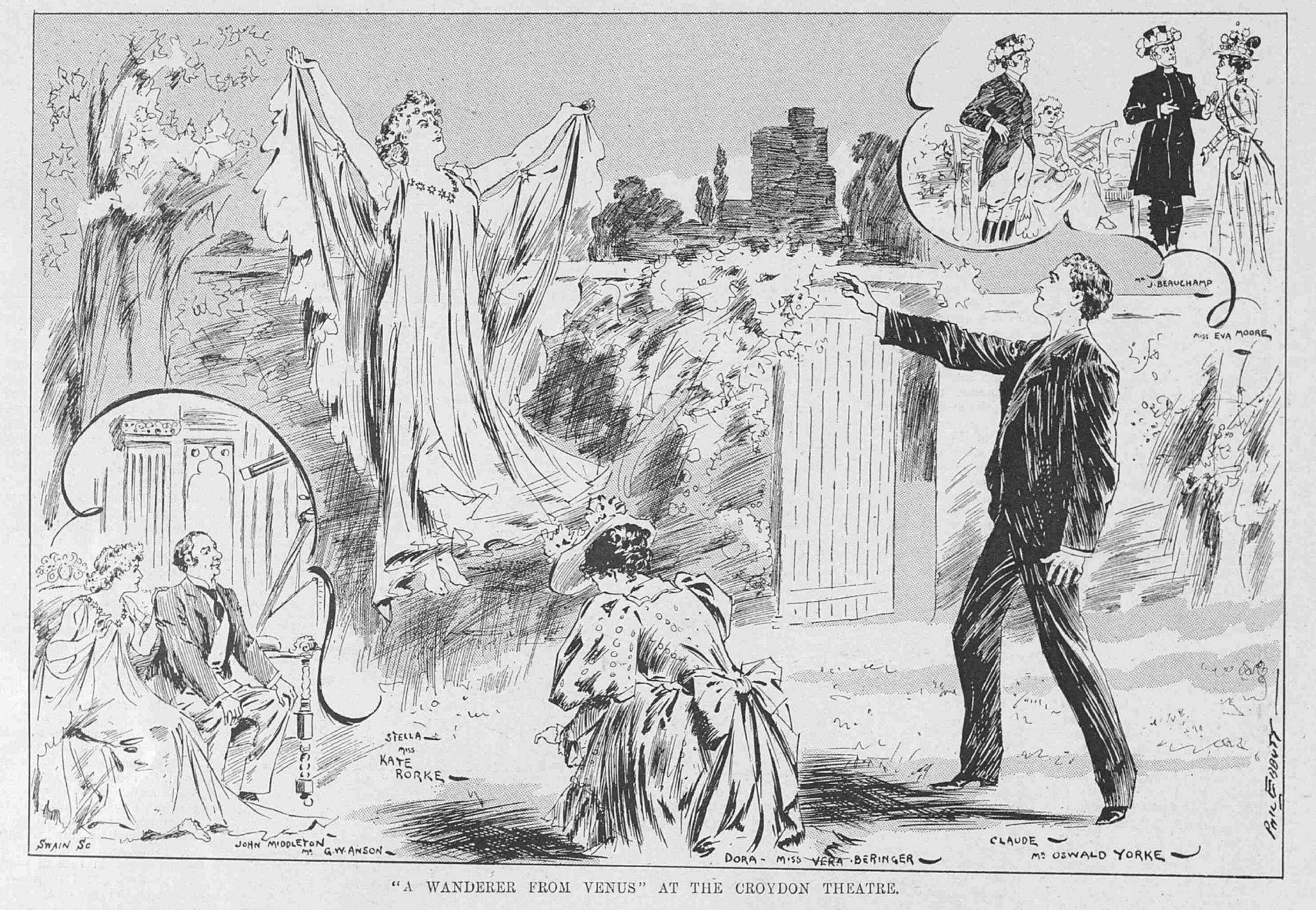
(p.28, 30) GRAND THEATRE, CROYDON. A FANCIFUL comedy by Mr. Robert Buchanan and “Mr. Charles Marlowe” has this week enjoyed a trial trip at the new and handsome Grand Theatre in Croydon and was evidently much enjoyed by its audience. As might perhaps have been guessed from its title, The Wanderer from Venus; or Twenty-four Hours with an Angel, the motive of the piece is distinctly akin to those of Pygmalion and Galatea and Niobe. A star-gazing lover while staring speculatively into the heavens invokes the descent of Venus, and his prayer is answered by the arrival on the scene of an angel named Stella attired somewhat after the meagre fashion affected by the angelic host according to our illustration of supernatural fiction. Of course Stella falls in love, and equally of course she angelically thinks it quite unnecessary to conceal her feelings, the result being that she upsets various mundane rivals extremely before she returns to her native sphere. The sentiment of the prettily written but rather trite romance is perhaps fresher than its humour; but both will be found most effective by those play goers who know neither Gilbert nor Paulton. ___
The Sporting Times (13 June, 1896 - p.3) The Wanderer from Venus was produced at the pretty new theatre at Croydon last Monday night. No one seemed to have a particularly definite idea of the meaning of the title, because, as a rule, men wander to Venus and not from her. The play, written by Messrs. Robert Buchanan and “Charles Marlowe,” however, speedily developed itself into a sort of hash-up of Pygmalian and Niobe mixed. A young party comes down from the stars to spoon with a spoony astronomer, already engaged to the daughter of the Vicar of his parish. Of course there are mistakes, and ructions in consequence, and in the end the young party is sent back to headquarters again. Miss Kate Rorke made a lovely Stella, but her talents were wasted. The piece can have little chance of living. The first act is terribly dull and preachy, and though there are one or two intervals of fun, the whole play leaves upon the mind an impression of dulness. ___
The Referee (14 June, 1896 - p.2) DRAMATIC & MUSICAL GOSSIP. THE long arm of coincidence has been at it again, and Robert Buchanan and “Charles Marlowe,” whose front name is Harriet, in their “new and original” fanciful comedy, “The Wanderer from Venus,” produced before a very fine and large audience on Monday evening at the Grand Theatre, Croydon, have—quite by accident, of course—got on to the lines laid down, first by Mr. W. Gilbert in “Pygmalion and Galatea,” and afterwards by the Paultons in “Niobe.” The idea of “The Wanderer from Venus” is the idea of the other plays named, although in such trifling affairs as fun and fancy and feeling it is a long way inferior to both. It is generally conceded that great minds very often run in similar grooves, and that no doubt accounts for the fact that while in the past Gilbert’s Galatea in the person of Miss Madge Robertson was wont to ask of Chrysos, the art patron, in the person of Mr. Buckstone, “Are you a man?” doubting the fact when she compared his ugliness with Pygmalion’s “big brave eyes, fair face, and tender voice,” the Buchanan-Marlowe Stella—strange visitant from another world—is found in the present calling in question the manliness of a suburban doctor because in the matter of personal comeliness he is not to be compared to her “mash”—the young star-gazer at whose bidding she has come down from the skies. These little coincidences, as you all know, will occur in the best regulated comedies, be they of the fairy-fanciful sort or otherwise. The star-gazer of the story is Claude Somerville. He has a big telescope, but he never looks through it, preferring to make his astronomical observations with the naked eye. He is engaged to be married to a clergyman’s daughter, but he is ever thinking of a sweet little angel who he is quite sure is sitting up aloft waiting the opportunity to come down and comfort him, and by him to be comforted. She comes at night and stays by him until the morning, flashing her diamonds and waving her gossamer wings, “designed by Karl, and executed by Messrs. Nathan.” She asks all manner of artless questions, and about breakfast time, when Claude’s landlady comes in and tells him she is not disposed to have an angel pottering about her place “promiskus like,” he, remembering that his strange visitor has told him how she has in the planet Venus been living on dewdrops, sends her out into the garden without shoes or stockings and looks on wonderingly when she comes in again to take very kindly to such mundane things as cold milk and macaroons. Then there are ructions, for the star-gazer’s sweetheart appears on the scene, and, seeing how matters stand, says good-bye for ever; while the ugly doctor’s lady-love—a Girton girl who has found him with the angel’s arms around his neck—pooh-poohs his excuse about a medical examination, coolly informing him that she accepted him because she knew he came of a healthy stock; that she knows that all men by nature are polygamists; and that she cannot tolerate a fellow who parades his imperfections under her very nose. The angel in the end, I believe, goes back whence she came, and there is peace again on earth, or so much of it as is represented by Claude Somerville’s home at Moonbury. Miss Kate Rorke made a very pretty angel, but her good and earnest work was wasted; and I could not get up any interest in the Claude Somerville of Mr. Oswald Yorke, the doctor of Mr. G. W. Anson, the clergyman of Mr. J. Beauchamp, or the clergyman’s fair daughters impersonated by Miss Harriet Jay and Miss Eva Moore. “The Wanderer from Venus” may possibly wander with some profit in the provinces. The Croydon crowd appeared to be delighted with her. But what will London say? ___
The People (14 June, 1896 - p.6) GRAND, CROYDON. Mingled with the feelings of congratulation at Mr. Tom Craven’s enterprise in obtaining a brand new “first night” of an important play for the magnificent theatre recently opened, many who journeyed to Croydon to assist at the function experienced a sense of disappointment at the character of Robert Buchanan and Charles Marlowe’s latest effort. That “The Wanderer from Venus: or, Twenty-four Hours with an Angel” is cleverly written so far as mere words are concerned it is, perhaps, unnecessary to state, but the gifted authors in the construction of their “new and original fanciful comedy” not only appear to have been considerably influenced by previous attempts in a similar direction, but to have been at war with themselves as to whether their comedy should be farcical or serious. A compromise seems to have resulted—the play begins with every prospect of much laughter and ends in sadness, if not in tears. Throughout the 3 acts perplexity was felt as to what the authors were really driving it, but when the curtain finally fell there was no mistaking the warmth of the reception accorded Miss Kate Rorke and the others who presented the play with such artistic completeness. The latest wanderer from Venus comes in response to a sentimental young stargazer, who, dabbling in astronomy, burns to know whether the planets are inhabited by sympathetic spirits. Stella flutters down at night in the scantiest attire into a village garden, finds her way to Claude Somerville through the open window, and, despite her celestial upbringing, soon experiences earthly love with desperate earnestness, but with a sufficient tinge of “otherworldliness” to lead to the throwing of innocent arms round the neck of country parson and local doctor alike. When the respectable old landlady finds this overnight addition in her lodger’s rooms she is, of course, immensely shocked, and is not alone in drawing the almost inevitable conclusion. That she is an angel none will believe, not even Claude’s fiancee, one of the parson’s pretty daughters, despite the fact that the wanderer takes bread and milk for the first time and seeks to question Claude on the difference between the sexes, a catechism which provoked the ironical laughter of the gods. However, hate is quickly acquired, and Stella’s heart turns against the unoffending maiden until feelings more in keeping with the heavenly spheres take possession of her, and in a scene full of power and pathos she surrenders her earthly love, and wings, for a time dull and heavy, now once more mount her into planetary space. In addition to Miss Rorke, who acted a difficult part with convincing earnestness, Mr. Oswald Yorke was equally successful in the role of the lover. Miss Eva Moore, Miss Harriett Jay (“Charles Marlowe”), who played at a moment’s notice, Miss L. Gourlay, and Messrs. G. W. Anson and J. Beauchamp added materially to the success of the play. It could not have been better acted, and the mounting was all that could be desired. ___
The Theatre (1 July, 1896) CROYDON has not yet been incorporated with London, and consequently the production at Mr. Tom Craven’s handsome new theatre situated there of a new play hardly comes within the scope of our metropolitan notices. A word, nevertheless, may be spared to The Wanderer from Venus, first performed at the Grand, Croydon, on June 8, inasmuch as the piece bears the sign-manual of two writers so well known as Mr. Robert Buchanan and “Charles Marlowe.” Not that, we fear, their new “fanciful comedy” is likely to add greatly to the fame of either, particularly as the ground it covers is already occupied, and occupied, we are constrained to say, to much better purpose. Had Pygmalion and Galatea never been written, one might be disposed to recognise in The Wanderer from Venus a certain measure of novelty. Unfortunately, as matters stand, we can only see in it a comparatively ineffective version of Mr. Gilbert’s brilliant work. And from this view even the efforts of a company including among its numbers Miss Kate Rorke, Miss Eva Moore, Miss Harriett Jay, Mr. G. W. Anson, and Mr. John Beauchamp have failed to convert us. ___
From Dramatic Opinions and Essays - Volume Two by George Bernard Shaw (New York: Brentano’s, 1906 - pp. 15-16) The Wanderer from Venus; or, Twenty-four Hours with an Angel: a new and original fanciful comedy. I note with satisfaction that the suburban theatre has now advanced another step. On Monday a new play by Mr. Robert Buchanan and his collaborator, “Charles Marlowe,” was produced at the new theatre at Croydon—a theatre which is to some of our Strand theatres as a Pullman drawing-room car is to an old second-class carriage—with a company which includes Miss Kate Rorke, Mr. Oswald Yorke, Mr. Beauchamp, Mr. Anson, Miss Eva Moore, and Miss Vera Beringer. The band played the inevitable overture to “Raymond” and Mr. German’s dances, for all the world as if we were at the Vaudeville. I paid three shillings for a stall, and two-pence for a programme. Add to this the price of a first-class return ticket from London, three and sixpence (and you are under no compulsion to travel first class if second or third will satisfy your sense of dignity), and the visit to the Croydon Theatre costs three and tenpence less than the bare price of a stall in the Strand. And as Miss Kate Rorke not only plays the part of an angel in her most touching manner, but flies bodily up to heaven at the end of the play, to the intense astonishment of the most hardened playgoers, there is something sensational to talk about afterwards. The play is a variation on the Pygmalion and Galatea theme. It is full of commonplace ready-made phrases to which Mr. Buchanan could easily have given distinction and felicity if he were not absolutely the laziest and most perfunctory workman in the entire universe, save only when he is writing letters to the papers, rehabilitating Satan, or committing literary assault and battery on somebody whose works he has not read. I cannot help suspecting that even the trouble of finding the familiar subject was saved him by a chance glimpse of some review of Mr. Wells’ last story but one. Yet the play holds your attention and makes you believe in it: the born storyteller’s imagination is in it unmistakably, and saves it from the just retribution provoked by the author’s lack of a good craftsman’s conscience. |
|
|
 |
|
|
|
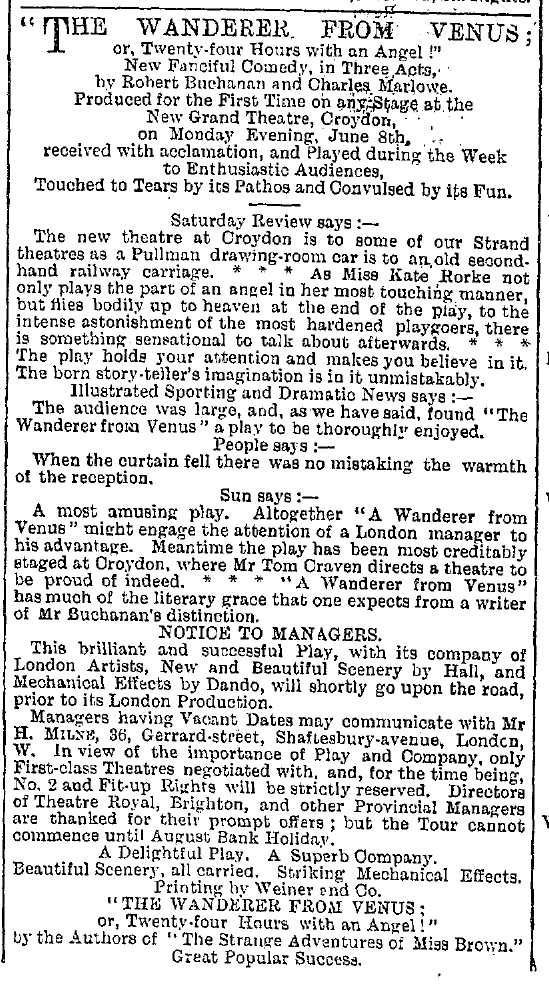
[Advert from The Era (20 June, 1896).] |
|
|
 |
|
|
|
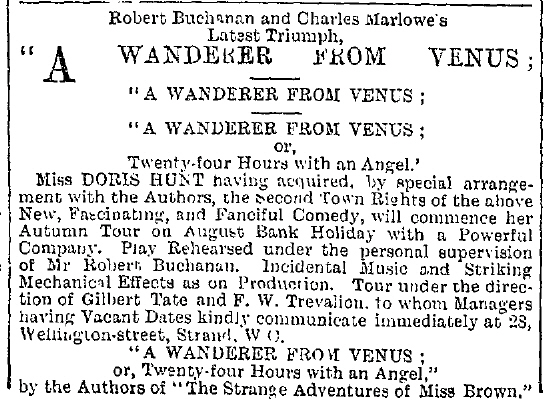
[Advert from The Era (11 July, 1896).]
The Wrexham Advertiser, and North Wales News (18 July, 1896 - p.2) OUR LADIES’ COLUMN. BY ONE OF THEMSELVES. . . . Messrs. Buchanan and “Charles Marlowe’s” play, “The Wanderer from Venus,” is a very reminiscent production, recalling whole pages of “Pygmalion and Galatea,” and of “Niobe,” as well as of Mr. Wells’ delightfully clever and witty book, “The Wonderful Visit.” Mr. Buchanan’s “Pygmalion” is an amateur astronomer engaged to marry a daughter of one of the typical mundane parsons of the modern stage. To him arrives, in answer to a pre-fervid invocation, an angel from the planet Venus, in the guise of Miss Kate Rorke—a charming actress—a lovely woman, but a very substantial angel. She immediately proceeds to fall in love with the star-gazer, with all the innocence and inexperience of a Galatea. Complications arise through the unbelief of neighbours and fiancée, in the celestial character of the visitor. The chief sceptic is the doctor of the village (like Dr. Crump in “The Wonderful Visit.”) This part was admirably played by Mr. Anson. Of course, when the disenchanted “Wanderer” understands the mischief she has caused, she reascends conveniently to her native planet, and human affairs resume their normal course. On the fall of the curtain Mr. Buchanan and his collaborateur, Miss Harriett Jay (who writes under the name of “Charles Marlowe”) responded to the call for “Author,” but made no attempt to address the friendly, though not very enthusiastic, audience. ___
The Northern Echo (3 August, 1896) THE DRAMA AND THE STAGE. DARLINGTON THEATRE ROYAL. More of the light and amusing fare which is so increasingly popular amongst theatre-goers is provided this week at the Darlington Theatre Royal in the engagement of Miss Doris Hunt’s company in “The Wanderer from Venus.” This is the first time the piece has been produced out of London, where this original, fanciful comedy has won golden opinions. The company includes Miss Doris Hunt as “The Wanderer from Venus,” and Mr L. Cory Thomas, who will be remembered with pleasure as one of the officers in “Bootles’ Baby” when in Darlington. |
|
|
 |
|
|
|
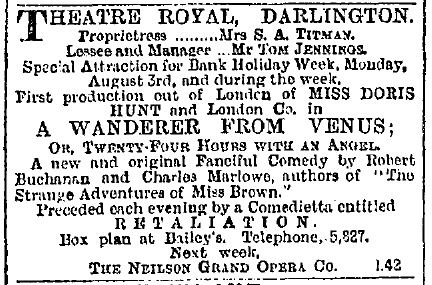
[Advert from The Northern Echo (4 August, 1896).]
The Lincolnshire Chronicle (23 October, 1896 - p.8) “A WANDERER FROM VENUS” AT THE THEATRE ROYAL.—When such experienced collaborators as Robert Buchanan and Charles Marlowe hit upon so whimsical an idea as that which has given birth to “The Wanderer from Venus,” one naturally looks for a play combining literary merit with the power to amuse. And in the piece this week being performed at the Theatre Royal we are not disappointed. Claude Somerville is a dreaming astronomer who likes nothing so well as communing with other worlds during the darkest hours of the night. He meditates much upon the nature of the inhabitants of the planets (never doubting that they are peopled) and, apostrophizing Venus, he pleads for visible confirmation of his theories. His prayer is answered, and “Stella” descends from the luminous orb to the dark and dreary earth. Then the trouble commences; the lady, “an angel,” Somerville calls her, is but lightly clad, and her diaphanous drapery would occasion remark, even if the fact of her strange presence in a bachelor’s apartments failed to excite comment. But Somerville is engaged to the Vicar’s daughter “Dora,” and his friend Dr. Middleton stands in a similar relation to Dora’s sister, “Euphemia,” a strong-minded woman of advanced education; in short, a Girton girl. The complications which ensue when Stella (who proves an apt pupil in the material conditions of the Earth, and experiences the sensation of human love), is discovered in tender situations with Somerville and Middleton by their respective sweethearts, are extremely diverting. The clever authors have contrived to put all the male characters, even the good old vicar, who feels it his duty to “talk seriously” to the “young person,” into compromising situations, and matters are only cleared up when Stella reveals a really angelic quality, and, renouncing her earthly love for Somerville, wings her way back to her own bright particular star. Miss Doris Hunt is very captivating as “Stella.” Bewilderment in her first acquaintance with the planet Earth is excellently conveyed, and then the transition from a state of amazed wonderment at, to enjoyment of, earthly pleasures is extremely naturally done, and gives evidence not only of intelligent appreciation of the character, but of ability to portray it. In the part of “Euphemia,” Miss Ethel Gordon makes every point tell, and she is mainly responsible for the most amusing quarter of an hour in the play, when she discovers her fiancé with the “angel’s” arms around his neck. Throughout the piece she delivers the incisive sayings of a woman of the “higher” education with penetrating emphasis, and even her father does not escape the lashings of her bitter tongue. If she be a true stamp of the Girton girl, we hope it will never be our direful destiny to live with so dogmatic a damsel, rather would we be at once translated to Venus, and dwell with amiable angels such as Stella. Miss Gordon must, nevertheless, be highly complimented on her admirable delineation of the character. As “Dora” the more gentle of the sisters, Miss Lucy Sibley is pleasing, and Miss Gertrude Le Sage, as Somerville’s astonished housekeeper, never misses a point, and elicits many a laugh. Mr. Graham Browne has a difficult rôle in that of the astronomer, and the clever manner in which he plays the character adds to his reputation as an earnest and conscientious actor of marked ability. Mr. A. B. Murray gives a good representation of a country doctor, and he is particularly diverting in the scene with “Euphemia,” when he is receiving his “roasting.” Mr. L. Cory-Thomas acts carefully and well as the “Vicar.” The play is preceded by a comedietta, “A Case for Eviction,” in which Mr. G. G. Kingsland, Miss Sibley, and Miss Le Sage show to advantage. ___
The Era (5 December, 1896 - p.12) A SYNDICATE has bought the rights to The Kiss of Delilah, for production after the pantomime season. Mr Robert Buchanan was so impressed by Miss Edith Jordan’s performance of Estelle Beaupas that he immediately engaged her to sustain the leading character in A Wanderer from Venus at the Lyceum, Edinburgh, on Monday. ___
Glasgow Herald (8 December, 1896 - p.5) ROYALTY—“THE WANDERER FROM VENUS.” A considerable proportion of the audience at the Royalty last night were doubtless drawn to the theatre by the title of the piece which was performed—“The Wanderer from Venus.” Another attraction was probably the fact that it is partly the work of Mr Robert Buchanan, poet, dramatist, and novelist. As in some others of his stage productions he has had in this instance also the co-operation of Miss Harriett Jay. Of the two sources of attraction we are inclined to think that the name selected for the comedy was the more potent. Mr Buchanan as a playwright has not always been an unqualified success. Neither is he in this, the latest of his essays, as a dramatic author. Over-seriousness is his besetting fault. To him the stage has evidently a mission—namely, to lift us all above base and conventional ideas of human life. If there is one quality more conspicuous than another in Mr Buchanan it is individuality. It asserts itself in all his work, nowhere more so than in his productions for the theatre. In “The Wanderer from Venus” his originality is scarcely so much as usual in evidence. The idea of the comedy is by no means new. In the school books for juveniles there used to be an interesting poem entitled “How it strikes a strange.” It was the story of the impressions of a celestial visitant to the earth—how he was rejoiced with the joyousness of nature, and saddened by the spectacle of decay and death. The idea has been turned to comedy by the skilful pen of Mr W. S. Gilbert, whose Galatea is not yet in danger of being surpassed for boldness of conception or brilliance of expression. Such poetic and mythological fancies have probably suggested to Mr Buchanan an expansion of the same idea. In response to the rapturous apostrophes of a love-sick youth, addressed to the starry firmament, he brings to this terrestrial globe an inhabitant of the planet Venus. This vision of loveliness, clad in airy robes, is made to walk the cold, dull earth barefooted, as if she were a sort of celestial Trilby. She is like the gay grisette of the Latin Quarter in another respect—she turns the heads of all the men she meets. She is presented by the youth, at whose invocation she has come from aloft, to his landlady, to his fiancée and her father, the vicar of the parish, and to his intimate friend, a Scotch doctor, as an angel from heaven. As the newcomer arrives late at night, and is accommodated in the young man’s rooms until the morning, his friends, not unnaturally, take a somewhat more prosaic view of the situation, and it is in this connection that the best comedy of the piece is introduced. A young lady who has learned philosophy at Girton, and has not been unobservant of the ways of the world, has some piquant remarks to make about men and angels in the abstract, and even the doctor and the clergyman discover that after all there may be more things in heaven and earth than even they have dreamed of. Of course, the visitor soon adapts herself to her environment, and begins like ordinary mortals to indulge in material sustenance. Then the passions of love, jealousy, and hate take possession of her for a while, and, finally, when she realises that the world and the things thereof are not worth the trouble they bring, she is hoisted back to Venus by means of a wire worked from the flies, and leaves the poor humans whose peace and happiness she has temporarily upset to resume the thread of their everyday existence. As a somewhat eccentric example of comedy the piece is interesting after a manner, but the passages, and there are several, in which the authors rise into the region of ethics are, truth to tell, a little tedious, and not at all convincing. The comedy was capably acted. Miss Edith Jordan had the sympathy of the audience entirely with her in her heroic, and, on the whole, distinctly successful effort to give dramatic embodiment to an extremely fanciful creation. The other parts were also well played by Mr Acton Bond, Mr George Traill, Mr Robson Paige, Miss Florence Tanner, Miss Lucy Sibley, and Miss Marie Anderson. ___
The Era (12 December, 1896) AMUSEMENTS IN GLASGOW. . . . ROYALTY THEATRE.—Lessees, Messrs Howard and Wyndham, Limited; Acting-Manager, Mr Frank Sephton.—The first performance in the provinces of The Wanderer from Venus, by Robert Buchanan and Charles Marlowe, was given here on Monday. The play is one of the many dealing with miraculous or supernatural visitations, of which W. S. Gilbert’s Pygmalion and Galatea is the best known and most satisfactory. The present production has all the advantages of Mr Buchanan’s poetic temperament and imagination, and is clothed in really beautiful language, the graceful and flowing blank verse of the two principal characters, the romantic star-gazer Claude Somerville and the mysterious Stella, contrasting well with the modern up-to-date prose of the other parts. The idea forming the basis of the play is good, that of an idealistic astronomer, strong in the belief of there being other inhabited worlds, hoping and praying for proof, and his wish being answered by the descent of the dainty wanderer from the planet Venus, whose advent flutter the dovecotes of the little village of Moonbury, and sets the various characters by the ears, for a time, at least. In the working out, however, the authors have allowed themselves to waver between the fanciful and the farcical, and the combination does not make a good blend. The ethereal Stella, who seems at first a being utterly removed from earthly weaknesses, speedily develops a human selfishness and tawdry jealousy that go far to estrange sympathy from the character, and the final scene, in which the wanderer elects to return to her native Venus, in place of being the outcome of some grand development of love, pity, or even jealousy, suggests nothing but female caprice of a very human description. Miss Edith Jordan as Stella acted throughout in graceful and sympathetic style, and spoke her lines with feeling and rhythmical charm. Mr Acton Bond was an effective and duly romantic Claude Somerville. Miss Florence Tanner as Dora, the lady whose happiness is so nearly blighted by the planetary visitor, looked and acted well, rising to the occasion in the scene in the third act with her lover and his “angel.” As the matter-of-fact Scotch doctor and his equally prosaic intended Mr George Traill and Miss Lucy Sibley were of decided value, and Mr Robson Paige as a prosy and earthly-minded parson was amusing without any tendency to over emphasise the part. Miss Marie Anderson was an attractive and effective housekeeper. The play was preceded by a comedietta, Down East, in which Miss Constance Wallis and Miss Helen Farrington worked hard to amuse. ___
The Era (19 December, 1896 - p.22) AMUSEMENTS IN EDINBURGH. . . . LYCEUM THEATRE.—Proprietors, Messrs Howard and Wyndham (Limited); Acting Manager, Mr A. Weston.—Messrs Robert Buchanan and Charles Marlowe’s new and original farcical comedy The Wanderer from Venus was presented here on Monday evening, but did not draw a large house. The comedy was effectively mounted and admirably acted. Mr Acton Bond bore himself bravely as the romantic star-gazer, Claude Somerville, and acted with his accustomed ability and success. Mr George Traill emphasised the character of Dr. Middleton with no little skill, and Mr Robson Paige gave a broadly humorous rendering of the Vicar, Dr. Dullamore. Miss Edith Jordan’s performance of Stella was deserving of the highest praise, and Miss Marie Anderson made an excellent Mrs Allgood. Dora was charmingly personated by Miss Florence Tanner, and Miss Lucy Sibley did her best with the rôle of the masculine and too outspoken Dora. Reply Paid preceded. |
|
|
 |
|
|
|
[Postcard of the Grand Theatre, Croydon - demolished 1959.] _____
Next: The Mariners of England (1897) Back to the Bibliography or the Plays or Harriett Jay Theatre Reviews
|
|
|
|
|
|
|