 |
|
|
Play List: 4. Corinne 7. The Mormons 9. Lucy Brandon 10. Storm-Beaten 11. Lady Clare 13. Bachelors 14. Constance 15. Lottie 16. Agnes 17. Alone in London 18. Sophia 19. Fascination 20. The Blue Bells of Scotland 21. Partners 24. Angelina! 25. The Old Home 26. A Man’s Shadow 27. Theodora 29. Clarissa 30. Miss Tomboy 32. Sweet Nancy 33. The English Rose 36. Marmion 37. The Gifted Lady 38. The Trumpet Call 39. Squire Kate 40. The White Rose 42. The Black Domino 44. The Charlatan 45. Dick Sheridan 47. Lady Gladys 48. The Strange Adventures of Miss Brown 49. The Romance of the Shopwalker 52. Two Little Maids from School ___ |
|
|
|
ROBERT WILLIAMS BUCHANAN (1841 - 1901) |
|
|
|
|
|
|
|
|
|
THEATRE REVIEWS 19. Fascination (1887) - continued
The Era (21 January, 1888) THE VAUDEVILLE. Lord Islay ... ... ... Mr H. B. CONWAY Heart of Hearts does not seem to have turned out a very valuable jewel, and, Mr. Thorne having put it on the shelf, on Thursday evening revived Mr Robert Buchanan’s and Miss Harriett Jay’s bright, interesting, ingeniously contrived, but very improbable comedy Fascination, which had so cordial a reception when, in October last, it was tentatively brought out at the Novelty Theatre, then under the direction of the lady who is partly responsible for the work. The story has already been given in detail in these columns. The heroine is a healthy English girl, with a taste for athletics, and no objection to a cigarette. We make her acquaintance at Hurlingham Lodge, Sunbury, and quickly learn that she is engaged to Lord Islay, who is something of a roué, and who gives more attention to Mrs Delamere, a fascinating widow of doubtful reputation, than to the lady who is to be his wife. The faith of Madge in his lordship is somewhat disturbed by the Comte de la Grange, a visitor at Hurlingham Lodge, who is smitten by Lady Madge, and endeavours thus to advance himself in her favour; and her suspicions are confirmed by the appearance in the neighbourhood of the widow, who passes down the river on her way to a picnic. Lady Madge, therefore, resolves to assume a masculine disguise, and to put Lord Islay’s fidelity to the proof. This plan is put into practice in the second act at Mrs Delamere’s house in Mayfair, where a merry party, including Lord Islay, the Duke of Hurlingham, and the Comte de la Grange, is assembled. Madge enters, disguised as “Young Mr Marlow from Jamaica,” and proceeds to make love to Mrs Delamere in order to carry out her scheme. Islay not only does not recognise his fiancée, but is even jealous of “Mr Marlow’s” progress in the good graces of Mrs Delamere, to whom he (Islay) has just before announced his desire to sever the relations between them, confessing that his love for his cousin is the reason. Mrs Delamere gratifies her vanity by telling “Mr Marlow” that Islay has proposed marriage to her, and she has rejected him; and this statement is apparently corroborated by what follows. The siren is induced by La Grange to obtain from Islay Madge’s engagement ring, and borrows it on pretence of wanting to seal a letter, then retains it, telling her friends that the ring was Islay’s free gift to her, and that he is now mean enough to ask for it back again. Madge, who has seen the ring given, but not heard the conversation which would have explained Islay’s parting with it, denounces him as “no gentleman,” and adds injury to insult by throwing a glass of champagne in his face. In the last act Mrs Delamere presents herself at the Duke of Hurlingham’s house in Berkeley-square, where, in an interview with Madge, who is still disguised, she confesses the whole truth, and adds the information that La Grange is a criminal who is “wanted” by the French police. Madge, still in male attire, meets Lord Islay, and extracts from him a lecture on the perils of fascination and the excellence of pure love, and a confession of his affection for herself. La Grange is exposed and handed over to the police; Islay is pardoned, and the lovers are united. ___
The Globe (21 January, 1888 - p.2) “FASCINATION” AT THE VAUDEVILLE. In judging Miss Harriett Jay and Mr. Robert Buchanan’s “Fascination,” produced on Thursday at the Vaudeville, playgoers should bear in mind that the authors themselves describe it as an “improbable” comedy. In so doing, they forestall, if they do not disarm, criticism on what is obviously a leading defect of the play. One cannot, of course, accept “Fascination” as an accurate picture of present-day society; nor, indeed, is it easy to conceive any period in which a young woman of rank could have played successfully such pranks as are here indulged in by Lady Madge Slashton. That Lady Madge, masquerading as a youth of fashion, should have been able to conceal her identity from her lover and her friends, as she is represented as doing, is more than improbable—it is virtually impossible. Nay, we may add, is there any more verisimilitude in the sketch of character supplied in the person of the Rev. Mr. Colley. The history of the eighteenth century supplies, no doubt, many instances of clerical deference to aristocratic patrons, but the authors of “Fascination” have never, we hope, made acquaintance with a clergyman of to-day who behaved as Mr. Colley behaves at the dictation of Lady Madge Slashton and the Duke of Hurlingham. ___
The Referee (22 January, 1888 - p.3) After standing out for H. A. Jones and his “Heart of Hearts” for a matter of sixty odd nights, R. Buchanan returned on Thursday night to the vaudeville fold, where the best play he ever wrote—“Sophia,” to wit—ran so long. R. B. has returned in company with Miss Harriett Jay, and they have brought with them their “new and improbable” comedy, “Fascination,” which some few months ago was tried at the up-to-now ill-fated Novelty. Some account of the story, together with sundry remarks, critical and otherwise, were given by yours truly in the Referee of the period. So no more of that. I will only remind you that I then held there was much cleverness in “Fascination,” buy that its improbability (which, according to the authors, seems to be its chief reason for existence) was so mixed up with bits of probability that it was neither one thing nor the other. As no perceptible attempt has since been made to render the play more consistent, either farcically or seriously, I cannot regard “Fascination”—notwithstanding the good writing it contains—as likely to be of any real service to the vaudeville treasury. The acting in “Fascination” is not, on the whole, so good as at the Novelty matinée. From this category I exclude Miss Jay, who, as Lady Madge Slashton—sometime disguised as “Young Mr. Marlowe, from Jamaica”—is, if anything, better than before. It is a clever and well-thought-out impersonation, and but for it the play could not be held together at all. As Lord Islay (originally played by Henry Neville) H. B. Conway was crude, and lacking in the reckless dash the character needs—a dash which Neville went in for boldly. Royce Carleton was not strong. His representation of the foreign adventurer, Count de Lagrange, lacked the decisiveness he has shown of late; also he made the character quite English, you know—perhaps because he was afraid of the foreign accent. T. Thorne as the comic curate, Mr. Colley, lacked the screaming low-comedy drollery of the original, which his name was Righton. T. Thorne was T. Thorne, and there’s an end of it. F. Thorne worked artistically as the Duke of Hurlingham. Mr. Scott-Buist repeated his manly and straightforward rendering of Lord Jack, and Mr. Frank Gilmore brought a good voice and a fine figure to bear on the small character of Captain Vane, and showed much promise. The only improvement on the original cast was the playing of the fascinatress, Mrs. Delamere, by Miss Vane, who was both artistic and attractive, but displayed so much bosom and back—or should I be genteel, and discreet, and simply say “neck”?—that I was afraid she would take cold, and be laid up again. ___
The Bristol Mercury and Daily Post (24 January, 1888) “Fascination,” the improbable comedy by Mr Robert Buchanan and Miss Harriett Jay, recently tried at the Novelty Theatre, has been put in the Vaudeville evening bill; but it fails to make the desired impression. ___
The Stage (27 January, 1888 - p.14) VAUDEVILLE. On Thursday evening, January 19, 1888, was produced here a “new and improbable comedy,” in three acts, written by Harriett Jay and Robert Buchanan, entitled:— Fascination. Lord Islay ... ... ... Mr. H. B. Conway When this strangely constructed play was first produced at a Novelty Theatre matinée on Thursday, October 6, 1887, we, in our issue dated October 14th the same year, said:—“Fascination is not only improbable, it is to a certain degree impossible. The plot is one upon which a most interesting and valuable play might have been founded had it been treated in a proper and workmanlike manner. There is nothing ‘new’ in the story of a man who, engaged to a young, beautiful, and wealthy girl, becomes ensnared in the toils of a dangerously fascinating adventuress. All who know anything of dramatic literature must recognise this as an oft told tale. Its sequel is also as familiar. By means of stratagem the cast aside fiancée manages to remove the scales from her lover’s eyes, and he, before it is too late, seeing how near to ruin he has been, casts aside his passing fancy and returns to his old love to be forgiven and made happy, while the adventuress, finding that the game is up, promises to reform and lead a better life. As we have remarked, much could have been done with such a plot. Miss Jay and Mr. Buchanan have, however, played with the idea as if fearing their capability to carry it out in a dramatic and consistent manner, and so they make their heroine, Lady Madge, don male attire and assume the name of ‘Mr. Marlowe’ that she may visit a haunt of vice, and so find out if her lover, Lord Islay, be true to her—not only does she, in company with her devoted brother Jack, enter the abode of Mrs. Delamere, but she also makes love to that woman before her own future husband’s eyes in order to pique him and draw him on to a declaration of his passion for Mrs. Delamere, the adventuress. This, it will be at once perceived, is not only an unpleasant incident, but one that is quite impossible—for Lady Madge is a lady, and her brother is the soul of honour. Again, Lady Madge is too thinly disguised to escape detection at the hands of Lord Islay and his friends—who, by-the-bye, are also her friends—for she trusts to hide her facial identity from her lover by means of pince-nez only. According to the authors such a disguise is sufficient, for Lady Madge’s lover remains in ignorance as to who the young gentleman—from whom he has suffered insult in the presence of Mrs. Delamere and her self-invited guests—really is. Not to make a short story long, suffice it that through the agency of the Comte de Lagrange—who, it appears, has lured Lord Islay to Mrs. Delamere’s house in order that he may not only win money from him at cards, but make overtures to the neglected heroine—all is cleared up, Lady Madge finds out that her lover had no true affection for the adventuress, but that his was a case of ‘fascination.’ She, therefore, in true womanly fashion, blots out the past, forgives him, and all ends happily. From this sketch of the plot it may be argued that the authors, evidently in doubt as to how their modern comedy would be accepted, were perfectly right in calling it ‘improbable.’” Fascination, since its appearance at the Novelty Theatre, has been but slightly altered. In the first act the setting of the stage is reversed—the house is now on the right, and so arranged as to give more room than before. Lady Madge, when in male attire, now wears a curled wig instead of a straight-haired one. Count de Lagrange has become an Englishman as far as his intonation and accent are concerned, and Miss Dottie Destrange is now christened Miss Lestrange. Apart from these trifling alterations the play remains much as it was. Fascination is unsatisfactory and inartistic throughout. To complete the unreality of the play the authors have retained the original poetical tag that ends with an appeal to the audience against the introduction of which we protested when the play was first produced. The day for such an absurdity is passed, and the authors are strongly to blame for trying to reintroduce it. The stage is more realistic than ever—more true to nature. A play is but a chapter from real life that is closed when the curtain falls. The illusion should be kept up by a dramatist till the last if an audience is to be interested. We never could understand a certain section of the Press praising this play, and now we are equally at a loss to fathom the meaning for its production at the Vaudeville Theatre. Perhaps Mr. Thomas Thorne saw money in the piece or he thought that he could make much out of the part of the Reverend Mr. Colley. We are unable to say. Everything in the way of stage adornment has been done for Fascination. Each of the three scenes is perfection in its way, but, though elaborate sets and beautiful painting will do much to assist the success of a piece, they will never make a good play out of a bad one. Strange to say, the acting of the company at the Vaudeville does not do much to help matters. Mr. Conway does not appear to be at home as Islay, there is no heart in his acting. He delivers the author’s words as if he did not quite believe in them. Mr. Fred Thorne, too, has not caught the right conception of the old Duke. We take it that the silly old man should be represented as a somewhat sly and artfully-disposed person anxious to escape from his wife’s apron- strings that he may indulge in the questionable pleasures of fast life, though preserving to the world a moral exterior. Mr. Fred Thorne makes him slow and plodding, not at all the sort of man who would lie about the House of Lords to his wife that he might visit the abode of the adventuress, Mrs. Delamere, and her attendant sirens. Mr. Carleton cannot be congratulated upon his performance of the Count. Mr. Buist is again the Lord Jack, which he plays in the same vigorous and straightforward manner as before. Mr. Wheatman and Mr. Grove have but little to do, but succeed. The same remark applies to Mr. Gilmore. Mr. Thomas Thorne, though differing in every way in his reading of the clergyman from that given by Mr. E. Righton, who was admirably suited in the part, manages to amuse his audience, and to secure their laughter and applause. Of Miss Jay’s Lady Madge, we can only repeat what we have before said. She is artistic throughout the part, what might be made ridiculous by many is, through her talent, made to stand out as a triumph of dramatic art. Mrs. Canninge is hard and uninteresting as the Duchess, and is certainly not an improvement upon the original exponent of the part, Miss Ethel Hope. Miss Banister is fairly good as Arabella. Miss Arnold is satisfactory as Miss Wilmere and Miss Warden as Adele contributes the sketch of a pert, pretty maid whose nationality would lead us to expect a better French accent than Miss Warden gives us. We have purposely mentioned the name of Miss Vane last, for her acting deserves special mention. Miss Vane gives, as Mrs. Delamere, a portrait that is the complete opposite of that contributed by her predecessor in the part, Miss Yorke. Miss Vane’s Mrs. Delamere is an anxious, scheming woman, yet one full of superb dignity and graceful poses—a woman that would with her presence rather control a man, and force him to her side, than fascinate and lure him on. Her scenes with Islay are not so much remarkable for a pretty display of feminine graces as for an over-powering majesty, upon which the adventuress appears to rely to bring her lover to her feet. Miss Vane’s acting is sound and artistic. Her final exit in the last act is one that only an actress possessing fine dramatic instinct that has been nurtured by experience could accomplish. On Thursday, Fascination appeared to please the audience, and loud calls for the authors were raised in the gallery and pit. There was no response. Cut off with a Shilling precedes the comedy, and is played by Miss Gertrude Warden, Mr. W. Scott Buist, and Mr. Fred Thorne in a manner that might, with advantage, be improved upon. ___
The Penny Illustrated Paper (28 January, 1888 - p.10) Mr. Thomas Thorne had in the character of the surreptitiously married butler a part that suited him “down to the ground.” So much so that I wonder at his withdrawing Mr. Henry A. Jones’s “Heart of Hearts” in favour of the “improbable comedy” of “Fascination,” by Mr. Robert Buchanan and Miss Harriet Jay. This talented and good-looking authoress assumes in “Fascination” both skirts and unmentionables. She is Lady Mable Slashton. In love with, and loved by, a young officer in the Guards, Lady Madge is jealous of Mrs. Delamere, a siren with whom her lover is entangled; and her Ladyship dons male attire in order to be able to watch gallant Lord Islay’s flirtation with this attractive woman at an evening party. Her father, the Duke, and his attendant Curate, also attend this party. There are other “improbabilities,” which deprived the piece of interest. The Curate, enacted by Mr. Thomas Thorne, was very shadowy. The senile Duke of Mr. Fred Thorne was an impossible peer. Mr. H. B. Conway, on the other hand, made a manly Lord Islay; Mr. Royce Carleton was a good Count De Lagrange; and Miss Harriet Jay, Mrs. Canninge, Miss Vane, and Mr. S. Buist and Miss Warden played their parts very well, Miss Vane imparting considerable strength to the part of seductive Mrs. Delamere, “a fine figger of a woman,” as Joe Gargery put it. ___
The Entr’acte (28 January, 1888 - pp.5-6) THE THEATRES. VAUDEVILLE.—The comedy entitled “Fascination” is well worth seeing, if only to enjoy the thoroughgoing manner in which the heroine of the story abandons herself to the scheme she adopts in order to test the real feelings of the young man who professes to love her. This part if played by Miss Harriett Jay, who, with Mr. Robert Buchanan, shares whatever honour there may be attaching to the authorship of the piece. Lady Madge Slashton loves the good-looking Lord Islay, and her love is returned, though his lordship finds some difficulty in shaking off an infatuation for a “society beauty” in the person of a Mrs. Delamere. Lady Madge is, by the Iago of the story, told of Islay’s admiration for Mrs. Delamere, and the flame of jealousy is carefully fanned until it becomes a big blaze. It is then that Lady Madge adopts the expedient of donning male garb and, under the assumed name of Mr. Marlow, visiting the house of the rival, chaperoned by her brother. There she professes to be fond of what is called “life,” and even pays marked attentions to the notorious hostess. But she is maddened at seeing her lover do the same kind of thing; and when she sees him take from his finger the ring which he has vowed to keep there at all hazards, a “situation” is created. Lord Islay really loves Madge, and only lends the ring believing that Mrs. Delamere will return it after it has sealed a letter, for which purpose it has been avowedly borrowed. Instigated by the Iago of the play, the lady, who is smarting under Islay’s neglect, chooses to retain it, upon which his lordship, finding her inexorable, hints that surely she cannot mean to steal it, an inuendo which provokes a withering denunciation from Mrs. Delamere, who humiliates her whilom admirer by telling her guests of how she has been pestered by the attentions of this man, who all the time has been trying to make a cousin in the country believe that she claimed the whole of his love. As a matter of course, the guests take the side of the hostess; and the visitor who so markedly champions her cause, and who throws a glass of champagne in the face of the apparently unchivalrous Islay, is no other than Madge, disguised as Mr. Marlow. This would not be a comedy if such a tension as we have adumbrated were permitted to continue, so that in the next act the rough places are made tolerably smooth, and the love of Madge is valued at a just figure by the man for whom it has sacrificed so much. As we have before said, Miss Harriett Jay throws her whole soul into the theme, and her thoroughness undoubtedly gives a value to “Fascination” that it otherwise would not possess. With such an example before him, one would imagine that Mr. H. B. Conway, who is cast as her lover, would be equal to pumping up a little enthusiasm; but, alas! there is no sign of such support; the well seems dry. When this piece was first tried at a matinée, Mr. Henry Neville played the rôle now entrusted to Mr. Conway, and it was commonly remarked at the time that Mr. Neville was too old for the part; but Mr. Conway’s acting has not a tenth part of the youth which marks Mr. Neville’s method,—in fact, Mr. Conway’s Lord Islay seems to be invertebrate, and destitute of that heartiness which would be likely to enslave such a heart as that possessed by Madge. Mrs. Delamere enjoys an excellent representative in Miss Vane; Mr. Thomas Thorne, as a country clergyman who takes rather kindly to frivolities, provides an amusing character sketch; and the same may be said of Mr. Fred Thorne, who is happily cast as Lord Hurlingham. Mr. Royce Carleton, as the mischief-maker, acts with his customary stiffness. ___
The Graphic (28 January, 1888) The reproduction of Fascination at the VAUDEVILLE Theatre has not furnished any reason for modifying the opinion we have already expressed upon this “improbable comedy.” The cast generally was somewhat weaker than that at the Novelty Theatre; but Miss Harriett Jay retains her original character, and plays it very cleverly. The scene before the clergyman and the over-demonstrative ladies in the second act cannot be praised for decorum or good taste. Altogether the expediency of reviving this eccentric production on the stage of the Vaudeville is not very obvious. ___
The Athenæum (28 January, 1888) Dramatic Gossip. ‘FASCINATION,’ an improbable comedy by Miss Harriett Jay and Mr. Robert Buchanan, produced late in last year at the Novelty Theatre at a morning performance, has replaced at the Vaudeville Mr. H. A. Jones’s ‘Heart of Hearts.’ It does not improve upon acquaintance. The moral sense is shocked by the presence in a compromising establishment of a young lady of rank who is conducted thither by her brother, and the opportunities for histrionic display which are afforded fail to compensate for the shortcomings of the story. Miss Jay wears masculine costume with ease and courage. She is not, however, seen at her best, and does not reconcile us to her hardy experiment. The earnestness and passion she displays in the stronger scenes only render the whole more distasteful—the spectacle of a young lady in a swallow- tail coat and black cloth trousers crying over, quarrelling with, and insulting a lover who does not recognize her being as unpleasant as it is unreal. In other characters the piece was acted with little conviction. Mr. Thomas Thorne was very amusing as a meek clergyman who not unwillingly drifts into scenes of dissipation. Mr. F. Thorne gave a whimsical caricature of an old duke who fills his coat pockets with his own champagne to join secretly a party of ladies to whom he has just been introduced. We can, indeed, but repeat our former judgment that ‘Fascination’ needs Offenbachian music. It is about as serious a production as ‘La Grande Duchesse de Gerolstein.’ ___
The Illustrated London News (28 January, 1888 - p.3) THE LADIES’ COLUMN. . . . Most of the theatrical critics, I perceive, have objected to Miss Harriett Jay’s clever and interesting play, which was placed on the boards at the Vaudeville last week, on the ground of the impossibility of the central incident—viz., of the girl dressing in manly attire, and mixing for an evening in company without detection, even by her own lover. The plot in this respect, obviously, precisely follows Shakspearian precedent; and is Shakspeare to be eulogised as the greatest dramatist the world ever produced without receiving the true flattery of imitation? But, apart from fiction, there is no small accumulation of evidence that a woman can successfully defy detection in manly guise. Not where a pre-engaged lover is supposed, however—I grant the critics that; and surely he would be but a poor lover who neither by look, nor voice, nor that je ne sçais quoi, which, for want of a better name, we must call magnetism, would get revealed to his perceptions the presence of “the object,” in any costume or situation. But so far as the disguising dress goes, to unsuspicious and uninterested observers, there is plenty of illustration of the actual accomplishment by a woman of the part of Portia or Lady Madge Slashton. The dress-coat of civilisation is an admirable disguise for such a character, too. Portia’s doctor’s robe, doubtless, is the ideal garment for the masquerade; but a dress-coat being cut off at the waist, conceals better than any other form of attire could do the outline of the figure where it in a woman naturally differs most from that of a man. This is, as every artist knows, at what Leigh Hunt calls “those-never-to-be-without-apology-alluded-to hips.” But in far less suitable disguising attire than dress-coats and advocate’s robes the women who played the man have been unsuspected, if, indeed, there be any truth in historic legend.
(p.6) The curious play “Fascination,” by Miss Harriett Jay and Mr. Robert Buchanan, that created considerable interest at a recent morning performance, has been taken in hand by Mr. Thomas Thorne and produced at the Vaudeville. To some it is still attractive from its cleverness; to others vexing on account of its improbability. Some think that seriousness and extravagance will not mix better than oil and vinegar. But the play, strange as it is, is well worth seeing on account of some capital acting that it contains. First of all, nothing could be better than the Lady Madge Slashton of Miss Harriett Jay, one of the very best representatives of boys’ characters on the stage. The Lady Madge in question suspects her lover of want of fealty, and follows him into fashionable and fast society dressed up as a boy. This is the true spirit of comedy; and the part is both tenderly and expressively played by Miss Jay, whose natural acting shows into forcible relief much of the farcical business by which it is surrounded. Another excellent sketch of genuine character comes from Miss Vane, who plays a woman of the world with the core of her heart pecked at by the birds of society. It is a most striking and true picture, and it is handled in the firm grasp of an artist. Mr. Thorne is capital as the shy curate, Mr. Colley, who follows like a dog at the heels of Lady Madge; and every attention has been paid to the society pictures that form an important feature of the play. At any rate, everything has been done for it that could be done, and it is so well acted that it ought to succeed. ___
The Illustrated Sporting and Dramatic News (28 January, 1888 - p.6) VAUDEVILLE THEATRE. A SECOND experience of Fascination—a play named on the lucus a non lucendo principle—quite fails to explain why Mr. Thomas Thorne thought it worthy of transfer from the experimental Novelty to his popular stage. Vaudeville audiences have shown long ago that they do not object to the mixture of farce with comedy, but this is something very different from the amalgamation of serious comedy and extravaganza. In certain scenes of their piece Mr. Buchanan and Miss Jay go as near as they can to a comedy sketch of the society in which a Duke of Hurlingham, a Lady Madge Slashton, and a Lord Islay are likely to appear. The picture is not a very natural one, but it is realistic in treatment, and so far one understands fairly enough what the playwrights are driving at. But when, in a peculiar fashion, Lady Madge’s jealousy of the adventurous Mr. Delamere is aroused, and when she determines to test Lord Islay’s fidelity, the play loses all grip, not only of probability—it is confessedly an “improbable” one—but of possibility. Lady Madge dressed up in a man’s evening clothes, and appearing at Mrs. Delamere’s fast supper party, is a figure fit only for burlesque, and for interpretation by actresses of the Sisters Watson order. She would deceive no one—least of all her father and lover—as to her identity. She is, ex hypothesi, quite out of place in her fast surroundings. She is playing her lover an unworthy trick, or, at any rate, a trick which commands little sympathy. Moreover, when the climax comes, and she is worked up to a fury by the flirtations of Lord Islay and Mrs. Delamere, she goes perilously near to making a fool of herself, as she throws her glass of wine in the face of her recreant admirer. A disagreeable flavour is given to the whole proceedings by the presence of the elderly Duke and the young clergyman. Mr. Thomas Thorne, it is true, makes of the latter a sufficiently amusing creature, with his outward respectability and his mildly vicious tastes. But if the situation means anything at all, it is one in which a clergyman should hardly be introduced as a figure of fun. ___
The Sporting Times (28 January, 1888 - p.3) SCENES AND NOT TO BE SEENS. I WAS not present at the first performance of Fascination at the Vaudeville for reasons that I fully explained last week [Cut out—unfit for publication.—Master]. I went later on, however, and so saw the play under every possible advantage. First night nervousness, of course, was not present; everybody had, or should have, settled down into their respective places, and it was therefore possible to consider the show for all it was worth without explanation, palliation, or excuse. Harriett Jay and Robert Buchanan call their play an “improbable comedy,” but what this vague designation is intended to cover or convey I fail to understand. I sat it out sternly determined to comprehend its meaning or purpose if I could—but I couldn’t. And the more I think about it the more certain do I feel that the entire work is a dreary and depressing combination of slushy sentiment, vulgarity, regrettable bad taste, and complete impossibility. IN the first act we see the Duke of Hurlingham, who looks like a retired grocer in an old-fashioned farce, sitting on his lawn by the banks of the Thames. He is talking to his wife, the Duchess, and to his nephew, Lord Jack Slashton. Of course they inform us that Lady Madge Slashton, Jack’s sister, can perform a variety of athletic feats, that she is passing fair and unusually beautiful. The voices are heard “off,” and it appears that Lady Madge is rowing a race with a parson on the adjacent river. Everybody shouts, and then her ladyship enters, seated in a dinghy which she has obviously been propelling with a broomstick. She is not passing fair. She is not unusually beautiful. She is a large, ordinary, rather awkward, woman of apparently some five and thirty summers, and she studiously refrains from exhibiting her muscular dexterity or intellectual superiority from the rising of the curtain to the going down thereof. When the unhappy parson, the Reverend Mr. Colley, arrives—also in a dinghy, also with a broomstick—Lady Madge exhibits exceedingly bad taste. A parson is a parson, after all, and his calling should secure for him some respect. By virtue of his black coat and his white tie many a parson in London is permitted freely and unmolested to enter courts and alleys off the Dials and in the East End where no policeman dare venture save in broad daylight and at the risk of his life. The creatures evolved out of the joint imaginations of Harriet Jay and Robert Buchanan have no regard for the holy calling of Mr. Colley. In their eyes he is quite the most fitting block on which to chop the inane vulgarisms that pass current with them for wit. Indeed, when Lady Madge carefully beguiles him into the singing of a comic song, which involves the enunciation of an oath, all the characters on the stage affect to be vastly diverted. Those amongst the audience however, who happen to possess any remnant of decent feeling cannot be other than sad. THE lady Madge Slashton loves a certain Lord Islay and she has promised to be his wife. Count de Lagrange, a Frenchman with absolutely no accent whatever, loves Lady Madge, not for herself—no wonder!—but for her fortune, so he proceeds to poison her mind by artfully detailing the beauties and advantages of Mrs. Delamere, and hinting at the attention so assiduously paid to her by Lord Islay. Presently Islay arrives, and the circumstances of his arrival should be carefully noted. “I came down to Windsor,” he says, “then missed the train, and so got a hack and rode over.” Islay is dressed in very correct breeches and boots, so we must either conclude that it is his custom to affect riding costume whenever he goes by train, or else we must assume that he dressed in the ordinary fashion and kept his boots and breeches in his trousers pocket, so as to be always prepared for casual emergencies. ISLAY tells Lady Madge that, amongst other things, he reads the Sporting Times every Sunday, and instantly she suspects the nature of his affection for her. Lord Jack Slashton subsequently lectures Islay at some length on the errors of his way in the direction of Mrs. Delamere, and Islay gets petulant; but their interview is interrupted by an incident. “What sweet sounds are those that float upon the water?” says Islay. “Don’t know,” says Lord Jack. “Perhaps it’s the Maria Wood.” It is not, however. It is supers at the wings singing out of tune, as an introduction to the entrance of yet another dinghy, this time alluded to as a punt, in which is seated a bevy of charming ladies surrounding Mrs. Delamere, who plays an excellent seven stringed banjo in brown suède gloves. Islay is nervous, and stammers a refusal to join the party. But the Duke of Hurlingham smartly picks up several bottles of champagne, such as it is thoroughly well-known dukes always keep loose about on their lawns, and he risks a watery death by squeezing into the already over-full dinghy, and is broomsticked away up the river as the supers recommence their inharmonious efforts. Islay sits regarding the proceedings with an expression of countenance that suggests a pain in the stomach, and Lady Madge, marking his look incontinently, ejaculates, “I wish I was a boy,” and she sinks into a chair as the curtain falls. NOTHING very noticeable, it may be observed, has happened so far. Nothing very remarkable occurs, as we go on. Mrs. Delamere gives a party, and Count de Lagrange improves the occasion by informing her that he made her, and that she is in his power. It is not clear how, but apparently she is, for she does his bidding implicitly. The nice young ladies out of the dinghy presently arrive, also the Duke of Hurlingham and Islay, and, finally, Lord Jack Slashton, bringing with him someone he calls “Mr. Marlow, of Jamaica.” This is Lady Madge in male evening dress. The costume is not becoming. In trousers, her legs don’t look straight, and her shoulders are ridiculously narrow for a woman with such large hips. That nobody should recognise the fact of her sex is perhaps the real reason why the play is called “Improbable.” OF course, the unhappy parson, Mr. Colley, is dragged to this assembly, and once more jeered and jibed at. He is stuck down amongst a lot of leering painted women, and snubbed and laughed at in the usual execrable taste. His presence serves no purpose whatever, and does not advance the story at all; indeed there is no story to speak of. Lady Madge makes violent love to Mr. Delamere, and makes Islay jealous. Then hearing from De Lagrange that he has “documents” in his possession that will ruin Islay, she purchases what turn out to be bills for £2,000, giving in exchange a cheque signed “Charles Marlow.” Now Islay, so far as may be gathered, has lost the money to De Lagrange at cards; but he has never repudiated his liability. The bills are good, therefore. For Lady Madge to acquire them by aid of a “stumer” is distinctly fraud. But what is a trifle such as this to Harriet Jay and Robert Buchanan? Later on there is a row, and Lady Madge first insults Islay, and then chucks a glass of champagne at him. Tableau. Curtain. THE subsequent proceedings were veiled in chaos and mystery. I tried hard to follow the erratic gyrations of the plot, but I cannot say that I succeeded. The scene is set down as “Lady Madge Slashton’s”—house understood, I presume—and we see her ladyship looking very uncomfortable while talking to a very pretty girl. Perhaps she is conscious of the contrast. At any rate, she makes the pretty girl accept the hand of Mr. Colley in marriage which seems to prove that she does not like her. Then Lady Madge proceeds to write notes and send forth erratic messengers, and gradually she collects the entire cast in her room. She has a scene with De Lagrange; a scene with Mrs. Delamere; a scene with Islay; but nothing in particular comes of it. Ultimately foreign detectives come for De Lagrange. Mrs. Delamere goes away to repent, and Islay is forgiven. This act, in fact, is characterised by an utter absence of ingenuity. It is clumsy, chaotic, and uninteresting. The authors have somehow got hold of a good idea in the disguised girl seeking her lover in the bower of a syren, and inducing that syren to fall in love with her; but they have studiously refrained from developing their notion with anything like aptness. They have bungled, blundered, and muddled coarsely through three acts, only to arrive with much effort at complete failure. THE acting was adequate, and that is all. Tom Thorne overdid the parson, and brother Fred was very like anything on earth but a duke. Conway—poor Conway!—evidently felt keenly how utterly hopeless was the part he had to play, and naturally he made nothing but an ordinary walking gentleman out of Islay. When I remember his Faust, his Romeo, and his admirable Captain Bradford in Peril, I wonder how he could constrain himself to the assumption of a commonplace twaddler like Islay at all. Royce Carleton, clever actor that he is, failed to do anything with De Lagrange. He spoke without any accent, and did not dress the part with any eye to character. Miss Bannister looked sweetly pretty, and played with ingenuous freshness, as the ultimate bride of Mr. Colley. Miss Florence Warden looked nice, and spoke English well, and French well; but failed lamentably over English with a French accent. Mrs. Canninge, as the Duchess of Hurlingham, had hardly anything to do, but she looked remarkably well; while as Mrs. Delamere, Miss Vane was strikingly beautiful, and altogether admirable. Her performance was clever, strong, brilliantly finished, and, indeed, it was little wonder that Islay should have preferred this gorgeously handsome, splendidly figured, and exquisitely dressed young woman to such an angular, hesitating, spasmodic person as the Lady Madge Slashton of Mr. Robert Buchanan’s collaborator. ___
Ally Sloper’s Half Holiday (28 January, 1888 - p.6) THOMAS THORNE, the genial manager of the Vaudeville, seems to have secured another success in Robert Buchanan’s new comedy, Fascination. If we are not mistaken, the piece was produced for the first time by Harriet Jay at the ill-fated Novelty Theatre, but only for one performance. But now, under the vigorous acting of T. Thorne and Co., it will be strange if one hundred nights will satisfy the wants of the G. B. P. But time will show, as it is at present it would be hard to find a more vivacious little piece throughout London. ___
The Freemason’s Chronicle (28 January, 1888 - p.11) THE THEATRES, &c. Vaudeville.—The improbable comedy, “Fascination,” by Miss Harriet Jay and Mr. Robert Buchanan, was put into the evening bill at the above theatre on the 19th instant. This piece was produced at the Novelty some little time back, and we may say that it is rightly described as “improbable.” some of the situations being decidedly so. The play itself in some parts is very good, but in others feeble, and taken altogether is a most peculiar work, as there seems a sort of “air of mystery” about it which cannot be explained. The different situations are well conceived and capitally depicted, while the acting, taken all round, is first class. Miss Harriet Jay, as Lady Madge Slashton, has decidedly improved since the first production, and may be congratulated on her performance. Miss Vane, as Mrs. Delamere, the adventuress, is certainly one of the best characters in the piece. This lady acts with all the force the character warrants, and scores an undoubted success. Mr. Thomas Thorne, as Rev. Mr. Colley, plays in his own inimitable style, which admirably suits the part. Mr. H. B. Conway, as Lord Islay, seemed a little undecided, while Mr. Royce Carlton is not up to his usual form as Count de Lagrange. Mr. Fred Thorne’s Duke of Hnrlingham was amusing, while Mr. Scott Buist, as Lord Jack Slasbton, acted in a manly and straight-forward manner. The piece is exceedingly well mounted, and we should not be surprised to see “Fascination” remain in the bill for some time to come. The other characters were represented by Mrs. Canninge, the Misses Bannister, Gertrude Warden, Grace Arnold, Messrs. F. Grove, J. Wheatman, and Frank Gilmore. ___
The Theatre (1 February, 1888 - pp.92-93) “FASCINATION.” A New and Improbable Comedy, in three acts, written by HARRIETT JAY and ROBERT BUCHANAN. |
|
|
|
|
|
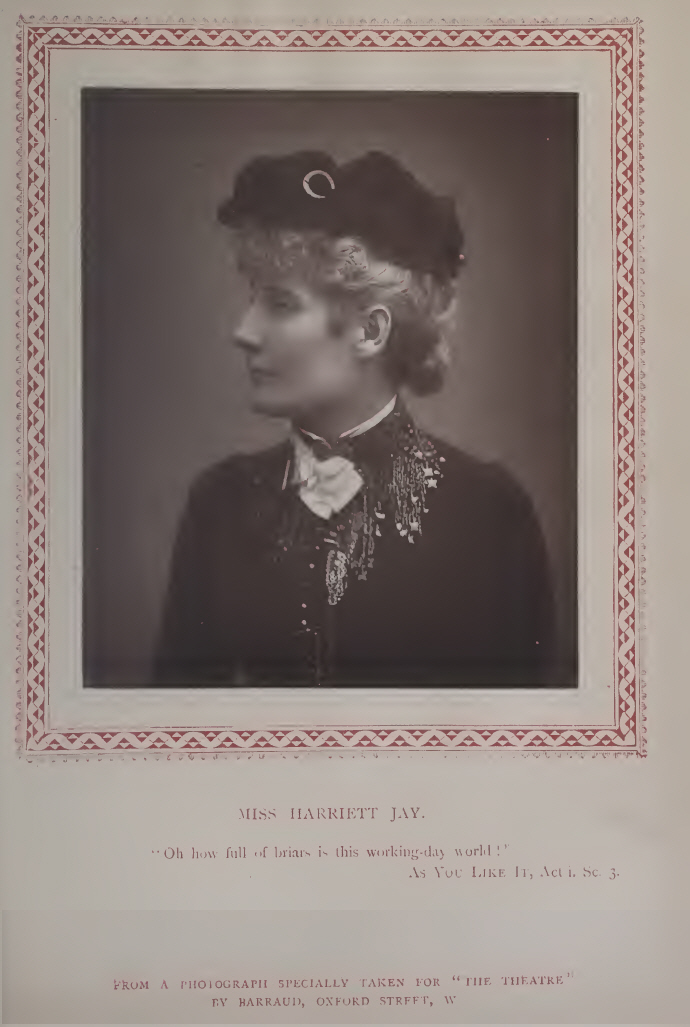
In the last November number of THE THEATRE I described the plot of this comedy with its then cast, but as the latter has been almost completely changed, I have given the fresh one. The improbability of the incidents appeared to jar upon some members of the audience assembled on the night of the reproduction, who seemed unable to determine in their minds whether to take it altogether au serieux, but the general verdict was a favourable one, the consummate acting of Miss Harriett Jay, admirably supported as she was by her rival, Mrs. Delamere, in the person of Miss Vane, producing this desirable result. Mr. W. Scott Buist, too, played his original character with as much freshness and originality as on the previous occasion. Mr. H. B. Conway was but half-hearted as the weak and easily led away Lord Islay. The Reverend Mr. Colley of Mr. Thomas Thome was humorous, and will doubtless be elaborated after a few nights, but Mr. F. Thorne has been seen to greater advantage than as the Duke of Hurlingham; he made the amorous and rakish nobleman too senile. Mr. Royce Carleton’s evil nature as Count de Lagrange was too transparent. The character of Arabella Armhurst was very naturally played by Miss Banister (incorrectly set down in some of the playbills as Miss Barton). The other parts were well filled, the ladies’ dresses handsome, and the scenery “on the banks of the Thames” beautifully painted by W. Perkins. The “interiors” were upholstered in excellent taste by Messrs. Maple. The authors were called, but only Miss Jay responded. The piece is decidedly worth seeing. |
|
|
 |
|
|
|
The Academy (4 February, 1888 - No. 822, p.86-87) THE STAGE. “FASCINATION” AT THE VAUDEVILLE. MR. ROBERT BUCHANAN and Miss Harriett Jay took the right measure of their piece at the Vaudeville when they called it an “improbable comedy.” It brings into the full nineteenth century a Rosalind masquerading in boy’s clothes; but the new Rosalind is stirred somewhat by jealousy, and her investigations take her into haunts which are not very choice. It is true that the lady whose relations with her own lover she suspects is described repeatedly as a fashionable beauty, if not a professional beauty, or a society beauty. Yet at the same time we are informed that nobody recognises her, and that at the very least she has a past which is discreditable. Perhaps Mr. Buchanan’s and Miss Jay’s notions of her were a little indefinite. Her conduct in the play does not seem to be very blameworthy. Nevertheless, it requires extraordinary tact on the part of an actress to reconcile us to the appearance of a young gentleman in a swallowtail coat and trousers, among some rather fast people—among, at all events, a group of undesirable men, of whom a mischievous and ancient duke is about the worst, and a silly but good-natured and fairly innocent clergyman about the best. And Miss Jay—for it is the authoress herself who plays the part—does display extraordinary tact, unquestionably. In the mere matter of wearing boy’s dress with naturalness and refined ease, she surpasses the most famous actress of the day. And other qualities she has besides the art de savoir porter—not la robe, but the swallowtail. She acts, in every sense, with spirit and feeling—takes the piece safely through its emotional passages, and through, at least, her share of comic situations. She betrays feeling with discretion, and swaggers very prettily. There can hardly before have been afforded so large an opportunity for exhibiting Miss Jay’s command of certain not unimportant phases of histrionic art. |
|
|
 |
|
|
|
[Press notices for Miss Vane in the Vaudeville Theatre production of Fascination
The New York Mirror (11 February, 1888 - p.10) London News and Gossip. LONDON, Jan. 26. . . . Since the holiday entertainments above alluded to got well under way certain managers have put forth more or less new ventures in the shape of drama, comedy, comedietta, farce, and what not. The latest of the principal ventures in this connection was the production at the Vaudeville a few nights ago of Robert Buchanan and Harriet Jay’s “improbable” comedy Fascination. Of the story and general details of Fascination I gave you some account when the piece was first tried on the matinee dog during Miss Jay’s brief tenancy of the Novelty Theatre. You will, perhaps, remember that although I found some good points in this piece I could not see any money—unless it were made more consistent. Four months have elapsed since Fascination’s trial trip and now here it is again, with little or no alteration. Therefore I am again constrained to say that I don’t see much chance for it. The fair Harriet (a fine figure of a woman) once more plays cleverly and with great go as the aristocratic young lady who disguises herself as a male masher in order to watch her lover’s proceedings at a notorious West-end house, where the female guests are no better than they should be, if so good. H. B. Conway assumes the character of Lord Islay, originally sustained by Henry Neville, but makes little out of it, whereas Neville made much. The inevitable comic clergyman is now played by Thomas Thorne, who shows some humor, but is not nearly so funny as his predecessor, Edward Righton. Royce Carleton, who made such a hit here as Blifil in Sophia, now fails as a foreign adventurer. Barring Miss Vane, who plays with great power as the naughty, fascinating siren, and Fred. Thorne, who is very comical as a doddering old duke, the rest of the cast is not up to the Novelty form. ___
East London Observer (18 February 1888 - p.7) “Fascination” is described in the programme as a new and improbable comedy. New, it may be; improbable, it certainly is. But whatever the merits or demerits of the joint production of Miss Harriett Jay and Mr. Robert Buchanan, the good company engaged in its representation does its best. The old tale of the spider and the fly is illustrated in the relations between Mrs. Delamere, the adventuress, and Lord Islay. This gentleman is, beyond his deserts, engaged to be married to a rich heiress—Lady Madge Slashton. This lady, although described by himself as a simple country girl, is not quite so verdant as might be supposed. By the aid of her brother, she gets an introduction into the house of Mrs. Delamere, in order to watch her lover and his enslaver. She appears in the disguise of man’s dress, and some attempt at the fast manners of a masher of the first rank. Mr. Marlowe, a rich young man from America, is anxious to spend his money like a lord. He commences by cutting Lord Islay out with Mrs. Delamere, and quite carries that battered fortress by storm. After learning all she wants to know, and circumventing all the knowing ones, she returns to innocence and petticoats, a sadder and a wiser woman. All, however, comes right; Lord Islay is forgiven and married, the naughty Mrs. Delamere is forgiven and forgotten—and the rest. Miss Harriett Jay acts her parts well, both in the unusual continuations and otherwise, and Miss vane is powerful as Mrs. Delamere. Of the others, Mr. H. B. Conway represents Lord Islay in his usual finished style, Mr. Fred Thorne makes up capitally as the naughty old Duke of Hurlingham, and Mr. Thomas Thorne is the funny man in the person of the Reverend Mr. Colley. We note, however, that since our visit, this part is now assigned to Mr. Fred Thorne, Mr. Thos. Thorne having migrated to Monte Carlo on account of illness. Mr. Royce Carleton is a gentlemanly villain in the character of Count de Lagrange. ___
Liverpool Mercury (7 March, 1888) DRAMATIC NOTES. NEW AND FORTHCOMING PLAYS. We have had several new plays in London during the past few weeks, and two or three of them deserve to be chronicled in Liverpool, for it is more than probable that they will be seen here before very long. The “new and improbable” comedy called “Fascination” will shortly be withdrawn, after a run of little more than a month. It has not been a remarkable commercial success, and it is not easy to say that it has been an artistic success. Nevertheless, it has much brightness, some humour, and a little real pathos. Improbable it is, but hardly more so than any of the many Elizabethan plays in which a woman is disguised as a man. Every playgoer knows the story. It is simply that of a young titled lady following her lover into his disreputable haunts to see if he is really unworthy. The acting of the part of the lady has been most excellent, and has put Miss Jay very high in her profession. But the piece as a whole lacks some needful sentiment. It is neither a serious drama nor a wild farce. The audience are fogged by it in one respect. They never know whether they are to take it seriously or as a joke. Probably this is one of the reasons why it does not succeed in any eminent degree. One thing should be said. If the piece comes to Liverpool, no one need keep away from the theatre where it is played out of fear that it is improper as well as improbable. One of its scenes does, indeed, take place in the house of a fashionable lady adventuress, who lives in St. John’s Wood; but there is nothing done or said that need outrage true modesty. ___
The New York Times (9 March, 1888) Col. Sinn, in spite of the adverse criticisms of the English press on “Fascination,” has booked Miss Cora Tanner for the play on the road as well as at the Fourteenth-Street Theatre in this city. “Fascination” was tried at the Brooklyn Park Theatre a year ago, and the result of that presentation satisfied Miss Tanner and Col. Sinn. Changes are being made in the piece by Charles Coote, stage manager of the “Alone in London” company and a brother of Miss Carrie Coote. ___
The Theatre (2 April, 1888 - pp.216-217) Our Omnibus-Box. Miss Harriett Jay combines the twofold occupation of authoress and actress, and in both followings has made a reputation. For years past her pen has employed her leisure moments, and it was in 1879 that Miss Jay first trod the boards with a touring company to get a little insight into theatrical life. After gaining some experience, the subject of our portrait was engaged by Mr. Henry Neville for Kathleen in “The Queen of Connaught” (a part originally played by Miss Ada Cavendish) at the Crystal Palace, and then came to London to appear as Lady Jane Grey in Robert Buchanan’s poetical play entitled “The Nine Days’ Queen.” Miss Jay next went to the Olympic, and besides playing various characters in several pieces, sustained the dual rôles of a Puritan maiden and Charles the Second in “The Madcap Prince;” and then starred as Lady Clancarty in the provinces during a prolonged tour. On her return to London, Miss Jay created the part of the Hon. Cecil Brookfield in “Lady Clare” at the Globe, and also appeared as Lemuel the Gipsy in “The Flowers of the Forest.” After a season at Drury Lane, Miss Jay went to America to produce “Alone in London,” and was the original Tom Chickweed, the street arab, and also gained considerable success there as Lady Clancarty and Cecil Brookfield. At the Olympic she resumed the character of Tom Chickweed, and also played Nan in “Alone in London,” and has since appeared at several matinées. Among her most vivid creations was that of Sappho in the play of that name. Miss Jay was the original Lady Ethel Gordon in “The Blue Bells of Scotland” at the Novelty, but her most remarkable performance was that of Lady Madge Slashton in “Fascination,” which was universally admitted to be one of the most original, clever, and artistic characterisations that had been seen. ___
The New York Times (3 June, 1888) Elaborate preparations are in progress for the scenic dress of Robert Buchanan’s “Fascination” at the Fourteenth-Street Theatre next Fall. The now familiar alleyway at the rear of the stage is to be utilized to represent the winding Thames in perspective in one of the scenes. “Fascination” is owned by Miss Cora Tanner, who will “star” in it all next season. ___
The Brooklyn Daily Eagle (1 July, 1888 - p.6) THE HOME OF AN ACTRESS. An Interview With Miss Cora Tanner. Keeping House in Brooklyn—Domestic Tastes. Mrs. William Sinn (Cora Tanner), the young actress who closed her season in the West two or three weeks ago, has returned to her pleasant home on State street. I had a little chat with her the other day on theatrical matters in general, but before I reproduce what she said I should like to give the reader an idea of her home and domestic life. Actresses are reputed deficient in domestic tastes, but Cora Tanner is an exception. Her home is a substantial and comfortable one. She has been busily engaged in furnishing it anew from top to bottom and has shown skill and judgment in the arrangement and selection of the furniture. She feels very proud of the fact that she did all the buying herself. She has succeeded in introducing into her home an effect of quiet elegance and harmony. The carpets, the paper, the drapery and furniture—every piece of which is different—tend toward harmonious combination in the blending of colors. Here and there are examples of Mrs. Sinn’s excellent taste. For instance, the mantel in the front drawing room displays one of her designs in draping which an enterprising local decorator has been quick to copy, giving it the name of “Mrs. Sinn’s design.” The mantel shelf is first covered with rich electric blue silk plush, hanging over in a deep border; then a brass rod is placed along the edge of the shelf, and another one, six inches above. Between these rods another piece of plush is gracefully twisted or festooned. Another piece of plush a foot wide hangs from another small brass rod against the wall above the mantel. The whole effect is very pretty. Mrs. Sinn’s dressing room is on the second floor front, and here again is her handiwork exhibited in decoration. She calls it the blue room because the mantels, the mirrors and the alcove are draped in blue silk. Large mirrors running to the floor are placed at each end and an immense ashwood dresser is placed at one side. On the mantel stands a cathedral clock and ornaments of brass and bric a brac. The windows are heavily curtained in blue plush and the furniture is easy and comfortable. A little old fashioned rocker, 75 years old, which once belonged to Mrs. Sinn’s grandfather, stands in one corner. ___
The Brooklyn Daily Eagle (1 July, 1888 - p.11) A fat woman recently appeared in a San Francisco variety theater and created great disgust by refusing to dance. She read a poem addressed to herself by an admirer, and a correspondent suggests that such “a bold and dangerous creature deserved to be welcomed with a lot of well seasoned eggs.” . . . Colonel Sinn has ordered $15,000 worth of lithographs for “Fascination,” the comedy by Robert Buchanan in which Cora Tanner will play for some seasons. ___
The World (New York) (22 July, 1888 - p.13) The regular season at the Fourteenth Street Theatre will begin Sept. 10 with five presentations of “Fascination.” Cora Tanner will be the star of the play. Prior to the regular season a preliminary one will be inaugurated by an offering of the comedy called “Fitz Noodle,” a rather questionable title at best, in which Mr. Pigott will play the leading rôle. This preface to the regular opening will not be a long one, two or three weeks’ time only being allotted to it. “Fascination” will be put upon the stage for a run, and as the house is celebrated for its runs of late years, there is every possibility that Cora Tanner’s venture will prove equally successful with the many successful plays that have passed current into popular favor there. The scenery is now being prepared, and a company strong in all its requirements will aid Miss Tanner. There will be some changes in the interior of the house—not many, however, as it has always been kept up to a good standard. The exterior of the theatre will be changed somewhat by a new garb of white paint, which will give it the appearance of a marble front. After “Fascination” has run its course a new play by Joseph Arthur, altogether different from “The Still Alarm,” will take its place. ___
The New York Times (12 August, 1888) “Crucify Her” is the startling and ill-chosen title of a new play in which Miss Selena Fetter, who sat down on the floor suddenly in “The Henrietta” last season, is to star. . . . Robert Buchanan’s play called “Fascination” will be presented for the first time in New-York at the Fourteenth- Street Theatre Sept. 10. Miss Cora Tanner, hitherto associated in this country with another play of the same author, “Alone in London,” will sustain the chief rôle. ___
The New York Mirror (25 August, 1888 - p.6) Cora Tanner’s Fascination. George W. Sammis, business manager of the Fascination company, which is at present rehearsing, is most enthusiastic over both play and players. In talking to a MIRROR representative recently he said: ___
The New York Times (3 September, 1888) Miss Cora Tanner and her company, who are to follow Miss Wilkes at the Fourteenth-Street Theatre next Monday night, are having the final rehearsals of “Fascination,” which is to be produced with a view to running it several weeks. Col. Sinn, Miss Tanner’s manager, and Mr. Rosenquest, the manager of the theatre, both have the greatest confidence in the attractive power of the play, which was written for Miss Tanner by Robert Buchanan, whose successful drama “Alone in London” was the medium through which the lady first secured her position as a star actress. “Fascination” is described as a comedy-drama, constructed with a special view to utilizing the versatile talents of Miss Tanner, but the cast is nevertheless so filled with strong characters that it is in no sense to be regarded as a one-part play. Miss Tanner will be seen in the double rôle of Lady Madge Slashton and Charles Marlowe, and her supporting company comprises Isabella Waldron, Eleanor Cary, Maggie Deans, Lucy Escott, Belle Waldron, Clara Knowles, Helen Ten-Broeck, Lionel Bland, Edward Bell, Augustus Cook, P. A. Anderson, W. F. Blonde, G. F. Gaden, Charles Coote, Norman Campbell, W. Deihl, W. Gilmore, Robert Mack, R. Matthews, and Frank Farnham. All the scenery, costumes, and properties have been manufactured expressly for the production, and Mr. Braham has composed new music, which will be a feature of the performance. The sale of seats for the first week will begin at the box office of the theatre on Thursday. ___
The New York Mirror (8 September, 1888 - p.6) Cora Tanner Chats. A MIRROR reporter went over to Brooklyn the other day to have a chat with Cora Tanner. He met her just as she came from rehearsal, and was enabled, with the assistance of Charles Coote, to take her an unwilling captive to the cosy retreat of her husband, Colonel Sinn, in the Park Theatre. |
|
|
 |
|
|
|
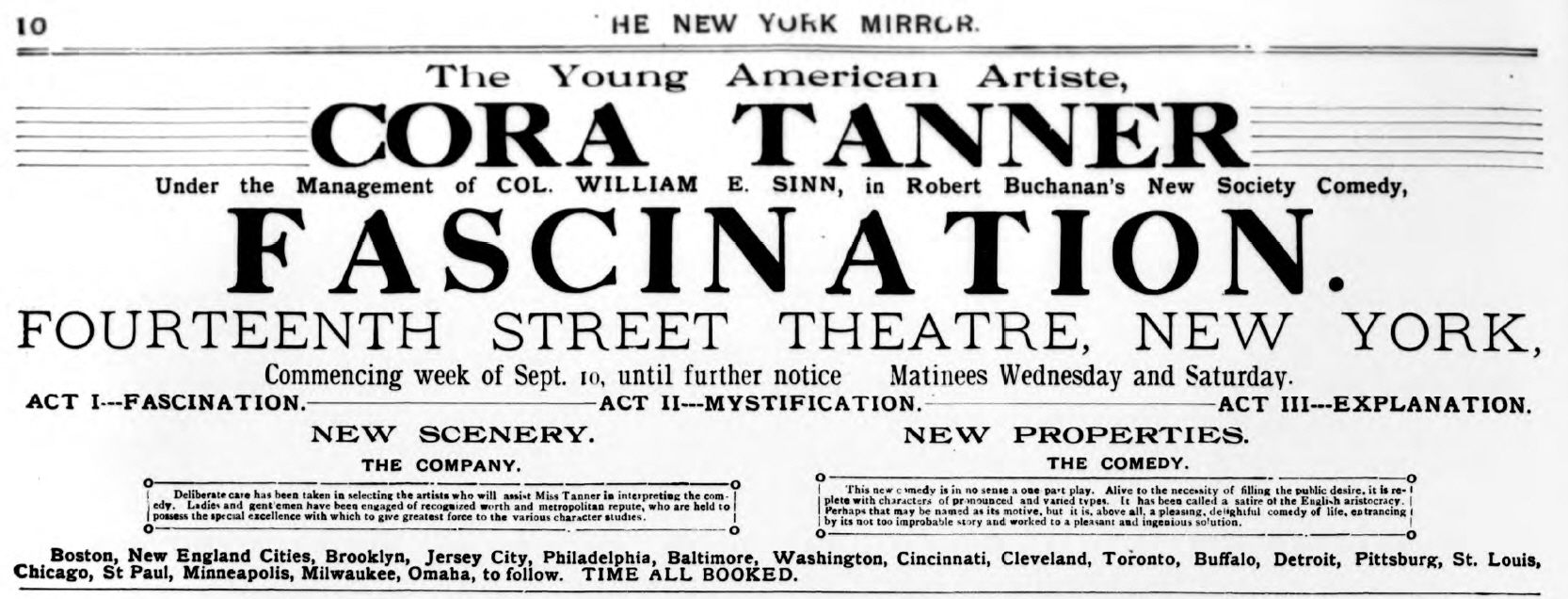
[Advert for Fascination from The New York Mirror (8 September, 1888 - p.10). Click image for readable version.]
New-York Daily Tribune (9 September, 1888 - p.16) Manager Rosenquest begins the regular fall and winter season at the Fourteenth Street Theatre tomorrow night, when Miss Cora Tanner will be seen for the first time in this city in a society drama called “Fascination,” which was written especially for her by Robert Buchanan, the author of “Alone in London.” The play was first produced last season at Colonel Sinn’s Theatre in Brooklyn, where Miss Tanner made an instant hit in the dual roles of Lady Madge Slashton and Charles Marlowe and established herself as an actress of unusual and varied ability. The parts are well suited to her style of work, and as Charles Marlowe, the handsome young actress is said to present a decidedly picturesque appearance. Her manager, Colonel Sinn, has selected the supporting company with great care, and, as the comedy is not a one-part play, they will have an excellent opportunity to display their ability. ___
The New York Times (11 September, 1888) AMUSEMENTS. “FASCINATION.” “Fascination” is a play written by Mr. Robert Buchanan. Its heroine (who, strangely, is also its hero) is Lady Madge Slashton, a healthy English girl, who can row a boat, ride a horse across country, and smoke a cigarette as well as her brother Sam, who is a pretty good hand at all these things, too. Lady Madge loves her cousin, Lord Islay (pronounced Eye-lay) and he loves her, too, but he is a fool of a fellow and proud of being seen at the opera with beautiful Mrs. Delamere, and of being looked upon by all the other fellows as the favourite guest at her handsome little dinner parties where the cards are brought in after the coffee and cigars, and the stakes are high. Now Mrs. Delamere is, of course, a common adventuress, not wholly to blame for her misdoing, poor thing, because she is in the toils of a villainous French Count, highly esteemed at the best clubs in London and an honored visitor in the homes of the élite, who, of course, is not a French Count at all, but just a plain thief, and a very stupid one, unworthy of his calling, as it turns out. ___
New-York Daily Tribune (11 September, 1888 - p.4) CORA TANNER IN “FASCINATION.” Cora Tanner made her first appearance in New-York last night at the Fourteenth Street Theatre, in Robert Buchanan’s new comedy “Fascination.” The house was well filled and the applause signified approval. The play is a daring experiment. It certainly merits the author’s claim of unconventionality, but this unconventionality is furnished by incidents and situations that are utterly impossible in life. The story is woven around Lady Madge Slashton, a bright, beautiful and fearless girl, who is betrothed to Lord Islay. The latter treats his engagement in a matter-of-fact way, while he amuses himself with a fascinating adventuress named Mrs. Delamere, who ultimately succeeds in enchanting Islay completely. Lady Madge, of course, has her eyes opened to the truth in time, but instead of pining away and nourishing a vain regret, she disguises herself in her brother’s attire and is presumed to become so metamorphosed that her false lover not only fails to recognize her, but becomes so jealous of her attentions to Mrs. Delamere that he is nearly involved in a duel with her. Even the keen perception of Mrs. Delamere, a woman of the world, is so blinded by the disguise that she actually falls in love with Lady Madge herself. A series of complications follows, but Lady Madge triumphs in the end, defeating her enemies and winning back her repentant lover. In the construction of the play Mr. Buchanan’s hand lacked the boldness of his ideas. There was too much uncertain wandering and unnecessary explanation before a situation was arrived at. The treatment, too, was a little crude, but there were two or three quiet bits of action that in a great measure made one overlook the rough edges. The comedy element was thoroughly English, much of it being quaint and pleasing. ___
The Evening Post (New York) (11 September, 1888 - p.8) MUSIC AND DRAMA. “FASCINATION.” “Fascination,” a machine-made melodrama of a coarse and hackneyed type, written by Robert Buchanan, and impudently called upon the playbills a satire upon the English aristocracy, was produced in the Fourteenth Street Theatre last evening for the purpose of displaying Miss Cora Tanner, an actress better known in Brooklyn than New York, in the character of a vulgarized Lady Gay Spanker, who masquerades as a man, and is a libel upon womanhood generally. The story is constructed upon the most antiquated of models, and deals chiefly with those violent travesties of life which are accepted as entirely veracious in country districts. There is a comic curate, who is an outrage on common sense and decency, an idiotic swell, a foreign sharper, a Hebrew money-lender, a scarlet woman or two, a fast young guardsman, and a host of other lay figures as old as the scenes in which they are made to move. Miss Tanner is an actress of limited experience and third-rate ability, who works hard, but is utterly unable to lend even a semblance of plausibility to the preposterous situations in which she is placed. Some of these, it may be added, are objectionable on other grounds than those of their absurdity. The mounting of the piece is fairly good, and Miss Eleanor Carey, Mr. Charles Coote, Mr. Edward Bell, and Mr. P. A. Anderson acquit themselves acceptably in the parts assigned to them. The other performers are mostly sad examples of misdirected ambition, but the piece is beyond all chance of redemption even by the best of acting. It was plainly intended to go on the road, and the sooner it is sent upon its mission, the better for this neighborhood. ___
The Daily Graphic (New York) (11 September, 1888) RECORD OF AMUSEMENTS. CORA TANNER IN “FASCINATION” AT THE The regular season at this popular house opened last night with Miss Cora Tanner in “Fascination.” The house was full to overflowing, with an audience that unmistakably enjoyed itself. ___
The Evening Telegram (New York) (11 September, 1888) MUSIC AND THE DRAMA. Cora Tanner In “Fascination” At the In his writings for the stage Robert Buchanan is a chronic if not a constitutional violator of the law of probability. Witness his “Alone in London,” and his adapted dramatization of a French story and play, which A. M. Palmer produced here as “Partners.” ___
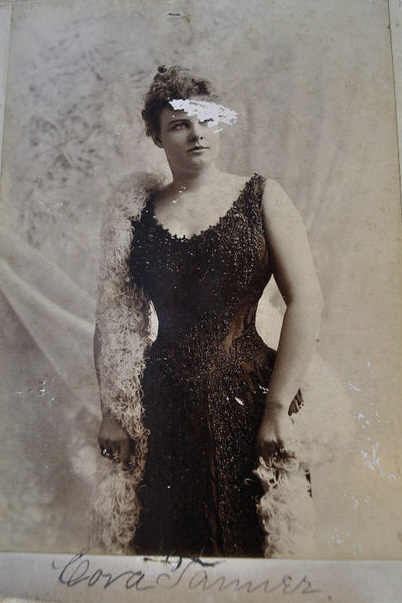
New York Herald (11 September, 1888 - p.5) THEY “LIKED IT VERY MUCH.” Robert Buchanan’s “Fascination” at ... Lady Madge Slashton .................................... The audiences at the Fourteenth Street Theatre for some time to come will resemble the Rev. Mr. Colley in “Fascination” and “Like it so much.” |
|
|
 |
|
|
|
|
|
|
|
|
|
|