|
|
 |
|
|
ROBERT WILLIAMS BUCHANAN (1841 - 1901)
|
|
|
|
9. When Knights Were Bold - Miscellanea
|
|
|
|
 |
|
|
|
|
|
|
1. Obituaries of three famous Guy de Veres:
i. James Welch
ii. Bromley Challenor
iii. Max Pallenberg
2. Jay v. Welch - When Knights Were Bold in Court
3. Die goldene Ritterzeit - the book
4. Odd items from the internet
i. Ernest Shackleton’s hat
ii. How Robert Buchanan and Harriett Jay Helped To Win World War 2
iii. Ken Russell
_____
1. Obituaries
James Welch
The Times (12 April, 1917 - p.9)
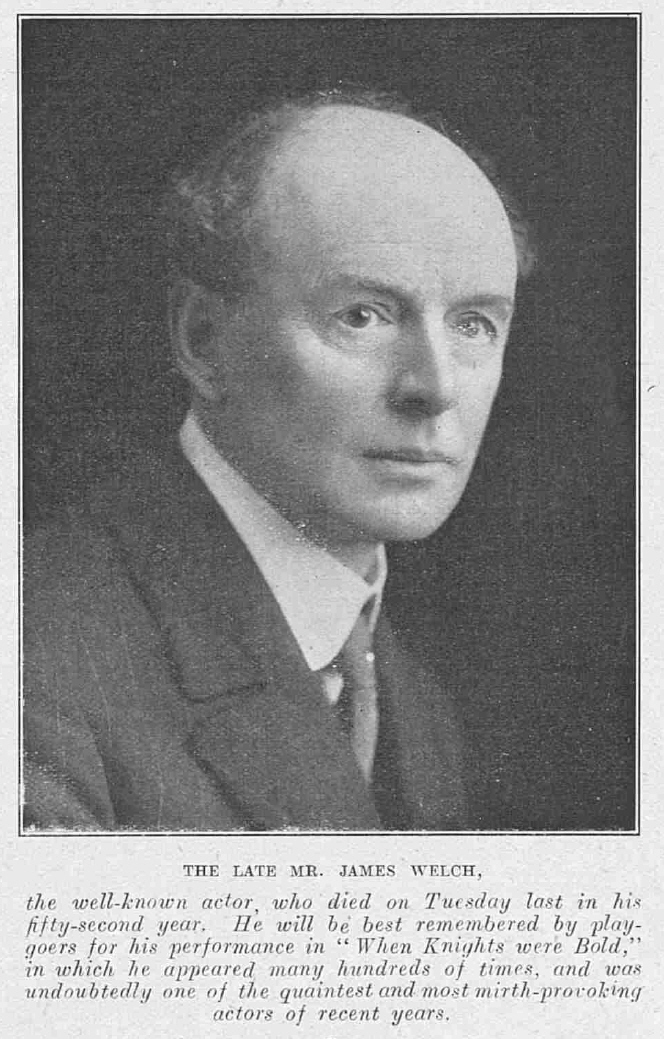
MR. JAMES WELCH.
The death has occurred of Mr. James Welch, the actor, who achieved such a great success in When Knights were Bold. He had been ill for some weeks and had not been able to appear on the stage for some time past.
The son of a chartered accountant of Liverpool, Mr. Welch began with amateur acting in his native town, and used to relate with glee that the first “line” he spoke on any stage was “This ’ere pie is a pie as is a pie, is this ’ere pie.” He came to London towards the end of the eighteen-eighties, about the same time as his brother-in-law, Mr. Richard Le Gallienne; and while the young poet found occupation as secretary to Wilson Barrett, the young actor became a member of his company. By the early ’nineties Mr. Welch had made a reputation as one of the most brilliant young players on the London stage, whether in comedy or in pathetic characters. He was one of those who took part in the earliest performances of Mr. Bernard Shaw’s plays, appearing as Lickcheese in Widowers’ Houses, on its first production in 1892, and as Petkoff in Arms and the Man at the Avenue in 1894. He was among the early Ibsenites also, taking the part of Hovstad in the first London production of An Enemy of the People in 1893. For the most part comedy claimed him, because he was extraordinarily funny; but one or two performances about that period showed him equally skilled in pathetic parts. A well-read man, he had more friends in those days (the days of “The Yellow Book”) among poets and novelists than among players; and his home in Gray’s Inn was a favourite resort with many of the “coming” men and women of the time. Later, he devoted himself almost entirely to farce, and the closing years of his life, much broken by the failing of health that had never been robust and needed particular care, were chiefly occupied with performances here, there, and everywhere of When Knights were Bold or The New Clown. If the promise of his early maturity was not fulfilled, he will be gratefully remembered as one of the greatest laughter-makers of his time.
___
Daily Express (Thursday, 12 April, 1917 - p.3)
DEATH OF JAMES WELCH.
_____
ACTOR OF INIMITABLE PATHOS AND HUMOUR.
_____
Mr. James Welch, the actor, died on Tuesday night at Ringwood, New Forest, after a lingering illness. His age was fifty-two, and he had been thirty years on the stage. He will be deeply regretted, both for his fine personal qualities and for his great talents as a comedian.
He had the most compelling of all stage gifts, the ability to command “the laughter that is akin to tears.” In that respect he could worthily be compared with the late John L. Toole. “Jimmy” Welch’s pathos was just as convincing as his laughter—and that was invariably uproarious. Nobody who saw him in “When Knights were Bold,” the mock-historical farce in which he acted more than a thousand times, is ever likely to forget the inimitable humour of his Sir Guy de Vere.
That play was his greatest popular success, but Mr. Welch’s art was by no means confined to the domain of bustling farce. In his early days he acted many varied parts in Wilson Barrett’s dramas and tragedies, and later he made an enviable reputation in Ibsen plays and the comedies of Bernard Shaw.
Thousands of playgoers will remember Mr. Welch for his comical cold in “When Knights were Bold.” It arose from a real cold. The audience roared at his wheezing and sneezing. They thought it was part of the play.
___
Daily Express (Thursday, 12 April, 1917 - p.1)
BOYS LOSE A GOOD FRIEND.
_____
ACTOR WHO BROKE UP HIS LIBRARY FOR THEM.
_____
By ORION.
The boys have lost a good friend in Mr. “Jimmy” Welch, whose death is reported elsewhere. So has the Cheery Fund. He was always helping it in one way or another. His later contributions were anonymous. He told me why.
Regular Cheery Funders will recall without effort how “Jimmy” Welch, at less than a week’s notice, got together a splendid company of artists for our fair at the Langham Hotel, and helped to make a great financial success of it. He took his turn, as auctioneer, and also bought so openhandedly that he left the fair without a penny in his pocket. He dwelt so long at the Langham that he had to dash off to do his turn at Croydon, where he arrived with only a minute to spare.
Frequently afterwards he used to pop into this office on a Sunday afternoon and cheer me up with his bright chatter. He never came empty-handed. He broke up his library for the boys, and most of his books went through my hands. Some must have cost him a pang to part with. Many of them were autographed by the authors. One, I remember, was a gift from Mr. Hall Caine to “Jimmy” Welch. Beneath the author’s signature was the printed dedication; below that was, “From James Welch to the Boys.” That volume, with many others, went to the Iron Duke. Mr. Welch said that “nothing was too good for the boys,” and that the hundreds of letters of thanks he had received through the Cheery Fund more than repaid him for the little he had been able to do.
One day he came into my room in his curious hesitating way. He was very “down” in the mouth. “My name must never again be mentioned in your column,” he said. He read to me portions of a letter he had received from another actor, in which he was accused of “giving to the Cheery Fund for the sake of advertisement.” I knew that to be untrue, because I had some trouble to get him to allow me to publish his name.
From that day, however, his name never appeared in our Honour List. His money did, though. And because he was a stanch believer in, and a good friend to, Jack and Tommy, may the earth rest lightly on him.
___
The Illustrated Sporting and Dramatic News (14 April, 1917 - p.5)
|
|
|
 |
|
|
|
The Bioscope (19 April, 1917 - p.7)
By the death of Jimmy Welch the theatre-going public loses a figure which it regarded almost with a personal affection, which was more deeply felt by all who had the privilege of more intimate association, for while his great sense of humour made him a delightful companion, his genuine heart qualities made him a sincere friend. His loss will be felt by the picture-going public, for in the film versions of “The New Clown” and “When Knights Were Bold” he showed an interest and adaptability for the new medium which promised much for his future work.
His first attempt was not in every respect a great success. I happened to meet him just after he had witnessed his own performance on the screen for the first time, and asked him what he thought of it. “Well,” he said, “some people regard me as a comedian, and some look upon me as a serious character actor. If anyone can tell from that film which I am, he knows a jolly sight more about me than I do!”
___
Daily Express (26 October, 1927 - p.8)
A Great Comedian.
Hesper Le Gallienne, who came from America, partly with the intention of tending the grave of her uncle, James Welch, the great comedian, writes me that everything is now settled. There was nothing to mark the grave. The patient niece searched for it for hours.
“There will be a little memorial service at Burley on November 6, Uncle Jim’s birthday,” she says. “My father, a couple of old friends, and myself have had a new cross put up. If possible, father will cross from Paris to be present. If any of his old friends care to send flowers they can be addressed to ‘The Vicar, Burley, Hants.’ and should any of them wish to be present the station is Ringwood, and the service at Burley at three.
“They do not know that, at his burial in the snow years ago, there were only three present, and one small bunch of flowers.”
“Father,” of course, is Richard Le Gallienne, the poet, who lives in New York, and whose daughter, Eva Le Gallienne, won, ten days ago, the £1,000 prize for the best work done by a woman in America that year. Her “work” was the Civic Theatre, Fourteenth-street, a brave and successful effort at repertory.
___
Daily Express (9 November, 1927 - p.9)
James Welch’s Grave.
There has been a family argument over James Welch’s grave.
Hesper le Gallienne, the niece of the famous comedian’s first wife, told me that “as there was nothing to mark the grave” there was to be a memorial service at Burley last Sunday, her father—Richard le Gallienne, the poet—two old friends and herself having arranged to have a new cross put up.
Later, Miss le Gallienne wrote me that Mrs. Ward, who was Mr. Welch’s second wife, objected to the erection of the new memorial.
“My solicitor wrote Alan Welch, nephew and next of kin of James Welch,” she says, “and it appeared that his sanction was all that was needed. It appears otherwise. If the law prevents Uncle’s friends erecting a new memorial, we will have a brass plate put in the church.”
Comedian’s Widow Replies
“The true facts are these,” writes Mrs. Ward, who has since remarried, and who used to act with her first husband under the name of Audrey Ford. “My husband, the late James Welch, had been living apart from me for some time before his death in 1917. I saw him during his last illness, and his brother and I assured ourselves that he received proper attention.
“His death came suddenly while he was in charge of a doctor in the New Forest. Mr. John Welch and myself supervised the arrangements for the funeral, which was carried out in all suitable order by the Vicar of Burley, and a memorial cross, designed by Albert Toft, R.A., and executed by Messrs. W. Aumonier, was placed over the grave on my instructions.
“I do not know why Mr. Welch’s niece should have found it necessary to search for hours in the minute cemetery of the church at Burley, for I presume the vicar or other parochial authorities could have easily pointed out the spot where Mr. Welch lies buried.”
_____
Bromley Challenor
The Daily Mirror (18 December, 1935 - p.5)
|
|
|
 |
|
|
|
The Times (18 December, 1935 - p.10)
DEATH OF MR. BROMLEY CHALLENOR
SIR GUY DE VERE, OF “WHEN KNIGHTS WERE BOLD”
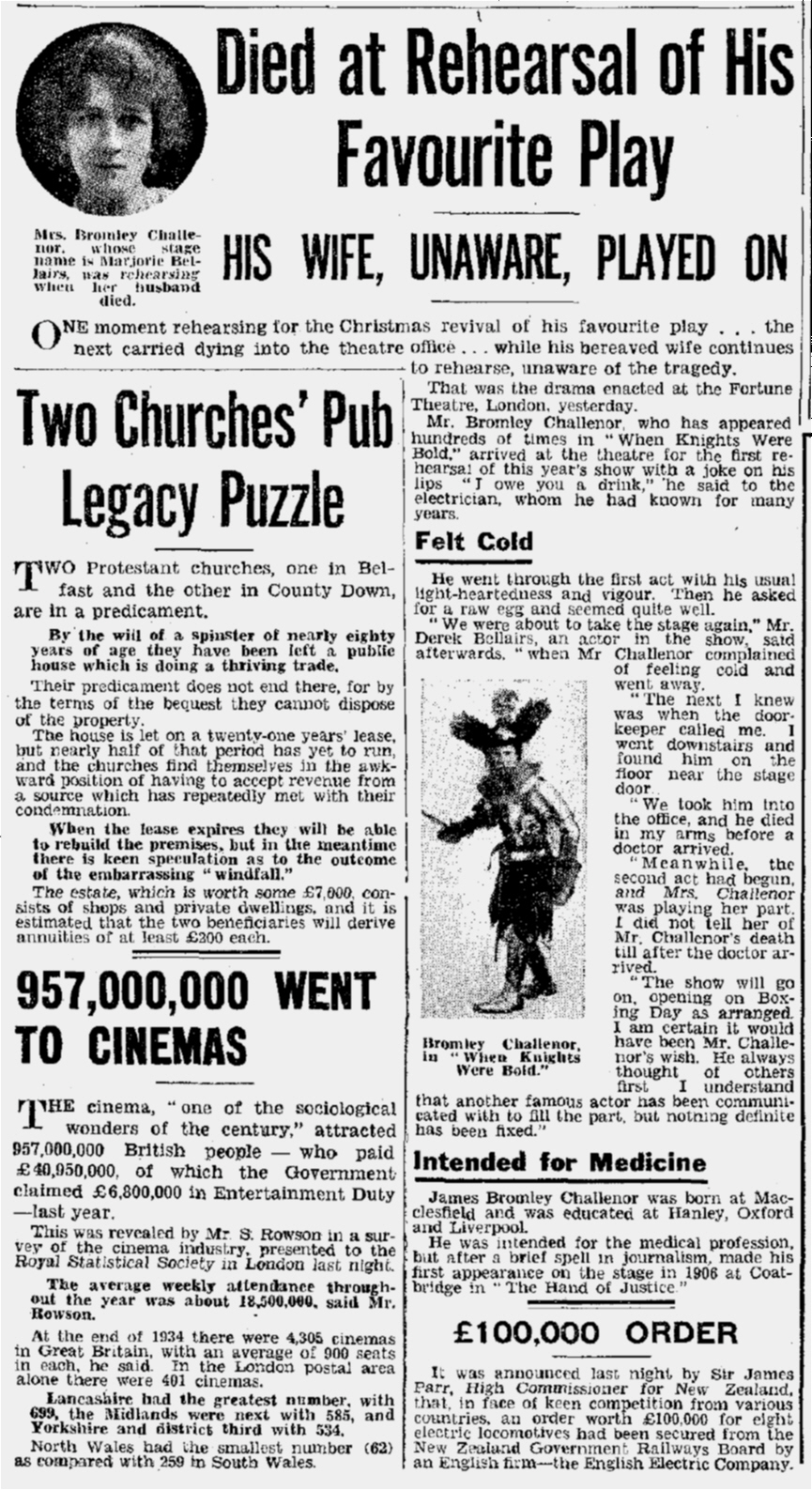
Mr. Bromley Challenor, the actor, died at the Fortune Theatre, yesterday, at the age of 51, while rehearsing in When Knights Were Bold, the play which made him famous. He stepped from the stage after the first act and collapsed.
Mrs. Challenor, who acts under the name of Miss Marjorie Bellairs, had taken her call for the second act, and she was on the stage when her husband was dying. After a doctor had been called, she was told of her husband’s death.
It was stated yesterday that the play would go on, as that would have been Mr. Challenor’s wish.
James Bromley Challenor, who was born at Macclesfield on September 3, 1884, was educated privately at Hanley, Oxford, and Liverpool. After studying for the medical profession he tried journalism, but his taste was for the theatre, and he made his first appearance on the stage in 1906 at Coatbridge in The Hand of Justice. In 1915 he purchased the rights of When Knights Were Bold, and, as the inimitable Sir Guy De Vere, he soon became known throughout the country, where he went on tour. In 1917 he began the first of a long series of Christmas revivals of the play at the Kingsway Theatre. As long ago as 1920 he stated that he had worn his suit of armour over 2,000 times.
Bromley Challenor appeared in many light plays at the Kingsway Theatre, the Scala, the Adelphi, and the Criterion, as well as on several tours. He played the Hon. Bertie Stuart in Society Ltd. at the Court Theatre in 1923, Tom Squire in The Audacious Mr. Squire, and Amos Bloodgood in Are You a Mason? During 1928 he toured in the popular success The Punch Bowl, and more recently in Gentlemen Prefer Crooks. He was also part author with Mr. Wilfrid Stephens of The Yellow Cockade, which ran at the Scala in 1920. Mr. Challenor embarked on several managerial ventures, and from time to time suffered heavy losses owing to temporary theatrical slumps. In 1930 he lost over £1,000 in connexion with the conversion of a parish hall in Kensington into a “Playgoers Theatre.”
He married Emily Reid Woodward, professionally known on the stage, as stated above, as Marjorie Bellairs.
___
The Scotsman (18 December, 1935 - p.12)
MR BROMLEY CHALLENOR
Well-Known Actor’s Death in London Theatre
MR BROMLEY CHALLENOR, the well-known actor, collapsed and died at the Fortune Theatre, London, yesterday, shortly before the first rehearsal of the Christmas revival of “When Knights Were Bold,” his favourite play, in which he had appeared hundreds of times.
He arrived at the stage door at noon, and spoke jovially to the electrician, whom he had known for many years. He suddenly staggered, and said that he felt cold, then he collapsed. Stage-hands and actors rushed to his aid, and he was carried to a room. A doctor was summoned, but Mr Challenor died in a few minutes. Death was due to a heart seizure. Mr Challenor was 51.
Originally intended for the medical profession Mr Challenor, after a brief spell in journalism, made his first appearance on the stage in 1906 at the Theatre Royal, Coatbridge, in “The Hand of Justice.”
In 1915 he purchased the rights of “When Knights Were Bold,” and, as the inimitable Sir Guy de Vere, he soon became known throughout the country.
He was born at Macclesfield and was educated privately at Hanley, Oxford, and Liverpool. He married Emily Reid, professionally known as Marjorie Bellairs.
_____
[Although James Welch and Bromley Challenor were the two actors most identified with the role of Sir Guy de Vere, the rave review for Max Pallenberg in the Berlin production of When Knights Were Bold sparked my curiosity.]
Max Pallenberg
The Times (27 June, 1934 - p.11)
HERR MAX PALLENBERG
COMEDIAN IN FARCE AND OPERETTA
Herr Max Pallenberg, whose death in an aeroplane accident near Karlsbad is reported on another page, was an actor long famous on the German stage.
He was one of that large company of persons distinguished in the theatre who received their theatrical training in the stimulating atmosphere of Vienna at the turn of the century; came to Germany and combined to bring international renown to the Berlin stage in the years immediately before and after the War; and have now disappeared from Germany as completely as last year’s snows, usually because they or their wives had Jewish blood. Among them are Herr Max Reinhardt, Fräulein Elizabeth Bergner, and Pallenberg’s wife, the revue and operetta actress Fritzi Massary.
Pallenberg was born in Vienna in 1877. He came by way of a small touring company to the Deutsches Volkstheater in Vienna, and subsequently to Berlin and Reinhardt, who at that time was developing ideas which, whatever may be thought of them now, then invigorated and stimulated theatrical methods in many countries. Pallenberg in his time had played many parts, and all with distinction. Older playgoers remember with affection his rendering of such characters as Argan in the Malade Imaginaire, but to the general public he was above all an inimitable comedian in farce and operetta. With his fellow-players he was sometimes less popular than with the public, and that was due to a habit of unbridled improvization which, though dutiful audiences often laughed uproariously, did not do justice to himself, harmed the play, and sometimes led an exasperated partner to ask audibly, “Shall we go on with the play now?”
_____
2. Jay v. Welch - When Knights Were Bold in Court
The Times (21 July, 1917 - p.4)
HIGH COURT OF JUSTICE.
CHANCERY DIVISION.
“WHEN KNIGHTS WERE BOLD”:
PERFORMING RIGHTS.
JAY v. WELCH.
(Before MR. JUSTICE ASTBURY.)
The question who was entitled to the performing rights in When Knights were Bold on the death of Mr. James Welch in April last came before the Court to-day. On July 3 Miss Harriet Jay, who wrote the play some time before 1901, and who is also the author of “The Life of Robert Buchanan,” issued a writ against Mrs. Amy Hannah Welch, the widow and administratrix of the estate of her husband, Mr. James Welch, asking the Court to declare that an agreement in writing dated September 9, 1905, between the plaintiff and Mr. James Welch as to the performing rights of a play therein called Good Old Times, but now called When Knights were Bold, was an agreement personal to Mr. James Welch, and that it ceased to be operative on his death. The plaintiff also asked for an injunction restraining the widow, as administratrix, from producing or performing or licensing the performance of the play or any adaptation or translation thereof.
Under the agreement of September 9, 1905, Harriet Jay granted to Mr. James Welch the sole right to perform the play in any place or country whatever, and also the sole right to license the performance of any adaptation or translation of it, and Mr. James Welch was to be at liberty to make any reasonable alteration in the play for the production and performance of it. Miss Harriet Jay was to receive for every performance in any West-end London theatre three guineas, and one pound ten shillings for each performance in any provincial town and London suburban theatre specified in a schedule to the agreement, and £1 for every performance in any other provincial town in Great Britain.
Miss Jay had made up her mind from the first that the success of the play depended to a great extent on the production of it with Mr. James Welch in the leading part, and she withheld the production of it for nearly four years so that he might appear in it.
The play was first produced in September, 1906, under the agreement, with Mr. Welch in the leading part, and it proved to be very successful. So favourable to Mr. Welch were the terms arranged by the agreement that his profit from the play, apart from his salary as actor, amounted to £20,000.
In these circumstances Miss Jay contended that the contract in 1905 was with Mr. James Welch personally, and that he was the only person able to carry out the terms of that contract, which, therefore, could not be extended beyond his lifetime.
To-day the plaintiff, Miss Jay, asked the Court to grant an injunction to restrain the defendant, as administratrix of the estate of Mr. James Welch, until the trial of the action, from producing or performing or licensing the play or any adaptation or translation thereof. Until his last illness the leading part in the play was always performed by Mr. Welch himself, except in cases in which he could not perform personally, but in every case (whether he took the leading part or not) the company was selected and rehearsed by him personally. Since the time when the state of his health precluded Mr. Welch from acting in the play his part had been taken by a Mr. Challenor under arrangement which, as between Mr. Welch and Miss Jay, was verbal. By that agreement Mr. Welch was entitled to receive 5 per cent. of the gross takings, and Miss Jay was entitled to receive in turn from Mr. Welch, instead of any fees payable under the agreement made in 1905, 40 per cent. of the 5 per cent. to be received by him.
It had been agreed that this motion by the plaintiff for an injunction should be treated as the trial of the action, but in the result it was arranged that the motion should stand over for a week, and that during that time the arrangement with Mr. Challenor should continue.
Mr. Coldridge, K.C., and Mr. J. K. Young appeared for the plaintiff; and Mr. Jenkins, K.C., and Mr. Horace Freeman for the defendant.
Solicitors.—Messrs. Martyn and Martyn for the plaintiff; Messrs. Lithgow and Pepper for the defendant.
___
The Times (20 October, 1917 - p.2)
“WHEN KNIGHTS WERE BOLD.”
JAY v. WELCH.
(Before MR. JUSTICE NEVILLE.)
In this action, Miss Jay, the writer of the play When Knights were Bold, sought to restrain the defendant, Mrs. Welch, who was the administratrix of Mr. James Welch, the actor, from producing or granting licences to produce the play. The plaintiff had granted a licence to J. A. Welch to produce the play and the question raised in the action was whether that licence was personal to the actor or whether it passed on his death as part of his estate to the defendant.
Mr. WARD COLDRIDGE, K.C., (Mr. J. K. Young with him), who appeared for the plaintiff, said that the parties had now come to terms under which the licence granted to the actor was to be cancelled; the plaintiff was to remain the sole proprietor of the play and would make certain money payments to the defendant, and all further proceedings in the action would be stayed.
Mr. JENKINS, K.C. and Mr. HORACE FREEMAN, who appeared for the defendant, concurred.
Solicitors.—Messrs. Martyn and Martyn; Messrs. Lithgow and Pepper.
_____
3. Die goldene Ritterzeit - the book
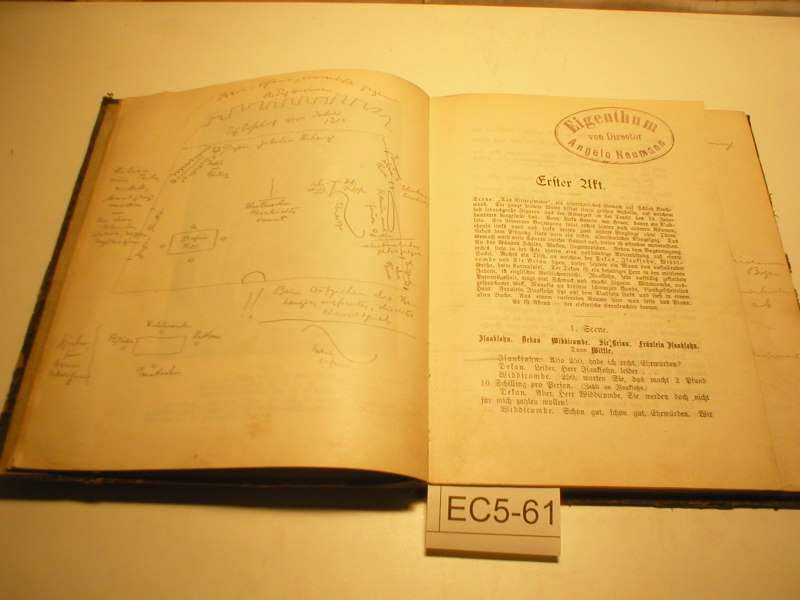
For some reason When Knights Were Bold was never published. However, the German translation by Siegfried V. Lutz, Die goldene Ritterzeit, was published in Berlin in 1910. I came across this picture of the book with the accompanying description in German which says (I hope, since I had to use an online translator) that it belonged to Angelo Neumannn (1838-1910), opera singer and theatre impresario.
|
|
|
|
 |
|
|
|
“Marlowe, Charles:
Die goldene Ritterzeit. (When Knights Were Bold) Burlesker Schwank in drei Akten. In Deutsche übertragen von Siegfried V. Lutz.
Berlin Verlag Eduard Bloch 1910.
Halbleineband der Zeit, 8°, 87 Seiten, Exemplar aus dem Besitz von ANGELO NEUMANN durchschossenes Exemplar mit Regieanweisungen und Anmerkungen von Angelo NeumannnNeumann Angelo, Sänger und Theaterdirektor. Geb. Wien, 18. 8.1838; gest. Prag, 20.12.1910. Vater des Indologen Karl Eugen N. (s. d.); wirkte anfangs in Krakau, Preßburg und Danzig, später wurde er Opernchef und administrativer Leiter des Leipziger Stadttheaters (1876-82). Mit seinem aus 132 Mitgl. bestehenden Richard Wagner-Gastspieltheater, in dem hervorragende Künstler, wie E. Scaria, M. Brandt, H. Reicher-Kindermann, H, und T. Vogl, A. Schott u. a., mitwirkten, bereiste er 1882/83 Österr.-Ungarn, Deutschland, Belgien, Holland, die Schweiz und Norditalien. 1884 war er Dir: des Landestheaters in Bremen, 1885-1910 Dir. des Dt. Landestheaters in Prag, das er zu ungeahnter Blüte brachte. Da am tschech. Nationaltheater in Prag Opern roman, und slaw. Ursprungs gespielt wurden, fiel N, die Aufführung von dt. Werken zu. Er kannte die Macht der Konkurrenz und verstand es sich ihr erfolgreich entgegenzustellen; ebenso erfolgreich setzte er sich mit antikünstler. Kompromissen und dem Mittelmaß auseinander. Seine Prager Ära zeichnete sich aus durch eine glückliche Wahl von künstler. Kräften (Dirigenten wie G. Mahler, s. d., K. Muck, F. Schalk, L. Blech, Sängerinnen wie Förstel, s. d., M. Siems etc.), durch ein ansprechendes, wertvolles Repertoire und durch kühne Unternehmungen, wie z. B,die große Gastspielreise mit Wagners Ring des Nibelungen" nach Rußland, ferner. durch Zyklen von Opern (Gluck, Mozart, Weber, Meyerbeer, Verdi und bes. Wagner) und Schauspielen (Shakespeare, Goethe, Schiller, Grillparzer, s. d., Anzengruber, s. d., Hebbel, s. d., Ibsen) sowie durch interessante Neuheiten (Der polnische Jude" von Weis, Tiefland" von d'Albert, Pelleas und Melisande" von Debussy). N.s sog. Maifestspiele und Symphoniekonzerte waren auch außerhalb der Landesgrenzen populär.”
_____
4. Odd items from the internet.
i. Ernest Shackleton’s hat
Geographical (Vol.79. No. 1, January, 2007)
Shackleton's hood: headgear worn by the renowned polar explorer during his first attempt to reach the South Pole.
Famed for a lifetime of polar exploits, Ernest Shackleton demonstrated an adventurous spirit from an early age. When he was 14, he enlisted in the Navy and by 16, he had joined the crew of the Hoghton Tower, a rigger owned by the North Western Shipping Company.
His first trip, an extremely rough turn around Cape Horn, was immediately followed by four years spent sailing to far- flung destinations including Asia and the USA. Then, in 1898, at the tender age of 24, he qualified as a master mariner. The following years were spent working on a mail ship, until, while on leave in 1900, he wrote a letter volunteering to join Captain Robert Falcon Scott and Edward Wilson on their expedition to Antarctica.
The party set sail on the summer of 1901, reaching the White Continent in January 1902. Eleven months later, Scott, Shackleton and Wilson set out for the South Pole, but were thwarted by severe blizzards, fatigue, frostbite and snow blindness. Shackleton fared particularly badly, displaying symptoms of advanced scurvy. In the face of bitter protests, Scott eventually ordered him to return home aboard the relief ship Morning.
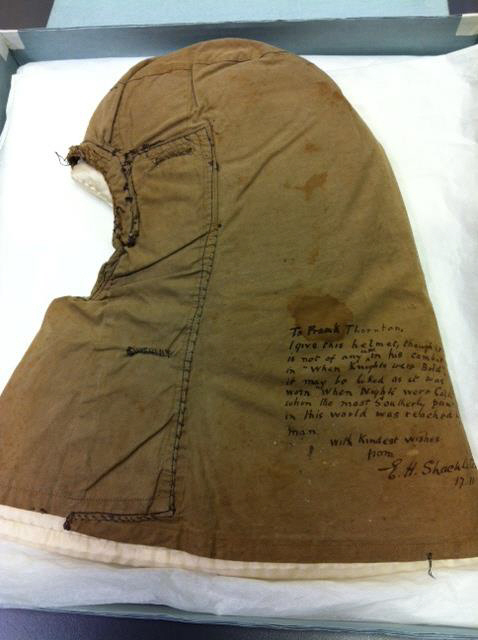
Shackleton had worn a Burberry hood on the aborted mission to the pole, and when, in 1907, he set off to lead a second polar expedition, he took it with him. While travelling to join his team in Australia aboard the SS India, he befriended an actor by the name of Frank Thornton, and when the pair parted company, Shackleton gave him the hood as a keepsake.
Thornton's daughter, Vera Copeland, who gave the hood to the Royal Geographical Society, wrote about her father's encounter with the polar explorer in a letter dated February 1922. “In 1907, my Father, the late Mr Frank Thornton, took a Company to Australia to produce ‘When Knights were bold’ and other plays. Sir Ernest was a fellow-voyager in the SS India and a warm friendship sprang up between the two. The particular incident leading to an exchange of mementos was their collaboration in a concert organised during the voyage in aid of nautical charities.”
Before giving Thornton the hood, Shackleton inscribed it with a message: “To Frank Thornton: I give this helmet though it is not of any use in his combat in ‘When ...
___
Unfortunately that’s where the free extract from the original article ends. However, here’s a photo of Shackleton’s hood and the full inscription reads:
“To Frank Thornton, I give this helmet, though it is not of any use in combat in ‘When Knights Were Bold’ it may be liked as it was worn ‘When Nights Were Cold’ when the most southerly point in this world was reached by man. With kindest wishes from E H Shackleton.”
|
|
|
|
 |
|
|
|
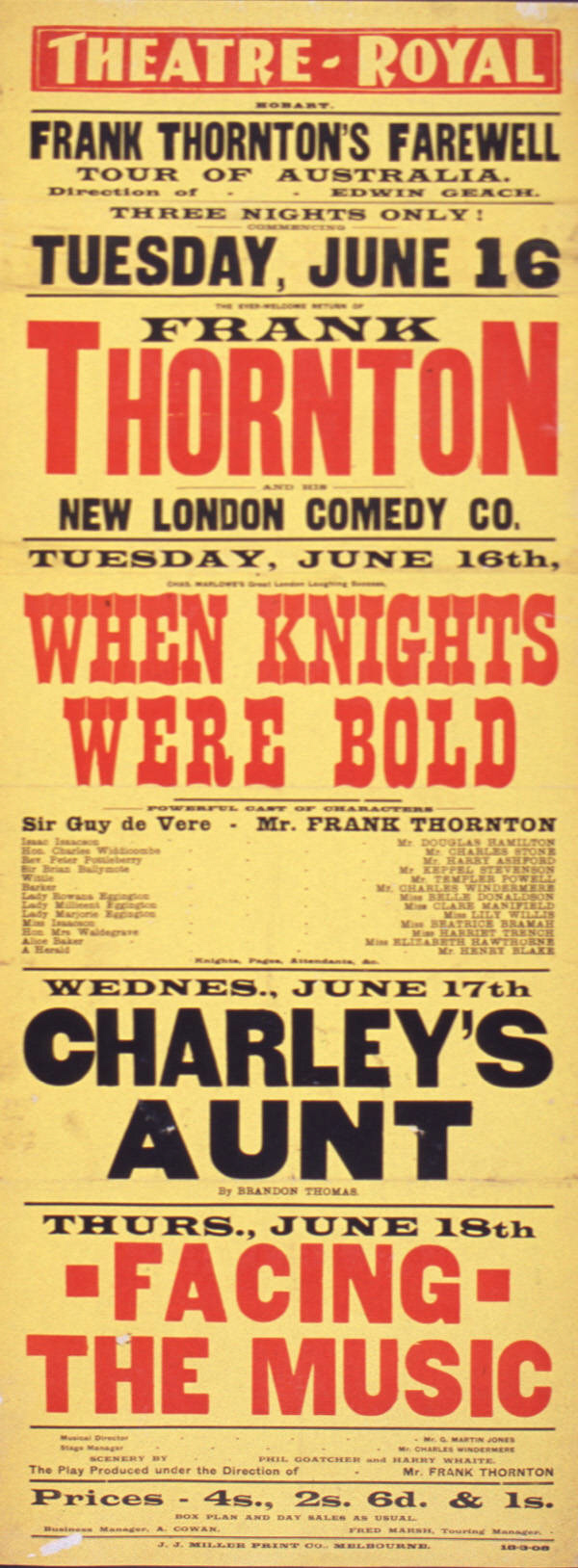
And here’s a poster from Frank Thornton’s farewell tour of Australia where When Knights Were Bold played at the Theatre Royal, Hobart, Tasmania on Tuesday 16th June, 1908.
|
|
|
|
 |
|
|
|
wikipedia:
“Perhaps the most famous political decoy, soldier M.E. Clifton James successfully impersonated General Bernard Montgomery (‘Monty’) for intelligence purposes during World War II.
In 1940, James acted in an Army production called When Knights Were Bold and his photograph appeared in an Army newspaper with a remark about how much he resembled General Montgomery.
As a result, he was approached by actor David Niven in May 1944. Niven, then a Colonel in the Army Kinematograph Section, told James he was wanted to impersonate ‘Monty’, as this would allow Montgomery to be somewhere else, so confusing the Germans.
James had to learn Montgomery’s gestures, mannerisms, gait and voice and had to give up smoking.
Because James had lost his right-hand middle finger in the First World War, a realistic replacement was made.
Even his wife had to be deceived and was both kept in the dark and sent back to Leicester. Once he was trained, his trip as ‘Monty’ was to Gibraltar and from there to Algiers. ‘Monty’s’ presence succeeded in confusing the Germans in regard to the invasion plans.
James was later the subject of a biopic called I Was Monty’s Double starring James himself in (of course) the double role as Monty and himself.”
___
And a more poignant reminder of another war appears in this letter from a Canadian soldier written in France on 28th November, 1917.
_____
iii. Ken Russell
Still the most notable enfant terrible of British Cinema, Ken Russell also appeared in When Knights Were Bold according to his article, ‘I was Billy Elliot until I became a space cadet’ in The Times (10 April, 2008):
“From dancing to acting is but one short step, which soon led me to a season with the Garrick Players in Newton Poppleford, South Devon, where playing a ghostly suit of armour in When Knights Were Bold during summer storms in the Redoubt Gardens, Teignmouth, was a risk worth taking only for a limited period. I just didn’t want to end my career as a burnt-out lightning conductor.”
Which is confirmed by an extract from a biography of Russell by Joseph Lanza (Phallic Frenzy: Ken Russell and his Films - Chicago Review Press, 2007):
“Taking a stab at being an actor, Russell perused the trade magazines before passing an audition for the Garrick Players of Newton Poppleford in South Devon, reading out the parts to Act 2 of Oscar Wilde’s Lady Windermere’s Fan. But the first night he was to perform, he faced what would be several brushes with his sexual identity: “I was supposed to be an ordinary chap in the play who comes in and says something like, ‘ Can I make a telephone call?’ But I had these eyelids painted purple and green with black and silver lines sweeping back to my ears. The others looked at me and thought; oh, he’s one of those.”
Russell tried lowering the volume on his makeup but still muffed up when donning armor for When Knights Were Bold, overacting as a decrepit old man for a part in Act 2 that required a man of only forty. Russell recalls the final performance in a park “to an audience of about three people, braving it out in the drizzle.” Alas, what seemed to be Ken’s Curse fell on that company as well: it too folded.”
_____
Back to When Knights Were Bold main menu
or on to Robert Buchanan’s Short Plays
|
|