 |
|
|
Play List: 4. Corinne 7. The Mormons 9. Lucy Brandon 10. Storm-Beaten 11. Lady Clare 13. Bachelors 14. Constance 15. Lottie 16. Agnes 17. Alone in London 18. Sophia 19. Fascination 20. The Blue Bells of Scotland 21. Partners 24. Angelina! 25. The Old Home 26. A Man’s Shadow 27. Theodora 29. Clarissa 30. Miss Tomboy 32. Sweet Nancy 33. The English Rose 36. Marmion 37. The Gifted Lady 38. The Trumpet Call 39. Squire Kate 40. The White Rose 42. The Black Domino 44. The Charlatan 45. Dick Sheridan 47. Lady Gladys 48. The Strange Adventures of Miss Brown 49. The Romance of the Shopwalker 52. Two Little Maids from School ___ |
|
|
|
ROBERT WILLIAMS BUCHANAN (1841 - 1901) |
|
|
|
|
|
|
|
|
|
THEATRE REVIEWS 33. The English Rose (1890) - continued
The Referee (10 August, 1890 - p.3) I am requested by Mr. Robert Buchanan to state that the allegations of Mr. John Coleman regarding “The English Rose,” published in the Era to-day (Saturday), will be traversed fully in the next number of the same journal, and that a literal translation of the French drama referred to will be issued for private circulation. ___
Truth (14 August, 1890 - p.6) The dispute between Mr. John Coleman and Mr. Robert Buchanan is curious and instructive. So far as I can ascertain, the facts are these:—When Mr. Coleman was lessee of the Queen’s Theatre, in Long-acre, and had lost money in an endeavour to revive a taste for Shakespeare, he meditated a volte-face to sensation melodramas. His attention was called to an old French drama, “Le Serment du Prêtre,” which contains a Corsican story of a vendetta, two brothers in love with the same girl, who is, of course, the daughter of a hated race; one brother adopting the priesthood in order to clear the way for the other; a murder; the confession made to the priest; the accusation of the priest’s brother, and the condemnation of an innocent man, who is saved from death by the skin of his teeth. Mr. Coleman at once saw the feasibility of turning this old play into an Irish drama. The vendetta would be the English and the Irish. The priest’s oath would be as valuable in Ireland as in Corsica. So Mr. Robert Buchanan, at Mr. Coleman’s request, made the “scenario” of the Irish play, which is now in Mr. Coleman’s possession, but retained the free adaptation of the French drama. Repeated applications were made for the English adaptation of “Le Serment du Prêtre,” but it could not be found. Eleven years after, a new and original Irish drama by Mr. George R. Sims and Mr. Robert Buchanan is produced at the Adelphi. It contains no signs of a vendetta, excepting that the English and the Irish are at loggerheads, but it contains two brothers both in love with the same girl—an enemy of their race. One brother takes orders so that he may no longer be a rival; a confession of murder is made to the priest brother; the lay brother is accused of the crime, condemned, and the priest brother’s mouth is still sealed. The murderer’s confession ends the story happily. Now, of course, all this may be a pure coincidence. Mr. Buchanan may have forgotten all about the “scenario” that he wrote for Mr. Coleman, and which is now in existence and in Mr. Coleman’s possession; but in order to further complicate matters it is asserted that the entire plot of “The English Rose” was invented by Mr. Sims, and not by Mr. Buchanan at all. The matter is easily settled one way or the other by either Mr. Sims or by Mr. Buchanan. Mr. Coleman has taken the floor and had his say. Who speaks next? ___
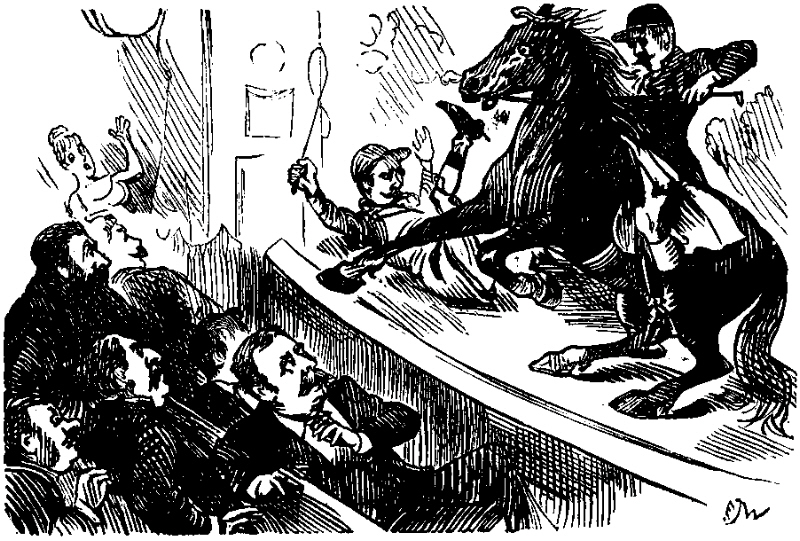
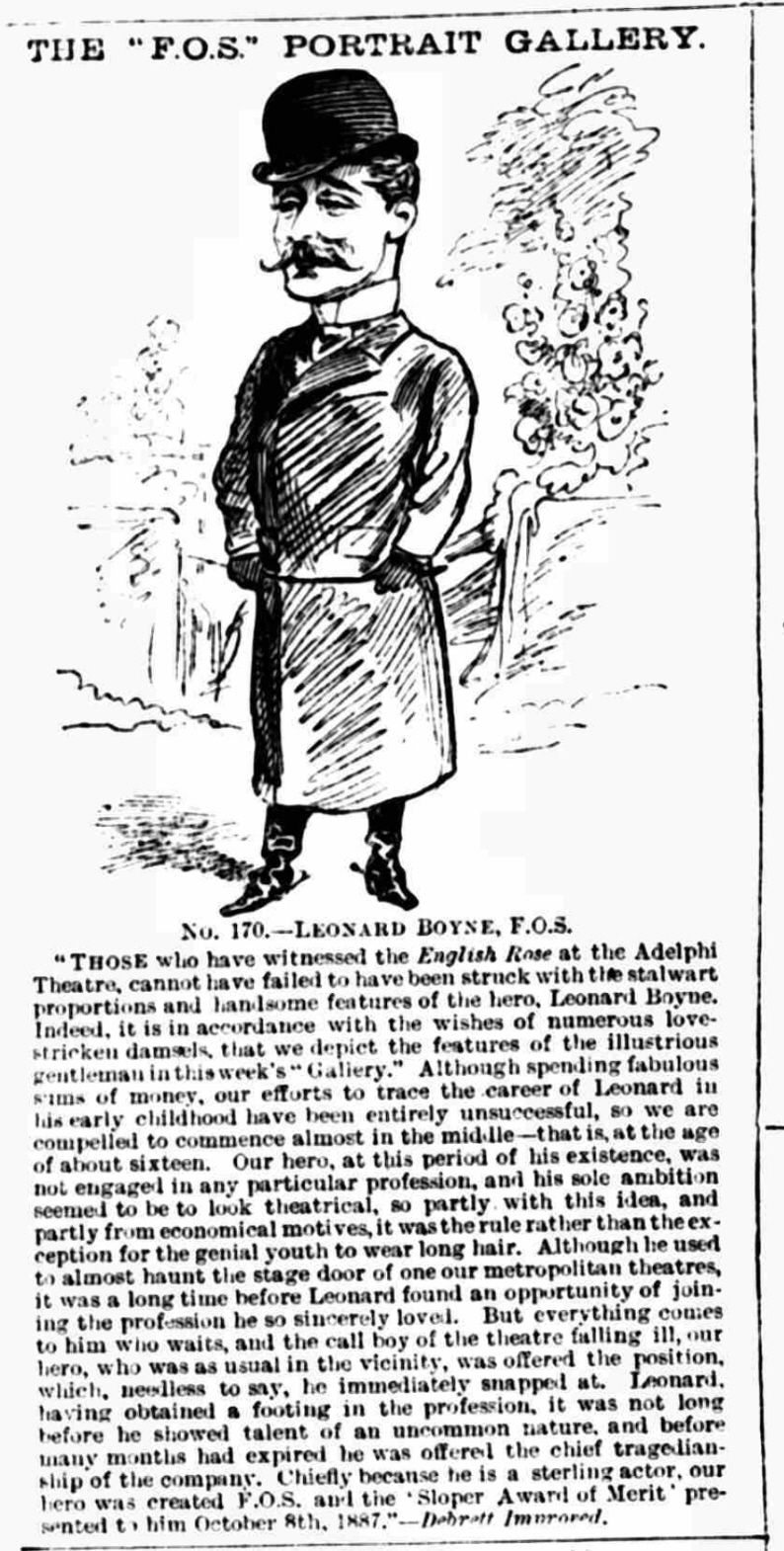
Western Mail (Cardiff) (15 August, 1890) EXCITING INCIDENT AT THE Leonard Boyne had a narrow squeak of his life at the Adelphi the other night. One of the most exciting incidents of “The English Rose” is a dashing piece of horsemanship, of which Mr. Boyne shares the credit with a fine specimen of the thoroughbred called “Tearaway.” The actor mounts the horse on the stage, has an exciting struggle on horseback with the villain, and then dashes off at full gallop into the wings on the way to the Devil’s Bridge, where there is murder doing. A very fair horseman, Mr. Boyne takes delight in showing off the mettle of his steed. On this night he used the snaffle with such effect as to make the horse rear, and then back up the stage on its hind legs. Unfortunately, a low raised platform was in the way, and the horse coming against this fell backwards over it. It seemed a certainty almost that the horse had fallen over on to his rider. If he had Mr. Boyne would not have been seen at the Adelphi for some time to come. But partly through luck and partly through expertness Mr. Boyne managed to fall just where the platform kept him clear of the horse. He was up again in a moment safe and sound, leaped again into the saddle, and after tearing round the stage went off as if he were riding for his life. Never was such a scene of excitement and enthusiasm. The other actors at the Adelphi look on in fear and wonder at Leonard Boyne’s daredevil horsemanship. ___
Punch (16 August, 1890) STARS IN THE STRAND; OR, THE HORSE AND THE LADY. MY DEAR MR. PUNCH, One of the greatest attractions in Town to the Country Cousin I need scarcely say is the Theatre. Speaking for myself, it is the place I earliest visit when I get to London, and consequently I was not surprised to find myself the other evening in the Adelphi, on the first night of a new play. As an Irishman might guess, from its name (The English Rose), the piece is all about Ireland. Both State and Church are represented therein—the former by a comic sergeant of the Royal Constabulary, and the latter by a priest, who wears a hat in the first Act that would have entirely justified his being Boycotted. The plot is not very strong, and suggests recollections of the Flying Scud, Arrah Na Pogue, and The Silver King. The acting is fairly satisfactory, the cast including a star, supported by an efficient company. The star is a horse that pranced about the stage in the most natural manner possible, carefully avoiding the orchestra. In spite, however, of his anxiety to keep out of the stalls, suggestive as they were (but only in name) of the stable, some little alarm was created in the neighbourhood of the Conductor, which did not entirely subside until the fall of the curtain. But the sagacious steed knew its business thoroughly well, and was indeed an admirable histrion. Only once, at the initial performance, did this intelligent creature remember its personality, and drop the public actor in the private individual. The occasion was when it had to put its head out of a loose-box to listen to the singing of a serio-comic song by a lady, dressed as a "gossoon." For a few minutes the talented brute made a pretence of eating some property foliage, and then, catching sight of the audience, it deliberately counted the house! I regret to add that, in spite of the valuable support afforded by this useful member of the Messrs. GATTI's Company, its name did not appear in the playbill. |
|
|
 |
|
|
|
|
|
|
|
RISING TO THE SITUATION! ___
The Illustrated Sporting and Dramatic News (16 August, 1890 - (p.9) GOOD horseman though he is, Mr. Leonard Boyne had what might have been a nasty accident in his spirited equestrian scene at the Adelphi one night last week. His steed, which, as we have already remarked, is not at all like the ordinary cab-horse used for racing and hunting on the stage, was frightened by the noise of the crowd of theatrical peasants, reared and nearly fell upon its rider, who was lucky to escape with nothing worse than a rather heavy fall. Mr. Boyne soon picked himself up and rode off amid the cheers of pit and gallery, which doubtless thought the whole affair was part of the regularly rehearsed action. But the actor looked rather pale and dazed, as well he might; and the episode may usefully suggest a little extra care over this showy but risky bit of business. Miss Olga Brandon appears rather stronger than she did on the first night of The English Rose; but her voice seems still to give her some trouble.
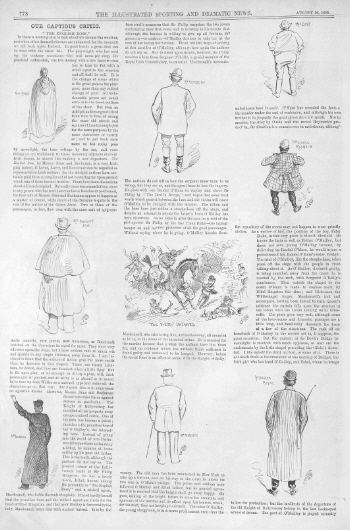
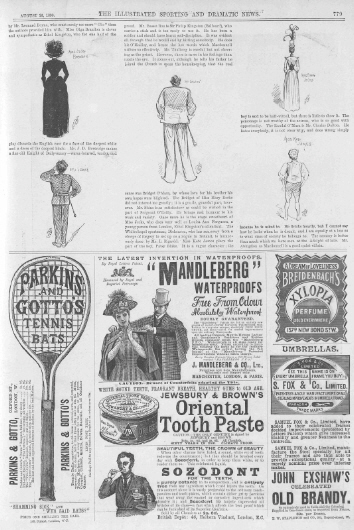
(p.24-25) OUR CAPTIOUS CRITIC. |
|||||
 |
 |
||||
|
The Entr’acte (16 August, 1890 - p.4) As I last week said, the new play at the Adelphi contains very little that is novel; but it is entertaining, and evidently yields a large amount of satisfaction to an Adelphi audience. It is fairly well played, though it is evident that one or two of the performers don’t care very much for their parts. Miss Kate Rorke knows she is equal to better things; and little Miss Kate James, who has done so well here before, seems to suffer by being put into the clothes of a stable-boy. Why she should be given a song I don’t pretend to understand. Then, giving Mr. Thalberg credit for the best of intentions, I cannot think that his Irish priest is a triumph. Mr. Leonard Boyne is well suited, and Mr. Lionel Rignold’s old-fashioned low comedy is excellent; while Mr. John L. Shine has never played anything better than the part with which he is at present entrusted. Miss Olga Brandon, as the heroine, makes fair use—nothing more—of her opportunities; Mr. J. D. Beveridge does creditable work, but nothing to distinguish himself; the same may be said of Mr. Bassett Roe; while the acting of Mr. Dalton may be credited with a good deal of rough vigour. As in “A Village Priest,” so it is here; the “Lord’s anointed” courts trouble by respecting the oath which has been exacted from him by virtue of his calling. Those persons who have seen “A Village Priest” and “The English Rose” cannot but be impressed with the resemblance existing between the two pieces at the churchyard juncture. Mr. John Coleman and Mr. Robert Buchanan seem to be in for a merry little squabble. ___
The Referee (17 August, 1890 - p.3) There is one admirable sentence in Mr. Buchanan’s answer to Mr. Coleman’s charge of stealing a leading incident for “The English Rose,” and in this all people who are sick of the cuckoo cry of “stealing” which follows the production of almost every new play must concur. Says Mr. B. to Mr. C., “If stealing is so easy, why don’t these gentleman steal also, and so produce successful plays?” As I last Sunday published Mr. Robert Buchanan’s formal declaration of what he was about to do with Mr. John Coleman, it is only fair that I should now make known what Coleman is going to do with Buchanan. To-night (Saturday) Coleman asks to be allowed to say that, seeing that Buchanan, “While admitting the truth of my [Coleman’s] statements as to the matters at issue . . . has raised a new issue which touches my [Coleman’s] honour . . . in next Saturday’s Era I [Coleman] will confute every allegation and every insinuation he [Buchanan] has advanced.” Meanwhile, I may tell you that Sims and Buchanan’s new drama, “The English Rose,” is going splendidly at the Adelphi, big houses being the rule nightly. ___
The Penny Illustrated Paper (23 August, 1890) FACTS AND FACES. Mr. G. R. Sims, the popular dramatist, is again to the fore, but he has changed his locality from sylvan England scenes and London streets to the Green Isle (in the company of Mr. Robert Buchanan). But we know what to expect from this genial, hearty writer, whether we meet him in St. Giles’s or Jerusalem. What we like in Mr. G. R. Sims is his manliness and freedom from cant. His pen is a keen lance that has pricked many a bubble reputation and exposed many a sham. But he is a poet as well as a satirist, and that teaches him to elevate the better side of life in Modern Babylon, and none can doubt his genuine sympathy for the poor. The mantle of Dickens has fallen upon “Dagonet”: but the hurried processes of journalism prevent his working out his dramatic and humorous ideas in the form of elaborate novels. It may almost be taken for granted, also, that the day for illustrations of actual life, in three-volume, circulating-library form, had gone by. The man who can sum up a theory in a sentence—who can demolish a fallacy in an epigram—who can give the spirit of a noble deed in a couplet—is the man of the time. And that man is Mr. G. R. Sims. Some may say of his dramas that they have not the French constructive faculty. They could not have, according to his method of working out his scenes. French wit serves the “tough-and-go” art of the Parisian dramatist; but English humour is slower, requires more elaboration, and, moreover, appeals to playgoers who take their time to think about a character or a scene. Hence it is that so many dramas on our stage go infinitely better after a few days’ performance—those of Mr. George R. Sims among them. It is my impression that the drama which will raise Mr. Sims’s reputation to its greatest height on the stage is yet to come. But already he has done work of admirable quality; and, while he comprehends low life in London as well as Zola does that of Paris, there is never a hint of the unclean in the atmosphere surrounding Mr. G. R. Sims’s work for the stage or elsewhere. “The English Rose” he has combined with Mr. Robert Buchanan to produce smells sweet and fresh as the typical English flower should do, and will to a certainty bloom for many and many a month to come at the Adelphi. Mr. Sims is now busily engaged with Mr. Henry Pettitt in finishing the new “Carmen” burlesque for the Gaiety, and has run down to Scarborough to confer with the genial musical director, Herr Meyer Lütz, who provides the melodies for the coming Gaiety travestie. Mr. Robert Buchanan. Mr. Robert Buchanan, who has worked so well with Mr. G. R. Sims in the new Adelphi drama, is one of the most industrious and versatile of modern authors; and one thing gives a distinction to his work which cannot be found in the productions of many writers for the stage—he is a poet. Years ago I had the pleasure of meeting Mr. Buchanan when he used to visit the late George Henry Lewes, at The Priory, North Bank. Mr. Buchanan had written a volume of charming poems—“Undertones,” it was called. They were real poems, and often since he has written beautiful poems and capital novels. At first he had singular ill-luck on the stage—not because the work was bad, but it was not of the conventional stereotyped kind. Mr. Buchanan has “the courage of his opinions,” and very bold opinions they sometimes are. He has been attacked with the utmost vehemence, and sometimes with gross unfairness; but he is not the man to be knocked over by hard words. Few men are better capable of defending themselves; and gradually, thanks to the quantity and quality of the work he has done, Mr. Buchanan has become a popular and successful dramatic author. Many of his pieces are very good indeed, and when he adapts or translates it is the work of a literary artist and not a mere hack. When he gave a dramatic version of Ohnet’s “Iron Master,” I thought it one of the best pieces of the kind I had seen. Very clever also are his arrangements of old comedies. He has made Vanbrugh’s coarse comedy “The Relapse” an amusing and interesting piece as “Miss Tomboy,” and he has succeeded, where many have failed, with the novels of Fielding. There is a great deal of humanity in the writings of Mr. Buchanan, and when he has a chance he can write delightful poetry—as, for example, “The Bride of Love.” But the gods have not made us poetical in these days, and Mr. Buchanan finds it more profitable to deal with the prose of modern life; but he frequently does so in a poetical spirit, and some capital lines in “The English Rose” are from his pen. ___
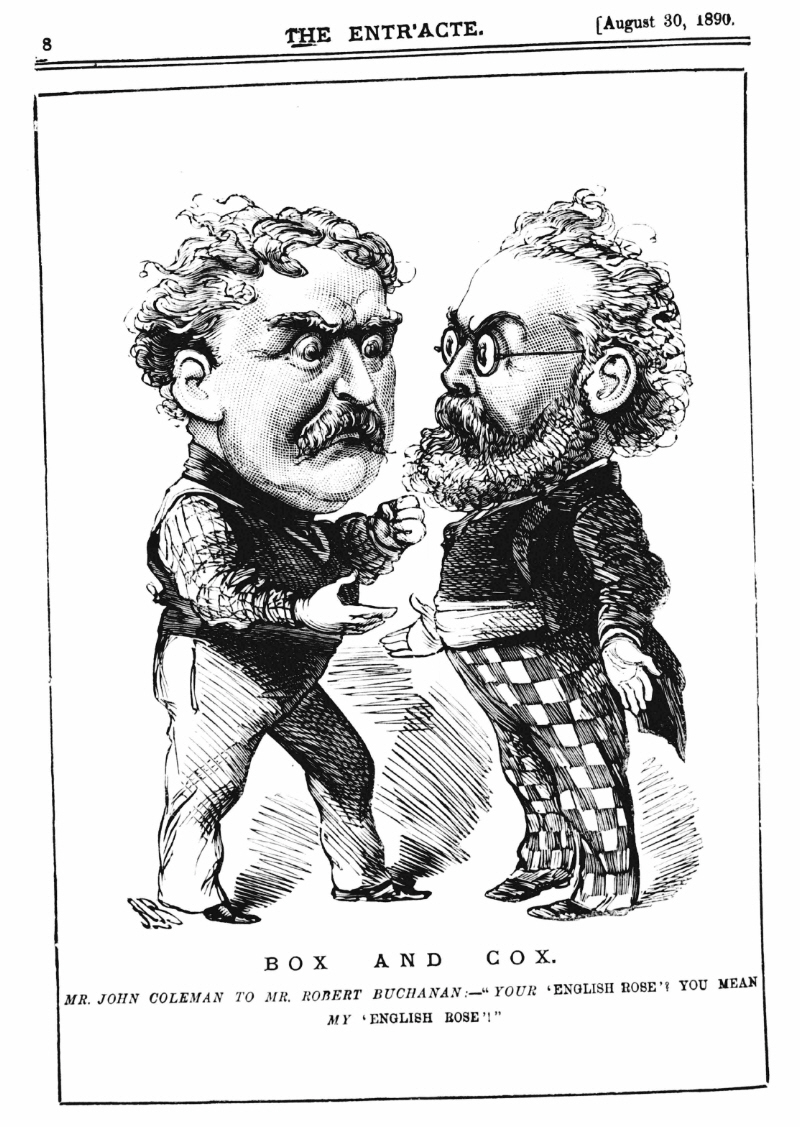
Truth (28 August, 1890 - pp.18-19) THE COLEMAN-BUCHANAN CONTROVERSY. A more temperate and crushing indictment has seldom appeared than Mr. John Coleman’s statement of facts in connection with his share of the Adelphi drama, “The English Rose,” which Mr. Robert Buchanan claims to be as “original” as it is “new.” Let me summarise the facts as they are stated by Mr. Coleman, and virtually endorsed by Mr. Buchanan:— At this juncture the public asks for a statement or explanation from Mr. G. R. Sims, who is surely as innocent a victim as the Daily Telegraph critic. No one wants him to throw over his collaborateur, and he would not be likely to do so; but he can easily say if he invented the plot of “The English Rose” himself—as is alleged—or if he accepted it ready-made by Robert Buchanan. This much, at least, the public is entitled to know. Buchanan has been heard; let Mr. Sims step up into the witness-box! It is a drama of coincidence, and the public awaits further evidence. ___
The Entr’acte (30 August, 1890 - p.8) |
|||||
|
|
 |
|
|
|
The Theatre (1 September, 1890) “THE ENGLISH ROSE.” New original drama, in four acts, by GEO. R. SIMS and ROBERT BUCHANAN. |
|
|
|
|
|
There is a picturesque aspect of Irish life that lends itself readily to the production of an interesting play, and though the work by Messrs. Sims and Buchanan bears an English title, the scene and all the incidents are Irish. We have threats of eviction, an Irish steeplechase, an assassination by moonlighters, and a rescue of a prisoner by an Irish mob from the Irish constabulary. Add to these, the hated English landlord and his agent, a real Irish jaunting car, and the typical “gossoon,” so that we have a fair picture of Irish life as known to readers of Lever’s works. The collaborators have made use of all these to weave around a persecuted hero, and of a murder, without which an Adelphi drama would be incomplete, have thrown in a song or two for their comic characters, and have given us far brighter dialogue than we have hitherto had in this class of play. All this combined has resulted in a most successful whole. The enthusiasm was very great on the first night, and crowded houses since then have proved that the applause was genuine. Sir Philip Kingston, an Englishman, has foreclosed on the Knight of Ballyveeney’s estates. Though but a poor gentleman, his son Harry has found favour in the eyes of Ethel Kingston, but her uncle forbids her to see him. Heroines, however, are not so submissive, and her meeting with her lover brings on him a blow from Sir Philip, which Harry for her sake does not return, but uses some threatening words. These are quoted against him as showing a motive for the murder of Sir Philip, who is shot down as he is driving home, and of which murder Harry is accused. The real assassin is one O’Mara, a moonlighter, who, fearing eviction, commits the deed at the instigation of’the agent, Captain Macdonell, who is anxious that Sir Philip should’be disposed of before his (the agent’s) accounts are gone into. O’Mara confesses his crime to Father Michael O’Mailley, whose lips are sealed by his priestly office, and he the while knowing the real culprit, dares not speak and so clear his own brother Harry. The hero is found guilty, mostly on the evidence of Ethel, who at first looked upon him as the murderer, but now convinced of his innocence, establishes it by collateral evidence, confirmed by the tardy death-bed confession of O’Mara. In unfolding the story, there are some exciting scenes and some strong situations. The steeplechase, in which Harry defeats his rival Macdonell, followed by Harry’s furious ride in his endeavour to save Sir Philip’s life, the murder at the Devil’s Bridge, the rescue of Harry by the mob after his conviction, and the search for him by the soldiers when he has taken refuge in his brother’s chapel, are all worked up with great spirit. The acting is excellent. Mr. Leonard Boyne is a gallant fellow, a bold rider, and artistic in expressing his affection and his agony when accused. Miss Olga Brandon, though still weak and hoarse, became a favourite at once by her truth to nature. Mr. Lionel Rignold has a part that just suits him, and in which he is very droll as a particularly sharp but thoroughly dishonest horsey individual. Mr. Shine, as a merry, good-hearted sergeant of police, makes love to Miss Clara Jecks, a London lady’s maid, who finds herself much out of her element in the wilds of the Emerald Isle. Miss Kate James is the liveliest of “gossoons,” and sings a pretty song. Mr. Abingdon is a thorough-faced villain, and is most properly handcuffed at last. Mr. Bassett Roe fitly represents a well-meaning but irascible English gentleman; and Mr. J. D. Beveridge is cheery and warm-hearted as the good old Knight of Ballyveeney. Mr. Charles Dalton displays great power as the half-mad O’Mara; and Miss Mary Rorke is tender and sweet as the true-hearted Bridget O’Mara, a victim to unrequited love. The scenery is beautifully painted, and the stage management of the very best. ___
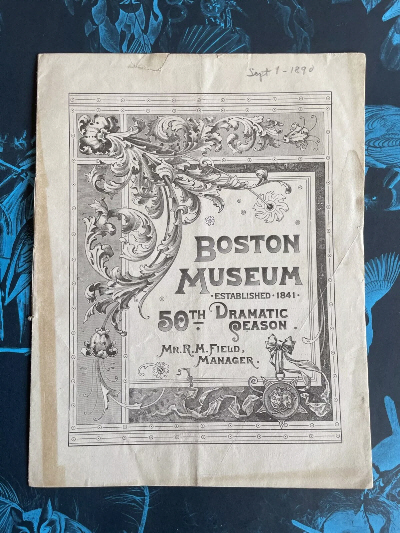
The Boston Daily Globe (2 September, 1890 - p.10) “THE ENGLISH ROSE,” . . . Opening night at the Boston Museum has an interest all its own. Whatever the play may be, the house is sure to be filled, and filled by an audience of exceptionally noteworthy character. Yesterday marked the opening of the 50th dramatic season at this historic theatre—a season of much promise, and one that should give abundant illustration of the worth and scope of one of the very few stock companies on the American stage. |
|
|
 |
|
|
|
Time (October, 1890) At the Adelphi, by Geo. R. Sims. After that, is there anything to be said? Any one with a little knowledge of stagecraft and of past Adelphi dramas could write such a burlesque as this, always provided that he brings to the task absolutely no literary qualifications whatever. And any one who held the same fortunate position as Geo. R. Sims could get the travesty of art and human nature accepted by the Brothers Gatti. The sorry thing is to see Mr. Robert Buchanan’s name mixed up with the business. He has certainly done dramatic work in the past too good for him to be punished by having his name printed cheek by jowl with Geo. R. Sims as one of the authors of “The English Rose.” Alec Nelson [pseudonym of Edward Aveling] [This review appears on the Marxist Internet Archive in the Eleanor Marx Dramatic Notes section.] ___
The Stage (3 October, 1890 - p.13) “THE ENGLISH ROSE.” On Monday, September 29, 1890, there was produced for the first time in the provinces, at the Court, Liverpool, the drama in four acts, written by Geo. R. Sims and Robert Buchanan, entitled:— The English Rose. Sir Philip Kingston ... ... Mr. A. Alexander There is no occasion for us to traverse the ground of this latest of Irish dramas upon this its first appearance out of London. Its original production in London is of so recent a date that its motive and action must still be fresh in the minds of our readers. There was a large audience to greet the new work on Monday, and honours were rightly and judiciously bestowed in the end. The acting halted a little here and there, but, taken altogether, the performance was thoroughly enjoyable, and the performers worked with great zeal to place the piece before the favourable notice of the audience, and in this they succeeded admirably. Mr. W. R. Sutherland, as the hero, Harry O’Mailley, particularly distinguished himself for the spirit and earnestness with which he played. He acted with a franker manliness than he has recently displayed in his “hero” work, and his brightness and freshness, and the richer warmth of his emotional acting observable on this occasion, indicated his intention to “lift” both his own powers and those of the piece into deserved prominence. Mr. Henry Pagden is in a somewhat equivocal position. So much fierce light has lately been thrown upon the stage priest that an exponent of such a character has to stand the steady concentration of critical observation. Mr. Pagden came through his ordeal exceedingly well, and his Father O’Mailley will soon ripen into a sterling exhibition of sound artistic work. Mr. Alexander gives weight and dignity as Sir Philip. Mr. C. K. Chute plays Captain McDonnell with distinction. Mr. John S. Chamberlain’s Randal O’Mara stood well on the picture, and he gave the part the benefit of strong emotional and passionate force, which made its impression upon the house. Mr. Edward Lewis as Sergeant O’Reilly was keenly enjoyed, and the racy deliveries told upon all occasions. The jovial knight and honest Irish gentleman was brightly and tellingly hit off by Mr. Stephen Caffrey; and Miss Mary Glover came in for rewards for her bright and clever performance as Patsie Blake. The two ladies prominent in the cast, Ethel Kingston and Bridget O’Mara, were faithfully rendered by Miss Gracie Warner and Miss Gwynne Herberte, though a little added force and directness would improve the interpretation in each case. Other parts in the long cast lost nothing in the telling. The play was magnificently staged. ___
The Times (28 November, 1890 - p.7) The English Rose having passed its 100th performance before a crowded and enthusiastic house, now takes rank as one of the most remarkable Adelphi successes of recent years. Very skilful from the literary point of view is the captivating air of romance which Messrs. Sims and Buchanan have contrived to throw over the prosaic difficulties of the Irish land question, and a curious proof of the evenhandedness of their treatment of the subject is the fact that the two most popular characters of the play should prove to be the young Irish squire represented by Mr. Leonard Boyne and the English renegade of Mr. Lionel Rignold. The ardour and spontaneity of Mr. Boyne’s performance appears to be unaffected by repetition; Mr. Rignold’s is one of the most searching and at the same time most humorous studies of Cockney rascality that the modern stage has seen. ___
The Daily Telegraph (26 December, 1890 - p.2) THE DRAMATIC YEAR. . . . ADELPHI. Be the weather fair or foul, fog or snow, rain or damp, there will certainly be a crowd round the doors of the popular Adelphi to-night, for the energetic managers, the Messrs. Gatti, thoroughly understand the public for whom they cater so liberally. According to the old familiar saying, “Good wine needs no bush.” The good dramatic wine of the Adelphi has been tested for so many years that there is no necessity to announce it by placard. melodrama succeeds melodrama at the Adelphi, and each one seems better than the last. Mr. George R. Sims is, of course, a standing dish. Sometimes he collaborates with Henry Pettitt, sometimes with Sydney Grundy, sometimes with Robert Buchanan. But George R. Sims is an Adelphi necessity, since he is at once cheery and humorous. He may pretend in his public writings that he is cursed with hypochondria; but his supposed malady is never betrayed in his writing. He is the sturdy opponent of “fads” and “crotchets.” He is the elected champion of the conventional—in other words he seeks to amuse his audience, not to bore them. It was no easy matter to write an Irish play without offence in the present state of the political atmosphere. But Mr. Sims and Mr. Buchanan have done it in “The English Rose.” It is not a partisan but a Unionist drama. Friendly feeling and good fellowship exist in every line of this excellent play, which contains all the humour and charm of the Irish nature without its bitterness, all the solidity of the English temperament without its obstinacy, and which is liberal enough to give us an Irish priest who does not break his vows, and is still a popular person in the eyes of an audience of mixed theological views. The play is capitally acted. In the first place, Mr. Leonard Boyne is an Irishman and a sportsman, so he is well suited to Harry O’Mailley. He can make love and he can ride, so he is a typical hero of Irish romance. For his companion he has the charming Miss Olga Brandon, with the “gipsy eyes,” who makes a most interesting heroine, whilst the dark side of human nature and the sorrows that must be the complement of all love, are well expressed by Mr. W. L. Abingdon, Mr. Charles Dalton, Miss Mary Rorke, and Mr. J. D. Beveridge. Mr. Sims could not write a play that had not plenty of fun in it, and he was lucky to have his comical sketches of character so well expressed as by Mr. Lionel Rignold, Mr. J. L. Shine, Miss Kate James, and notably by Miss Clara Jecks—the Mrs. Keeley of the Adelphi stage. Mr. Thalberg, Mr. Bassett Roe, and Mr. James East contribute not a little to the success of this excellent drama. There will be no need of any change at the Adelphi for many a long month to come. ___
The Illustrated London News (27 December, 1890) Crowds will gather at the Adelphi door to see the hearty English play, by George R. Sims and Robert Buchanan, called “The English Rose”. It is an English title to an Irish story, and one of the best of the Adelphi series. Who would miss the excitement when Mr. Leonard Boyne gallops off on his thoroughbred to rescue his beloved Miss Olga Brandon? And it is no exaggeration to say that this is the most popular and best-written Irish play that has been seen at the Adelphi since the famous “Colleen Bawn” of Dion Boucicault. |
|
|
 |
|
|
|
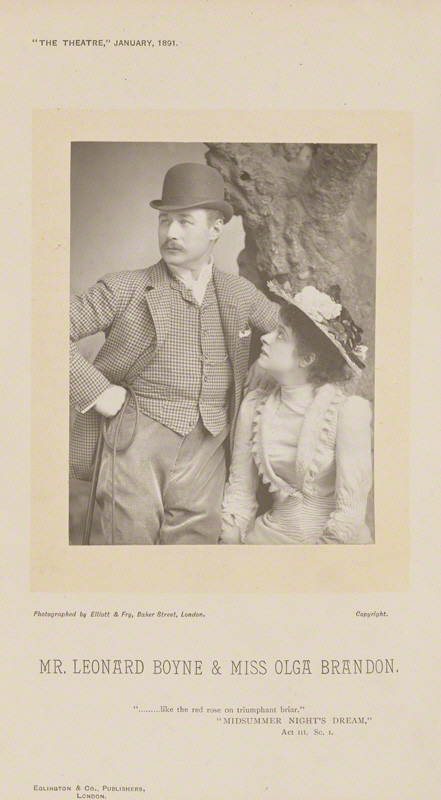
[From The Theatre (January, 1891).]
Reynolds’s Newspaper (1 February, 1891) “The English Rose,” at the Adelphi Theatre, was played for the 150th time to a crowded and enthusiastic house on the 15th instant. The drama, which has already been played in Boston, is to be produced in New York in September next. ___
The Manchester Courier and Lancashire General Advertiser (7 February, 1891 - p.10) A domestic drama by Messrs. George R. Sims and Robert Buchanan will be the next production at the London Adelphi. Miss Olga Brandon has declined an engagement to play her original part in The English Rose when this successful melodrama is produced in New York next autumn. The statement that Mr. Leonard Boyne will go out to impersonate the hero on the American tour is, at all events, premature, as although he has had an offer from Mr. Hayman, nothing whatever has been settled. It should be mentioned here that Messrs. Gatti have arranged a special performance of The English Rose, to be given under the immediate patronage of the Lord Lieutenant and the Chief Secretary, in aid of the Irish Distress Fund. ___
The Glasgow Herald (3 March, 1891 - p.4) ROYAL—“THE ENGLISH ROSE.” Under the somewhat mal-apropos title of “The English Rose” Messrs George R. Sims and Robert Buchanan have produced an interesting drama dealing with present-day Irish life. In its main incidents the story goes upon lines that have long been tried and never seem to fail in this class of dramatic work. The agrarian troubles that afflict the sister isle have once more been turned to account for the construction of a thrilling tale, and as among the principal characters there are, as heretofore, a rack-renting and evicting landlord, his tyrannous and self-interested agent, a pair of lovers, the course of whose affection is the reverse of smooth, and a variety of personages who more or less help forward the action of the play. Amidst much that is conventional, not to say hackneyed, one feature stands out conspicuously, and more than redeems the otherwise commonplace character of the drama. This is a splendidly worked-out scene in which a priest, under the sacred seal of the confessional, hears the story of a murder, and, keeping inviolate his vow of secrecy, allows his brother to be condemned for the crime which he knows another man to have committed. The idea, of course, is not new, but the way in which it has been utilised in the present case gives a special and peculiar interest to the development of the drama almost from the beginning. An excellent company has been sent round with the play, which was presented for the first time in Glasgow at the Theatre-Royal last night. Most of the leading characters are admirably played. Mr Stephen Caffrey has a congenial part as a squire upon whom adversity has laid a heavy hand, but who, in the midst of all his troubles, still wears a kindly, sympathetic heart. A capital representation of the part of Father O’Mailley is given by Mr Henry Pagden. It is in every respect that of a typical Irish priest—the counsellor and friend of all his flock, the enemy of evil in every form, and in matters of faith and duty a Stoic. Mr John S. Chamberlain gives a powerful reading of a most difficult character; and the comedy element is well sustained by Mr Frank Wood and Mr Arthur C. Percy. Miss Gracie Warner has a heavy part as “The English Rose,” but it is not more than she is able thoroughly to undertake. Throughout she plays most acceptably, and in the more emotional passages she proves herself a very capable actress. Miss Gwynne Herberte also plays a rather trying part with much credit. The drama, which was capitally staged, was favourably received by a large audience. ___
The Western Daily Press, Bristol (16 February, 1892 - p.3) THE THEATRE ROYAL.—The sudden change in the weather must in a great measure be accountable for the meagre attendance last night at the King Street house, for it is seldom plays by G. R. Sims and Robert Buchanan fail to draw large audiences. Theatre-goers are well acquainted with the works of these joint authors, and it is rarely that the representations of the plays of these writers fail to find sympathy with lovers of pathos. “In the Ranks,” “Harbour Lights,” and “Alone in London,” are amongst the works of Messrs Sims and Buchanan, and these pieces are well known to Bristol audiences. “The English Rose” is just as well worked out and just as pathetic as any of the above, and the authors have shown no lack of their play-writing abilities in the production of this work. This is the first time that “The English Rose” has been performed in Bristol, and, judging by last night’s representation, it is sure to be a success during the week. The piece had a good run in London when it was produced at the Adelphi, and at the Theatre Royal the scenery from the London House has been fitted up. Mr W. R. Sutherland as Harry O’Mailley is excellent. Father Michael is portrayed with fine effect by Mr George Byrne, Mr Frank Woodville is earnest and effective as Randal O’Mara; Mr Cecil Paget is most natural as the Knight of Ballyvenny. Mr A. D. Pierpoint’s acting as Captain McDonnell was good, and Mr George Miller as the Irish sergeant is capital. Miss Swaine Kinton is the English Rose, Miss Marguerite Gregor is powerful as Bridget O’Mara and Miss Alice Ardaley gives a clever representation of Louisa. Next week Mr and Mrs Warwick Gray’s Company will appear in “Black Diamonds.” ___
The Referee (28 February, 1892 - p.3) The dramatic season at the Surrey opened on Monday with a revival of George R. Sims and Robert Buchanan’s stirring Adelphi drama, “The English Rose,” the part of the hero, Harry O’Mailley, played when the piece was presented here in August last by Mr. C. J. Hague, now promoted to the Lyceum, being taken by Mr. E. Leicester, who has met his match in size and weight, if not in virtue, in the Captain Macdonnel of Mr. Graham Wentworth, who with noticeable prudence has shirked the whipping after his defeat at Westport Steeplechases. George Conquest jun. has repeated his funny impersonation of Dickerson, car-driver, bookie, and blackleg, and especially in “laying them” on the Race Scene has caused roars of laughter. Miss Annie Conway has been greatly admired as Ethel Kingston, and a very pretty and charming Bridget O’Mara has been Miss Cissy Farrell, long beloved of Surrey patrons. “The English Rose” goes on at Proctor’s (Twenty Third-street) Theatre, New York, next Thursday evening. Aubrey Boucicault has been engaged to play Harry O’Mailley. Robert Buchanan’s “Squire Kate” has reached its fiftieth night at the Lyceum, New York, and will run on there till Easter Monday, when its place will be taken by “The Grey Mare” (Sims and Raleigh). Edwin F. Thorne will presently start an American tour with “The Golden Ladder” (Sims and Wilson Barrett). Our Mr. DAGONET and his collaborators seem to be all over the shop. ___
The New York Times (10 March, 1892) AMUSEMENTS. PROCTOR’S THEATRE. Mr. Charles Frohman and his excellent company having retired from Proctor’s Theatre, “The Lost Paradise” was succeeded there last night by “The English Rose,” a British melodrama put together by G. R. Sims and Robert Buchanan. The scene of this is Ireland; the heroine is an English girl, the hero an Irish boy of the long-familiar stage pattern, with a sound, warm heart, a reckless temperament, and an abundance of animal spirits. “The English Rose” is not a new play in any sense. It had a long run in London, and was also performed in Boston. Moreover, its plot and incidents are very old. The piece might have been written by Edmund Falconer. ___
New-York Daily Tribune (10 March, 1892 - p.7) “THE ENGLISH ROSE.” Another English melodrama is to be recorded. It is called “The English Rose.” The first performance of it here began at Proctor’s Theatre last evening at a quarter before 9 o’clock, and it is probably over by the time this paper is read. The first half of the play did not show that it differed in any essential respect from other English melodramas. This great class of theatrical entertainments includes two subdivisions—those which have racing scenes and those which have not racing scenes. This one has a racing scene and a well-trained horse, which jumps about the stage while two men fight over it, does not trample anybody down and does not fall over the footlights. If everybody connected with the production had done his share as well as the horse, the house would have been closed earlier. ___
The Era (11 August, 1894 - p.7) THE BRITANNIA. Sir Philip Kingston ... ... Mr WILLIAM DACRE In the happiest of holiday moods was the tremendous crowd of Hoxton Britons who on Monday made the rafters of Mrs Lane’s house ring with applause and laughter. The amiable proprietress had put before them a bill that was long, strong, and exciting, and their determination to enjoy it to the full was evidenced even before the early hour of seven o’clock, when the curtain rose on The English Rose, which was produced at the Adelphi in August, 1890. With its extensive scenic effects, its succession of stirring incident, its well-contrasted characters, and its interesting story, Mr George R. Sims and Mr Robert Buchanan’s piece is just the right selection for a holiday audience of workers, who on Monday welcomed the chief situations of the “Rose” with a whole-hearted enthusiasm that could not be excelled. The special engagement of Mr J. H. Clyndes, who years since made himself popular in the delineation of Grecian heroes—not, bien entendu, of mythological origin, but heroes of drama at the City-road Grecian—is a very wise move on the part of Mrs Lane. Harry O’Mailly is one of those sturdy, impetuous fellows whose recklessness and carelessness specially recommend him to the hearts of gallery and pit; and there is scarcely any need to say how thoroughly and completely he ingratiated himself into favour on Monday. From the time of his winning the steeplechase until tried for a murder of which he is falsely accused, the latest representative of the hot-headed, good-hearted young Irishman may be said to have had his finger on the pulse of the house. Mr. J. B. Howe’s Knight of Ballyveeny had all the chivalrous qualities that by tradition belong to the ancient Irish aristocracy; and Mr Walter Steadman invested the rascally agent, Captain Macdonell, with the usual attributes of such people. Rougher methods of villainy found a capital exponent in Mr W. H. Perrette, who played that irreconcileable son of the soil Randal O’Mara with all his usual carefulness and efficiency. Mr Bruce Lindley was seen to greater advantage than usual as Sergeant O’Reilly; Mr Jackson Hayes’s pronounced peculiarities of elocution were subdued to the requirements of the part of the good-hearted priest; Miss Nellie Sinclair, a new comer to the Britannia, was a bright and lively Patsy Blake, and will be better still when she gets more accustomed to her new surroundings; Mr Joseph Rowland was quite at home as a Cockney jarvey; and Mr William Dacre was the Sir Philip Kingston. Miss Beatrice Toy’s portrayal of the title-part was at all times womanly and sympathetic. The sunshine of Ethel Kingston’s nature she emphasised with much archness, and was particularly fascinating in the first scene between the lovers. Miss Oliph Webb made an attractive Bridget O’Mara, the love-lorn Irish girl; Mrs Marion Arnold was quite safe as Widow Flannigan; Miss Florrie Kelsey may be commended for her impersonation of Judy; and Miss Julia Summers submitted a stolid interpretation of Louisa Ann Ferguson. The many minor parts were adequately played; the stage-management of Mr Bigwood was excellent; and the scenery reached the high standard usually attained at this theatre. The Loan of a Lover was the concluding item of the bill. ___
The Era (23 July, 1898) ELEPHANT AND CASTLE. An appeal on the part of the dramatist to the sporting tastes of an average English audience is seldom misplaced. They have a great regard for all sorts and conditions of the article in question, but, perhaps, the warmest corner is reserved for a good horse—it is an instinct with us that the advent of that buzzing abomination the motor car has decidedly not lessened. Apart from this element there is much in Sims and Buchanan’s work to admire and interest. The stir and bustle of the steeplechase course, with its accompanying crowd of “sports” of all grades, from the enterprising tipster to the aristocratic owner, is a picture full of life and animation, containing many a little incident familiar to the followers of the “sport of kings,” and recognised and applauded in the most appreciative of fashions. Mr Sidney Herberte-Basing’s scenery is altogether too good to be passed without eulogium. It is always in keeping, and frequently attains a very high level. We would particularly commend the Devil’s Bridge at Connemara and the Twelve Pins of Galway for their picturesque beauty. Mrs Elwyn Eaton’s company, under the experienced direction of Mr Charles Howitt, has been carefully chosen—in fact, seldom have we seen characters more discriminately distributed. Mr Howitt himself undertakes the hero’s responsibilities, and they are many, acquitting himself admirably throughout. He sits his mount as to the manner born, and there is not a fault to be found with his “hands,” a compliment not always to be paid to stage equestrianism. Manliness is the keynote of his performance, and this, with a sufficient touch of tenderness in the love passages, makes him a general favourite. Too much praise can hardly be awarded to Mr Percy Rhodes for his Father Michael O’Mailly. The asceticism of appearance is admirably combined with the gentleness of manner befitting his calling, and in the scene of the confession of O’Mara he rises to great heights. Mr Adam Alexander presents a good picture of the English gentleman, Sir Philip Kingston, and Randal O’Mara gets full justice from the playing of Mr J. P. Kennedy. Lovable, easy-going, yet quietly-dignified, are the characteristics of the Knight of Ballyveeney, and these qualities, combined with his great affection for his two boys, are splendidly brought out by Mr Frank Woodville. The cool, deliberate villainy of Captain Macdonnell loses nothing of its hatefulness in the care it receives from Mr Weldon Atherstone; very popular is the Sergeant O’Reilly of Mr Cecil Morand; Mr Harold Rignold hits off the peculiarities of Nickodemus Dickenson in happy fashion; and other male characters are well placed. The English rose, Ethel Kingston, is endowed with all the characteristics of the best of English womanhood by Miss Ethel Kay, her acting being marked by much sweetness and charm. Bridget O’Mara is tinged with just the touch of sadness required in this somewhat trying rôle by Miss Nellie Brash; a lively colleen is made of Louisa Ann Ferguson by Miss Beatrice Annersley, her business with Sergeant O’Reilly being the signal for mirth of the most pronounced order. Miss Mabel Rosamon, Miss Emily Cranen, Miss Phœbe Walker, and Miss Mabel Mason are all associated in small parts, and their careful treatment materially tends to the all-round success attained. While the management go on engaging companies of this description good business will of necessity ensue, and they may safely defy even the most tropical of weather. |
|
|
 |
|
|
|
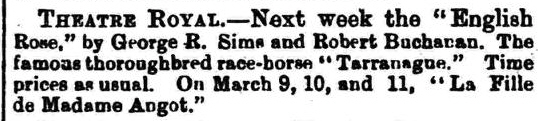
[From The Essex County Standard West Suffolk Gazette (4 March, 1899 - p.8).]
The Stage (27 April, 1899 - p.17) THE PAVILION. The excellent Pavilion company, reinforced by the return of Mr. Albert Marsh, and by three newcomers specially engaged—Mr. Edmund Gurney, Mr. Coventry Davies, and Miss Edyth Olive—are appearing in a revival of The English Rose, that seemed to be highly acceptable to the very large and enthusiastic audience on Monday. George R. Sims and Robert Buchanan’s successful Adelphi drama possesses several of the elements of enduring popularity, and its representation at the Pavilion, though slightly unequal on Monday, is in the main thoroughly sound and effective, while the scenery and general mounting are up to the exalted standard always expected where Mr. Isaac Cohen is managing director. Mr. Ashley Page, of course, is an immense favourite for his trenchant and direct style as that intrepid and outspoken young Irish horseman, Harry O’Mailley, and he performs commendably the equestrian feats executed so finely at the Adelphi by Mr. Leonard Boyne. Once more associated with Mr. Ashley Page is Miss Marion Denvil, who makes Ethel Kingston, the English Rose of the title, a heroine of high spirits, but full, too, of womanly tenderness. Miss Denvil’s characteristic winsomeness of manner and nervous energy find an effective contrast in the tearful and plaintive performance of Bridget O’Mara by Miss Edyth Olive, whose work seems pitched for the most part in a minor key. Bridget’s bold and desperately reckless brother Randall receives a strong and vigorous interpretation from Mr. Frank Harding, while the unscrupulous Captain Macdonell is played in forcible but studiously gentlemanly fashion by that accomplished exponent of melodramatic villainy Mr. Oscar Adye. Mr. Charles Cecil is sufficiently stiff, martial, and unbending as Sir Philip Kingston, and at the opposite pole is the genial and truly Hibernian Knight of Ballyveeney of Mr. Edmund Gurney. Mr. Albert Marsh was warmly greeted on his reappearance in the Mile End Road, in a rôle quite of his usual line, as Father Michael O’Mailley, and he is to be complimented on the success with which he assumes the priestly utterance and benign manner. Mr. Coventry Davies makes Sergeant O’Reilly a much more cheery and amiable personage than many members of the Royal Irish Constabulary used to be considered to be, and Mr. Lennox Pawle, the popular Pavilion comedian, lays stress upon the droller traits of that nondescript Cockney, ex-forger, horse-coper, Welsher, and Nicodemus Dickenson. The third of the comic trio, the sprightly Louisa Ann Ferguson, is played smartly enough by Miss Eva Levens. Miss Lucy Beaumont acts with point and success as the lad Patsie Blake, and other parts are filled suitably by Misses K. Gladding, Rose Winter, Mr. F. Boustead, Mr. A Edmunds, and so forth. The fateful ambush in the picturesque set of the Devil’s Bridge is only one of the many telling and exciting scenes in this capital Sims- Buchanan drama. ___
Birmingham Daily Post (20 February, 1900) THE QUEEN’S THEATRE. Mr. Page Moore’s Company are appearing at the Queen’s Theatre this week in Messrs. Sims and Buchanan’s drama, “The English Rose.” Well staged and admirably played, this interesting and exciting piece should command a fair measure of success in Birmingham, as it undoubtedly will if one may judge from the enthusiastic reception accorded it by a capital audience last evening. The racing scene, in which the thoroughbred “Tarangue” is introduced, and the sensational struggle on horseback at the Devil’s Bridge, Connemara, are incidents which would of themselves ensure the popularity of the play, which, however, abounds with other items calculated to interest and excite. Miss Ellen Snow appears as Ethel Kingston, the heroine, and plays the part in a very satisfactory manner; whilst Mr. S. Herbert Humber’s presentation of Harry O’Mailley leaves nothing to be desired. A word of praise is due to Mr. Melville Bickford for his acting as Sergeant O’Reilly, and the whole of the other parts are creditably sustained by the various members of the company. Several capital songs are introduced into the performance with considerable success. The piece will be repeated each evening during the week. ___
The Era (1 September, 1900 - p.10) THE LONDON THEATRES. THE PAVILION. On Monday, Aug. 27th, the Drama, in Four Acts, Though not quite so strongly melodramatic as many of the pieces produced at the “Drury-lane of the East,” the story of The English Rose, from the joint pens of Mr George R. Sims and Mr Robert Buchanan, is told with much literary grace, and the well-contrasted characters and the stirring incidents have appealed with considerable force to the crowds that have patronised this popular house. The hero, Harry O’Mailley, is one of those sturdy, impetuous young Irishmen whose reckless optimism and gaiety of manner specially recommend him to the hearts of gallery and pit, and there is scarcely any need to say how thoroughly and completely he has ingratiated himself into favour during the week, especially when we mention the fact that the part is played by Mr Ashley Page, a rare favourite with the Eastenders. From the time of Harry’s winning the steeplechase until tried for a murder of which he is falsely accused, the latest representative of the hot-headed, good-hearted young Hibernian gentleman may be said to have his finger on the pulse of the house. The Knight of Ballyveeny has all the chivalrous qualities that by tradition belong to the ancient Irish aristocracy as embodied by Mr J. C. Aubrey; and Mr George Cockburn acts that irreconcilable son of the soil Randal O’Mara with his usual carefulness and efficiency. Miss Essex Dane’s portrayal of the title-part is at all times womanly and sympathetic. The sunshine of Ethel Kingston’s nature she emphasises with much archness, and is particularly fascinating in the first scene between the lovers. The humour of the piece is always refreshing. Mr Lennox Pawle, who has done such good work under the ægis of Mr Isaac Cohen, is again at hand to lend the force of his comic personality to the part of the Cockney jarvey, Nicodemus Dickenson; and nothing but praise can be written concerning the Sergeant O’Reilly of Mr Watty Brunton, jun. The Bridget O’Mara of Miss East Robertson is a clever piece of work, and brightness animates the Patsie Blake of Miss Enid Alexander, whose portrait of the half-witted Irish lad is very welcome. Mr Charles Cecil preserves the aristocratic dignity of Sir Philip Kingston; Mr Herbert Pearson is well placed as Father Michael; and Mr Frank Harding emphasises with his usual success the shady character of Capt. Macdonell, the estate agent to Sir Philip. The scenery includes some capital brushwork illustrating the hills and vales of Erin; and the mounting shows all that liberality and good taste that one expects from Mr Isaac Cohen. ___
The Referee (22 December, 1907 - p.2) Melodrama of the better kind, which the REFEREE has always advocated so strongly, looks like having a good innings again at last. Messrs. Savory and Smyth Pigott are making elaborate revivals of “The English Rose” (by George R. Sims and Robert Buchanan) and “The harbour Lights” and “In the Ranks” (by George R. Sims and Henry Pettitt). Messrs. Alfred Cuthbert and Royston Keith recently made a proposal to do the same with Mr. Sims’ perennial “Lights o’ London.” Their offer having been accepted, Mr. Herbert Hollister, so long associated with “The Lights o’ London,” will now devote himself to his production of Sims and Pettitt’s “Master and Man,” with which he opens at Portsmouth on February 3. The above-mentioned revivals will have the advantage of being revised and brought up to date by Mr. Sims. ___
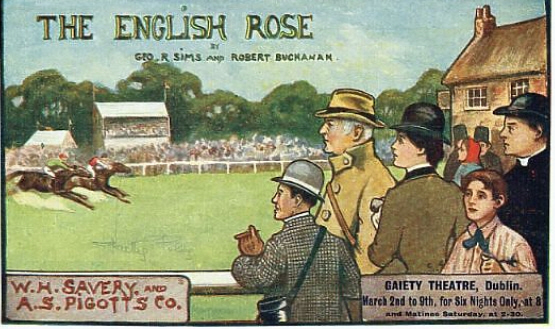
The Referee (5 January, 1908 - p.3) “The English Rose,” by George R. Sims and the late Robert Buchanan, started a tour with a capital company under the direction of Messrs. W. H. Savery and A. S. Pigott at the Assembly Rooms, Malvern, a few evenings ago. This picturesque and powerful Irish drama, which has been thoroughly revised and re-written by Mr. Sims, was received with such enthusiasm as to augur splendidly for its tour. |
|
|
 |
|
|
|
The Referee (19 September, 1909 - p.3) In his interesting “Notes of the Theatre,” published in Friday’s Evening Standard, my friend “B. L.” suggests that “some great dramatist” should “reply” to “False Gods” at His Majesty’s. What “B. L.” would fain see undertaken is a play upholding Christianity, as opposed to “False Gods,” which he describes as “an attack upon the holiest convictions of millions of people.” I commend “B. L.” for his desire to honour true religion; but I doubt whether it is worth while for anyone, however great, to write another “argumentative” play of the sort—even though it were “on the side of the angels.” Rather do I feel inclined to say with the poor old King at the Haymarket, “That way madness lies!” Anon “B. L.” goes on to state that when Mr. Grundy’s “Village Priest” (with its “seal of confession” episode) was produced at the Haymarket, Messrs. Gatti produced Mr. Robert Buchanan’s play “An English Rose” as a counterblast to it. As all this was many years ago, “B. L.” says he may be wrong, and in such case asks some kindly reader to put him right. Why, cert’nly. “The Village Priest” was adapted by Grundy from Busnach and Cauvin’s play “Le Secret de la Terreuse.” “The English Rose” was written by George R. Sims and Robert Buchanan, and was not only a big success when originally produced, but its popularity has endured through nineteen years. This was particularly noticeable during a series of revivals of the Sims, Pettitt, and Buchanan dramas at the Kennington Theatre a few weeks ago. ___
The Era (18 June, 1910 - p.13) KENNINGTON THEATRE. “THE ENGLISH ROSE.” The summer stock season at Kennington Theatre is now in full swing, and on Monday Mr. Robert Arthur produced that thrilling and interesting drama, from the joint pens of Mr. G. R. Sims and Mr. Robert Buchanan, entitled The English Rose. The play is splendidly staged and dressed, and nothing was wanting on the opening night to ensure it making an immediate and successful appeal to the sympathies of a large house. The story has a romantic Irish setting, and abounds with exciting situations, varied with humorous incidents, so that lovers of melodrama have their requirements amply met. That they appreciated the production was evident by the frequent curtain calls on Monday. In the title-rôle Miss Jessie Winter was as winsome and charming as ever, making an ideal English girl (Ethel Kingston), who had captivated the affections of a chivalrous gentleman. Mr. Walter Gay was a frank and manly Harry O’Mailley, enacting the part with much histrionic skill; Mr. G. P. Polson was a warm-hearted and picturesque figure as the ruined Knight of Ballyveeny; and Mr. Frank Robertson was a dignified Father Michael, the priest, who was prevented by the seal of confession from denouncing the perpetrator of the murder for which his brother was sentenced to death. Mr. Fred Morgan as the villainous Captain MacDonell was excellent, putting in some of his best work; Mr. Herbert Lloyd won high praise for his admirable study of the drunken and misguided Randal O’Mara, the tool of MacDonell; Mr. Wilson Blake was well placed as Sir Philip Kingston, the unpopular landlord, who fell a victim to his agent’s treachery; Mr. Maitland Marler was full of fun as Dickinson, the reprobate car-driver, and kept the house in a roar whenever he was about; Mr. Frank Crimp also revealed the possession of rare gifts of comedy, and made a big hit as Sergeant O’Reilly; while Miss Nellie Burdette was bright and lively as a lady’s maid. Miss Elsie Videau was a general favourite as Patsey, the changeling boy; Miss Winifred Whyte gave a vivid sketch of Bridget O’Mara. other rôles were well filled. An excellent series of cinematograph pictures was shown before and after the play. ___
The Referee (19 June, 1910 - p.3) Kennington seems to be quite happy under Mr. Robert Arthur’s melodramatic revivals; and its appetite appears to grow by what it feeds on. “The Romany Rye,” having drawn good business for a fortnight, made way on Monday for “The English Rose,” and crowded houses have been the order of the week. Twenty years have gone since Messrs. George R. Sims and Robert Buchanan’s stirring story delighted the patrons of the Adelphi, and, judging by the fervour with which it has been again received over the water, its power to please has in no wise abated. Up-to-date gags have been allotted to the low-comedy people, who have talked of aviation and taxi-cabs and some other things unheard of when the piece was originally produced; but this has served only for welcome relief from the tension brought about by the trials of the brave and patient and always admired Harry O’Mailley and his ever-loving sweetheart Ethel Kingston, known among the Irish peasantry as “the English Rose.” Harry has had a vigorous representative in Mr. Walter Gay, and Ethel has been sympathetically portrayed by Miss Jessie Winter. Pit and gallery have had tremendous cheers for Ethel turning wrathfully upon her guardian, Sir Philip Kingston, and crying “You have listened to the man I hate; you have insulted the man I love.” Excellent service has been rendered by Mr. G. P. Polson, as the Knight of Ballyveeny. Mr. Polson has been the good old Irish gentleman to the life, with a ready humour, a quick temper, and a brogue very much like good music. Mr. Fred Morgan, as the rascally agent; Mr. Maitland Marler, as the comical car-driver; and Mr. Frank H. Crimp, as the amatory Sergeant O’Reilly (with song), have all scored handsomely, and there have been many admirers of the good work done by Mr. Frank R. Robertson, as the priest with a due regard for the seal of confession; Mr. Herbert Lloyd, as Randal O’Mara, the moonlighter and murderer; Miss Winifred Whyte, as poor Bridget O’Mara, disappointed in love; and Miss Nellie Burdette, who has cleverly helped the gallant Sergeant O’Reilly in the making of laughter. ___
The Referee (11 June, 1911- pp.2-3) George R. Sims and Robert Buchanan’s picturesque and popular Adelphi drama, “The English Rose,” was presented as the holiday attraction at the King’s Theatre, Hammersmith, and was welcomed heartily. With the thermometer registering a bit over eighty in the shade, it might have been thought too hot vigorously to express approval, but the sturdy frequenters of the King’s capacious pit and roomy gallery evidently thought otherwise, and put themselves into a red-hot heat by vigorous applause. The coolest of customers must be moved to admiration and appreciation by the doings of handsome Harry O’Mailley. Who so gallant in love? Who so valiant in fight? Who so indignant under the affliction that comes of calumny? Harry was represented with sympathy-compelling power by Mr. Frederick Victor; and pretty Ethel Kingston, the idol of his worship, was beautifully portrayed by Miss Winifred Whyte. Harry, you will remember, was wrongfully accused of the murder of Sir Philip Kingston, who was Ethel’s guardian, and the very hard master of the Ballyveeny Estates. Harry, by the Devil’s Bridge in Connemara, held in his hand the gun that brought Sir Philip down. Ethel was asked to believe in his guilt. Resolutely she refused; and if that refusal had not moved the holiday audience to enthusiasm I should have been grievously disappointed. Mr. George P. Polson made a very fine old fellow of the Knight of Ballyveeny, whose son, Father Michael, was impressively impersonated by Mr. George Belmore. Prime favourites were Mr. Frank H. Crimp, as Sergeant O’Reilly, and Mr. Maitland Merler, as Nicholas Dickinson, the car-driver. The Sergeant bought down the house with his song what time he was fooling around with Louisa Fergusson, humorously depicted by Miss Nellie Burdette. ___
The Gloucester Citizen (8 September, 1922 - p.7) “DAGONET’S” ASHES SCATTERED ON At the funeral of Mr. George R. Sims, the Rev. J. Weller delivered a brief address at the service at St. Marylebone Parish Church, in which he referred to “Dagonet’s” remarkable industry and cheerfulness, and to the good which his writings had done for the public. ___
The Burnley News (11 November, 1922 - p.4) Victoria Opera House. Next week the Denville Stock Coy. will present “The English Rose,” which was jointly written by George R. Sims and R. Buchanan. It has run with great success at the Adelphi Theatre, London, and should prove a big attraction to Burnley audiences. The story is full of incident, and terminates with one of those happy-ever-after endings when the heroine is restored to the arms of her lover. Miss Marjorie Denville will give a charming study of “Ethel Kingston,” whilst Jack McCaig will play the role of “Harry O’Mailley” with his accustomed ability. _____
Next: The Struggle For Life (1890) Back to the Bibliography or the Plays
|
|
|
|
|
|
|